

- The Spices Board Registration process runs entirely online through the official Spices Board portal.
- It has three core stages: document preparation, Form-1 submission with fee payment, and Board verification.
- Merchant exporter applications usually clear in about 5 working days; manufacturer exporter cases can take 7–10 days.
- The process ends with a downloadable CRES certificate valid for 3 years, after which it must be renewed.
Introduction
The Spices Board Registration process is the online procedure through which a spice exporter obtains the Certificate of Registration as Exporter of Spices (CRES) from the Spices Board of India. It begins with securing an Import Export Code (IEC) from DGFT, followed by creating a login on the Spices Board portal, filling Form-1 with business and export details, uploading self-attested documents, and paying the prescribed government fee.

The Board then verifies the application — with a site visit for manufacturer exporters — before issuing the CRES digitally. The entire process typically takes 5 to 10 working days from submission to certificate issuance.
What is the Spices Board Registration Process?
Before diving into the steps, it helps to understand what this process is actually verifying. The Spices Board isn't just collecting paperwork — it's confirming that the applicant is a genuine, traceable business entity entitled to export India's scheduled spices under the Spices Board Act, 1986. That's why the process combines an online form, identity and business documents, a government fee, and — for manufacturer exporters — a physical check of the processing facility.
Because the entire registration process is digital, exporters anywhere in India can apply without visiting the Spices Board's Kochi headquarters or its regional offices in person. That said, accuracy at each step matters more than speed — a mismatched document or an incomplete Form-1 field is the most common reason applications get sent back for correction, adding days to the timeline.
Before You Begin: What You Need Ready
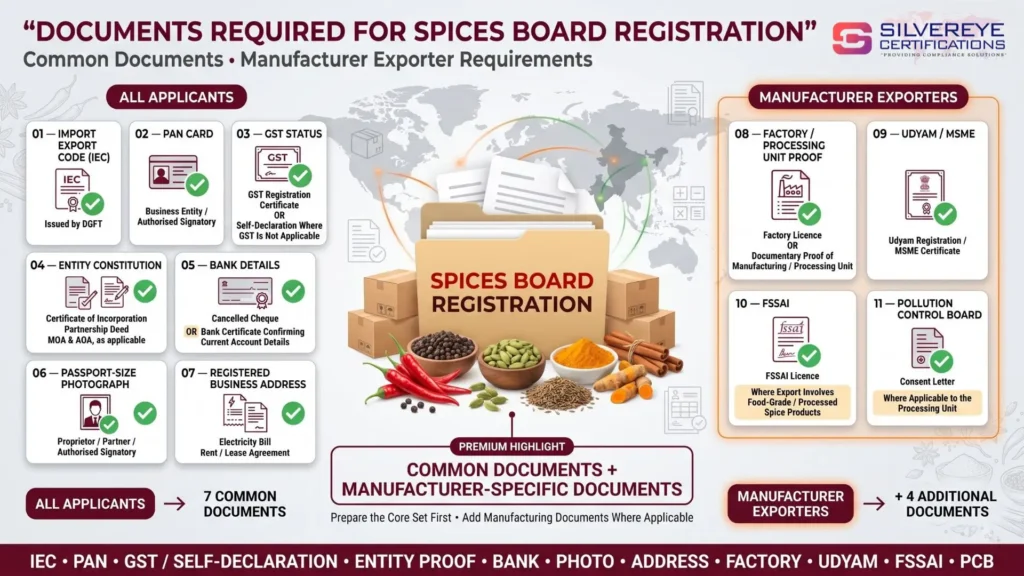
A smooth Spices Board Registration process depends on having these in place before you even open the portal:
- A valid Import Export Code (IEC) from DGFT — this is a hard prerequisite, not optional paperwork.
- GST registration certificate, or a self-declaration if GST doesn't apply to your business category.
- PAN card of the business entity or the authorized signatory.
- Proof of business constitution — Certificate of Incorporation, Partnership Deed, or MOA & AOA as relevant.
- Bank account proof — a cancelled cheque or a bank certificate in the prescribed format.
- For manufacturer exporters: factory licence, Udyam/MSME certificate, and FSSAI licence where the product is food-grade.
Spices Board Registration Process: Step-by-Step
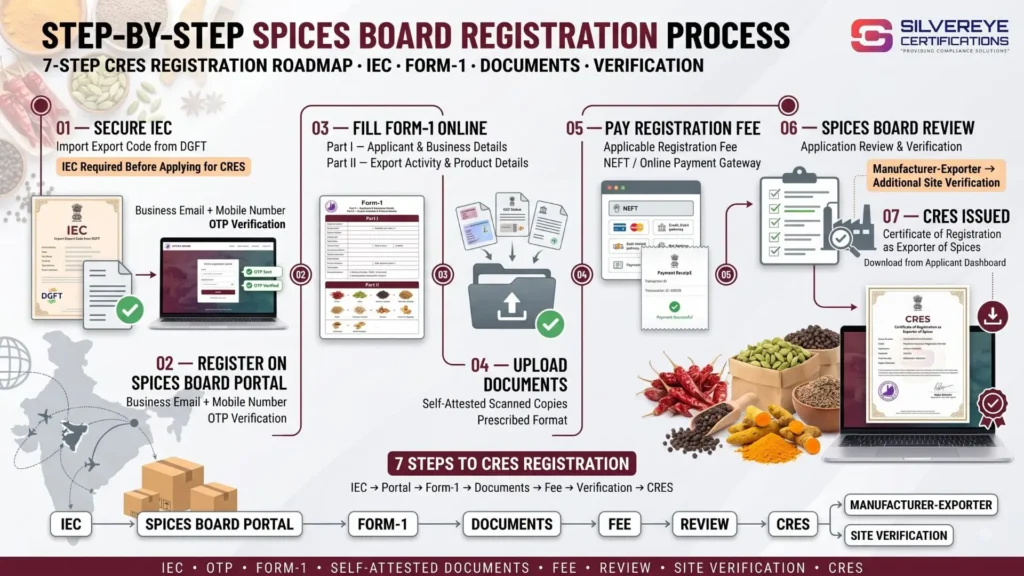
Step 1: Obtain Your IEC First
If you don't already export any product, your first move isn't the Spices Board portal — it's DGFT. The Import Export Code is a one-time registration and a mandatory gateway document; the Spices Board application won't proceed without a valid IEC number.
Step 2: Create Your Login on the Spices Board Portal
Head to the official Spices Board of India registration portal and sign up using your business email ID and mobile number. Both are verified through an OTP before you're allowed to start the application — keep the registered mobile number accessible during this step.
Step 3: Fill Form-1 — Part I and Part II
Form-1 is where the actual application happens. Part I collects your business identity details — entity type, PAN, GST number, registered address, and IEC. Part II covers your export profile — which scheduled spices you intend to export, your exporter category (merchant or manufacturer), and your processing facility details if applicable.
Step 4: Upload Self-Attested Documents
Every document from your checklist needs to be scanned and self-attested before upload. File formats and size limits are specified on the portal — keep files legible; blurry or oversized uploads are a common cause of processing delays.
Step 5: Pay the Government Registration Fee
Once documents are uploaded, you'll be directed to pay the prescribed fee — the amount depends on whether you're registering as a merchant or manufacturer exporter. Payment is typically made online or via NEFT as specified by the portal at the time of application.
Step 6: Application Scrutiny by the Spices Board
After submission, the Spices Board reviews your Form-1 entries against the uploaded documents. Merchant exporter files usually move through desk verification alone. Manufacturer exporter applications often include an additional site visit to confirm the processing facility actually exists and matches what's declared.
Step 7: CRES Certificate Issuance
Once verification clears, the Certificate of Registration as Exporter of Spices is generated digitally with a unique CRES number and pushed to your applicant dashboard for download. This number is what customs checks against your shipping bill for every export consignment going forward.
How Long Does the Spices Board Registration Process Take?
Processing time depends mainly on your exporter category and how complete your first submission is.
| Stage | Merchant Exporter | Manufacturer Exporter |
| Document preparation (your side) | 1–2 days | 2–3 days |
| Form-1 submission & fee payment | Same day | Same day |
| Spices Board scrutiny | 2–3 working days | 3–5 working days |
| Site verification (if required) | Not applicable | 2–4 working days |
| Certificate issuance | 1 working day | 1–2 working days |
| Typical total turnaround | ~5 working days | ~7–10 working days |
Fee Payment Step: What to Expect
The government fee is paid mid-process, right after document upload and before your application moves to scrutiny. Indicative government fee ranges are roughly ₹5,000 for merchant exporters and ₹10,000–₹15,000 for manufacturer exporters, with GST charged extra — but these figures are periodically revised by the Board, so always confirm the exact amount shown on the portal at the time you apply rather than relying on any fixed number from a blog. If you're using a compliance consultant for the process, their service fee is billed separately from this government fee.
Common Reasons the Process Gets Delayed or Rejected
- IEC details on the application don't match DGFT records exactly (spelling, address format, etc.).
- Uploaded documents are unclear, expired, or not self-attested as required.
- Exporter category is misdeclared — for instance, applying as a merchant exporter while listing manufacturing activity.
- Bank certificate or cancelled cheque doesn't match the business name on record.
- Manufacturer applicants are not available or not ready at the declared facility during the site visit.
What Happens After the Process Is Complete
- Your CRES number becomes mandatory on every shipping bill for scheduled spice exports.
- You gain access to Spices Board quality-testing facilities and export promotion programs.
- You become eligible to separately apply for RCMC, which unlocks further DGFT scheme benefits.
- Your CRES validity clock starts from the date of issue — mark your calendar for renewal 2–3 months before the 3-year mark.
The Renewal Process (Once Your CRES Nears Expiry)
Renewal follows a very similar path to first-time registration, with a few practical differences worth planning around:
- Log back into your existing Spices Board portal account rather than creating a new one.
- File a fresh Form-1 as a renewal application, referencing your existing CRES number.
- Re-upload any documents that have changed or expired since your original registration (updated GST, IEC, or bank details, for instance).
- Pay the renewal fee, which is generally equal to or slightly lower than the fresh registration fee.
- Apply 2–3 months before expiry — a lapsed CRES can freeze export shipments until it's renewed or reapplied for.
Who Can Go Through This Process?
There's no turnover or business-size threshold. You're eligible to start the Spices Board Registration process if you're:
- A proprietorship, partnership, LLP, or company exporting any of the 52 scheduled spices, their powders, blends, oils, or oleoresins.
- In possession of a valid IEC, or actively obtaining one before applying.
- Able to provide GST records or a valid self-declaration where GST doesn't apply.
- Ready with facility proof if you're registering as a manufacturer exporter.
How Silvereye Certifications Simplifies the Process
The Spices Board Registration process is straightforward on paper but easy to slow down in practice — a mismatched IEC entry, an unclear document scan, or an unprepared site visit can all push your timeline out by days or weeks. Silvereye Certifications handles the process end-to-end for exporters: verifying your IEC, GST, and business documents before they're uploaded, filling and cross-checking Form-1 accurately, coordinating with the Spices Board during scrutiny and site verification, and tracking your renewal date so the certificate never lapses. That means fewer back-and-forth corrections and a CRES certificate in hand faster, without you having to learn the portal's quirks yourself.
Conclusion
The Spices Board Registration process isn't complicated once you know the sequence — IEC first, then portal registration, Form-1, document upload, fee payment, verification, and finally your CRES certificate. Where exporters usually lose time isn't the process itself but small mismatches: a document that doesn't quite line up, an incomplete form field, or being unprepared for a site visit.
Getting each step right the first time is what keeps your registration — and later, your renewal — on a predictable timeline instead of stretching into weeks. If you'd rather not navigate the portal, forms, and verification calls yourself, Silvereye Certifications can run the entire Spices Board Registration process for you, from document review to CRES certificate delivery, so your export business stays on schedule.
Frequently Asked Questions on the Spices Board Registration
What is the first step in the Spices Board Registration process?
Obtaining a valid Import Export Code (IEC) from DGFT — the Spices Board application cannot be filed without it.
Is the entire Spices Board Registration process online?
Yes. Application, document upload, fee payment, and certificate download all happen through the Spices Board portal.
How long does the Spices Board Registration process take?
Around 5 working days for merchant exporters and 7–10 working days for manufacturer exporters, depending on verification and any site visit.
What form is used in the Spices Board Registration process?
Form-1, which has two parts — Part I for business/applicant details and Part II for export activity and product details.
Is a site inspection part of the process for every applicant?
No. Site inspections are generally relevant to manufacturer exporters with their own processing facility, not merchant exporters.
What causes delays in the Spices Board Registration process?
Mismatched IEC or GST details, unclear document scans, incorrect exporter category, and unavailability during a site visit are the most common causes.
Can I track my application status during the process?
Yes, application status is visible on your applicant dashboard on the Spices Board portal once you've logged in and submitted Form-1.
When should I start the renewal process?
Ideally 2–3 months before your existing CRES certificate's 3-year validity expires, to avoid any gap in export eligibility.
Do I need to repeat the entire process for renewal?
You follow a similar Form-1 filing and fee payment process, but you log into your existing account and reference your current CRES number rather than starting fresh.
What do I receive at the end of the process?
A digitally issued Certificate of Registration as Exporter of Spices (CRES) with a unique registration number, downloadable from your portal dashboard.
Can a consultant complete the Spices Board Registration process on my behalf?
Yes, many exporters engage a compliance firm or consultant like Silvereye Certifications to manage documentation, filing, and follow-up through the process.