

- CRES is legally mandatory before exporting any of India's 52 scheduled spices.
- Issued by the Spices Board of India, an autonomous body under the Ministry of Commerce and Industry.
- Valid for 3 years from the date of issue and must be renewed before it lapses.
- Applicants need a valid IEC, GST record, PAN, and bank details to apply online.
Introduction
Spices Board Registration, officially called the Certificate of Registration as Exporter of Spices (CRES), is a mandatory license issued by the Spices Board of India under the Spices Board Act, 1986. Any business — merchant or manufacturer — that wants to export India's 52 notified spice varieties, including whole spices, powders, blends, oils, and oleoresins, must hold a valid CRES before the first shipment.
To apply, an exporter needs an Import Export Code (IEC) from DGFT, GST registration, PAN, and bank details, then submits Form-1 online through the Spices Board portal. The certificate is valid for three years and must be renewed before expiry to keep exporting without customs delays.
What Is Spices Board Registration (CRES)?
Spices Board Registration is the process through which a spice exporter based in India gets formally listed with the Spices Board of India, the apex regulatory and export-promotion body for the spice trade, headquartered in Kochi and functioning under the Ministry of Commerce and Industry, Government of India. On successful registration, the exporter is issued the Certificate of Registration as Exporter of Spices (CRES) — a statutory document required under the Spices Board Act, 1986, before any consignment of scheduled spices can be legally shipped out of the country.
The CRES certificate applies to the export of the 52 spices notified under the Spices Board's schedule — common examples include black pepper, cardamom, turmeric, chilli, ginger, coriander, cumin, fennel, fenugreek, saffron, and their processed forms such as spice oils, oleoresins, blended masalas, and curry powders. Whether you deal in raw agricultural spices or value-added spice products, if the item falls under the notified schedule, CRES registration applies to your export activity.
Why Spices Board Registration Matters for Exporters
- Customs clearance is directly linked to it — shipping bills for scheduled spices are not processed without a valid CRES number on record.
- It acts as an official mark of authenticity and traceability, which many importing countries and international buyers specifically look for.
- Registered exporters become eligible for the Spices Board's export promotion schemes, market development assistance, and participation in international trade fairs.
- It strengthens buyer confidence, since CRES-holders are listed with a government regulatory body and subject to its quality oversight.
- It is the first step toward obtaining the Registration-cum-Membership Certificate (RCMC), which unlocks further DGFT trade-policy benefits.
Who Needs Spices Board Registration?
Spices Board Registration is open to individuals as well as business entities, and there is no minimum turnover or export volume threshold. In broad terms, you are eligible — and required — to register if:
- You are a proprietorship, partnership, LLP, or private/public limited company engaged in, or planning to begin, the export of scheduled spices from India.
- You already hold, or are in the process of obtaining, a valid Import Export Code (IEC) issued by the Directorate General of Foreign Trade (DGFT).
- Your business has a GST registration, or you can furnish a self-declaration where GST registration does not apply to your category of business.
- You can provide standard KYC and business-identity documents as required by the Spices Board's online application.
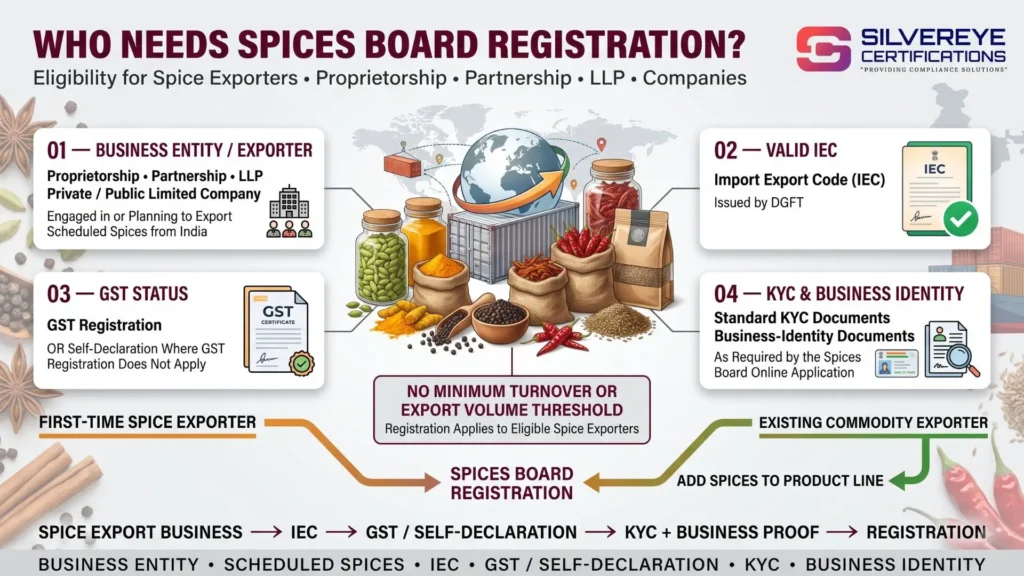
This applies equally to first-time exporters entering the spice trade and to existing exporters of other commodities who want to add spices to their product line.
Merchant Exporter vs Manufacturer Exporter: Know the Difference
The Spices Board classifies applicants into two categories, and the documentation, fee, and verification process differ slightly between them.
| Basis | Merchant Exporter | Manufacturer Exporter |
| Definition | Buys processed or packed spices from others and exports them | Owns a processing/manufacturing unit and exports self-produced spices |
| Facility Proof | Not required | Factory licence, MSME/Udyam certificate, or SSI proof required |
| Site Inspection | Generally not required | May be required as part of verification |
| Government Fee | Comparatively lower | Comparatively higher |
| Typical Processing Time | Around 5 working days | 7–10 working days, subject to inspection |
Documents Required for Spices Board Registration
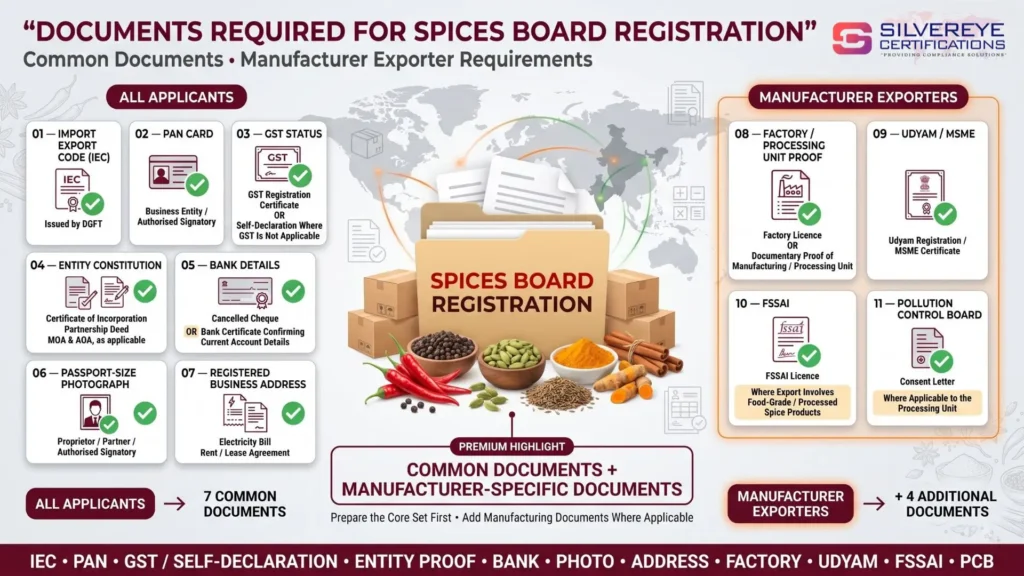
Common Documents (All Applicants)
- Import Export Code (IEC) certificate issued by DGFT
- PAN card of the business entity or authorized signatory
- GST registration certificate, or a self-declaration where GST is not applicable
- Certificate of Incorporation, Partnership Deed, or MOA & AOA, as applicable to the entity type
- Cancelled cheque or a bank certificate confirming the current account details
- Recent passport-size photograph of the proprietor, partner, or authorized signatory
- Proof of registered business address (electricity bill, rent or lease agreement)
Additional Documents for Manufacturer Exporters
- Factory license or documentary proof of the manufacturing/processing unit
- Udyam Registration / MSME certificate
- FSSAI license, wherever the export involves food-grade or processed spice products
- Pollution Control Board consent letter, where applicable to the processing unit
Step-by-Step Spices Board Registration Process
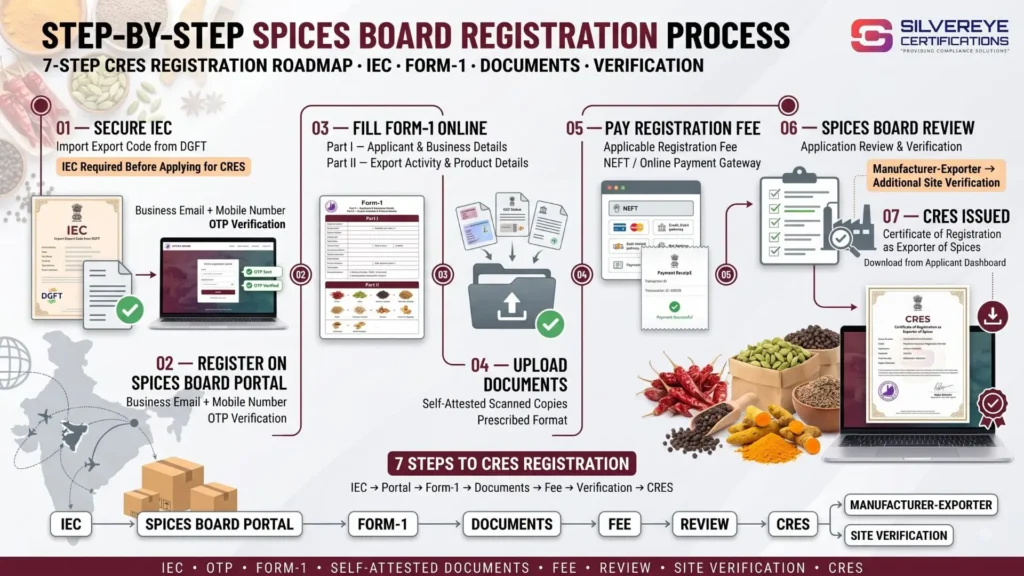
- Secure your IEC first. If you don't already have an Import Export Code from DGFT, this has to be obtained before you can apply for CRES.
- Register on the official Spices Board portal using your business email and mobile number; the details are verified through an OTP before you proceed.
- Fill in Form-1 online, covering Part I (applicant and business details) and Part II (export activity and product details).
- Upload the required documents as self-attested scanned copies in the prescribed format.
- Pay the applicable registration fee through the payment mode specified on the portal (commonly NEFT or online payment gateway).
- The Spices Board reviews and verifies the application; manufacturer-exporter applications may involve an additional site verification.
- Once approved, the Certificate of Registration as Exporter of Spices (CRES) is issued digitally, along with a unique registration number, and can be downloaded from your applicant dashboard.
Spices Board Registration Fees
Government fees for Spices Board Registration are prescribed separately for merchant exporters and manufacturer exporters, and are typically lower for renewal than for a fresh application. The figures below reflect the government fee structure commonly referenced for 2026; exact amounts can be revised periodically by the Spices Board, so it is advisable to confirm the current fee on the official portal before payment.
| Category | New Registration (Govt. Fee) | Renewal (Govt. Fee) | Validity |
| Merchant Exporter | Approx. ₹5,000 | Approx. ₹3,000–₹5,000 | 3 years |
| Manufacturer Exporter | Approx. ₹10,000–₹15,000 | Approx. ₹7,500–₹10,000 | 3 years |
| Amendment / Modification | Approx. ₹1,000–₹5,000 | — | As applicable |
GST is charged extra on the government fee. If you engage a consultant or compliance firm for documentation and filing assistance, their professional service charge is separate from — and in addition to — the government fee shown above.
Validity and Renewal of the CRES Certificate
- The CRES certificate is valid for 3 years from the date of issue under the current block-period system.
- Renewal is not automatic — the exporter must file a fresh Form-1 application along with the renewal fee before the certificate lapses.
- It's advisable to apply for renewal 2–3 months ahead of the expiry date to avoid any gap in your export eligibility.
- An expired CRES can lead to shipments being held at customs, so tracking your renewal date is a critical compliance task, not an optional one.
CRES vs RCMC: What's the Difference?
Exporters often confuse CRES with RCMC (Registration-cum-Membership Certificate), but the two serve different purposes even though both are issued through the Spices Board.
| Feature | CRES | RCMC |
| Full Form | Certificate of Registration as Exporter of Spices | Registration-cum-Membership Certificate |
| Governing Framework | Spices Board Act, 1986 | Foreign Trade Policy (DGFT) |
| Purpose | Statutory licence to export scheduled spices | Membership certificate for DGFT scheme benefits |
| Mandatory for Shipment? | Yes — customs clearance depends on it | Not mandatory for shipment, but needed for scheme benefits |
| Typical Validity | 3 years | Typically renewed annually / periodically |
What Happens If You Export Spices Without Registration?
Exporting scheduled spices without a valid CRES is not a minor compliance gap — it is a breach of the Spices Board Act, 1986, and typically results in:
- Customs holding or rejecting the shipment at the port, causing delays and demurrage costs.
- Ineligibility for export incentives and Spices Board–linked promotional schemes.
- Loss of standing to apply for the RCMC and related DGFT trade-policy benefits.
- Reputational risk with overseas buyers who expect verified, board-registered suppliers.
Key Benefits of Spices Board Registration
- Legal authorization to export any of the 52 notified spice varieties from India.
- Access to the Spices Board's quality-testing and certification infrastructure.
- Eligibility for export promotion support, subsidy schemes, and trade-fair participation.
- Greater credibility with import authorities and international buyers.
- A direct pathway to RCMC and further DGFT scheme benefits such as duty drawback and Advance Authorisation.
How Silvereye Certifications Can Help
Spices Board Registration involves multiple moving parts — matching the right applicant category, assembling the correct document set, filling Form-1 accurately, and tracking renewal timelines so your export eligibility never lapses. Silvereye Certifications works with spice exporters, both merchant and manufacturer, to manage this end-to-end: reviewing your IEC, GST, and business documents before submission, preparing the online application, coordinating with the Spices Board during verification, and setting up renewal reminders well before your CRES expiry date.
For a business focused on shipping spices, not paperwork, that kind of hands-on support can be the difference between a smooth first export and an avoidable customs delay.
Frequently Asked Questions
What is the full form of CRES?
CRES stands for Certificate of Registration as Exporter of Spices, issued by the Spices Board of India.
Is Spices Board Registration mandatory for spice exporters?
Yes. Any business exporting a spice listed in the Spices Board's schedule of 52 notified spices must hold a valid CRES before shipment.
How long does Spices Board Registration take?
Merchant exporter applications are typically processed faster (around 5 working days), while manufacturer exporter applications can take 7–10 working days due to additional verification.
What is the validity of the CRES certificate?
The certificate is valid for 3 years from the date of issue and must be renewed before it expires.
Can I apply for CRES without an IEC?
No. A valid Import Export Code from DGFT is a mandatory prerequisite before applying for Spices Board Registration.
What is the difference between CRES and RCMC?
CRES is the statutory licence required for customs clearance of spice shipments, while RCMC is a separate membership certificate needed to access DGFT trade-policy benefits like duty drawback.
Is GST registration compulsory for Spices Board Registration?
A GST certificate is generally required; where GST registration doesn't apply to your business category, a self-declaration can be submitted instead.
What happens if I miss the CRES renewal deadline?
A lapsed CRES can lead to shipments being held at customs and loss of export eligibility until the certificate is renewed or reapplied for.
Does Spices Board Registration cover spice oils and oleoresins?
Yes. Value-added spice products such as oils, oleoresins, and blended masalas made from scheduled spices fall within the scope of CRES registration.
Can an individual apply for Spices Board Registration, or only companies?
Individuals, proprietorships, partnerships, LLPs, and companies can all apply, as long as they meet the standard eligibility and documentation requirements.
Where is the Spices Board Registration application filed?
The application is filed online through the official Spices Board of India portal, using Form-1 for both new registration and renewal.
Is a site inspection required for every applicant?
Site inspection is generally more relevant for manufacturer exporters with a processing facility; merchant exporters usually aren't subject to this requirement.