
- DGFT Registration (IEC Code) is mandatory for anyone importing or exporting goods or services from India.
- The government fee is a flat ₹500, and the IEC certificate is usually issued within 1–3 working days.
- IEC has lifetime validity — there's no renewal, but an annual update on the DGFT portal (April 1–June 30) is compulsory.
- Since 2017, your IEC number is the same as your PAN, but you still must apply separately to activate it with DGFT.
Introduction
DGFT Registration is the process of obtaining an Importer-Exporter Code (IEC) from the Directorate General of Foreign Trade, the government body under the Ministry of Commerce and Industry that regulates India's foreign trade. Any individual, proprietor, partnership firm, LLP, or company that wants to import goods into India or export goods and services out of India must complete DGFT Registration first.

The IEC is a 10-digit code linked to your PAN, costs a one-time government fee of ₹500, is issued within 1 to 3 working days, and stays valid for life — subject to a mandatory free annual update between April and June. Without a valid IEC, customs will not clear shipments and banks will not process cross-border trade payments.
What Is DGFT and Why Does It Matter?
DGFT stands for the Directorate General of Foreign Trade. It is the government authority responsible for framing and implementing India's Foreign Trade Policy, issuing import-export licenses, and administering export promotion schemes such as duty drawback and Advance Authorization.
In simple terms, DGFT is the gatekeeper of India's international trade — no business can legally move goods across Indian borders without first being registered with it. Understanding DGFT's role matters because every export incentive, customs clearance, and international payment your business ever makes will ultimately trace back to the IEC that DGFT issues.
What Is an IEC Code?
An Importer-Exporter Code (IEC) is a unique 10-digit identification number that DGFT issues to a business or individual, acting much like a passport for cross-border trade. Since a 2017 policy change, the IEC number is identical to the applicant's PAN — but the two are not automatically linked.
You still need to submit a separate application on the DGFT portal to activate your PAN as a functional IEC. Once active, this code must appear on every shipping bill, bill of entry, and international trade invoice; customs authorities and banks will not process a shipment or a foreign remittance without it.
Benefits of DGFT Registration
Getting your IEC in place unlocks more than just legal permission to trade. Here's what it actually does for a business:
| Benefit | What It Means for Your Business |
| Legal Trade Authorisation | Lets you legally import or export goods and services from India. |
| Access to Global Markets | Opens the door to international buyers, suppliers, and marketplaces. |
| Government Scheme Eligibility | Required to claim benefits under schemes like RoDTEP, duty drawback, and Advance Authorisation. |
| Smooth Customs Clearance | Shipping bills and bills of entry are cleared only when a valid IEC is quoted. |
| Easier Banking & Payments | Banks require an IEC to process export proceeds and import remittances via SWIFT. |
| Lifetime Validity | One-time registration; no yearly renewal fee, unlike many other business licences. |
| Builds Business Credibility | An IEC on your documents signals genuine, compliant trade operations to overseas partners. |
Who Needs DGFT Registration?
DGFT Registration is open to almost any legally recognized business structure in India. You need it if you fall into any of these categories:
- Sole proprietors and individual exporters or importers
- Partnership firms and Limited Liability Partnerships (LLPs)
- Private limited, public limited, and One Person Companies (OPCs)
- Trusts, societies, and HUFs (Hindu Undivided Families) engaged in trade
- Manufacturers, traders, and service exporters (including IT and consulting exports)
- E-commerce sellers shipping products internationally
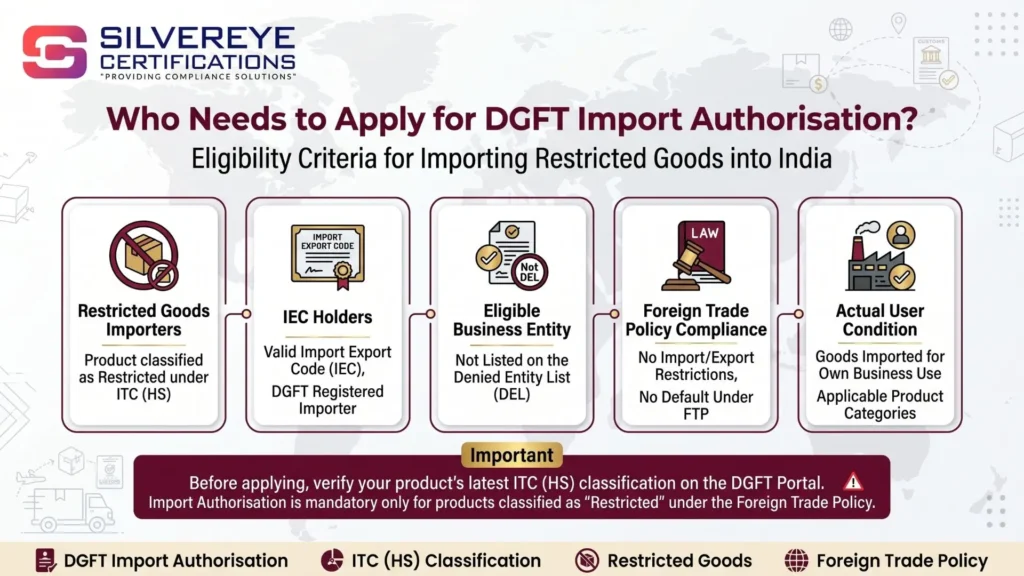
Exception: Government departments/ministries and individuals importing or exporting goods strictly for personal use (not for trade, manufacturing, or agriculture) are exempt from mandatory IEC registration.
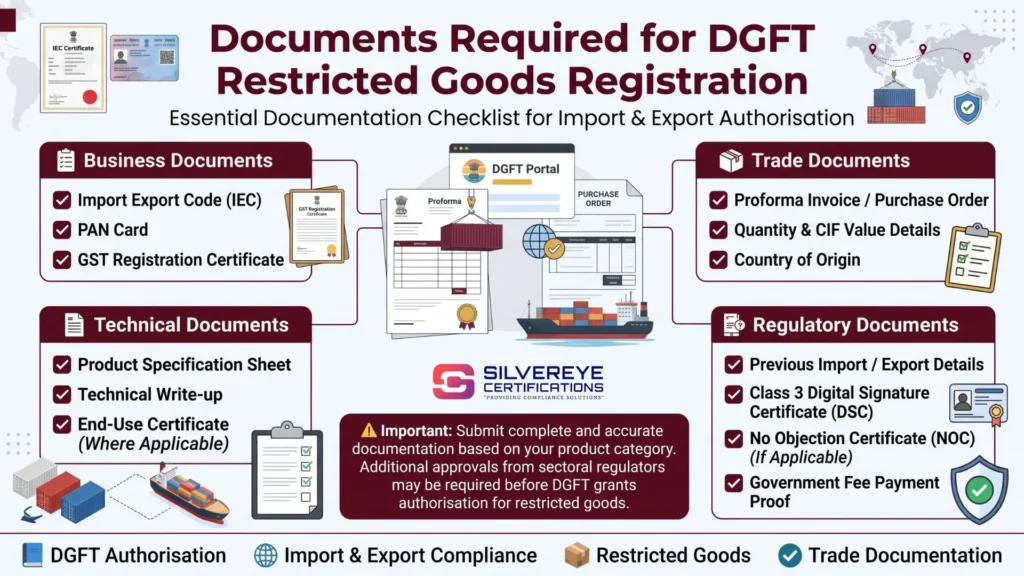
Documents Required for DGFT Registration
Keeping the right documents ready in advance is what actually decides whether your IEC gets approved in one shot or gets stuck in resubmission. Here's the checklist by entity type:
For Individuals / Sole Proprietorships
- PAN card of the individual/proprietor
- Aadhaar card, voter ID, or passport as identity proof
- Cancelled cheque or bank certificate of the current account
- Address proof of the business (electricity bill, rent agreement, or property document)
- A valid, active email ID and mobile number for OTP verification
For Partnership Firms / LLPs
- PAN card of the firm/LLP
- Partnership deed or LLP incorporation certificate
- Cancelled cheque of the firm's current bank account
- Address proof of the registered office
- Digital Signature Certificate (DSC) of the authorized partner
For Companies (Pvt Ltd / OPC / Public Ltd)
- PAN card of the company
- Certificate of Incorporation
- Memorandum & Articles of Association (MOA/AOA)
- Board resolution authorizing the applicant
- Cancelled cheque of the company's current account
- Digital Signature Certificate (DSC) of the director
Step-by-Step DGFT Registration Process
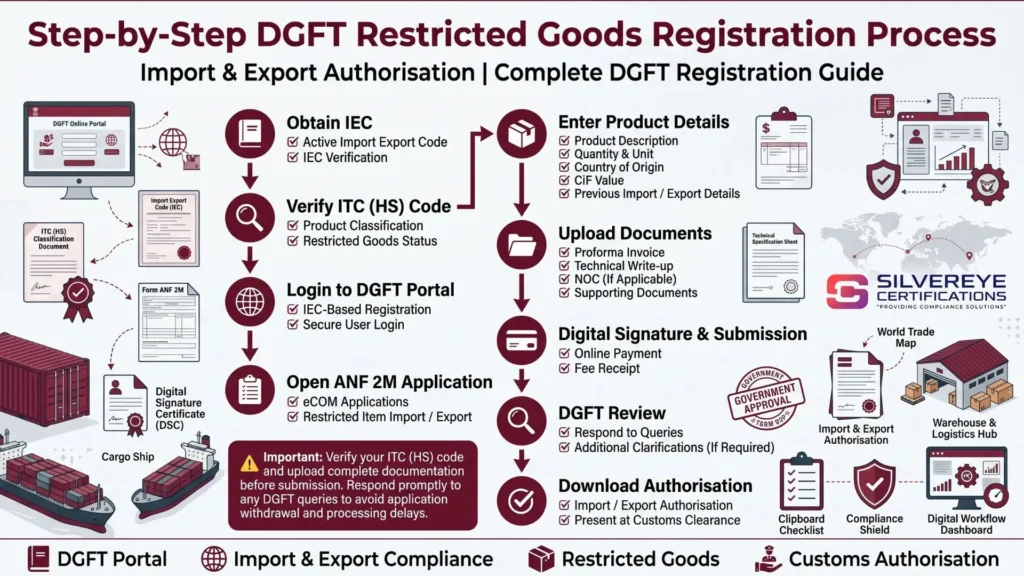
The entire process is fully online through the DGFT portal and typically takes 15–30 minutes to fill, with approval following in 1–3 working days.
- Visit the official DGFT portal at dgft.gov.in and click on 'Register' under IEC Profile Management.
- Enter your PAN, business name, and registered mobile number and email; verify both using the OTPs received.
- Set up your DGFT user ID and password once your credentials are verified.
- Log in and select 'Apply for IEC' from the Services menu.
- Fill in business details — entity type, registered address, bank account, and nature of business activity.
- Upload the required documents (PAN, address proof, cancelled cheque, and DSC where applicable) in the specified format.
- Pay the government fee of ₹500 online via net banking, debit/credit card, or UPI through the Bharatkosh gateway.
- Submit the application and note the application reference number for tracking.
- DGFT verifies your details; once approved, the e-IEC certificate becomes available for download from your DGFT profile.
DGFT Registration Fees
| Particulars | Fee (Approx.) |
| New IEC application (government fee) | ₹500 (one-time, non-refundable) |
| Modification/update of IEC details | ₹200 |
| Duplicate IEC certificate | ₹200 |
| Annual profile update (April–June) | Free |
| Professional/consultant assistance | ₹1,000 – ₹5,000 (varies by provider) |
The ₹500 government fee is paid directly to DGFT via the Bharatkosh payment gateway and is non-refundable even if the application is rejected due to a PAN or document mismatch.
IEC Validity, Renewal, and the Annual Update Rule
An IEC issued by DGFT carries lifetime validity — there is no expiry date and no renewal fee to worry about. That said, DGFT introduced a mandatory annual update rule in 2021: every IEC holder must log in to the DGFT portal between April 1 and June 30 each year and simply confirm that their registered details are still accurate, even if nothing has changed. This step is completely free. Skipping this window can cause DGFT to mark your IEC as inactive, which means shipments can get stuck at customs and export payments can be delayed until the code is reactivated.
Common Reasons DGFT Applications Get Rejected
- Mismatch between PAN details and the name entered in the application
- Incorrect or expired bank account/cancelled cheque details
- Poor quality or unclear scanned copies of documents
- Missing Digital Signature Certificate for companies and LLPs
- Address proof that doesn't match the business's registered address
DGFT Registration vs GST Registration
People often confuse IEC with GST registration since both are issued by government portals, but they serve different purposes. GST registration is about domestic tax compliance on goods and services, while DGFT Registration (IEC) is specifically about authorizing cross-border trade. A business can be GST-registered without an IEC (if it only trades domestically), and having GST does not automatically activate your IEC — the two need to be separately applied for and linked through your PAN.
How Silvereye Certifications Can Help
DGFT Registration looks simple on paper, but small errors — a mismatched bank certificate, a wrong entity type, or a missed annual update — can delay your first shipment or freeze an active IEC at the worst possible time. Silvereye Certifications works with importers, exporters, manufacturers, and service providers across India to handle the entire DGFT Registration journey — document preparation, application filing, error correction, and the yearly compliance update — so your business stays trade-ready without the back-and-forth.
Whether you're a first-time exporter or renewing compliance for an existing IEC, Silvereye Certifications' team can guide the process end to end.
Conclusion
DGFT Registration is the single most important compliance step for any Indian business planning to import or export. It's a one-time, low-cost process — a flat ₹500 government fee, a handful of standard documents, and an approval time of just 1 to 3 working days — but its impact lasts for the lifetime of your business, provided you remember the free annual update between April and June.
Getting this right at the start means smoother customs clearance, faster international payments, and access to export incentives down the line. If you'd rather have the paperwork, filing, and yearly compliance handled correctly the first time, Silvereye Certifications can manage the entire DGFT Registration process for you, start to finish.
Frequently Asked Questions
What is DGFT Registration?
It is used to obtain the Importer-Exporter Code (IEC), the mandatory identification number required to legally import or export goods and services from India.
Is DGFT Registration mandatory for all businesses?
It is mandatory only for businesses or individuals engaged in cross-border import or export activity. Domestic-only businesses do not need it.
How much does DGFT registration cost?
The government charges a flat, one-time fee of ₹500 for a new IEC application, paid online through the Bharatkosh gateway on the DGFT portal.
How long does it take to get an IEC certificate?
Most applications are approved and the e-IEC certificate is issued within 1 to 3 working days, provided the documents are accurate and complete.
Does an IEC need to be renewed?
No. An IEC has lifetime validity and never expires. You only need to complete a free annual update on the DGFT portal between April 1 and June 30 each year.
What happens if I miss the annual IEC update?
DGFT can mark your IEC as inactive. An inactive IEC cannot be used for customs clearance or trade payments until it is reactivated.
Can an individual apply for an IEC, or only companies?
Yes, individuals and sole proprietors can apply for an IEC using their personal PAN, just like partnership firms and companies do with their entity PAN.
Is IEC the same as GST registration?
No. GST registration covers domestic tax compliance, while IEC specifically authorises import and export activity. Both are separate registrations, even though they share the PAN link.
What documents are compulsory for DGFT registration?
At minimum, you need a PAN card, address proof, a cancelled cheque or bank certificate, and (for companies/LLPs) a Digital Signature Certificate and incorporation documents.
Can my DGFT application get rejected, and can I reapply?
Yes, applications are commonly rejected for PAN mismatches or incorrect bank details. You can reapply, but the ₹500 fee is non-refundable and must be paid again for the fresh application.
Is DGFT registration required for service exporters, like IT or consulting firms?
Yes. Any business receiving payments from abroad for exported services also needs a valid IEC to route those payments correctly through banking channels.
Who can help me complete DGFT registration correctly?
You can apply yourself on dgft.gov.in, or engage a professional service like Silvereye Certifications to manage documentation, filing, and the yearly compliance update on your behalf.