

- Eight documents form the core WPC ETA checklist, and the RF test report is the one every other document is built around.
- Model numbers, brand names, and technical values must match character-for-character across the RF report, invoice, label photo, and application form — mismatches are the top cause of delay.
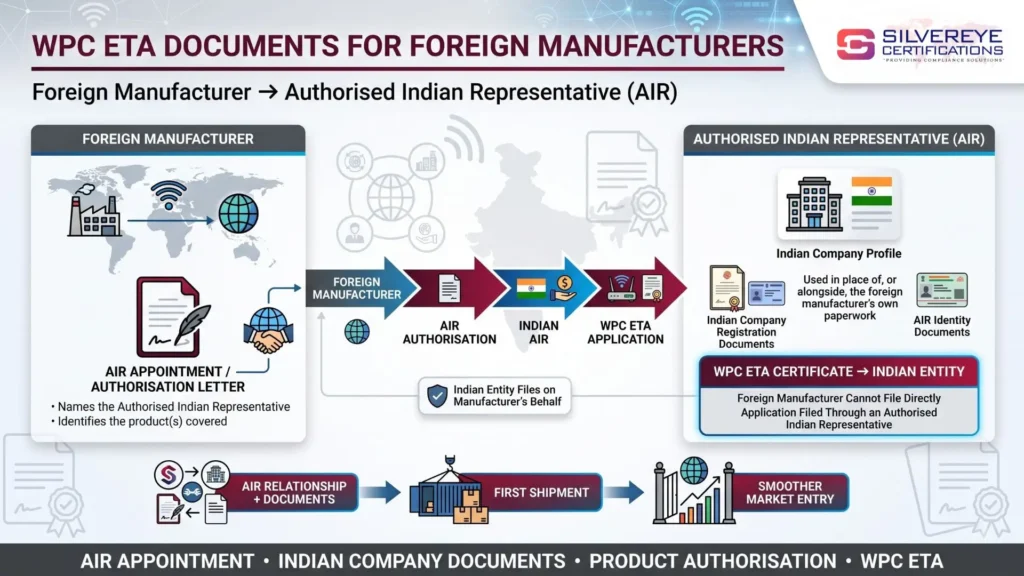
- Foreign manufacturers need one additional document that Indian applicants don't: an Authorized Indian Representative (AIR) authorization letter, since WPC only issues ETA to Indian entities.
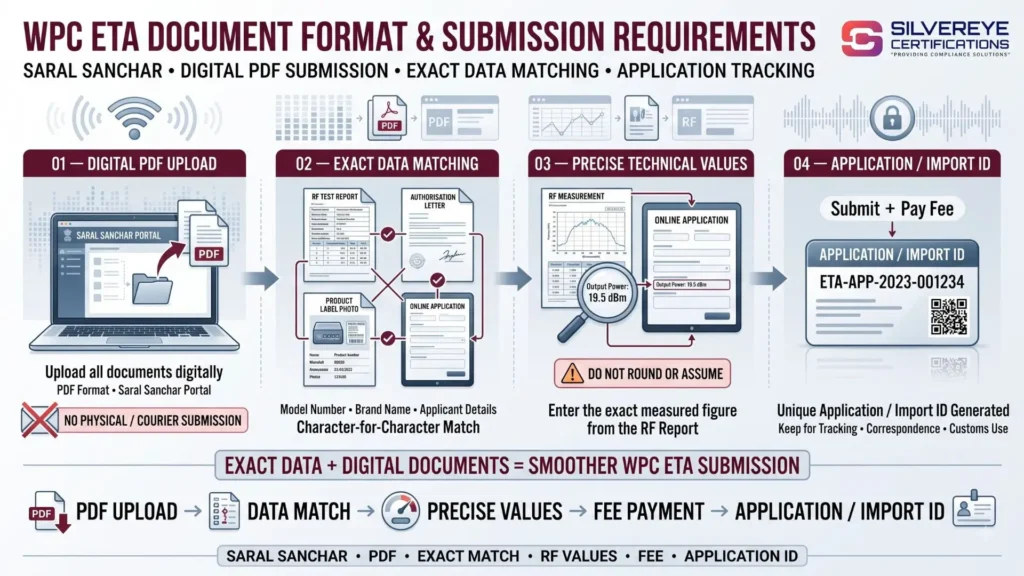
- All documents are uploaded digitally on the Saral Sanchar portal in PDF format — there is no physical or courier submission required.
Introduction
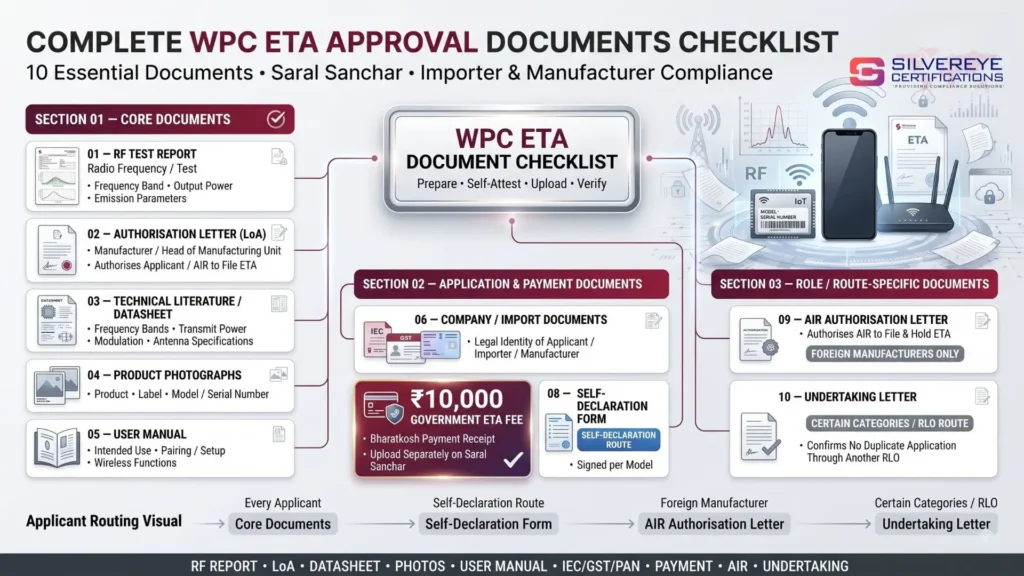
WPC ETA approval documents are the set of technical and legal papers the Wireless Planning & Coordination (WPC) Wing requires before granting Equipment Type Approval for a wireless device in India. The core list includes an RF test report from a NABL or TEC-accredited lab, an authorization letter from the manufacturer, a technical datasheet, product photographs, a user manual, a signed self-declaration form, company/import documents (IEC, GST), and the ₹10,000 Bharatkosh payment receipt.
Every document must be uploaded as a PDF on the Saral Sanchar portal, and the model number must match exactly across all of them. Missing or inconsistent documents — not the approval fee — are the single biggest reason WPC ETA applications get delayed.
What Documentation Do You Need for WPC ETA Approval?
The WPC ETA process is entirely digital, run through the Saral Sanchar portal of the Department of Telecommunications (DoT). There's no factory inspection and no in-person interview — which means the quality and consistency of your paperwork is effectively the entire application. Most delays reported by importers and manufacturers don't come from WPC being slow; they come from an incomplete RF report, a mismatched model number, or a technical value entered imprecisely on the portal.
Understanding exactly which documents are needed, what each one must contain, and how they need to align with each other is what separates a WPC ETA application that clears in a couple of weeks from one that sits in query-and-response limbo for months.
Complete WPC ETA Approval Documents Checklist
| Document | Required For | Purpose |
| RF Test Report | Every applicant | Confirms frequency band, output power, and emission parameters are within India's permitted limits. |
| Authorisation Letter (Letter of Authorisation / LoA) | Every applicant | From the manufacturer or head of the manufacturing unit, authorising the applicant/AIR to file the ETA application. |
| Technical Literature / Datasheet | Every applicant | States frequency band(s), transmit output power, modulation, and antenna specifications. |
| Product Photographs | Every applicant | Clear images of the product, its label, and the visible model/serial number. |
| User Manual | Every applicant | Describes the product's intended use, pairing/setup process, and wireless functions. |
| Self-Declaration Form | Self-declaration route | Signed declaration confirming the product meets de-licensed band conditions; filed per model. |
| Company/Import Documents (IEC, GST, PAN) | Every applicant | Establishes the legal identity of the importer, manufacturer, or applicant entity. |
| Bharatkosh Payment Receipt | Every applicant | Proof of the ₹10,000 government ETA fee, uploaded separately on Saral Sanchar. |
| AIR Authorisation Letter | Foreign manufacturers only | Confirms the Authorised Indian Representative is empowered to file and hold the ETA on the foreign manufacturer's behalf. |
| Undertaking Letter | Certain categories/RLO route | Confirms the same product model has not already been separately applied for through another Regional Licensing Office. |
Document-by-Document: What Each One Actually Needs to Contain
1. RF Test Report
This is the technical foundation of the entire application — every other document is built to support what the RF report states. It must come from a NABL or TEC-accredited Indian laboratory; since WPC's 2021 guidelines, most self-declaration filings are expected to rely on Indian-accredited lab reports rather than foreign ones, so confirm current lab-acceptance policy before testing.
The report needs to clearly state the frequency range, maximum output power, bandwidth, and modulation type for every wireless module in the product — not just the primary radio.
2. Authorization Letter (Letter of Authorization)
This letter, issued by the manufacturer or the head of the manufacturing unit, formally authorizes the applicant — whether that's the importer directly or an Authorized Indian Representative — to file the WPC ETA application and correspond with WPC on the manufacturer's behalf. It should clearly name the product model(s) covered, the manufacturer's details, and the applicant's details.
3. Technical Literature / Datasheet
This document should mirror the RF test report's key figures — frequency band, output power, antenna type and gain — in a clear specification-sheet format. Any inconsistency between the datasheet and the RF report (for example, a rounded output power figure that doesn't match the report's measured value) is a common trigger for WPC queries.
4. Product Photographs
Clear images of the product from multiple angles, plus a close-up of the regulatory label or nameplate showing the model/serial number, help WPC visually confirm the device matches the documentation. Blurry images or photos that don't clearly show the model number are a frequent, easily avoidable cause of delay.
5. User Manual
The manual should describe the product's intended use, how it connects or pairs, and its wireless functions in plain terms. It doesn't need to be an exhaustive user guide, but it should be consistent with the product category and technical claims made elsewhere in the application.
6. Self-Declaration Form
For products on the self-declaration route, this signed form is the applicant's formal confirmation that the device operates within India's de-licensed frequency bands and meets the applicable conditions. It's filed separately for each model, even if multiple models share the same underlying chipset.
7. Company / Import Documents
These establish who is actually applying — typically the Importer-Exporter Code (IEC), GST registration, and company PAN. For a foreign manufacturer applying through an AIR, the AIR's own company documents are what get submitted, alongside the AIR authorisation letter.
8. Bharatkosh Payment Receipt
The ₹10,000 government ETA fee is paid through the Bharatkosh (NTRP) portal, separately from Saral Sanchar, and the payment receipt is then uploaded back onto the Saral Sanchar application as proof. Per DoT's current guidance, this fee applies per product with one or more built-in RF modules — whether the application covers a finished device or a standalone RF module.
Documents Needed for Foreign Manufacturers (via AIR)
WPC ETA certificates are issued only to Indian entities, so a foreign manufacturer cannot file directly. Instead, an Authorised Indian Representative (AIR) — an Indian company or individual — files on the manufacturer's behalf. This adds one extra document requirement beyond the standard checklist:
- A formal AIR appointment/authorization letter from the foreign manufacturer, naming the AIR and the product(s) covered
- The AIR's own Indian company registration and identity documents (in place of, or alongside, the foreign manufacturer's own paperwork)
Setting up this AIR relationship and its documentation before the first shipment is finalised avoids one of the most common delays foreign brands run into when entering the Indian market.
Document Format and Submission Requirements
- All documents must be uploaded digitally on the Saral Sanchar portal in PDF format — there is no physical or courier submission.
- Model numbers, brand names, and applicant details should match exactly, character for character, across the RF test report, authorization letter, product label photo, and the online application form.
- Technical values like output power should be entered as the precise measured figure from the RF report (for example, the exact dBm reading), not a rounded or assumed number, even if the rounded number would still fall within the permitted limit.
- Once submitted and the fee is paid, the portal generates a unique application/Import ID reference number — keep this for all further tracking, correspondence, and customs use.
How Document Requirements Vary by Product Type
The core checklist above applies broadly, but the technical content of the RF report and datasheet shifts depending on the product's wireless technology.
| Product Type | What the RF Report Must Additionally Cover |
| Wi-Fi routers & access points | All supported bands (2.4/5/6 GHz) and channel bandwidths |
| Bluetooth/BLE devices & fitness bands | Bluetooth version, and any secondary radio like NFC or Wi-Fi sync |
| Walkie-talkies & two-way radios | Exact frequency and power against the license-exempt threshold, to confirm self-declaration eligibility |
| Multi-radio IoT/smart devices | Every wireless module present — Wi-Fi, Bluetooth, Zigbee, GPS transmission, or cellular — individually |
Step-by-Step: How These Documents Are Used in the Application Process
Compile the RF test report first, since every other document is checked against it for consistency.
- Draft the authorization letter, technical datasheet, and user manual, keeping the frequency, power, and model details identical to the RF report.
- Take clear product photographs, including a close-up of the model/serial number on the label.
- Prepare the self-declaration form for the specific model being filed.
- Gather company documents — IEC, GST, PAN — or AIR documents for foreign manufacturers.
- Pay the ₹10,000 government fee via Bharatkosh and download the payment receipt.
- Upload all documents as PDFs on the Saral Sanchar portal and submit the application.
- Track the application using the generated reference number and respond quickly to any WPC document queries.
WPC ETA Fees Related to Documentation
| Fee Component | Amount | Paid Through |
| Government ETA fee (per model/RF module) | ₹10,000 | Bharatkosh (NTRP) portal |
| RF/EMC laboratory testing fee | Varies by lab and number of wireless modules tested | NABL/TEC-accredited testing laboratory |
| Consultant/documentation preparation fee (optional) | Varies by service provider | WPC compliance consultant, if engaged |
Per current DoT guidance, the ₹10,000 fee applies to each product carrying one or more in-built RF modules, whether the filing covers a complete finished device or a standalone RF module sold on its own.
Document Validity, Renewal, and Certificate Verification
Once WPC ETA is granted, it carries lifetime validity for that model unless revoked by the WPC Wing — there's no periodic renewal of the underlying documents. A fresh set of documents, and a fresh application, is only needed if:
- The RF module, chipset, or frequency band changes
- The maximum output power changes
- A new wireless technology is added to an existing model
- The model number or brand name changes
The issued WPC ETA certificate number can be verified through the Saral Sanchar portal's public certificate verification section, which confirms the certificate's validity, the model it covers, and the AIR or entity that filed it — a useful check for distributors and buyers who want to confirm a supplier's ETA is genuine before onboarding a product.
Common Documentation Mistakes That Delay WPC ETA Approval
- Submitting an RF test report from a lab that isn't NABL/TEC-accredited in India
- Rounding technical values (like output power) instead of using the exact measured figure from the RF report
- Model number or brand name mismatches between the RF report, authorization letter, product photos, and the online application
- Uploading a datasheet that lists specifications inconsistent with the RF report
- Missing the AIR authorization letter for foreign manufacturers
- Testing and documenting only the primary radio while overlooking a secondary wireless module in the same device
What Happens If Documents Are Incomplete, Incorrect, or Fraudulent
Incomplete or inconsistent documentation typically results in a WPC query and processing delay rather than an outright rejection, provided the applicant responds with corrected paperwork.
However, submitting knowingly false declarations or fabricated test reports is a serious compliance issue under India's wireless regulations and can result in certificate revocation, financial penalties, and legal action, in addition to the standard consequences of operating without valid ETA — shipment seizure and marketplace delisting.
Conclusion
WPC ETA approval isn't hard to get right once you understand what the documentation actually needs to prove: that a specific product model, with a specific RF module, operates within a specific frequency and power limit — consistently, across every single document filed.
The RF test report anchors everything else, and keeping model numbers, technical values, and product descriptions identical across the authorisation letter, datasheet, photographs, and self-declaration form is what turns a routine filing into a fast one. Since the resulting certificate carries lifetime validity, the time spent getting the documentation precise the first time is what protects a product's India market access for the long run.
Frequently Asked Questions
What documents are required for WPC ETA approval?
The core set includes an RF test report, authorisation letter, technical datasheet, product photographs, user manual, self-declaration form, company/import documents (IEC, GST), and the Bharatkosh payment receipt. Foreign manufacturers additionally need an AIR authorization letter.
Is the RF test report the most important document?
Yes. It's the technical foundation every other document is checked against, and it's the single biggest source of delay when it's incomplete, from a non-accredited lab, or inconsistent with the rest of the application.
Can I submit an RF test report from a foreign laboratory?
WPC's 2021 guidelines generally require Indian NABL or TEC-accredited lab reports for self-declaration filings. Some sources note limited exceptions for ILAC-accredited foreign labs, so it's best to confirm current acceptance policy before committing to a lab.
Do all documents need to be uploaded in PDF format?
Yes. The entire WPC ETA process runs through the Saral Sanchar portal, and all supporting documents are uploaded digitally as PDFs — there's no physical or courier submission.
What is a Letter of Authorization (LoA) in the WPC ETA process?
It's a letter from the manufacturer authorising the applicant, or the Authorised Indian Representative, to file the ETA application and act as the point of contact with WPC for that product.
Do foreign manufacturers need extra documents compared to Indian applicants?
Yes. Since WPC ETA is issued only to Indian entities, foreign manufacturers need an additional AIR authorization letter, along with the AIR's own Indian company documents.
What happens if my model number doesn't match across documents?
It's one of the most common reasons for a WPC query and processing delay. Model numbers, brand names, and technical values should match exactly, character for character, across the RF report, authorization letter, product photos, and application form.
Do I need a separate self-declaration form for every product variant?
Yes, for each model filed under the self-declaration route, even if multiple variants share the same underlying wireless chipset.
How do I prove I paid the WPC ETA government fee?
Payment is made through the Bharatkosh (NTRP) portal, and the resulting payment receipt is uploaded separately as a document on the Saral Sanchar application.
Can I verify if a product's WPC ETA certificate and documentation are genuine?
Yes. The Saral Sanchar portal has a public certificate verification section where you can enter a certificate number to confirm its validity, the model it covers, and the filing entity.
Do documents need to be resubmitted if nothing about the product changes?
No. Once WPC ETA is granted, it carries lifetime validity for that model unless revoked, so there's no periodic resubmission required as long as the RF specifications, model number, and brand stay the same.
What if I submit incorrect or fabricated documents?
Incomplete or inconsistent documents usually lead to a query and delay if corrected honestly. Knowingly fabricated test reports or false declarations are a serious compliance issue that can lead to certificate revocation and legal consequences.