

- Every EPF registration documents needs three groups: entity proof, authorized-signatory proof, and employee KYC — the exact list varies by business type.
- A Class 3 Digital Signature Certificate is compulsory for the authorized signatory; Class 2 DSCs stopped being accepted from January 2021.
- PAN entered on the portal now goes through real-time API verification with the Income Tax Department, so name mismatches are caught instantly in 2026.
- UAN generation for employees now uses Face Authentication Technology (FAT), which makes accurate Aadhaar and photo details more important than ever.
Introduction
To register for EPF, employers need three document sets: entity proof (PAN, incorporation/partnership/trust deed, GST or Shop & Establishment certificate, address proof, cancelled cheque), authorized-signatory proof (PAN, Aadhaar, a Class 3 Digital Signature Certificate, specimen signature), and employee KYC (name, DOB, Aadhaar, PAN, bank details for UAN generation).
The exact entity documents differ for a proprietorship, partnership, LLP, private limited company, trust or society. All files are uploaded as PDFs on the EPFO Unified Portal or Shram Suvidha Portal, where PAN is verified in real time and employee UANs are generated using Face Authentication Technology. Missing or mismatched documents are the single biggest reason EPF applications get delayed in 2026.

Most EPF registration applications don't get rejected because of a legal problem — they get stuck because one document doesn't match another. A director's name spelled differently on the PAN card versus the incorporation certificate, an address proof older than the accepted window, or a DSC that's the wrong class are the everyday reasons a clean-looking application bounces back.
This guide lays out exactly which documents EPFO expects in 2026, how the list changes by business structure, what format and quality each file needs to be in, and the fresh digital-verification changes — real-time PAN checks and Face Authentication for UAN — that make document accuracy more important than it used to be.
Why the Right Documents Matter for EPF Registration
EPF registration is entirely paperless — there is no physical filing counter, no in-person verification desk for a new registration. That means the EPFO's system relies completely on the documents you upload to confirm who you are, whether your business legally exists, and who is authorized to sign on its behalf. A document set that is complete, current and internally consistent is what separates an application approved in a single cycle from one that bounces between the employer and the regional EPFO office for weeks.
EPF Registration Documents: The Three Core Categories
Regardless of business type, every EPF application needs proof in three buckets. Get these right first, then layer on the entity-specific documents covered in the next section.
1. Entity (business) proof
- PAN card of the establishment (proprietorship uses the proprietor's individual PAN).
- Certificate of Incorporation / Registration Certificate / Partnership Deed / Trust Deed, matching the entity type.
- GST registration certificate, Shop & Establishment Certificate, or any other license issued by a government authority for the establishment.
- Proof of business address — a recent electricity or telephone bill (usually not older than two months), or a lease/rent agreement.
- Cancelled cheque or bank statement of the establishment's current account, for verifying banking details.
- Copy of the first sale invoice or purchase bill, sometimes requested to establish the date of commencement of business.
2. Authorized signatory proof
- PAN card and Aadhaar card of the proprietor, partner(s), or director(s), as applicable.
- A Class 3 Digital Signature Certificate (DSC) of the person who will digitally sign the application.
- Specimen signature of the authorized representative, in the format specified on the portal.
- Mobile number and email ID for OTP-based validation during signup.
3. Employee KYC and payroll details
- Full name, date of birth and gender of each employee, matched exactly to their Aadhaar card.
- PAN and Aadhaar number of each employee, for UAN generation and linking.
- Date of joining, designation and monthly wage details (basic + dearness allowance).
- Bank account number and IFSC code of each employee, for PF-linked banking records.
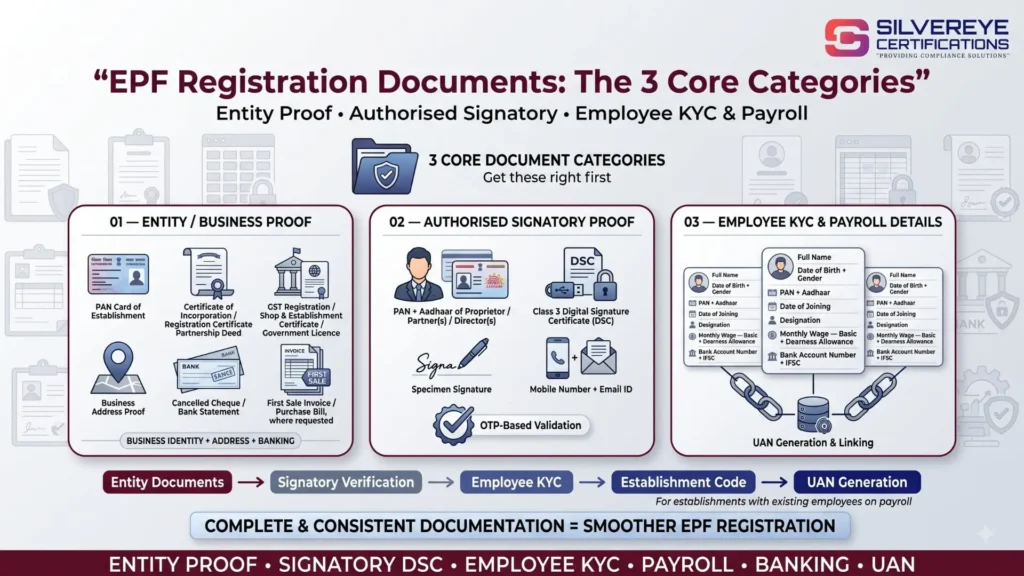
If the establishment already has staff on payroll at the time of registration, this employee data is submitted alongside the entity documents so UANs can be generated immediately after the Establishment Code is allotted.
Documents Required by Business Type (Entity-Wise Checklist)
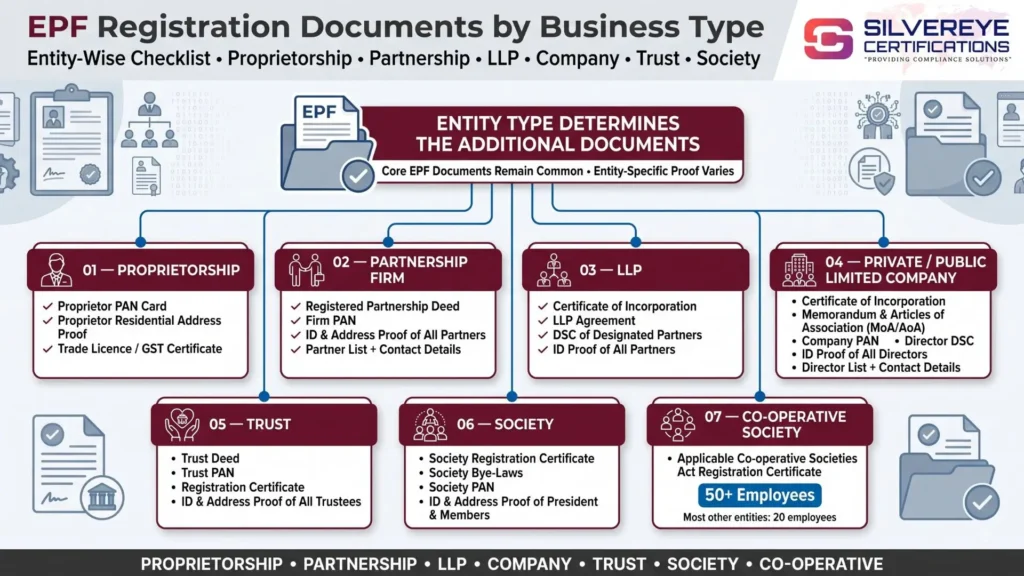
The core three categories above stay the same, but the specific entity document differs by legal structure. Use this table to check exactly what applies to your business:
| Entity Type | Additional Entity-Specific Documents |
| Proprietorship | PAN card of the proprietor, residential address proof of the proprietor, and any trade licence or GST certificate in the proprietor's or firm's name |
| Partnership Firm | Registered Partnership Deed, PAN of the firm, ID and address proof of all partners, list of partners with contact details |
| LLP | Certificate of Incorporation, LLP Agreement, Digital Signature Certificate of designated partners, ID proof of all partners |
| Private / Public Limited Company | Certificate of Incorporation, Memorandum & Articles of Association (MoA/AoA), PAN of the company, DSC of the director, ID proof of all directors, list of directors with contact details |
| Trust | Trust Deed, PAN of the Trust, registration certificate from the concerned authority, ID and address proof of all trustees |
| Society | Society Registration Certificate, bye-laws of the society, PAN of the society, ID and address proof of the president and members |
| Co-operative Society | Registration certificate under the applicable Co-operative Societies Act (registration is triggered at 50+ employees for co-operative societies, versus 20 for most other entities) |
Common Documents Required Across All Entity Types
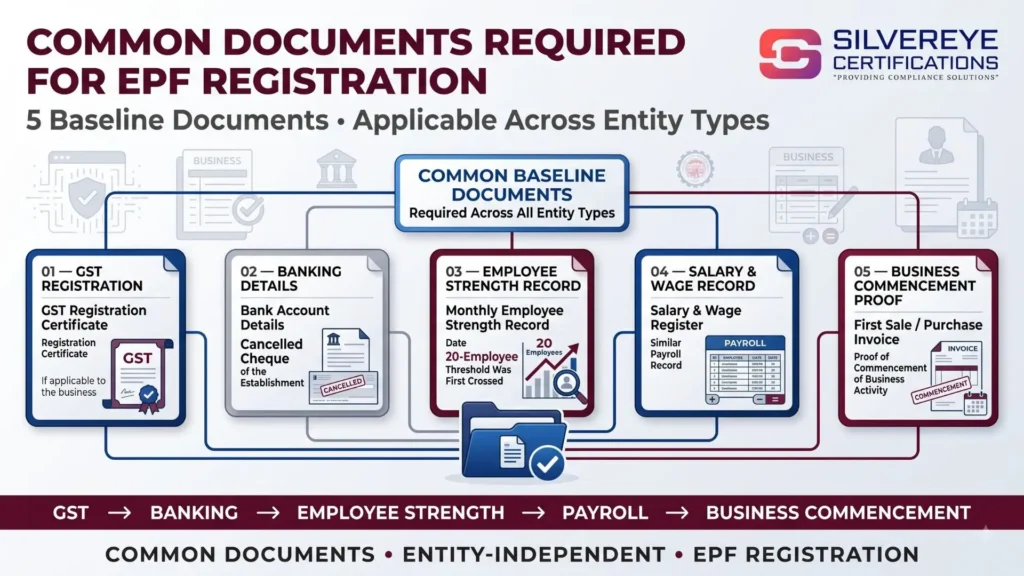
On top of the entity-specific paperwork above, EPFO asks every applicant — regardless of business structure — for the same baseline set:
- GST registration certificate (if applicable to the business).
- Bank account details and a cancelled cheque of the establishment.
- Monthly employee strength record, including the date the 20-employee threshold was first crossed.
- Salary and wage register, or a similar payroll record.
- First sale or purchase invoice, as proof of commencement of business activity.
Document Format, Size and Upload Specifications
The EPFO Unified Portal and Shram Suvidha Portal are strict about file quality — a blurry scan or an oversized file is one of the most common, and most avoidable, reasons an application stalls.
| Requirement | Specification |
| File format | PDF for most identity, address and entity documents (some portals also accept JPG/JPEG for photographs and signatures) |
| File size | Typically 20 KB to 300 KB per document for photo/signature files; most entity and ID documents are capped around 1-2 MB, though some registration workflows allow up to 2-5 MB per file |
| Scan quality | High-resolution, clearly legible scans — text and seals should be readable at normal zoom, not pixelated |
| Signature | Scanned signature on plain white paper in black or dark blue ink, saved separately as an image file where required |
| Digital Signature Certificate | Must be Class 3 (Class 2 DSCs are no longer accepted for EPFO filings since January 2021) |
Always compress files without losing clarity, and double-check that names, dates and addresses are readable before uploading — a document that is technically the correct type but illegible on screen is treated the same as a missing document by the reviewing officer.
2026 Updates That Affect EPF Registration Documents
The documentation process itself hasn't changed dramatically in 2026, but three digital-verification upgrades directly affect how carefully your paperwork needs to line up:
1. Real-time PAN verification
When you enter the establishment's or signatory's PAN during registration, the portal now performs a live API check against Income Tax Department records. If the name on the PAN doesn't match what you've typed — including sequencing issues like first name, middle name and last name being entered in the wrong order — the system flags it immediately rather than after manual review, which is actually faster for correcting errors early.
2. Face Authentication Technology (FAT) for UAN
EPFO has extended Face Authentication Technology to UAN generation and activation for new employees, tightening the link between the Aadhaar photo on file and the person being enrolled. This makes it essential that employee Aadhaar details, especially date of birth and name spelling, are accurate and current before submission — mismatches here now surface faster than under the older manual verification process.
3. The Employees' Provident Funds Scheme, 2026
Effective 1 July 2026, the Employees' Provident Funds Scheme, 2026 replaced the 1952 scheme under the Code on Social Security, 2020. It keeps the same core document requirements for new registration but strengthens digital record-keeping and governance, which is part of why document mismatches are caught earlier in the process now than in previous years.
4. Employees' Enrolment Campaign (EEC) 2026 — a documentation note
For employers using the EEC 2026 window (open 1 July 2026 to 31 October 2026) to enrol employees who were left out of EPF coverage between April 2009 and March 2026, the same employee KYC documents apply — Aadhaar, PAN, bank details and proof of continuous employment with the establishment — since eligibility depends on the employee still being employed with the same establishment at the time of declaration.
Common Document Mistakes That Delay EPF Registration
- Name spelled differently across PAN, Aadhaar and incorporation documents — the single most frequent cause of rejection.
- Using a Class 2 Digital Signature Certificate, which EPFO no longer accepts.
- Uploading an address proof older than the accepted window (commonly two months for utility bills).
- Submitting low-resolution or cropped scans where seals, signatures or numbers aren't fully legible.
- Missing employee bank details or incorrect IFSC codes, which blocks UAN generation even after the Establishment Code is issued.
- Forgetting entity-specific documents — for example, submitting only the company PAN without the MoA/AoA, or a partnership deed without individual partner ID proofs.
Do EPF Registration Documents Expire or Need Renewal?
The Establishment Code itself never expires and the documents used to obtain it are not re-verified periodically. However, some documents have a practical shelf life at the point of submission — address proofs like utility bills are generally expected to be recent (commonly within two months), and a Digital Signature Certificate has its own validity period (usually one to two years) that must be current on the day you sign the application. Beyond registration, employee KYC documents (Aadhaar, PAN, bank details) need to stay updated on the UAN portal throughout employment, since incorrect KYC can block claims, transfers and withdrawals later.
Getting Your Document Set Right the First Time
Almost every EPF registration delay traces back to a document that doesn't match, isn't current, or wasn't scanned clearly enough to verify. Building your entity, signatory and employee document set correctly before you open the EPFO portal — and checking names character-by-character across PAN, Aadhaar and incorporation papers — is the single highest-leverage step toward a clean, one-cycle approval in 2026's more tightly verified digital environment.
Want your document set checked before you submit? Silvereye Certifications helps employers compile, verify and cross-check every EPF registration document — entity proof, DSC, and employee KYC — so applications clear EPFO verification in a single cycle instead of bouncing back for corrections.
Frequently Asked Questions on EPF Registration Documents
What documents are compulsory for every EPF registration, regardless of business type?
PAN of the establishment, proof of business address, a Class 3 Digital Signature Certificate of the authorized signatory, PAN and Aadhaar of that signatory, and a cancelled cheque of the business bank account.
Is a Digital Signature Certificate mandatory for EPF registration?
Yes. The application must be digitally signed using a Class 3 DSC (or e-Sign where permitted) of the proprietor, partner or director — Class 2 DSCs have not been accepted since January 2021.
What documents does a private limited company need for PF registration?
Certificate of Incorporation, PAN of the company, Memorandum and Articles of Association, DSC and ID proof of the director(s), and the standard address proof and bank details.
What format should documents be uploaded in on the EPFO portal?
Most documents are uploaded as PDF; photographs and signatures are typically JPG/JPEG. File sizes are generally capped between 20 KB and a few MB depending on the document type — check the specific limit shown on each upload field.
What documents does a proprietorship need for EPF registration?
PAN card of the proprietor, their residential address proof, a GST certificate or trade licence in the firm's name, and standard business address and bank proof.
Do partnership firms need documents for every partner?
Yes. Along with the registered Partnership Deed and firm PAN, ID and address proof is required for every active partner, plus a list of partners with their contact details.
Why do EPF registration applications commonly get delayed?
The most common reason is a document mismatch — usually a name spelled differently across PAN, Aadhaar and incorporation papers — followed by expired address proofs and low-quality scans.
Do EPF registration documents need to be renewed later?
The Establishment Code and its original documents are not re-verified periodically, but employee KYC (Aadhaar, PAN, bank details) must be kept updated on the UAN portal throughout their employment to avoid issues with claims or transfers.
Are the same documents used for the EPFO Enrolment Campaign 2026?
Yes. Employers using the EEC 2026 window to enrol previously left-out employees still submit standard employee KYC — Aadhaar, PAN and bank details — along with proof that the employee remains with the same establishment.
Can EPF registration documents be submitted offline?
No. EPF registration is conducted entirely online through the EPFO Unified Portal or Shram Suvidha Portal — there is no offline document-filing route for new establishment registration.