

- EPF registration is now filed through the unified Shram Suvidha 2.0 portal under the Labour Codes, 2026.
- A single Labour Identification Number (LIN) now covers EPF, ESIC and most other labour-law registrations.
- Approval usually takes 3–7 working days once your Digital Signature Certificate and documents are in order.
- Registration has lifetime validity — there's no renewal, but monthly ECR filing is compulsory from day one.
Introduction
The EPF registration process is the online procedure an employer follows to enrol their establishment with the Employees' Provident Fund Organization (EPFO), making it mandatory once headcount touches 20 employees. As of 2026, registration is filed through the unified Shram Suvidha 2.0 portal under the new Labour Codes framework, which issues a single Labour Identification Number (LIN) covering EPF, ESIC, and other central labour-law registrations together.

The process needs the establishment's PAN, incorporation proof, address proof, a Digital Signature Certificate, and employee KYC details. There is no government fee for registration itself, approval typically takes 3–7 working days, and once granted, the registration never expires — though monthly contribution filing (ECR) becomes mandatory immediately.
What Does EPF Registration Process Actually Involve?
EPF registration is the formal act of bringing your establishment under the Employees' Provident Funds and Miscellaneous Provisions Act, 1952, so that EPFO recognizes it as a covered employer. Once registered, the establishment receives a unique code that ties every future contribution, employee UAN, and compliance filing back to that single record. It's a one-time administrative step, but it unlocks a recurring monthly obligation — deducting, matching, and depositing provident fund contributions for every eligible employee, on time, every month, for as long as the business operates.
Employers sometimes confuse 'EPF registration' with 'EPF compliance.' Registration is the entry point; compliance is everything that follows — accurate payroll mapping, timely Electronic Challan-cum-Return (ECR) filing, KYC updates, and responding to EPFO notices. Getting the registration step right the first time makes every one of those downstream tasks considerably easier.
Who Must Complete EPF Registration?
Mandatory Registration
Registration becomes compulsory the moment your establishment employs 20 or more people, counted across all categories of workers — permanent, contractual, and casual — on any single day in a month. Certain notified industries carry a lower threshold. Importantly, coverage is a one-way door: even if your headcount later dips below 20, the establishment remains covered.
Voluntary Registration
Under Section 1(4) of the Act, an establishment with fewer than 20 employees can register voluntarily, provided the employer and a majority of the employees agree in writing. This route is common among early-stage startups that want to offer a credible retirement benefit while still building headcount, since it signals maturity to both talent and enterprise clients during vendor due diligence.
Employee-Level Eligibility
Any employee earning basic pay plus dearness allowance up to the statutory wage ceiling of ₹15,000 a month must be enrolled from their date of joining — there's no waiting period or probation exemption. Employees above that ceiling can still be enrolled with employer consent; many companies extend PF coverage to their entire workforce regardless of salary band as standard policy.
Documents Required For EPF Registration
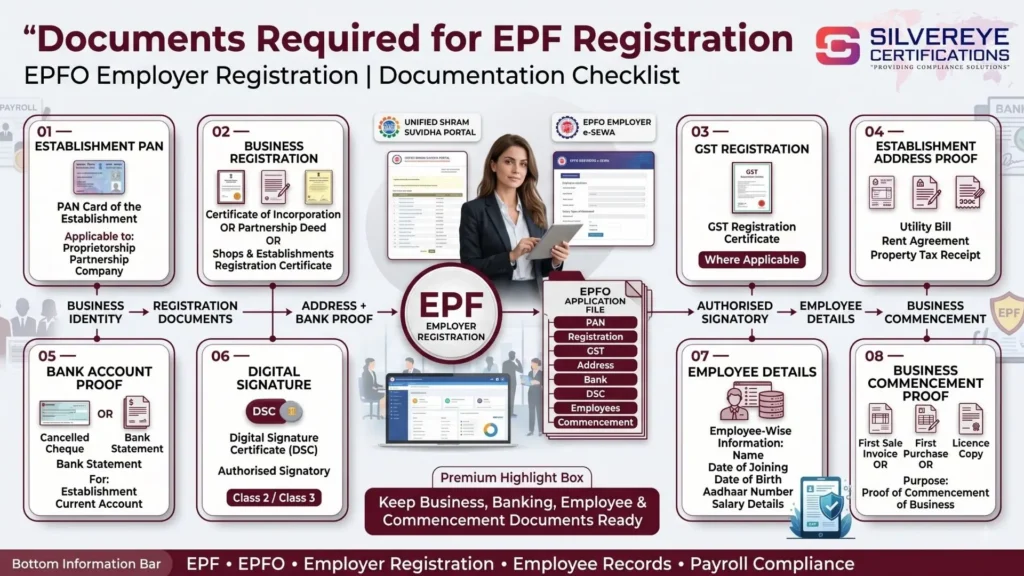
Have scanned, legible copies of the following ready before logging in — incomplete uploads are the single biggest reason applications sit pending:
- PAN card of the establishment (proprietorship, partnership, LLP, or company, as applicable).
- Certificate of incorporation, partnership deed, or registration certificate under the Shops & Establishments Act.
- GST registration certificate, where applicable.
- Address proof of the business premises — a utility bill or rent agreement no older than two months.
- A cancelled cheque or recent bank statement of the establishment's current account.
- Digital Signature Certificate (Class 2 or 3) of the authorised signatory, registered on the portal before submission.
- PAN and Aadhaar of the authorised signatory/director/partner.
- Proof of business commencement — first sale invoice, first purchase bill, or an applicable trade licence.
- Employee master data — full name, date of birth, date of joining, Aadhaar number, and bank account details for each employee to be enrolled.
EPF Registration Process 2026: Step-by-Step
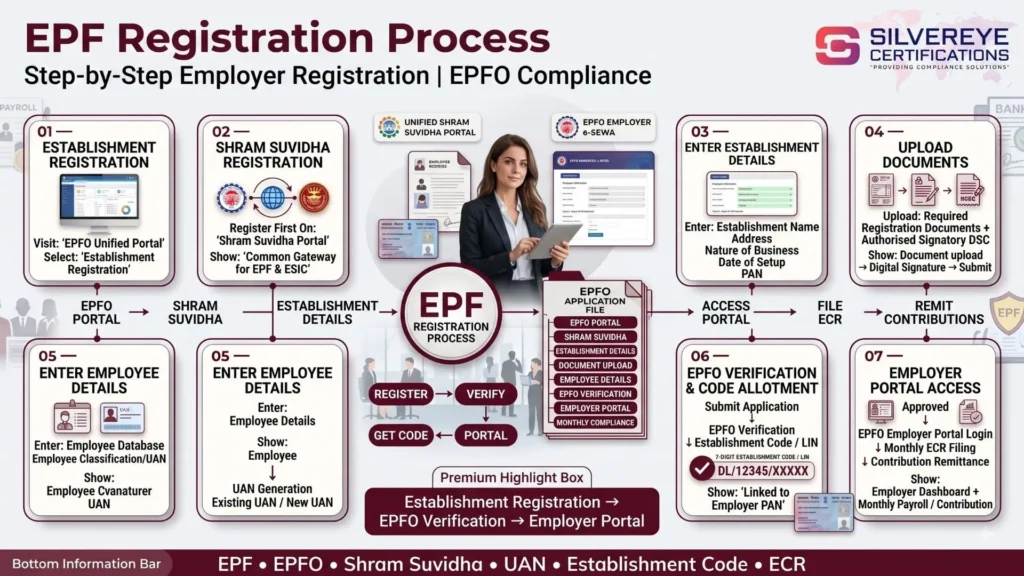
From April 2026, EPF registration for new establishments is filed through the unified Shram Suvidha 2.0 portal, introduced as part of the Labour Codes 2026 rollout. The earlier, EPF-specific route via the standalone EPFO employer portal now redirects into this single-window system. Here is the process in the order employers actually experience it:
- Create your employer profile on the Shram Suvidha 2.0 portal (registration.shramsuvidha.gov.in) using your business email ID and mobile number.
- Verify your account through the OTP sent to your registered mobile number, then set a secure User ID and password.
- Log in and open the 'Registration' section, then select the EPF (and ESIC, if applicable) registration option — both can be filed together in a single application.
- Fill in establishment details: legal name, constitution (proprietorship/partnership/company), date of setup, nature of business, PAN, and address.
- Register your Digital Signature Certificate on the portal — this is mandatory before the application can be signed and submitted.
- Upload the document checklist covered above, ensuring file sizes and formats match the portal's specifications (clear PDFs work best).
- Add employee details for everyone who needs to be enrolled — the system auto-generates a UAN for any employee who doesn't already have one from a previous employer.
- Review the auto-populated summary carefully, then submit the application using your registered DSC.
- Track status on the portal dashboard — EPFO cross-verifies PAN, address, and bank details before approval.
- On approval, you receive a unique Labour Identification Number (LIN), which now doubles as your EPF establishment code, along with login credentials for ongoing monthly filings.
One practical tip: register your DSC on the portal a day or two before you plan to submit. DSC registration errors — expired certificates, mismatched signatory names, or unsupported browsers — cause more delays than any document issue.
EPF Registration Fees, Timeline, Validity & Renewal
| Aspect | Details |
| Government Fee | EPFO does not charge a fee for registration itself. If you engage a consultant or compliance firm, professional service charges apply separately. |
| Processing Time | Typically 3-7 working days when documents, DSC, and employee data are accurate and complete; PAN or address mismatches are the most common cause of delay. |
| Validity | Permanent — EPF registration does not expire and never needs to be renewed for the life of the establishment. |
| Immediate Post-Approval Task | First month's payroll must be mapped to UANs and the first ECR filed and paid by the 15th of the following month. |
| Ongoing Requirement | Monthly ECR filing, annual return, and timely KYC/nomination updates for all enrolled employees — this is where recurring compliance risk actually sits, not at the registration stage. |
Common Mistakes That Delay EPF Registration
- Address proof older than two months or not matching the PAN database exactly.
- Using an expired or wrongly-classed Digital Signature Certificate (Class 3 is generally recommended for company filings).
- Employee Aadhaar details that don't match the name/date-of-birth format EPFO expects, causing UAN generation errors.
- Bank account details on the cancelled cheque not matching the name registered against the establishment's PAN.
- Submitting before the DSC is fully registered and validated on the portal, causing signature verification failure at the final step.
- Treating registration as complete without immediately preparing for the first ECR filing deadline.
What Happens Right After Registration: A Post-Approval Checklist
Approval is the beginning of your compliance cycle, not the end of the task. Employers should immediately:
- Share each employee's UAN with them and guide them to activate it via Aadhaar OTP on the EPFO Member portal.
- Ensure every employee completes KYC — Aadhaar, PAN, and bank linkage — since incomplete KYC blocks contribution transfers and claim settlements later.
- Collect and file e-Nomination for every employee; EPFO has made this mandatory, and unfiled or pre-marriage nominations are treated as invalid.
- Set a fixed internal payroll cut-off so ECR filing and contribution payment happen well before the 15th of every month, avoiding interest under Section 7Q.
- Keep a compliance calendar for annual returns and periodic KYC re-verification, especially when hiring in bulk or during appraisal cycles when basic pay changes.
Penalties for Not Registering or Registering Late
Delaying registration doesn't reduce liability — it accumulates it. If EPFO determines an establishment should have been covered from an earlier date, contributions become payable retrospectively from that date, along with:
| Default | Consequence |
| Late or missing registration | Retrospective contribution liability from the date coverage was actually due, not the date you eventually applied. |
| Delayed contribution payment after registration | Interest under Section 7Q, currently 12% per annum for the delay period. |
| Persistent short payment or default | Damages under Section 14B, assessed on the amount and duration of default, on top of Section 7Q interest. |
| Deducting employee share without depositing it | Prosecutable under Section 14 of the EPF Act, with imprisonment of up to 3 years and a fine. |
What's New in the EPF Registration Process for 2026
The registration process itself has changed meaningfully this year — here's what's genuinely different from the older, EPF-only workflow:
- Labour Codes 2026 in full effect — the four consolidated labour codes came into force in phases, with full rollout from April 1, 2026, replacing dozens of overlapping registrations with a unified compliance framework.
- Shram Suvidha 2.0 is now the single point of registration — new EPF (and ESIC) applications are filed at registration.shramsuvidha.gov.in rather than through separate department-specific portals used earlier.
- One Labour Identification Number (LIN) now functions as the establishment's EPF code, replacing the need to separately track a PF code, ESIC number, and other departmental IDs.
- UAN generation is more tightly integrated into the registration flow itself — adding employee data during registration auto-creates or links their UAN in the same step, rather than as a separate post-registration task.
- EPFO's compliance monitoring has become more system-driven, with irregular filings and unresolved employee grievances (such as 'contribution deducted but not deposited') increasingly flagged through automated checks rather than manual, discretionary review — making accurate first-time registration and consistent monthly filing more important than ever.
Because the Shram Suvidha 2.0 transition is still recent, employers who registered under the older portal don't need to re-register — existing establishment codes carry forward — but any new registration, or any request to add a second registration (like ESIC) to an existing entity, should now be filed through the new unified system.
Conclusion
The EPF registration process itself isn't the hard part — most delays come from underestimating the documentation and DSC steps, or forgetting that approval is the start of a monthly obligation, not the finish line. Getting each step right the first time, especially under the newly unified Shram Suvidha 2.0 system, saves weeks of back-and-forth and keeps your establishment clear of avoidable interest and damages later.
Need hands-on support getting your EPF registration filed correctly the first time? Silvereye Certifications helps employers manage end-to-end EPF, ESIC, and labour-law registration on the Shram Suvidha 2.0 portal — from document preparation and DSC handling to employee KYC and ongoing monthly compliance — so your registration goes through cleanly and stays compliant long after approval.
Frequently Asked Questions
How do I register for EPF as a new employer in 2026?
You apply online through the unified Shram Suvidha 2.0 portal (registration.shramsuvidha.gov.in) — creating an employer profile, uploading required documents, registering your Digital Signature Certificate, entering employee details, and submitting for EPFO verification.
Is EPF registration mandatory for a company with fewer than 20 employees?
Not mandatorily, but it's optional. Establishments below the 20-employee threshold can register voluntarily under Section 1(4) if the employer and a majority of employees agree.
What documents are needed for EPF registration?
You'll need the establishment's PAN, incorporation or Shops & Establishments certificate, address proof, a cancelled cheque, a Digital Signature Certificate of the authorised signatory, and employee KYC data (Aadhaar, bank details).
Is there a government fee for EPF registration?
No. EPFO does not charge a fee for registration itself. You may incur professional charges only if you hire a consultant or compliance service to file it on your behalf.
How long does EPF registration take to get approved?
Typically 3-7 working days when your documents, DSC, and employee data are complete and accurate. Mismatched address proof or an unverified DSC are the most common causes of delay.
Does EPF registration expire and need renewal?
No. EPF registration is a one-time process with lifetime validity for the establishment. There is no renewal requirement, though monthly contribution filing is mandatory indefinitely.
What is the Shram Suvidha 2.0 portal and why does it matter for EPF registration?
It's the unified registration and compliance portal introduced under the Labour Codes 2026, through which new EPF (and ESIC) registrations are now filed, replacing the earlier department-specific portals and issuing one Labour Identification Number for the establishment.
Do existing EPF-registered establishments need to re-register on Shram Suvidha 2.0?
No. Establishment codes issued under the earlier system carry forward. The new portal is primarily the entry point for fresh registrations or additional registrations linked to an existing entity.
What happens if I delay EPF registration after crossing 20 employees?
Liability applies retrospectively from the date your establishment actually became eligible, not from your application date, and can attract interest under Section 7Q plus damages under Section 14B for the delayed period.
Is a Digital Signature Certificate compulsory for EPF registration?
Yes. A Class 2 or Class 3 DSC of the authorised signatory must be registered on the portal before the application can be signed and submitted.
Are UANs generated automatically during EPF registration?
Yes, for any employee who doesn't already have one from a previous employer. Entering employee data during registration triggers UAN generation or links to their existing UAN in the same step.
What should an employer do immediately after EPF registration is approved?
Share UANs with employees, ensure KYC (Aadhaar, PAN, bank) and e-Nomination are completed, and prepare to file the first Electronic Challan-cum-Return (ECR) and payment by the 15th of the following month.