

- Employers with 20 or more employees must register for EPF; smaller firms can opt in voluntarily.
- Standard contribution is 12% of basic wages from both employee and employer every month.
- EPFO 3.0 (2026) brings UPI-based withdrawals, auto-settlement up to ₹5 lakh, and a mandatory 25% retirement buffer.
- Late or missed EPF payments attract interest under Section 7Q and damages under Section 14B of the EPF Act.
Introduction
EPF Registration (Employees' Provident Fund) is a government-backed retirement savings scheme run by the Employees' Provident Fund Organization (EPFO) under the EPF & MP Act, 1952. Employers with 20 or more staff must register on the EPFO Unified Portal, after which both employee and employer contribute 12% of basic wages plus dearness allowance every month. The employer's share is split across the EPF, the Employees' Pension Scheme (EPS), and EDLI insurance.

In 2026, EPFO rolled out EPFO 3.0 — faster UPI withdrawals, auto-settlement up to ₹5 lakh, a 25% mandatory balance-retention rule, and a 36-month waiting period for EPS pension withdrawal. The EPF wage ceiling remains ₹15,000/month for now, though a hike to ₹25,000 has been approved by the Finance Ministry and is expected from around April 2027.
If you are an employer trying to register your establishment, an HR or payroll professional keeping up with compliance, or an employee trying to understand your own PF passbook, this guide walks through everything — from EPFO's role and who must register, to the 2026 contribution structure, UAN, EPF vs EPS vs EDLI, the newest withdrawal rules, tax treatment, and the penalties for getting compliance wrong.
What Is EPF Registration? Understanding the Employees' Provident Fund
The Employees' Provident Fund (EPF) is a mandatory, government-backed retirement savings scheme for salaried employees in India, established under the Employees' Provident Funds and Miscellaneous Provisions (EPF & MP) Act, 1952. In simple terms, it works like a forced savings account: a small, fixed percentage of an employee's monthly salary is deducted and deposited into their PF account, and the employer contributes a matching amount on their behalf. Over the course of a career, this combined contribution — plus annual interest declared by the government — builds into a retirement corpus that the employee can withdraw on leaving service, retiring, or in specific situations of financial need.
EPF is one of three linked schemes administered together: the Provident Fund itself, the Employees' Pension Scheme (EPS), and the Employees' Deposit Linked Insurance (EDLI) scheme. Together, they form India's core social-security net for the organized private-sector workforce, covering retirement savings, a monthly pension after a minimum service period, and life insurance cover in case of the employee's death while in service.
What Is EPFO and What Role Does It Play?
The Employees' Provident Fund Organization (EPFO) is the statutory body under the Ministry of Labour & Employment, Government of India, responsible for administering the EPF, EPS, and EDLI schemes. EPFO registers establishments, allots each member a Universal Account Number (UAN), collects monthly contributions through employers, invests the accumulated corpus, declares the annual interest rate, processes withdrawal and transfer claims, and enforces compliance against defaulting employers.
EPFO functions through a network of regional and zonal offices, but in 2026 it introduced an 'Anywhere Service' model that removed strict territorial jurisdiction — members and employers can now approach any EPFO office, not just the one tied to their registered address, for most services. EPFO also runs the Unified Member Portal and the UMANG app for self-service access to passbooks, claims, and KYC updates.
Who Must Register for EPF Registration? Eligibility for Employers and Employees
Employer Eligibility
Under Section 1(3) of the EPF Act, EPF registration is mandatory for:
- Any factory or establishment employing 20 or more persons, across almost all industries and business categories notified under the Act.
- Certain specified industries (such as cinema, and a few others notified by the Central Government) where the threshold can be lower than 20 employees.
- Establishments that once crossed the 20-employee threshold — coverage continues even if headcount later falls below 20.
Establishments with fewer than 20 employees can register voluntarily, provided the employer and a majority of employees agree. Many startups and small firms choose voluntary registration to offer competitive benefits and build trust with early employees.
Employee Eligibility
Any employee — whether on the rolls directly or through a contractor — drawing basic wages plus dearness allowance up to the statutory wage ceiling of ₹15,000 per month must compulsorily become an EPF member from the date of joining.
Employees drawing a higher basic salary can still join with the consent of the employer and the Assistant PF Commissioner; many companies extend PF coverage to all employees regardless of salary as a standard HR benefit. Once enrolled, membership continues for the entire working life, portable across employers through the UAN.
Benefits of EPF Registration
- Builds a disciplined, tax-efficient retirement corpus through mandatory monthly savings.
- Employer contribution is essentially a guaranteed addition to the employee's retirement fund at no direct cost to the employee.
- Government-declared interest (8.25% p.a. for FY 2025-26) is compounded monthly and largely tax-free.
- EDLI cover provides the employee's family a lump-sum insurance payout in case of death while in service, at no cost to the employee.
- EPS provides a monthly pension after 10 years of contributory service, from age 58 onward.
- Registered establishments gain credibility with employees, clients, and lenders, and stay compliant with labour law audits and tenders that require EPF compliance certificates.
Documents Required for EPF Registration
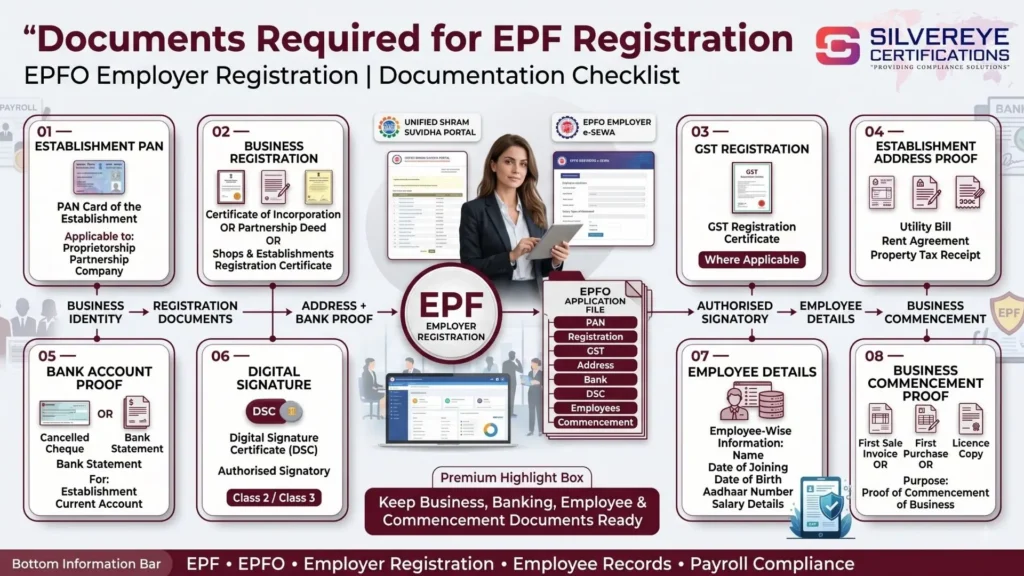
EPFO registration is done online through the Unified Shram Suvidha Portal / EPFO Employer e-Sewa portal. Employers should keep the following ready:
- PAN card of the establishment (proprietor, partnership, or company, as applicable).
- Certificate of incorporation / partnership deed / registration certificate under the Shops & Establishments Act.
- GST registration certificate, if applicable.
- Address proof of the establishment (utility bill, rent agreement, or property tax receipt).
- Cancelled cheque or bank statement of the establishment's current account.
- Digital Signature Certificate (DSC) of the authorized signatory (Class 2 or 3).
- Details of all employees — name, date of joining, date of birth, Aadhaar number, and salary details.
- First sale invoice / first purchase bill, or license copy, as proof of commencement of business.
EPF Registration Process, Fees, Timeline, Validity & Renewal
Here is the standard step-by-step process an employer follows for EPF registration in 2026:
- Visit the EPFO Unified Portal (Employer registration section) and select 'Establishment Registration'.
- Register on the Shram Suvidha Portal first (a common registration gateway for EPF and ESIC) using the establishment's basic details.
- Fill in establishment details — name, address, nature of business, date of setup, and PAN.
- Upload the required documents listed above, including the DSC of the authorised signatory.
- Enter employee details — this generates each employee's UAN if they do not already have one.
- Submit the application; EPFO verifies the details and allots a 7-digit Establishment Code / Labour Identification Number (LIN) linked to the employer's PAN.
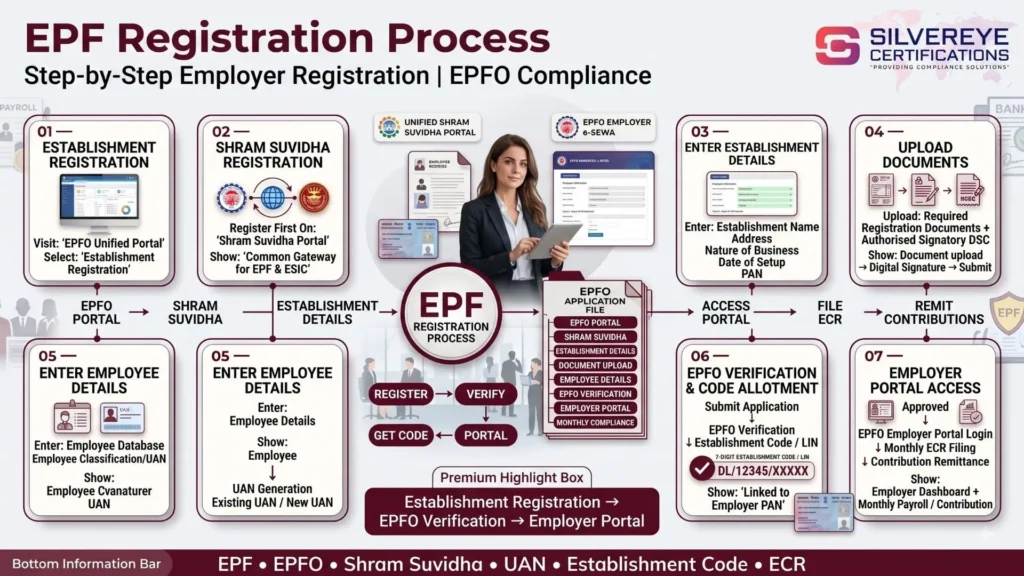
Once approved, the employer receives login credentials for the EPFO Employer portal to file monthly returns (ECR) and remit contributions.
| Aspect | Details |
| Government Fee | No government fee is charged for EPF registration itself; professional/consultant charges may apply if you outsource the filing. |
| Processing Timeline | Typically 3-7 working days if documents and DSC are in order; delays are usually due to document mismatches. |
| Validity | EPF registration is a one-time process with lifetime validity - it does not expire and does not need renewal. |
| Ongoing Compliance | Monthly Electronic Challan-cum-Return (ECR) filing and contribution payment by the 15th of the following month is mandatory, along with KYC and nomination updates. |
| Digital Signature | Class 2/3 DSC of the authorised signatory is mandatory for registration and monthly filings. |
Because registration itself never expires, the real compliance burden sits in monthly filing accuracy — correct UAN mapping, timely challan payment, and updated employee KYC. Employers that skip a month or file with mismatched data are the ones who typically end up facing EPFO notices and penalties, covered later in this guide.
EPF Contribution Rate 2026: How the 12% Split Works
Both the employee and the employer contribute 12% of the employee's basic wages plus dearness allowance (subject to the statutory wage ceiling of ₹15,000/month) every month. However, the employer's 12% is not credited entirely to the EPF account — it is split across three heads:
| Contribution Head | Rate | Who Pays | Purpose |
| EPF (Provident Fund) | 3.67% of employer's 12%, plus full 12% from employee | Employee + Employer | Core retirement savings, earns annual interest |
| EPS (Pension Scheme) | 8.33% (capped on Rs.15,000 wage ceiling, approx Rs.1,250/month) | Employer only | Funds monthly pension after 10 years of service, from age 58 |
| EDLI (Insurance) | 0.50% of wages | Employer only | Life insurance cover for the employee's nominee |
| EPF Admin Charges | 0.50% of wages (subject to a minimum) | Employer only | EPFO's account administration cost |
| EDLI Admin Charges | NIL (waived since April 2017) | - | - |
So on a basic salary of ₹15,000, the employee contributes ₹1,800 (12%) entirely to the EPF account, while the employer's ₹1,800 is split into roughly ₹1,250 to EPS and the remainder to EPF, plus separate admin and EDLI charges paid on top. Employees can also opt for a Voluntary Provident Fund (VPF), contributing more than the mandatory 12% to earn the same EPF interest rate on the extra amount — and under the EPF Scheme 2026 update, employees can now start, increase, reduce, or pause VPF contributions at any point in the financial year, instead of being locked in for twelve months as under the older rules.
The EPF interest rate for FY 2025-26 has been fixed at 8.25% per annum, unchanged for the third consecutive year, as notified by EPFO following government ratification. Interest is calculated monthly on the running balance but credited to member accounts at the end of the financial year.
UAN (Universal Account Number): What It Is and How to Activate It
The Universal Account Number (UAN) is a unique 12-digit number allotted by EPFO to every EPF member. It stays constant throughout a person's career regardless of how many employers they work for — each new employer only adds a new 'member ID' under the same UAN, and EPFO now auto-links and transfers the previous PF balance to the new employer account, reducing the need to file transfer claims manually.
How to Activate and Use Your UAN
- Get your UAN from your employer (usually shared on the payslip or offer letter) or look it up on the EPFO Unified Member Portal using your PF number.
- Visit the EPFO Member e-Sewa portal and click 'Activate UAN', entering your UAN, name, date of birth, and registered mobile number.
- Verify with the OTP sent to your mobile number to activate the account.
- Log in and complete your KYC - link Aadhaar, PAN, and bank account details; Aadhaar-based e-KYC now uses Aadhaar OTP e-Sign for authentication.
- Update or file your e-Nomination, which EPFO has made mandatory under the EPF Scheme, 2026.
Once activated, your UAN lets you download your PF passbook, track contributions, file withdrawal or transfer claims online, and update KYC — all without visiting an EPFO office. Note the 2026 nomination rule: any nomination filed before marriage is automatically treated as invalid once the member marries, so re-filing e-nomination after a change in marital status is essential to avoid claim disputes for your family.
EPF vs EPS vs EDLI: What's the Difference?
People often use 'PF' loosely to mean all three schemes, but each serves a distinct purpose. Here's a side-by-side comparison:
| Feature | EPF | EPS | EDLI |
| Full Form | Employees' Provident Fund | Employees' Pension Scheme | Employees' Deposit Linked Insurance |
| Purpose | Retirement savings corpus | Monthly pension after retirement | Life insurance for nominee |
| Employee Contribution | 12% of basic wages | Nil (funded from employer's share) | Nil |
| Employer Contribution | 3.67% of basic wages | 8.33% (capped on wage ceiling) | 0.50% of wages |
| Interest / Returns | 8.25% p.a. (FY 2025-26) | No interest; pension formula-based payout | No interest; lump-sum insurance benefit |
| Eligibility to Claim | On leaving job / retirement, subject to 2026 balance-retention rules | Minimum 10 years of contributory service; pension from age 58 | Applicable if death occurs while in active service |
| Payout Type | Lump sum (with partial withdrawal options) | Monthly pension (lump sum only in limited exit cases) | Lump sum to nominee, up to Rs.7 lakh |
EPF Withdrawal Rules 2026: What's Changed Under EPFO 3.0
2026 has been the biggest year of reform for EPF withdrawals since the scheme's inception, following the Central Board of Trustees' (CBT) approval of the EPF Scheme, 2026 and the phased rollout of EPFO 3.0. Here's what employees need to know:
- 13 withdrawal categories consolidated into 3 - broadly covering essential needs (medical, education, housing, marriage), housing-linked withdrawal, and general/illness advances - making claim filing simpler and faster.
- 25% mandatory balance retention - full-value withdrawal is not allowed while still in service; members must keep at least 25% of their accumulated PF balance untouched as a retirement buffer.
- 100% withdrawal is permitted only on complete account closure - retirement (55+ years), permanent disability, or permanent migration abroad.
- Auto-settlement limit raised to Rs.5 lakh for eligible, KYC-complete claims, cutting typical claim settlement time from the earlier 7-20 days to a much faster, largely automated process.
- UPI-based withdrawal and faster digital claim verification introduced under EPFO 3.0, in partnership with banking partners, for near-instant access to eligible funds.
- EPS pension-fund withdrawal waiting period extended from 2 months to 36 months of unemployment before a member can withdraw the accumulated pension corpus, encouraging long-term pension continuity instead of early cash-outs.
- Auto-transfer of PF balance on job change - EPFO now links the previous employer's balance to the new one automatically under the same UAN.
EPFO and the Ministry of Labour & Employment have clarified that these changes are designed to expand flexibility and speed up settlements — not to restrict members' access to their own money — while protecting long-term retirement adequacy. As always, actual eligibility for a specific claim still depends on the purpose of withdrawal, length of membership, and KYC status, so members should verify their specific case on the official EPFO portal before filing.
Tax Implications of EPF Contributions and Withdrawals
- Employee contribution up to Rs.1.5 lakh per year qualifies for a deduction under Section 80C of the Income Tax Act, 1961.
- Interest earned is tax-free, except that interest on an employee's own contribution exceeding Rs.2.5 lakh in a financial year (Rs.5 lakh for accounts with no employer contribution) is taxable and subject to TDS.
- Withdrawal after 5 years of continuous service is fully tax-exempt, including the interest earned.
- Withdrawal before completing 5 years of service is taxable, and TDS applies at 10% (with PAN) on withdrawals above Rs.50,000, or a higher rate without PAN - though TDS is skipped if the transfer is between recognized PF accounts or on account of specified circumstances like ill health or business closure.
- The employer's contribution to EPF, EPS, and EDLI is not treated as taxable income in the employee's hands, within prescribed limits.
Penalties for EPF Registration Non-Compliance
EPF compliance is not optional, and EPFO enforces it with financial and legal consequences for defaulting employers:
| Type of Default | Consequence |
| Late deposit of contributions | Interest under Section 7Q of the EPF Act, currently levied at 12% per annum for the period of delay. |
| Delayed or short payment of dues | Damages under Section 14B, calculated on the amount and duration of default, in addition to interest under Section 7Q. |
| Failure to register an eligible establishment | Retrospective liability for contributions from the date coverage was due, plus interest and damages. |
| Deducting employee's share but not depositing it | Treated as a serious offence - prosecutable under Section 14 of the EPF Act, with imprisonment of up to 3 years and fine. |
| Filing incorrect or fraudulent ECR/returns | Penal action, potential blacklisting from government tenders, and scrutiny in future EPFO inspections. |
Beyond the direct financial penalty, non-compliance also affects employees' pension eligibility, insurance cover, and ability to withdraw or transfer their PF — making timely, accurate EPF compliance a direct extension of an employer's duty of care toward its workforce.
EPF Registration Scheme 2026 - What's New: A Quick Summary
If you only remember five things about EPF changes in 2026, make it these:
- EPFO 3.0 rollout - UPI-based withdrawals, faster digital claims, and a rebuilt IT backbone for the Unified Member Portal and UMANG app to reduce server downtime and login failures.
- 25% mandatory retirement buffer - members can no longer withdraw their entire PF balance while still employed; a quarter of the corpus stays locked for retirement security.
- EPS withdrawal wait extended to 36 months, up from 2 months, to discourage premature pension cash-outs.
- Auto-settlement ceiling raised to Rs.5 lakh, plus 'Anywhere Service' that removes the old requirement to deal only with your regional EPFO office.
- Wage ceiling hike approved in principle - the Finance Ministry has cleared raising the EPF wage ceiling from Rs.15,000 to Rs.25,000, though the Union Budget 2026 kept it unchanged for now; the increase is widely expected to roll out around April 2027, subject to final Cabinet notification. Employers and payroll teams should track this closely, as it will raise both employee take-home deductions and long-term pension coverage once notified.
Because several of these changes are still moving through implementation phases, employers and employees should always cross-check the live status on the official EPFO portal (epfindia.gov.in) or through a registered compliance advisor before acting on any specific claim or payroll change.
Conclusion
EPF compliance in 2026 is no longer a once-a-year formality — between UAN-based digital filing, the new 25% retirement-buffer rule, the 36-month EPS waiting period, and a wage ceiling revision on the horizon, both employers and employees need to stay current to avoid penalties and make the most of their retirement savings. Whether you're registering a new establishment, reconciling monthly ECR filings, or simply trying to understand your own PF passbook, getting the fundamentals right the first time saves significant time, money, and compliance risk later.
Need help with EPF registration or ongoing compliance? Silvereye Certifications assists employers with end-to-end EPF, ESIC, and labour law registration and compliance support — from documentation and portal filing to monthly return management — so you can focus on running your business while staying fully compliant with EPFO's evolving 2026 rules.
Frequently Asked Questions
What is EPF Registration and how does it work?
EPF (Employees' Provident Fund) is a retirement savings scheme where the employee and employer each contribute 12% of basic wages monthly into an EPFO-managed account. The corpus earns annual interest (8.25% for FY 2025-26) and is paid out on retirement, resignation, or under specific withdrawal categories.
Is EPF registration mandatory for all employers?
It is mandatory for any establishment employing 20 or more persons. Establishments with fewer employees can register voluntarily with mutual consent between the employer and the majority of employees.
What is the current EPF contribution rate in 2026?
Both employee and employer contribute 12% of basic wages plus DA (capped on the Rs.15,000 wage ceiling for the pension component). The employer's 12% splits into roughly 3.67% EPF, 8.33% EPS, 0.5% EDLI, and 0.5% admin charges.
What is UAN and how do I activate it?
UAN is a 12-digit Universal Account Number that stays with you across all employers. Activate it on the EPFO Member e-Sewa portal using your UAN, registered mobile number, and OTP verification, then complete Aadhaar and bank KYC.
What is the difference between EPF, EPS, and EDLI?
EPF is your retirement savings account funded by both employee and employer. EPS is an employer-funded pension scheme paying a monthly pension after 10 years of service from age 58. EDLI is an employer-funded life insurance cover payable to your nominee if you pass away while in service.
Can I withdraw my full PF balance in 2026?
Not while still employed. Under the EPF Scheme 2026, at least 25% of your accumulated balance must remain untouched. Full 100% withdrawal is allowed only on retirement (55+), permanent disability, or permanent migration abroad.
Is EPF withdrawal taxable?
Withdrawals after 5 years of continuous service are tax-free. Withdrawals before 5 years are taxable, with TDS applicable at 10% (with PAN) on amounts above Rs.50,000, subject to certain exemptions like ill health or business closure.
What documents are required for EPF registration?
You'll need the establishment's PAN, incorporation/registration certificate, address proof, a cancelled cheque, a Digital Signature Certificate of the authorized signatory, and employee details including Aadhaar and bank information.
How long does EPF registration take and what are the fees?
EPFO does not charge a government fee for registration itself; approval typically takes 3-7 working days if all documents and the DSC are in order. Registration, once granted, is valid for the establishment's lifetime with no renewal required.
What happens if an employer fails to deposit EPF contributions on time?
The employer becomes liable for interest under Section 7Q (currently 12% p.a.) and damages under Section 14B of the EPF Act. Deducting an employee's share and not depositing it is a prosecutable offence under Section 14, carrying imprisonment of up to 3 years.
Has the EPF wage ceiling of Rs.15,000 increased in 2026?
Not yet in force. The Finance Ministry has approved raising the ceiling to Rs.25,000, but Union Budget 2026 kept it unchanged at Rs.15,000. The revised ceiling is widely expected to be notified around April 2027, pending final Cabinet clearance.
What is EPFO 3.0?
EPFO 3.0 is the 2026 technology and process overhaul of EPFO's systems, introducing UPI-based withdrawals, higher auto-settlement limits (up to Rs.5 lakh), 'Anywhere Service' across EPFO offices, and a more stable Unified Member Portal and UMANG app.