
- What a WMI code actually is, and why NHTSA and international regulators require one before a vehicle can carry a legal VIN.
- The real, step-by-step WMI registration process — through SAE International in the U.S. and national authorities elsewhere.
- Actual 2026 costs, processing timelines, and what renewal (or non-renewal) really means for your WMI.
- Who must register: OEMs, low-volume and specialty manufacturers, EV makers, and trailer or motorcycle producers.
Introduction
A WMI Registration (World Manufacturer Identifier) is the first three characters of a vehicle's 17-character VIN, assigned under ISO 3780 and SAE J1044 to identify a manufacturer and its country of production. In the U.S., NHTSA contracts SAE International to assign WMIs at no government charge; outside the U.S., a national standards body — such as India's BIS or Ireland's NSAI — coordinates the request with SAE.

WMI registration is required before any OEM, low-volume manufacturer, EV maker, or trailer/motorcycle builder can legally assign VINs. With complete documentation, SAE has issued a WMI in as little as 13 business days.
What Is a WMI Code?
A World Manufacturer Identifier (WMI) is the first three characters of a vehicle's 17-character Vehicle Identification Number (VIN). It is defined under the international standard ISO 3780 and the related SAE recommended practices — SAE J853, J187, J272, and J1044 — which govern how VINs are structured and how manufacturer codes are issued on a uniform, global basis.
Each WMI is unique to one manufacturer, or one manufacturing division within a larger company, and it communicates two things in three characters: the country or region where the vehicle is built, and the specific company that built it. A VIN beginning with "1", "4", "5", or "7" generally points to final assembly in the United States; "J" points to Japan; "W" to Germany; and "M" to India — the exact blocks of codes are allocated by SAE International, which acts as the global registration authority for ISO 3780.
Production volume changes the format. Manufacturers producing 900 or more vehicles a year in a given category receive a standard 3-character WMI. Manufacturers producing fewer than 900 vehicles annually — a common scenario for EV startups, specialty vehicle builders, and low-volume trailer or motorcycle manufacturers — are instead assigned a 6-character WMI, in which the third character is the numeral "9" and three further characters (occupying VIN positions 12–14) complete the manufacturer's unique identity. This threshold and structure comes directly from SAE J1044, the recommended practice governing WMI issuance.
Why Is WMI Registration Required?
WMI registration isn't optional paperwork — it's the legal foundation that makes a VIN valid. In the United States, 49 CFR Part 565 requires every VIN to begin with a properly assigned WMI before a manufacturer can affix it to a vehicle offered for sale. Equivalent requirements exist worldwide under ISO 3779/3780, enforced through each country's national standards or transport authority.
- Legal compliance — Vehicles without a properly registered WMI cannot be lawfully titled, registered, insured, or sold in most jurisdictions.
- Traceability and recalls — Regulators, insurers, and law enforcement use the WMI to trace a vehicle back to its manufacturer for safety recalls, theft recovery, and warranty claims.
- Global market access — A registered WMI is what allows a vehicle built in one country to be legally imported, titled, and sold in another.
- Brand and manufacturer identity protection — Because a WMI is exclusive to one company, it prevents two manufacturers from issuing conflicting or duplicate VINs.
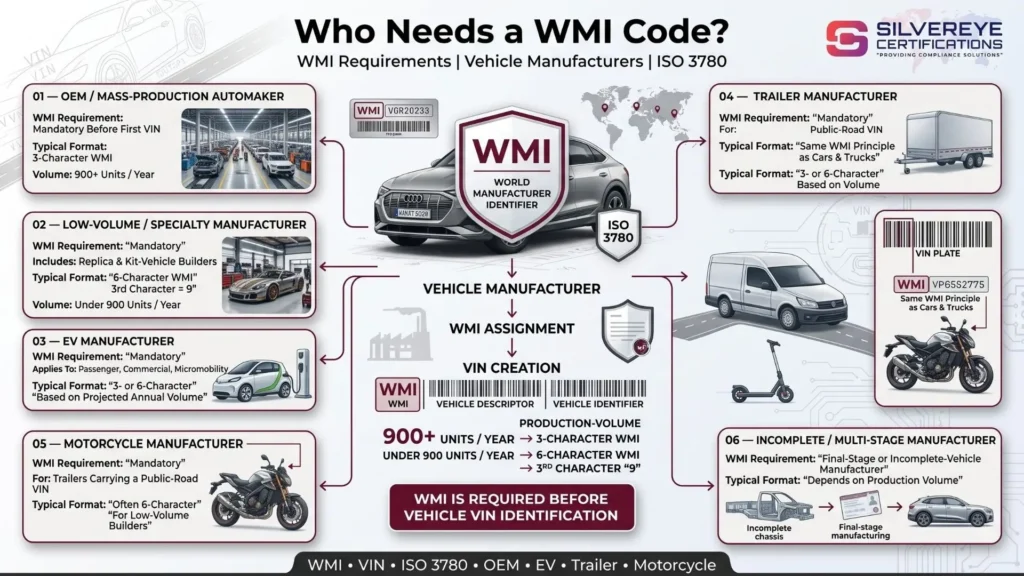
Who Needs a WMI Code? (OEMs, Low-Volume, EV, Trailer & Motorcycle Manufacturers)
Any company that manufactures complete vehicles, trailers, or motorcycles intended for on-road use and titling needs its own WMI. This applies regardless of production volume — the only thing volume changes is whether you receive a 3-character or 6-character code.
| Manufacturer Type | WMI Requirement | Typical Format |
| OEM / mass-production automaker | Mandatory before first VIN is issued | 3-character WMI (900+ units/year) |
| Low-volume or specialty manufacturer | Mandatory, including replica and kit-vehicle builders producing under 900 units/year | 6-character WMI (3rd character "9") |
| EV manufacturer (passenger, commercial, or micromobility) | Mandatory — treated the same as any new vehicle manufacturer under ISO 3780 | 3- or 6-character, based on projected annual volume |
| Trailer manufacturer | Mandatory for any trailer that will carry a public-road VIN | Often 6-character for low-volume trailer builders |
| Motorcycle manufacturer | Mandatory — motorcycle VINs follow the same WMI structure as cars and trucks | 3- or 6-character, based on volume |
| Incomplete-vehicle / multi-stage manufacturer | The final-stage or incomplete-vehicle manufacturer registers its own WMI | Depends on production volume |
SAE International vs. Country-Specific Authorities
SAE International is the single global registration authority for WMI codes under ISO 3780, but the application route differs depending on where a manufacturer is based. In the U.S., manufacturers apply directly to SAE. In most other countries, a national standards or transport body first verifies the manufacturer, then forwards the request to SAE so the code is entered into the global database and doesn't conflict with an identifier already in use anywhere in the world.
| Region | Coordinating Authority | How It Works | Notable Detail |
| United States | SAE International, under contract to NHTSA (49 CFR Part 565) | Manufacturer applies directly to SAE's WMI Coordinator | Manufacturer identifiers are supplied by SAE at no government charge |
| India | Bureau of Indian Standards (BIS) | Applicant files with BIS; BIS verifies and forwards the proposed code to SAE for global confirmation | Government fee is nominal (commonly cited near ₹5,000 plus applicable taxes) |
| Ireland | National Standards Authority of Ireland (NSAI) | Applicant files with NSAI, which notifies SAE once the WMI is assigned | Manufacturers under 500 units/year receive a code with "9" as the third character; fee is roughly €265 plus VAT |
| Other ISO member countries | A national standards or transport body designated under ISO | Process mirrors the above: national verification, then coordination with SAE's global database | Fees, document lists, and timelines vary by country — always confirm with the current national authority |
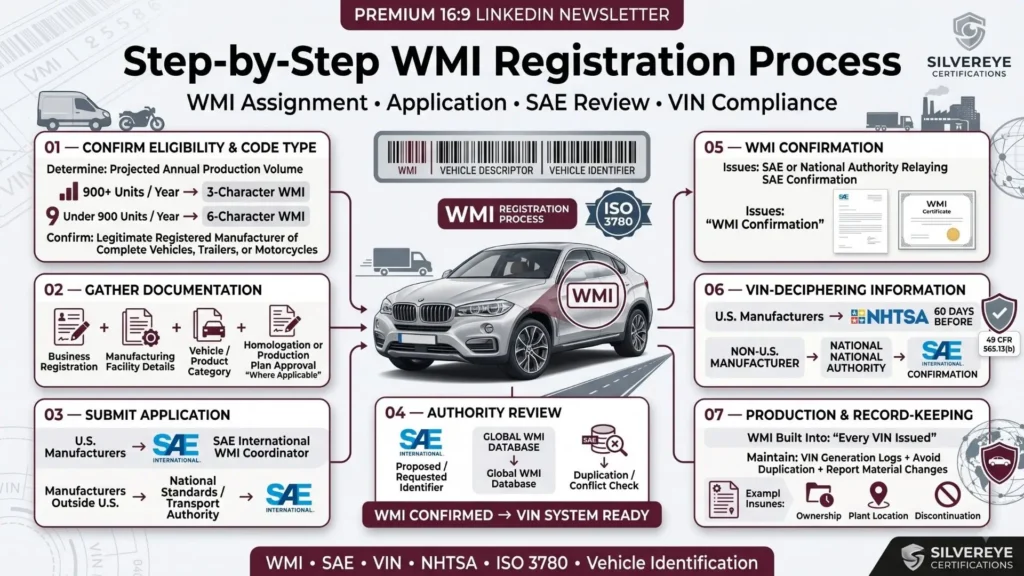
Step by Step Process For WMI Registration
- Confirm eligibility and code type. Determine your projected annual production volume — this decides whether you'll receive a 3-character or 6-character WMI — and confirm your entity is a legitimate, registered manufacturer of complete vehicles, trailers, or motorcycles.
- Gather required documentation. Assemble your business registration, manufacturing facility details, product/vehicle category information, and (where applicable) homologation or production-plan approval.
- Submit the application. U.S.-based manufacturers apply directly to SAE International's WMI Coordinator. Manufacturers based elsewhere apply through their national standards or transport authority, which forwards the request to SAE.
- Authority review and database check. SAE checks the proposed or requested identifier against its global WMI database to rule out duplication or conflict with any WMI already assigned worldwide.
- WMI confirmation. SAE (or, outside the U.S., the national authority relaying SAE's confirmation) issues written confirmation of the assigned WMI — commonly referred to as a WMI confirmation letter or certificate.
- File VIN-deciphering information. U.S. manufacturers must separately submit VIN-deciphering information to NHTSA, and must do so at least 60 days before affixing the first VIN using the new identifier, per 49 CFR 565.13(b).
- Begin production and record-keeping. Once confirmed, the WMI is built into every VIN the manufacturer issues. Manufacturers must maintain VIN generation logs, avoid duplication, and report material changes (ownership, plant location, discontinuation) to the relevant authority.
Documents Required for WMI Registration
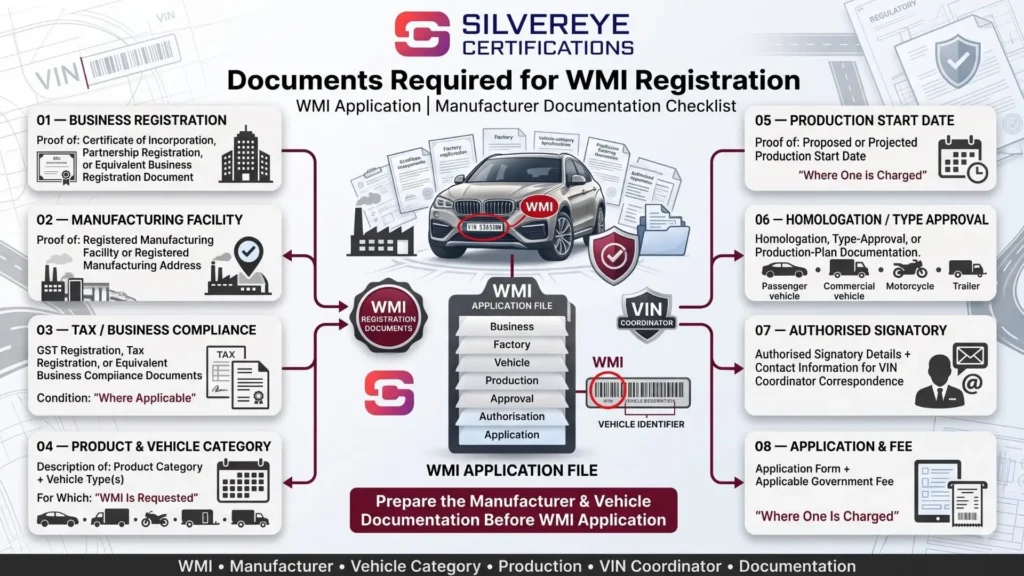
- Certificate of incorporation, partnership registration, or equivalent business registration document
- Proof of a registered manufacturing facility or address
- GST/tax registration or equivalent business compliance documents (where applicable)
- Description of the product category and vehicle type(s) for which the WMI is requested
- Proposed or projected production start date
- Homologation, type-approval, or production-plan documentation from a recognized testing/approval agency, where required by the national authority
- Authorized signatory details and contact information for the VIN Coordinator correspondence
- Application form and applicable government fee, where one is charged
WMI Registration Cost in 2026
The government-level cost of registering a WMI is low almost everywhere — the real cost variable for most manufacturers is professional/consulting support to prepare documentation correctly the first time, not the registration fee itself.
| Country / Authority | Approx. Government Fee | Notes |
| United States (SAE International) | No charge | 49 CFR 565.13(a) states manufacturer identifiers are supplied by SAE at no charge to U.S. manufacturers |
| India (BIS) | ~₹5,000 + applicable taxes | Fee can vary by product/vehicle category; consultant fees are separate and not fixed by BIS |
| Ireland (NSAI) | ~€265 + VAT | Applies to manufacturers requesting a WMI for national or EU type-approval purposes |
| Other countries | Varies | Contact the designated national standards or transport authority for current fees |
How Long Does WMI Registration Take?
Timelines depend heavily on how complete and accurate the initial application is. When SAE reviews a request directly (as in the U.S.), turnaround can be fast: one documented EV manufacturer applied for a WMI on July 8 and received its confirmed code, 1V9, on July 21 of the same year — just 13 days later. That said, incomplete applications, code conflicts, or routing through a national authority (as in India or Ireland) typically extend the timeline to several weeks.
| Route | Typical Timeline | What Speeds It Up |
| Direct SAE application (U.S.) | As fast as 2 weeks; commonly 2–6 weeks | A clean, complete first submission with no requested-identifier conflicts |
| National authority + SAE (e.g., BIS, NSAI) | Several weeks to a few months | Pre-verified documents, prompt response to authority queries, correct product-category classification |
| VIN-deciphering filing (U.S., post-WMI) | Must be filed at least 60 days before the first VIN is affixed | Preparing the Part 565 deciphering submission in parallel with the WMI request |
WMI Renewal, Validity, and Reporting Changes
A WMI is not a license that expires on a fixed schedule. Once assigned, it remains valid for as long as the manufacturer continues operating and producing that vehicle type — there is no annual renewal fee to pay simply to keep it active. However, "no renewal" does not mean "no obligations." Manufacturers are expected to keep their WMI record current and accurate with the assigning authority.
- Report ownership changes — A change in company name, parent company, or ownership structure must be reported to the assigning authority so manufacturer records stay accurate (real-world example: a trailer manufacturer formally notified NHTSA of a legal name change tied to its existing WMI rather than applying for a new one).
- Report discontinuation — If production under a WMI stops permanently, the authority should be informed.
- 10-year non-reissuance rule — Under SAE J1044, once a WMI is issued it will not be reassigned to a different manufacturer for at least 10 years following that manufacturer's last known production using that code.
- Multiple WMIs are allowed — A single manufacturer may hold more than one WMI, commonly used to separate brands, vehicle categories, or manufacturing divisions.
- Misuse can trigger cancellation — Falsely using a WMI, or using one that wasn't properly assigned, can lead to loss of the identifier and compliance action.
What's New for WMI Registration in 2026
A few practical shifts are worth flagging for manufacturers planning a 2026 application:
- Digital-first filing is now standard. NHTSA's vPIC Manufacturer Portal is the primary channel for Part 565/566 manufacturer identification and VIN-deciphering submissions, with the underlying vPIC dataset and documentation continuing to be refreshed through 2026 — manufacturers should file and track submissions through the current portal rather than mailed paper filings.
- EV and low-volume applications are rising. Growth in EV, micromobility, and specialty-vehicle manufacturing has meant more first-time WMI applicants entering the SAE and national-authority pipelines, which makes clean, complete documentation more important than ever for a fast turnaround.
- Fees and forms are administrative, not statutory — confirm before filing. Government-level fees (like BIS's or NSAI's) are set administratively and can be revised; always verify the current fee and document checklist directly with SAE International or your national authority before submitting payment.
- Regulatory scrutiny on low-volume and replica manufacturers continues. Programs built around the FAST Act's low-volume manufacturer provisions remain an active area of NHTSA rulemaking, so low-volume and replica-vehicle manufacturers should track Part 565/566/586 updates alongside their WMI application.
This guide reflects the WMI registration framework and figures confirmed as of 2026. Because government fees and portal procedures can change, always cross-check current requirements with SAE International, NHTSA, or your national standards authority before submitting a paid application.
Benefits of WMI Registration
- Legal right to issue VINs — Without a registered WMI, a manufacturer cannot legally title, register, or sell a new vehicle.
- Global recognition — A WMI listed in SAE's database is recognized by regulators, insurers, and title agencies worldwide.
- Brand protection — An exclusive WMI prevents another manufacturer from issuing conflicting VINs under your identity.
- Smoother recalls and warranty tracking — A unique WMI makes it far easier to trace a vehicle back to its production batch and manufacturer.
- Foundation for market expansion — Once your WMI is confirmed, it becomes far simpler to pursue import/export approval and multi-country type-approval down the line.
Common Mistakes That Delay WMI Registration
- Applying with an inaccurate production-volume estimate, which affects whether you should receive a 3- or 6-character WMI
- Submitting incomplete or mismatched business documents (names, addresses, or entity type not matching across documents)
- Requesting a specific identifier that conflicts with a code already reserved or issued in SAE's database
- Missing the 60-day advance filing requirement for VIN-deciphering information before the first VIN is affixed (U.S. manufacturers)
- Failing to report ownership changes, plant relocations, or discontinued production after the WMI is assigned
- Assuming a WMI "expires" and re-applying unnecessarily instead of simply updating the existing record
Get Expert Help With Your WMI Registration
WMI registration is a one-time, foundational step — but getting the production-volume classification, documentation, and authority routing right the first time is what determines whether it takes two weeks or two months. Silvereye Certifications works with OEMs, low-volume and specialty manufacturers, EV makers, and trailer and motorcycle producers to prepare and file WMI applications correctly the first time, coordinate with SAE International and national authorities such as BIS, and keep manufacturer records current after the code is issued.
If you're preparing to apply for a WMI code in 2026, Silvereye Certifications can review your production plan, assemble your documentation, and manage the application process end to end — so you can focus on building vehicles, not paperwork.
Frequently Asked Questions
What is a WMI code?
A WMI (World Manufacturer Identifier) is the first three characters of a 17-character VIN. It identifies the vehicle's manufacturer and country of production under ISO 3780 and SAE J1044.
Is WMI registration mandatory?
Yes. Under regulations like 49 CFR Part 565 in the U.S. and equivalent ISO-based rules elsewhere, a vehicle cannot legally be assigned a valid VIN — and therefore cannot be titled or sold — without a properly registered WMI.
How much does WMI registration cost?
In the U.S., SAE International supplies WMI codes to manufacturers at no government charge. Outside the U.S., government fees are typically modest — for example, roughly ₹5,000 plus taxes in India or around €265 plus VAT in Ireland — though professional preparation support may add to the total cost.
How long does it take to get a WMI code?
Turnaround varies. A direct SAE application with complete documentation has been confirmed in as little as 13 days in a documented case. Applications routed through a national authority, or with incomplete documents, commonly take several weeks to a few months.
Who assigns WMI codes?
SAE International is the global registration authority for WMI codes under ISO 3780. In the U.S., SAE is contracted directly by NHTSA. In many other countries, a national standards or transport body (such as India's BIS or Ireland's NSAI) verifies the manufacturer and coordinates the assignment with SAE.
Can a manufacturer have more than one WMI code?
Yes. A single company may hold multiple WMIs — commonly used to distinguish separate brands, vehicle categories, or manufacturing divisions.
What's the difference between a 3-character and 6-character WMI?
Manufacturers producing 900 or more vehicles annually receive a standard 3-character WMI. Manufacturers below that volume receive a 6-character WMI, where the third character is "9" and three more characters (VIN positions 12–14) complete the identifier.
Does a WMI code expire or need renewal?
No fixed-term renewal exists. A WMI stays valid as long as the manufacturer remains active. Manufacturers must, however, report material changes — ownership transfers, name changes, or discontinued production — to the assigning authority.
Do EV manufacturers need a separate WMI code?
EV manufacturers follow the exact same WMI registration process as any other vehicle manufacturer under ISO 3780 — there is no separate "EV track," though most new EV makers apply for a 6-character, low-volume WMI initially based on projected production.
Do trailer and motorcycle manufacturers need a WMI code?
Yes. Any company manufacturing trailers or motorcycles that will carry a public-road VIN must register its own WMI, following the same 3- or 6-character rules based on production volume.
What happens if I use a WMI that isn't properly registered?
Using an unassigned, conflicting, or misappropriated WMI can result in invalid VINs, blocked vehicle titling and registration, and compliance action from the relevant regulatory authority.
How do I check if a WMI code is already in use?
SAE International maintains the master WMI database. Before requesting a specific identifier, applicants can ask SAE (or their national coordinating authority) to confirm whether that code is already reserved or assigned to another manufacturer.