

- Who must register: Producers of base/lubrication oil, used oil importers, collection agents and recyclers must each register separately on CPCB's Used Oil EPR Portal.
- Current recycling target: For FY 2025-26, producers must recycle 10% of the base or lubrication oil they sold or imported in FY 2023-24, rising every year toward 50% by FY 2030-31.
- Registration fee range: From ₹500 for a small collection agent up to ₹10,00,000 for a large producer, based on annual oil volume — plus a yearly processing charge.
- Rule in force since: 1 April 2024, under Chapter VII of the Hazardous and Other Wastes (Management and Transboundary Movement) Second Amendment Rules, 2023.
Introduction
EPR Registration for Used Oil is the mandatory CPCB approval that producers of base oil and lubrication oil, used oil importers, collection agents, and recyclers must obtain under Chapter VII of the Hazardous and Other Wastes (Management and Transboundary Movement) Second Amendment Rules, 2023, effective 1 April 2024.

It requires registering on CPCB's dedicated Used Oil EPR Portal, meeting yearly used-oil recycling targets — 5% in FY 2024-25, rising to 50% by FY 2030-31 — and buying EPR Certificates from CPCB-registered recyclers to prove compliance. Registration fees range from ₹500 to ₹10,00,000 depending on entity type and volume, and operating without registration is prohibited under the Rules.
What Is EPR Registration for Used Oil?
Extended Producer Responsibility (EPR) for used oil places the environmental burden of spent lubricants back on the companies that put base oil and lubrication oil into the Indian market. In simple terms, if you manufacture, import, or brand engine oil, gear oil, hydraulic oil, transformer oil or similar products, the government now holds you responsible for ensuring an equivalent share of that oil is collected back and safely re-refined or recovered once it's used.
Used oil that isn't properly recycled is a genuine environmental hazard — it commonly ends up dumped into drains, burned as cheap fuel, or mixed into other products, releasing heavy metals and toxic compounds. To formalise this into a traceable, accountable system, the Ministry of Environment, Forest and Climate Change (MoEFCC) introduced a dedicated EPR chapter for used oil, built on the same certificate-based model that already works for waste tyres and e-waste.
Legal Framework Governing Used Oil EPR
- Rule: Hazardous and Other Wastes (Management and Transboundary Movement) Second Amendment Rules, 2023
- Notification number: G.S.R. 677(E), dated 18 September 2023
- Governing chapter: Chapter VII — "Extended Producer Responsibility for Used Oil" — inserted into the Hazardous and Other Wastes (Management and Transboundary Movement) Rules, 2016
- Effective date: 1 April 2024
- Regulator: Central Pollution Control Board (CPCB), under MoEFCC
Under these Rules, "used oil" specifically means oil derived from crude or synthetic sources — spent engine oil, gear oil, hydraulic oil, turbine oil, compressor oil, industrial gear oil, heat transfer oil, transformer oil, and their tank-bottom sludge — that still meets the reprocessing specification in Part A of Schedule V of the Hazardous and Other Wastes Rules, 2016. It's worth noting used oil is legally distinct from "waste oil," which is too contaminated to recycle and falls outside this EPR framework.
Who Needs EPR Registration for Used Oil?
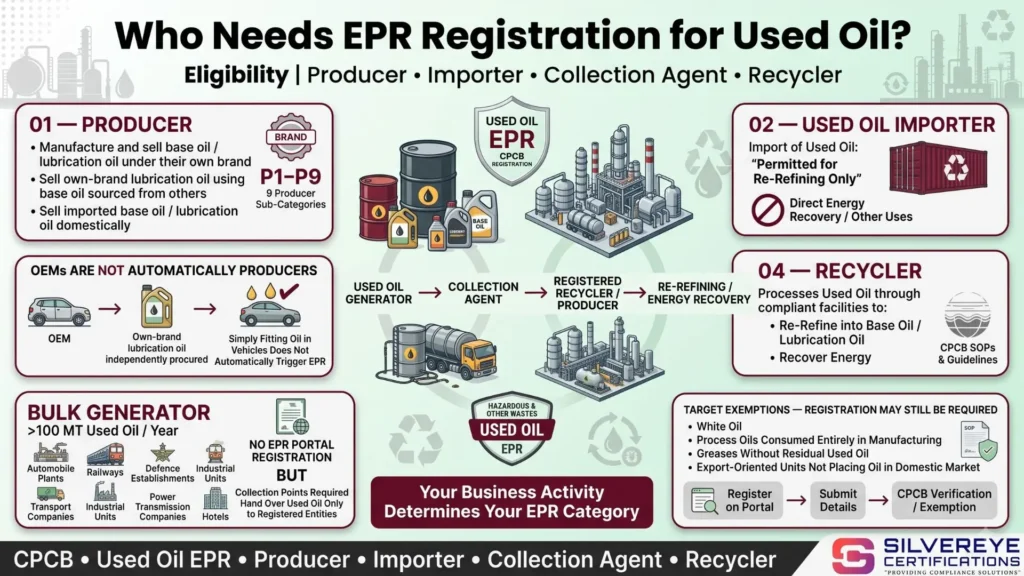
Four categories of stakeholders must register separately on the CPCB Used Oil EPR Portal. An entity that plays more than one role — say, a company that both produces lubrication oil and imports used oil — must register each activity individually, unless the activities share the same GST number, in which case a single sign-up can cover multiple linked profiles.
1. Producer
A Producer is any person or entity — regardless of whether they sell directly, through a dealer, retailer, or e-retailer — who:
- Manufactures and sells base oil or lubrication oil domestically under its own brand
- Sells lubrication oil domestically under its own brand, using base oil made by other manufacturers or suppliers
- Sells imported base oil or lubrication oil domestically
CPCB further classifies producers into nine sub-categories on the portal (P1–P9) based on the exact business model — from straightforward base oil manufacturing to brand owners who source re-refined base oil and sell finished lubrication oil under their own label.
2. Used Oil Importer
Any entity importing used oil into India, permitted strictly for the purpose of re-refining. Importing used oil for direct energy recovery or any other use is not allowed.
3. Collection Agent
Entities that collect used oil from generators and supply it onward to a registered recycler or producer, and upload that movement data on the portal.
4. Recycler
Entities that re-refine used oil into base oil or lubrication oil, or recover energy from it, using facilities that meet CPCB's specified SOPs and guidelines.
Do OEMs Count as Producers?
Not automatically. A car or equipment OEM only becomes a "Producer" under this framework if it independently procures base oil or lubrication oil (domestically or via import) and sells that lubrication oil under its own brand. Simply fitting a vehicle with oil at the factory doesn't, by itself, trigger EPR obligation.
Bulk Generators — A Related but Separate Category
A bulk generator is any entity generating more than 100 metric tonnes of used oil per year — automobile plants, railways, defence establishments, transport companies, industrial units, power transmission companies, hotels, and similar large operations. Bulk generators aren't required to register on the EPR portal themselves, but they must set up collection points and hand over their used oil only to registered recyclers, producers, or collection agents.
Exemptions — With a Catch
Certain oils — white oil, process oils consumed entirely within a manufacturing process, and greases that don't generate residual used oil — may be exempt from the recycling target itself. However, the producer of such oil is still required to register on the portal and submit details so CPCB can verify and formally grant the exemption. Export-oriented units that never place oil in the Indian domestic market are similarly exempt from targets but still need to register.
Latest CPCB Notifications & Updates on Used Oil EPR (2025–2026)
The Used Oil EPR Portal is still being rolled out in phases, so the notification calendar has moved quickly. Here's what's changed most recently:
| Date | Notification / Update |
| 18.09.2023 | Second Amendment Rules, 2023 notified (G.S.R. 677(E)) — Chapter VII introduces EPR for used oil |
| 01.04.2024 | EPR for used oil comes into force nationwide |
| 24.06.2024 | CPCB launches the Used Oil EPR Portal — Sign-up and Producer Registration modules go live |
| 02.07.2024 | CPCB circular directs all base oil/lubrication oil manufacturers and importers to register as "Producer" by 31.07.2024 |
| 2025 | Used Oil Importer's Registration module goes live on the portal |
| 2025 | Annual Return filing timeline for FY 2024-25 extended to 30 September 2025 |
| 25.02.2026 | CPCB issues the official Guidance Document for Submission of Annual Return by Registered Producers on the Used Oil EPR Portal |
Registration for Recyclers and Collection Agents was still being phased in as the portal matured, so it's worth checking the live CPCB Used Oil EPR Portal, or confirming current module availability with a compliance consultant such as Silvereye Certifications, before assuming every registration type is open for immediate self-filing.
Benefits of EPR Registration for Used Oil
- Legal continuity: Since transacting with unregistered entities is prohibited under the Rules, registration is what allows a producer, importer, collection agent or recycler to actually trade in the formal used oil ecosystem.
- Avoids Environmental Compensation: Registered, compliant entities stay outside the reach of CPCB's Environmental Compensation charges for non-fulfilment or false certificates.
- Access to genuine trading partners: Producers can only meet their obligation by purchasing EPR Certificates from registered recyclers — so registration is the gateway to the entire certificate market.
- Cleaner, traceable recycling: Every EPR Certificate is tied to verified re-refining or energy recovery, pushing used oil away from illegal dumping and unsafe blending.
- Supports India's circular economy goals: Producers who additionally choose to buy back re-refined base oil (beyond just certificates) directly support domestic re-refining capacity.
- Stronger compliance record: A documented EPR trail increasingly matters for tenders, marketplace approvals, and ESG/EHS audits.
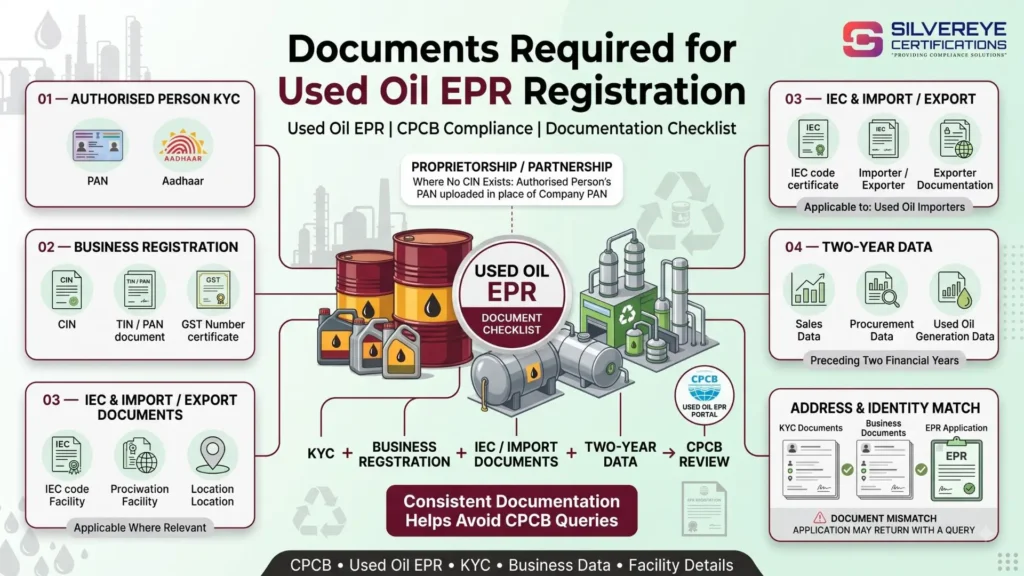
Documents Required for Used Oil EPR Registration
- KYC of the authorised person (PAN, Aadhaar)
- Business registration proof — CIN, TIN/PAN, and GST number of the company
- IEC (Importer Exporter Code) and import/export documentation — required for used oil importers
- Sales, procurement and used oil generation data for the preceding two financial years
- Details of the recycling or collection facility, where applicable (capacity, technology, location)
For a proprietorship or partnership without a CIN, CPCB requires the PAN of the authorised person to be uploaded in place of a company PAN. As with other CPCB EPR portals, address and identity details across all uploaded documents should match exactly — mismatches are the most common reason applications come back with a query.
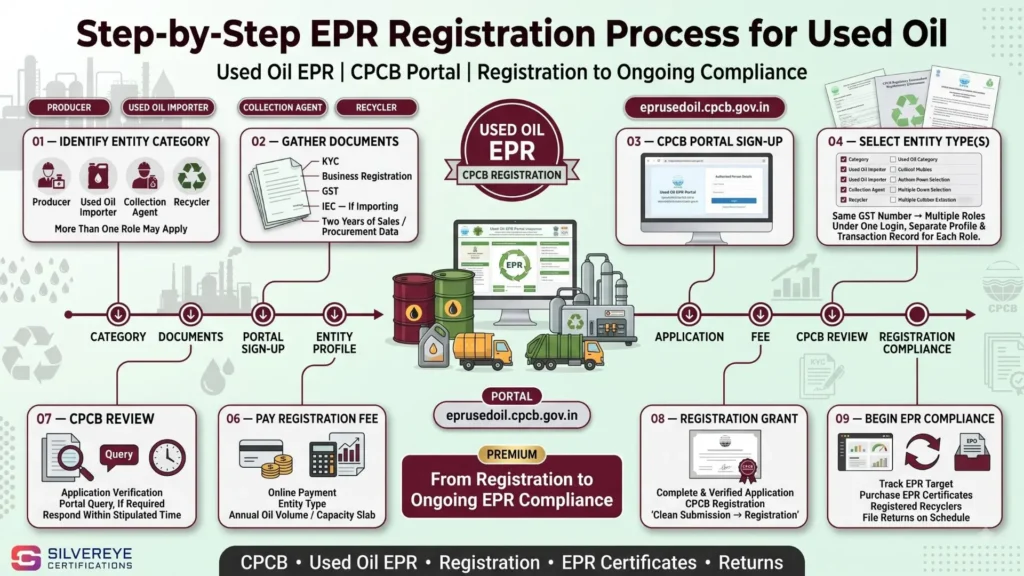
Step-by-Step EPR Registration Process for Used Oil
- Identify which category applies to your business — Producer, Used Oil Importer, Collection Agent, or Recycler (a business can hold more than one role).
- Gather the required KYC, business registration, GST, IEC (if importing), and two years of sales/procurement data.
- Visit the official CPCB Used Oil EPR Portal at eprusedoil.cpcb.gov.in and sign up with the authorised person's details.
- Select the applicable entity type(s) at sign-up — entities sharing the same GST number can register multiple roles under one login, though each role keeps its own separate profile and transaction record.
- Complete the online registration form for each applicable category and upload the supporting documents.
- Pay the applicable registration fee online, based on your entity type and annual oil volume/capacity slab.
- CPCB reviews the application. If information is missing or incorrect, a query is raised through the portal — respond within the stipulated time to avoid a possible late fee.
- Once the application is complete and verified, CPCB grants registration — producers can generally expect this within a few weeks of a clean submission.
- Begin compliance: track your EPR target on the portal dashboard, purchase EPR Certificates from registered recyclers, and file your returns on schedule.
One portal-specific nuance worth knowing: your EPR target may initially be calculated on the total oil you've placed in the market, but it can be adjusted afterward if other registered producers confirm, on the portal, that they received material from you to place under their own brand — so the numbers can shift as counterparties confirm transactions.
Used Oil EPR Recycling Targets (Obligation Schedule)
A producer's EPR target is a rising percentage of the base oil or lubrication oil they sold or imported two financial years earlier. Here's the full glide path as notified under Rule 27(2):
| Financial Year | Recycling Target for Producers |
| 2024-25 | 5% of base/lubrication oil sold or imported in 2022-23 |
| 2025-26 | 10% of base/lubrication oil sold or imported in 2023-24 |
| 2026-27 | 20% of base/lubrication oil sold or imported in 2024-25 |
| 2027-28 | 20% of base/lubrication oil sold or imported in 2025-26 |
| 2028-29 | 40% of base/lubrication oil sold or imported in 2026-27 |
| 2029-30 | 40% of base/lubrication oil sold or imported in 2027-28 |
| 2030-31 onward (Year Y) | 50% of base/lubrication oil sold or imported in year (Y-2) |
| New units (est. after 01.04.2024) | Obligation starts 2 years after the unit's establishment, per the schedule above |
| Used oil importers | 100% of the used oil imported in the previous year (Y-1) |
A producer cannot meet this target simply by collecting used oil and physically handing it to a recycler — that act alone doesn't count. The obligation is fulfilled only by purchasing EPR Certificates from a registered recycler through the portal, even if the producer and recycler have their own separate collection arrangement.
How EPR Certificates for Used Oil Are Calculated
EPR Certificate (QEPR) = Quantity of End Product (QP) × Conversion Factor (CF) × Weightage (WP)
| End Product / Process | Weightage (WP) |
| Producing re-refined base oil or lubrication oil | 1.0 |
| Co-processing / utilisation / energy recovery for used oil unsuitable for recycling (subject to CPCB's maximum permissible percentage) | 0.25 |
The Conversion Factor (CF) is fixed separately by CPCB based on the recycling technology used and the quality of re-refined base oil produced — oils that meet BIS quality standards are given more favourable weightage. There's also a cap on how much a producer can buy at once: a producer's certificate purchase is limited to its current-year liability, plus any unpaid liability carried over from earlier years, plus 10% of the current year's liability.
CPCB also regulates certificate pricing directly — the highest and lowest exchange price for EPR Certificates is fixed at 100% and 30% respectively of the notified Environmental Compensation rate for used oil, so prices can't be arbitrarily inflated or dumped. Certificates themselves are not tradable between two producers or between two used oil importers; they only move from a registered recycler to a registered producer or importer.
EPR Registration Fees for Used Oil (2026)
Producers (based on annual base/lubrication oil sales)
| Sale of Base Oil/Lubrication Oil (MTPA) | Registration Fee (INR) |
| Above 1,00,000 MT | ₹10,00,000 |
| Above 50,000 – 1,00,000 MT | ₹5,00,000 |
| Above 10,000 – 50,000 MT | ₹2,00,000 |
| 5,000 – 10,000 MT | ₹50,000 |
| Below 5,000 MT | ₹25,000 |
Used Oil Importers (based on annual import quantity)
| Quantity of Used Oil Imported (MTPA) | Registration Fee (INR) |
| Above 1,00,000 MT | ₹10,00,000 |
| Above 50,000 – 1,00,000 MT | ₹5,00,000 |
| Above 10,000 – 50,000 MT | ₹2,00,000 |
| Above 1,000 – 10,000 MT | ₹1,00,000 |
| 500 – 1,000 MT | ₹50,000 |
| Below 500 MT | ₹25,000 |
Recyclers (based on recycling facility capacity)
| Capacity of Recycling Facility (MTPA) | Registration Fee (INR) |
| Above 20,000 MT | ₹75,000 |
| Above 10,000 – 20,000 MT | ₹50,000 |
| 5,000 – 10,000 MT | ₹35,000 |
| Below 5,000 MT | ₹25,000 |
Collection Agents (based on collection facility capacity)
| Capacity of Collection Facility (MTPA) | Registration Fee (INR) |
| Above 10,000 MT | ₹10,000 |
| Above 5,000 – 10,000 MT | ₹5,000 |
| Above 2,000 – 5,000 MT | ₹2,000 |
| 500 – 2,000 MT | ₹1,000 |
| Below 500 MT | ₹500 |
On top of the one-time registration fee, CPCB charges an annual processing fee equal to 25% of the applicable registration fee in each category. If an application is returned for missing information and the applicant delays re-submission beyond the stipulated period, a late fee may also apply — CPCB has indicated the exact late-fee structure will be notified separately.
Validity, Renewal & Compliance Timeline
- EPR Certificate validity: Two years from the end of the financial year in which the certificate was generated — expired certificates are automatically archived or deleted from the portal.
- Annual returns: Producers and used oil importers must file annual returns on the portal on or before 30 June following the relevant financial year.
- Quarterly + annual returns: Collection agents and recyclers must file both quarterly and annual returns in the prescribed portal format.
- Producer awareness duty: Producers must publish contact details (address, email, toll-free/helpline number) to consumers and run awareness activities through media, publications or advertisements.
Because the portal was rolled out module-by-module — Producer registration first, Used Oil Importer registration added later, with Recycler and Collection Agent modules following — it's genuinely worth double-checking which modules are currently live and what your specific renewal cycle looks like before assuming last year's process still applies.
What Happens If You Don't Register or Comply?
CPCB can levy Environmental Compensation (EC) on producers and used oil importers who fail to meet their obligations, or who transact using false EPR Certificates, and on recyclers who issue false certificates or submit false invoices. Unregistered producers, recyclers, and any entity that knowingly aids or abets a violation of these Rules also fall within EC's reach.
Beyond the financial penalty, non-compliance risks registration cancellation and further enforcement action under the Environment (Protection) Act, 1986 — and for importers specifically, using imported used oil for anything other than re-refining can lead directly to cancellation of the import registration.
How Silvereye Certifications Can Help
The Used Oil EPR Portal has more moving parts than most other CPCB EPR systems — nine producer sub-categories, four separate stakeholder types, volume-based fee slabs, and a phased rollout where not every registration module has been available at the same time. That combination makes it easy for a first-time applicant to pick the wrong category or submit a mismatched document set.
Silvereye Certifications is a regulatory compliance consultancy supporting manufacturers, importers and brand owners across BIS, CDSCO, WPC-ETA, TEC-MTCTE, and EPR authorisations — including used oil, waste tyre, e-waste, plastic waste, and battery waste. For used oil EPR specifically, Silvereye Certifications typically helps with:
- Identifying the correct producer sub-category (P1–P9) or confirming whether your business needs to register as Importer, Collection Agent, or Recycler as well
- Compiling KYC, GST, IEC and two years of sales/procurement data in the format CPCB expects
- Calculating your likely EPR target and the applicable registration fee slab before you file
- Guiding you through the portal's sign-up, multi-entity registration, and EPR Certificate purchase workflow
- Tracking annual/quarterly return deadlines and new module go-live notices so nothing is missed
If you're registering as a producer for the first time, adding an importer or recycler profile, or simply trying to work out your correct recycling target, a consultant like Silvereye Certifications can help you get it right on the first submission.
Conclusion
EPR registration for used oil is still a relatively young compliance regime compared to plastic or e-waste EPR, and CPCB has been rolling out portal modules and guidance documents in stages right through early 2026. That means the fastest way to get registered without back-and-forth queries is to work from the current, official rules rather than a generic checklist — get your producer sub-category right, keep two years of accurate sales data ready, and file your returns on schedule from day one. If you'd rather have someone track the moving parts for you, a consultancy such as Silvereye Certifications can guide the entire process, from first registration through to annual return filing.
Frequently Asked Questions
Is EPR registration mandatory for all used oil businesses in India?
Yes. Under Chapter VII of the Hazardous and Other Wastes (Management and Transboundary Movement) Second Amendment Rules, 2023, every producer of base/lubrication oil, used oil importer, collection agent and recycler must register on CPCB's Used Oil EPR Portal. Operating without registration, or transacting with an unregistered entity, is prohibited.
When did EPR for used oil become applicable in India?
The Rules were notified on 18 September 2023 and came into force from 1 April 2024. The Used Oil EPR Portal itself went live for sign-up and Producer registration on 24 June 2024.
What is the registration fee for used oil EPR?
It varies by entity type and volume: producers pay between ₹25,000 and ₹10,00,000 based on annual sales, importers ₹25,000 to ₹10,00,000 based on import quantity, recyclers ₹25,000 to ₹75,000 based on facility capacity, and collection agents ₹500 to ₹10,000. An annual processing charge of 25% of the registration fee also applies.
What is the current used oil recycling target for producers?
For FY 2025-26, producers must recycle 10% of the base or lubrication oil they sold or imported in FY 2023-24. This target rises progressively to 50% of the corresponding year's sales by FY 2030-31.
Can a producer meet its EPR target just by collecting used oil and giving it to a recycler?
No. Simply handing collected used oil to a recycler does not, by itself, count toward the target. A producer fulfils its obligation only by purchasing EPR Certificates from a registered recycler through the CPCB portal.
What is the validity of an EPR Certificate for used oil?
An EPR Certificate is valid for two years from the end of the financial year in which it was generated. Once it expires, it's automatically archived or deleted from the portal.
Do original equipment manufacturers (OEMs) need used oil EPR registration?
Only if the OEM itself procures base oil or lubrication oil (domestically or via import) and sells that lubrication oil under its own brand. Simply fitting oil into a new vehicle or machine at the factory doesn't, on its own, make an OEM a "Producer" under these Rules.
Are white oil and grease producers exempt from EPR targets?
Certain oils like white oil, in-process oils, and greases that don't generate residual used oil may be exempt from the recycling target itself — but the producer must still register on the portal and get the exemption formally verified by CPCB.
Can used oil be imported into India for any purpose?
No. The import of used oil is permitted strictly for re-refining. Using imported used oil for energy recovery or any other purpose can lead to cancellation of the importer's registration and further enforcement action.
What returns does a registered entity need to file?
Producers and used oil importers file annual returns by 30 June following the relevant financial year. Collection agents and recyclers file both quarterly and annual returns in the prescribed portal format.
Can EPR Certificates be traded directly between two producers?
No. EPR Certificates for used oil are not tradable between registered producers or between used oil importers — they can only be purchased from a registered recycler
What happens if a business doesn't fulfil its EPR obligation?
CPCB can levy Environmental Compensation on producers and importers for non-fulfilment or use of false certificates, and on recyclers for issuing false certificates. Registration can also be cancelled, alongside further action under the Environment (Protection) Act, 1986.