- A screenless fitness band still counts as a wireless device — its built-in Bluetooth module makes WPC ETA mandatory, regardless of the absence of a screen, Wi-Fi, or a SIM.
- Most fitness bands qualify for the faster self-declaration route via the Saral Sanchar portal, at a flat government fee of ₹10,000 per model.
- A valid RF test report from a NABL or TEC-accredited lab covering the Bluetooth module is the core document every application depends on.
- Once issued, WPC ETA has lifetime validity — a fresh application is only needed if the Bluetooth chipset, frequency, or model changes.
Introduction
WPC ETA (Equipment Type Approval) is the mandatory approval from the Wireless Planning & Coordination (WPC) Wing, Department of Telecommunications (DoT), required before any screenless fitness band is imported, manufactured, or sold in India. Since almost every fitness band syncs data to a phone using Bluetooth (BLE) on the de-licensed 2.4 GHz band, it qualifies for the faster self-declaration route on the Saral Sanchar portal.
The application needs an RF test report, technical documents, and a government fee of ₹10,000 per model. Approval typically takes 2–6 weeks, and once granted, WPC ETA is valid for the product's lifetime, with no periodic renewal needed unless the wireless module or specifications change.
What Is WPC ETA Approval for Fitness Bands?
WPC ETA, short for Wireless Planning & Coordination – Equipment Type Approval, is the regulatory clearance issued by the WPC Wing under India's Department of Telecommunications (DoT), Ministry of Communications, the national radio spectrum regulator established in 1952. Any product that transmits or receives radio frequency signals — including a screenless fitness band with a Bluetooth chip — needs a valid ETA before it can be imported, manufactured, or sold in India.
A screenless fitness band may look like a simple accessory, but from a regulatory standpoint it is treated the same as any other Bluetooth-enabled wireless product. The band's Bluetooth Low Energy (BLE) radio, which syncs step count, heart rate, and sleep data to a companion phone app, operates on the 2.4 GHz de-licensed band — the same band WPC regulates for Wi-Fi routers, wireless earbuds, and smartwatches. ETA confirms the device stays within permitted frequency and power limits and will not interfere with licensed communication networks used by defense, aviation, or emergency services.
Why WPC ETA Matters for Fitness Band Importers and Manufacturers
For importers, fitness bands are a high-volume, low-unit-cost product category, which makes customs scrutiny at ports especially important — a single non-compliant shipment can hold up thousands of units at once. Fitness bands are frequently sourced from contract manufacturers overseas, so importers should never assume that a factory's own compliance paperwork covers India; WPC ETA has to be obtained separately by the Indian importer or its Authorized Indian Representative.
For domestic manufacturers and D2C wearable brands assembling or private-labelling fitness bands in India, ETA is mandatory for every finished model before launch. CE marking (Europe) or FCC certification (USA) does not substitute for WPC ETA, since India maintains its own frequency allocation plan; a Bluetooth chipset legal abroad still requires India-specific ETA verification.
Which Fitness Band and Wearable Types Fall Under WPC ETA?
WPC ETA applies to virtually every fitness-tracking wearable that includes a radio module, whether or not it has a display. The table below summarises common variants.
| Device Type | Typical Wireless Module | WPC ETA Route |
| Screenless fitness band (basic step/sleep tracker) | Bluetooth Low Energy (BLE), 2.4 GHz | Self-declaration |
| Screenless fitness band with heart-rate/SpO2 sensor | Bluetooth Low Energy (BLE), 2.4 GHz | Self-declaration |
| Fitness band with display (smart band) | Bluetooth Low Energy (BLE), 2.4 GHz | Self-declaration |
| Fitness band with GPS receiver (location tracking) | BLE + GPS receive-only module | Self-declaration (GPS reception is generally not separately licensed; confirm module specifics with the testing lab) |
| Fitness band with NFC (contactless payment) | BLE + NFC, 13.56 MHz | Self-declaration |
| Smart ring fitness trackers | Bluetooth Low Energy (BLE), 2.4 GHz | Self-declaration |
| Fitness band with Wi-Fi sync (rare, premium models) | BLE + Wi-Fi, 2.4/5 GHz | Self-declaration |
| Fitness band with cellular/eSIM connectivity | BLE + licensed cellular band | Self-declaration for BLE; cellular module may need additional TEC/DoT approval |
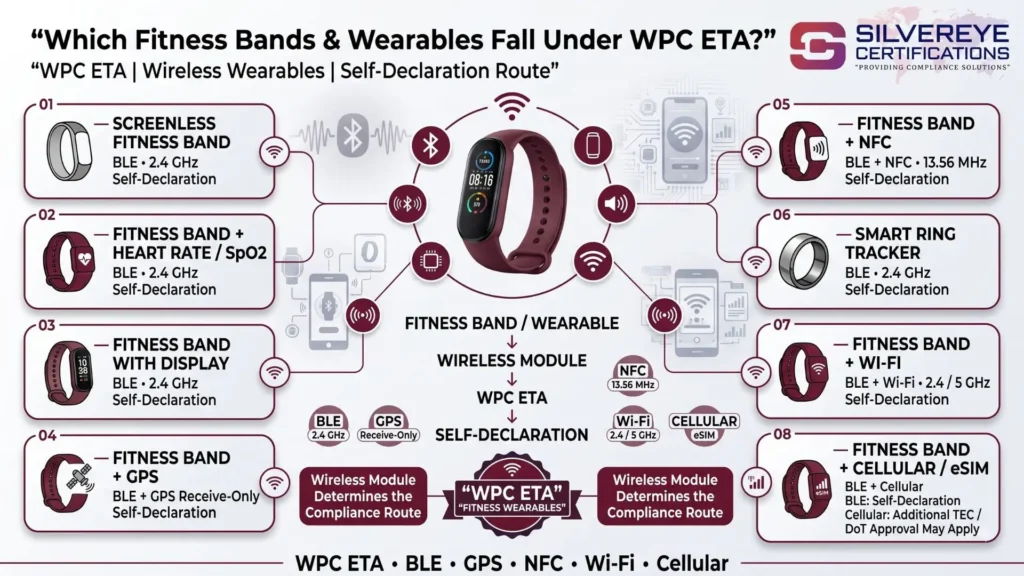
Note: A fitness band that combines more than one wireless technology — for example, BLE plus NFC, or BLE plus GPS — needs an RF test report and ETA that covers every transmitting module in the product, not only the primary Bluetooth radio.
Eligibility for the WPC ETA Self-Declaration Route
Since DoT's self-declaration orders, most fitness bands qualify for the faster route on Saral Sanchar, provided the product meets both conditions below:
- The device is exempt from import licensing requirements under the DGFT Import Policy.
- It operates entirely within India's de-licensed frequency bands (2.4 GHz for Bluetooth/BLE, and 5 GHz where Wi-Fi sync is present).
Fitness bands with only BLE, or BLE combined with NFC or a receive-only GPS chip, comfortably fall within this eligible category, which is why almost the entire fitness-band market uses self-declaration rather than the longer Regional Licensing Office (RLO) route.
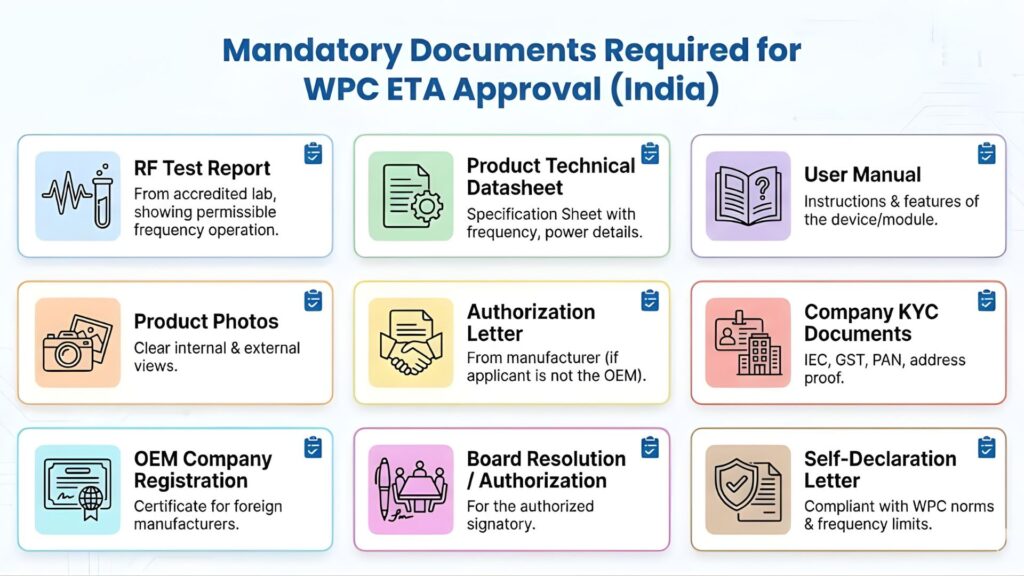
Documents Required for WPC ETA Approval (Fitness Bands)
| Document | Purpose |
| RF Test Report | From a NABL or TEC-accredited Indian laboratory, covering the Bluetooth module and any additional radio (Wi-Fi, NFC) in the band. |
| Authorisation Letter | From the manufacturer or head of the manufacturing unit, authorising the applicant/AIR to file the application. |
| Technical Literature / Datasheet | Bluetooth version, frequency band, transmit power, and antenna specifications. |
| Product Photographs | Clear images of the fitness band, its packaging, and model/serial number. |
| User Manual | Manual describing the device's intended use, pairing process, and wireless functions. |
| Self-Declaration Form | Signed declaration confirming the product meets de-licensed band conditions, filed per model. |
| Company/Import Documents | IEC (Importer-Exporter Code), GST registration, and company PAN, as applicable. |
| Bharatkosh Payment Receipt | Proof of the ₹10,000 government fee payment, uploaded separately on the portal. |
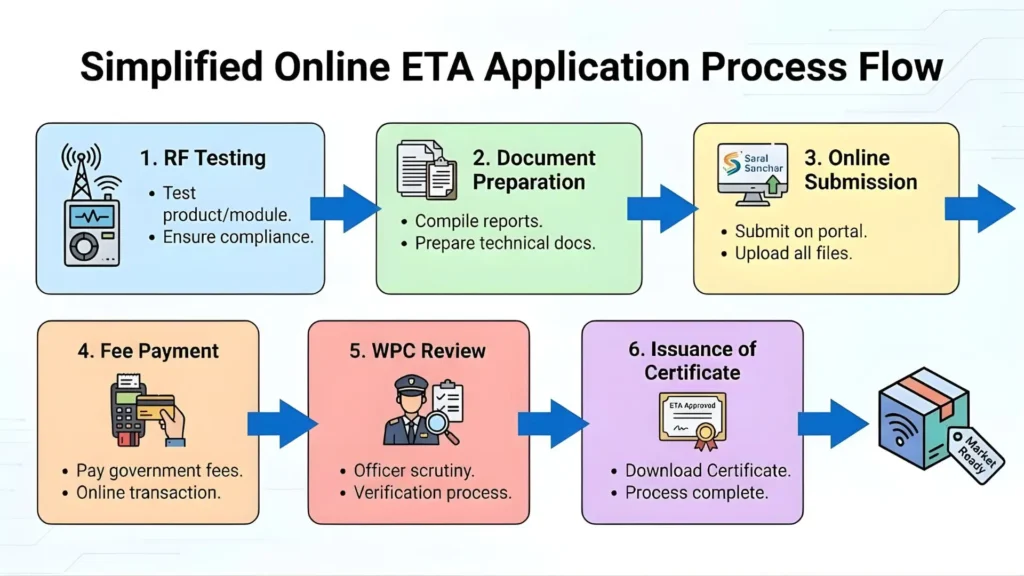
Step-by-Step WPC ETA Application Process for Fitness Bands
- Identify every wireless technology built into the fitness band — BLE is standard, but check for added NFC, GPS, or Wi-Fi sync, since each affects the RF testing scope.
- Get RF testing done at a NABL or TEC-accredited Indian laboratory covering the Bluetooth module and any other radio present.
- Register on the Saral Sanchar portal, the DoT's official platform for WPC ETA filings.
- Upload the RF test report, authorization letter, technical literature, and self-declaration form in PDF format.
- Pay the government fee of ₹10,000 per model through the Bharatkosh (NTRP) portal and upload the receipt on Saral Sanchar.
- Submit the application; the portal generates an Import ID/application reference for tracking.
- Respond promptly to any WPC queries — mismatched model names across marketing material, packaging, and the RF report are a common cause of delay for fitness bands sold under multiple SKU names.
- Download the ETA certificate from the Saral Sanchar portal once WPC completes verification.
WPC ETA Approval Fees for Fitness Bands
| Fee Component | Amount | Paid To |
| Government ETA fee (per model) | ₹10,000 | Bharatkosh (NTRP) portal, DoT |
| RF/EMC laboratory testing fee | Varies by lab and number of wireless modules tested | NABL/TEC-accredited testing laboratory |
| Consultant/professional fee (optional) | Varies by service provider and product complexity | WPC compliance consultant, if engaged |
The ₹10,000 government fee is charged per model, not per unit or per shipment — so a brand launching a fitness band in three colour-and-strap variants that share identical RF hardware may often file these under a single model reference, but any variant with a different chipset or frequency behaviour needs its own filing. Laboratory and consultant fees are not government-fixed and vary by provider, so always confirm current quotes directly.
WPC ETA Approval Timeline For Fitness Band
| Scenario | Typical Timeline |
| Self-declaration route, complete documents | A few days to about 2 weeks |
| Standard/typical case with minor queries | 4 to 6 weeks |
| Complex cases (multi-module devices, foreign AIR setup, documentation issues) | Up to 8 weeks |
Because fitness bands are often launched around festive sales calendars or crowdfunding timelines, importers should file for WPC ETA as soon as the final hardware revision (chipset and antenna) is locked — not after inventory has already been produced or shipped.
WPC ETA Approval Validity and Renewal For Fitness Band
A WPC ETA certificate for a fitness band carries lifetime validity once issued — there is no periodic renewal requirement. However, a fresh ETA becomes necessary if any of the following change after approval:
- The Bluetooth chipset or wireless module used in the band
- The frequency band or transmit output power
- Addition of a new wireless feature (for example, adding NFC or Wi-Fi sync to a BLE-only model)
- The product's model number or brand name
Cosmetic changes such as a new strap colour or casing design, with no change to the internal RF hardware, generally do not require a fresh ETA filing.
WPC ETA vs BIS CRS: What's the Difference for Fitness Bands?
Fitness bands sold in India usually need both approvals, since each covers a different risk.
| Parameter | WPC ETA | BIS CRS |
| Regulator | WPC Wing, Department of Telecommunications | Bureau of Indian Standards (BIS) (Not Required For Screenless Fitness Band) |
| What it checks | Radio frequency compliance and spectrum interference | Electrical, battery, and safety standards |
| Portal | Saral Sanchar | BIS CRS portal |
| Applies to fitness bands? | Yes, mandatory for the Bluetooth/wireless module | Yes, typically mandatory given the lithium battery and charging circuitry |
| Can one replace the other? | No — both are independent requirements | No — both are independent requirements |
Special Requirements for Foreign Fitness Band Manufacturers
WPC ETA certificates are issued only to Indian entities. A foreign fitness-band brand or contract manufacturer cannot hold the certificate directly and must appoint an Authorized Indian Representative (AIR) — an Indian company or individual who files the application, holds the ETA, and serves as WPC's point of contact for that product.
Brands sourcing white-label fitness bands from overseas factories should confirm the AIR arrangement is in place before finalising the first purchase order, since this is one of the most common gaps that delays a launch.
Penalties for Selling Fitness Bands Without WPC ETA
Importing, manufacturing, or selling a fitness band without a valid WPC ETA is a violation under the Indian Wireless Telegraphy Act, 1933, and related DoT regulations. Consequences can include:
- Detention or seizure of goods at the port of entry
- Financial penalties and fines
- Legal proceedings under applicable telecom and wireless laws
- Extended demurrage costs while compliance is retroactively arranged
- Delisting risk on e-commerce marketplaces, which increasingly ask sellers for ETA proof before approving wireless wearable listings
Common Mistakes That Delay WPC ETA Approval for Fitness Bands
- Submitting an RF test report from a lab that isn't NABL/TEC-accredited in India
- Testing only the Bluetooth module and overlooking a secondary radio like NFC or Wi-Fi sync present in the same device
- Model name mismatches between the retail packaging, app listing, and the Saral Sanchar application
- Delaying the Authorised Indian Representative (AIR) appointment for overseas or white-label brands
- Applying for ETA only after production and shipping are already underway
Conclusion
For any importer, D2C brand, or manufacturer bringing screenless fitness bands into the Indian market, WPC ETA approval is a foundational compliance step, not an afterthought once inventory has already landed. Getting the RF test report right — covering the Bluetooth module and any secondary radio like NFC or GPS — filing accurate documentation on the Saral Sanchar portal, and paying the ₹10,000 government fee per model are what stand between a smooth customs clearance and a shipment stuck in a bonded warehouse.
Because the certificate carries lifetime validity once granted, resolving this early protects a fitness band business through every future production run, as long as the RF hardware stays unchanged.
Frequently Asked Questions
Does a screenless fitness band really need WPC ETA if it has no Wi-Fi or SIM?
Yes. Any radio-frequency transmitter, including a basic Bluetooth Low Energy (BLE) chip used to sync step and sleep data, makes WPC ETA mandatory — the absence of a screen, Wi-Fi, or SIM does not exempt the device.
How much does WPC ETA approval cost for a fitness band?
The government fee is ₹10,000 per model, paid through the Bharatkosh portal. RF laboratory testing and, if used, consultant fees are additional and vary by provider.
How long does WPC ETA approval take for a fitness band?
With complete documentation, the self-declaration route can be granted within a few days to about two weeks. Standard cases typically take 4 to 6 weeks, and multi-module devices can take up to 8 weeks.
Where do I apply for WPC ETA for a fitness band?
Applications are filed online through the Saral Sanchar portal (saralsanchar.gov.in), the Department of Telecommunications' official system for WPC ETA.
Does WPC ETA expire for fitness bands?
No. Once granted, WPC ETA is valid for the lifetime of the product. A fresh application is only needed if the Bluetooth chipset, frequency band, or model/brand name changes.
Can a foreign fitness band brand apply for WPC ETA directly?
No. WPC ETA is issued only to Indian entities. A foreign brand or manufacturer must appoint an Authorised Indian Representative (AIR) to file and hold the certificate.
Does a fitness band with a GPS chip need extra approval beyond the BLE module?
GPS reception used for location tracking is generally receive-only and is not separately licensed the way transmitting radios are, but the RF test report should still document the GPS module alongside the BLE radio so WPC has a complete technical picture of the device.
Is CE or FCC certification enough to sell a fitness band in India?
No. CE and FCC approvals apply to Europe and the USA respectively. India runs its own frequency allocation framework, so a fitness band needs WPC ETA regardless of any international certification it already holds.
Do I need BIS CRS as well as WPC ETA for a fitness band?
In most cases, yes. WPC ETA covers radio frequency compliance, while BIS CRS covers electrical and battery safety. Since fitness bands carry a lithium battery and charging circuitry, both approvals are typically required.
What happens if a fitness band is imported without WPC ETA?
The shipment can be detained or seized at customs, the importer may face fines and legal action under the Indian Wireless Telegraphy Act, 1933, and the business risks demurrage costs and marketplace delisting.
Which lab should test a fitness band's Bluetooth module?
The RF test report must come from a NABL or TEC-accredited laboratory in India, covering the Bluetooth module and any other radio (NFC, Wi-Fi) present in the device.