- Mandatory for any ecommerce seller, D2C brand, or marketplace vendor who sells pre-packaged goods with a declared MRP and quantity.
- Registration is issued under Rule 27 of the Legal Metrology (Packaged Commodities) Rules, 2011 — separate from GST or Shops & Establishment registration.
- Your product label and online listing details (MRP, net quantity, importer/seller info) must match exactly — mismatches are a common enforcement trigger.
- Registration is typically valid for around 5 years and must be renewed before expiry to avoid penalties or listing takedowns.
Introduction
LMPC registration For Ecommerce Seller is the Legal Metrology Packaged Commodities registration that ecommerce sellers, D2C brands, and online marketplace vendors in India need before selling pre-packaged goods to consumers. It's required under Rule 27 of the Legal Metrology (Packaged Commodities) Rules, 2011, and is issued by the Controller or Director of Legal Metrology in your state, or centrally if you sell across multiple states. If you package products — cosmetics, food items, electronics, apparel, or household goods — and sell them online with a fixed MRP and quantity, you need this registration, along with compliant labeling on every package, before your listings go live.
What Is LMPC Registration and Why Does It Apply to Ecommerce Sellers?
LMPC stands for Legal Metrology Packaged Commodities. It's the registration and compliance framework that governs how pre-packaged goods are measured, labeled, and sold in India, under the Legal Metrology Act, 2009 and the Legal Metrology (Packaged Commodities) Rules, 2011.

If you run an online store, sell through a marketplace like Amazon or Flipkart, or ship D2C orders directly to customers, and your products come pre-packed with a fixed quantity and declared price, you fall squarely within this framework. The rules exist so that a customer buying a 200 ml bottle of serum or a 500 g pack of dry fruits online gets exactly what the listing promises — correct weight, correct price, and a way to reach the seller if something's wrong.
What makes this particularly relevant for ecommerce specifically is that your obligations don't stop at the physical label. Regulators have increasingly treated the product listing itself — the MRP, quantity, and seller details shown on your Amazon, Flipkart, or Shopify page — as an extension of the declaration on the package. If your listing says one thing and your label says another, that mismatch is now a compliance risk in its own right, not just a customer service problem.
Who Needs LMPC Registration?
The requirement isn't limited to large manufacturers. It applies across the ecommerce value chain:
- D2C brands that manufacture or get their own products packed under their brand name for online sale.
- Marketplace sellers who source, repack, or private-label goods before listing them on Amazon, Flipkart, Meesho, or similar platforms.
- Importers who bring in pre-packaged goods — cosmetics, electronics, supplements, apparel — and sell them online in India.
- Distributors and traders who package or repackage bulk stock into retail-ready units before selling online.
- Dropshippers and resellers, where the product is pre-packed by a third party but sold under conditions that still trigger declaration requirements.
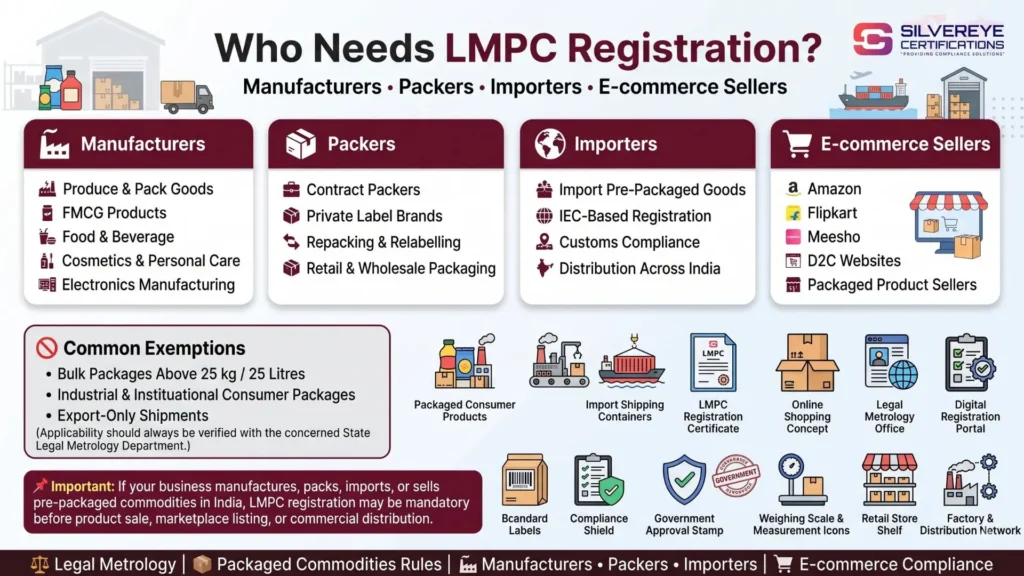
A small number of exemptions exist — for example, very small packages (typically under 10 g or 10 ml in certain categories) and bulk packages meant strictly for industrial or institutional buyers. These exemptions are narrow and product-specific, so it's worth confirming your exact category rather than assuming your product qualifies.
Mandatory Declarations for Ecommerce Product Labels
Whether you're packing in-house or outsourcing to a contract packer, every pre-packaged product sold online must carry these declarations on the Principal Display Panel (PDP) — the part of the package a consumer sees first:
| Declaration | What It Must Show |
| Name & address | Manufacturer, packer, or importer name and full address (with Indian importer details for imported goods) |
| Generic/common name | The common name of the commodity, not just a brand or marketing name |
| Net quantity | Weight, volume, or count in standard units (g, kg, ml, l, or number of pieces) |
| MRP | Maximum Retail Price, inclusive of all taxes |
| Country of origin | Mandatory for imported goods |
| Month & year | Of manufacture, packing, or import |
| Consumer care details | Phone number and/or email address for customer complaints |
| Batch/lot number | For traceability of the specific production or import batch |
For online listings, best practice is to mirror every one of these fields in your product description or specification table — not just print them on the physical label. This keeps your marketplace listing consistent with what actually ships, which is exactly what enforcement checks tend to compare.
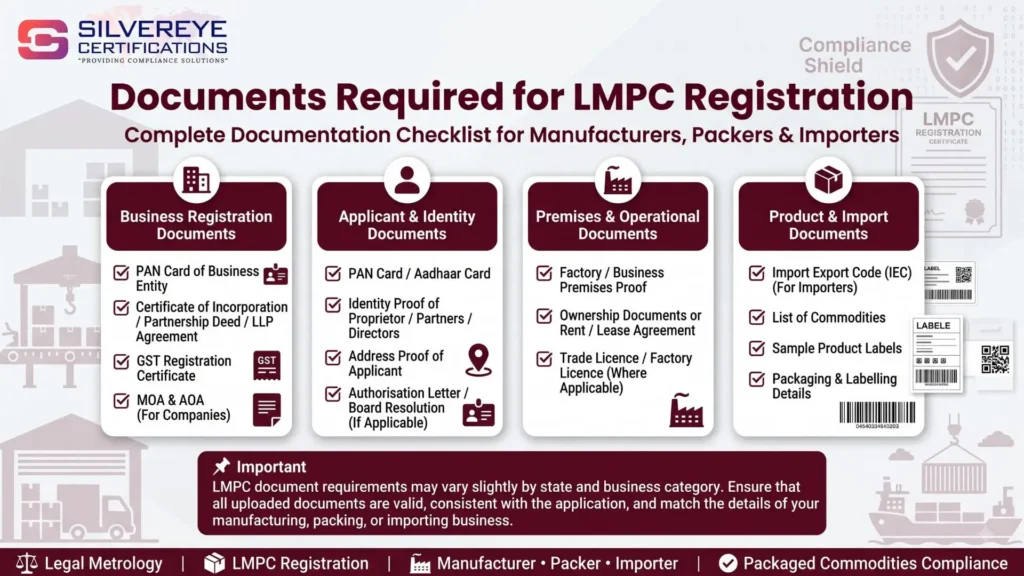
Documents Required for LMPC Registration For Ecommerce Sellers
- PAN card and business incorporation proof (company, LLP, partnership, or proprietorship documents).
- GST registration certificate.
- Import Export Code (IEC), where the seller imports pre-packaged goods.
- Proof of business address and, where applicable, warehouse or fulfillment center address.
- A list of products/SKUs proposed to be sold, with category and packaging details.
- Draft product labels showing all mandatory declarations, for each product category.
- Authorization letter, in case an authorized signatory or compliance consultant is filing on the seller's behalf.
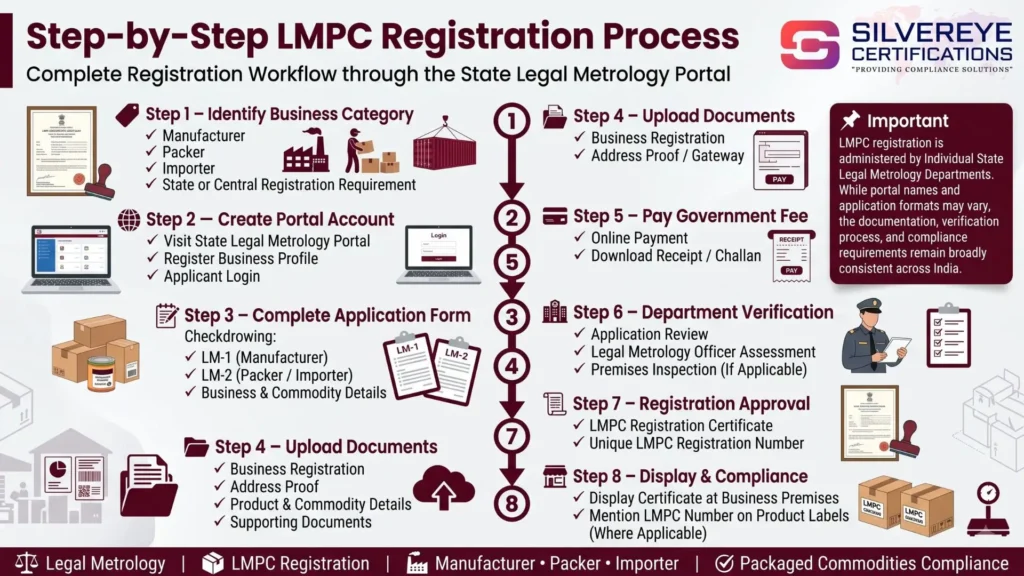
LMPC Registration Process for Ecommerce Sellers
Step 1: Confirm Whether Your Products Fall Under the Rules
Review your product catalog and identify which SKUs qualify as pre-packaged commodities under the Legal Metrology (Packaged Commodities) Rules, 2011, and check whether any fall under a narrow exemption.
Step 2: Gather Business and Product Documentation
Collect PAN, GST, incorporation documents, IEC (if importing), and a finalized product list with category-wise packaging details.
Step 3: Prepare Compliant Labels for Every Product Category
Design or review labels to ensure every mandatory declaration — MRP, net quantity, manufacturer/importer details, consumer care information — is present, accurate, and legible on the Principal Display Panel.
Step 4: Submit the Application
Applications are generally filed through the National Single Window System (NSWS) or the relevant state Legal Metrology department portal, depending on whether you're registering as a manufacturer, packer, or importer, and whether you operate in one state or across multiple states.
Step 5: Pay the Prescribed Fee
The registration fee is set by the respective state Legal Metrology department and varies depending on the state and the number of business premises being registered.
Step 6: Respond to Queries and Receive Registration
The Controller or Director of Legal Metrology may raise queries on documentation or labeling before approving the application. Once cleared, the registration certificate is issued.
Step 7: Align Your Online Listings with the Approved Label
Update every marketplace listing and product description page so the MRP, net quantity, and seller/importer details match your approved, registered label exactly.
LMPC Registration Fees For Ecommerce Sellers
There is no single flat fee across India — the fee is prescribed by each state's Legal Metrology department and is generally modest, but it varies by state and by the number of premises or product categories being registered.
| Verify before you file LMPC registration fees differ by state and are revised periodically by the respective Legal Metrology department. Confirm the current fee schedule for your state, or with your compliance consultant, before submitting payment. |
Validity, Renewal, and Timelines For Ecommerce Sellers
LMPC registration is commonly issued for a validity period of around 5 years in most states, though the exact term can depend on the state authority and the category of registration (manufacturer, packer, or importer).
- Track your registration's expiry date as soon as it's issued — an expired registration can trigger the same enforcement risk as never having registered at all.
- File for renewal well before expiry; processing timelines can extend to several weeks depending on the state and document readiness.
- While the legal outer limit for processing an application can run up to 90 days, most straightforward applications with complete documentation are cleared in 7 to 21 working days.
| Verify before you file Validity periods and renewal timelines can differ by state and registration category. Check your specific certificate's expiry date and your state department's current renewal process rather than assuming a uniform national timeline. |
Benefits of LMPC Registration for Ecommerce Sellers
- Uninterrupted ability to list and sell pre-packaged products across major online marketplaces, which increasingly verify compliance before onboarding sellers.
- Smooth customs clearance for imported inventory, avoiding shipment holds or detention.
- Reduced exposure to penalties under the Legal Metrology Act for mis-declared MRP, quantity, or missing seller information.
- Stronger consumer trust, since accurate labeling and traceable consumer care details reduce disputes and returns.
- A documented compliance trail that supports other requirements — GST invoicing, FSSAI labeling (for food items), and BIS or EPR obligations where applicable.
Common Compliance Mistakes Ecommerce Sellers Make
- Listing MRP or net quantity online that doesn't match what's printed on the actual package shipped to the customer.
- Using a foreign label as-is on imported goods, without adding Indian-compliant declarations for importer details, MRP in INR, and country of origin.
- Assuming marketplace onboarding approval means Legal Metrology compliance is automatically satisfied — the two are separate checks.
- Missing consumer care details or listing an outdated phone number/email that no longer reaches the business.
- Letting registration lapse by not tracking the renewal date, then discovering the gap only when a shipment is held or a compliance notice arrives.
Penalties for Non-Compliance For Ecommerce Sellers
Non-compliance carries real financial and operational risk. Selling pre-packaged goods without LMPC registration, or with incorrect declarations, can lead to detention of goods at customs, monetary penalties, and enforcement action against the business.
Mis-declaration on the package itself — wrong MRP, incorrect net quantity, or missing mandatory information — is penalized separately and escalates with repeat violations: fines for a first offence, higher fines for a second, and even higher fines or imprisonment for further offences. In practical terms, the ongoing labeling accuracy often carries steeper risk than the one-time registration itself, which is why both need equal attention.
Conclusion
For any ecommerce seller, D2C brand, or marketplace vendor in India, LMPC registration isn't a side formality — it's a market-entry requirement that sits right alongside GST and other core business registrations. The rules exist to protect the customer on the other end of the order: someone who's trusting the MRP, the quantity, and the seller details on your listing to be exactly right. Getting registration in place, and keeping your labels and online listings consistent with it, protects your business from customs holds, marketplace takedowns, and escalating penalties — while building the kind of consumer trust that keeps orders coming back.
Silvereye Certifications helps ecommerce sellers, D2C brands, and importers manage this end-to-end — from checking which SKUs fall under the Legal Metrology (Packaged Commodities) Rules, to preparing compliant labels, filing the registration application, and keeping renewal timelines on track as your product catalog grows. If you're scaling across marketplaces or bringing in imported inventory, having this compliance foundation sorted early saves you from far costlier fixes later.
Frequently Asked Questions
Do I need LMPC registration if I only sell through a marketplace like Amazon or Flipkart?
Yes. Selling through a marketplace doesn't remove your obligation as the manufacturer, packer, importer, or brand owner. Marketplace onboarding checks and Legal Metrology registration are separate requirements, and you need both.
Is LMPC registration different from GST registration?
Yes, they're entirely separate. GST registration relates to tax compliance, while LMPC registration relates to product labeling, quantity, and pricing declarations under the Legal Metrology Act. You'll typically need both if you sell pre-packaged goods online.
What counts as a 'pre-packaged commodity' for ecommerce purposes?
Any product packed in a predetermined quantity before the consumer is present to see it packed — cosmetics, food items, electronics accessories, apparel sets, and household goods sold online in sealed retail packs all typically qualify.
Can I use the same LMPC registration for multiple product categories?
Registration itself covers your business as a manufacturer, packer, or importer, but each product category's label still needs to independently carry all mandatory declarations correctly. It's not a blanket approval that skips label-level compliance for new SKUs.
How long does LMPC registration take to process?
Straightforward applications with complete documentation are commonly cleared in 7 to 21 working days, though the legal outer limit for processing can extend up to 90 days depending on the state and any queries raised.
What happens if my online listing shows a different MRP than my physical label?
This mismatch is treated as a compliance issue in its own right, separate from registration. Regulators increasingly compare listing data against physical labels, so any discrepancy — even unintentional — creates enforcement risk.
Do dropshippers need LMPC registration?
If you're selling pre-packaged goods to Indian consumers under conditions that trigger declaration requirements — even when a third party packs the product — you generally still need to ensure compliant labeling and, depending on your role in the supply chain, registration.
Is LMPC registration valid across all of India, or state by state?
It depends on your registration category. Businesses operating within a single state typically register with that state's Legal Metrology department, while those selling across multiple states may need a Central Government packer license or equivalent multi-state coverage.
What documents does an importer selling online need for LMPC registration?
Importers typically need PAN, GST registration, Import Export Code (IEC), business address proof, and product-wise label drafts showing importer details, country of origin, MRP, and net quantity, in addition to the standard registration documents.
Can small quantities or sample packs be exempt from LMPC declarations?
Some very small packages (commonly cited around 10 g or 10 ml in specific categories) and certain bulk industrial packages carry narrow exemptions. These are product- and category-specific, so confirm your exact SKU against the current exemption list rather than assuming exemption.
What's the penalty if I sell without LMPC registration?
Consequences can include detention or seizure of goods, monetary penalties, and further enforcement action. Separate, escalating fines also apply for mis-declared labels even where a business has registered, so registration alone doesn't cover ongoing labeling accuracy.
How do I renew LMPC registration before it expires?
Track your certificate's expiry date and file for renewal with the same Legal Metrology authority that issued your original registration, well ahead of the deadline — renewal processing timelines can take several weeks depending on the state and documentation.