

- IS 1867:2023 is the revised Indian Standard for rubber hot water bottles, replacing the older IS 1867:1975.
- BIS Certification for Rubber Hot Water Bottle is granted under Scheme-I of the BIS (Conformity Assessment) Regulations, 2018.
- Manufacturers and importers need a valid BIS/ISI mark license before they can legally sell rubber hot water bottles in the Indian market.
- The license involves document submission, product testing, a factory audit, and periodic renewal to stay valid.
Introduction
Bureau of Indian Standards (BIS) Certification for Rubber Hot Water Bottle is the quality approval that lets a manufacturer or importer put the ISI mark on rubber hot water bottles sold in India. It is issued under the current Indian Standard IS 1867:2023, which replaced the earlier IS 1867:1975 specification.

The certification confirms that the bottle has passed BIS-prescribed tests for material safety, seam strength, leak-proofing, bursting pressure, and temperature performance. To obtain it, a manufacturer applies to BIS under Scheme-I, submits a product manual and test reports, undergoes a factory inspection, and — once approved — receives a license that must be renewed periodically to remain valid.
What Is BIS Certification for Rubber Hot Water Bottle?
Rubber hot water bottles are used across Indian households for pain relief, warmth during winters, and post-injury care, which makes their safety performance directly relevant to consumer health. BIS Certification for Rubber Hot Water Bottle is the formal process through which the Bureau of Indian Standards verifies that a manufacturer's product and production process conform to IS 1867:2023, the national specification that governs the material, design, dimensions, sealing, and safety performance of rubber hot water bottles.

Once a manufacturer clears this process, BIS grants a license that allows the company to mark its rubber hot water bottles with the Standard Mark, popularly known as the ISI mark. This mark works as a trust signal for retailers, e-commerce platforms, and end consumers that the bottle has been independently tested and is fit for safe household use.
About IS 1867:2023 — What Changed From the Older Standard
IS 1867 was first published decades ago and last carried as IS 1867:1975 under the Rubber Products Sectional Committee (PCD 13) of BIS. IS 1867:2023 is the updated revision of this specification for rubber hot water bottles. A revised standard typically realigns the specification with current manufacturing practices, updated test methods, and contemporary safety expectations, and BIS certification bodies now process new and renewal applications against this current 2023 edition rather than the old 1975 version.
For a manufacturer, this means product formulations, wall thickness, closure design, and test protocols should be checked against the current IS 1867:2023 document rather than any older printed copy, since BIS testing and factory audits are carried out against the standard that is in force at the time of application.
Is BIS Certification Mandatory for Rubber Hot Water Bottles?
BIS has been steadily expanding compulsory certification (through Quality Control Orders, or QCOs, issued by the Department for Promotion of Industry and Internal Trade) across everyday consumer products such as potable water bottles, insulated flasks, and bottled water dispensers. Rubber hot water bottles fall in this same consumer-safety-sensitive category, since they involve hot water, pressure, and prolonged skin contact.
At present, certification under IS 1867:2023 is available and actively processed by BIS, and it is the standard manufacturers should certify against when applying for or renewing an ISI mark licence for this product. Because QCOs for consumer products are notified periodically, manufacturers and importers should always check the latest QCO list on the official BIS and DPIIT portals before dispatch or import, so they are not caught off guard if compulsory certification is notified or updated for this product category.
Who Needs BIS Certification for Rubber Hot Water Bottle?
- Indian manufacturers producing rubber hot water bottles for domestic sale.
- Importers bringing rubber hot water bottles into India for retail or wholesale distribution.
- Private-label and OEM brands that get bottles manufactured on contract and sell under their own brand name.
- E-commerce sellers and distributors who want to display the ISI mark as a quality assurance to buyers.
- Export-oriented units that also want to service the domestic Indian market alongside exports.
Benefits of BIS Certification for Rubber Hot Water Bottle
Getting the ISI mark is not just a compliance formality — it has direct commercial value:
- Legal market access: allows the product to be manufactured, imported, and sold without regulatory risk once certification requirements apply.
- Consumer trust: the ISI mark is widely recognized in India as a symbol of tested, government-verified quality.
- Retail and e-commerce acceptance: many organized retailers and marketplaces prefer or require ISI-marked products in regulated categories.
- Reduced product liability: consistent adherence to IS 1867:2023 lowers the risk of bursting, leaking, or burn-related complaints.
- Brand differentiation: certified sellers stand out from unregulated, uncertified competitors in the same category.
- Smoother government and institutional supply: hospitals, government tenders, and bulk buyers often ask for BIS-certified products.
Eligibility Criteria for BIS Registration
Before applying, a business should confirm it satisfies the basic eligibility conditions BIS expects from applicants:
- The applicant must be a manufacturer with an operational, identifiable factory or production unit where rubber hot water bottles are made.
- The unit must have in-house or accessible testing facilities capable of carrying out (or arranging) the tests specified in IS 1867:2023, or access to a BIS-recognized laboratory.
- The manufacturing process, raw material sourcing, and quality control system must be documented and traceable.
- For importers/foreign manufacturers, a BIS-recognized Authorized Indian Representative (AIR) is required as per BIS foreign manufacturer certification rules.
- The applicant should maintain proper records of production, testing, and quality checks that BIS officers can verify during a factory inspection.
Documents Required for BIS Certification
| Category | Documents Typically Required |
| Business Proof | Company/factory registration certificate, GST registration, PAN, Udyam/MSME certificate (if applicable) |
| Factory Details | Site layout, list of machinery, manufacturing process flow chart |
| Product Details | Product manual describing raw materials, dimensions, design, and manufacturing process as per IS 1867:2023 |
| Testing | In-house test reports or third-party lab test reports for parameters covered under the standard |
| Quality Control | Quality control system documentation, calibration records of testing instruments |
| Authorisation | Authorised signatory details; Authorised Indian Representative agreement for foreign manufacturers |
| Application Forms | BIS application form (Form V or applicable online form), fee payment proof |
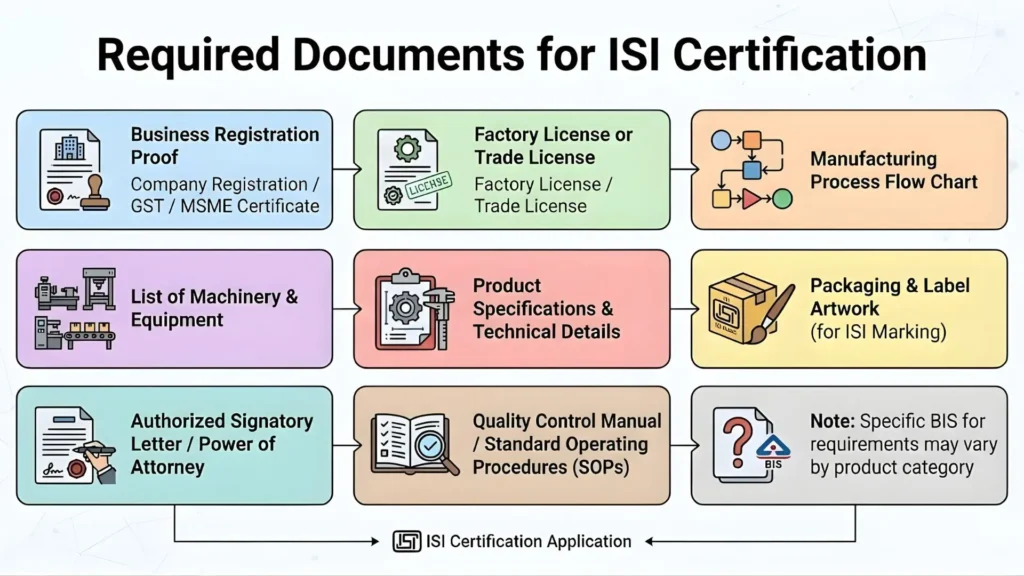
Exact document requirements can vary slightly based on whether the applicant is a domestic manufacturer or a foreign manufacturer applying through an Indian representative, so it is advisable to confirm the current checklist on the official BIS portal before submission.
Step-by-Step BIS Certification Process for Rubber Hot Water Bottle
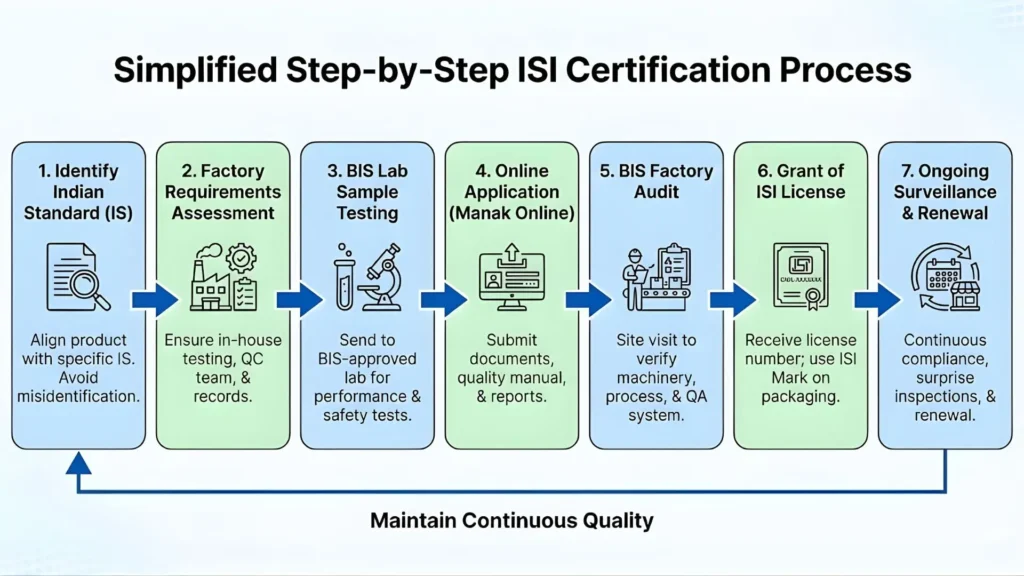
BIS Certification for Rubber Hot Water Bottle is generally processed under Scheme-I of the BIS (Conformity Assessment) Regulations, 2018 — the standard route used for ISI mark licensing of manufactured goods. The broad process looks like this:
- Online application: Submit the application on the BIS Standard Mark portal (Manak Online) along with the required documents and applicable fee.
- Document scrutiny: BIS reviews the application and documents for completeness and correctness against IS 1867:2023.
- Factory inspection: A BIS officer visits the manufacturing unit to verify machinery, process control, in-house testing capability, and raw material quality.
- Sample testing: Samples of the rubber hot water bottle are drawn and tested — either in the factory's own approved lab or a BIS-recognized third-party laboratory — against the parameters defined in the standard.
- Review and grant of license: Once the inspection and test reports are found satisfactory, BIS grants the licence and allotment of the CM/L (Certification Marks License) number.
- Marking with ISI mark: The licensee can now affix the Standard Mark (ISI mark) along with the licence number on the certified rubber hot water bottles.
- Surveillance: BIS conducts periodic surveillance inspections and market sample testing after the licence is granted, to confirm ongoing compliance.
Testing Parameters Under IS 1867:2023
While the exact clause-wise requirements should always be verified from the official IS 1867:2023 document, BIS testing for rubber hot water bottles broadly evaluates:
- Material composition and rubber compound quality.
- Dimensional accuracy of capacity, wall thickness, and neck/closure fitting.
- Leak-proof and seam/joint strength under filled conditions.
- Bursting pressure and resistance to deformation under hot-water fill.
- Closure/stopper performance to prevent accidental opening or leakage.
- Ageing, flexibility, and general workmanship checks.
Government Fees for BIS Certification
BIS charges an application fee, a licence fee, and marking fees as prescribed under the BIS Rules and the applicable fee schedule notified from time to time. These government fees are separate from any professional or consultancy charges a company may pay if it engages a BIS certification consultant for documentation, liaison, and inspection support. Because BIS periodically revises its fee schedule, applicants should always check the current fee structure on the official BIS website (bis.gov.in) or the Manak Online portal before submitting payment, rather than relying on older published figures.
Timeline for Getting BIS Certification
| Stage | Typical Activity |
| Application & Document Review | Submission of application and scrutiny of documents by BIS |
| Factory Inspection | BIS officer visits the unit, checks process control and testing capability |
| Sample Testing | Samples tested against IS 1867:2023 parameters |
| Licence Grant | CM/L number allotted and license issued after satisfactory review |
The overall time taken depends on how quickly documents are submitted, how soon the factory is ready for inspection, and how fast test results are returned. Delays are most commonly caused by incomplete documentation, non-functional in-house testing equipment, or process gaps found during the factory audit — so preparing thoroughly before applying helps shorten the timeline.
Validity and Renewal of BIS License
A BIS licence for rubber hot water bottles is not permanent — it is granted for a fixed validity period and must be renewed before expiry to keep using the ISI mark legally. Renewal generally involves:
- Submitting a renewal application before the current license expires.
- Paying the applicable renewal fee.
- Undergoing periodic surveillance/renewal inspection and sample testing, as BIS may require.
- Continuing to maintain the same quality control and testing standards approved at the time of original grant.
Operating without a valid, renewed license — or continuing to use the ISI mark after expiry — can expose the company to penal action, so renewal timelines should be tracked proactively.
Penalties for Non-Compliance
Manufacturing, selling, or importing a product that requires BIS certification without a valid license, or misusing the ISI mark, is an offence under the BIS Act, 2016. Consequences can include seizure of non-compliant stock, monetary penalties, and legal proceedings against the manufacturer or importer. This is one of the strongest commercial reasons to complete certification proactively rather than reactively.
2026 Update: What's New for Rubber Hot Water Bottle BIS Certification
The most relevant recent development for this category is the shift from the decades-old IS 1867:1975 specification to the current IS 1867:2023 standard, which is now the version BIS certification bodies test and audit against for both new applications and renewals. This kind of standard revision typically reflects updated safety expectations, refreshed test methods, and closer alignment with how rubber hot water bottles are actually manufactured and used today.
Separately, India's broader Quality Control Order (QCO) programme — run jointly by DPIIT and BIS — has been steadily bringing more everyday consumer products (from potable water bottles to insulated flasks and bottled water dispensers) under compulsory ISI marking. Manufacturers of rubber hot water bottles should keep monitoring the official BIS and DPIIT QCO lists, since compulsory certification timelines for adjacent product categories have historically come with defined compliance windows for large, small, and micro enterprises. Staying certified under the current IS 1867:2023 standard now keeps a business ready in advance, regardless of whether or when a specific QCO is notified for this exact product.
Why Work With a BIS Certification Consultant
Because the process involves technical documentation, coordination with BIS-recognized labs, and a physical factory audit, many manufacturers — especially first-time applicants and foreign manufacturers — prefer working with an experienced BIS certification consultant. A consultant can help prepare the product manual, align in-house testing capability with IS 1867:2023 requirements, coordinate the factory inspection, and track renewal timelines so the license never lapses.
Conclusion
BIS Certification for Rubber Hot Water Bottle under IS 1867:2023 is becoming an increasingly important compliance and trust marker for manufacturers, importers, and brands operating in India's consumer wellness and healthcare accessories space. Aligning your product, documentation, and testing with the current IS 1867:2023 standard — rather than the outdated IS 1867:1975 version — keeps your business audit-ready, builds consumer confidence through the ISI mark, and positions you ahead of any future compulsory Quality Control Order for this category.
If you manufacture or import rubber hot water bottles, the practical next step is to review your product against IS 1867:2023, gather the required documentation, and initiate the BIS application through the official Manak Online portal or with the help of a qualified BIS certification consultant.
Frequently Asked Questions
What is BIS Certification for Rubber Hot Water Bottle?
It is the approval granted by the Bureau of Indian Standards confirming that a rubber hot water bottle meets the safety and quality requirements of IS 1867:2023, allowing the manufacturer to use the ISI mark on the product.
Is BIS certification mandatory for rubber hot water bottles in India?
Certification under IS 1867:2023 is available and actively processed by BIS. Whether it is compulsory for every seller depends on whether a specific Quality Control Order applies to this product at a given time, so businesses should check the current BIS/DPIIT QCO list before selling.
What is IS 1867:2023?
IS 1867:2023 is the current Indian Standard specification for rubber hot water bottles, issued by BIS under its Rubber and Rubber Products Sectional Committee, replacing the earlier IS 1867:1975 version.
Who can apply for BIS Certification for Rubber Hot Water Bottle?
Any manufacturer with an operational factory producing rubber hot water bottles can apply, including domestic manufacturers and foreign manufacturers applying through a BIS-recognized Authorized Indian Representative.
What documents are needed for BIS registration of rubber hot water bottles?
Common documents include business/factory registration proof, a detailed product manual, manufacturing process details, in-house or third-party test reports, quality control records, and the BIS application form with fee payment proof.
How long does it take to get BIS certification?
Timelines vary by applicant readiness — documentation, factory inspection scheduling, and lab test turnaround are the main factors. Applicants with complete documents and a functioning quality control system generally move through the process faster.
What is the validity of a BIS license for rubber hot water bottles?
The license is valid for a fixed period set by BIS and must be renewed before expiry, along with ongoing surveillance inspections, to keep using the ISI mark legally.
What happens if I sell rubber hot water bottles without BIS certification when it's required?
Selling a product that requires BIS certification without a valid license, or misusing the ISI mark, is an offence under the BIS Act, 2016 and can lead to seizure of stock and penalties.
Does BIS certification apply to imported rubber hot water bottles?
Yes. Importers and foreign manufacturers can obtain BIS certification through a BIS-recognized Authorised Indian Representative based in India, following the same core Scheme-I process.
What tests are conducted under IS 1867:2023?
Testing broadly covers material and rubber compound quality, dimensional accuracy, leak-proof seam strength, bursting pressure, closure performance, and general workmanship, as detailed in the official standard.
How much does BIS certification cost?
BIS charges application, license, and marking fees as per its official fee schedule, which is updated periodically — applicants should confirm current rates on the official BIS website. Separate professional fees may apply if a consultant is engaged.
Can a small-scale manufacturer apply for BIS certification?
Yes, small and micro manufacturers can apply, and QCOs for other consumer product categories have historically included extended compliance timelines for MSMEs — the same pattern is worth watching for this category.