

- Covers the migration from IS 13252 (Part 1):2010 to IS/IEC 62368-1:2023 for scanners.
- Includes the new 5-year BIS CRS license validity update effective 25 February 2026.
- Full documents, fees, step-by-step process, and 01 November 2028 migration deadline.
- Powered by Silvereye Certifications — India's trusted BIS CRS consultant for electronics & IT goods.
2026 Dual Update Alert — IS/IEC 62368-1:2023 now supersedes IS 13252 (Part 1):2010 for Scanners, barcode readers, iris scanners, and fingerprint scanners — migration deadline 01 November 2028. BIS CRS licence validity extended to 5 years effective 25 February 2026 under amended Scheme-II.
What Is BIS CRS Registration for Scanners?
BIS CRS (Compulsory Registration Scheme) registration for Scanners is mandatory under India's Electronics and Information Technology Goods (Requirement of Compulsory Registration) Order, 2021. All scanners — document scanners, USB-driven barcode readers, barcode scanners, iris scanners, and optical fingerprint scanners — must carry the BIS Standard Mark. Following MeitY's notification dated 29 October 2025, the applicable standard IS 13252 (Part 1):2010 has been superseded by IS/IEC 62368-1:2023, with a concurrent running period until 01 November 2028.

Separately, from 25 February 2026, BIS CRS licences under Scheme-II are valid for 5 years instead of 1 year. No scanner can be legally manufactured, imported, or sold in India without a valid BIS CRS licence.
What Is BIS CRS and Why Is It Mandatory for Scanners?
The Bureau of Indian Standards (BIS) administers the Compulsory Registration Scheme (CRS) under the BIS (Conformity Assessment) Regulations, 2018. Electronics and IT goods notified under the Electronics and Information Technology Goods (Requirement of Compulsory Registration) Order, 2021 — issued by the Ministry of Electronics and Information Technology (MeitY) — must be tested against the applicable Indian Standard and registered with BIS before sale in India.

Scanners fall squarely within this order, and the CRO classification is broad — it covers traditional document and flatbed scanners, USB-driven barcode readers used at retail checkout counters, handheld barcode scanners, and biometric devices including iris scanners and optical fingerprint scanners. Whether you manufacture office document scanners, import retail barcode readers, or supply biometric authentication hardware, your product cannot legally enter the Indian market without BIS CRS registration and the BIS Standard Mark affixed to every unit.
Why Scanners Specifically Need BIS CRS
- Scanners carry internal power supplies, optical sensors, and USB/wireless interface circuitry that pose electrical and fire risk if not safety-tested.
- IS/IEC 62368-1:2023 evaluates energy source classification, thermal safety, and mechanical hazards specific to electronic devices including scanning hardware.
- Biometric scanners (iris and fingerprint) are increasingly used in banking, government ID systems (Aadhaar-linked devices), and access control — all requiring certified hardware.
- Government and institutional procurement — banks, airports, government offices — require BIS-certified scanners as a tender prerequisite.
- E-commerce platforms including Amazon India and Flipkart require valid BIS CRS registration before listing scanners and barcode readers for sale.
2026 Regulatory Updates: What Changed for Scanner Manufacturers and Importers
Two separate but equally important regulatory developments affect every business dealing in scanners, barcode readers, and biometric scanning devices in India. Both require timely action.
Migration from IS 13252 (Part 1):2010 to IS/IEC 62368-1:2023
MeitY, vide Notification S.O. 4997(E) dated 29 October 2025, amended the Electronics and Information Technology Goods (Requirement of Compulsory Registration) Order, 2021, notifying IS/IEC 62368-1:2023 — Audio/Video, Information and Communication Technology Equipment, Part 1: Safety Requirements. This standard supersedes IS 13252 (Part 1):2010 and IS 616:2017 across 38 product categories, including Scanners, USB-driven barcode readers, barcode scanners, iris scanners, and optical fingerprint scanners.
| S.No | Product Category | Previously Applicable IS | Superseded By | Concurrent Running Until |
| 1 | Scanners, USB driven Barcode readers, barcode scanners, Iris scanners, Optical fingerprint scanner | IS 13252 (Part 1):2010 | IS/IEC 62368-1:2023 | 01 Nov 2028 |
The last date of concurrent running for IS 13252 (Part 1):2010 with IS/IEC 62368-1:2023 is 01 November 2028. Until this date, both standards remain valid for processing applications. After 01 November 2028, IS 13252 (Part 1):2010 stands fully withdrawn for scanners and biometric readers, and no licence can be granted or remain operative under the old standard.
BIS CRS License Validity Extended to 5 Years (Effective 25 February 2026)
Pursuant to the amendment dated 25 February 2026 in the BIS (Conformity Assessment) Regulations, 2018, Scheme-II CRS licence provisions — applicable to scanners as well — have been revised as follows:
| Provision | Before 25 Feb 2026 | After 25 Feb 2026 (Current Rule) |
| Initial Licence Validity | 1 Year | 5 Years (effective 25 Feb 2026) |
| Renewal Period | 1 Year | 5 Years |
| Fee Payment | Annual in advance | Annual in advance (within 5-yr block) |
| Production Details | Annual | Annual (mandatory each year) |
| Non-payment Consequence | Suspension / cancellation | Suspension / deferment / cancellation |
Annual Fee Still Mandatory — The 5-year validity does NOT remove annual fee obligations. Annual marking fees and production details must be submitted every year within the 5-year block. Non-payment triggers suspension under BIS (Conformity Assessment) Regulations, 2018, as amended.
Scanner Product Categories Covered Under BIS CRS (IS/IEC 62368-1:2023)
If your product falls under any of the following Scanner categories, BIS CRS registration is legally compulsory before manufacturing, importing, or selling in India.
| S.No | Scanner Product Type | Previous Standard | Current Standard | Scheme |
| 1 | Flatbed Document Scanners | IS 13252 (Part 1):2010 | IS/IEC 62368-1:2023 | CRO – Class A |
| 2 | Sheet-Fed / ADF Document Scanners | IS 13252 (Part 1):2010 | IS/IEC 62368-1:2023 | CRO – Class A |
| 3 | USB-Driven Barcode Readers | IS 13252 (Part 1):2010 | IS/IEC 62368-1:2023 | CRO – Class A |
| 4 | Barcode Scanners (Handheld/Fixed) | IS 13252 (Part 1):2010 | IS/IEC 62368-1:2023 | CRO – Class A |
| 5 | Iris Scanners | IS 13252 (Part 1):2010 | IS/IEC 62368-1:2023 | CRO – Class A |
| 6 | Optical Fingerprint Scanners | IS 13252 (Part 1):2010 | IS/IEC 62368-1:2023 | CRO – Class A |
| 7 | Photo / Slide / Film Scanners | IS 13252 (Part 1):2010 | IS/IEC 62368-1:2023 | CRO – Class A |
| 8 | Portable Handheld Document Scanners | IS 13252 (Part 1):2010 | IS/IEC 62368-1:2023 | CRO – Class A |
This covers traditional office and document scanners (flatbed and sheet-fed/ADF types), retail and logistics barcode scanning hardware (both USB-driven and standalone), and biometric scanning devices used for identity verification — iris scanners and optical fingerprint scanners. Scanners that are built into a larger device (such as a printer-scanner combo / MFD) fall under the Printers/MFD/Plotters category rather than this standalone Scanner classification.
Complete List of Products Migrating to IS/IEC 62368-1:2023 (Full CRO Reference)
Scanners are one of 38 product categories migrating from IS 13252 (Part 1):2010 / IS 616:2017 to IS/IEC 62368-1:2023 under MeitY's October 2025 notification. The table below is provided for full context, since many manufacturers produce scanners alongside other notified electronics such as printers, POS terminals, or biometric access devices.
| S.No | Product Category | Currently Applicable IS | Superseded By |
| 1 | Electronic Games (Video) | IS 616:2017 | IS/IEC 62368-1:2023 |
| 2 | Laptops/Notebooks/Tablets | IS 13252 (Part 1):2010 | IS/IEC 62368-1:2023 |
| 3 | Plasma/LCD/LED Television | IS 616:2017 & IS 18112:2025 | IS/IEC 62368-1:2023 & IS 18112:2025 |
| 4 | Optical Disc Players (amp. input ≥200W) | IS 616:2017 | IS/IEC 62368-1:2023 |
| 5 | Visual Display Units, Video Monitors | IS 13252 (Part 1):2010 | IS/IEC 62368-1:2023 |
| 6 | Printers/MFD/Plotters | IS 13252 (Part 1):2010 | IS/IEC 62368-1:2023 |
| 7 | Scanners, Barcode/Iris/Fingerprint Scanners | IS 13252 (Part 1):2010 | IS/IEC 62368-1:2023 |
| 8 | Wireless Keyboards | IS 13252 (Part 1):2010 | IS/IEC 62368-1:2023 |
| 9 | Telephone Answering Machines | IS 13252 (Part 1):2010 | IS/IEC 62368-1:2023 |
| 10 | Amplifiers (input ≥2000W) | IS 616:2017 | IS/IEC 62368-1:2023 |
| 11 | Electronic Musical Systems | IS 616:2017 | IS/IEC 62368-1:2023 |
| 12 | Set Top Boxes | IS 13252 (Part 1):2010 | IS/IEC 62368-1:2023 |
| 13 | Automatic Data Processing Machines | IS 13252 (Part 1):2010 | IS/IEC 62368-1:2023 |
| 14 | Power Adaptors for IT Equipment | IS 13252 (Part 1):2010 | IS/IEC 62368-1:2023 |
| 15 | Power Adaptors for Audio/Video Apparatus | IS 616:2017 | IS/IEC 62368-1:2023 |
| 16 | Mobile Phones | IS 13252 (Part 1):2010 & IS 16333 (Part 3):2022 | IS/IEC 62368-1:2023 & IS 16333 (Part 3):2022 |
| 17 | Cash Registers | IS 13252 (Part 1):2010 | IS/IEC 62368-1:2023 |
| 18 | Point of Sale Terminals | IS 13252 (Part 1):2010 | IS/IEC 62368-1:2023 |
| 19 | Copying Machines/Duplicators | IS 13252 (Part 1):2010 | IS/IEC 62368-1:2023 |
| 20 | Smart Card Readers | IS 13252 (Part 1):2010 | IS/IEC 62368-1:2023 |
| 21 | Mail Processing/Postage/Franking Machines | IS 13252 (Part 1):2010 | IS/IEC 62368-1:2023 |
| 22 | Passport Readers | IS 13252 (Part 1):2010 | IS/IEC 62368-1:2023 |
| 23 | Power Bank (Portable Application) | IS 13252 (Part 1):2010 | IS/IEC 62368-1:2023 |
| 24 | CCTV Cameras/Recorders | IS 13252 (Part 1):2010 + Security ER | IS/IEC 62368-1:2023 + Security ER |
| 25 | Smart Watches | IS 13252 (Part 1):2010 | IS/IEC 62368-1:2023 |
| 26 | Keyboards | IS 13252 (Part 1):2010 | IS/IEC 62368-1:2023 |
| 27 | Automatic Teller/Cash Dispensing Machines | IS 13252 (Part 1):2010 | IS/IEC 62368-1:2023 |
| 28 | USB External Hard Disk Drives | IS 13252 (Part 1):2010 | IS/IEC 62368-1:2023 |
| 29 | Wireless Headphones and Earphones | IS 616:2017 | IS/IEC 62368-1:2023 |
| 30 | USB External SSDs (above 256GB) | IS 13252 (Part 1):2010 | IS/IEC 62368-1:2023 |
| 31 | Standalone SMPS (output ≤48V) | IS 13252 (Part 1):2010 | IS/IEC 62368-1:2023 |
| 32 | Televisions other than Plasma/LCD/LED | IS 616:2017 & IS 18112:2025 | IS/IEC 62368-1:2023 & IS18112:2025 |
| 33 | Wireless Microphones | IS 616:2017 | IS/IEC 62368-1:2023 |
| 34 | Digital Cameras | IS 13252 (Part 1):2010 | IS/IEC 62368-1:2023 |
| 35 | Video Cameras | IS 616:2017 | IS/IEC 62368-1:2023 |
| 36 | Webcams (Finished Product) | IS 616:2017 | IS/IEC 62368-1:2023 |
| 37 | Smart Speakers (with/without Display) | IS 616:2017 | IS/IEC 62368-1:2023 |
| 38 | Bluetooth Speakers | IS 616:2017 | IS/IEC 62368-1:2023 |
Note: For Plasma/LCD/LED Televisions (S.No. 3) and Mobile Phones (S.No. 16), additional standards (IS 18112:2025 and IS 16333 Part 3:2022 respectively) continue to apply alongside IS/IEC 62368-1:2023. CCTV Cameras (S.No. 24) also carry additional security Essential Requirements. Scanners (S.No. 7) do not carry any such additional parallel standard.
Who Needs BIS CRS Registration for Scanners?
- Indian Manufacturers: Any company manufacturing document scanners, barcode readers, or biometric scanning devices in India must hold a BIS CRS licence before affixing the ISI Standard Mark and offering products for sale.
- Importers: Companies importing scanners — including handheld barcode scanners, iris scanners, and fingerprint readers — from overseas must ensure the products are BIS CRS registered before customs clearance and sale in India.
- Brand Owners / OEM Buyers: Businesses sourcing scanners from contract manufacturers under their own brand must ensure their brand and models are covered within a valid BIS CRS licence scope.
- E-Commerce Sellers: Online sellers of scanners and barcode readers on Amazon, Flipkart, or similar platforms must list only BIS-certified products; platforms actively enforce CRS compliance and delist non-compliant listings.
- System Integrators (Banking, Retail, Government ID): Businesses that supply or install biometric scanning hardware for banking KYC, retail point-of-sale systems, or government identity verification systems must verify that the scanners carry valid BIS CRS certification.
BIS Guidelines for Existing Scanner Licensees — Migration Checklist
If you already hold a BIS CRS licence for scanners under IS 13252 (Part 1):2010, BIS guidelines dated 09 March 2026 (Ref: Reg/IS/IEC 62368-1:2023/Guidelines/01) place clear obligations on you ahead of the 01 November 2028 deadline.
- Identify all lead models in your current BIS CRS license scope tested under IS 13252 (Part 1):2010.
- Submit lead models to a BIS-recognized laboratory for fresh testing under IS/IEC 62368-1:2023. Submit the test report through the Standard Revision/Amendment/Essential Requirement provision available at your BIS login.
- Provide a signed undertaking confirming that IS/IEC 62368-1:2023 requirements have been implemented across all series models in your license scope.
- If your scanner models overlap with other notified standards under the same license (not applicable for standard scanners but relevant if you also manufacture TVs, mobile phones, or CCTV cameras), ensure those parallel standards are also addressed.
- If compliance with IS/IEC 62368-1:2023 has no impact on any parallel standard, submit a duly signed declaration to that effect along with your test reports.
- On successful implementation, BIS will issue a letter confirming the model(s) for which IS/IEC 62368-1:2023 compliance has been established.
- Complete all actions before 01 November 2028 — failure may result in cancellation of the licence or deletion of non-compliant models from scope.
Plan Ahead — Don't Wait Until 2028 — While the deadline is 01 November 2028, lab testing slots and BIS officer availability typically tighten significantly as deadlines approach. Existing licensees are advised to plan migration testing well in advance rather than waiting for the final year.
Documents Required for BIS CRS Registration — Scanners (2026)
A complete and accurate document package is the foundation of a smooth BIS CRS application for scanners and biometric reading devices.
| S.No | Document | Applicability / Remarks |
| 1 | Factory / Manufacturing Site Details (address, layout, capacity) | Mandatory for all applicants |
| 2 | Test Report from BIS-Recognised Laboratory (IS/IEC 62368-1:2023) | Most critical document; required for all scanner models |
| 3 | ISO 9001 / ISO 14001 Certificate (if available) | Preferred; strengthens application |
| 4 | Declaration of Conformity to IS/IEC 62368-1:2023 | Signed by authorised signatory |
| 5 | Product Technical Specification Sheet | Scanner type, interface (USB/wireless), input power, optical sensor details |
| 6 | Lead Model and Series Model List | All scanner models/variants to be covered under licence scope |
| 7 | BIS Registration Fees Challan | Paid online via BIS Connect portal |
| 8 | GST Registration Certificate | Mandatory for Indian manufacturers |
| 9 | Brand Authorization Letter (if applicable) | Required where brand/trade name differs from manufacturer |
| 10 | Undertaking for Revised Standard Compliance (existing licensees) | Confirming IS/IEC 62368-1:2023 implementation across series models |
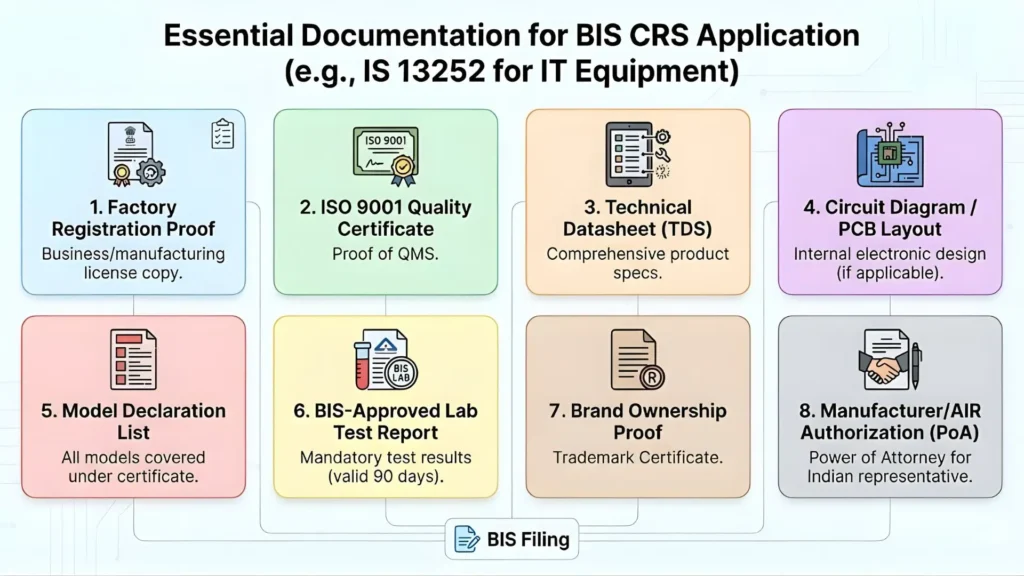
All documents must be submitted via the BIS Connect portal (connect.bis.gov.in) in PDF format. Ensure test reports cover all applicable clauses of IS/IEC 62368-1:2023, including energy source classification and thermal safety requirements relevant to scanner power supplies, USB interfaces, and optical sensor modules.
Step-by-Step BIS CRS Registration Process for Scanners
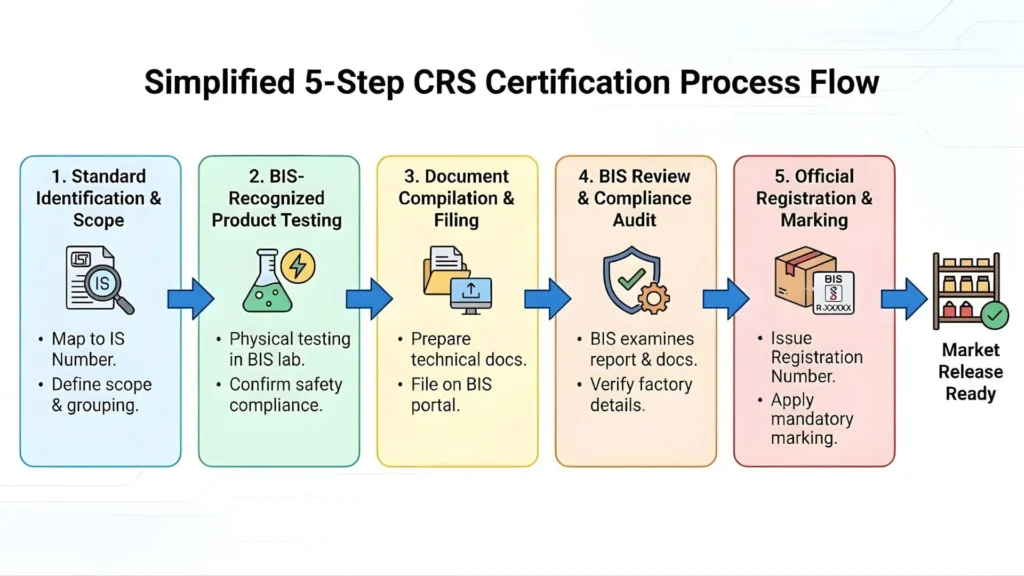
- Confirm product applicability — verify your scanner type (document scanner, barcode reader, iris scanner, fingerprint scanner, etc.) falls under the CRO schedule.
- Select a BIS-recognised laboratory — choose a NABL-accredited, BIS-authorised lab capable of testing under IS/IEC 62368-1:2023.
- Submit product samples — typically 3 to 5 units per lead model, along with technical drawings, power supply specifications, and interface datasheets.
- Receive complete test report — confirm the report addresses all applicable IS/IEC 62368-1:2023 clauses for energy sources, thermal limits, and mechanical safety.
- Register/update on BIS Connect portal — complete or update your company and product registration profile.
- File online application — submit the CRS application with all documents, test reports, product specifications, and prescribed fees.
- BIS document scrutiny — respond promptly to any deficiency letters or queries raised by BIS officers.
- Factory inspection — prepare manufacturing premises, QC records, and production documentation for the BIS inspection visit.
- Grant of BIS CRS License — upon successful review, BIS issues the Standard Mark Licence valid for 5 years from the date of grant.
- Annual compliance — pay annual marking fees and submit production details every year through BIS Connect to keep the licence active across the 5-year validity period.
BIS CRS Registration Timeline for Scanners (Indicative)
| Stage | Activity | Estimated Time |
| Step 1 | Confirm product applicability & classify scanner type | 1–2 days |
| Step 2 | Select BIS-recognised lab & submit samples | 1 week |
| Step 3 | Lab testing & receipt of test report | 4–8 weeks |
| Step 4 | Prepare documents & BIS Connect application | 1–2 weeks |
| Step 5 | BIS document scrutiny & query resolution | 2–4 weeks |
| Step 6 | Factory inspection by BIS officer | 1–3 weeks |
| Step 7 | Grant of BIS CRS Licence | 1–2 weeks after inspection |
| Total | End-to-end estimate | 3–5 months |
New applicants should account for 3 to 5 months from sample submission to licence grant. Existing licensees migrating ahead of 01 November 2028 should factor in similar lead times for re-testing and undertaking submission, and should not leave migration to the final months before the deadline.
BIS CRS Registration Fees for Scanners (2026)
The following is an indicative fee overview. Always verify current fee amounts on the official BIS Connect portal, as fees are periodically revised.
| Particulars | MSME / Small Scale | Large Scale | Remarks |
| Application / Grant of Licence Fee | Per BIS schedule | Per BIS schedule | Paid via BIS Connect portal |
| Annual Marking Fee (per model, per year) | Varies by turnover slab | Varies by turnover slab | Payable each year in the 5-yr block |
| Lab Testing Charges (BIS-recognised lab) | ₹20,000–₹55,000 approx. | ₹35,000–₹85,000 approx. | Depends on scanner type and lab |
| Renewal Fee | Same as grant fee | Same as grant fee | Due before end of 5-year licence period |
Under the new 5-year validity regime, license fees remain payable annually in advance within the 5-year block. The 5-year validity provides license stability but does not consolidate annual fees into a single one-time payment.
BIS CRS License Validity and Renewal for Scanners — 2026 Rules
- Initial Validity: 5 years from the date of grant (changed from 1 year, effective 25 February 2026).
- Renewal Period: Renewed for a further period of 5 years; renewal fees follow the same schedule as the grant fee.
- Annual Fee Payment: Mandatory every year, payable in advance by the prescribed due date, within the 5-year licence block.
- Production Details Submission: Annual submission of production data is mandatory and used by BIS for compliance monitoring.
- Suspension / Cancellation: Non-payment of annual fees or non-submission of production details triggers suspension; continued non-compliance leads to cancellation or expiry.
- Standard Migration Deadline: Independent of licence validity, all scanner models must comply with IS/IEC 62368-1:2023 by 01 November 2028, regardless of when the licence itself was granted or renewed.
Benefits of BIS CRS Certification for Scanners
- Legal Market Access: Mandatory under the CRO — certified scanners can be legally manufactured, imported, and sold across India without additional state-level safety approvals.
- Government and Institutional Tenders: BIS Standard Mark is a prerequisite for government procurement, banking KYC hardware contracts, and identity-verification (Aadhaar-linked) device tenders.
- Consumer and Buyer Trust: The ISI mark assures buyers that the scanner meets IS/IEC 62368-1:2023 safety requirements for electrical and thermal safety.
- E-Commerce Compliance: Amazon India and Flipkart enforce BIS CRS for scanner and barcode reader listings; certification protects your seller account from delisting.
- Long-Term Planning Certainty: With the migration deadline set at 01 November 2028, certified manufacturers have a clear multi-year runway to plan re-testing and product development cycles.
- Market Protection: BIS enforcement against non-compliant and counterfeit scanners protects certified manufacturers from unfair competition.
Get Your BIS CRS Scanner Certification Done Right — Choose Silvereye Certifications
Silvereye Certifications is one of India's leading BIS CRS consultants with deep specialisation in electronics and IT equipment certifications under the CRO. From IS/IEC 62368-1:2023 migration support to end-to-end CRS application management for scanners and biometric devices, Silvereye's team of regulatory experts ensures your products are certified accurately and on schedule.
Why Manufacturers and Importers Choose Silvereye Certifications
- Deep expertise in IS/IEC 62368-1:2023 and the full range of electronics and IT goods notified under the CRO — updated with every BIS and MeitY notification.
- End-to-end service: product classification, lab selection and coordination, sample preparation, BIS application filing, deficiency response, and factory inspection support.
- Dedicated support for existing licensees migrating from IS 13252 (Part 1):2010 to IS/IEC 62368-1:2023 well ahead of the 01 November 2028 deadline.
- Transparent, fixed-fee engagement model with no hidden charges.
- Dedicated relationship manager for every client, ensuring responsive and personalised support throughout the certification journey.
- Post-certification support — annual fee reminders, production detail submissions, and proactive renewal management so your 5-year licence never lapses.
- Support for both Indian manufacturers and overseas importers registering scanners, barcode readers, and biometric devices for the Indian market.
Conclusion
BIS CRS registration for Scanners is a non-negotiable legal requirement under the Electronics and Information Technology Goods (Requirement of Compulsory Registration) Order, 2021. With IS 13252 (Part 1):2010 now being superseded by IS/IEC 62368-1:2023 and a concurrent running window until 01 November 2028, manufacturers and importers have a defined but finite runway to plan their migration.
The 5-year BIS CRS licence validity, effective from 25 February 2026, gives certified businesses welcome long-term stability — but annual fees and production details must still be submitted every year without fail.
Whether you manufacture office document scanners, import retail barcode readers, or supply biometric iris and fingerprint scanning hardware for banking and government identity systems, the path forward is the same: get tested under IS/IEC 62368-1:2023, file your BIS CRS application, and build your migration timeline well ahead of 01 November 2028.
For expert, reliable guidance on BIS CRS registration for Scanners, Silvereye Certifications is your trusted compliance partner in India.
Frequently Asked Questions
What is BIS CRS Registration for Scanners?
BIS CRS (Compulsory Registration Scheme) is a mandatory certification under the Electronics and Information Technology Goods (Requirement of Compulsory Registration) Order, 2021. All scanners — including document scanners, USB barcode readers, barcode scanners, iris scanners, and optical fingerprint scanners — must carry the BIS Standard Mark under IS/IEC 62368-1:2023 before they can be legally manufactured, imported, or sold in India.
Which Indian Standard applies to Scanners in 2026?
Scanners, USB-driven barcode readers, barcode scanners, iris scanners, and optical fingerprint scanners were previously certified under IS 13252 (Part 1):2010. Following MeitY's notification dated 29 October 2025, this has been superseded by IS/IEC 62368-1:2023. The last date of concurrent running — when both standards are accepted — is 01 November 2028.
What is the deadline for existing Scanner licensees to migrate to IS/IEC 62368-1:2023?
The last date of concurrent running is 01 November 2028. Existing licensees must submit complete test reports from a BIS-recognised laboratory for all lead models under IS/IEC 62368-1:2023, through the Standard Revision/Amendment/Essential Requirement provision available at their BIS login, and provide an undertaking confirming implementation across series models before this date. After 01 November 2028, IS 13252 (Part 1):2010 stands withdrawn for scanners.
Can a new applicant still apply for scanner CRS registration under IS 13252 (Part 1):2010?
Yes, but only until 01 November 2028. Applications where samples have already been submitted to a lab or test reports issued under the old standard may continue under IS 13252 (Part 1):2010. New applications filed henceforth may be processed under either standard until the concurrent running deadline, provided the applicant declares they will implement IS/IEC 62368-1:2023 by that date.
What is the new 5-year BIS CRS licence validity for Scanners?
Pursuant to the amendment dated 25 February 2026 to the BIS (Conformity Assessment) Regulations, 2018, Scheme-II (CRS) licences — including those for scanners and barcode/iris/fingerprint readers — are now granted for 5 years initially and renewed for further periods of 5 years, instead of the earlier 1-year validity.
Does the 5-year validity mean I only pay BIS fees once every 5 years?
No. The 5-year validity means the licence itself does not expire annually, but annual marking fees and production details must still be submitted every year within the 5-year block. Non-payment by the due date triggers suspension or deferment under BIS (Conformity Assessment) Regulations, 2018, as amended
What documents are required for BIS CRS registration of scanners?
Key documents include: a complete test report from a BIS-recognised laboratory under IS/IEC 62368-1:2023, factory/site details, Declaration of Conformity, technical specification sheet, lead and series model list, GST certificate, and brand authorization letter (if applicable). Existing licensees must also submit an undertaking for series model compliance.
How long does BIS CRS registration take for scanners?
The end-to-end process typically takes 3 to 5 months, including 4 to 8 weeks for lab testing, 2 to 4 weeks for BIS document scrutiny, and 1 to 3 weeks for factory inspection. Manufacturers and importers are advised to start well ahead of the 01 November 2028 migration deadline to avoid lab queue bottlenecks.
Are iris scanners and fingerprint scanners covered under the same BIS CRS scheme as document scanners?
Yes. The CRO classification groups 'Scanners, USB driven Barcode readers, barcode scanners, Iris scanners, Optical fingerprint scanner' together under a single product category. All of these biometric and document scanning devices require BIS CRS registration under IS/IEC 62368-1:2023.
Why should I use a BIS CRS consultant for Scanner registration?
BIS CRS for scanners involves technical compliance with IS/IEC 62368-1:2023, lab coordination, factory inspection readiness, and BIS Connect portal management — all against a long-term migration deadline. An experienced consultant like Silvereye Certifications ensures accurate, complete applications, faster turnaround, and ongoing compliance support so your licence never lapses.