- Patient monitors are notified medical devices under MDR 2017 — CDSCO registration is mandatory before import, manufacture, or sale in India.
- Classification ranges from Class A (low-risk, spot-check devices) to Class D (high-risk, implantable monitoring systems) — the class determines which license form applies.
- Importers apply via Form MD-14 and receive their license on Form MD-15; wholesalers use MD-41/MD-42; manufacturers use MD-3/MD-5 (Class A/B) or MD-7/MD-9 (Class C/D).
- In 2026, enforcement of MDR 2017 compliance has intensified — non-registered devices are being intercepted at ports and penalized under the Drugs and Cosmetics Act.
Introduction
Patient monitors are notified medical devices under the Medical Devices Rules, 2017. They fall under Class A, B, C, or D depending on risk level. Importers need CDSCO licenses via Form MD-14 (application) and MD-15 (license grant). Manufacturers require MD-3/MD-5 for Class A & B and MD-7/MD-9 for Class C & D.
Wholesale distributors must obtain MD-41/MD-42. In 2026, all patient monitoring devices require a valid CDSCO registration before import, manufacture, or sale in India. This guide covers device classification, license types, documents, fees, and the step-by-step process.
What Is CDSCO Registration for Patient Monitor?
A patient monitor is a medical device designed to continuously or periodically measure and display one or more physiological parameters — such as heart rate, blood pressure, oxygen saturation (SpO2), body temperature, end-tidal CO2, or invasive pressures — of a patient in a clinical or home setting.
Under India's Medical Devices Rules (MDR), 2017, all patient monitoring devices notified by the Ministry of Health and Family Welfare (MoHFW) are regulated as medical devices. This means that any entity wishing to import, manufacture, or distribute a patient monitor in India must obtain the appropriate CDSCO license before commencing any commercial activity.
The Central Drugs Standard Control Organization (CDSCO) under the Directorate General of Health Services (DGHS) is the national regulatory authority responsible for granting these licenses. The 2017 Rules replaced the earlier regime and brought in a risk-based classification system aligned with the Global Harmonization Task Force (GHTF) guidelines.
Patient Monitor Classification Under MDR 2017: Class A, B, C & D
CDSCO classifies medical devices based on the risk they pose to the patient and the duration and invasiveness of contact. Patient monitors span all four risk classes. Understanding your device class is the first and most critical step, as it determines the license forms, fees, timelines, and documentation required.
Classification Principles at a Glance
| Class | Risk Level | Example Devices | Import Form | Mfg Form |
| Class A | Low risk | Spot-check pulse oximeter, non-powered NIBP (data-log only) | MD-14 → MD-15 | MD-3 → MD-5 |
| Class B | Low-moderate risk | Multi-parameter ward monitor, ward telemetry, Holter recorder | MD-14 → MD-15 | MD-3 → MD-5 |
| Class C | Moderate-high risk | ICU multi-parameter monitor, IBP module, anaesthesia monitor | MD-14 → MD-15 | MD-7 → MD-9 |
| Class D | High risk | Implantable event recorder, PAC system, ICP monitor | MD-14 → MD-15 | MD-7 → MD-9 |
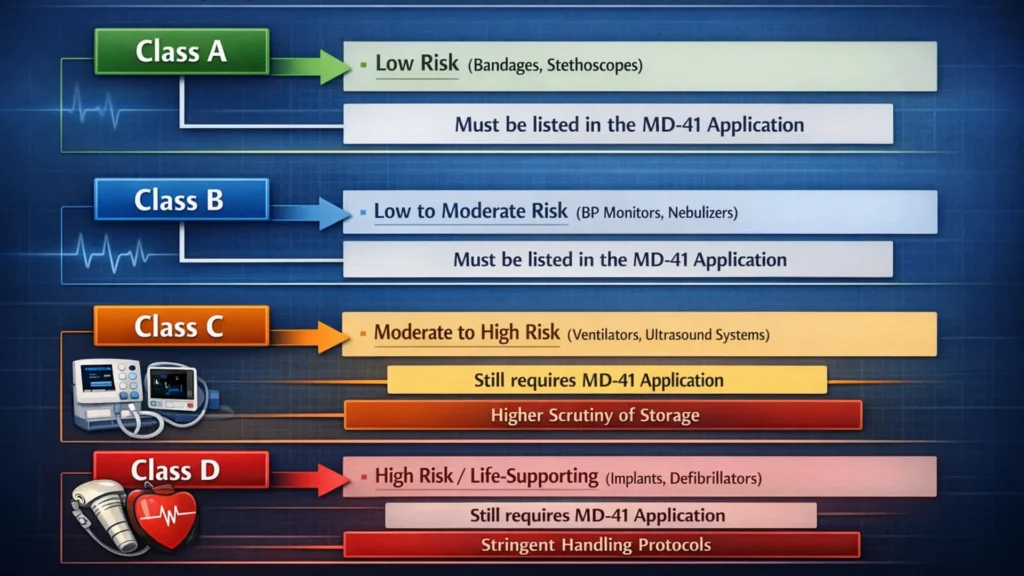
The following four sections provide a detailed, class-wise breakdown of patient monitor devices with their CDSCO classification. This list is informed by the notified device schedules and the risk-based classification guidelines under MDR 2017. Always verify your specific device against the latest CDSCO notification before proceeding with registration.
Class A Patient Monitors — Low Risk
Class A patient monitors are low-risk, non-invasive devices typically used in home, OPD, or general ward settings where failure or malfunction does not pose an immediate threat to life. These devices are usually supplied in a non-sterile state, have a simple intended use, and do not require highly skilled clinical interpretation in real time.
Class A devices require CDSCO registration, but the documentation burden and regulatory scrutiny are comparatively lower than higher-class devices. The import license (MD-15) and manufacturing license (MD-5) for Class A devices are typically processed faster.
| S.No. | Device Name | Intended Use | CDSCO Class | Remarks |
| 1 | Non-invasive blood pressure (NIBP) monitor (standalone, single-parameter) | Measurement of blood pressure by non-invasive method in low-risk settings | Class A | General ward/home use |
| 2 | Pulse oximeter (non-monitoring, clip-type, spot-check) | Spot-check SpO2 and pulse rate; not for continuous monitoring | Class A | Consumer/OPD segment |
| 3 | Non-electronic, non-powered thermometer (for reference in monitoring kits) | Body temperature measurement; non-invasive, non-critical | Class A | Included in monitoring kits |
| 4 | Finger-tip pulse oximeter (spot-check, OTC type) | Short-duration SpO2 spot checks, non-continuous use | Class A | OTC/home health |
| 5 | Ambulatory blood pressure monitor (non-alarming, data-logging only) | Recording BP readings over 24 hours; data download offline | Class A | No real-time alarm feature |
Note: As regulatory notifications are periodically updated by MoHFW/CDSCO, it is advisable to cross-check the current notified device list on the SUGAM portal before commencing the registration process.
Class B Patient Monitors — Low to Moderate Risk
Class B patient monitors are medium-risk devices intended for use in hospital general wards, step-down units, labour rooms, and outpatient diagnostic settings. They involve continuous monitoring with alarm functionality but are not typically deployed in life-critical ICU environments.
These devices must meet more rigorous technical standards than Class A. For import, a more complete technical file is required, and CDSCO scrutiny may involve queries for performance and safety evidence. For manufacturing, the same MD-3/MD-5 route applies as for Class A, but the dossier content is more detailed.
| S.No. | Device Name | Intended Use | CDSCO Class | Remarks |
| 1 | Multi-parameter patient monitor (ECG, SpO2, NIBP, temperature — ward level) | Continuous monitoring of vital signs in general ward patients; low acuity | Class B | General ward, step-down care |
| 2 | Bedside cardiac monitor with ECG display (non-ICU) | Real-time display of ECG waveform and heart rate; non-critical care | Class B | General ward monitoring |
| 3 | Fetal heart rate monitor (CTG/cardiotocograph, external) | Non-invasive monitoring of fetal heart rate and uterine contractions | Class B | Labour ward, OBG use |
| 4 | Continuous pulse oximeter (hospital-grade, alarming, ward use) | Continuous SpO2 and pulse rate with alarm; general ward patient use | Class B | General nursing station |
| 5 | Patient telemetry monitor (single-channel ECG, ward use) | Wireless ECG transmission to central station in general ward | Class B | Telemetry ward |
| 6 | Ambulatory ECG monitor / Holter recorder (diagnostic, 24–48 hr) | Recording cardiac rhythm over 24–48 hours for arrhythmia diagnosis | Class B | OPD/diagnostic use |
| 7 | Capnograph (sidestream, low acuity, non-ICU) | Monitoring end-tidal CO2 in spontaneously breathing patients in low-risk areas | Class B | Recovery room, general ward |
| 8 | Non-invasive cardiac output monitor (low acuity) | Estimating cardiac output non-invasively in stable patients | Class B | Step-down care |
| 9 | Temperature monitoring system (multi-point, ward) | Continuous body temperature monitoring for multiple ward patients | Class B | Infection, post-op ward |
| 10 | Neonatal SpO2/pulse oximeter monitor (hospital, alarming) | Continuous SpO2 monitoring in neonates in nursery/SNCU | Class B | Neonatal nursing care |
Class C Patient Monitors — Moderate to High Risk
Class C patient monitors are high-acuity devices used in Intensive Care Units (ICUs), Operation Theatres (OTs), and specialised clinical environments. These devices continuously monitor critically ill patients where inaccurate readings or device failure could cause serious injury or death.
Importing Class C patient monitors requires a more comprehensive technical dossier, clinical evidence, and in many cases international regulatory approval (e.g., CE Mark under EU MDR 2017/745, US FDA 510(k)/PMA, or TGA approval). Manufacturing Class C devices requires an MD-7 application and CDSCO GMP audit before the MD-9 license is issued.
| S.No. | Device Name | Intended Use | CDSCO Class | Remarks |
| 1 | ICU multi-parameter patient monitor (ECG, SpO2, NIBP, IBP, EtCO2, Temp) | Continuous comprehensive vital sign monitoring in ICU/HDU patients | Class C | Critical care, ICU |
| 2 | Cardiac monitor with 12-lead ECG analysis (ICU/CCU) | Real-time 12-lead ECG display, arrhythmia detection, and ST-segment analysis in critical care | Class C | CCU/cardiac ICU |
| 3 | Invasive blood pressure (IBP/arterial line) monitoring module | Continuous arterial/venous pressure monitoring via invasive catheter | Class C | ICU/OT, hemodynamic monitoring |
| 4 | Neonatal/paediatric ICU patient monitor (multi-parameter) | High-acuity monitoring of critically ill neonates/children | Class C | NICU/PICU |
| 5 | Anaesthesia workstation patient monitor (integrated, OT) | Monitoring vital signs and anaesthetic agent concentrations during surgery | Class C | Operation theatre use |
| 6 | Central monitoring station / bedside network (ICU) | Aggregating, displaying and alarming patient data from multiple ICU bedside monitors | Class C | ICU nursing station |
| 7 | Portable transport monitor (ICU-grade, alarming, battery) | Continuous monitoring of critically ill patients during intra-/inter-hospital transport | Class C | Transport/retrieval use |
| 8 | Haemodynamic monitoring system (PiCCO/PAC/LIDCO type) | Advanced cardiac output, preload, and afterload monitoring via thermodilution or pulse contour | Class C | ICU haemodynamic assessment |
| 9 | Transcutaneous CO2/O2 monitor (NICU/paediatric) | Non-invasive continuous measurement of transcutaneous PtCO2/PtO2 in neonates | Class C | NICU critical monitoring |
| 10 | Bispectral index (BIS) depth-of-anaesthesia monitor | Monitoring depth of sedation/anaesthesia via processed EEG in OT/ICU | Class C | Anaesthesia/sedation monitoring |
| 11 | Intraoperative neurophysiology monitoring (IONM) system | Continuous monitoring of neural function (SSEP, MEP, EMG) during high-risk surgery | Class C | Neuro/spinal OT |
| 12 | Near-infrared spectroscopy (NIRS) cerebral/somatic oximeter | Non-invasive continuous monitoring of regional tissue oxygen saturation | Class C | Cardiac/vascular/NICU |
| 13 | EEG monitoring system (ICU, seizure detection) | Continuous EEG monitoring for seizure detection in ICU patients | Class C | Neurological ICU |
| 14 | Volumetric capnograph (mainstream, ICU/OT) | Accurate breath-by-breath volumetric CO2 measurement in intubated patients | Class C | ICU/OT capnography |
Class D Patient Monitors — High Risk
Class D patient monitors represent the highest risk category under MDR 2017. These are typically implantable or invasive devices where failure directly endangers the patient's life. CDSCO applies the most stringent requirements for Class D — including mandatory international regulatory approval, full clinical evidence, and CDSCO GMP audit for manufacturers.
Very few standalone patient monitoring devices fall in Class D. The category is largely defined by implantable sensor systems and high-invasiveness haemodynamic monitoring requiring right-heart catheterisation.
| S.No. | Device Name | Intended Use | CDSCO Class | Remarks |
| 1 | Implantable cardiac event monitor / loop recorder (with external programmer) | Long-term subcutaneous ECG monitoring for paroxysmal arrhythmia detection | Class D | Implanted; highest risk |
| 2 | Pulmonary artery catheter (PAC/Swan-Ganz) monitoring system | Invasive haemodynamic monitoring via right heart catheterisation; cardiac output, wedge pressure | Class D | ICU; highest invasive risk |
| 3 | Intracranial pressure (ICP) monitoring system | Invasive measurement of intracranial pressure via intraparenchymal/intraventricular sensor | Class D | Neurosurgical ICU; implanted sensor |
| 4 | Continuous glucose monitoring (CGM) implantable sensor system (hospital-grade) | Real-time interstitial glucose monitoring via implanted sensor in critically ill patients | Class D | ICU glucose management; implanted |
| 5 | Implantable haemodynamic monitoring system (e.g., CardioMEMS-type) | Continuous remote pulmonary artery pressure monitoring via permanently implanted sensor | Class D | Heart failure remote monitoring |
CDSCO License Types for Patient Monitors: At a Glance
Depending on your business activity — importing, wholesaling, or manufacturing — a different set of CDSCO license forms applies. The table below summarises all applicable license types for patient monitors in India.
| License Type | Application Form | Grant Form | Applicable Class | Validity | Authority |
| Import License | MD-14 | MD-15 | A, B, C, D | 3 years | CDSCO Central Licensing Authority |
| Wholesale License | MD-41 | MD-42 | A, B, C, D | 5 years | State Licensing Authority |
| Manufacturing (Low Risk) | MD-3 | MD-5 | A & B | 5 years | State/CDSCO SLA |
| Manufacturing (High Risk) | MD-7 | MD-9 | C & D | 3 years | CDSCO Central LA |
How to Get CDSCO Import License for Patient Monitor (MD-14 & MD-15)
If your company imports patient monitors into India from any foreign country — whether you are the Indian arm of a global OEM, an authorised distributor, or an independent importer — you must obtain an import license under the Medical Devices Rules, 2017, before the first commercial shipment arrives at Indian customs.
What Is Form MD-14?
Form MD-14 is the application form for grant of a license to import a medical device into India. It is submitted electronically through the SUGAM portal, which is CDSCO's single-window online regulatory submission system. MD-14 must be accompanied by the full technical dossier for the device, the manufacturer's authorisation, and the government fee.
What Is Form MD-15?
Form MD-15 is the import license granted by CDSCO (the Central Licensing Authority) to the importer upon successful evaluation of the MD-14 application. The MD-15 license is device-specific and has a validity of three years, after which it must be renewed.
Eligibility for Import License
- The applicant must be a company registered in India or a proprietorship/partnership firm with a valid business address in India.
- The applicant must have a business premises suitable for storage of the imported devices (temperature-controlled if required by the device).
- A qualified person (Diploma in Pharmacy or equivalent as per MDR 2017 Schedule II) must be appointed for Class B, C, and D devices.
- The foreign manufacturer must be a registered company manufacturing devices in compliance with the GMP standards of their country.
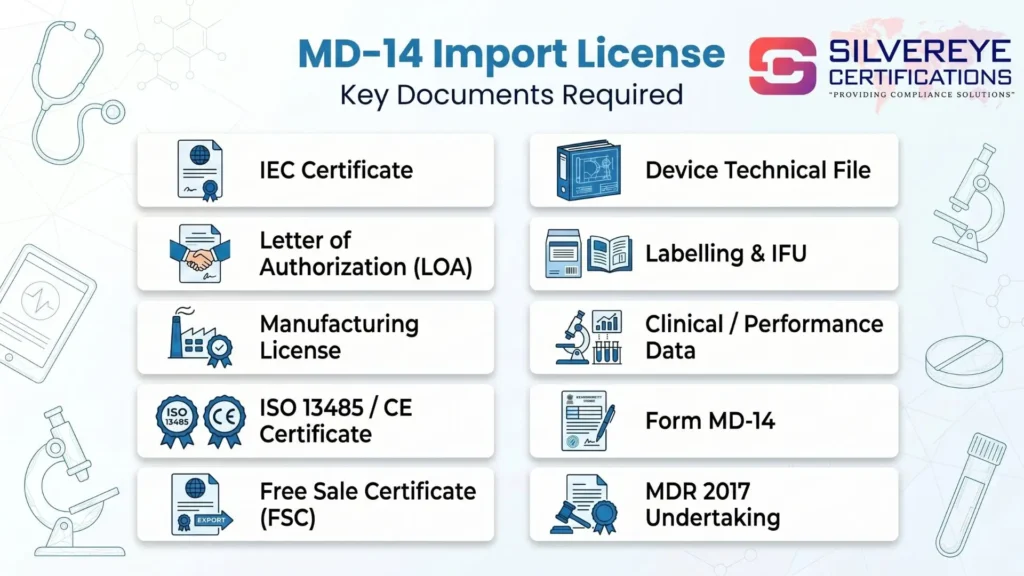
Documents Required for MD-14 Import License Application
| S.No. | Document | Details / Notes |
| 1 | Form MD-14 application (duly filled & signed) | Submitted on SUGAM portal with authorised signatory |
| 2 | Device Master File (DMF) / Technical File | Full technical dossier as per Schedule III of MDR 2017 |
| 3 | CE / US FDA / TGA / Health Canada approval (if applicable) | Mandatory for Class C & D; preferred for Class B |
| 4 | ISO 13485 Certificate of foreign manufacturer | Quality management system certification |
| 5 | Free Sale Certificate (FSC) from country of origin | Apostilled/notarised; CDSCO may accept e-FSC |
| 6 | Performance & safety test reports (IEC 60601-1 / relevant IS standard) | Including EMC (IEC 60601-1-2) and alarm (IEC 60601-1-8) reports |
| 7 | Clinical evaluation report / clinical evidence | Summary of clinical evidence; full for Class C & D |
| 8 | Risk management file (ISO 14971) | Summary acceptable for import dossier |
| 9 | Relationship agreement / authorisation letter | Foreign manufacturer authorising Indian importer |
| 10 | Manufacturing site details / GMP certificate | Site address, WHO-GMP or equivalent |
| 11 | Undertaking on CDSCO-prescribed format | Declaration of device compliance and recall obligations |
| 12 | Demand draft / online fee payment proof | As per MDR 2017, Schedule IV fee structure |
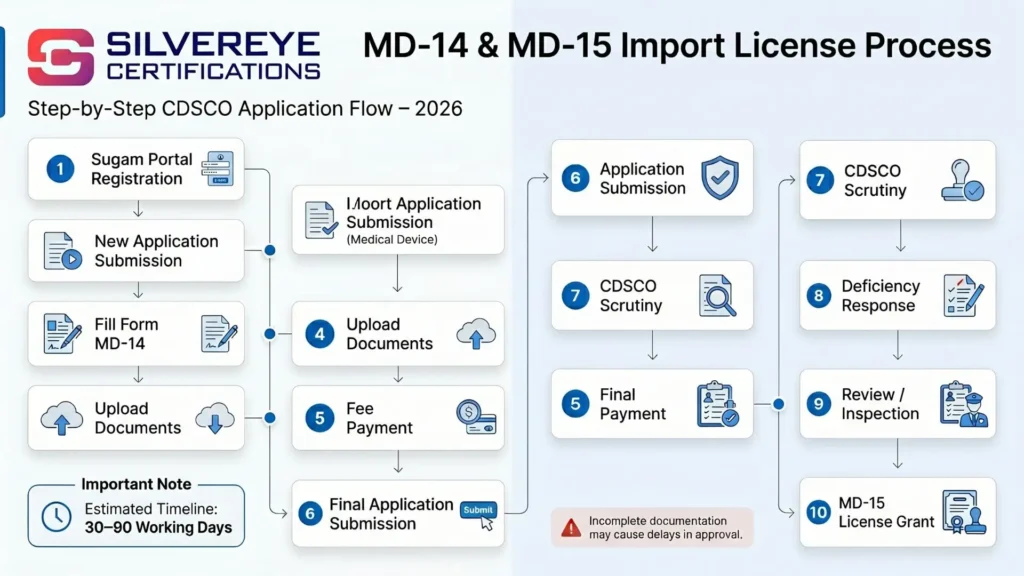
Step-by-Step Import License Process (MD-14 to MD-15)
- Create applicant account on SUGAM portal and register as an importer.
- Prepare the complete technical dossier as per Schedule III of MDR 2017.
- Fill Form MD-14 online and upload all supporting documents in the prescribed format (PDF, max file size per SUGAM limits).
- Pay the prescribed government fee (₹5,000 for Class A/B; ₹10,000 for Class C/D) through the SUGAM payment gateway.
- CDSCO scrutinizes the application; a deficiency letter (query) may be raised within 30 working days — respond promptly.
- For Class C/D, CDSCO's Technical Expert Committee (TEC) may be involved in the review.
- On approval, CDSCO issues the import license on Form MD-15, which is downloadable from the SUGAM portal.
- The MD-15 license number and validity must be mentioned on the device label or commercial invoice for customs clearance.
CDSCO Wholesale License for Patient Monitor (MD-41 & MD-42)
Any company that buys patient monitors in bulk from an importer or manufacturer and sells them to hospitals, clinics, or retailers in India must obtain a wholesale license. The wholesale license is issued by the State Licensing Authority (SLA) — typically the State Drugs Controller — rather than CDSCO centrally.
What Is Form MD-41?
MD-41 is the application form for grant of a wholesale license for medical devices. It is submitted to the State Licensing Authority of the state where the wholesale business premises are located.
What Is Form MD-42?
MD-42 is the wholesale license issued by the State Licensing Authority on receipt and approval of the MD-41 application. The MD-42 license has a validity of five years and must be renewed before expiry.
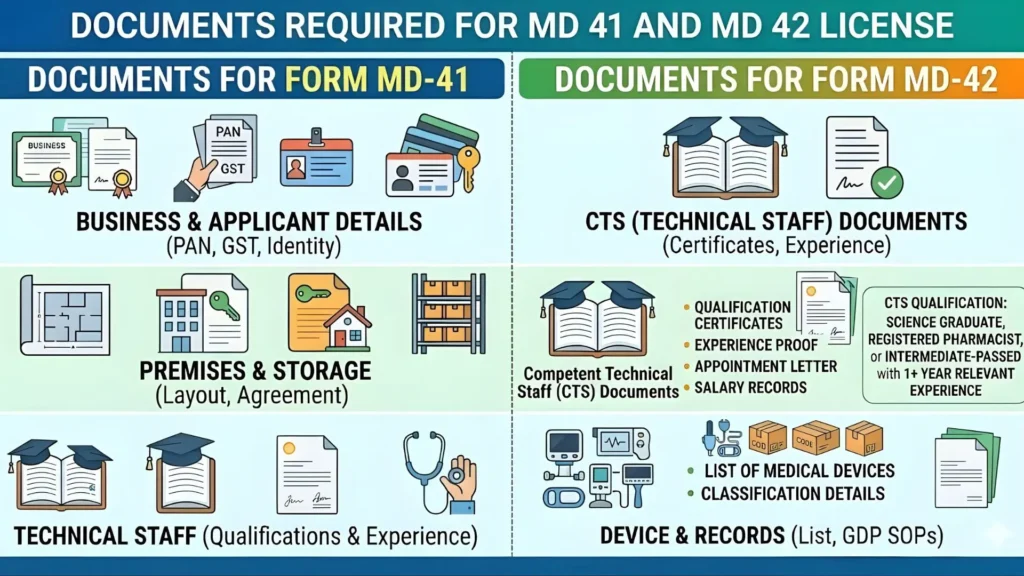
Documents Required for MD-41 Wholesale License
| S.No | Document | Notes |
| 1 | Form MD-41 application (signed by proprietor/authorised person) | Submitted to State Licensing Authority |
| 2 | Proof of business premises (owned/rented) | Lease deed or ownership document |
| 3 | Layout plan of wholesale premises (to scale) | Separate cold-storage, storage, and dispatch areas |
| 4 | Affidavit of non-conviction under Drugs & Cosmetics Act | From proprietor or all directors |
| 5 | Identity and address proof of applicant/partners/directors | PAN, Aadhaar, Passport as applicable |
| 6 | List of devices proposed to be wholesaled | With CDSCO registration numbers |
| 7 | Qualified person (QP) appointment letter and qualification proof | Diploma in Pharmacy or equivalent as per rules |
| 8 | Fee payment challan/demand draft | As prescribed by State Licensing Authority |
Key Points on Wholesale License for Patient Monitors
- A separate MD-41/MD-42 may be required for each state where wholesale activity takes place.
- Hospitals purchasing patient monitors directly from importers for their own use may be exempt from obtaining a wholesale license, but must purchase only from licensed sellers.
- The State Licensing Authority may inspect the wholesale premises before granting or renewing the MD-42 license.
- Cold-chain patient monitoring accessories (e.g., certain electrode types or calibration solutions) may require temperature-controlled storage at the wholesale premises.
CDSCO Manufacturing License for Class A & B Patient Monitors (MD-3 & MD-5)
Indian manufacturers of Class A and Class B patient monitors must obtain a manufacturing license under the Medical Devices Rules, 2017. The application is made on Form MD-3 and the license is issued on Form MD-5 by the State Licensing Authority (for Class A/B) or CDSCO (in some cases depending on state delegation).
What Is Form MD-3?
MD-3 is the application form for grant of a license to manufacture medical devices of Class A and Class B risk categories. It is submitted along with the site master file, technical documentation, and GMP compliance declaration.
What Is Form MD-5?
MD-5 is the manufacturing license issued by the State Licensing Authority upon successful evaluation of the MD-3 application and, where required, GMP inspection of the manufacturing site. MD-5 has a validity of five years.
Documents Required for MD-3 Manufacturing License (Class A/B)
| S.No | Document | Notes |
| 1 | Form MD-3 application | Via SUGAM portal to State Licensing Authority |
| 2 | Site Master File (SMF) | Facility description, layout, QMS overview |
| 3 | Technical file / Device Master Record | Design, BoM, manufacturing process, IFU, labelling |
| 4 | ISO 13485 certificate or QMS documentation | Quality management system evidence |
| 5 | Risk management file (ISO 14971 summary) | Risk analysis and mitigation evidence |
| 6 | Performance test reports (relevant IS/IEC standards) | Safety and performance test data |
| 7 | List of critical suppliers | With supplier qualification records |
| 8 | GMP compliance undertaking | Signed by MD/CEO of the company |
| 9 | Land/building documents for manufacturing site | Ownership or long-term lease (min. 10 years) |
| 10 | Fee payment proof | Schedule IV of MDR 2017 |
Manufacturing Process: MD-3 to MD-5 (Class A/B)
- Submit Form MD-3 application through SUGAM portal to the State Licensing Authority.
- State SLA scrutinizes the application; deficiency queries may be raised.
- GMP inspection of manufacturing facility by State Drug Inspector (required for most applicants).
- Resolve any inspection observations (if raised in the inspection report).
- SLA issues Form MD-5 manufacturing license upon compliance — valid for 5 years.
CDSCO Manufacturing License for Class C & D Patient Monitors (MD-7 & MD-9)
Manufacturers of Class C and Class D patient monitors face the most rigorous regulatory pathway. The application is made on Form MD-7 to CDSCO (Central Licensing Authority) and the license is issued on Form MD-9. The process involves a mandatory CDSCO GMP audit, clinical evidence review, and in some cases Technical Expert Committee (TEC) evaluation.
What Is Form MD-7?
MD-7 is the application form for grant of a manufacturing license for Class C and Class D medical devices. It is submitted via the SUGAM portal to CDSCO's Central Licensing Authority. The application must be supported by a comprehensive technical dossier, clinical evaluation, and full risk management documentation.
What Is Form MD-9?
MD-9 is the manufacturing license granted by CDSCO upon successful evaluation of the MD-7 application, GMP audit, and all supporting technical and clinical documentation. MD-9 has a validity of three years for Class C/D devices.
Documents Required for MD-7 Manufacturing License (Class C/D)
| S.No. | Document | Notes |
| 1 | Form MD-7 application | SUGAM portal; CDSCO Central Licensing Authority |
| 2 | Full technical dossier (Schedule III, Part III) | Comprehensive design history file (DHF) |
| 3 | Clinical evaluation report (ISO 14155 / MEDDEV 2.7/1 Rev. 4) | Clinical evidence summary and appraisal |
| 4 | Detailed risk management file (ISO 14971) | Full risk management process documentation |
| 5 | ISO 13485 certificate | Mandatory for Class C/D; audited by accredited CB |
| 6 | Software documentation (IEC 62304) — if software included | SOUP list, architecture, validation report |
| 7 | Electrical safety and EMC test reports (IEC 60601-1 and -1-2) | From NABL-accredited or ILAC-member lab preferred |
| 8 | Biocompatibility data (ISO 10993) — if device contacts patient | For accessories in contact with skin/tissue |
| 9 | Sterility/packaging validation — if sterile accessories included | ISO 11135 or EN ISO 11607 as applicable |
| 10 | Post-market surveillance plan | PMS/PMCF plan for post-approval monitoring |
| 11 | GMP audit by CDSCO inspector | Mandatory; scheduled after application acceptance |
| 12 | Fee payment (higher than Class A/B) | ₹50,000–1,00,000 per Schedule IV |
Manufacturing Process: MD-7 to MD-9 (Class C/D)
- Prepare comprehensive technical dossier (Schedule III, Part III of MDR 2017) and clinical evaluation report.
- Submit Form MD-7 via SUGAM portal with complete dossier and pay prescribed fee.
- CDSCO scrutinizes the dossier; TEC review may be initiated for novel or complex devices.
- CDSCO inspector conducts GMP audit of the manufacturing facility — prepare Site Master File and audit trail.
- Address all GMP audit observations and submit CAPA (Corrective and Preventive Action) report.
- CDSCO issues Form MD-9 manufacturing license — valid 3 years; commence manufacturing and post-market surveillance.
Government Fees for CDSCO Patient Monitor Registration (2026)
Fees are prescribed under Schedule IV of the Medical Devices Rules, 2017. The following table summarises the key fee structures applicable to patient monitor registration in India. Note that fees are subject to revision by MoHFW; always verify current fees on the SUGAM portal before submission.
| License Type | Applicable Form | Class A/B (₹) | Class C/D (₹) | Remarks |
| Import License | MD-14 / MD-15 | 5,000 per device | 10,000 per device | SUGAM portal payment |
| Wholesale License | MD-41 / MD-42 | 2,000 | 2,000 | State SLA payment |
| Manufacturing (Class A/B) | MD-3 / MD-5 | 5,000 per device | N/A | State SLA; first product line |
| Manufacturing (Class C/D) | MD-7 / MD-9 | N/A | 50,000–1,00,000 | CDSCO; includes audit |
| Test Import License | MD-16 | As prescribed | As prescribed | For evaluation/testing only |
Professional service charges of regulatory consultants are separate from and additional to the above government fees. These vary based on device class, dossier complexity, and the scope of consulting engagement.
CDSCO Patient Monitor Registration Timeline (2026)
The timelines below reflect typical processing times under the Medical Devices Rules, 2017. Actual timelines depend on application completeness, CDSCO workload, and whether a deficiency letter (query) is raised. A well-prepared application with a complete dossier significantly reduces processing time.
| License | Class A/B Timeline | Class C/D Timeline | Key Milestones |
| Import (MD-14 → MD-15) | 30–60 working days | 60–90 working days | SUGAM review → scrutiny → clarification → approval |
| Wholesale (MD-41 → MD-42) | 15–30 working days | 15–30 working days | State SLA inspection → license issuance |
| Manufacturing A/B (MD-3 → MD-5) | 30–60 working days | N/A | State SLA inspection → GMP audit → license |
| Manufacturing C/D (MD-7 → MD-9) | N/A | 90–180 working days | CDSCO audit + clinical evidence review |
Important: The clock stops when CDSCO raises a deficiency letter and restarts only when the applicant responds. Prompt, accurate responses to queries are the single most effective way to reduce total registration time.
Validity and Renewal of CDSCO Licenses for Patient Monitors
CDSCO licenses for patient monitors are not permanent. Each license type has a defined validity period, and renewal must be applied for before the license expires. Operating with an expired license is a regulatory violation and can result in supply chain disruption, stock hold-up at customs, and penalties.
| License Type | Validity | Renewal Window | Consequence of Lapse |
| Import License (MD-15) | 3 years | Apply 90 days before expiry | Cannot import; stock recall risk |
| Wholesale License (MD-42) | 5 years | Apply 60 days before expiry | Cannot distribute; supply chain disruption |
| Manufacturing A/B (MD-5) | 5 years | Apply 90 days before expiry | Cannot manufacture or sell |
| Manufacturing C/D (MD-9) | 3 years | Apply 90 days before expiry | Production halt; CDSCO enforcement |
Renewal Process
- Submit the renewal application on the same form (MD-14 for import, MD-41 for wholesale, MD-3 for Class A/B manufacturing, MD-7 for Class C/D manufacturing) through the SUGAM portal.
- Updated documents — including revised test reports, updated FSC, and updated ISO 13485 certificate — must be submitted if any have expired or changed since the original application.
- For manufacturing licenses, a renewal GMP inspection may be required.
- CDSCO and State SLAs are expected to process renewal applications within the same statutory timelines as fresh applications.
If the renewal application is submitted before expiry and is pending at CDSCO/SLA at the time of expiry, the existing license is typically deemed valid until the renewal decision is made (deemed renewal provision).
Labelling Requirements for Patient Monitors Under MDR 2017
Every patient monitor sold in India — whether imported or manufactured locally — must carry a label compliant with Schedule I (Labelling) of the Medical Devices Rules, 2017. Non-compliant labelling is a ground for rejection at customs or market withdrawal.
Mandatory Label Elements
- Name of the device and its intended use
- Name and address of the manufacturer (and importer, for imported devices)
- Batch/lot number and date of manufacture
- Expiry date (if applicable)
- CDSCO import license number (MD-15) or manufacturing license number (MD-5/MD-9)
- IFU reference or Instructions for Use document number
- Warnings or precautions (e.g., 'Not for life support use' for Class A devices where applicable)
- Unique Device Identification (UDI) — to be phased in as per MoHFW roadmap
- Language: English and/or Hindi; regional language may be added
Post-Market Surveillance (PMS) Obligations for Patient Monitors
CDSCO requires all license holders — importers, manufacturers, and wholesalers — to maintain post-market surveillance systems for notified medical devices. This is particularly critical for Class C and D patient monitors given their use in high-acuity clinical settings.
PMS Requirements Under MDR 2017
- Maintain complaint records and grievance logs for all patient monitors sold in India.
- Report serious adverse events (SAEs) to CDSCO within 30 days (or 10 days for fatal/life-threatening events) of becoming aware.
- Implement a field safety corrective action (FSCA) / recall procedure if a safety issue is identified.
- For Class C/D: Maintain a Post-Market Clinical Follow-up (PMCF) plan and submit periodic safety update reports (PSUR) as directed by CDSCO.
- Retain all device distribution records for a minimum of five years (or the device lifetime if longer) to support traceability during recalls.
Common Mistakes That Delay CDSCO Patient Monitor Registration
A significant proportion of CDSCO registration applications for patient monitors are delayed because of avoidable errors. The following are the most frequently observed issues:
- Incorrect device classification — filing as Class B when the device is actually Class C due to its ICU use case.
- Incomplete technical dossier — missing EMC test reports, alarm safety reports (IEC 60601-1-8), or risk management summary.
- Expired Free Sale Certificate — FSC from the country of origin must be current at the time of application.
- Missing or incorrect relationship agreement — the authorization letter from the foreign manufacturer must be on company letterhead, notarized/apostilled, and address the specific device and the Indian importer by name.
- Wrong fee amount — Class C/D fees are ₹10,000 per device; applicants sometimes submit ₹5,000 (the Class A/B rate) for Class C products.
- Technical file not aligned with MDR 2017 Schedule III — dossiers prepared to EU MDR or FDA format need to be restructured for CDSCO.
- Slow response to CDSCO deficiency letters — CDSCO sets a deadline for responding to queries; missing it can result in the application being closed.
How Silvereye Certifications Can Help With CDSCO Patient Monitor Registration
Silvereye Certifications is a specialist regulatory consulting and certification firm with deep expertise in CDSCO medical device registration across all device classes. For patient monitor manufacturers, importers, and distributors, Silvereye offers end-to-end support — from device classification and dossier preparation to SUGAM submission, deficiency response management, and post-approval compliance.
Services Offered by Silvereye Certifications
- Device classification review under MDR 2017 (Class A, B, C, D)
- Preparation of technical dossier as per Schedule III — tailored for import (MD-14) and manufacturing (MD-3/MD-7) applications
- SUGAM portal account setup and application filing
- Deficiency letter response drafting and follow-up with CDSCO officers
- Gap analysis and readiness assessment for CDSCO GMP audits (Class C/D manufacturers)
- Wholesale license (MD-41/MD-42) filing support across all Indian states
- Renewal tracking and timely reminder service for MD-15, MD-42, MD-5, and MD-9 licenses
- Post-market surveillance (PMS) documentation and PSUR preparation
Silvereye Certifications has helped medical device companies across India, Korea, China, Germany, the US, and the UK navigate CDSCO registration for patient monitoring equipment — from basic pulse oximeters to complex ICU multi-parameter monitoring systems.
Conclusion: CDSCO Patient Monitor Registration in 2026
CDSCO registration for patient monitors is not a one-time formality — it is an ongoing regulatory commitment that begins with classification, runs through the license application process, and continues through post-market surveillance and timely renewal. In 2026, with enforcement intensity at an all-time high and SUGAM portal processes becoming increasingly sophisticated, businesses that invest in getting the regulatory pathway right from the start will save significant time, cost, and risk.
Whether you are an OEM bringing a new ICU multi-parameter monitor to the Indian market, an importer distributing ward-level patient monitoring systems, or an Indian manufacturer developing a domestically designed patient monitor for export and domestic sale — understanding the CDSCO regulatory framework is non-negotiable.
Partnering with an experienced regulatory consulting firm like Silvereye Certifications can make the difference between a smooth, on-time registration and months of costly delays due to incomplete documentation or incorrect classification.
Frequently Asked Questions
Are patient monitors notified of medical devices in India?
Yes. Patient monitors — including multi-parameter monitors, ECG monitors, pulse oximeters (hospital-grade), and ICU monitors — are notified medical devices under the Medical Devices Rules, 2017 and require CDSCO registration before import, manufacture, or sale.
What is the CDSCO risk classification of a multi-parameter ICU monitor?
A fully featured ICU multi-parameter monitor (ECG, IBP, SpO2, EtCO2, temperature) is typically classified as Class C due to its use in critical/high-acuity patients where failure could cause serious harm.
Which form do importers use to apply for a patient monitor import license?
Importers submit Form MD-14 (application) through the SUGAM portal. CDSCO issues the import license on Form MD-15 after review and approval.
What is the difference between MD-41 and MD-42?
MD-41 is the application form for a wholesale (distribution) license. MD-42 is the grant/license form issued by the State Licensing Authority confirming approval to wholesale medical devices including patient monitors.
Which manufacturing license forms apply to Class C & D patient monitors?
Manufacturers of Class C and D patient monitors apply via Form MD-7. CDSCO grants the manufacturing license on Form MD-9, following a GMP audit and clinical evidence review.
Do home-use pulse oximeters also require CDSCO registration?
Yes. Even consumer/home-use pulse oximeters are notified devices. Spot-check types without alarming function are typically Class A, but still require CDSCO registration for import or sale.
Is a CE Mark sufficient for CDSCO patient monitor registration?
A CE Mark under EU MDR 2017/745 is accepted as supporting evidence, particularly for Class C & D devices. However, it does not replace the CDSCO registration process; a full SUGAM application and CDSCO approval are still mandatory.
How long does CDSCO take to grant an import license for a Class B patient monitor?
Typically 30–60 working days for Class B devices, provided all documents are complete and no deficiency letter (query) is raised. Class C/D can take 60–90 working days.
What fees apply for importing a Class C patient monitor?
The CDSCO import license fee (Form MD-14) for a Class C or D device is ₹10,000 per device as per Schedule IV of the Medical Devices Rules, 2017.
Can a single MD-15 import license cover multiple patient monitor models?
Each device/model typically requires separate registration. However, accessories or variants that are substantially similar may be covered under a single license if CDSCO accepts them as the same device family.