CDSCO K-Beauty product registration follows two separate pathways depending on whether the products are imported or manufactured in India. For imported Korean cosmetics, the Indian agent, subsidiary, or importer files Form COS-1 on the CDSCO SUGAM portal; once CDSCO reviews the formulation, labelling, and Free Sale Certificate, it issues the COS-2 Import Registration Certificate, valid for 5 years.
For K-Beauty-style products manufactured inside India, the applicant files Form COS-5 with the State Licensing Authority; after document review and a site inspection, the SLA issues the COS-8 Manufacturing License, which stays valid indefinitely subject to a retention fee every 5 years. Both routes require every product to be mapped to one of CDSCO's roughly 80 cosmetic categories under the Cosmetics Rules, 2020.
Why CDSCO K-Beauty Products Registration Brands Need CDSCO Registration Before Entering India
Korean beauty has become one of the fastest-growing segments in India's personal care market, and that growth has pulled it directly under CDSCO's regulatory lens. Whether a brand is shipping finished serums and sheet masks from Seoul or setting up a contract manufacturing line in Gujarat or Himachal Pradesh, the product cannot legally enter Indian shelves, e-commerce listings, or distributor warehouses without the matching CDSCO approval.
CDSCO — the Central Drugs Standard Control Organization under the Ministry of Health and Family Welfare — regulates cosmetics under the Drugs and Cosmetics Act, 1940 and the Cosmetics Rules, 2020. The regulation splits cleanly into two tracks: import is handled centrally by CDSCO, while manufacturing is licensed by the State Licensing Authority (SLA) of the state where the factory is located. K-Beauty brands almost always start on the import track and later consider the manufacturing track once Indian sales volumes justify a local production or contract-manufacturing setup.
COS-1 and COS-2: The Import Pathway for CDSCO K-Beauty Products Registration
Most K-Beauty brands enter India as finished imported goods, which makes COS-1 and COS-2 the first compliance milestone. These two forms work as a pair: COS-1 is the application you submit, and COS-2 is the certificate CDSCO hands back once it is satisfied.
What Is Form COS-1?
Form COS-1 is the online application for an Import Registration Certificate, filed on the CDSCO SUGAM portal. It can be submitted by the foreign manufacturer's authorized Indian agent, an Indian subsidiary of the Korean brand, or any Indian importer bringing the products in. The form captures manufacturer and manufacturing-site details, brand name, the cosmetic category each product falls under, pack sizes, and all variants (shades, fragrances, sizes) sold under that brand.
Key documents that accompany a COS-1 filing for K-Beauty products typically include:
- Free Sale Certificate (FSC) issued by the Korean health authority, confirming the product is legally sold in Korea
- Manufacturing site details and a Certificate of GMP/ISO 22716 compliance from the Korean facility
- Power of Attorney authorizing the Indian agent to file on the brand's behalf, notarized or apostilled
- Ingredient list (INCI) for each product, mapped against India's Ninth Schedule restricted/permitted substances
- Product labels (inner and outer) showing compliance with Indian labelling rules under the Cosmetics Rules, 2020
- Certificate of Incorporation, GST certificate, PAN and Import Export Code (IEC) of the Indian importing entity
- Bharatkosh fee payment receipt
What Is Form COS-2?
COS-2 is not a separate application — it is the Import Registration Certificate CDSCO issues after it has reviewed and approved the COS-1 filing. Once issued, COS-2 is the legal document that allows the K-Beauty brand's products to clear Indian customs and be sold, distributed, or marketed anywhere in the country. Indian law does not allow products to be imported first and registered later, so COS-2 must be in hand before the first shipment lands.
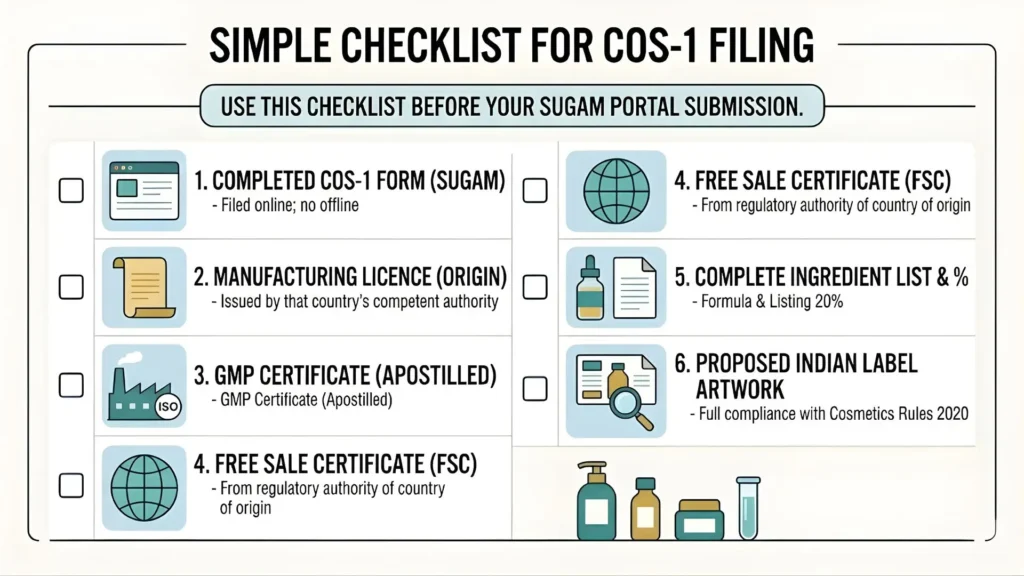
COS-1 starts the process, COS-2 completes it. A brand cannot get COS-2 without first filing a complete and accurate COS-1.
COS-5 and COS-8: The Manufacturing Pathway for K-Beauty Products
Once a K-Beauty brand decides to manufacture in India — either through its own facility or a third-party contract manufacturer — the import route no longer applies. Domestic manufacturing is licensed by the State Licensing Authority (SLA), not CDSCO centrally, even though both operate under the same Cosmetics Rules, 2020 framework.
What Is Form COS-5?
Form COS-5 is the application for a license to manufacture cosmetics for sale or distribution in India. It is filed with the SLA of the state where the manufacturing unit is located, through the SUGAM portal. A manufacturer can apply under COS-5 for up to ten items within a given cosmetic category in a single application.
Documents generally required with a COS-5 filing include:
- Cover letter and the completed application form, along with the prescribed government fee receipt
- Site Master File and manufacturing premises plant layout
- List of cosmetic products and categories proposed to be manufactured
- Proof of qualified technical staff (a Diploma or degree in pharmacy, or equivalent qualification recognised by the Licensing Authority)
- Form COS-7 self-declaration confirming Good Manufacturing Practice (GMP) compliance under the Seventh Schedule
- List of equipment and machinery installed at the facility
- Undertaking of product compliance as per the Cosmetics Rules, 2020
Brands that do not own a manufacturing facility but want to use a third-party GMP-compliant plant can instead apply for a Loan License using Form COS-6, which is issued as Form COS-9 rather than COS-8.
What Is Form COS-8?
COS-8 is the Manufacturing License itself — the certificate the SLA issues after it has reviewed the COS-5 application and physically inspected the manufacturing premises. The State Licensing Authority (also called the State Drug Controller) is required to inspect the site within 30 days of receiving the application and is expected to grant or reject the license within 45 days of completing document and site verification.
A COS-8 license remains valid indefinitely unless the SLA suspends or cancels it, but the manufacturer must pay a license retention fee before the end of every 5-year period to keep it active. This is a key difference from the import side, where COS-2 has a fixed 5-year validity and requires a full renewal, not just a retention fee.
COS-1 vs COS-2 vs COS-5 vs COS-8: Side-by-Side Comparison
| Parameter | COS-1 | COS-2 | COS-5 | COS-8 |
| What it is | Import registration application | Import Registration Certificate | Manufacturing license application | Manufacturing License certificate |
| Who files / issues it | Filed by Indian agent, subsidiary, or importer | Issued by CDSCO (Central Licensing Authority / DCGI) | Filed by the manufacturer or brand owner | Issued by the State Licensing Authority (SLA) |
| Governing route | Central — CDSCO, SUGAM portal | Central — CDSCO | State — SLA, SUGAM portal | State — SLA / State Drug Controller |
| Typical timeline | 60–90 days for review | Issued on approval of COS-1 | Site inspection within 30 days; decision within 45 days | Issued on approval of COS-5 and site inspection |
| Validity | One-time application per filing | 5 years from date of issue | One-time application per filing | Valid indefinitely; retention fee due every 5 years |
| Best suited for | Brands shipping finished K-Beauty products into India | Holding the legal right to import & sell in India | Brands setting up or using an Indian factory | Legally manufacturing & selling cosmetics made in India |
Step-by-Step Process: COS-1 to COS-2 Import Registration
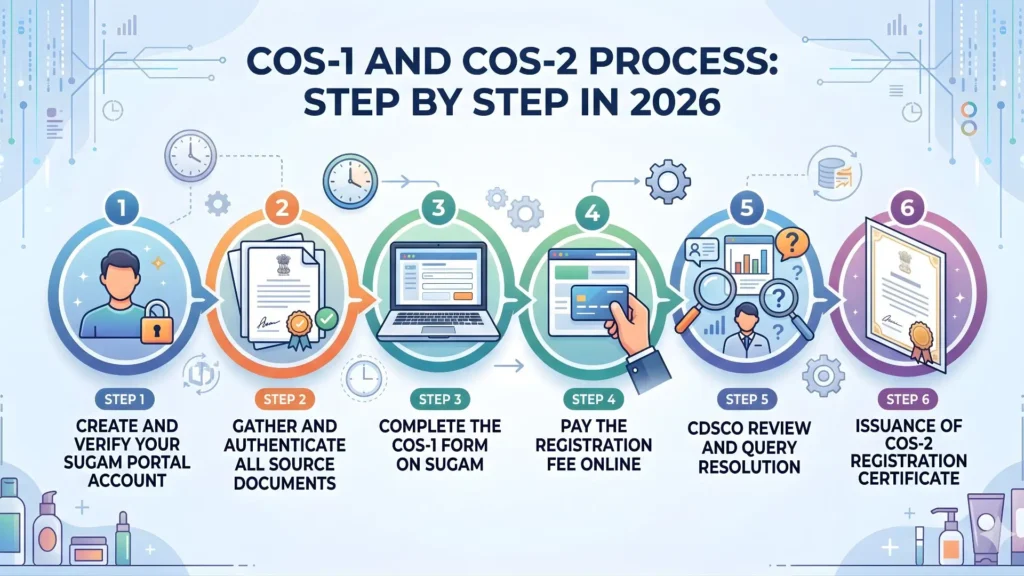
- Appoint an Authorized Indian Agent if the Korean manufacturer does not have an Indian subsidiary.
- Register on the CDSCO SUGAM portal and create login credentials with a valid email and mobile number.
- Categorize every product correctly against CDSCO's cosmetic category list — this single step prevents most delays.
- Compile documents: Free Sale Certificate, ingredient list, labels, Power of Attorney, manufacturing site details.
- Submit Form COS-1 with all supporting documents and pay the prescribed fee through the Bharatkosh gateway.
- Respond to CDSCO queries, if any, through the SUGAM dashboard within the stipulated time.
- Receive the COS-2 Import Registration Certificate once CDSCO is satisfied with the application.
- Print the COS-2 registration number on every product label before the first shipment clears customs.
Step-by-Step Process: COS-5 to COS-8 Manufacturing License
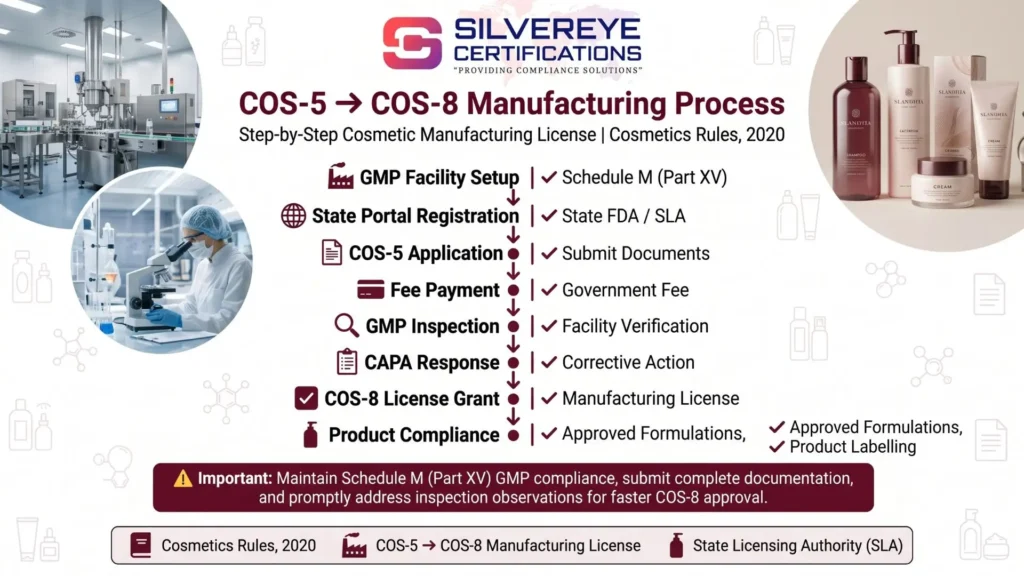
- Register on the SUGAM portal and select the cosmetic manufacturing license application.
- Prepare the Site Master File, plant layout, equipment list, and technical staff qualification proof.
- File Form COS-5 along with the Form COS-7 GMP self-declaration and prescribed fee.
- The SLA reviews documents and schedules a physical inspection of the manufacturing premises within 30 days.
- Address any deficiencies raised by the inspecting officer or Licensing Authority.
- The SLA grants the COS-8 Manufacturing License within 45 days of completed verification.
- Upload the license to the CDSCO portal for transparency and print the Mfg. Lic. No. on product labels.
- Prepare for routine inspections — every licensed facility is inspected at least once every 3 years.
Eligibility: Who Can Apply for Each CDSCO Cosmetic Approval
Eligibility for COS-1 / COS-2 (Import)
- The Korean manufacturer itself, if it has a registered presence in India
- An authorized Indian agent appointed by the Korean manufacturer
- An Indian subsidiary of the foreign brand
- Any Indian importer bringing in cosmetics from a Korean manufacturer, with the manufacturer's authorization
Eligibility for COS-5 / COS-8 (Manufacturing)
- Any entity with a GMP-compliant manufacturing facility in India, or access to one through a loan-license arrangement
- A nominated technical staff member holding a Diploma or degree in Pharmacy, or a qualification the Licensing Authority considers equivalent (such as Intermediate/Class 12 with Chemistry, in some states)
- Premises that meet the plant, equipment, and hygiene standards under the Seventh Schedule of the Cosmetics Rules, 2020
CDSCO Cosmetic Product Categories: Full Table for K-Beauty Products
CDSCO classifies cosmetics into roughly 80 categories under the Cosmetics Rules, 2020. Every product in a COS-1 or COS-5 filing must be mapped to the correct category, since it determines the applicable fee, the labelling rules, and the safety standards the product is checked against. Below is a practical grouping of the major category clusters most relevant to K-Beauty product lines — skincare, haircare, and color cosmetics make up the bulk of Korean beauty exports to India.
| Category Cluster | Typical K-Beauty Products | Key Regulatory Note |
| Skin care | Essences, serums, ampoules, face creams, moisturisers, gel creams, sleeping masks | Largest cluster by volume; therapeutic claims (e.g. "treats acne") push the product into drug classification |
| Face masks & sheet masks | Sheet masks, peel-off masks, wash-off clay masks, sleeping packs | Claims must stay cosmetic — "hydrating" and "brightening" are fine; "anti-inflammatory treatment" is not |
| Sun care | Sunscreens, sun sticks, cushion SPF products, after-sun gels | SPF data must be included in the technical dossier submitted with COS-1 |
| Color cosmetics / makeup | Cushion foundations, BB/CC creams, lip tints, eyeshadow palettes, eyeliners | Multi-shade palettes sold as one retail unit are treated as a single variant for fee purposes |
| Lip care | Lip balms, lip sleeping masks, tinted lip oils | SPF-containing lip products need the same SPF data requirement as sun care |
| Eye care | Eye creams, eye patches, dark-circle serums | Products applied inside the eye itself are not cosmetics and need separate approval |
| Hair care | Shampoos, conditioners, hair masks, scalp serums, hair oils | Anti-dandruff and anti-hair-loss claims may trigger additional category-specific requirements |
| Hair color | Semi-permanent and permanent hair dyes, tints | Oxidation hair dyes are a distinct sub-category from non-oxidative color products |
| Body care | Body lotions, body washes, scrubs, body mists | Distinct category from "hand care," even when formulations overlap |
| Oral & personal hygiene | Whitening toothpaste, mouthwash, intimate hygiene washes | Whitening claims must stay cosmetic in nature; therapeutic oral claims require drug licensing |
| Fragrance & deodorant | Perfumes, colognes, deodorant sprays and roll-ons | Alcohol content and labelling disclosures apply under the Ninth Schedule |
| Nail care | Nail polish, nail strengtheners, cuticle oils | Acetone-based removers may carry additional safety labelling requirements |
CDSCO K-Beauty Registration Fees (2026)
| Approval | Government Fee | Fee Basis | Payment Gateway |
| COS-1 / COS-2 (Import) | USD 2,000 (or INR equivalent) per category, per brand | Charged per cosmetic category as listed in CDSCO's category list, plus a smaller per-variant fee for additional shades/sizes within the same brand | Bharatkosh |
| COS-5 / COS-8 (Manufacturing) | Approx. INR 10,000 for grant or retention of license, per category (up to 10 items); INR 500 for each additional category | Charged per cosmetic category covered by the manufacturing license | Bharatkosh / State treasury, as applicable |
Fee figures are based on current CDSCO and State Licensing Authority fee schedules at the time of writing and are subject to revision by government notification. Always confirm the latest applicable fee on the official CDSCO SUGAM portal before filing, since fee heads and amounts are set by government order and can change.
Validity, Renewal & Ongoing Compliance
- COS-2 (import) is valid for 5 years from the date of issue and must be renewed before expiry — there is no grace period for retrospective renewal.
- COS-8 (manufacturing) is valid indefinitely but requires a retention fee payment before the end of every 5-year cycle to remain active.
- Manufacturing facilities holding COS-8 are inspected at least once every 3 years, and within 30 days of the license being first granted.
- Any change — new SKU, new manufacturing room, change of technical in-charge — must be filed as an endorsement/amendment on the SUGAM portal, not left unreported.
- Adverse reactions, market withdrawals, or quality-standard issues reported by any regulator globally must be disclosed to CDSCO under the registration holder's standing undertaking.
Common Mistakes K-Beauty Brands Make During CDSCO Filing
- Filing under the wrong cosmetic category, especially for multi-function products like tinted sunscreens or BB creams
- Using therapeutic or drug-like claims ("treats," "cures," "heals") on labels or marketing, which can reclassify a cosmetic as a drug
- Submitting an unnotarized or non-apostilled Power of Attorney from the Korean manufacturer
- Assuming import registration covers manufacturing, or vice versa — they are entirely separate approvals
- Importing stock before COS-2 is issued, which Indian law does not permit under any circumstance
Conclusion
This guide reflects CDSCO's cosmetic regulatory framework under the Drugs and Cosmetics Act, 1940 and the Cosmetics Rules, 2020, as applicable through mid-2026. It draws on CDSCO's official guidance documents, the SUGAM portal process flow, and current State Licensing Authority practice for manufacturing licenses.
Regulatory fee schedules, processing timelines, and category lists are set and periodically revised by government notification. Before filing any application, confirm current fee amounts, document checklists, and category mappings directly on the CDSCO SUGAM portal or with a registered regulatory consultant, since this guide is intended as a comprehensive reference rather than a substitute for official notification text.
Frequently Asked Questions
What is the difference between COS-1 and COS-2 for K-Beauty imports?
COS-1 is the application an Indian agent or importer files with CDSCO to register Korean cosmetics for import. COS-2 is the Import Registration Certificate CDSCO issues once that application is approved. You cannot get COS-2 without first filing COS-1; they are two stages of one process, not two independent licenses.
Can a Korean cosmetics brand sell in India without CDSCO registration?
No. Under the Drugs and Cosmetics Act, 1940 and the Cosmetics Rules, 2020, no cosmetic product can be imported, sold, or distributed in India without the relevant CDSCO or State Licensing Authority approval. Selling unregistered K-Beauty products exposes the importer and seller to seizure of stock and penalties.
How long does CDSCO K-Beauty registration take?
Import registration (COS-1 to COS-2) typically takes around 60 to 90 days from a complete filing. Manufacturing license approval (COS-5 to COS-8) typically takes about 45 days after the State Licensing Authority completes document review and a site inspection, which itself must happen within 30 days of filing.
What is the validity of the COS-2 import certificate?
The COS-2 Import Registration Certificate is valid for 5 years from its date of issue. It must be renewed before expiry, since Indian regulations do not allow retrospective or lapsed registrations to be revived after the fact.
Is the COS-8 manufacturing license valid for life?
COS-8 remains valid indefinitely unless the State Licensing Authority suspends or cancels it. However, the manufacturer must pay a license retention fee before completing every 5-year period from the date of issue to keep the license active.
Do I need both COS-2 and COS-8 for my K-Beauty brand?
Only if your brand does both — imports finished Korean products and also manufactures some products locally in India. If you only import, you need COS-2. If you only manufacture domestically, you need COS-8. Many K-Beauty-inspired Indian brands eventually need both as they expand their product range.
What happens if I import K-Beauty products without COS-2?
Customs clearance will be blocked, since CDSCO registration is checked at the port of entry. Importing without COS-2 also risks confiscation of stock and regulatory penalties, and there is no provision in Indian law to register the product retroactively after import.
How many product categories does CDSCO recognize for cosmetics?
CDSCO recognizes approximately 80 cosmetic product categories under the Cosmetics Rules, 2020. Each K-Beauty product (serum, sheet mask, cushion foundation, sunscreen, and so on) must be mapped to the correct category before filing COS-1 or COS-5, as the category determines the fee and the applicable safety standards.
Can a K-Beauty brand use a third-party manufacturer in India instead of COS-5/COS-8?
Yes. A brand can use another company's GMP-compliant facility through a Loan License route, applying via Form COS-6, with the license issued as Form COS-9 rather than COS-8. This is common for brand owners who want to launch in India without building their own factory.
What documents does a Korean manufacturer need to provide for COS-1?
The Korean manufacturer typically needs to provide a Free Sale Certificate from Korea's health authority, a notarized or apostilled Power of Attorney authorizing the Indian agent, the manufacturing site's GMP/ISO 22716 certification, and a full ingredient (INCI) list for each product being registered.
Does CDSCO inspect Korean manufacturing facilities before granting COS-2?
CDSCO primarily reviews documentation, the Free Sale Certificate, and product safety data for imported cosmetics rather than conducting a routine physical inspection of the overseas factory. However, CDSCO can request product samples for testing and analysis if it considers this necessary during review.
What is the cost of CDSCO registration for a K-Beauty brand?
Import registration fees run to roughly USD 2,000 (or the INR equivalent) per cosmetic category per brand, plus smaller per-variant charges for additional shades or sizes. Manufacturing license fees are lower, at roughly INR 10,000 per category (covering up to 10 items) for grant or retention of a COS-8 license. Always verify current figures on the SUGAM portal, since government fee schedules can be revised.