
- CDSCO Medical Device Products List classifies all medical devices into 4 risk-based classes: A (lowest) to D (highest) under MDR 2017.
- As of 2026, over 50 categories of medical devices are notified and regulated under Schedule I of the Medical Device Rules, 2017.
- Every manufacturer and importer must obtain CDSCO registration/license before selling any notified medical device in India.
- Devices in Class C and Class D require mandatory clinical evaluation data along with regulatory submission.
What Is the CDSCO Medical Device Classification System?
If you are a medical device manufacturer, importer, distributor, or healthcare professional in India, understanding the CDSCO medical device products list by class is the single most important compliance step you need to take in 2026. The Central Drugs Standard Control Organization (CDSCO), operating under the Ministry of Health and Family Welfare, regulates all medical devices in India through the Medical Device Rules, 2017 (MDR 2017).
The classification framework divides medical devices into four distinct risk categories — Class A, Class B, Class C, and Class D — based on the intended use, duration of contact with the human body, degree of invasiveness, and potential risk to patients. This risk-based classification determines the level of regulatory scrutiny, documentation requirements, and the type of CDSCO license or registration a business must obtain.
CDSCO Medical Device Classification — Class A to D
The table below summarises all four risk classes, their risk profile, and typical device examples:
| Class | Risk Level | Regulatory Control | Examples |
| Class A | Low Risk | Self-declaration / Enrolment | Bandages, tongue depressors, thermometers |
| Class B | Low-to-Moderate Risk | CDSCO Registration | Hypodermic needles, sutures, hearing aids |
| Class C | Moderate-to-High Risk | CDSCO License (State + Central) | Lung ventilators, bone fixation plates, dialysis machines |
| Class D | Highest Risk | Rigorous CDSCO License + Clinical Data | Active implantable cardiac devices, HIV diagnostics, drug-eluting stents |
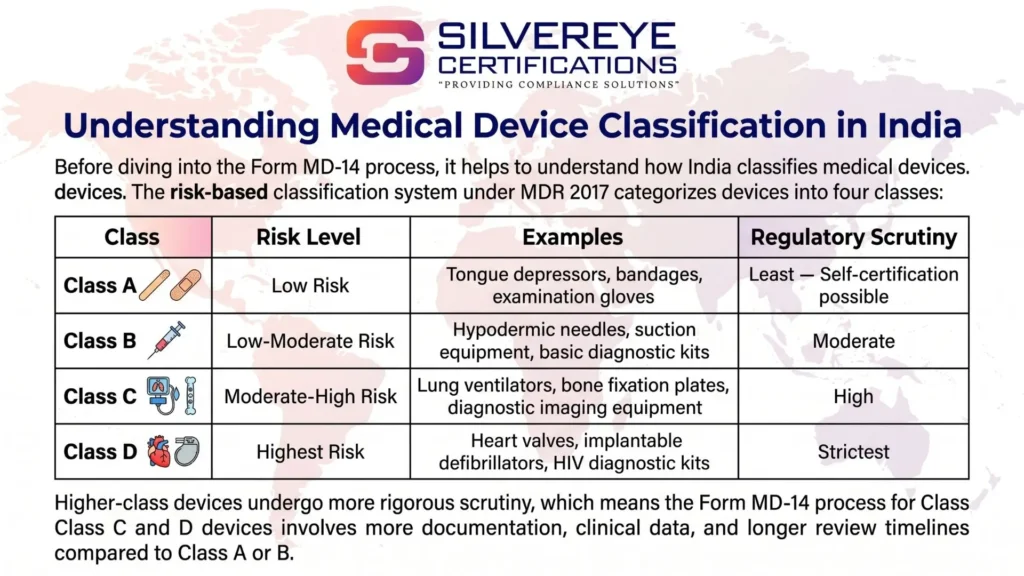
The regulatory pathway and documentation intensity increases significantly from Class A to Class D. Manufacturers or importers of Class D devices must submit clinical evaluation reports, post-market surveillance plans, and quality management system certificates.
Class A Medical Devices — Low-Risk Products List
Class A medical devices have a lowest risk to patients and users. These are non-invasive devices or devices with minimal body contact. Under MDR 2017, Class A devices require enrolment with the CDSCO portal (not a full license), making the compliance barrier lowest in this category. However, manufacturers must still maintain technical documentation, labelling compliance, and adverse event reporting obligations.
Complete List of Class A Medical Devices (CDSCO Notified, MDR 2017)
| S.No. | Product Name | Category / Sub-type |
| 1 | Adhesive Bandages | Wound Care |
| 2 | Gauze / Absorbent Cotton | Wound Dressing |
| 3 | Surgical Drapes (Non-sterile) | Surgical Accessories |
| 4 | Examination Gloves (Non-sterile) | Protective Equipment |
| 5 | Tongue Depressors | Examination Tools |
| 6 | Plasters and Adhesive Dressings | Wound Care |
| 7 | Digital Clinical Thermometers | Diagnostic Equipment |
| 8 | Walking Aids (crutches, canes) | Mobility Assistive Devices |
| 9 | Wheelchair (manually powered) | Mobility Assistive Devices |
| 10 | Hospital Beds (non-adjustable) | Hospital Furniture |
| 11 | Cold / Hot Packs (non-chemical) | Physical Therapy |
| 12 | Corrective Spectacles / Lenses (Class A variant) | Ophthalmic Devices |
| 13 | Dental Floss | Dental Accessories |
| 14 | Condoms (male) | Contraceptive Devices |
| 15 | Elastic Bandages / Compression Wraps | Wound Care / Orthopaedic |
| 16 | Urine Collection Bags (external, non-sterile) | Urology |
| 17 | Stethoscope | Diagnostic Instruments |
| 18 | Blood Pressure Monitoring Cuffs (manual) | Cardiovascular — Monitoring |
| 19 | Spatulas (non-invasive) | Examination Tools |
| 20 | Orthopaedic Supports / Soft Braces | Orthopaedic Accessories |
Note: Class A sterile devices (e.g., sterile wound dressings) require a higher level of conformity assessment and may be treated as Class B for registration purposes.
Class B Medical Devices — Low-to-Moderate Risk Products List (CDSCO)
Class B devices have a moderate interaction with the human body and carry a slightly elevated risk compared to Class A. These devices require a CDSCO Registration Certificate obtained from the Central Licensing Authority. Class B device manufacturers must submit a technical file demonstrating conformity with applicable Indian standards or equivalent international standards.
Complete List of Class B Medical Devices (CDSCO Notified, MDR 2017)
| S.No. | Product Name | Category / Sub-type |
| 1 | Hypodermic Syringes (disposable) | Injection Devices |
| 2 | Hypodermic Needles (disposable) | Injection Devices |
| 3 | IV Administration Sets | Infusion Therapy |
| 4 | Blood Transfusion Sets | Haematology Equipment |
| 5 | Urethral Catheters (short-term) | Urology |
| 6 | Sutures (absorbable and non-absorbable) | Wound Closure |
| 7 | Surgical Gloves (sterile) | Surgical Accessories |
| 8 | Hearing Aids (air-conduction) | ENT / Audiology |
| 9 | Orthopaedic Soft Tissue Implants (non-active) | Orthopaedics |
| 10 | Dental Impression Materials | Dental Devices |
| 11 | Wound Dressings (advanced, sterile) | Wound Management |
| 12 | Contact Lenses (daily wear, non-corrective) | Ophthalmic Devices |
| 13 | Blood Glucose Monitoring Systems (self-testing) | In Vitro Diagnostics |
| 14 | Nasogastric Tubes | Enteral Feeding Devices |
| 15 | Oxygen Masks and Tubing Sets | Respiratory Devices |
| 16 | Laryngoscope (non-electrical) | Anaesthesia Equipment |
| 17 | Foetal Doppler (hand-held) | Obstetric & Gynaecology |
| 18 | Pulse Oximeters | Patient Monitoring |
| 19 | Infusion Pumps (gravity-based) | Drug Delivery |
| 20 | Examination Gloves (sterile) | Protective Equipment |
| 21 | Spinal Needles | Anaesthesia Equipment |
| 22 | Endotracheal Tubes | Airway Management |
| 23 | Surgical Masks (Type IIR) | Infection Prevention |
| 24 | Compression Stockings (medical grade) | Vascular Devices |
| 25 | Dental Burs and Diamond Points | Dental Instruments |
Manufacturers of Class B devices must hold a valid manufacturing license from the State Licensing Authority and a CDSCO registration before commercial sale or import. Imported Class B devices require an Import License (Form MD-15) from CDSCO.
Class C Medical Devices — Moderate-to-High Risk Products List (CDSCO)
Class C devices are moderate-to-high risk devices that have significant interaction with human tissue, blood, or critical body systems. These include active therapeutic devices, long-term implantable devices, and devices used in critical care settings. Class C medical devices require both State Manufacturing License and Central License (Form MD-9) from CDSCO. Importers must obtain an Import License in Form MD-15.
The technical documentation for Class C devices must include pre-clinical safety data, biocompatibility testing, electrical safety testing (for active devices), and performance testing. Post-market clinical follow-up (PMCF) plans are also required.
Complete List of Class C Medical Devices (CDSCO Notified, MDR 2017)
| S.No. | Product Name | Category / Sub-type |
| 1 | Lung Ventilators (Invasive) | Critical Care / Respiratory |
| 2 | Haemodialysis Machines | Renal Care Equipment |
| 3 | Infusion Pumps (electronic, volumetric) | Drug Delivery Systems |
| 4 | Orthopaedic Bone Plates and Screws (implantable) | Orthopaedic Implants |
| 5 | Intramedullary Nails | Orthopaedic Implants |
| 6 | Spinal Implant Systems (non-active) | Spinal Devices |
| 7 | Vascular Grafts (non-drug coated) | Cardiovascular Implants |
| 8 | Hip Joint Replacement Systems | Orthopaedic Implants |
| 9 | Knee Joint Replacement Systems | Orthopaedic Implants |
| 10 | Intraocular Lenses (IOLs) | Ophthalmic Implants |
| 11 | Cochlear Implants (non-active component) | ENT Implants |
| 12 | Haemodialysis Filters / Dialysers | Renal Disposables |
| 13 | Oxygenators (heart-lung bypass) | Cardiac Surgery Equipment |
| 14 | Centrifugal Blood Pumps | Cardiac Surgery Equipment |
| 15 | Peripheral Vascular Stents (bare metal) | Cardiovascular Devices |
| 16 | Endoscopes (rigid and flexible, non-imaging) | Endoscopy Equipment |
| 17 | Laparoscopic Instruments (powered) | Minimally Invasive Surgery |
| 18 | Electrosurgical Units (ESUs) | Surgical Instruments |
| 19 | Anaesthesia Workstations | Anaesthesia Equipment |
| 20 | Patient Monitoring Systems (multi-parameter) | ICU Monitoring |
| 21 | Defibrillators (external, non-AED) | Cardiac Resuscitation |
| 22 | Enteral Feeding Pumps (electronic) | Enteral Nutrition |
| 23 | Blood Warmer Devices | Infusion Therapy |
| 24 | Neonatal Incubators | Neonatal Care |
| 25 | Phototherapy Units (neonatal) | Neonatal Care |
| 26 | Dental Implants (root form, titanium) | Dental Implants |
| 27 | Breast Implants (silicone, saline) | Plastic and Reconstructive Surgery |
| 28 | Tissue Expanders | Plastic and Reconstructive Surgery |
| 29 | Penile Implants | Urology Implants |
| 30 | Peritoneal Dialysis Equipment | Renal Care |
Class D Medical Devices — Highest Risk Products List (CDSCO)
Class D represents the most complex and highest-risk category of medical devices regulated by CDSCO. These are devices that sustain or support life, are implanted in the human body long-term, or are used in diagnostics of life-threatening conditions. The regulatory requirements for Class D devices are the most stringent — mandatory clinical investigation data, post-market surveillance studies, and in many cases, CDSCO-notified body conformity assessment.
Importers and manufacturers of Class D devices are required to demonstrate substantial equivalence or, in the absence of a predicate device, provide new clinical data. The CDSCO scrutinizes Class D device applications through its Expert Committee for Medical Devices before granting approval.
Complete List of Class D Medical Devices (CDSCO Notified, MDR 2017)
| S.No. | Product Name | Category / Sub-type |
| 1 | Pacemakers (implantable, cardiac) | Active Implantable Cardiac Devices |
| 2 | Implantable Cardioverter Defibrillators (ICDs) | Active Implantable Cardiac Devices |
| 3 | Cardiac Resynchronisation Therapy Devices (CRT-D, CRT-P) | Active Implantable Cardiac Devices |
| 4 | Drug-Eluting Coronary Stents | Cardiovascular Implants |
| 5 | Coronary Stents (bare metal, second use) | Cardiovascular Implants |
| 6 | Heart Valve Prostheses (mechanical and biological) | Cardiac Surgery Implants |
| 7 | Total Artificial Heart | Cardiac Implants |
| 8 | Ventricular Assist Devices (VADs) | Active Cardiac Support |
| 9 | Implantable Neurostimulators (spinal cord, deep brain) | Neuro Implants |
| 10 | Implantable Drug Delivery Systems (intrathecal pumps) | Drug Delivery Implants |
| 11 | Cochlear Implant (active component) | Active ENT Implants |
| 12 | Retinal Implants | Active Ophthalmic Implants |
| 13 | Total Disc Replacement Systems (active) | Spinal Implants |
| 14 | HIV Rapid Diagnostic Test Kits | In Vitro Diagnostics (IVDs) |
| 15 | Hepatitis B Surface Antigen (HBsAg) Test Kits | In Vitro Diagnostics |
| 16 | Hepatitis C Antibody Test Kits | In Vitro Diagnostics |
| 17 | Blood Grouping Reagents | Transfusion Medicine IVDs |
| 18 | CD4 Count Diagnostic Systems | IVDs for AIDS Monitoring |
| 19 | NAT (Nucleic Acid Testing) Kits for Blood Screening | Transfusion Safety IVDs |
| 20 | Dengue NS1 / IgG / IgM Combination Test Kits | Infectious Disease IVDs |
| 21 | Active Implantable Bone Growth Stimulators | Orthopaedic Active Implants |
| 22 | Long-Term Implantable Vascular Stents (drug-coated) | Peripheral Vascular |
| 23 | Intracranial Stents | Neurovascular Devices |
| 24 | Left Atrial Appendage Closure Devices | Structural Heart Devices |
| 25 | Transcatheter Aortic Valve Implantation (TAVI) Systems | Structural Heart Devices |
| 26 | Extracorporeal Membrane Oxygenation (ECMO) Systems | Critical Care Life Support |
| 27 | Implantable Loop Recorders | Active Cardiac Monitoring |
| 28 | Insulin Pumps (closed-loop, artificial pancreas) | Active Endocrine Implants |
| 29 | Continuous Glucose Monitoring (CGM) Systems (implantable) | Active Metabolic Monitoring |
| 30 | HbA1c Diagnostic Analysers (point-of-care) | In Vitro Diagnostics |
CDSCO Medical Device Registration & Licensing Process in India (Step-by-Step, 2026)
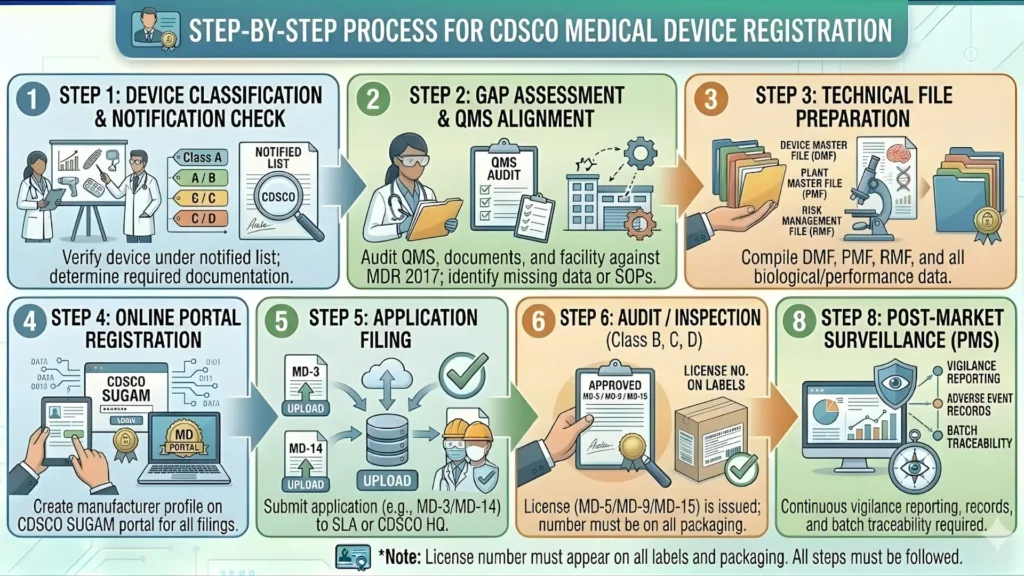
Whether you are a domestic manufacturer or an overseas company looking to import medical devices into India, here is the complete step-by-step CDSCO medical device registration process under MDR 2017 as it stands in 2026:
- Create an account on the CDSCO online portal: sugam.mohfw.gov.in — all applications are processed digitally.
- Determine the correct classification of your medical device (Class A, B, C, or D) as per Schedule III of MDR 2017.
- Prepare the technical documentation file including device description, intended use, standards compliance, risk analysis, biocompatibility data, and labelling.
- For Class C and Class D devices, prepare clinical evaluation reports (CER) and post-market surveillance (PMS) plans.
- For imported devices: appoint an Indian Authorized Agent and obtain a Free Sale Certificate / Certificate of Conformity from the country of origin.
- Pay the applicable application fee through the online portal.
- Submit the application online in the prescribed form (Form MD-14 for import registration / Form MD-3 for manufacturing license).
- Respond to CDSCO queries within the stipulated timeline — typically 30 to 90 working days depending on device class.
- If approved, CDSCO issues the Registration Certificate / Manufacturing License / Import License in digital format.
- Maintain post-market vigilance: report adverse events within 30 days of awareness (serious incidents within 10 days).
Who Needs to Register a Medical Device with CDSCO?
The Medical Device Rules, 2017 mandates regulatory action from the following entities:
- Indian Manufacturers producing any notified medical device for sale in India or for export.
- Importers bringing foreign-manufactured medical devices into India for commercial distribution.
- Authorized Indian Agents of overseas manufacturers who handle regulatory and post-market responsibilities in India.
- Contract Manufacturers producing devices on behalf of a brand owner for the Indian market.
- Re-labellers and Repackagers who modify the branding or packaging of registered devices.
Distributors and retailers are not required to obtain a CDSCO license but must ensure they deal only in devices covered by a valid CDSCO registration or license.
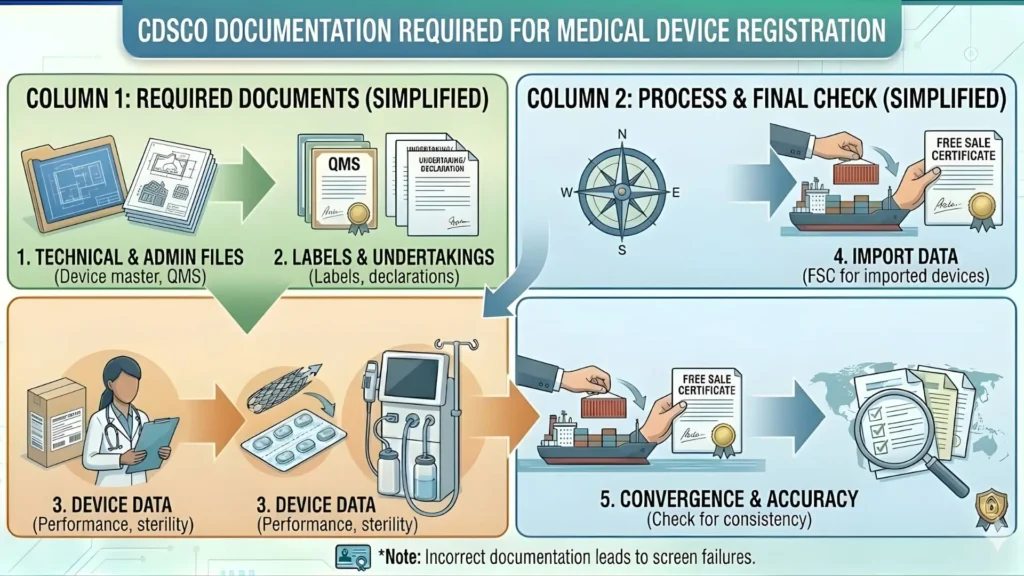
Documents Required for CDSCO Medical Device Registration
The documents required vary by device class. Here is a consolidated checklist:
| Document | Class A | Class B | Class C | Class D |
| Device Description and Intended Use | Yes | Yes | Yes | Yes |
| Technical File / Technical Documentation | Basic | Full | Full | Comprehensive |
| List of Standards Complied (BIS/ISO/IEC) | Yes | Yes | Yes | Yes |
| Risk Management File (ISO 14971) | No | Yes | Yes | Yes |
| Biocompatibility Test Reports (ISO 10993) | No | Yes | Yes | Yes |
| Electrical Safety Reports (IEC 60601, if applicable) | No | Partial | Yes | Yes |
| Sterility / Packaging Validation | If sterile | If sterile | Yes | Yes |
| Clinical Evaluation Report (CER) | No | Summary | Full CER | Full CER + Data |
| Post-Market Surveillance Plan | No | Basic | Detailed | Comprehensive |
| Free Sale Certificate (FSC) / CE / FDA Approval (imports) | No | Yes | Yes | Yes |
| ISO 13485 Quality Management Certificate | No | Yes | Yes | Yes |
| Undertaking by Authorised Agent (imports) | Yes | Yes | Yes | Yes |
| Manufacturing Site Master File | No | No | Yes | Yes |
| Drug Master File / Design Dossier (if combination device) | No | No | Conditional | Yes |
CDSCO Medical Device Registration Fees (Updated for 2026)
Government fees for CDSCO medical device registration are determined by the Third Schedule of MDR 2017. Fees differ based on device class and application type. The figures below are indicative and based on the latest CDSCO fee schedule:
| Application Type | Class A | Class B | Class C | Class D |
| New Device Registration (Domestic) | INR 5,000 | INR 15,000 | INR 50,000 | INR 1,00,000 |
| New Device Registration (Import) | INR 25,000 | INR 50,000 | INR 1,50,000 | INR 2,50,000 |
| Renewal of Registration (Domestic) | INR 2,500 | INR 7,500 | INR 25,000 | INR 50,000 |
| Renewal of Registration (Import) | INR 12,500 | INR 25,000 | INR 75,000 | INR 1,25,000 |
| Amendment to Registration Certificate | INR 1,000 | INR 2,500 | INR 10,000 | INR 20,000 |
Note: Fees for small-scale manufacturers (SSI) and start-ups may be eligible for concessions. Always verify the current fee schedule on the CDSCO website (cdsco.gov.in) before making payment, as these are subject to revision.
Validity Period and Renewal Timeline for CDSCO Medical Device License
| License / Registration Type | Validity Period | Renewal Application Window | Processing Time (Approx.) |
| Class A Enrolment | Perpetual (subject to compliance) | N/A | 7 to 15 working days |
| Class B Registration Certificate | 3 years | 90 days before expiry | 30 to 60 working days |
| Class C Manufacturing License (Form MD-9) | 5 years | 90 days before expiry | 60 to 90 working days |
| Class D Manufacturing License | 5 years | 90 days before expiry | 90 to 120 working days |
| Import License (Form MD-15) — All Classes | 3 years | 90 days before expiry | 30 to 90 working days |
Failing to apply for renewal within the prescribed window may result in lapse of the registration, requiring fresh application. The CDSCO has been increasingly strict about post-market compliance as part of its regulatory maturation in 2025 and 2026.
Benefits of CDSCO Medical Device Registration for Manufacturers and Importers
Obtaining CDSCO registration for your medical device offers significant business and compliance advantages:
- Legal market access: Only CDSCO-registered or licensed devices can be legally sold, distributed, or imported in India.
- Consumer trust and credibility: CDSCO approval signals product safety, quality, and performance to healthcare professionals and procurement committees.
- Participation in government tenders: Most Central and State government procurement portals mandate CDSCO registration as a pre-qualification criterion.
- Eligibility for export: CDSCO registration and a Certificate to Foreign Government (CFG) are required for exporting devices from India to regulated markets.
- Protection from product bans: Registered devices are less likely to face arbitrary market bans or enforcement actions by State Drug Controllers.
- Investment attractiveness: CDSCO-compliant product portfolios attract private equity, strategic buyers, and institutional investors in the MedTech space.
- Alignment with global standards: The MDR 2017 framework is broadly harmonised with the IMDRF guidelines, making CDSCO-compliant documentation reusable for CE, FDA, or TGA filings.
Conclusion — Navigating the CDSCO Medical Device Classification System in 2026
Understanding the CDSCO medical device products list by class is not just a regulatory exercise — it is a strategic business imperative for anyone operating in India's fast-growing INR 90,000 crore medical devices sector. Whether you manufacture stethoscopes (Class A), blood glucose monitors (Class B), hip implants (Class C), or cardiac pacemakers (Class D), the regulatory pathway, timelines, fees, and documentation requirements vary significantly.
India's medical device regulatory framework under MDR 2017 has matured considerably since its implementation, with CDSCO strengthening post-market surveillance, expanding the notified device list, and progressively aligning with global standards like IMDRF, ISO, and IEC. Companies that invest early in regulatory strategy — building proper technical files, obtaining the right licenses, and maintaining post-market vigilance systems — are far better positioned to capture growth in this regulated market.
If you are unsure about the classification of your specific product, CDSCO offers a pre-submission meeting facility. Additionally, engaging a qualified Indian Regulatory Affairs consultant can significantly reduce approval timelines and avoid costly application deficiencies.
Frequently Asked Questions
What is the full form of CDSCO and what does it do for medical devices?
CDSCO stands for Central Drugs Standard Control Organisation. It is India's national regulatory authority for pharmaceuticals and medical devices, functioning under the Directorate General of Health Services (DGHS), Ministry of Health and Family Welfare. For medical devices, CDSCO oversees classification, registration, licensing, quality control, and post-market surveillance under the Medical Device Rules, 2017.
How many classes of medical devices are there under MDR 2017?
There are four classes — Class A (low risk), Class B (low-to-moderate risk), Class C (moderate-to-high risk), and Class D (highest risk). Classification is based on intended use, duration of body contact, degree of invasiveness, and systemic effect on the body.
Are all medical devices regulated by CDSCO in India?
No. Only medical devices notified under Schedule I of the Medical Device Rules, 2017 are currently regulated by CDSCO. Devices not on this notified list are not yet under mandatory CDSCO oversight, though the government has signalled an intent to bring all medical devices under regulation progressively.
What is the difference between a CDSCO Registration Certificate and a Manufacturing License?
A Registration Certificate (Form MD-17 for Class A & B) is typically granted to manufacturers of lower-risk devices after document review. A Manufacturing License (Form MD-9 for Class C & D) is issued after a more rigorous assessment including site inspection and clinical data review. Import licenses (Form MD-15) are required for all imported notified medical devices, regardless of class.
How long does CDSCO medical device registration approval take in 2026?
Processing times vary by class and workload at CDSCO. Practically, Class A and Class B registrations take between 30 to 90 working days. Class C applications typically take 3 to 6 months, and Class D applications can take 6 to 12 months, especially if the Expert Committee needs to review clinical data.
Is ISO 13485 certification mandatory for CDSCO medical device registration?
ISO 13485 (Quality Management System for Medical Devices) is not explicitly mandated for all classes under MDR 2017, but it is practically required for Class C and Class D devices. CDSCO increasingly expects manufacturers to demonstrate a functional quality management system, and ISO 13485 is the accepted evidence of compliance. It is also required for obtaining WHO-PQ status and CE marking.
Can a foreign manufacturer directly apply for CDSCO registration without an Indian agent?
No. Foreign manufacturers must appoint an Authorised Indian Agent who holds a valid Wholesale Drug License in India. The Indian agent takes regulatory responsibility for the device, handles correspondence with CDSCO, and manages post-market vigilance activities on behalf of the overseas manufacturer.
What happens if a medical device is sold in India without CDSCO registration?
Selling or importing a notified medical device without valid CDSCO registration is a punishable offense under the Drugs and Cosmetics Act, 1940 and MDR 2017.
What is a Free Sale Certificate and why is it required for imported devices?
A Free Sale Certificate (FSC), also known as a Certificate to Foreign Government or a Certificate of Conformity, is a document issued by the regulatory authority of the device's country of manufacture, confirming that the device is legally marketed in that country.
How do I renew a CDSCO medical device registration or license?
Renewal applications must be submitted online on the CDSCO Sugam portal at least 90 days before the expiry date of the existing certificate. A renewal application fee is payable, and updated technical documentation may be required if there have been changes to the device design, intended use, or manufacturing site.