- CDSCO Medical Device Registration for Heart valve— mechanical, bioprosthetic, and TAVI — are classified as Class C medical devices under MDR 2017, requiring mandatory CDSCO registration before import or sale in India.
- The registration process involves technical dossier submission via the SUGAM portal, clinical evaluation, and review by the Medical Device Technical Advisory Committee (MDTAC).
- A valid CDSCO Import/Manufacturing License under Form MD-15 or MD-9 is mandatory, with a standard validity of 3 years, renewable before expiry.
- Non-compliance attracts penalties under the Drugs and Cosmetics Act 1940, including product seizure, fines, and import bans — making timely registration critical for all stakeholders.
Introduction
If you are a foreign manufacturer, an authorized Indian agent, or a domestic heart valve producer, understanding CDSCO heart valve registration in India is no longer optional — it is a legal necessity. India's Medical Devices Rules, 2017 (MDR 2017), enforced under the Central Drugs Standard Control Organization (CDSCO), has fundamentally changed the way cardiovascular devices including mechanical heart valves, transcatheter aortic valve implantation (TAVI) systems, and bioprosthetic valves are approved and sold across the country.
This guide is built to give you a real, honest, and detailed understanding of the entire CDSCO heart valve registration process — from eligibility and document requirements to fees, timelines, and renewal. Whether you are a first-time applicant or looking to renew an existing license.
What Is CDSCO Medical Device Registration For Heart Valve?
CDSCO — the Central Drugs Standard Control Organization — is India's national regulatory authority for medical devices. It operates under the Directorate General of Health Services, Ministry of Health and Family Welfare, Government of India. Just as the FDA in the US or the CE mark in Europe is mandatory for medical devices, CDSCO registration is the Indian equivalent that ensures only safe, effective, and quality-proven heart valves reach patients.
Under MDR 2017, all heart valves are notified as medical devices and classified under Class C — representing a high-risk category. This means that every mechanical heart valve, bioprosthetic valve, and TAVI system — whether imported or manufactured in India — must hold a valid license issued by the Licensing Authority (Central Licensing Authority or CLA) before it can be legally marketed or implanted.
Why MDR 2017 Changed Everything
Before MDR 2017, cardiac devices existed in a largely unregulated grey zone. The rules introduced a risk-based classification system (Class A to D), mandatory performance standards, post-market surveillance obligations, and a structured import/manufacturing approval process. For heart valves — devices directly responsible for life-sustaining cardiac function — this shift was both necessary and transformative.
Classification of Heart Valves Under MDR 2017
Understanding how CDSCO classifies heart valves is the first step before initiating registration. The classification directly determines the type of dossier required, the review process, and the applicable fees.
| Device Type | MDR 2017 Classification | Risk Level | Applicable Form |
| Mechanical Heart Valve (Tilting Disc, Bileaflet) | Class C | High Risk | MD-14 (Import) / MD-7 (Mfg) |
| Bioprosthetic Heart Valve (Porcine/Bovine) | Class C | High Risk | MD-14 (Import) / MD-7 (Mfg) |
| TAVI System (Transcatheter Aortic Valve Implantation) | Class C | High Risk | MD-14 (Import) |
| Valve Repair Ring / Annuloplasty Ring | Class C | High Risk | MD-14 (Import) |
| Percutaneous Heart Valve | Class C | High Risk | MD-14 (Import) |
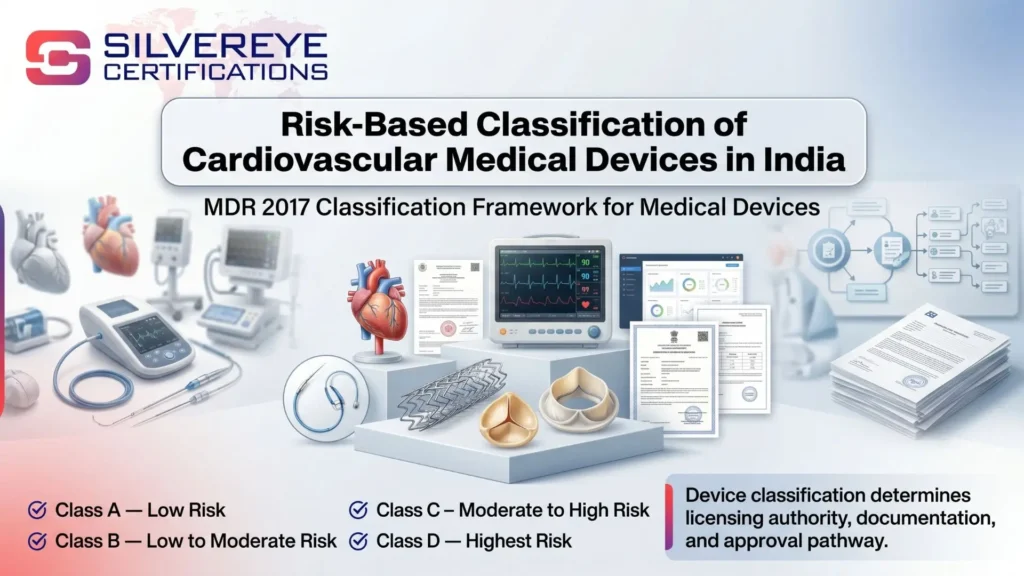
All the above device types fall squarely under the high-risk Class C category as per Schedule III of MDR 2017. Class C devices undergo the most rigorous technical and clinical scrutiny during the CDSCO review process.
Who Needs to Register For Heart Valves?
Before diving into documents and processes, it is important to understand who is legally required to obtain a CDSCO licence for heart valves.
Foreign Manufacturers (Importers)
- Any foreign company manufacturing mechanical or bioprosthetic heart valves or TAVI systems intending to sell in India.
- Must appoint an Authorized Indian Representative (AIR) as a mandatory compliance step.
- The AIR acts as the legal representative and point of contact for all CDSCO communications.
Indian Manufacturers
- Domestic companies manufacturing heart valves under their own brand or under contract.
- Must obtain a Manufacturing License (Form MD-9) from the State Licensing Authority (SLA) for certain sub-categories.
- Require CLA approval for Class C devices before commercial production can begin.
Authorized Indian Representatives (AIR)
- An Indian entity — individual, company, or LLP — officially appointed by the foreign manufacturer.
- Responsible for maintaining records, responding to CDSCO queries, and ensuring post-market surveillance compliance.
- Must be a registered entity in India with a valid business address and contact details.
Documents Required for CDSCO Heart Valve Registration
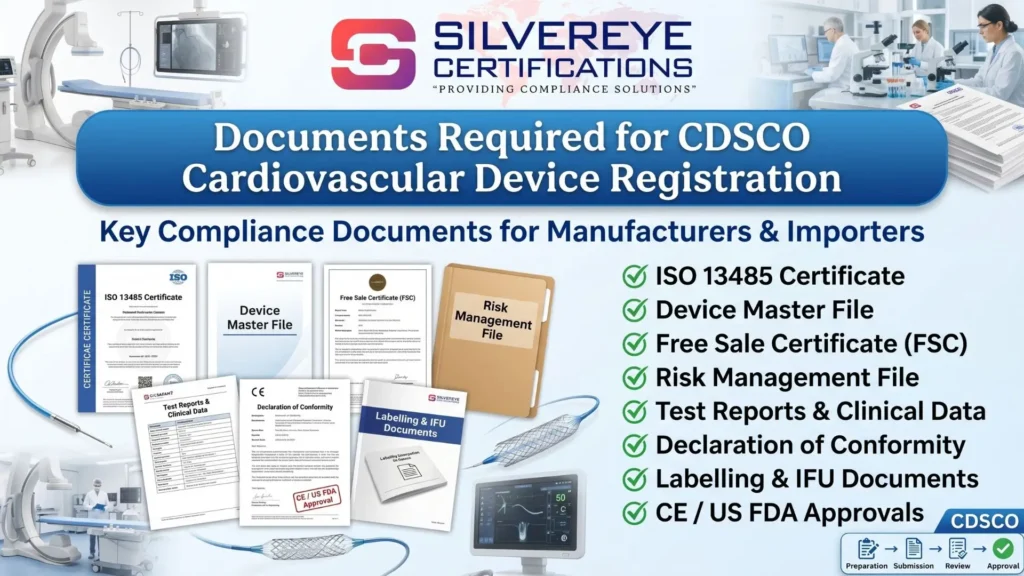
The technical dossier for a Class C heart valve registration is comprehensive. Missing even one document can lead to a deficiency query from CDSCO, delaying your approval by weeks or months. Here is an exhaustive checklist based on the requirements as of 2026.
A. Administrative Documents
- Duly filled Application Form MD-14 (for import license) signed by the AIR
- Appointment Letter from the foreign manufacturer appointing the AIR — notarized and apostilled
- Certificate of Incorporation / Business Registration of the foreign manufacturer
- Valid ISO 13485:2016 Certificate of the manufacturer (scope must include the device being registered)
- Free Sale Certificate (FSC) or Certificate of Marketability from the country of origin — notarized and apostilled
- List of countries where the device is approved/marketed
B. Technical Documents
- Device Description and Intended Use — covering design, material composition, operating principle
- Risk Management File as per ISO 14971:2019
- Summary of Design and Development (D&D) documentation
- Labelling, Instructions for Use (IFU), and Patient Information Leaflet in English (Hindi translation if applicable)
- Shelf life and packaging validation data
- Sterilization validation report (for sterile devices)
C. Performance and Safety Data
- Preclinical test reports — biocompatibility (ISO 10993 series), mechanical testing, haemolysis, thrombogenicity
- Clinical evaluation report as per Schedule VII of MDR 2017 — literature-based or clinical investigation data
- Post-market clinical follow-up (PMCF) plan or summary
- CE Marking technical file summary or FDA 510(k) / PMA approval (if applicable)
Step-by-Step CDSCO Heart Valve Registration Process
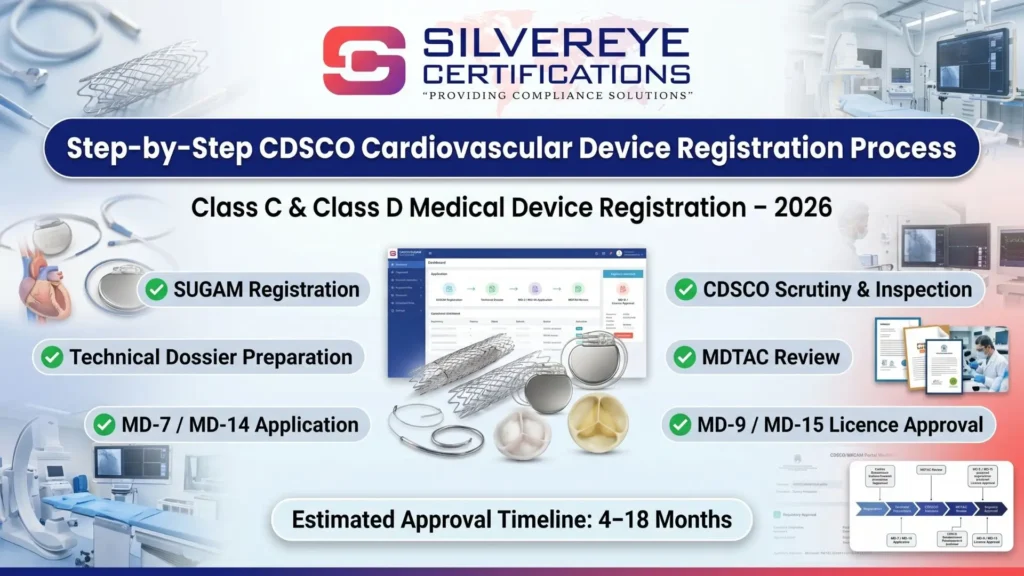
The CDSCO registration process for heart valves follows a structured pathway. Understanding each stage helps you plan timelines, avoid delays, and respond efficiently to CDSCO queries.
| Step | Action | Responsible Party | Estimated Timeframe |
| 1 | Appoint Authorised Indian Representative (AIR) | Foreign Manufacturer | Before application |
| 2 | Prepare Technical Dossier (as per MDR 2017 Schedule requirements) | Manufacturer + AIR | 4–8 weeks |
| 3 | Create account on SUGAM Portal (sugamapplication.mohfw.gov.in) | AIR | 1–2 days |
| 4 | Submit online application with Form MD-14 and dossier upload | AIR | 1–3 days |
| 5 | Pay prescribed application fee online | AIR | Same day |
| 6 | CDSCO scrutiny of application — Screening for completeness | CDSCO | 15–30 days |
| 7 | Deficiency letter (if documents are incomplete) — respond within 30 days | AIR | As required |
| 8 | Technical review by MDTAC (Medical Device Technical Advisory Committee) | CDSCO/MDTAC | 30–90 days |
| 9 | Site inspection of manufacturing facility (if required for Indian manufacturers) | CDSCO | As scheduled |
| 10 | Grant of Import Licence / Manufacturing Licence (Form MD-15 / MD-9) | CDSCO/SLA | Final stage |
CDSCO Registration Fees for Heart Valves
The fee structure for CDSCO heart valve registration is prescribed under Schedule VI of MDR 2017 and is subject to periodic revision by the government. As of 2026, the following fee schedule applies.
| Application Type | Device Class | Fee (INR) | Remarks |
| Import Licence Application (Form MD-14) — Per Device | Class C | Rs. 50,000 | Per device; multiple devices = multiple fees |
| Manufacturing Licence Application (Form MD-7/MD-9) | Class C | Rs. 50,000 | Per manufacturing site + per device |
| Licence Renewal | Class C | Rs. 25,000 | Applicable at 3-year renewal |
| Amendment to Existing Licence | Class C | Rs. 10,000 | For changes in manufacturer, AIR, indications |
| Additional Indication / Model Addition | Class C | Rs. 25,000 | Per new model/indication added |
| Duplicate Licence (in case of loss) | All Classes | Rs. 500 |
Important Note: Fees are non-refundable regardless of the outcome. All payments must be made through the SUGAM portal using accepted payment methods (NEFT, RTGS, or online payment gateway). Fee revisions can be notified by the government without prior public consultation, so always verify the current fee schedule on the official CDSCO website before applying.
Timeline for CDSCO Heart Valve Registration
One of the most common questions from manufacturers and importers is: how long does the CDSCO registration actually take? The honest answer is — it depends on the completeness of your dossier and the workload at CDSCO. Here is a realistic breakdown.
| Phase | Activity | Minimum Time | Maximum Time |
| Pre-Application | AIR appointment, dossier preparation | 4 weeks | 12 weeks |
| Submission to Screening Clearance | SUGAM upload + fee payment + screening | 2 weeks | 6 weeks |
| Deficiency Resolution (if any) | Responding to CDSCO queries | 2 weeks | 8 weeks |
| Technical Review (MDTAC) | Committee review and evaluation | 3 months | 6 months |
| Site Inspection (if applicable) | Manufacturing facility audit by CDSCO | 1 month | 3 months |
| Licence Issuance | Formal grant of MD-15 / MD-9 | 2 weeks | 4 weeks |
| Total Estimated Timeline | 6–8 months | 12–18 months |
Most well-prepared applications with complete dossiers and no deficiencies are processed within 9 to 12 months. Applications with multiple rounds of deficiency queries can take up to 18 months or longer. Engaging a regulatory consultant experienced in CDSCO Class C submissions can significantly reduce timelines.
License Validity and Renewal Process
How Long Is a CDSCO Heart Valve License Valid?
An Import License (Form MD-15) granted for a Class C heart valve is valid for heart valve license remains valid in perpetuity provided you pay the license retention fee every 5 years from the date of issue.
When Should You Apply for Renewal?
- Renewal application must be submitted at least 9 months before the license expiry date.
- Failure to apply for renewal before expiry results in automatic cancellation of the license.
- Once cancelled, you will need to apply as a fresh registration — losing all previous approval history.
- Post-market surveillance reports and adverse event data from the previous license period must be submitted along with the renewal application.
Renewal Documents Required
- Form MD-14 (renewal application)
- Current ISO 13485:2016 certificate (must be valid)
- Updated Free Sale Certificate from country of origin
- Post-market surveillance summary and adverse event reports
- Updated risk management file (if any significant changes were made)
- Declaration of no changes OR details of any changes made to device design, labelling, or manufacturing process
Mechanical Heart Valve vs Bioprosthetic Valve vs TAVI — Registration Differences
While all three types of heart valves fall under Class C MDR 2017, there are specific nuances in the technical requirements for each. Knowing these helps you prepare a targeted and complete dossier.
| Criteria | Mechanical Heart Valve | Bioprosthetic Heart Valve | TAVI System |
| Device Classification | Class C | Class C | Class C |
| Key Performance Standards | ISO 5840-2:2021 (implantable heart valves) | ISO 5840-3:2021 | ISO 5840-3:2021 + delivery system standards |
| Biocompatibility Standard | ISO 10993 series | ISO 10993 + tissue processing standards | ISO 10993 series |
| Clinical Data Requirement | Long-term durability data (10+ years preferred) | Calcification & structural deterioration data | TAVR clinical trial data; Indian population data preferred |
| Special Considerations | Anticoagulation protocol; thrombogenicity testing | Tissue origin (porcine/bovine) declaration; animal health certificate | Delivery system compatibility; imaging data; operator training requirements |
| Import Licence Form | MD-14 | MD-14 | MD-14 (system as a whole) |
Benefits of CDSCO Heart Valve Registration
Beyond regulatory compliance, a valid CDSCO registration for your heart valve product opens several commercial and strategic doors in the Indian market.
| Benefit | What It Means for You |
| Legal Market Access | Only CDSCO-registered devices can be legally imported, sold, or implanted in India — registration protects your commercial interests. |
| Hospital & Tender Eligibility | Government hospitals, CGHS, AIIMS, and state health departments mandate CDSCO registration for procurement in tenders. |
| Patient Safety Assurance | CDSCO review validates clinical safety and performance — building trust with surgeons and cardiologists. |
| Reimbursement under PMJAY / Ayushman Bharat | Only registered devices are eligible for reimbursement under government health schemes, significantly expanding patient reach. |
| Brand Credibility | CDSCO approval signals quality compliance, which is a strong marketing differentiator in a competitive market. |
| Protection from Seizure & Penalties | Registered devices are protected from regulatory action; unregistered devices face seizure, fines, and criminal liability. |
| Pathway for Insurance Coverage | Insurers increasingly require CDSCO registration proof for cardiac device reimbursement claims. |
Conclusion: Getting Your Heart Valve Registration Right in India
CDSCO Medical Device Registration For Heart Valves in India is a multi-stage, document-intensive process that requires thorough preparation, regulatory expertise, and consistent follow-through. The MDR 2017 framework has brought Indian medical device regulation much closer to global standards — and for high-risk devices like heart valves, that is a positive development for patients, clinicians, and compliant manufacturers alike.
Whether you are registering a mechanical heart valve, a bioprosthetic valve, or a cutting-edge TAVI system for the Indian market, the fundamentals remain the same: appoint a qualified AIR, prepare a technically complete dossier, apply through the SUGAM portal, respond promptly to CDSCO queries, and plan for a 9 to 18-month registration cycle.
India's cardiovascular device market is growing rapidly — driven by rising prevalence of valvular heart disease, increasing surgical volumes, and expanding insurance coverage under Ayushman Bharat. Manufacturers who secure CDSCO registration early gain a significant first-mover advantage in a regulated, high-value market.
If you are planning to register a heart valve in India, working with a regulatory affairs professional who has direct experience with CDSCO Class C submissions is strongly advisable. The investment in expert guidance upfront pays dividends in time, cost, and compliance certainty over the life of your licence.
Frequently Asked Questions
Is CDSCO registration mandatory for all heart valves sold in India?
Yes. Under MDR 2017 and the Drugs and Cosmetics Act 1940, all heart valves — whether mechanical, bioprosthetic, or TAVI systems — are classified as Class C medical devices and require a valid CDSCO Import License (MD-15) or Manufacturing License (MD-9) before they can be legally marketed, sold, or implanted in India.
Can a foreign company apply directly or does it need an Indian representative?
A foreign manufacturer cannot apply directly to CDSCO. They must appoint an Authorized Indian Representative (AIR) who is a registered entity in India.
How long does CDSCO heart valve registration take in 2026?
Realistically, a complete and well-prepared dossier takes 9 to 12 months from submission to licence grant.
What is the registration fee for importing a heart valve to India?
As of 2026, the application fee for an Import License (Form MD-14) for a Class C heart valve is Rs. 50,000 per device.
Is CE marking or US FDA approval accepted in lieu of CDSCO registration?
No. CE marking or FDA approval does not replace or exempt a device from CDSCO registration. However, these approvals significantly strengthen your technical dossier and clinical evaluation report.
What happens if I sell a heart valve in India without CDSCO registration?
Selling or importing a heart valve without a valid CDSCO license is a violation of the Drugs and Cosmetics Act, 1940 and MDR 2017.
Do bioprosthetic valves from animal tissue have any special requirements?
Yes. Bioprosthetic valves made from porcine or bovine tissue require additional documentation, including a declaration of animal tissue origin, compliance with animal health and welfare standards, spongiform encephalopathy (TSE/BSE) risk assessment, and evidence of tissue processing validation (fixation, sterilization, and calcification prevention).
Can I add new heart valve models to an existing CDSCO license?
Yes, adding new models or variants of a registered heart valve device is possible through a licence amendment process. A fresh application for amendment must be submitted through the SUGAM portal with technical data for the new model, demonstrating similarity to the already-registered device or providing additional testing data for new features. The amendment fee is Rs. 10,000 to Rs. 25,000 depending on the nature of the change.
What is MDTAC and what role does it play in heart valve approvals?
MDTAC — the Medical Device Technical Advisory Committee — is an expert body constituted by CDSCO to provide technical and scientific advice on complex device applications including Class C devices.
Is there a clinical investigation requirement for TAVI registration in India?
For TAVI systems backed by robust international clinical data (CE or FDA approval with published clinical trials), CDSCO typically accepts a literature-based clinical evaluation report without requiring a mandatory local Indian clinical investigation.