
Introduction
If you are planning to import oximeters into India, you cannot skip the CDSCO Import License. The Central Drugs Standard Control Organization (CDSCO) is the apex regulatory body that governs the import of medical devices, including pulse oximeters, under the Medical Devices Rules, 2017. Without this license, your consignment can be seized, rejected, or penalized at the Indian port of entry.
This guide gives you everything you need to know — from understanding MD-14 and MD-15 forms to documents, fees, timelines, and renewal. Whether you are a first-time importer or looking to renew your existing license, this 2026-updated guide will save you time, money, and unnecessary back-and-forth with regulatory authorities.
What Is the CDSCO Import License for Oximeters?
A CDSCO Import License is a mandatory regulatory approval issued by the Central Drugs Standard Control Organization under the Ministry of Health and Family Welfare, Government of India. It authorizes a foreign manufacturer or their Indian authorized agent to import a specific medical device — in this case, an oximeter — for commercial sale, distribution, or use in India.
Oximeters are classified as Class B medical devices under Schedule II of the Medical Devices Rules, 2017. Class B devices carry a moderate-to-low risk and must comply with performance and safety standards before they can be legally imported and sold in India.
| Important Note (2026 Update): As per the Medical Devices Rules, 2017, the import of oximeters without a valid CDSCO registration or license is a punishable offence. Penalties can include cancellation of import permission, seizure of goods, and financial penalties. |
Why Do You Need a CDSCO Import License for Oximeters?
Many importers wonder — 'Is the license really mandatory for something as small as a pulse oximeter?' The answer is yes, absolutely. Here is why:
- Legal Requirement: Under Rule 29 of the Medical Devices Rules, 2017, no person can import any medical device unless it has been granted a valid import license or registration certificate.
- Customs Clearance: Indian Customs authorities require a valid CDSCO import license number before allowing any medical device consignment to pass through.
- Product Safety Assurance: The CDSCO registration process ensures that the product meets IS/ISO/IEC standards for safety and performance before it reaches Indian patients or healthcare providers.
- Market Reputation: Hospitals, distributors, and procurement agencies in India only purchase from licensed importers. A valid CDSCO license builds buyer trust.
- Avoiding Penalties: Unlicensed import can result in heavy fines, product recall, and even criminal liability under the Drugs and Cosmetics Act, 1940.
MD-14 vs MD-15 – Understanding the Difference
This is where most applicants get confused. Let's break it down clearly.
| Feature | MD-14 (Import Registration) | MD-15 (Import License) |
| What it is | Registration Certificate for import | License for import of notified devices |
| Applicable to | All Class A, B, C, D medical devices | Devices listed in Schedule I & Schedule II (Notified List) |
| Who applies | Authorised Indian Representative (AIR) on behalf of foreign manufacturer | Authorised Indian Representative (AIR) on behalf of foreign manufacturer |
| Form Used | Form MD-14 | Form MD-15 |
| Issuing Authority | CDSCO (Central Licensing Authority) | CDSCO (Central Licensing Authority) |
| For Oximeters? | Yes – Primary route for most oximeter imports | Yes – If oximeter falls under notified device list |
| Validity | 5 years (renewable) | 5 years (renewable) |
| Fee | Rs. 50,000 per device | Rs. 50,000 per device |
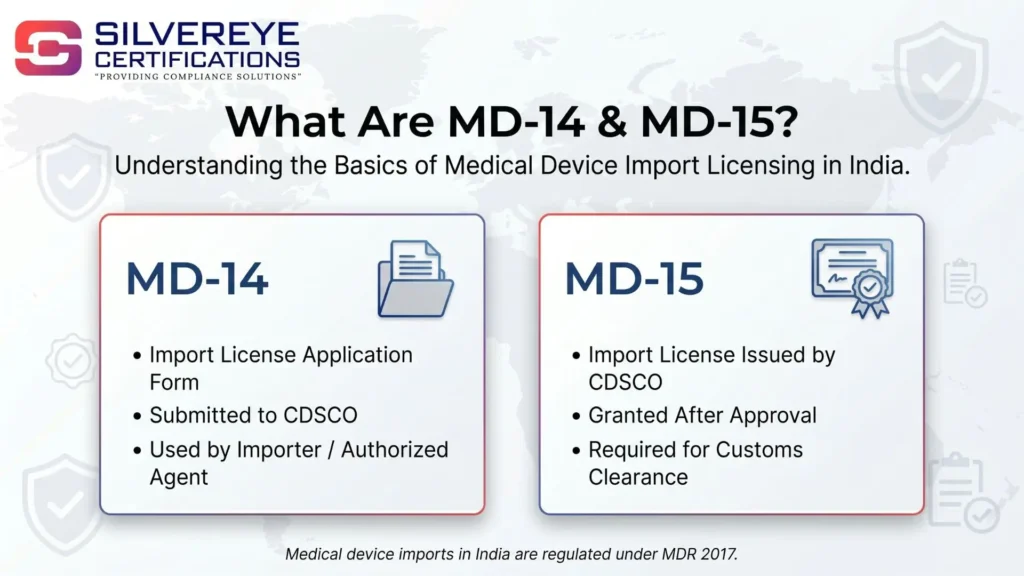
| Practical Tip: Most standard pulse oximeters imported commercially in India require an MD-14 Registration Certificate. If you are unsure which form applies to your product, consult a CDSCO-authorized regulatory consultant or check the notified device list published on the CDSCO official website. |
Who Is Eligible to Apply for CDSCO Import License for Oximeters?
Not everyone can directly apply for a CDSCO import license. The eligibility criteria are well-defined:
Foreign Manufacturer
- The manufacturer must be based outside India and must have a legally incorporated business entity.
- The manufacturing site must hold a valid Quality Management System (QMS) certificate — typically ISO 13485:2016.
- The product must comply with applicable standards such as IEC 60601-1 (general requirements for medical electrical equipment) and ISO 80601-2-61 (specific to pulse oximeters).
Authorized Indian Representative (AIR)
- Every foreign manufacturer must appoint an Authorized Indian Representative (AIR) to file the application on their behalf in India.
- The AIR must be an Indian resident or a company registered in India.
- The AIR must hold a valid Wholesale Drug License (WDL) or a valid license under the Drugs and Cosmetics Act.
- The AIR is legally responsible for the product's compliance in India after import.
| Key 2026 Point: CDSCO has tightened its AIR eligibility checks. Make sure the Authorized Indian Representative has an active Drug License and is not blacklisted or under regulatory action before submitting the application. |
Documents Required for CDSCO Import License – Oximeters
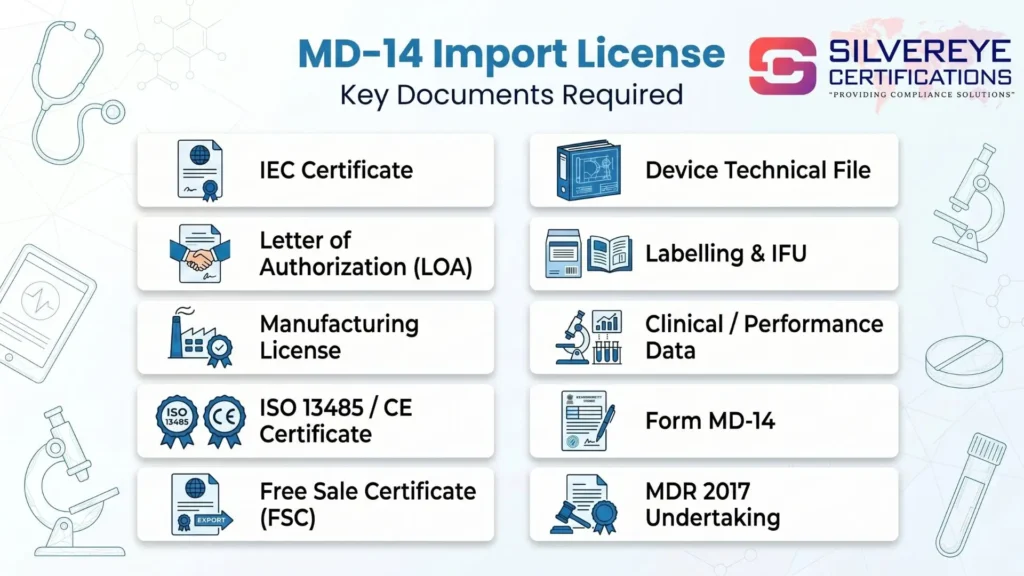
The document checklist for CDSCO import license for oximeters under MD-14/MD-15 is extensive. Missing even a single document can delay your application by months. Here is the complete list:
A. Documents from the Foreign Manufacturer
- Manufacturing Site License: Valid manufacturing license issued by the regulatory authority of the country of origin (e.g., FDA 510(k), CE Certificate, TGA approval).
- ISO 13485 Certificate: Valid Quality Management System certificate from an accredited certification body.
- Free Sale Certificate (FSC): Certificate from the country of origin confirming the device is freely marketed there.
- Product Information Dossier: Technical documentation including intended use, product description, classification, materials used, and shelf life.
- Test Reports: Performance test reports confirming compliance with IEC 60601-1 and ISO 80601-2-61 from a recognized/accredited laboratory.
- Declaration of Conformity: Manufacturer's self-declaration conforming to applicable standards and regulations.
- Authorization Letter: A formal letter from the manufacturer appointing the AIR and authorizing them to file the application.
- Undertaking by Manufacturer: Undertaking that the product is safe, meets Indian regulatory requirements, and post-market surveillance will be maintained.
B. Documents from the Authorized Indian Representative (AIR)
- Wholesale Drug License: Valid WDL issued by the State Licensing Authority.
- AIR Agreement: Signed agreement between the foreign manufacturer and the AIR specifying responsibilities.
- KYC Documents: PAN Card, Aadhar Card / Passport of the authorized signatory.
- GST Registration Certificate: Mandatory for Indian entities.
- Company Registration Certificate: Certificate of Incorporation or Partnership Deed, as applicable.
C. Product-Specific Documents for Oximeters
- Sample Labels: Draft label for the Indian market complying with Medical Devices Rules, 2017 labelling requirements (in English, with all required information).
- Package Insert / IFU: Instructions for Use document in English.
- Device Master Record: Design specifications, drawings, and manufacturing process details.
- Post-Market Surveillance Plan: Plan for monitoring the device's performance post-import.
| S.No. | Document | Issued By |
| 1 | Manufacturing License | Regulatory Authority – Country of Origin |
| 2 | ISO 13485 Certificate | Accredited Certification Body (e.g., TUV, BSI, Bureau Veritas) |
| 3 | Free Sale Certificate | Regulatory Authority – Country of Origin |
| 4 | Test Reports (IEC/ISO) | NABL-accredited or equivalent international lab |
| 5 | Declaration of Conformity | Manufacturer |
| 6 | Authorisation Letter (AIR) | Manufacturer |
| 7 | Undertaking | Manufacturer + AIR |
| 8 | Wholesale Drug License | State Licensing Authority |
| 9 | Draft Label & IFU | Prepared by AIR / Manufacturer |
| 10 | Post-Market Surveillance Plan | Manufacturer / AIR |
Step-by-Step Process to Get CDSCO Import License for Oximeters (MD-14 / MD-15)
The CDSCO import registration process is entirely online through the SUGAM portal (sugam.gov.in). Here is the exact step-by-step process updated for 2026:
Step 1 – Register on the SUGAM Portal
- Visit: Go to https://sugam.gov.in and register as an 'Applicant' (AIR).
- Create Account: Provide company name, email, mobile number, and Drug License number to complete registration.
- Login: Use your credentials to access the dashboard.
Step 2 – Prepare and Organize Your Documents
- Compile all documents listed in the previous section.
- Ensure all foreign documents are duly apostilled/notarized and translated into English where required.
- All documents must be in PDF format with a maximum size as permitted by the SUGAM portal (generally 5 MB per document).
Step 3 – Fill and Submit the Application Form
- On SUGAM portal, navigate to 'Import' > 'Import Registration/License'.
- Select Form MD-14 (for registration certificate) or MD-15 (for import license), as applicable.
- Fill in all required fields: device name, device class, IVD/non-IVD classification, manufacturer details, AIR details, standards compliance.
- Upload all required documents in the designated sections.
- Review all information carefully before submission.
- Submit the application and note the Application Reference Number (ARN).
Step 4 – Pay the Government Fee
After submission, pay the applicable government fee online through the SUGAM portal using net banking, credit card, or debit card. A payment receipt will be generated automatically.
Step 5 – CDSCO Screening and Review
CDSCO evaluates the application in two stages:
- Screening: Initial check of documents and application completeness. If any deficiency is found, a Deficiency Note (DN) is issued and you must respond within the stipulated time.
- Technical Evaluation: A CDSCO technical expert reviews the product dossier, test reports, standards compliance, and labelling for adequacy and safety.
Step 6 – Site Inspection (if required)
For certain Class C and D devices, CDSCO may conduct a manufacturing site inspection. For Class B oximeters, site inspection is generally waived if all documents are in order, but CDSCO reserves the right to inspect.
Step 7 – Grant of License / Registration Certificate
Once all evaluations are satisfactorily completed, CDSCO grants the Import Registration Certificate (MD-14) or Import License (MD-15). The certificate is issued digitally and is available for download on the SUGAM portal.
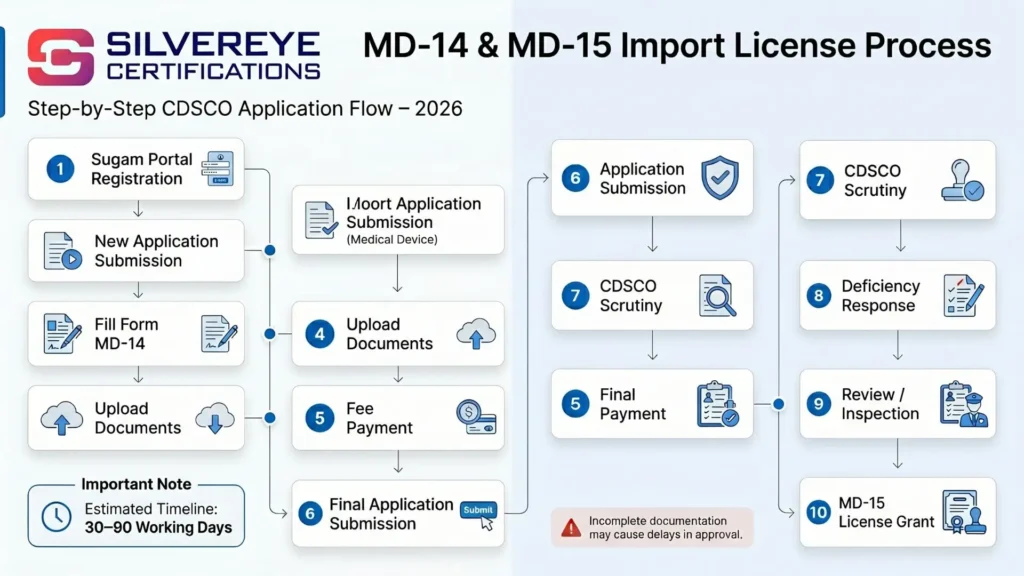
| Average Timeline: The CDSCO target timeline for processing an MD-14/MD-15 application is 6 to 9 months from the date of submission (with all documents in order). However, actual timelines can vary based on query volume and document completeness. |
CDSCO Import License Fee Structure for Oximeters
Here is the current government fee structure for CDSCO import license for medical devices, applicable to oximeters:
| Application Type | Device Class | Fee (Indian Company) | Fee (Foreign Company) |
| MD-14 – Import Registration | Class A | Rs. 5,000 | USD 500 |
| MD-14 – Import Registration | Class B (Oximeters) | Rs. 50,000 | USD 2,000 |
| MD-14 – Import Registration | Class C | Rs. 1,00,000 | USD 3,000 |
| MD-14 – Import Registration | Class D | Rs. 2,00,000 | USD 5,000 |
| MD-15 – Import License | Class B (Oximeters) | Rs. 50,000 | USD 2,000 |
| Renewal Fee (MD-14/MD-15) | Class B | 50% of original fee | 50% of original fee |
| Note: Fees are non-refundable. If the application is rejected, the fee is not refunded. All fees are payable online through the SUGAM portal. Foreign manufacturer fees are payable in USD at the time of application. Fee structure is as per the Medical Devices Rules, 2017 and subject to revision — always verify from the official CDSCO website before submitting. |
Validity and Renewal of CDSCO Import License for Oximeters
Validity Period
- An MD-14 Import Registration Certificate is valid for 5 years from the date of issuance.
- An MD-15 Import License is also valid for 5 years from the date of issuance.
- If no application for renewal is made, the license lapses and the import of the device becomes illegal after the expiry date.
Renewal Timeline
Many importers overlook renewal timelines and end up with a lapsed license, which means they cannot import until re-registration is complete. Here is how to stay on top of it:
| Timeline | Action Required |
| 6 months before expiry | Start preparing renewal documents; check for any changes in product, manufacturer, or AIR |
| 3 months before expiry | Submit renewal application on SUGAM portal (Form MD-14 or MD-15 as applicable) |
| 2 months before expiry | Ensure renewal fee has been paid and acknowledgment received |
| 1 month before expiry | Follow up with CDSCO if renewal certificate not received |
| On or after expiry (without renewal) | Import immediately becomes non-compliant — stop all imports immediately |
Documents Required for Renewal
- Copy of existing MD-14 / MD-15 certificate
- Updated ISO 13485 certificate (if renewed or revised)
- Updated Free Sale Certificate (if expired)
- Updated Wholesale Drug License of AIR
- Revised label / IFU (if any changes made)
- Undertaking of no adverse regulatory action against the product globally
- Proof of fee payment
| Critical Reminder: Even if your renewal application is pending, you CANNOT import the device after the license expiry date unless CDSCO has explicitly extended the validity. Always apply for renewal at least 3 months before expiry. |
Benefits of Getting a CDSCO Import License for Oximeters
Getting your CDSCO import registration for oximeters is not just a regulatory tick-box exercise. Here is how it genuinely benefits your business:
| Benefit | What It Means for You |
| Legal Market Access | You can legally sell oximeters to hospitals, pharmacies, and e-commerce platforms in India |
| Customs Clearance | No risk of shipment being detained or rejected at Indian ports of entry |
| B2B Trust | Government hospitals, large pharmacy chains, and distributors only buy from CDSCO-licensed importers |
| IP Protection | Your device gets a unique CDSCO registration number, preventing counterfeit products from being registered under your name |
| Competitive Advantage | Fewer competitors in the market as non-compliant importers get filtered out |
| Tender Eligibility | Mandatory for all government and public sector procurement tenders for medical devices |
| Brand Credibility | CDSCO registration signals regulatory confidence to healthcare professionals and end users |
Common Mistakes to Avoid When Applying for CDSCO Import License
Based on real regulatory experience, here are the most frequent mistakes that delay or result in rejection of CDSCO import license applications for oximeters:
- Incorrect Device Classification: Filing MD-14 when MD-15 is required or vice versa. Always confirm classification before applying.
- Expired or Invalid Free Sale Certificate: The FSC must be valid at the time of application submission, not just at the time of obtaining it.
- Incomplete Test Reports: Only test reports from NABL-accredited or equivalent international accredited laboratories are accepted. Reports from non-accredited labs are rejected.
- Wrong AIR Documentation: The AIR must hold a Wholesale Drug License specifically for medical devices — a general drug license may not be accepted.
- Label Non-Compliance: Not including all mandatory labelling elements (batch number, date of manufacture, expiry, intended use, warnings) in the draft label.
- Failure to Respond to Deficiency Notes: CDSCO issues deficiency notes with strict deadlines. Missing the deadline results in automatic rejection of the application.
- Ignoring Product Changes: Any change in device design, manufacturer, or manufacturing site after registration requires a fresh application or amendment. Many importers ignore this.
Conclusion – Getting Your CDSCO Import License Right the First Time
Getting a CDSCO import license for oximeters is a process that rewards preparation. The regulatory requirements are detailed but completely achievable if you approach the application methodically. The most successful importers are those who take time to build a complete, accurate, and well-organized dossier before hitting 'Submit' on the SUGAM portal.
If you are a foreign manufacturer entering the Indian market or an Indian company looking to bring in a new oximeter brand, the key is to start early, appoint a reliable Authorized Indian Representative, and not cut corners on technical documentation or standards compliance.
India's medical device market is growing rapidly, and oximeters — driven by post-pandemic awareness of respiratory health — remain one of the most demanded devices in the country. A valid CDSCO import registration opens the door to hospitals, pharmacies, government tenders, and online retail platforms across India.
Frequently Asked Questions
Is CDSCO import license mandatory for all types of oximeters imported into India?
Yes. All oximeters, including fingertip pulse oximeters, handheld pulse oximeters, tabletop oximeters, and neonatal oximeters, are classified as medical devices under the Medical Devices Rules, 2017 and require a valid CDSCO import registration (MD-14) or import license (MD-15) before they can be imported for commercial purposes.
What is the difference between MD-14 and MD-15 forms for importing oximeters?
MD-14 is used to obtain an Import Registration Certificate, which is the standard route for most medical devices including oximeters. MD-15 is used when the device falls under the notified list requiring an Import License rather than a registration certificate.
Can a foreign manufacturer directly apply for CDSCO import license without an Indian agent?
No. A foreign manufacturer cannot directly apply. They must appoint an Authorized Indian Representative (AIR) who holds a valid Wholesale Drug License in India.
How long does CDSCO take to process an import registration application for oximeters?
The official CDSCO target timeline is approximately 6 to 9 months for a complete application.
What happens if I import oximeters without a valid CDSCO license?
Importing medical devices without a valid CDSCO import license is a serious offence under the Drugs and Cosmetics Act, 1940. Consequences include: confiscation of the imported goods, cancellation of import permission, financial penalties, and possible criminal prosecution.
How much does a CDSCO import license cost for oximeters in 2026?
For Class B medical devices such as oximeters, the government fee is Rs. 50,000 per device for Indian companies and USD 2,000 for foreign manufacturer applications.
What standards must an imported oximeter comply with for CDSCO registration?
An oximeter must comply with IEC 60601-1 (General requirements for basic safety and essential performance of medical electrical equipment) and ISO 80601-2-61 (Particular requirements for basic safety and essential performance of pulse oximeter equipment).
Can I import oximeters for personal use without a CDSCO license?
Strictly speaking, importing medical devices even for personal use is subject to customs regulations and drug import rules.
How do I renew my CDSCO import registration for oximeters?
Renewal must be applied for through the SUGAM portal at least 3 months before the expiry date
What is a Deficiency Note (DN) from CDSCO and how should I respond?
A Deficiency Note is a formal communication from CDSCO requesting additional information, clarification, or corrected documents. It is issued when the submitted application has gaps, missing documents, or non-compliant information.
Can I make changes to my product after getting CDSCO import registration?
Any significant change to the registered product — including changes to design, labelling, manufacturer, manufacturing site, intended use, or materials — must be notified to CDSCO. Depending on the nature and significance of the change, you may need to file an amendment application or a fresh registration application. Importing a changed product under an old registration without approval is a regulatory violation.
Is the SUGAM portal mandatory for CDSCO import license applications?
Yes, as of 2022, all CDSCO import license and registration applications are processed exclusively through the SUGAM online portal (sugam.gov.in). Physical/paper applications are not accepted.