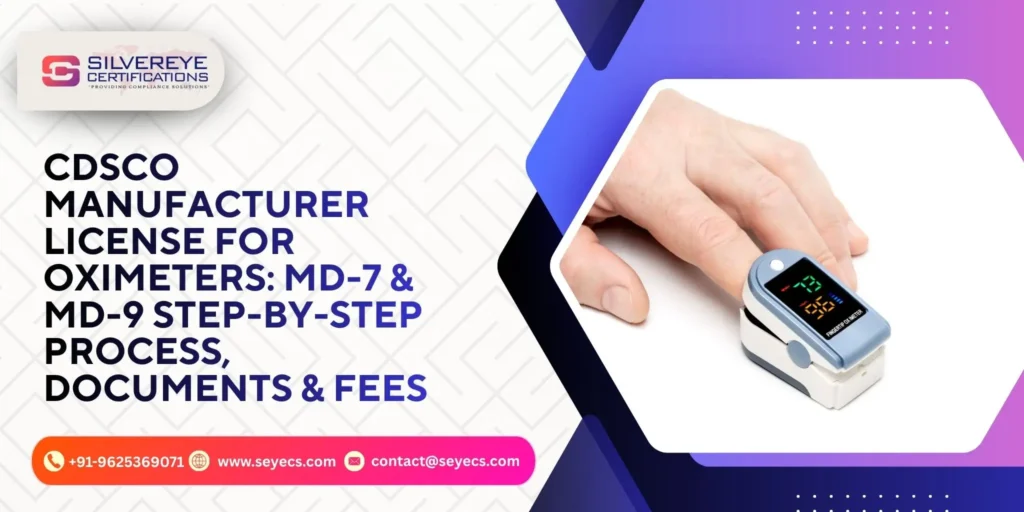
Key Takeaways – CDSCO Manufacturer License for Oximeters: MD-7 & MD-9
- Form MD-7 applies to Class C and Class D medical devices — filed with CDSCO as the Central Licensing Authority
- Form MD-9 is the Loan License route — allows manufacturing at another company's licensed facility
- ISO 13485:2016 is not mandatory now you have follow all the guidelines according ISO Rules.
- Design History File (DHF) is a mandatory document for Class C device licensing — not optional
- Government fee: Rs. 1,00,000 (Class C – MD-7); Rs. 50,000 (Class B Loan – MD-9)
- License validity: 3 years — apply for renewal at least 3 months before expiry
- All applications, fees, and communications are exclusively through the SUGAM portal (sugam.gov.in)
- CDSCO conducts its own site inspection for MD-7 — facility must be fully operational on inspection day
Introduction
If you are setting up an oximeter manufacturing business in India and your device falls under Class C — or if you are looking to produce oximeters through a Loan License arrangement — you are dealing with two of the most misunderstood regulatory forms under the Medical Devices Rules, 2017: Form MD-7 and Form MD-9.
Most oximeter manufacturers in India are familiar with Form MD-5, which covers Class B devices through the State Licensing Authority. But when your oximeter product crosses into Class C territory — think advanced multi-parameter patient monitoring systems with integrated SpO2, clinical diagnostic oximeters used in hospital ICUs, or oximeter modules embedded in higher-risk monitoring platforms — the licensing jurisdiction shifts entirely to CDSCO as the Central Licensing Authority. That is where Form MD-7 comes in.
And then there is Form MD-9 — the Loan License — which enables a brand owner or a company without its own manufacturing facility to legally produce oximeters under its own name using an existing licensed manufacturer's infrastructure.
This 2026-updated pillar guide gives you a complete, accurate, and jargon-free breakdown of both pathways. No guesswork. No hallucinated steps. Just what the Medical Devices Rules, 2017 actually say — plus the on-ground practical reality of what CDSCO inspectors and officials actually look for.
Understanding the Regulatory Framework – Where MD-7 and MD-9
India regulates medical devices under the Medical Devices Rules, 2017 (amended), notified under the Drugs and Cosmetics Act, 1940. The Central Drugs Standard Control Organization (CDSCO) is the apex national regulatory body headed by the Drugs Controller General of India (DCGI). CDSCO functions as the Central Licensing Authority (CLA) for higher-risk medical devices.
The Medical Devices Rules classify all medical devices into four risk-based classes — A, B, C, and D — from lowest to highest risk. The licensing authority depends on this classification:
| Device Class | Risk Level | Licensing Authority | Applicable Form | Oximeter Relevance |
| Class A | Lowest Risk | State Licensing Authority (SLA) | Self-Declaration (MD-3) | Not applicable |
| Class B | Low–Moderate | State Licensing Authority (SLA) | Form MD-5 | Standard pulse oximeters |
| Class C | Moderate–High | CDSCO – Central Licensing Authority | Form MD-7 | Advanced / multi-param oximeters |
| Class D | Highest Risk | CDSCO – Central Licensing Authority | Form MD-7 | Rare – implantable SpO2 sensors |
| Any Class (Loan) | N/A | Same authority as device class | Form MD-9 | Applies across all classes |
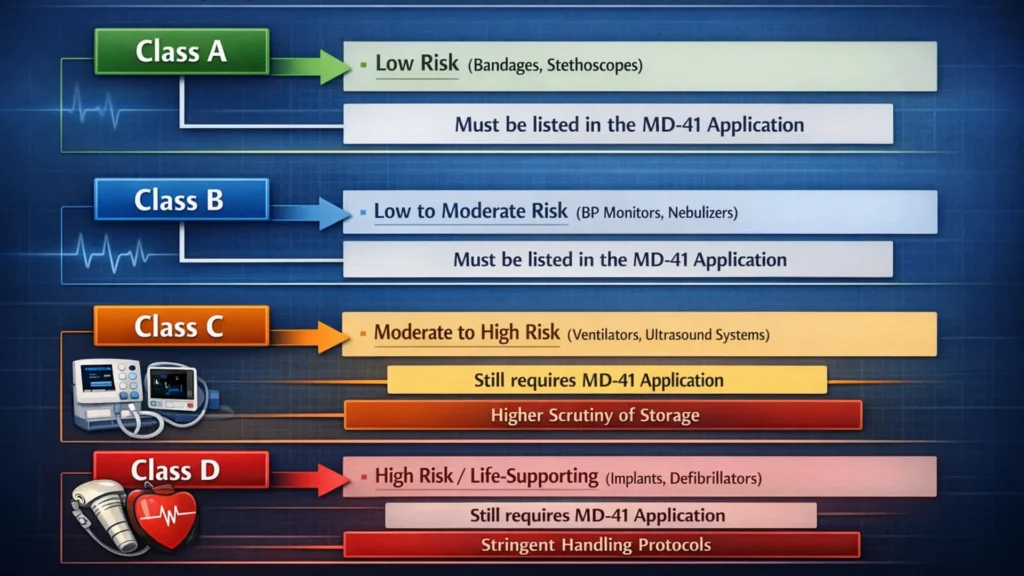
| Regulatory Clarity for 2026: Standard fingertip pulse oximeters are Class B devices licensed via Form MD-5 (State Licensing Authority). Form MD-7 applies to Class C and Class D oximeter variants — devices with higher clinical complexity, higher risk to the patient, or devices that form part of a multi-parameter monitoring system. If you are unsure which class your oximeter product belongs to, check the CDSCO classification guidelines on cdsco.gov.in or consult a qualified regulatory affairs professional before filing. |
What Is Form MD-7?
Form MD-7 is the Application for Grant of License to Manufacture Medical Devices for Sale or Distribution for Class C and Class D medical devices. It is filed directly with CDSCO — the Central Licensing Authority — not with the State Drug Controller.
When CDSCO receives an MD-7 application, it triggers a more rigorous review process compared to state-level licensing. This includes technical evaluation by CDSCO's own subject matter experts, a mandatory manufacturing site inspection by CDSCO-designated inspectors, and a deeper review of the product's technical documentation and safety data.
Which Oximeter Products Fall Under MD-7 (Class C)?
Here are the types of oximeter products that typically fall under Class C and therefore require Form MD-7:
| Oximeter / SpO2 Device Type | Why It Is Class C |
| Multi-parameter patient monitors with integrated SpO2 | Combined diagnostic functions increase clinical risk — classified as Class C |
| Hospital-grade bedside pulse oximeters with alarms and trending | Intended for ICU/critical care use — higher patient dependency = higher risk class |
| Oximeter modules integrated into anaesthesia workstations | Part of a life-supporting system — escalates risk classification |
| Fetal pulse oximeters | Invasive/semi-invasive application and foetal patient group = Class C or higher |
| Oximeter devices with built-in diagnostic decision support | Clinical decision support features trigger higher classification |
| Standalone capnography-oximetry combined devices | Multi-modality diagnostic device — typically Class C |
| Practical Note: The classification of a specific oximeter product can sometimes be borderline between Class B and Class C. CDSCO has published classification rules and guidance. If your device is a simple standalone pulse oximeter used in non-critical settings, it is likely Class B. If it is intended for ICU, anaesthesia, neonatal, or critical care settings with decision support features, Class C is more appropriate. Always get a written classification opinion from a regulatory consultant or CDSCO before filing. |
What Is Form MD-9? Loan License for Oximeter Manufacturers Explained
Form MD-9 is the Application for Grant of Loan License to Manufacture Medical Devices for Sale or Distribution. A Loan License is a specific licensing arrangement where one company — called the Loan Licensee — legally manufactures medical devices using the manufacturing facility, equipment, and quality infrastructure of another company — called the Lender — who already holds a valid manufacturer license.
This model is widely used in the pharmaceutical and medical device industries in India. For oximeter manufacturers, it offers a practical route to market for companies that have a strong brand, distribution network, and product design capability but do not yet have their own manufacturing facility.
How the MD-9 Loan License Works in Practice
| Party | Role | Responsibility Under MD-9 |
| Lender (Licensed Manufacturer) | Owns and operates the manufacturing facility | Provides facility, equipment, and technical resources to the loan licensee; remains accountable for facility compliance |
| Loan Licensee (Applicant) | Applies for the Loan License (Form MD-9) | Responsible for product quality, labelling, post-market surveillance, and regulatory compliance of the manufactured device |
| CDSCO / SLA | Licensing Authority | Evaluates both the lender's facility and the loan licensee's QMS and product documentation before granting MD-9 |
When Should You Choose the MD-9 Loan License Route?
- You want to launch your own branded oximeter but do not have a CDSCO-licensed manufacturing facility.
- You are an importer or distributor looking to source oximeters domestically under your own brand.
- You are a startup or MSME that wants to enter the oximeter market without the capital investment of setting up a full manufacturing unit.
- You have a product design and brand but need a licensed contract manufacturer to produce for you.
- You are a foreign company entering India who wants to manufacture locally through a licensed Indian partner facility.
Eligibility Criteria – Who Can Apply CDSCO Manufacturer License For Oximeters
A. Eligibility for Form MD-7 (Class C/D Manufacturing License)
To be eligible to apply for Form MD-7 through CDSCO, the applicant must meet the following requirements:
1. Legal Business Entity
- Must be a legally incorporated company in India — Private Limited, Public Limited, or LLP.
- Sole proprietorships may be accepted for lower-risk applications but are uncommon for Class C devices.
- Active GST Registration and PAN are mandatory.
2. Manufacturing Premises
- Dedicated manufacturing premises located in India with valid ownership or lease documentation.
- The facility must comply with the Schedule M (Revised) General Requirements for Medical Device Manufacturing Facilities notified by CDSCO.
- Clean room / controlled environment areas appropriate for the type of oximeter being manufactured.
- Premises must have clearly demarcated zones for raw material storage, manufacturing, quality control, finished goods, and quarantine.
3. Qualified Technical Personnel
| Position | Minimum Qualification | Responsibilities |
| Head of Manufacturing / Technical Director | B.E./B.Tech – Biomedical, Electronics, Electrical Engineering or equivalent; 5+ years experience | Overall manufacturing oversight, regulatory accountability |
| Quality Assurance Manager | Graduate in Engineering or Life Sciences; ISO 13485 Lead Auditor certified preferred | QMS implementation, internal audits, CAPA management |
| Regulatory Affairs Manager | Science/Engineering graduate with regulatory affairs experience | CDSCO liaison, application management, post-market compliance |
| Production Supervisor | Diploma or Degree in Electronics/Biomedical Engineering | Day-to-day production management, batch records |
4. Quality Management System
- Valid ISO 13485:2016 Certificate from an accredited certification body — mandatory and non-negotiable.
- The ISO 13485 scope must specifically cover the manufacture of the oximeter product type being licensed.
- A fully documented QMS including Quality Manual, SOPs, Work Instructions, and all quality records must be in place.
- Design Control procedures (per ISO 13485 Clause 7.3) must be implemented and documented for Class C devices.
B. Eligibility for Form MD-9 (Loan License)
For a Loan License, both the Lender and the Loan Licensee must meet specific eligibility criteria:
| Eligibility Factor | Lender (Licensed Manufacturer) | Loan Licensee (Applicant) |
| Legal Status | Must hold a valid existing manufacturer license (MD-5 or MD-7) for the same product class | Must be a legally registered company in India with GST and PAN |
| Facility | Must have a compliant, inspected, and licensed manufacturing facility | No facility required — uses lender's facility |
| ISO 13485 | Must hold valid ISO 13485 covering the relevant scope | Must also have ISO 13485 if required for the device class |
| NOC Requirement | Must provide formal NOC to the loan licensee | Must obtain and submit lender's NOC with application |
| QMS | Lender's QMS governs manufacturing operations | Loan Licensee must have its own Quality Agreement and QMS for post-market activities |
| Regulatory Accountability | Responsible for facility and manufacturing compliance | Fully responsible for product quality, PMS, and regulatory compliance post-manufacture |
Documents Required – Form MD-7 and Form MD-9 for Oximeters
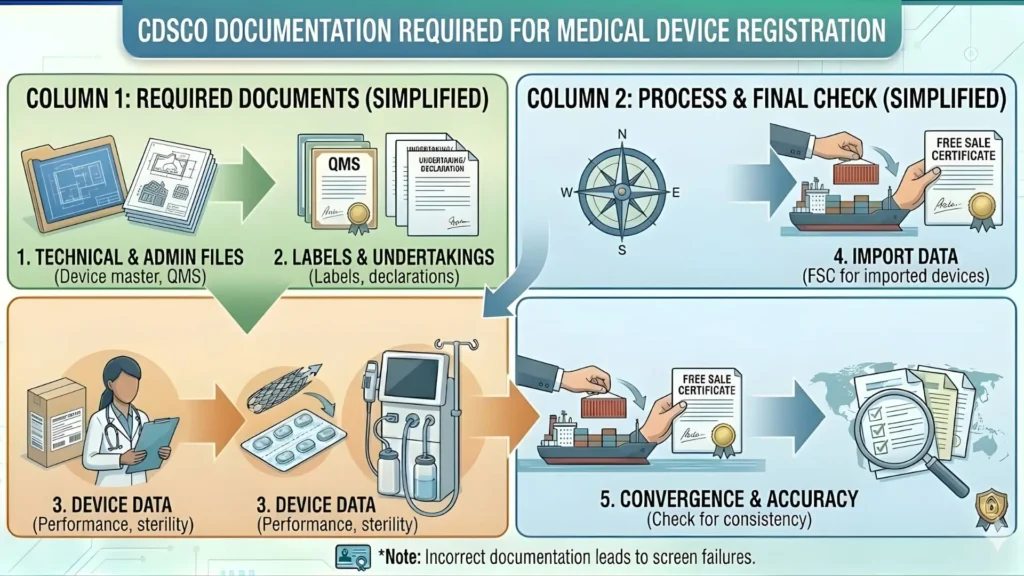
The following is a comprehensive, categorised document checklist. For MD-7, all categories apply. For MD-9, additional Loan License-specific documents are required from both the Lender and the Loan Licensee.
Business and Premises Documents
| S.No. | Document | Remarks |
| 1 | Certificate of Incorporation / LLP Agreement | Issued by MCA – Ministry of Corporate Affairs |
| 2 | GST Registration Certificate | Active and valid |
| 3 | PAN Card of Company | Income Tax Department |
| 4 | Proof of Premises – Ownership Deed or Registered Lease Agreement | Lease must cover at least the license validity period |
| 5 | Layout Plan of Manufacturing Premises (to scale) | Show all zones: production, QC, storage, utilities, personnel areas |
| 6 | Site Master File (SMF) | Comprehensive facility dossier as per CDSCO SMF guidelines |
| 7 | Utility Qualification Documents (HVAC, water, compressed air) | Evidence of qualification and maintenance for controlled environments |
Technical Personnel Documents
| S.No. | Document | Remarks |
| 8 | Educational Qualification Certificates of Technical Director / Head of Manufacturing | B.E./B.Tech or equivalent in relevant engineering discipline |
| 9 | Experience Certificates of Technical Director | Minimum 5 years in medical device manufacturing for Class C |
| 10 | Appointment and Acceptance Letters of all key technical personnel | Company issued; countersigned by technical person |
| 11 | CV / Resume of all key technical staff | Demonstrating relevant experience |
| 12 | Government-issued ID Proof (Aadhar / Passport) of Technical Director | For CDSCO verification |
Quality Management System Documents
| S.No. | Document | Remarks |
| 13 | ISO 13485:2016 Certificate | From accredited body; must be valid and scope-specific |
| 14 | Quality Manual | Covering all ISO 13485 clauses with company-specific procedures |
| 15 | Master List of SOPs with Version Control | All production, QC, QA, regulatory, and support SOPs |
| 16 | Internal Audit Reports (last 2 cycles) | Evidencing functioning QMS |
| 17 | Management Review Meeting Minutes (latest) | Demonstrating top management engagement in QMS |
| 18 | CAPA (Corrective and Preventive Action) Records | Evidencing systematic problem resolution |
Product Technical Documentation
| S.No. | Document | Remarks |
| 19 | Device Master Record (DMR) | Complete design history, BOM, manufacturing process, specifications |
| 20 | Design History File (DHF) – Class C mandatory | Design inputs, outputs, verification, validation, reviews |
| 21 | Risk Management File (ISO 14971:2019) | Full risk analysis, risk evaluation, risk controls, residual risk |
| 22 | Clinical Evidence / Performance Data | Literature review or clinical study data demonstrating safety and performance |
| 23 | Test Reports – IEC 60601-1 (3rd Ed) | From NABL-accredited or ILAC-MRA equivalent lab |
| 24 | Test Reports – ISO 80601-2-61 | Pulse oximeter-specific performance standards |
| 25 | EMC Test Reports – IEC 60601-1-2 | Electromagnetic compatibility testing |
| 26 | Biocompatibility Data – ISO 10993 (if patient-contact parts) | Required if any component contacts patient skin or mucosa |
| 27 | Software Validation Documentation (if embedded software) | Per IEC 62304 for medical device software |
| 28 | Declaration of Conformity | Signed by company's authorised signatory |
| 29 | Draft Label and Instructions for Use (IFU) | Compliant with MDR 2017 Schedule VI labelling requirements |
| 30 | Post-Market Surveillance (PMS) Plan | Systematic plan for ongoing safety monitoring post-launch |
Step-by-Step Process to Get MD-7 / MD-9 Manufacturer License for Oximeters
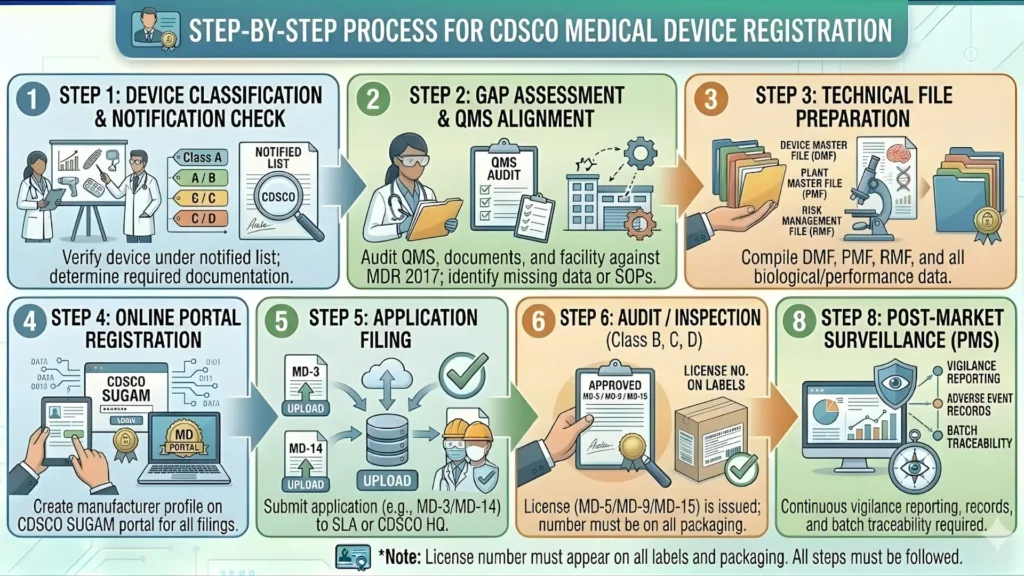
The entire application process for both MD-7 and MD-9 is managed through the SUGAM online portal (sugam.gov.in), which is CDSCO's official regulatory submission and tracking platform. Here is the precise sequence:
Step 1 – Confirm Device Classification
- Verify your oximeter's classification under Schedule II of the Medical Devices Rules, 2017.
- Class C → Form MD-7 → Filed with CDSCO. Class B → Form MD-5 → Filed with State Licensing Authority.
- If uncertain, initiate a classification query with CDSCO through the formal pre-submission meeting request process.
- Incorrect classification is the most common and costly early mistake — resolve it before investing in documentation.
Step 2 – Facility Setup and QMS Implementation
- Establish your manufacturing facility in compliance with Schedule M (Revised) requirements for medical device manufacturers.
- Implement ISO 13485:2016 across all manufacturing, quality control, design control, and post-market functions.
- Commission your facility utilities (HVAC, clean rooms, water systems) and complete installation qualification (IQ), operational qualification (OQ), and performance qualification (PQ).
- Engage an accredited ISO 13485 certification body for a Stage 1 and Stage 2 audit and obtain the ISO 13485 certificate.
Step 3 – Register on the SUGAM Portal
- Go to https://sugam.gov.in and register as a 'Manufacturer' applicant.
- Enter company details: legal name, registered address, CIN/LLPIN, GST number, authorized signatory details.
- For MD-9 (Loan License): both the Lender and the Loan Licensee must have active SUGAM accounts.
Step 4 – Prepare the Complete Application Package
- Compile all documents from the checklist in Section 5 of this guide.
- Convert all documents to PDF — ensure each file is within the SUGAM portal upload size limits (5 MB per document typically).
- Have all foreign-origin documents apostilled/notarized and translated into English where required.
- Prepare the Site Master File (SMF) — this is one of the most scrutinized documents during CDSCO review.
Step 5 – Fill and Submit Form MD-7 (or MD-9) on SUGAM Portal
- Log into SUGAM → Manufacturing → New Application → Select Form MD-7 (Class C/D) or Form MD-9 (Loan License).
- Complete all sections: applicant details, facility details, technical personnel, device information (name, classification, intended use, model numbers, standards), QMS details.
- Upload all documents in the designated upload sections — do not skip any mandatory field.
- For MD-9: enter details of both the Lender and the Loan Licensee in the respective sections and upload all shared documents.
- Review the completed application carefully — errors at this stage cause deficiency notes that cost months.
- Submit the application and save the Application Reference Number (ARN) for tracking.
Step 6 – Pay the Government Application Fee
After submission, the portal generates a fee challan. Pay the applicable fee online through net banking, credit card, or debit card via the SUGAM portal's payment gateway. Save the payment receipt — this is a mandatory document for all future correspondence with CDSCO.
Step 7 – CDSCO Screening and Technical Evaluation
CDSCO reviews the application in two phases:
- Phase 1 – Screening: Administrative check of document completeness and application accuracy. If deficiencies are found, a Deficiency Note is issued. Respond within the deadline (30 to 90 days typically) or face application rejection.
- Phase 2 – Technical Evaluation: CDSCO's technical officers evaluate the product dossier, risk management file, clinical evidence, test reports, and labelling. Queries may be raised during this phase as well.
Step 8 – Manufacturing Site Inspection by CDSCO
For MD-7 applications, CDSCO conducts a mandatory site inspection of the manufacturing facility. This is performed by CDSCO-designated inspectors — not state drug inspectors. Here is what they evaluate:
Government Fee Structure – MD-7 and MD-9 for Oximeters
The following fee schedule is based on the Medical Devices Rules, 2017 as applicable to CDSCO-regulated manufacturing licenses. All fees are payable online through the SUGAM portal and are non-refundable.
| Form / License Type | Device Class | Applicable to Oximeters | Fee – Indian Company | Fee – Foreign-Owned Indian Entity |
| MD-7 – Manufacturing License | Class C | Advanced / clinical oximeters | Rs. 1,00,000 per device | Rs. 1,00,000 per device |
| MD-7 – Manufacturing License | Class D | Rare – implantable SpO2 | Rs. 2,00,000 per device | Rs. 2,00,000 per device |
| MD-9 – Loan License | Class B | Standard oximeters (via loan) | Rs. 50,000 per device | Rs. 50,000 per device |
| MD-9 – Loan License | Class C | Advanced oximeters (via loan) | Rs. 1,00,000 per device | Rs. 1,00,000 per device |
| Renewal – MD-7 | Class C/D | At 3-year renewal | 50% of original fee | 50% of original fee |
| Renewal – MD-9 | Any Class | At 3-year renewal | 50% of original fee | 50% of original fee |
| Amendment – MD-7/MD-9 | Any Class | For product/facility changes | 25% of original fee (approx.) | 25% of original fee (approx.) |
Validity and Renewal – MD-7 and MD-9 Manufacturing License for Oximeters
Validity Period
- Both MD-7 (Class C/D Manufacturing License) and MD-9 (Loan License) are valid for 3 years from the date of issue.
- The license must be renewed before expiry — there is no grace period for manufacturing continuity after the license expires.
- After expiry without renewal, all manufacturing and distribution activities must cease immediately to remain compliant.
Renewal Process and Timeline
| Timeline Before Expiry | Action Required |
| 6 months before expiry | Conduct internal audit against current MDR 2017 requirements; review for any product, facility, or personnel changes that require amendment |
| 5 months before expiry | Renew ISO 13485 if it expires before or with the license; update test reports if any product changes occurred during the license period |
| 3 months before expiry | Submit renewal application on SUGAM portal — Form MD-7 renewal or MD-9 renewal as applicable; pay renewal fee online |
| 2 months before expiry | Confirm CDSCO has acknowledged the renewal application; follow up if no acknowledgment received |
| 1 month before expiry | Formally escalate to CDSCO if renewal certificate not yet issued; obtain written confirmation of application status |
| On expiry date (renewal pending) | CDSCO may extend the validity if renewal is in process — get written confirmation; do not assume continuity without it |
| Post-expiry without renewal | Manufacturing is non-compliant; all production must stop; re-application required — a full fresh MD-7/MD-9 with inspection |
Documents Required for Renewal
- Copy of existing MD-7 or MD-9 license certificate.
- Updated ISO 13485:2016 certificate (if renewed during the license period).
- Updated equipment calibration records (all measuring and test instruments).
- Updated technical personnel documents (if any changes in key staff).
- Revised facility layout plan (only if any layout changes were made and previously notified).
- Summary of post-market surveillance activities conducted during the license period.
- Summary of customer complaints received and CAPA actions taken.
- Declaration that no adverse regulatory action has been taken against the product globally.
- Renewal fee payment receipt from SUGAM portal.
Applicable Standards for Class C Oximeter Manufacturing
Class C oximeters require compliance with a more comprehensive set of standards compared to Class B. Here is the full reference:
| Standard | Title | Applicability |
| ISO 13485:2016 | Quality Management Systems – Medical Devices | Mandatory QMS for all medical device manufacturers |
| IEC 60601-1 (3rd Edition) | General requirements – safety and essential performance of medical electrical equipment | Core electrical safety standard for all oximeters |
| ISO 80601-2-61 | Particular requirements – pulse oximeter equipment | Product-specific performance and safety |
| IEC 60601-1-2 (4th Edition) | Electromagnetic compatibility (EMC) | Mandatory for all electrically powered medical devices |
| IEC 60601-1-6 | Usability engineering | Required for devices where usability errors can cause patient harm |
| IEC 60601-1-8 | Alarm systems in medical devices | Applicable for critical care oximeters with alarm functions |
| ISO 14971:2019 | Risk management for medical devices | Mandatory risk management throughout product lifecycle |
| IEC 62304:2006+A1 | Medical device software — software lifecycle processes | Mandatory if the oximeter has embedded software or firmware |
| ISO 10993 series | Biological evaluation of medical devices | Required for any patient-contact components |
| ISO 15223-1 | Symbols used in medical device labelling | For label symbol compliance |
| CDSCO Labelling Guidelines (Schedule VI) | Indian-specific labelling requirements | Mandatory for all devices sold in India |
Benefits of Getting CDSCO MD-7 / MD-9 Manufacturer License for Oximeters
| Benefit | What It Means for Your Business |
| Full Legal Manufacturing Rights | Legally manufacture and sell Class C oximeters across India without regulatory risk |
| CDSCO-Backed Brand Credibility | A CDSCO license from the Central Licensing Authority carries greater market credibility than state-level licensing |
| Government and Defence Tender Access | All government, military, CGHS, ESIC, and public hospital tenders require CDSCO-issued manufacturer licenses |
| Export and International Registration | Your MD-7 license supports Certificate of Free Sale issuance needed for CE marking, US FDA, TGA, and international market registrations |
| Investor and Bank Finance Access | Institutional investors, SIDBI, and commercial banks require valid manufacturer licenses for medical device company funding |
| Contract Manufacturing Revenue | A licensed facility can offer manufacturing services to other companies on a Loan License basis (MD-9) — creating an additional revenue stream |
| Regulatory Pathway for New Products | An active CDSCO manufacturing license simplifies the addition of new device models through amendment applications |
| IP Protection and Anti-Counterfeiting | Your CDSCO-registered device models are protected — counterfeit products cannot legally be registered under your device specifications |
Conclusion – Getting MD-7 and MD-9 Right for Oximeter Manufacturing in 2026
The MD-7 and MD-9 pathways for oximeter manufacturing in India represent a more demanding — but ultimately more rewarding — regulatory journey compared to Class B licensing. CDSCO's direct involvement means stricter standards, more thorough inspections, and deeper technical scrutiny. But it also means that once you are licensed, your product carries the regulatory credibility of central government approval — which opens doors in government hospitals, defence procurement, export markets, and premium healthcare institutions across India.
Whether you are building a Class C multi-parameter monitoring system with integrated SpO2, pursuing a Loan License to launch your oximeter brand without building your own factory, or planning to use India as an export base for internationally certified oximeters, the process is the same: start with accurate classification, build your QMS first, prepare your technical documentation to the highest standard, and engage with a regulatory partner who has done this before.
The oximeter market in India is growing rapidly, driven by post-pandemic awareness, expanding healthcare infrastructure, and government health programmes. There has never been a better time to invest in a properly licensed oximeter manufacturing operation.
Frequently Asked Questions
What is the difference between Form MD-5 and Form MD-7 for oximeter manufacturing?
Form MD-5 is used by manufacturers of Class A and Class B medical devices and is filed with the State Licensing Authority of the state where the manufacturing unit is located. Form MD-7 is used by manufacturers of Class C and Class D medical devices and is filed directly with CDSCO as the Central Licensing Authority.
Does a Loan License (MD-9) holder need their own manufacturing facility?
No. That is the defining feature of a Loan License. The Loan Licensee uses the manufacturing facility, equipment, and technical infrastructure of the Lender — a company that already holds a valid manufacturer license.
Is ISO 13485 mandatory for both the Lender and the Loan Licensee in an MD-9 arrangement?
Yes. The Lender must hold a valid ISO 13485:2016 certificate covering the manufacturing scope. For Class C devices, the Loan Licensee is also expected to demonstrate QMS capability relevant to their product oversight responsibilities.
Can one facility manufacture under both its own MD-7 license and also serve as a Lender for an MD-9 Loan License?
Yes. A facility that holds a valid MD-7 manufacturing license can simultaneously act as a Lender for one or more MD-9 Loan Licensees — provided the same facility is approved for the product scope of both the MD-7 license and the Loan License products.
How long does it take to get an MD-7 license from CDSCO for a Class C oximeter?
The official CDSCO processing target for MD-7 is 6 to 9 months from the date of receipt of a complete application. In practice, for first-time applicants with all documents in order and a successful first-attempt inspection, the total timeline including document preparation, ISO 13485 certification, testing, and CDSCO processing is typically 12 to 18 months from project initiation.
What happens if CDSCO's inspector finds non-compliances during the MD-7 facility inspection?
The CDSCO inspector documents all non-compliances in the inspection report and classifies them by severity — typically as Critical, Major, or Minor. For Critical and Major non-compliances, you are given a deadline (usually 30 to 60 days) to implement corrective actions and submit evidence of compliance.
Can I add new oximeter product models to my existing MD-7 license?
Yes, but you need to file an amendment application through the SUGAM portal. You cannot add new models and start manufacturing them without obtaining the amendment approval from CDSCO.
Is there a clinical trial requirement for Class C oximeters to get an MD-7 license?
A full clinical trial is not mandatory for most Class C oximeters. However, clinical evidence demonstrating the device's safety and performance is required. This can be fulfilled through a systematic clinical literature evaluation — a formal literature review using published peer-reviewed clinical data on your device or equivalent devices — combined with performance test data from accredited labs.
What are the renewal fees for MD-7 and MD-9 licenses for oximeters?
The renewal fee for both MD-7 and MD-9 licenses is 50 percent of the original application fee paid at the time of initial licensing. For a Class C oximeter MD-7 license (original fee Rs. 1,00,000), the renewal fee is Rs. 50,000. For a Class C Loan License (MD-9), similarly Rs. 50,000 at renewal. All renewal fees are paid online through the SUGAM portal and are non-refundable.
Can a startup or small company apply for MD-7 without a fully operational facility?
No. CDSCO requires the manufacturing facility to be fully set up, equipped, staffed, and operational at the time of the inspection. Submitting an application with a facility that is still under construction or not yet operational will result in a failed inspection. The correct approach for startups is to either set up the complete facility before applying, or use the MD-9 Loan License route — which allows you to manufacture at a licensed facility while you build your own.