
- Infant nutrition products are classified as a high-risk food category — they remain subject to full FSSAI hygiene, testing, and inspection requirements regardless of the relaxed 2026 turnover thresholds.
- FSSAI has proposed (consultation paper dated 1–2 May 2025) restricting Basic Registration for infant nutrition, milk powders, and packaged water — pushing these categories to State or Central License only; confirm the current status on FoSCoS before applying.
- Every infant milk substitute, infant formula, and follow-up formula must additionally comply with the Infant Milk Substitutes, Feeding Bottles and Infant Foods (Regulation of Production, Supply and Distribution) Act, 1992 — advertising to the public is banned under this law.
- Composition, labelling, and additive limits for infant formula and follow-up formula are separately governed by the FSS (Foods for Infant Nutrition) Regulations, 2020.
Introduction
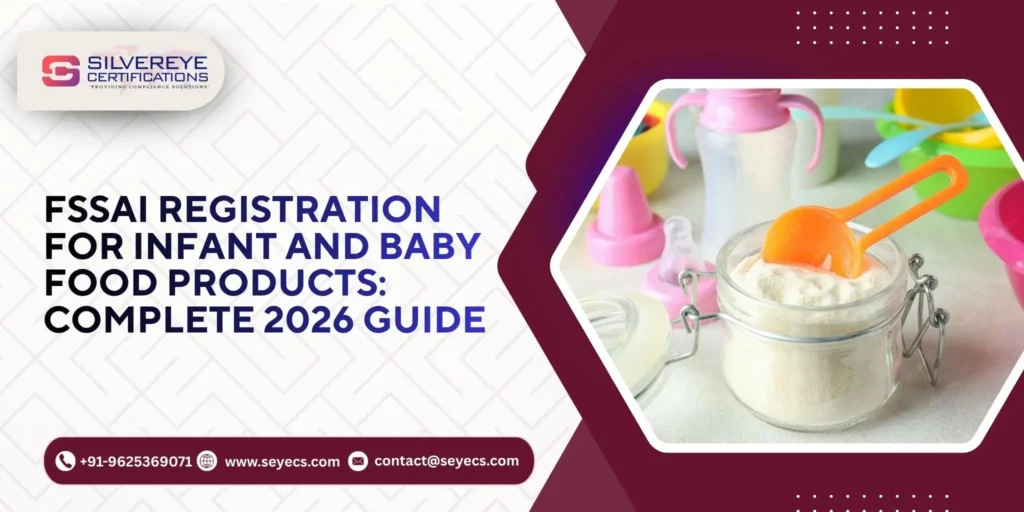
FSSAI registration for infant and baby products is the food safety approval every manufacturer, importer, or marketer of infant formula, follow-up formula, and baby cereals needs before selling in India. Because this is a high-risk category, most producers need a State or Central License rather than simple Basic Registration, and must also follow the Infant Milk Substitutes Act, 1992, which bans public advertising of these products.
The FSS (Foods for Infant Nutrition) Regulations, 2020 fix exact composition limits by age group, and the license itself follows the same 2026 turnover slabs — up to ₹1.5 crore for Registration, ₹1.5 crore–₹50 crore for State License, and above ₹50 crore for Central License — layered on top of infant-food-specific safety rules.
What Is FSSAI Registration for Infant and Baby Products?
FSSAI registration or license for infant and baby food products is the mandatory food safety approval issued to any business that manufactures, imports, distributes, repacks, or sells food intended for infants and young children — infant milk substitutes, infant formula, follow-up formula, foods for special medical purposes intended for infants, and foods for infants based on traditional food ingredients (commonly sold as baby cereals or weaning foods).
This category sits above standard packaged food in regulatory scrutiny. Beyond the general Food Safety and Standards Act, 2006, infant food businesses must separately comply with the Infant Milk Substitutes, Feeding Bottles and Infant Foods (Regulation of Production, Supply and Distribution) Act, 1992 (the IMS Act) and the Food Safety and Standards (Foods for Infant Nutrition) Regulations, 2020, which fix precise nutrient composition limits by product type and age group.
Why This Registration Matters for Infant Food Businesses
- Legal requirement: Manufacturing, importing, or selling infant food without valid FSSAI approval and IMS Act compliance is a punishable offence, and infant nutrition sits under FSSAI's high-risk food category with stricter inspection norms.
- Child health protection: Composition standards under the 2020 Regulations exist because infants cannot metabolise nutrients the way older children or adults can — incorrect formulation is a direct health risk.
- Retail and hospital listing: Pharmacies, hospitals, and e-commerce platforms verify FSSAI approval and IMS Act compliance before stocking or listing any infant formula or baby food brand.
- Marketing restrictions matter for brand survival: violating the IMS Act's advertising ban can trigger penalties and reputational damage that are hard to recover from in this sensitive category.
2026 FSSAI Turnover Update and What It Means for Infant Food
FSSAI's Order No. RCD-01002/1/2021-Regulatory-FSSAI-Part(1), dated 13 March 2026, revised the general turnover thresholds for food business categorisation under the Food Safety and Standards (Licensing and Registration of Food Businesses) Amendment Regulations, 2026 (Gazette notification dated 10 March 2026), effective 1 April 2026.
| License Type | Old Turnover Limit (pre-2026) | New Turnover Limit (from 1 April 2026) |
| Basic Registration | Up to ₹12 lakh | Up to ₹1.5 crore |
| State License | ₹12 lakh – ₹20 crore | Above ₹1.5 crore up to ₹50 crore |
| Central License | Above ₹20 crore | Above ₹50 crore |
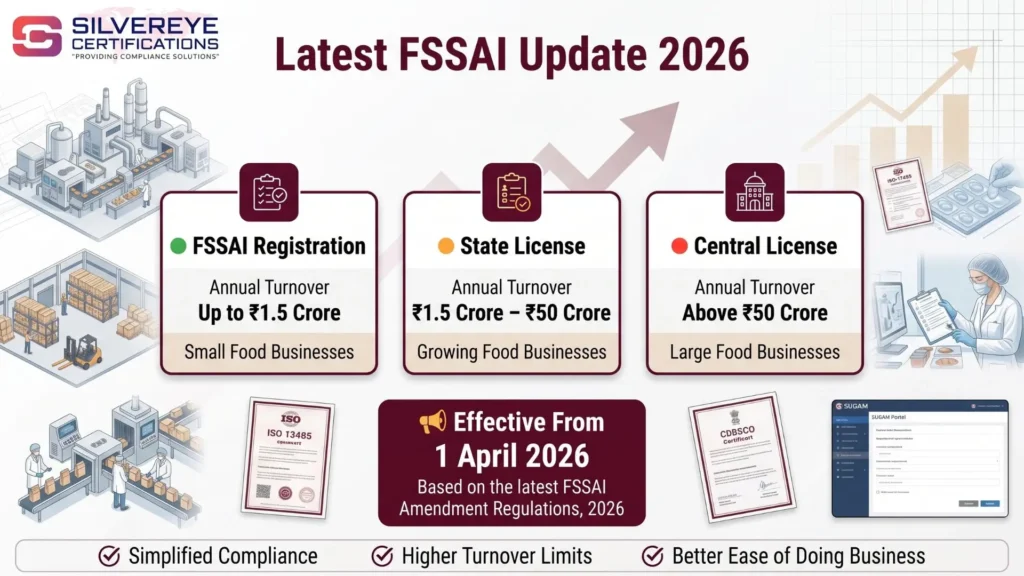
Important distinction for infant food businesses: current guidance on the 2026 amendment explicitly confirms that manufacturers in high-risk categories — dairy, meat, packaged drinking water, infant food, and fishery products — must continue to comply fully with all applicable hygiene, testing, and food safety requirements regardless of the revised turnover thresholds. In other words, the higher turnover ceiling for Basic Registration does not automatically mean an infant food manufacturer can operate under lighter compliance.
There is also a separate, product-specific tightening in motion: FSSAI issued a consultation paper (dated 1–2 May 2025) proposing to stop new Basic Registrations and registration renewals for infant nutrition products, milk powders, and packaged/mineral water altogether — pushing these categories to State or Central License only, with a proposed transition window for existing stock. Because this was a consultation-stage proposal, infant food businesses should verify the current, finalised position on FoSCoS or with their state Food Safety Department before assuming Basic Registration is still available for this category.
Applicable Laws Governing Infant and Baby Food in India
| Law / Regulation | What It Covers |
| Food Safety and Standards Act, 2006 | Overarching food safety law; licensing/registration framework administered by FSSAI |
| FSS (Licensing and Registration of Food Businesses) Regulations, 2011, as amended 2026 | Turnover-based categorisation into Registration, State License, and Central License |
| Infant Milk Substitutes, Feeding Bottles and Infant Foods Act, 1992 (IMS Act) | Bans advertising of infant milk substitutes, feeding bottles, and infant foods to the public; regulates promotion to healthcare workers and facilities |
| FSS (Foods for Infant Nutrition) Regulations, 2020 | Sets composition, additive, and quality standards for infant formula, follow-up formula, and related products by age group |
| FSS (Packaging and Labelling) Regulations, 2011 / Labelling and Display Regulations, 2020 | Mandatory label declarations, warning statements, and age-group indications |
| FSS (Contaminants, Toxins and Residues) Regulations, 2011 | Maximum permissible contaminant and residue limits applicable to infant food ingredients |
Types of FSSAI Approval for Infant and Baby Food Businesses
1. Basic Registration (subject to current eligibility)
Historically available for small infant food sellers/repackers with turnover up to the applicable threshold. Given the proposed 2025 restriction discussed above, confirm on FoSCoS whether Basic Registration is still open for this specific category before applying — many consultants now recommend going straight to a State or Central License for infant nutrition products to avoid a rejected or reverted application.
2. State License (₹1.5 crore–₹50 crore turnover)
Applicable to mid-sized infant food manufacturers or repackers operating within a single state. Given the high-risk classification, expect a more thorough premises inspection than a standard State License application in other food categories.
3. Central License (above ₹50 crore turnover, or activity-based triggers)
Mandatory for large infant formula manufacturers, and for these activities regardless of turnover: importing infant food or formula, exporting, supplying to Central Government institutions, or running a pan-India e-commerce infant-food business.

Eligibility and Compliance Requirements
- Manufacturing premises must meet Schedule 4 Good Manufacturing Practice (GMP) standards, with enhanced hygiene controls appropriate to a high-risk food category.
- Product formulations must match the composition tables in the FSS (Foods for Infant Nutrition) Regulations, 2020 for the relevant product type and age band.
- Businesses must commit to full compliance with the IMS Act's promotion and advertising restrictions before applying, since violations can affect the FSSAI license itself.
- A Food Safety Management System (FSMS) plan tailored to infant food hygiene risks is required as part of the license application.
- Importers of infant formula need a Central FSSAI License, an Import Export Code (IEC), and — since milk-based infant formula is a dairy product — likely a Sanitary Import Permit and foreign facility registration (see the dairy compliance table below).
Composition Standards by Product Type and Age Group
The FSS (Foods for Infant Nutrition) Regulations, 2020 set detailed nutrient composition tables for each category — this is the core technical compliance document every infant food manufacturer must formulate against.
| Product Category | Age Group Covered | Key Composition Requirement |
| Infant Formula (Infant Milk Substitute) | Birth up to 6 months | Must be nutritionally adequate as the sole source of nutrition; composition based on cow, buffalo, or other milch-animal milk with specified nutrient ranges |
| Follow-up Formula | After 6 months up to 24 months | Nutritionally adequate to support normal growth as part of a mixed diet; specific mineral, vitamin, and protein ranges apply (e.g., calcium and choline limits under the 2021 corrigenda) |
| Food for Infants Based on Traditional Food Ingredients | After 6 months up to 24 months | Prepared using traditionally home-made recipes but manufactured and packaged commercially, meeting defined nutrient adequacy standards |
| Preterm Infant Milk Substitute | Babies born before 37 weeks, until 40 weeks or as advised by a physician | Formulated specifically for preterm nutritional needs, distinct from standard infant formula |
| Food for Special Medical Purpose Intended for Infants | Birth to 24 months with specific medical conditions | Specially manufactured to meet particular nutritional requirements arising from a disorder or disease, under medical supervision |
Dairy Compliance Table for Infant Formula and Baby Food Manufacturers
Since most infant formula and follow-up formula is milk-based, manufacturers and importers face the same high-risk dairy compliance layer that applies to milk and milk products generally — on top of the infant-nutrition-specific rules above.
| Requirement | What It Means for Infant Formula Businesses | Governing Authority |
| High-risk food category status | Infant nutrition products face pre-license/pre-registration inspection and stricter ongoing audit requirements | FSSAI |
| Foreign facility registration (for imports) | Overseas manufacturers of milk-based infant formula must be registered with FSSAI through their country's competent authority before exporting to India (FSSAI Order dated 10 October 2022, effective 1 February 2023) | FSSAI |
| Sanitary Import Permit (SIP) | Required for imported milk and milk-based infant formula, obtained before shipping, based on DAHD's import risk analysis | Department of Animal Husbandry & Dairying (DAHD) |
| Designated ports of entry | Import of milk-based infant food allowed only through Bangalore, Chennai, Delhi, Hyderabad, Kolkata, and Mumbai | DAHD |
| Third-party audits / annual inspections | Mandatory for high-risk category manufacturers and Centrally Licensed manufacturers under FSSAI's risk-based inspection framework | FSSAI |
Documents Required for FSSAI Infant/Baby Food License
- Photo ID and address proof of the Food Business Operator / authorized signatory
- Business constitution certificate — Certificate of Incorporation, Partnership Deed, or LLP Agreement
- Layout plan of the manufacturing premises, machinery list, and Schedule 4 GMP compliance declaration
- Food Safety Management System (FSMS) plan specific to infant food hygiene and quality control
- Complete product composition data mapped against the relevant FSS (Foods for Infant Nutrition) Regulations, 2020 table
- Water testing report from an NABL-accredited laboratory
- Label drafts showing the mandatory IMS Act warning statements and age-group declarations (see labelling section below)
- Declaration of compliance with the IMS Act's advertising and promotion restrictions
- For importers: IEC certificate, Sanitary Import Permit (where the product is milk-based), and foreign facility registration confirmation

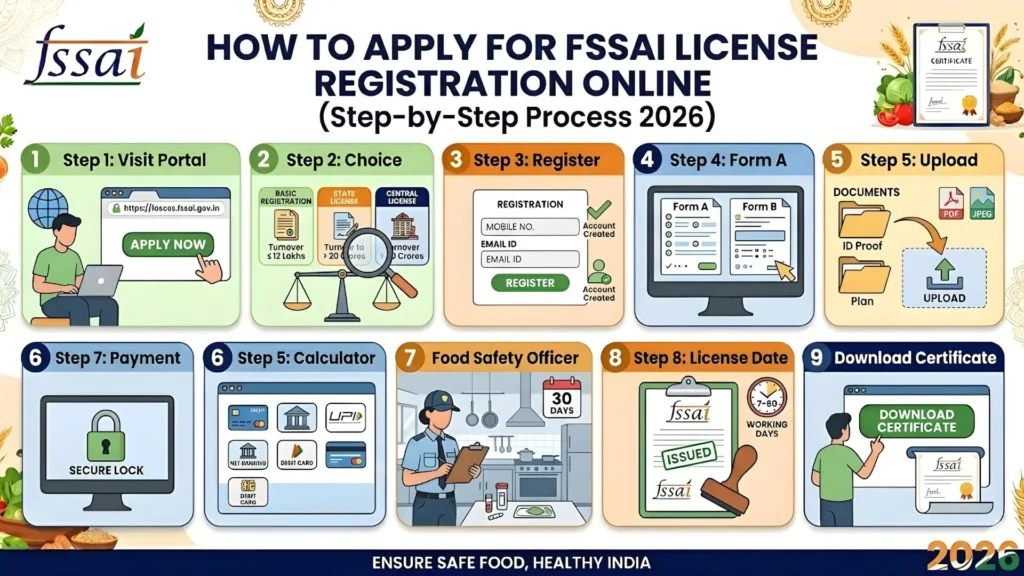
Step-by-Step FSSAI Application Process
- Confirm your product's exact category under the FSS (Foods for Infant Nutrition) Regulations, 2020 — infant formula, follow-up formula, preterm formula, traditional-ingredient infant food, or FSMP for infants.
- Verify current eligibility for Basic Registration versus State/Central License for your specific product on the FoSCoS Kind of Business matrix, given the proposed restrictions on registration for this category.
- Prepare your product formulation dossier against the applicable composition table, and your FSMS plan covering infant-food-specific hygiene risks.
- Apply on FoSCoS (foscos.fssai.gov.in) using Form A (Registration, if still available for your category) or Form B (State/Central License), uploading all required documents.
- Pay the applicable government fee for your license category.
- A Food Safety Officer conducts a premises inspection, typically more detailed than a standard food business inspection given the high-risk classification.
- On approval, print the 14-digit FSSAI number, mandatory IMS Act warning statements, and age-group declarations on every product label before market launch.
- Set up internal controls to ensure marketing, sales representatives, and any hospital/healthcare-worker interactions comply with the IMS Act's promotion restrictions on an ongoing basis.
Mandatory Labelling Requirements Under the IMS Act and FSSAI Rules
- The statement 'Mother's milk is best for your baby' must appear in capital letters on every container, as required by the IMS Act.
- A clear warning that infant milk substitutes or infant foods should be used only on the advice of a health worker, and only when necessary.
- The intended age group must be specified (for example, 0–6 months or 6–24 months), matching the product's composition category.
- FSSAI logo, 14-digit license number, complete ingredient list, nutritional information, and preparation instructions must be included.
- Labelling must be in English or Hindi at minimum; other regional languages may be added but are not mandatory.
- Advertising and promotional claims aimed at the general public are prohibited under the IMS Act — this includes packaging language that could be read as promotional beyond factual nutrition information.
FSSAI Fee Chart for Infant and Baby Food Businesses
| License/Approval | Government Fee | Typical Timeline |
| Basic Registration (where still available for this category) | ₹100 per year | 7–10 working days |
| State License | ₹2,000 – ₹5,000 per year | 30–60 working days (detailed inspection expected) |
| Central License | ₹7,500 per year | 60–90 working days (includes inspection) |
| Sanitary Import Permit (for milk-based infant formula imports) | As per DAHD's notified fee schedule | Typically 5–7 working days once documents are complete |
| Product Approval (if a non-standardised ingredient is used) | ₹50,000 + GST per application | Varies; scientific review can take several months |
Renewal, Perpetual Validity, and Ongoing Compliance
- Perpetual validity: registrations/licenses granted after 1 April 2026 no longer expire on a fixed 1–5 year term, subject to risk-based inspections — but high-risk categories like infant food should expect more frequent and thorough inspections than lower-risk businesses.
- Older, fixed-term licenses: renew at least 30 days before expiry; a late fee of ₹100 per day applies if filed after that window but before the license lapses.
- Annual Return (Form D-1): due by 31 May every year for State/Central License holders.
- Third-party audits: high-risk category manufacturers, including infant food producers, may be directed to undergo periodic third-party audits in addition to routine FSSAI inspections.
- Ongoing IMS Act compliance: this is a continuous obligation, not a one-time check at the time of licensing — marketing materials, sales practices, and hospital engagement all remain subject to the Act throughout the business's operation.
Penalties for Non-Compliance
Manufacturing or selling infant and baby food without valid FSSAI approval is an offence under the FSS Act, 2006, carrying penalties of up to ₹5 lakh and imprisonment of up to six months for operating without a license. Separately, violations of the IMS Act — such as advertising infant milk substitutes to the public, offering free samples, or promoting products through healthcare facilities in restricted ways — carry their own penalties under that Act, independent of FSSAI's food-safety penalties.
Frequently Asked Questions
Is FSSAI registration mandatory for infant and baby food products?
Yes. Every business that manufactures, imports, or sells infant formula, follow-up formula, or baby food needs FSSAI approval, in addition to complying with the IMS Act, 1992.
Can a small infant food business get Basic Registration instead of a license?
This is currently uncertain. FSSAI proposed in a May 2025 consultation paper to restrict Basic Registration for infant nutrition products, pushing them to State or Central License only. Confirm the current status for your specific product on FoSCoS before applying.
What law governs advertising of infant formula in India?
The Infant Milk Substitutes, Feeding Bottles and Infant Foods (Regulation of Production, Supply and Distribution) Act, 1992 (IMS Act) bans advertising infant milk substitutes and infant foods to the general public and restricts promotion through healthcare workers and facilities.
What composition standards apply to infant formula in India?
The FSS (Foods for Infant Nutrition) Regulations, 2020 set detailed nutrient ranges for infant formula (birth to 6 months), follow-up formula (6–24 months), preterm infant milk substitute, and food for special medical purpose intended for infants.
Do imported infant formula products need extra approvals?
Yes. Since most infant formula is milk-based, importers typically need a Central FSSAI License, IEC, Sanitary Import Permit from DAHD, and confirmation that the foreign manufacturing facility is registered with FSSAI.
What mandatory statement must appear on every infant formula label?
The IMS Act requires the statement 'Mother's milk is best for your baby' in capital letters, along with a warning that infant milk substitutes should be used only on a health worker's advice.
How long does it take to get an FSSAI license for infant food manufacturing?
State Licenses typically take 30–60 working days and Central Licenses 60–90 working days, given the more detailed inspection expected for this high-risk category.
Does the 2026 turnover threshold increase apply to infant food manufacturers?
The general turnover slabs (up to ₹1.5 crore for Registration, ₹1.5 crore–₹50 crore for State License, above ₹50 crore for Central License) apply as the categorisation framework, but infant food remains a high-risk category subject to full hygiene, testing, and inspection requirements regardless of the higher thresholds.
What is the penalty for advertising infant formula to the public?
Violations of the IMS Act's advertising and promotion restrictions carry their own penalties under that Act, separate from and in addition to any FSSAI food-safety penalties for licensing non-compliance.
Can infant food be sold as a 'proprietary food' without a fixed FSSAI standard?
Generally no — infant formula and follow-up formula compositions must match the specific tables in the FSS (Foods for Infant Nutrition) Regulations, 2020, rather than being formulated freely as proprietary food.