
- Dairy is a high-risk food category — most milk, paneer, cheese, and ghee manufacturers need a State or Central License, not Basic Registration.
- New 2026 turnover slabs apply from 1 April 2026: up to ₹1.5 crore (Registration), ₹1.5 crore–₹50 crore (State), above ₹50 crore (Central).
- Dairy units processing over 50,000 litres/day of milk or 2,500 MT/year of milk solids need a Central License irrespective of turnover.
- A March 2026 FSSAI advisory made registration mandatory for independent milk producers and vendors who sell outside dairy cooperative societies.
Introduction
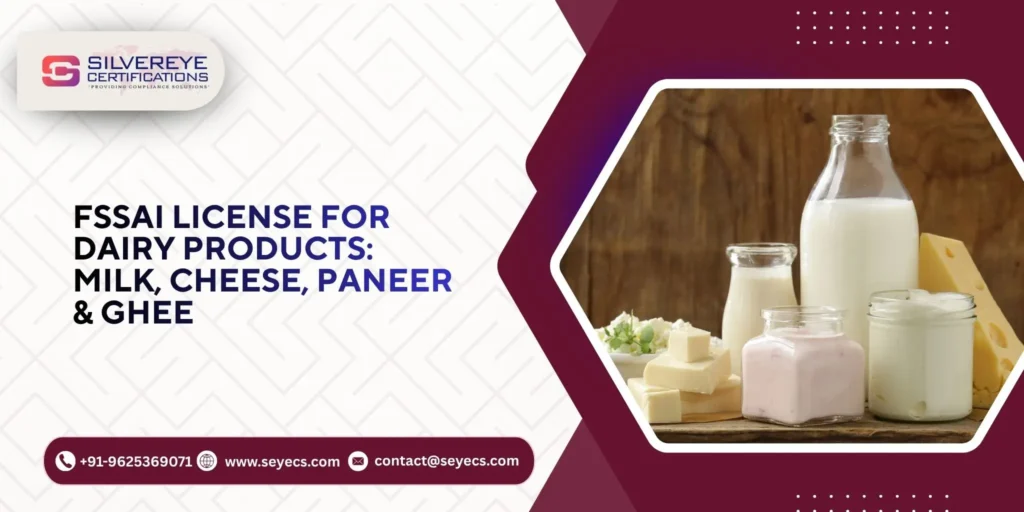
An FSSAI license for dairy products is mandatory for anyone manufacturing, processing, packing, or selling milk, paneer, cheese, ghee, curd, butter, or khoa in India. FSSAI treats dairy as a high-risk food category, so most processing units need a State or Central License rather than Basic Registration — and any dairy unit handling more than 50,000 litres of liquid milk per day or 2,500 MT of milk solids per year must hold a Central License regardless of turnover.
Under FSSAI's revised 2026 turnover rule (effective 1 April 2026), Registration applies up to ₹1.5 crore turnover, State License from ₹1.5 crore to ₹50 crore, and Central License above ₹50 crore. Government fees range from ₹100 to ₹7,500 a year, and since March 2026, FSSAI has also directed independent milk producers and vendors outside dairy cooperatives to get registered.
What Is an FSSAI License for Dairy Products?
An FSSAI license for dairy products is the statutory approval issued by the Food Safety and Standards Authority of India under the Food Safety and Standards Act, 2006, that allows a business to legally manufacture, process, store, distribute, or sell milk and milk products such as paneer, cheese, ghee, butter, curd, khoa, and ice cream. It is applied for and issued through the FoSCoS (Food Safety Compliance System) portal at foscos.fssai.gov.in.
Because milk spoils quickly and is one of the most commonly adulterated food items in India — with starch, detergent, urea, and diluted or synthetic milk among the recurring issues flagged by food safety officers — FSSAI classifies dairy as a high-risk food category. This directly affects which type of FSSAI approval a dairy business can apply for, how often it gets inspected, and what records it must maintain.
Latest FSSAI Update (2026) Relevant to Dairy Businesses
Two regulatory developments from 2026 are directly relevant if you're applying for an FSSAI license for dairy products today.
Revised Turnover Thresholds (effective 1 April 2026)
FSSAI's Regulatory Compliance Division issued Order No. RCD-01002/1/2021-Regulatory-FSSAI-Part(1) on 13 March 2026, implementing revised turnover thresholds for categorizing all food businesses, based on the Food Safety and Standards (Licensing and Registration of Food Businesses) Amendment Regulations, 2026, notified 10 March 2026. These thresholds took effect from 1 April 2026 and supersede all earlier turnover-based criteria.
| License / Registration Type | Revised Turnover Threshold (from 1 April 2026) |
| FSSAI Registration | Annual turnover up to ₹1.5 crore |
| FSSAI State License | Annual turnover above ₹1.5 crore and up to ₹50 crore |
| FSSAI Central License | Annual turnover above ₹50 crore |
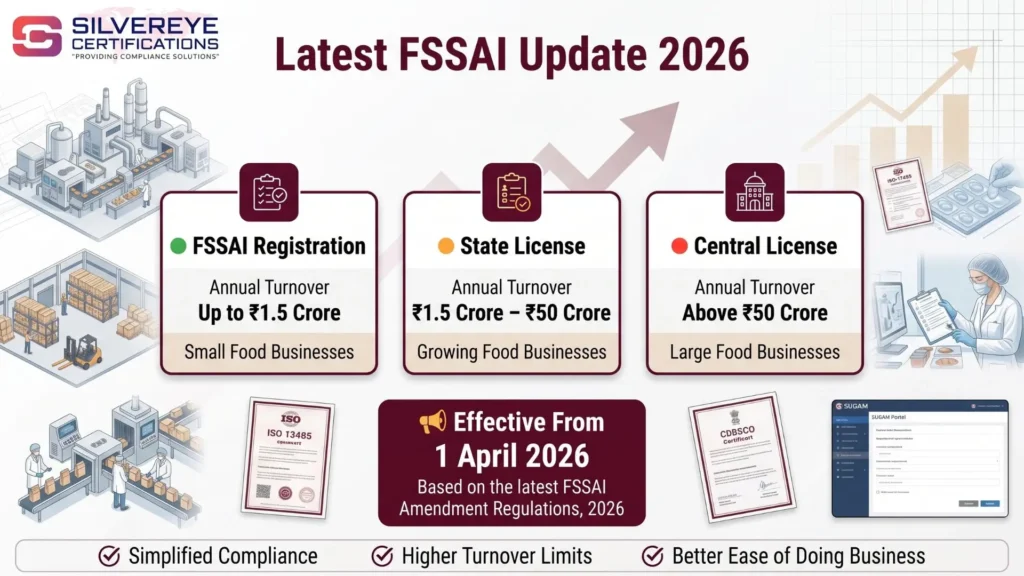
For dairy specifically, this turnover table is only one part of the picture. FSSAI's Kind of Business (KoB) eligibility matrix, last updated 1 April 2026, generally allows only petty milkmen and small milk vendors to opt for Basic Registration. Dairy processing plants, chilling units, and manufacturing facilities — anyone actually converting raw milk into paneer, cheese, ghee, or packaged milk — are typically required to hold at least a State License, even if their turnover would otherwise qualify for Basic Registration.
Mandatory Registration for Independent Milk Producers and Vendors
On 11 March 2026, FSSAI issued Advisory No. RCD-11003/1/2021-Regulatory-FSSAI(Part1), directing all milk producers who are not members of a dairy cooperative society, and all milk vendors, to mandatorily register with FSSAI before starting or continuing operations.
The advisory followed reports of milk adulteration across several states and was paired with a special enforcement drive for milk and milk products ordered on 16 December 2025. Producers who are registered members of a cooperative society and sell their entire milk output to that society remain covered under the society's own license and are generally exempt from separate individual registration.
Dairy Product Categories Covered Under FSSAI (With Compositional Standards)
FSSAI's Food Products Standards and Food Additives Regulations, 2011 lay down minimum compositional standards for each major dairy product. Meeting these is a condition of holding a valid license, not just a labelling formality — products that fall short are legally treated as adulterated or substandard.
| Product | Key FSSAI Standard | Notes |
| Cow Milk | Min. 3.5% fat, 8.5% SNF | SNF = solids-not-fat |
| Buffalo Milk | Min. 6.0% fat, 9.0% SNF | Higher fat than cow milk |
| Paneer / Chhana | Max. 70% moisture; min. 50% fat on dry-matter basis | Only sour milk, lactic acid, or citric acid permitted as coagulants; no starch or non-dairy fat allowed |
| Cheese | Composition varies by type (hard/soft/processed) | Formed by curdling milk with enzymes or acid; salt and approved additives permitted |
| Ghee | Min. 99.7% milk fat, max. 0.3% moisture | No artificial colour, flavour, or preservative allowed |
| Curd / Yogurt (plain) | Min. 3% fat, 8.5% SNF, min. 0.7% titratable acidity | Flavoured variants: min. 2.5% fat |
| Butter | Water-in-oil emulsion made exclusively from milk/cream | Table butter must be made from pasteurised cream |
| Ice Cream | Min. 10% fat, 11% SNF | No synthetic sweeteners or dyes permitted |
| Khoa / Mawa | Free from added starch and added sugar | Fat extracted must meet prescribed ghee-equivalent values |
A related point worth knowing: ghee and creamery (salted) butter are the only dairy products that can carry the voluntary AGMARK grading, and even that requirement was made non-mandatory following FSSAI's 2024 amendments — theFSSAI license itself is now the only compulsory certification for these products, alongside BIS, which remains a voluntary quality mark for dairy unless a specific state or buyer contract requires it.
Why Dairy Businesses Need FSSAI Approval
- Legal requirement: Selling milk, paneer, cheese, or ghee without valid FSSAI approval is an offence under the FSS Act, 2006, with fines and possible imprisonment for repeat or serious violations.
- Adulteration control: FSSAI's licensing and inspection regime is the main check against starch in paneer, water/urea in milk, and non-dairy fat substitution — issues that are actively enforced through 2026 special drives.
- Market access: Retail chains, hotels, e-commerce platforms, and export buyers require a valid FSSAI number before they will stock or list dairy products.
- High-risk classification benefits: FSSAI's risk-based inspection model means compliant, well-documented dairy units face fewer surprise inspections over time.
- Business credibility: A valid license supports GST registration, MSME scheme eligibility, and bank financing for dairy plants and cold-chain investment.
Types of FSSAI License for Dairy Products
| Type | Who It's For | Typical Turnover / Capacity Band |
| FSSAI Registration | Petty milkmen, small milk vendors, and very small-scale sellers of dairy products (not manufacturing units) | Turnover up to ₹1.5 crore |
| FSSAI State License | Paneer, cheese, ghee, curd, and packaged-milk manufacturers operating within one state; most dairy processing and chilling units | ₹1.5 crore–₹50 crore, or as specified by KoB regardless of turnover |
| FSSAI Central License | Large dairy processors, multi-state operators, importers/exporters, and any dairy unit handling over 50,000 litres/day of milk or 2,500 MT/year of milk solids | Above ₹50 crore, or mandatory by capacity regardless of turnover |

If your dairy business currently holds one category of FSSAI approval and your turnover or production capacity has since moved into a different slab, you can file a category modification on FoSCoS rather than applying from scratch.
Eligibility Criteria for FSSAI License for Dairy Products
- The applicant must be a legally constituted entity — proprietorship, partnership, LLP, private limited company, or registered cooperative society — engaged in producing, processing, packing, or selling milk or milk products.
- The processing premises must meet Schedule 4 hygiene and Good Manufacturing Practice standards, including pasteurisation facilities, cold storage, and clean-in-place equipment sanitation where applicable.
- Milk must be sourced from healthy animals and tested for adulterants (starch, water, detergent, urea) at reception before processing.
- The unit should maintain cold-chain conditions — chilled dairy products stored and transported below 4°C, and frozen products such as ice cream below -18°C.
- Key technical staff for manufacturing units are generally expected to have relevant qualifications in dairy technology, food technology, or a related discipline, or documented equivalent experience.
- Independent milk producers who are not part of a registered dairy cooperative society, and all milk vendors, must obtain at least Basic Registration under the March 2026 advisory.
Documents Required for FSSAI License for Dairy Products
Basic Documents (all applicants)
- Passport-size photograph and ID proof (Aadhaar, PAN, voter ID, or passport) of the proprietor/partners/directors
- Proof of business premises — rent agreement, electricity bill, or property ownership document
- Business constitution proof — partnership deed, MOA & AOA, LLP agreement, cooperative registration certificate, or certificate of incorporation
- PAN card of the business entity and GST registration certificate, where applicable
- Declaration of the nature and scale of the dairy business (milk, paneer, cheese, ghee, curd, etc.)
Additional Documents for State / Central License
- Food Safety Management System (FSMS) plan and factory/unit layout plan
- List of machinery and equipment with installed processing capacity (litres of milk per day or MT of milk solids per annum)
- Water testing report confirming potability of water used in processing
- List of directors/partners along with proof of financial capability for larger manufacturing units
- NOC from the municipal body or Panchayat for the manufacturing premises
- Recall plan and, for milk chilling centres, details of Bulk Milk Cooling Centres (BMCs) or Milk Collection Centres owned or managed by the applicant

Step-by-Step FSSAI Registration Process for Dairy Products
- Identify your correct category — Registration, State License, or Central License — based on turnover, processing capacity, and whether you're a vendor or a manufacturer.
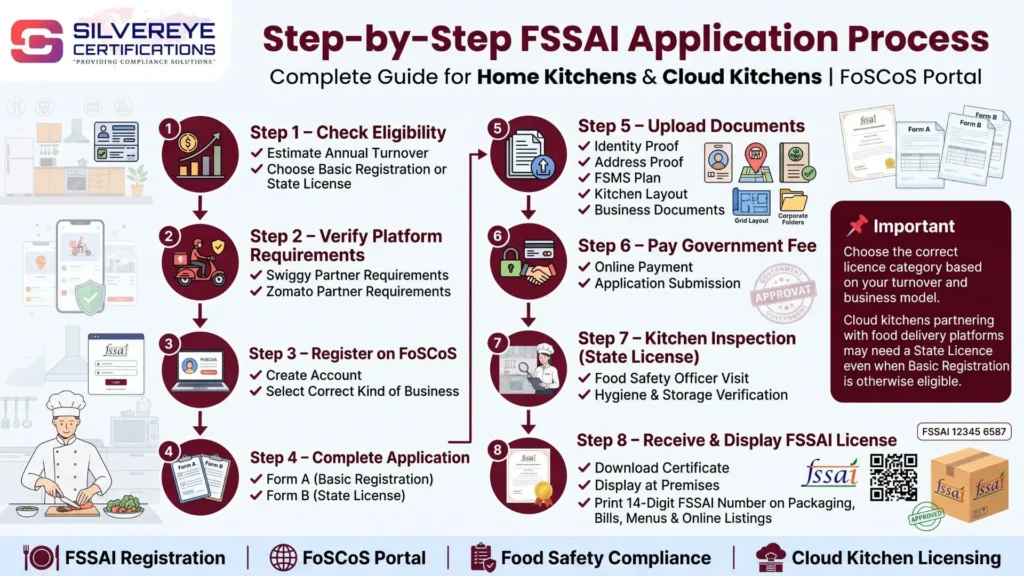
- Create an account on the FoSCoS portal (foscos.fssai.gov.in) with your mobile number and email ID.
- Select "Apply for New License/Registration," choose your state, and select the correct Kind of Business (e.g., "Milk and Milk Product Vendor," "Milk Chilling Unit," "Paneer/Cheese Manufacturer," or "Ghee Manufacturing Unit").
- Fill Form A (Registration) or Form B (State/Central License) with business, premises, and product details.
- Upload all required documents in the prescribed PDF/JPEG format.
- Pay the applicable government fee online and choose your validity period, where renewal still applies.
- Await document scrutiny and, for State/Central License applications, a pre-license inspection of the manufacturing or chilling unit by a Food Safety Officer.
- Download your FSSAI Registration Certificate or License from FoSCoS on approval and display it at your premises.
- Print your 14-digit FSSAI number on every pack of paneer, cheese, ghee, or packaged milk before dispatch.
FSSAI Fees for Dairy Product License (2026)
| License Type | Government Fee | Notes |
| FSSAI Registration | ₹100 per year | Can be paid up to 5 years upfront (₹500 total) |
| FSSAI State License | ₹2,000 – ₹5,000 per year | Varies with processing capacity and business type |
| FSSAI Central License | ₹7,500 per year | Mandatory for large processors and units above the capacity threshold |
These are official government fees on FoSCoS and exclude any professional or consultancy charges. GST at 18% applies on select FSSAI service fees such as the Central License.
Validity, Renewal & Annual Returns
Under the Food Safety and Standards (Licensing and Registration of Food Businesses) Amendment Regulations, 2026, FSSAI approvals granted from 1 April 2026 carry perpetual validity — they don't expire and don't require a fresh renewal application, provided the business stays compliant and pays its annual fee. Approvals issued before that date continue to follow the earlier 1-to-5-year validity cycle until their existing term ends.
Dairy businesses carry an extra reporting obligation: in addition to the standard Annual Return (Form D-1) due by 31 May each year, any FBO manufacturing or handling milk and milk products must file a half-yearly return (Form D-2), manually submitted to the concerned licensing authority for the periods 1 April–30 September and 1 October–31 March, within a month of each period ending.
Labeling Requirements for Dairy Products
- 14-digit FSSAI license/registration number printed clearly on the label
- Correct product name as per FSSAI's compositional standard (e.g., "Paneer," "Medium-Fat Paneer," "Ghee") — dairy terms cannot be used for products that don't meet the defined composition
- Batch number, manufacturing date, and best-before/expiry date
- Net quantity, storage instructions, and manufacturer's full address
- Fat and SNF percentage declaration for milk, curd, and similar products where applicable
Penalties for Non-Compliance
Selling dairy products without a valid FSSAI license, or supplying adulterated milk or milk products, is treated seriously under the FSS Act, 2006. Penalties range from monetary fines — which can run into several lakh rupees for high-risk food categories like dairy — to imprisonment for cases involving unsafe or adulterated food, with reported penalties for paneer and milk adulteration cases going up to six years' imprisonment in serious instances.
Given FSSAI's active 2026 enforcement drive specifically targeting milk and milk products, unregistered dairy vendors and producers face a materially higher chance of inspection and penalty right now.
Conclusion
An FSSAI license for dairy products isn't a one-size-fits-all approval — it sits at the intersection of the general 2026 turnover thresholds, dairy's high-risk categorization, and, for larger units, a hard capacity-based trigger for Central License. Whether you're a milk vendor bringing yourself into compliance after the March 2026 advisory, or a paneer, cheese, or ghee manufacturer scaling production, the safest approach is to match your Kind of Business and processing capacity against the current FoSCoS eligibility matrix rather than relying on turnover alone.
Because dairy compliance rules are being actively enforced and periodically updated, always cross-check your category and document checklist on foscos.fssai.gov.in before you apply.
Frequently Asked Questions
Is FSSAI registration mandatory for milk vendors and dairy farmers?
Yes. Under FSSAI's March 2026 advisory, all independent milk producers who are not members of a dairy cooperative society, and all milk vendors, must obtain at least FSSAI Registration. Producers who supply their entire milk output to a cooperative society are generally covered under the society's license.
Which FSSAI license is needed for a paneer, cheese, or ghee manufacturing unit?
Most manufacturing units need at least a State License because dairy processing is treated as high-risk, regardless of whether turnover would otherwise qualify for Basic Registration. Large units crossing ₹50 crore turnover, or handling more than 50,000 litres/day of milk or 2,500 MT/year of milk solids, require a Central License.
What are the new 2026 FSSAI turnover limits?
Effective 1 April 2026: Registration applies up to ₹1.5 crore turnover, State License from ₹1.5 crore to ₹50 crore, and Central License above ₹50 crore, per FSSAI Order No. RCD-01002/1/2021-Regulatory-FSSAI-Part(1) dated 13 March 2026.
Does a Central License apply to dairy units regardless of turnover?
Yes, in specific cases. Dairy units, including chilling units, that handle or process more than 50,000 litres of liquid milk per day or 2,500 MT of milk solids per annum must hold a Central License irrespective of their annual turnover.
How much does an FSSAI license for dairy products cost?
Government fees range from ₹100 per year for Basic Registration to ₹2,000–₹5,000 per year for a State License and ₹7,500 per year for a Central License, excluding consultancy charges.
What is the FSSAI standard for paneer fat and moisture content?
FSSAI requires paneer to have a maximum of 70% moisture and a minimum of 50% fat on a dry-matter basis, with only sour milk, lactic acid, or citric acid permitted as coagulants
Is BIS or AGMARK certification compulsory for ghee and dairy products?
No. BIS certification for dairy products is voluntary, and AGMARK grading — historically applicable only to ghee and creamery butter — was made non-mandatory following FSSAI's 2024 regulatory amendments. The FSSAI license is now the primary compulsory approval.
What documents are required for an FSSAI dairy license?
Common requirements include ID and address proof, business constitution documents, premises proof, a Food Safety Management System plan, machinery/capacity details, and a water testing report; State/Central applicants also need a layout plan and NOC from the local municipal body.
Do dairy manufacturers have any extra return-filing obligation?
Yes. In addition to the standard annual return (Form D-1) due by 31 May, FBOs manufacturing or handling milk and milk products must file a half-yearly return (Form D-2) for the periods April–September and October–March.
Does my FSSAI license for dairy products expire now that validity is 'perpetual'?
Licenses and registrations granted from 1 April 2026 do not expire automatically, but you must still pay the annual fee, file returns on time, and stay compliant — non-payment or violations can lead to suspension or cancellation.