
- Every food importer needs a Central FSSAI License with 'Importer' as the Kind of Business — this applies regardless of turnover, shipment size, or frequency of import.
- Each consignment must separately clear the Food Import Clearance System (FICS), which is linked to Customs ICEGATE, before it can leave the port.
- Imported dairy products (and meat, egg powder, infant food, nutraceuticals) additionally need the foreign manufacturing facility registered with its home country's competent authority, plus a Sanitary Import Permit from DAHD.
- Imported food must have at least 60% of its total shelf life (or a minimum of 3 months) remaining at the time of import, and the label must declare the country of origin.
Introduction
An FSSAI license for imported food products is the mandatory Central License every business needs before bringing chocolates, cereals, sauces, or any other food item into India for sale. Turnover doesn't decide the category here — importing food always requires a Central License (₹7,500/year) with 'Importer' selected as the Kind of Business, plus an Import Export Code from DGFT.
Every shipment must then clear FSSAI's Food Import Clearance System (FICS) at the port of entry, where labelling, shelf life, and lab-test compliance are checked before a No Objection Certificate is issued.
What Is an FSSAI License for Imported Food Products?
An FSSAI license for imported food products is the Central License issued by the Food Safety and Standards Authority of India to any business that imports packaged or bulk food — chocolates, breakfast cereals, sauces, condiments, dairy items, snacks, or beverages — for sale in the Indian market. It is separate from, and in addition to, the per-consignment clearance every shipment must obtain through FSSAI's Food Import Clearance System (FICS) before customs release it.
Without this license and the matching Import Export Code, no food consignment — however small — can legally clear an Indian port, airport, or land customs station.
Why Importers of Chocolates, Cereals and Sauces Need This License
- Legal gateway: FICS applications cannot even be filed without an active Central FSSAI License — your consignment simply cannot be cleared without it.
- Port detention risk: Consignments arriving without a valid license or FICS NOC are held at the port, attracting demurrage and storage charges until compliance is sorted out.
- Retail and e-commerce listing: Supermarkets, gourmet retailers, and platforms like Amazon and BigBasket verify the FSSAI import license and product-level compliance before listing an imported food brand.
- Consumer trust and safety: Every imported chocolate, cereal, or sauce is checked for banned additives, correct labelling, and safe shelf life before it reaches Indian shelves.
2026 FSSAI Turnover Update: How It Applies to Importers
FSSAI's Order No. RCD-01002/1/2021-Regulatory-FSSAI-Part(1), dated 13 March 2026, revised turnover thresholds for food business categorization under the Food Safety and Standards (Licensing and Registration of Food Businesses) Amendment Regulations, 2026 (Gazette notification dated 10 March 2026), effective 1 April 2026.
| License Type | Old Turnover Limit (pre-2026) | New Turnover Limit (from 1 April 2026) |
| Basic Registration | Up to ₹12 lakh | Up to ₹1.5 crore |
| State License | ₹12 lakh – ₹20 crore | Above ₹1.5 crore up to ₹50 crore |
| Central License | Above ₹20 crore | Above ₹50 crore |
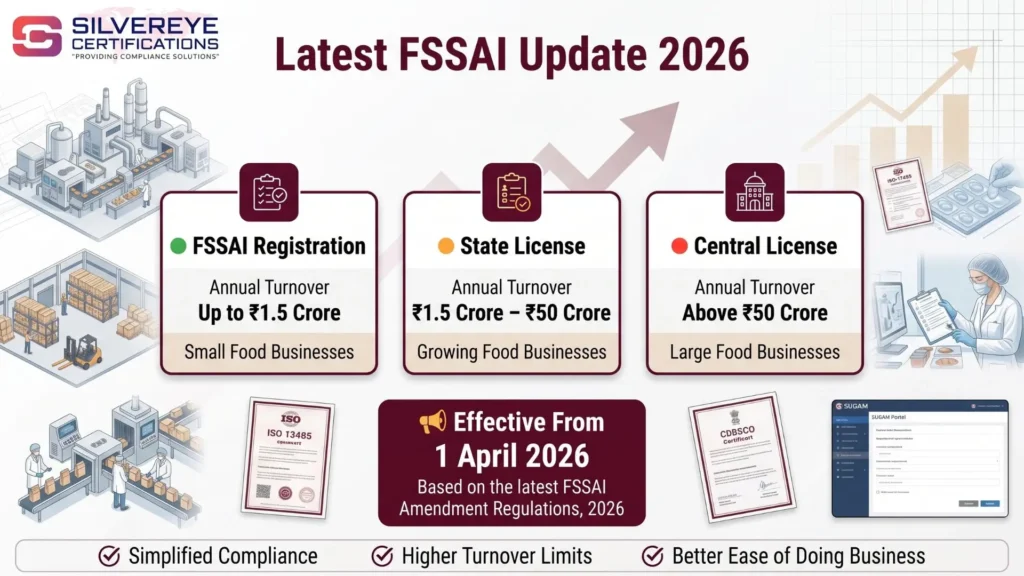
Important distinction for importers: These turnover slabs govern general food businesses. Importing food is an activity-based exception — as confirmed by the FoSCoS Kind of Business (KoB) Eligibility Matrix (updated 1 April 2026), importers must hold a Central License irrespective of turnover.
A small business bringing in even one container of imported chocolate a year still needs the same Central License as a large-scale distributor. The 2026 turnover slabs become directly relevant only once you're selling that imported stock domestically as a trader or retailer at a scale that needs its own registration or license for the distribution business.
- Perpetual validity: Registrations/licenses granted after 1 April 2026 no longer need renewal every 1–5 years, subject to risk-based inspection.
- Automatic category Upgrade with no extra fee if turnover crosses your existing slab, retaining the same license number.
Step-by-Step Process to Import Chocolates, Cereals or Sauces into India
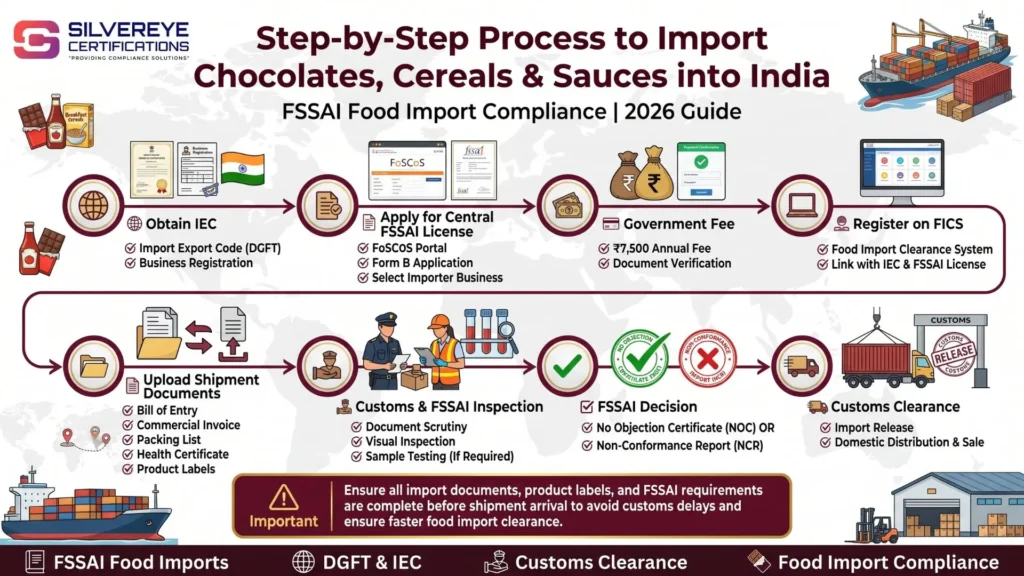
- Obtain an Import Export Code (IEC) from DGFT — a 10-digit code, typically issued within 2–3 working days.
- Apply for a Central FSSAI License on FoSCoS using Form B, selecting 'Importer' as your Kind of Business and listing every product category you intend to bring in (e.g., Confectionery for chocolates, Cereals and Cereal Products, Sauces and Condiments).
- Pay the government fee of ₹7,500 per year and complete document verification.
- Register on the Food Import Clearance System (FICS) at fics.fssai.gov.in using your Central License credentials, linked to your IEC.
- Before each shipment arrives, file the FICS application with the Bill of Entry, invoice, packing list, health/sanitary certificate (where applicable), and label images.
- Customs refers the consignment to FSSAI's Authorized Officer at the port of entry (62 dedicated FSSAI entry points, plus 99 more where Customs officials are notified as Authorized Officers).
- The Authorized Officer scrutinizes documents, conducts a visual inspection, and — based on FSSAI's Risk Management System — may draw samples for lab testing at a notified laboratory.
- If compliant, FSSAI issues a No Objection Certificate (NOC); if not, a Non-Conformance Report (NCR) is issued, and the importer can rectify certain labelling deficiencies at the bonded warehouse before re-inspection, or file a review under Regulation 8 of the FSS (Import) Regulations, 2017.
Documents Required for FSSAI Import License and FICS Clearance
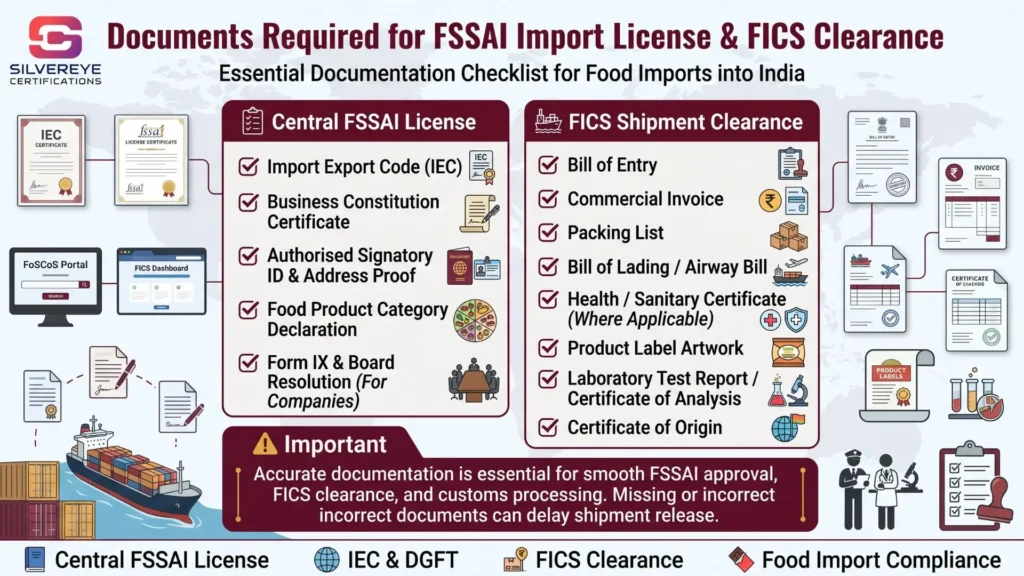
For the Central License application
- Import Export Code (IEC) certificate from DGFT
- Business constitution certificate — Certificate of Incorporation, Partnership Deed, or LLP Agreement
- Photo ID and address proof of the authorised signatory
- Declaration of the food product categories to be imported (chocolates, cereals, sauces, etc.)
- Nomination of a responsible person (Form IX with board resolution, for companies)
For each FICS shipment clearance
- Bill of Entry and commercial invoice
- Packing list and Bill of Lading / Airway Bill
- Health certificate or certificate of sanitary export from the exporting country's competent authority, where applicable
- Label images/artwork showing compliance with Indian labelling norms
- Laboratory test report or Certificate of Analysis, where required by the product's risk category
- Certificate of origin, confirming country of manufacture for labelling and duty purposes
FSSAI Labelling Rules for Imported Chocolates, Cereals and Sauces
- Country of origin must be declared on every imported food label; if a second country processes the product enough to change its 6-digit HS code, that country becomes the declared origin.
- Complete name and address of the importer, in addition to the manufacturer's details, must appear on the label.
- FSSAI logo with the 14-digit license number, ingredient list, allergen declaration, net quantity, and date of manufacture/best-before must all be present, in English or Hindi.
- Minor, non-critical label gaps (not batch/lot number, date marking, or country of origin) can be rectified with a single non-detachable sticker at a customs-bound warehouse before inspection, under FSSAI's labelling-rectification order.
- Shelf-life rule: imported food must retain at least 60% of its total shelf life, or a minimum of 3 months, whichever applies, at the time of import.
Product-Specific FSSAI Categories for Chocolates, Cereals and Sauces
| Product | FSSAI Food Product Category (FPC) | Key Compliance Point |
| Chocolates & chocolate confectionery | FPC 5.1 (Chocolate and chocolate products); 5.1.4 covers imitation/substitute chocolate | Must meet cocoa-solids and compositional standards under FSS (Food Product Standards) Regulations, 2011 |
| Breakfast cereals, flours, pasta, noodles | FPC 6 (Cereals and cereal products) | Fortified cereal claims (iron, folic acid, vitamins) must match FSSAI fortification standards |
| Sauces, ketchup, condiments, dressings | FPC 12 (Salts, spices, soups, sauces, salads and protein products) | Preservative and additive limits under the Food Additives Regulations apply; tomato-based sauces have specific compositional standards |
| Toppings, sweet sauces, dessert syrups | FPC 5.4 | Distinguished from savoury sauces (FPC 12) for category and labelling purposes |
Dairy Products in Imported Food Consignments: Special Compliance Table
Dairy items — imported cheese, chocolate with dairy fillings, milk-based sauces, or dairy-blended cereal products — face additional scrutiny beyond the standard FICS process, because milk and milk products sit in FSSAI's high-risk import category alongside meat, egg powder, infant food, and nutraceuticals.
| Requirement | What It Means for Dairy Importers | Governing Authority |
| Foreign facility registration | The exporting country's competent authority must register the foreign manufacturing facility with FSSAI before it can export milk/milk products to India (FSSAI Order dated 10 October 2022, effective 1 February 2023) | FSSAI |
| Sanitary Import Permit (SIP) | Mandatory for milk and milk products, obtained before shipping from the country of origin, based on DAHD's import risk analysis | Department of Animal Husbandry & Dairying (DAHD) |
| Veterinary Health Certificate (VHC) | An integrated VHC accompanying the consignment is required for milk and milk products | DAHD / exporting country's veterinary authority |
| Designated ports of entry | Import allowed only through notified sea ports/airports — Bangalore, Chennai, Delhi, Hyderabad, Kolkata, and Mumbai — where animal quarantine and certification services exist | DAHD |
| Certificate of origin | Must include order number, container number, port of discharge, buyer's name, product description, and a declaration of the goods' country of origin | Exporting country's government/industry body |
Practical tip: if your imported chocolate, cereal, or sauce product contains a dairy filling, dairy powder, or dairy-based sauce component, check whether it falls under the 'milk and milk products' definition for SIP purposes — the safest approach is to confirm with DAHD or your customs broker before shipping, since misclassification is a common cause of port delays.
FSSAI Import License Fee Chart
| Requirement | Government Fee | Typical Timeline |
| Central FSSAI License (Importer KoB) | ₹7,500 per year | 30–60 working days for first-time license approval |
| Import Export Code (IEC) | ₹500 (DGFT fee) | 2–3 working days |
| FICS clearance (per consignment) | As per FSSAI's notified consignment clearance fee schedule | 1–2 weeks for routine, complete-documentation shipments |
| Sanitary Import Permit (dairy/meat/eggs) | As per DAHD's notified fee schedule | Typically 5–7 working days once documents are complete |
| Product Approval (if a non-standardised ingredient is involved) | ₹50,000 + GST per application | Varies; scientific review can take several months |
FSSAI License Renewal and Ongoing Compliance for Importers
- Renewal window: file at least 30 days before expiry for licenses still on a fixed 1–5 year term; an express window may open up to 180 days before expiry.
- Late fee: ₹100 per day if renewal is filed after the 30-day-before-expiry deadline but before the license lapses.
- Annual Return (Form D-1): due by 31 May every year for Central License holders, including importers.
- Per-shipment discipline: even with an active annual license, every individual consignment still needs its own FICS clearance — the license is not a one-time pass for all future imports.
- Facility registration renewal (dairy/meat/egg/infant food/nutraceutical importers): confirm your overseas supplier's facility registration with FSSAI remains current before placing repeat orders.
Penalties for Importing Food Without Proper FSSAI Compliance
Importing or selling food without a valid Central FSSAI License, without FICS clearance, or with non-compliant labelling is an offence under the FSS Act, 2006, and the FSS (Import) Regulations, 2017. Consequences range from consignment detention and destruction orders to penalties of up to ₹5 lakh and imprisonment of up to six months for operating without a valid license, in addition to demurrage and storage costs accumulated while the consignment sits uncleared at the port.
Frequently Asked Questions
Is FSSAI license mandatory for importing chocolates, cereals, or sauces into India?
Yes. Every food importer needs a Central FSSAI License with 'Importer' as the Kind of Business, regardless of the product, shipment size, or how often you import.
Can a small importer get a Basic Registration or State License instead of a Central License?
No. Per the FoSCoS Kind of Business Eligibility Matrix, importers must hold a Central License irrespective of turnover — there's no smaller-scale alternative for the import activity itself.
What is the fee for an FSSAI import license?
The government fee for the Central FSSAI License is ₹7,500 per year. Additional costs apply for the Import Export Code, per-consignment FICS clearance, and, for high-risk categories, Sanitary Import Permits.
Do I need FICS clearance for every shipment, even with an active FSSAI license?
Yes. The Central License is the baseline requirement to operate as an importer, but each individual consignment must separately clear the Food Import Clearance System (FICS) before customs releases it.
What shelf life is required for imported chocolates, cereals, and sauces?
Imported food must have at least 60% of its total shelf life remaining, or a minimum of 3 months, at the time of import — whichever standard applies to that product.
Do imported dairy-containing products need extra approvals?
Yes. Milk and milk products need the foreign manufacturing facility registered with FSSAI, a Sanitary Import Permit from DAHD, and import only through designated ports — this can extend to dairy-filled chocolates or dairy-based sauces, so check classification before shipping.
Can labelling errors on an imported consignment be fixed at the port?
Minor label gaps can be corrected with a single non-detachable sticker at a customs-bound bonded warehouse before inspection. However, batch/lot number, date marking, and country of origin cannot be altered — they must be correct on arrival.
How long does FSSAI import clearance take for a routine shipment?
For consignments with complete documentation, FICS clearance typically takes about 1–2 weeks; high-risk categories or incomplete paperwork can take longer due to lab testing and Non-Conformance Report resolution.
Which ports can I use to import dairy or dairy-containing food products?
Animal-origin and dairy imports are permitted only through the sea ports/airports of Bangalore, Chennai, Delhi, Hyderabad, Kolkata, and Mumbai, where animal quarantine and certification services are available.
What happens if my consignment fails FSSAI inspection?
FSSAI issues a Non-Conformance Report (NCR). Depending on the issue, you may rectify labelling at the bonded warehouse, or file a review application under Regulation 8 of the FSS (Import) Regulations, 2017; non-compliant consignments can otherwise be detained, re-exported, or destroyed.