
- Importers need Form COS-1 (application) and Form COS-2 (Import Registration Certificate) from CDSCO before any oral gel product enters India.
- Manufacturers need Form COS-5 (application) and Form COS-8 (Manufacturing License) from the State Licensing Authority before production begins.
- Registration is mandatory under the Cosmetics Rules, 2020 — selling an unregistered oral gel risks seizure, penalties, and blocked customs clearance.
- Once granted, COS-2 and COS-8 stay valid indefinitely, provided the licensee pays the retention fee every 5 years.
What Is Cosmetic Oral Gel Product Registration?
A cosmetic oral gel is any non-medicated gel applied in or around the mouth for cleansing, freshening, whitening, or cosmetic care — as opposed to a medicated drug product that treats or prevents a disease. Under Section 3(aaa) of the Drugs and Cosmetics Act, 1940, a "cosmetic" is any article meant to be rubbed, applied, or introduced into the human body to cleanse, beautify, or alter appearance, without making a therapeutic claim.
Because oral gels are absorbed or contact mucous membranes, CDSCO treats this category with the same regulatory seriousness as other cosmetics — and sometimes more, given the labelling scrutiny around "non-therapeutic" claims. Every business that wants to sell a cosmetic oral gel in India — whether imported from abroad or manufactured domestically — must first secure the correct government registration before the product reaches store shelves, e-commerce listings, or distributor warehouses.
The path you take depends on where the product is made:
- Imported oral gel → Form COS-1 (application) → Form COS-2 (Import Registration Certificate) from CDSCO, the Central Licensing Authority.
- Domestically manufactured oral gel → Form COS-5 (application) → Form COS-8 (Manufacturing License) from the State Licensing Authority (SLA).
Cosmetic Oral Gel Products Covered Under This Registration
CDSCO classifies cosmetics into roughly 80 product categories under the Fourth Schedule of the Cosmetics Rules, 2020. Oral gels are assessed under the dentifrice/oral-care cluster of this classification. Common cosmetic oral gel product types that require COS-1/COS-2 (import) or COS-5/COS-8 (manufacture) registration include:
| Product Name | Typical Use Case | Registration Note |
| Tooth Gel (Gel Toothpaste) | Daily cleaning, non-abrasive alternative to paste | Must be non-medicated; no anti-cavity drug claim |
| Teeth Whitening Gel (Cosmetic) | Cosmetic surface stain removal | No peroxide/bleaching drug claim permitted as cosmetic |
| Herbal / Ayurvedic Oral Gel | Natural or herbal oral hygiene | Herbal origin does not exempt it from CDSCO filing |
| Mouth Freshener Gel | Breath freshening, non-ingested | Classified as cosmetic only if applied, not swallowed |
| Gum Care Cosmetic Gel | Gum massage, cosmetic soothing | Must avoid therapeutic "treats gum disease" claims |
| Charcoal Tooth Gel | Cosmetic stain removal, trending format | Abrasivity and label claims are checked closely |
| Kids' Flavoured Tooth Gel | Flavoured, low-abrasion children's oral care | Extra label scrutiny for child-safe claims |
| Sensitive-Teeth Cosmetic Gel | Cosmetic comfort gel for daily use | Cannot claim to "cure" sensitivity as a drug would |
Important: If an oral gel makes a therapeutic claim (e.g., "treats gingivitis," "cures ulcers," contains scheduled anti-microbial drug actives), it may be classified as a drug rather than a cosmetic, and would instead require approval from the Drug Controller General of India (DCGI) — not the COS-series forms covered here. Always confirm classification before filing.
Two Regulatory Pathways: Import vs. Manufacture
| Aspect | Import Route (Importer / Foreign Brand) | Manufacturing Route (Domestic Manufacturer) |
| Application Form | COS-1 | COS-5 |
| Approval / License Form | COS-2 (Import Registration Certificate) | COS-8 (Manufacturing License) |
| Licensing Authority | Central Licensing Authority (CDSCO) | State Licensing Authority (SLA) |
| Filing Platform | CDSCO SUGAM Portal | SLA / State online portal (SUGAM-linked in most states) |
| Site Inspection | Not required for the Indian applicant's premises | Mandatory factory inspection within 30 days |
| Typical Timeline | 60–180 working days | 45–120 working days |
| Validity | Indefinite, subject to 5-year retention fee | Indefinite, subject to 5-year retention fee |
Import Route for Cosmetic Oral Gel Products — Form COS-1 & COS-2
This route applies to any business bringing a finished cosmetic oral gel into India from an overseas manufacturing site for sale, distribution, or e-commerce listing.
Who Can Apply (Eligibility)
- The overseas manufacturer of the oral gel directly.
- An Authorized Agent in India formally appointed by the manufacturer.
- An Indian subsidiary of the overseas manufacturer.
- An Importer in India who is not the manufacturer, agent, or subsidiary, but sources the product for resale.
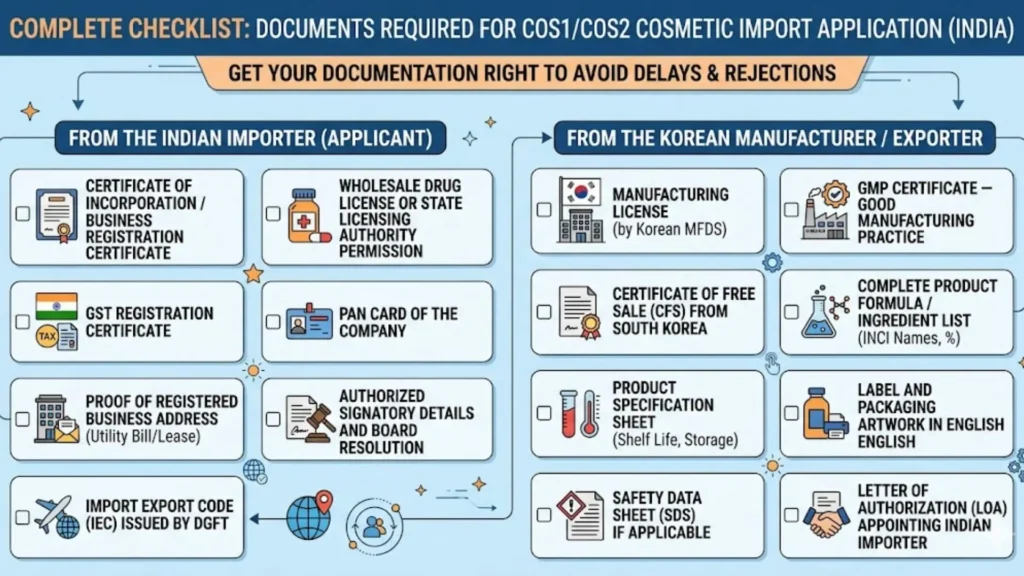
Documents Required for COS-1 (Import Application)
| Document | Purpose |
| Covering letter to the Drugs Controller General of India (DCGI) | Formal request accompanying the application |
| Form COS-1 (duly filled, uploaded on SUGAM) | Core application with manufacturer and product particulars |
| Power of Attorney / Authorisation letter | Authorises the Indian agent to file and represent the manufacturer |
| Free Sale Certificate (FSC) from country of origin | Confirms the product is freely sold/marketed there |
| Product ingredient list (INCI nomenclature) | Full formulation disclosure |
| Certificate of Analysis (CoA) | Lab test report of a representative batch |
| Product label / artwork | For compliance check against Indian labelling rules |
| Manufacturing licence of the overseas site | Confirms lawful manufacture in the country of origin |
| Fee payment receipt (Bharatkosh) | Proof of prescribed government fee payment |
Step-by-Step Process: COS-1 to COS-2
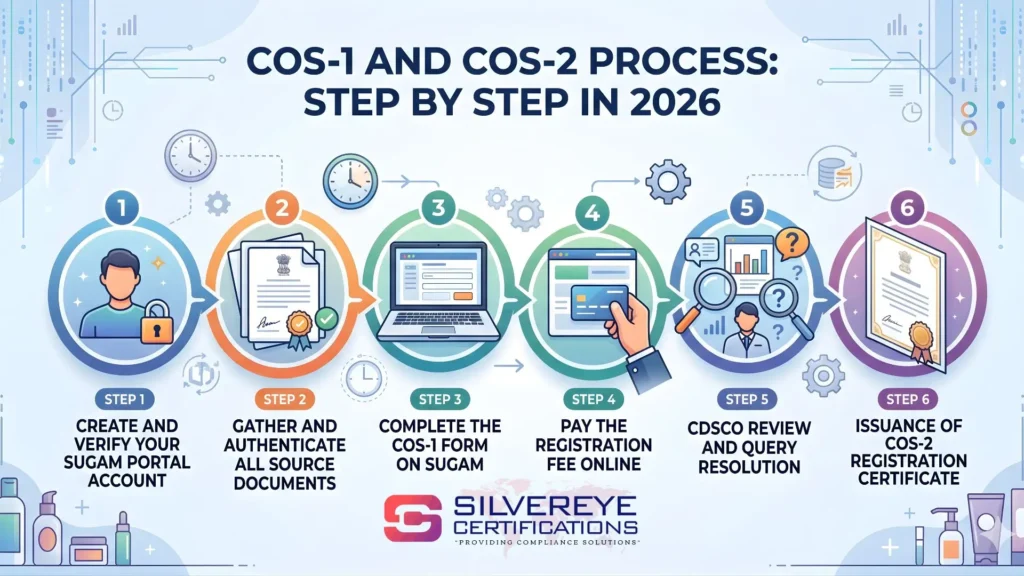
Classify the oral gel product correctly under the CDSCO Fourth Schedule category and confirm it is a cosmetic, not a drug.
- Appoint an Authorized Indian Agent if the applicant is an overseas manufacturer.
- Register on the CDSCO SUGAM portal (cdscoonline.gov.in).
- Compile and upload all COS-1 supporting documents as per the official checklist.
- Pay the prescribed government fee through the Bharatkosh gateway.
- Submit Form COS-1 online; CDSCO scrutinises the dossier and may raise queries.
- Respond to any discrepancies flagged on the SUGAM dashboard promptly.
- On approval, CDSCO issues the Form COS-2 Import Registration Certificate.
- Use the COS-2 certificate for customs clearance, distribution, and e-commerce listing.
Fees, Validity & Renewal — Import Route
Government fees for cosmetic import registration are prescribed by notification and paid via the Bharatkosh gateway. Fee heads vary by number of brands, products, and manufacturing sites, and are subject to periodic revision — confirm the current amount on the SUGAM portal before filing.
Once issued, the COS-2 Import Registration Certificate remains valid indefinitely, provided the licensee pays the prescribed retention fee at the end of every 5-year cycle. Missing the retention deadline attracts a late fee (2% of the retention fee per month) for up to 180 days, after which the certificate is treated as cancelled. There is no provision to revive a lapsed or expired registration retroactively, so renewal timelines should be tracked carefully.
Manufacturing Route for Cosmetic Oral Gel Products — Form COS-5 & COS-8
This route applies to any business that manufactures oral gel products at its own facility (or through a loan-license arrangement) within India for domestic sale or export.
Who Can Apply (Eligibility)
- A manufacturer with its own factory premises in a notified industrial or permitted non-residential area.
- The facility must comply with Good Manufacturing Practices (GMP) under the Cosmetics Rules, 2020.
- At least one full-time qualified technical/competent person (e.g., a Diploma or Degree in Pharmacy or an equivalent qualifying science degree) must be employed.
- Businesses without their own facility can use a third party's GMP-compliant plant via the Loan License route (Form COS-6, issued as Form COS-9) instead of COS-5/COS-8.
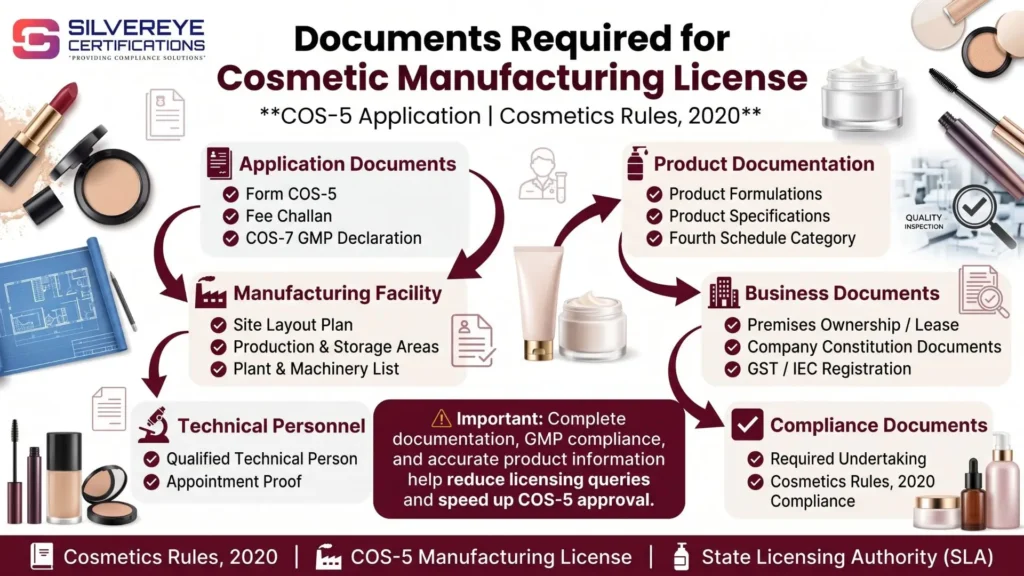
Documents Required for COS-5 (Manufacturing Application)
| Document | Purpose |
| Form COS-5 (duly filled) | Core manufacturing licence application |
| Constitution documents (Certificate of Incorporation, partnership deed, Udyam Registration, etc.) | Establishes legal identity of the applicant firm |
| Site/plant layout and list of machinery | Confirms adequacy of manufacturing infrastructure |
| Ownership/lease document for the manufacturing premises | Proves legal right to operate at the site |
| List of cosmetic products (including all oral gel variants) | Defines scope of the licence |
| Product formula and specification sheet, signed and stamped | Technical basis for GMP compliance checks |
| GMP self-certificate (Form COS-7) | Declares compliance with Good Manufacturing Practices |
| Details and qualification proof of the competent technical staff | Confirms a qualified person oversees production |
| Undertaking of compliance with the Cosmetics Rules, 2020 | Legal declaration of adherence to the Rules |
| Fee payment receipt as per the Third Schedule | Proof of prescribed government fee payment |
Step-by-Step Process: COS-5 to COS-8
- Set up the manufacturing facility to meet GMP requirements under the Cosmetics Rules, 2020 (Seventh Schedule conditions).
- Register on the State Licensing Authority's online portal.
- Fill and submit Form COS-5 with the complete document set.
- Pay the prescribed fee as specified in the Third Schedule.
- The SLA scrutinises documents; a site inspection is generally carried out within 30 days of the application.
- The SLA grants or rejects the license, typically within 45 days of document/site verification.
- On approval, the manufacturer receives Form COS-8 (or Form COS-9 for a loan license).
- Upload a copy of the licence to the CDSCO website for transparency and public record, then commence production.

Fees, Validity & Renewal — Manufacturing Route
The Third Schedule of the Cosmetics Rules, 2020 prescribes the manufacturing licence fee, historically around ₹10,000 for ten items in a category with a smaller additional fee per extra item — these figures are revised by government order, so confirm the current schedule with your SLA. Once granted, the Form COS-8 Manufacturing Licence remains valid indefinitely unless suspended or cancelled, provided the retention fee is paid every 5 years. As with COS-2, a missed retention deadline triggers a 2% per month late fee for up to 180 days, beyond which the licence is deemed cancelled.
Benefits of Registering Your Cosmetic Oral Gel Product
- Legal market access: only registered products can clear customs (import) or legally leave the factory gate (manufacture).
- E-commerce and retail eligibility: most marketplaces and large retailers require proof of COS-2/COS-8 before onboarding a listing.
- Consumer trust and brand credibility: registration signals that the product meets BIS-referenced safety and quality standards.
- Reduced regulatory risk: avoids seizure, penalties, and forced market withdrawal under the Drugs and Cosmetics Act, 1940.
- Smoother scaling: one registration can often cover multiple variants/shades/flavours in the same category, simplifying future launches.
Common Mistakes That Delay Approval
- Filing an oral gel as a cosmetic when its label or claims (e.g., "treats" or "cures") make it a drug in substance.
- Mismatched names/addresses across the Free Sale Certificate, authorization letter, and Form COS-1.
- Incomplete ingredient disclosure or missing INCI names.
- Submitting outdated label artwork that doesn't reflect Indian labelling requirements.
- Underestimating GMP infrastructure requirements before a manufacturing site inspection.
- Missing the 5-year retention fee deadline, risking cancellation of an otherwise valid COS-2 or COS-8.
Timeline at a Glance
| Stage | Import Route | Manufacturing Route |
| Document preparation | 2–6 weeks (varies by document readiness) | 2–4 weeks (facility-dependent) |
| Authority review | 60–180 working days | Document review + inspection within 30 days |
| Final approval | COS-2 issued on approval | COS-8 issued, typically within 45 days of verification |
| Renewal cycle | Retention fee every 5 years | Retention fee every 5 years |
Conclusion
Whether you're importing a premium whitening gel from overseas or manufacturing an Ayurvedic tooth gel domestically, the path to legal market access runs through the same core idea: apply first (COS-1 or COS-5), get approved (COS-2 or COS-8), then track your 5-year retention renewal so the license never lapses. Getting the classification, documentation, and timeline right the first time is the single biggest lever for a fast, uneventful approval.
Frequently Asked Questions
Is a cosmetic oral gel required to be registered before it is sold in India?
Yes. Under Rule 12 of the Cosmetics Rules, 2020, no cosmetic — including an oral gel — can be imported into India without a valid COS-2 Registration Certificate, and no domestic facility can manufacture one for sale without a valid COS-8 Manufacturing Licence.
What is the difference between Form COS-1 and Form COS-2?
Form COS-1 is the online application an importer, authorised agent, or Indian subsidiary files on the CDSCO SUGAM portal. Form COS-2 is the Import Registration Certificate CDSCO issues once that application is reviewed and approved.
What is the difference between Form COS-5 and Form COS-8?
Form COS-5 is the application a domestic manufacturer files with the State Licensing Authority to manufacture cosmetics, including oral gels. Form COS-8 is the Manufacturing License issued after document review and a site inspection confirm GMP compliance.
Who is eligible to apply for COS-1 import registration?
The overseas manufacturer, an Authorized Agent appointed by the manufacturer, an Indian subsidiary of the manufacturer, or an independent importer in India can each apply for COS-1, depending on the business structure.
How long does it take to get a COS-2 Import Registration Certificate?
Processing generally takes around 60 to 180 working days from a complete filing, depending on documentation quality and any CDSCO queries raised during review.
How long does it take to get a COS-8 Manufacturing License?
The State Licensing Authority typically inspects the site within 30 days of the application and grants or rejects the license within about 45 days of completing document and site verification.
What is the validity of the COS-2 and COS-8 certificates?
Both remain valid indefinitely once granted, as long as the licensee pays the prescribed retention fee at the end of every 5-year cycle. Missing this deadline can lead to cancellation after a 180-day grace period with a late fee.
Can a herbal or Ayurvedic oral gel skip cosmetic registration?
No. Herbal or natural origin does not exempt an oral gel from CDSCO cosmetic registration if it makes only cosmetic (non-therapeutic) claims. If it claims to treat a condition, it may instead require drug approval from the DCGI.
Can one registration cover multiple oral gel variants or flavours?
Generally yes — different shades, flavours, or variants within the same cosmetic category and from the same manufacturer can often be covered under one registration, subject to the licensing authority's confirmation.
What happens if an oral gel is sold in India without COS-2 or COS-8?
It is a punishable offence under the Drugs and Cosmetics Act, 1940. Consequences can include seizure of stock at customs or in the market, financial penalties, and forced withdrawal from sale.
Does a Loan License exist for manufacturers without their own factory?
Yes. A manufacturer without its own facility can apply for a Loan License using Form COS-6, which is issued as Form COS-9, allowing production at a third party's GMP-compliant plant.
Where is the application for cosmetic oral gel registration filed?
Import applications (COS-1) are filed on the CDSCO SUGAM portal (cdscoonline.gov.in). Manufacturing applications (COS-5) are filed with the concerned State Licensing Authority, generally through its linked online portal.