
- No cosmetic can legally enter India without a CDSCO Registration Certificate — this applies to every foreign brand, regardless of size or country of origin.
- Foreign manufacturers cannot file directly with CDSCO; they must route the application through an authorized Indian agent, an Indian subsidiary, or an Indian importer.
- The journey runs through two forms: Form COS-1 (the application) filed on the SUGAM portal, leading to Form COS-2 (the Registration Certificate) once approved.
- A single COS-2 certificate can support multiple Indian distributors later on through the simpler COS-4/COS-4A route, without re-filing the full application each time.
Introduction
Cosmetic import registration in India is the mandatory approval a foreign brand needs before its cosmetics can be imported, cleared through customs, and sold in India, under Rule 12(1) of the Cosmetics Rules, 2020. Since a foreign manufacturer cannot apply directly, the journey starts with appointing an authorized Indian agent, Indian subsidiary, or Indian importer to file Form COS-1 on CDSCO's SUGAM portal. Once CDSCO reviews the ingredient list, Free Sale Certificate, labels, and manufacturer authorization, it issues the COS-2 Registration Certificate.
The whole process usually takes 60–90 days, costs roughly USD 2,000 per cosmetic category, and the certificate stays valid subject to a periodic retention fee. Getting the product category and documentation right the first time is what separates a smooth approval from a months-long delay.
What Is Cosmetic Import Registration, and Why Does It Matter for Foreign Brands?
Cosmetic import registration is the regulatory gateway that allows a cosmetic manufactured outside India to be legally imported, cleared at an Indian port, and sold to Indian consumers. It is issued by the Central Drugs Standard Control Organization (CDSCO), India's national regulator for drugs, cosmetics, and medical devices, functioning under the Directorate General of Health Services, Ministry of Health & Family Welfare.
For a foreign brand, this registration is the single non-negotiable gate before entering the Indian market. Without a valid Registration Certificate in Form COS-2, customs authorities can detain or seize a shipment, e-commerce marketplaces will not list the product, and retail distributors cannot legally stock it. Understanding this journey end-to-end — who can apply, what documents are needed, how long it takes, and what it costs — is essential groundwork before a foreign brand commits marketing budget or signs a distribution agreement in India.
Legal Framework Behind Cosmetic Import Registration
- Drugs and Cosmetics Act, 1940 – the parent law defining "cosmetic" under Section 3(aaa) and empowering the Central Government to regulate cosmetic import.
- Cosmetics Rules, 2020 – the operative rulebook; Rule 12(1) makes registration mandatory before import, Rule 13 governs the certificate's validity, and the Fourth Schedule lists roughly 80 cosmetic categories used to classify every product.
- SUGAM Portal – CDSCO's online case-management system; all COS-1 applications and correspondence are handled digitally.
- Bharatkosh Gateway – the government payment portal used to pay the prescribed registration fee under the designated head of account.
Fee levels, category numbers, and processing timelines are set by government notification and can be revised. Always verify current figures on the CDSCO SUGAM portal, or with a registered regulatory consultant, before filing or budgeting for the process.
The Three Entry Routes for Foreign Brands
A foreign manufacturer cannot file Form COS-1 directly. CDSCO requires the application to be routed through one of three recognised entities in India, each suited to a different stage of market entry:
| Entry Route | Best Suited For | Key Consideration |
| Authorised Indian Agent | Brands testing the Indian market through a distributor before committing to a local entity | Agent acts on the manufacturer's behalf under a notarised/apostilled Power of Attorney; relationship depends on the agent's reliability and compliance history |
| Indian Subsidiary of the Manufacturer | Brands planning a long-term, owned presence in India | Registration sits with the brand's own Indian entity, giving direct control over renewals, label updates, and future product additions |
| Indian Importer/Distributor-led Registration | Brands entering India purely through a distributor relationship without a local entity or dedicated agent | The importer holds the registration; if the distribution relationship ends, the brand may need to re-register through a new route |
Whichever route is chosen, the Indian entity named on Form COS-1 becomes the point of contact for CDSCO on all matters relating to that registration — including inspections, product additions, and renewal. Many foreign brands start with an authorised agent or importer and migrate to a subsidiary-led registration once the Indian business scales.
Who Is Eligible to Apply, and What Are the Prerequisites?
- The applicant must be a manufacturer, an authorized Indian agent of the manufacturer, an Indian subsidiary authorized by the manufacturer, or an Indian importer with valid authorization.
- The product must meet the legal definition of a "cosmetic" under Section 3(aaa) of the Drugs and Cosmetics Act, 1940 — no therapeutic, medicinal, or disease-related claim can be attached to it.
- The product must comply with the Ninth Schedule quality and safety standards, or, where not listed there, with the standards applicable in its country of origin.
- A valid Free Sale Certificate from the country of origin (or a recognised regulatory authority) confirming the product is freely sold there.
- A complete, accurate ingredient/composition declaration signed by the manufacturer.
Choosing the Right Cosmetic Category (Fourth Schedule)
Every product listed in Form COS-1 must be mapped to one of CDSCO's roughly 80 Fourth Schedule categories. Category selection drives the applicable fee, the quality standard applied, and the labelling checklist — getting it wrong is one of the most common reasons foreign brands face delays.
| Category Cluster | Representative Products | Typical Filing Consideration |
| Skin care | Creams, lotions, moisturisers, serums, sunscreens, face washes, masks | SPF claims need substantiation data; therapeutic claims (acne treatment, medicated) risk drug reclassification |
| Hair care | Shampoos, conditioners, hair oils, hair dyes, styling products, anti-dandruff | Hair dyes/bleaches need detailed ingredient declaration and patch-test label warnings |
| Colour cosmetics | Lipsticks, foundations, eyeshadows, blushes, nail polish | Colourants must align with permitted-colourant standards under the rules |
| Fragrances & deodorants | Perfumes, colognes, body sprays, deodorants, antiperspirants | Alcohol-based fragrance formulations may need additional compliance documentation |
| Oral care | Toothpastes, mouthwashes, teeth-whitening products (cosmetic claims only) | Fluoride/whitening claims are reviewed closely against cosmetic vs drug boundaries |
| Baby care | Baby shampoos, lotions, oils, powders | Faces the strictest scrutiny on microbiological limits and permissible preservatives |
| Bath & body / nail care | Soaps, shower gels, body lotions, scrubs, nail lacquers, cuticle products | Generally the most straightforward category cluster to register |
A practical categorization framework: identify the product's primary intended use, the body area of application, whether it is rinse-off or leave-on, and any special claim (SPF, anti-dandruff, anti-hair-loss, hair-colour) that might shift it into a more closely reviewed sub-category or, in the worst case, out of the cosmetics definition entirely.
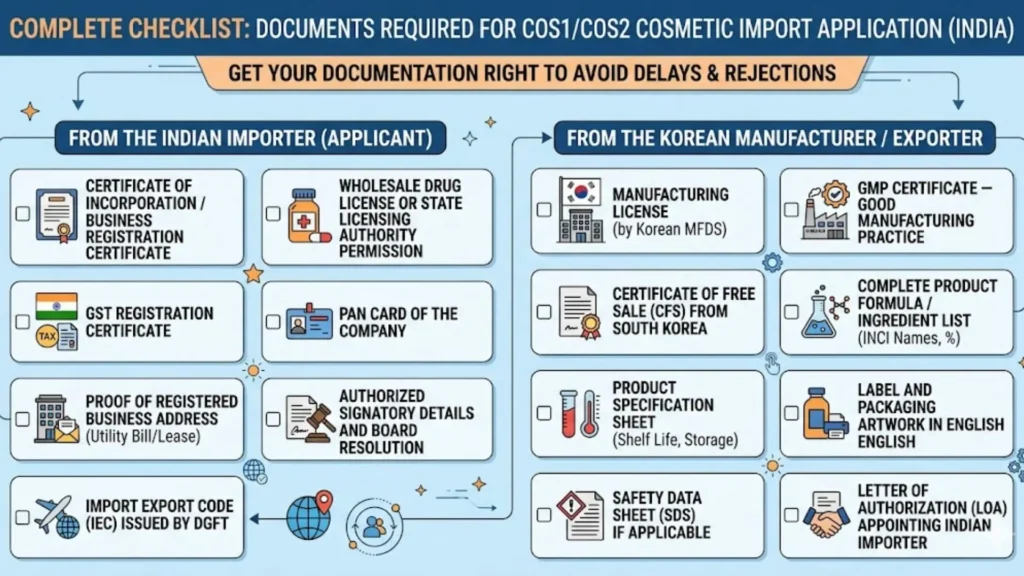
Documents Required for Form COS-1
- Covering letter stating the purpose of the application (fresh registration, endorsement, or re-registration)
- Duly filled, signed, and stamped Form COS-1, listing every product and variant proposed for import
- Authorization from the manufacturer to the Indian agent/subsidiary/importer, apostilled or authenticated by the Indian Embassy or a First Class Magistrate in the country of origin
- Free Sale Certificate confirming the cosmetic is freely sold in its country of origin
- Complete ingredient list / composition declaration with percentages, signed by the manufacturer
- Product labels compliant with the Cosmetics Rules, 2020 labelling schedule
- Correlation chart linking each product/variant in COS-1 to the corresponding Free Sale Certificate and manufacturer authorization
- Undertaking of compliance with the Cosmetics Rules, 2020, including allowing CDSCO or an authorized inspector to access the manufacturing site or draw samples
- Proof of fee payment through the Bharatkosh gateway
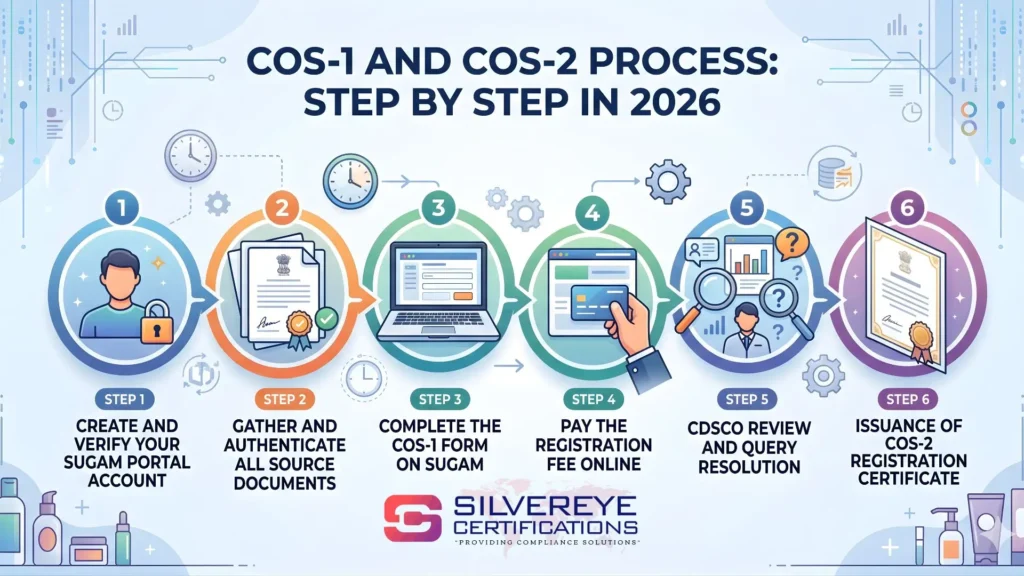
Step-by-Step Cosmetic Import Registration Process
- Decide the entry route: appoint an authorized Indian agent, register through your Indian subsidiary, or route the application through your Indian importer.
- Register on the CDSCO SUGAM portal and create login credentials for the applicant entity.
- Map every product and variant to the correct Fourth Schedule category — this single step determines much of the review timeline.
- Compile the Free Sale Certificate, signed ingredient list, compliant labels, and apostilled manufacturer authorization.
- Fill and submit Form COS-1 on SUGAM with all supporting documents, and pay the prescribed fee through Bharatkosh.
- Monitor the SUGAM dashboard and respond promptly to any CDSCO query or discrepancy notice — most delays stem from slow or incomplete responses at this stage.
- Receive the COS-2 Registration Certificate once CDSCO is satisfied with the application, documents, and fee.
- Print the RC (Registration Certificate) number on every product label before the first shipment is dispatched to India.
- Coordinate with your customs broker to ensure the Bill of Entry references the correct RC number and approved product/variant list at the port of import.
Form COS-2: Grant of the Registration Certificate
COS-2 is the actual Registration Certificate — the document that legally authorizes import and sale of the specific cosmetic products and variants named in it. It is granted by the Central Licensing Authority, the Drugs Controller General (India), once the COS-1 application clears review.
A COS-2 certificate typically records the registration number, the manufacturer's name and manufacturing site, the Indian agent/subsidiary/importer details, and the full list of approved products and variants. Under Rule 13 of the Cosmetics Rules, 2020, a COS-2 certificate remains valid in perpetuity, subject to timely payment of the prescribed registration retention fee before the validity period stated on the certificate lapses — commonly tracked on a 5-year cycle consistent with CDSCO's broader retention-fee framework. Because certificate terms can vary by case, always confirm the exact validity and renewal date printed on your own certificate.
If products are manufactured at more than one site for the same brand, an additional fee applies per extra manufacturing site declared in the application.
Adding More Indian Distributors: The COS-4 / COS-4A Route
Foreign brands rarely stay with a single Indian distributor forever. Once a product is already registered under a COS-2 certificate, any additional Indian importer wanting to bring in the same registered product does not need to repeat the entire COS-1 process. Instead, that importer files Form COS-4 for an Import Registration Number in Form COS-4A, supported by an undertaking or authorization from the original COS-2 holder.
- Form COS-4A is tied to the underlying COS-2 registration and inherits its product/variant scope.
- A Form COS-4A registration is valid for 3 years from the date of issue.
- This route is significantly faster than a fresh COS-1 filing, since the product's ingredient and label compliance has already been reviewed once under the original COS-2.
- It is especially useful for foreign brands expanding across multiple Indian states or appointing region-specific distributors after the initial market entry.
Cosmetic Import Registration Fees for Foreign Brands
| Fee Head | Approximate Amount | When Payable |
| Registration fee per cosmetic category per brand | ≈ USD 2,000 (or INR equivalent) per category | At the time of filing Form COS-1 |
| Additional manufacturing site fee | ≈ USD 500 per additional site for the same product | At the time of filing, if applicable |
| Registration retention fee (COS-2) | As per the prescribed schedule, payable before the certificate's stated validity period lapses | Before completion of the validity cycle (commonly tracked at 5 years) |
| Form COS-4A fee (additional importer) | Prescribed fee per application, lower than a fresh COS-1 filing | At the time of filing Form COS-4 |
These figures reflect commonly cited 2026 fee levels for cosmetic import registration. Government fee heads are revised by notification, so confirm the exact current amount on the CDSCO SUGAM portal or Bharatkosh before budgeting or submitting payment.
Validity and Renewal Timeline
| Certificate | Validity | Renewal / Retention Requirement | Authority |
| COS-2 (Registration Certificate) | Valid in perpetuity, subject to the validity terms and retention fee stated on the certificate | Pay the prescribed retention fee before the certificate's stated validity period lapses; confirm the exact renewal date on your certificate | CDSCO |
| COS-4A (Import Registration Number) | 3 years from date of issue | Fresh application before expiry, unless suspended or cancelled earlier | CDSCO |
Processing Timeline: What to Expect
| Stage | Typical Timeline | Notes |
| Document preparation (foreign brand side) | 2–6 weeks | Apostille/embassy authentication of the manufacturer authorisation is usually the longest lead-time item |
| COS-1 filing to COS-2 grant | Roughly 60–90 days from a complete filing | Extends to several months if CDSCO raises categorisation, ingredient, or label queries |
| Form COS-4A grant (additional importer) | Generally faster than a fresh COS-1, since the base product is already registered | Depends on completeness of the supporting undertaking/authorisation |
After COS-2: Customs Clearance and Ongoing Compliance
- Ensure every import consignment's Bill of Entry references the correct COS-2 Registration Certificate number and the approved product/variant list.
- Keep product labels updated to reflect the RC number, manufacturer and importer details, batch number, net quantity, and full ingredient list in descending order of weight.
- Retain copies of the Free Sale Certificate, ingredient declarations, and COS-2 certificate available for customs or CDSCO verification at the port or during market surveillance.
- Track the retention-fee due date for your COS-2 certificate well in advance — a lapsed certificate can halt further imports until it is renewed.
- Notify CDSCO and update documentation before adding new product variants, changing the manufacturing site, or switching the Indian agent/importer named on the certificate.
Common Mistakes Foreign Brands Make
- Assuming the manufacturer can file directly with CDSCO — every foreign brand needs an Indian agent, subsidiary, or importer as the applicant of record.
- Under-authenticating the manufacturer's Power of Attorney/authorization letter — apostille or embassy attestation is not optional.
- Mis-categorising a product under the wrong Fourth Schedule cluster, especially for SPF, anti-ageing, or hair-colour products with borderline claims.
- Submitting labels or marketing claims that read as therapeutic ("treats," "cures," "heals"), which risks reclassification as a drug rather than a cosmetic.
- Filing an overly large first product catalogue instead of starting with hero SKUs and expanding after the first COS-2 approval.
- Losing track of the retention-fee renewal date, resulting in a lapsed registration and halted imports.
- Not planning for the COS-4/COS-4A route early, leading to duplicated effort when a second Indian distributor comes on board.
Benefits of Getting Cosmetic Import Registration Right
- Uninterrupted customs clearance — registered shipments move through Indian ports without seizure or detention risk.
- Faster market entry for future SKUs — an established COS-2 registration and Indian entity relationship streamlines subsequent product additions.
- Retail and e-commerce eligibility — most organised retail chains and marketplaces require proof of valid CDSCO registration before onboarding a brand.
- Stronger negotiating position with Indian distributors — a brand that already holds its own registration (via subsidiary or agent) retains more control than one relying entirely on an importer-led registration.
- Reduced regulatory risk — avoids the financial and reputational cost of stock seizure, recalls, or enforcement action.
Penalties for Importing Without Registration
Importing cosmetics into India without a valid COS-2 Registration Certificate is a violation of Rule 12(1) of the Cosmetics Rules, 2020, made under the Drugs and Cosmetics Act, 1940. Consequences can include seizure of stock at the port of entry, denial of customs clearance, mandatory recall of any product that has already reached the market, and prosecution under the Act's penal provisions. CDSCO also retains the power to suspend or cancel an existing COS-2 certificate if the conditions of registration are violated.
Conclusion
Cosmetic import registration in India is not just paperwork — it is the foundation that determines whether a foreign brand's products clear customs smoothly, land on retail shelves without disruption, and scale to new Indian distributors without re-doing the entire process. The journey runs through two forms, COS-1 and COS-2, but the real work lies in choosing the right entry route, mapping every product to the correct cosmetic category, and keeping documentation, labels, and retention-fee deadlines consistent from the very first filing. Foreign brands that treat this as a strategic first step — not an afterthought before shipping — consistently see faster approvals and fewer surprises at the Indian border.
Frequently Asked Questions
Can a foreign cosmetic manufacturer apply directly to CDSCO for import registration?
No. A foreign manufacturer must route the application through an authorized Indian agent, its own Indian subsidiary, or an Indian importer holding valid authorization. Direct applications from an entity outside India are not accepted.
What is the difference between COS-1 and COS-2?
Form COS-1 is the online application filed on the SUGAM portal to seek import registration. Form COS-2 is the Registration Certificate CDSCO issues once that application is reviewed and approved. COS-1 is the request; COS-2 is the outcome.
How long does cosmetic import registration take for a foreign brand?
A complete, correctly categorised COS-1 filing typically takes around 60 to 90 days to reach COS-2 grant. Add extra time upfront for apostille/embassy authentication of the manufacturer's authorization letter.
What documents does a foreign brand need to prepare before filing COS-1?
Key documents include an apostilled manufacturer authorisation, a Free Sale Certificate from the country of origin, a signed ingredient/composition list, compliant product labels, and proof of fee payment through Bharatkosh.
Should a foreign brand use an agent, a subsidiary, or an importer to register?
It depends on the stage of market entry. An agent or importer-led route suits brands testing the market through a distributor; an Indian subsidiary suits brands planning a long-term, directly controlled presence in India.
What is the validity of a COS-2 Registration Certificate?
Under Rule 13 of the Cosmetics Rules, 2020, a COS-2 certificate is valid in perpetuity, subject to payment of the prescribed retention fee before the validity period stated on the certificate lapses. Always confirm the specific date on your certificate.
How much does cosmetic import registration cost for a foreign brand?
Registration fees are commonly cited at roughly USD 2,000 per cosmetic category per brand, plus an additional fee per extra manufacturing site. Confirm the current fee on the CDSCO SUGAM portal, since amounts are revised by notification.
Can multiple Indian distributors sell the same foreign brand's registered products?
Yes. Once a product holds a COS-2 certificate, additional Indian importers can file the simpler Form COS-4 for an Import Registration Number (Form COS-4A), backed by an undertaking from the original registration holder.
What happens if a foreign brand's product label doesn't match its CDSCO filing?
Mismatched labels and ingredient declarations are one of the most common reasons for CDSCO queries, shipment delays, and in serious cases, customs detention of the consignment.
Can a foreign brand's registration be cancelled after approval?
Yes. CDSCO can suspend or cancel a COS-2 certificate if the manufacturer, agent, or importer fails to comply with the conditions attached to the registration.
What is Form COS-4A's validity, and how is it different from COS-2?
Form COS-4A, used to add an additional Indian importer to an already-registered product, is valid for 3 years from the date of issue, whereas the underlying COS-2 certificate is valid in perpetuity subject to its own retention-fee terms.
Can a cosmetic be sold in India while its COS-1 application is still pending?
No. A cosmetic cannot be legally imported or sold in India until the COS-2 Registration Certificate is granted. Selling or importing based on a pending COS-1 application carries the same risk as having no registration at all.