- CDSCO Registration For Operation Theatre 27 Operation Theatre medical devices are classified under IMDR Class A, B, and C — each with different registration requirements.
- Class A (low-risk) devices like operation tables and surgical lights require the least regulatory oversight, while Class C (high-risk) devices like surgical robots need full CDSCO import/manufacturing licenses.
- All medical devices sold in India must comply with the Medical Devices Rules (MDR), 2017 under CDSCO — non-compliance leads to penalties and product recalls.
- This guide covers the complete CDSCO registration process, eligibility, documents, fees, validity, and renewal for every OT device class.
What Is CDSCO Registration and Why Does It Matter for OT Medical Devices?
The Central Drugs Standard Control Organization (CDSCO) is the national regulatory authority for medical devices in India, functioning under the Ministry of Health and Family Welfare. Every manufacturer and importer of medical devices — including operation theatre equipment — must comply with CDSCO regulations as defined under the Medical Devices Rules (MDR), 2017.
For healthcare manufacturers, importers, and distributors, understanding CDSCO registration is not optional. Whether you are bringing in a surgical robot from overseas or manufacturing scalpels locally, you need valid approvals before placing your product in the Indian market.
The Indian medical devices market is projected to reach USD 50 billion by 2030, and CDSCO compliance is the gateway to participating in this growth — especially in the high-demand operation theatre (OT) segment.
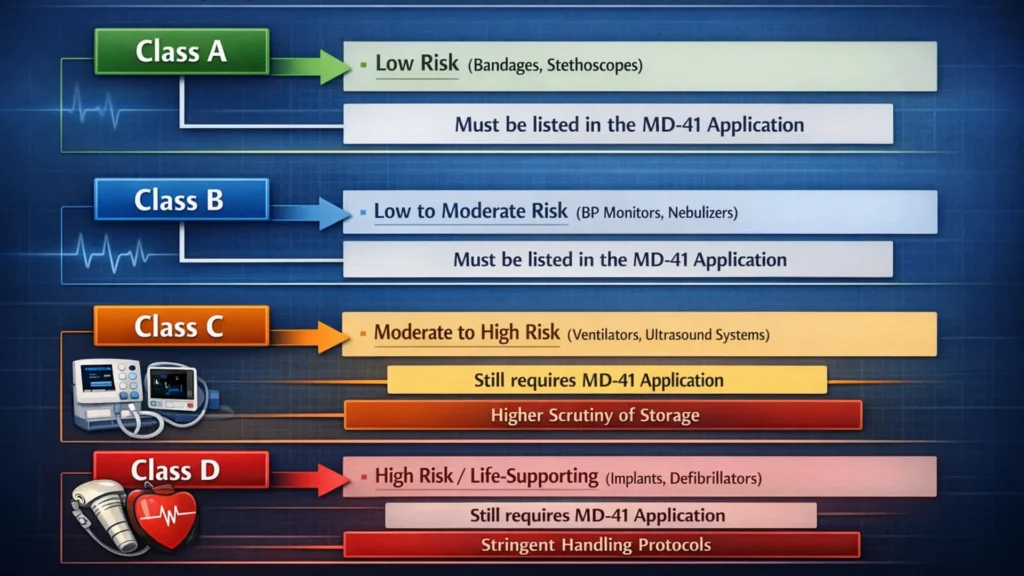
Understanding IMDR Classification for Operation Theatre Devices
India's Medical Devices Rules (MDR), 2017 classify medical devices into four risk-based categories: Class A (lowest risk), Class B (low-to-moderate risk), Class C (moderate-to-high risk), and Class D (highest risk). The OT devices covered in this guide span Classes A, B, and C.
The classification directly determines your regulatory pathway — Class A devices follow a simpler enrollment process, while Class C devices demand rigorous conformity assessment and clinical evaluation before CDSCO grants a license.
Quick Classification Summary
| IMDR Class | Risk Level | Examples (OT Devices) | Registration Type |
| Class A | Low Risk | Operation Table, Surgical Light, Diagnosis Table | Enrollment (Form MD-1) |
| Class B | Low-Moderate Risk | Scalpel, Surgical Forceps, Hemostatic Clip Applier | Import/Mfg License (Form MD-14/MD-9) |
| Class C | Moderate-High Risk | Surgical Robot, Electrosurgical Unit, Multiparameter Monitor | Import/Mfg License with Clinical Data |
| Class D | High Risk | Not applicable to these 27 OT devices | Full Conformity Assessment + CDSCO Approval |
Class A Operation Theatre Medical Devices — Complete List
Class A devices are low-risk devices that require enrollment with CDSCO. They do not need a full import or manufacturing license but must be enrolled before being marketed in India. Below is the full list of Class A OT devices from the official IMDR classification.
| S.No. | Device Name | Intended Use | IMDR Class |
| 1 | Distractor / Retractors | Surgical device used to separate connected surfaces and retain their positions during a surgical operation. | Class A |
| 2 | Suction System — Portable, Electrical/Pneumatic | Generates negative pressure for aspiration of liquid or granular substances. | Class A |
| 3 | Suction System — Vacuum Operated | Aspiration of liquid/granular substances using negative pressure from hospital medical gas supply system. | Class A |
| 4 | Operation Table System | Complete surgical table system for changing patient position and attaching surgical accessories. | Class A |
| 5 | General-Purpose Diagnosis/Treatment Table | Table for general diagnosis and procedures in examination rooms. | Class A |
| 6 | Surgical Light System | Provides optimal light and colour rendering to aid in performing surgery. | Class A |
| 7 | Motorized Diagnostic Imaging View Box | Electrically controlled device that retains, retrieves, and projects light for direct observation of medical images (X-ray, MR, CT, ultrasound). | Class A |
| 8 | General-Purpose Manually Operated Operation Table | Completely mobile, general-purpose surgical table with manual or hydraulic operation. | Class A |
Registration Requirements for Class A OT Devices
- File Form MD-1 (Enrollment Application) on the SUGAM portal of CDSCO.
- No clinical performance data or clinical investigation is required for Class A devices.
- Manufacturers must maintain a Quality Management System (QMS) as per ISO 13485.
- Enrolled devices must display CDSCO enrollment number on labelling.
- Importers need to appoint an Authorised Indian Representative (AIR).
Class B Operation Theatre Medical Devices — Complete List
Class B devices carry a low-to-moderate risk level and require a valid CDSCO Import License (Form MD-14) for imported devices or a Manufacturing License (Form MD-9) for locally manufactured devices. These include core surgical instruments like scalpels, forceps, and hemostatic tools.
| S.No. | Device Name | Intended Use | IMDR Class |
| 1 | Hemostatic Clip Applier | Surgical device designed to apply a hemostatic clip for ligation of a blood vessel. | Class B |
| 2 | Hemostatic Knife | Blade that transmits heat directly to body tissues to achieve hemostasis. | Class B |
| 3 | Scalpel | Instrument used to sever and separate body tissues during surgery. | Class B |
| 4 | Scalpel Blade | Blade intended to be attached to the handle of a scalpel. | Class B |
| 5 | Surgical Forceps | Surgical or dental device used to clamp and sever cartilage, bone, and other hard tissues. | Class B |
| 6 | Staple Remover | Metal or plastic surgical instrument used to remove staples from a surgical wound or incision. | Class B |
| 7 | Surgical Punch | Surgical instrument used to create a hole for suturing or anastomosis of tissue, blood vessel, etc. | Class B |
| 8 | Surgical File | Manually operated instrument with bumps or teeth used to smooth, grind, or sever tissues. | Class B |
| 9 | Blood Vessel Surgical Stripper | Surgical instrument used for complete or partial vascular resection. | Class B |
| 10 | Surgical Probe | Device used to explore sinuses, fistulae, and other cavities and wounds. | Class B |
| 11 | Powered General-Purpose Operation Table | Completely mobile surgical table operable electrically by line or battery power. | Class B |
| 12 | Operation Table System (Component-Based) | Multi-component surgical table system with columns, removable tabletop, trolley, and remote controller. | Class B |
Registration Requirements for Class B OT Devices
- Apply for Import License on Form MD-14 (importers) or Manufacturing License on Form MD-9 (manufacturers) via SUGAM portal.
- Submit a Technical File including product description, labelling, instructions for use, and manufacturing process details.
- Performance evaluation data or safety & performance testing reports required.
- Quality Management System certificate (ISO 13485) mandatory.
- Audio/Visual aids, user manuals, and risk management documentation as per ISO 14971.
Class C Operation Theatre Medical Devices — Complete List
Class C devices are moderate-to-high risk and are subject to the strictest regulatory requirements among the OT devices listed here. They require comprehensive technical documentation, clinical evaluation data, and a full CDSCO license. These include life-critical equipment such as surgical robots, electrosurgical units, and multiparameter patient monitors.
| S.No. | Device Name | Intended Use | IMDR Class |
| 1 | General-Purpose Electrosurgical Unit | Resects/ablates tissue or coagulates incision/wound site with high-frequency waves. | Class C |
| 2 | Long-Term Use Enterostomy Feeding Tube | Hollow device surgically placed in stomach, duodenum, or jejunum for long-term enteral nutrition. | Class C |
| 3 | Gastrostomy Tube for Long-Term Use | Hollow device surgically placed in stomach, duodenum, or jejunum for enteral nutrition — long-term use. | Class C |
| 4 | Warming High-Flow Infusion Pump | Heats and rapidly infuses blood or fluids during major bleeding surgeries, burns, or injuries. | Class C |
| 5 | High-Flow Blood Transfusion Pump | Rapidly infuses blood or fluids during surgical procedures involving major bleeding or injuries. | Class C |
| 6 | Multiparameter Monitor with Critical Parameters | Collects ECG, blood pressure, temperature, cardiac output, respiratory gases, and critical parameters including arrhythmia detection and anaesthesia dose determination. | Class C |
| 7 | Surgical Robot Unit | Operation support device used in open or endoscopic surgery for tissue treatment including suturing, detaching, severing, and prosthesis installation. | Class C |
Registration Requirements for Class C OT Devices
- Full CDSCO Import License (Form MD-14) or Manufacturing License (Form MD-9) with clinical evaluation data.
- Clinical investigation or clinical performance studies required unless sufficient clinical evidence is available in published literature.
- Conformity Assessment by a CDSCO-recognised Testing Laboratory (NABL accredited).
- Post-Market Surveillance (PMS) plan to be submitted and maintained.
- Risk Management File as per ISO 14971, Usability Engineering as per IEC 62366.
- For electrosurgical and monitoring devices: IEC 60601 series compliance testing required.
Benefits of Getting CDSCO Registration for OT Medical Devices
CDSCO registration is not just a compliance checkbox — it unlocks real business advantages for manufacturers and importers in the Indian healthcare sector.
- Legal Market Access: Only registered devices can be imported, sold, or distributed in India. Registration protects you from regulatory action and market bans.
- Government Procurement Eligibility: CGHS, ESIC, and state government hospitals require CDSCO-registered devices for procurement. Registration opens the door to large public sector tenders.
- Brand Credibility: Hospitals and surgeons prefer CDSCO-approved devices — it signals safety, efficacy, and regulatory compliance.
- Export Advantage: CDSCO registration supports export documentation and helps meet regulatory requirements in SAARC and African markets that reference Indian approvals.
- Reduced Liability: Registered devices with proper clinical data protect manufacturers from product liability claims.
Who Is Eligible to Apply for CDSCO Registration?
CDSCO registration is open to both Indian manufacturers and foreign manufacturers through their authorised representatives. The eligibility criteria vary slightly depending on whether you are a manufacturer or importer.
For Indian Manufacturers
- Must hold a valid manufacturing licence issued by the State Licensing Authority (SLA) under MDR 2017.
- Factory premises must comply with Schedule M (Good Manufacturing Practices for Medical Devices).
- ISO 13485 Quality Management System certification is mandatory for Class B, C, and D devices.
For Importers / Foreign Manufacturers
- Foreign manufacturer must appoint an Authorized Indian Representative (AIR) who is registered with CDSCO.
- AIR must be an Indian entity (company or individual) with a valid presence in India.
- The foreign manufacturing site must hold a valid QMS certificate (ISO 13485 or equivalent) from a recognized certification body.
- The device must already be approved for marketing in the country of origin or a reference country (US FDA, EU CE, TGA, PMDA, or Health Canada).
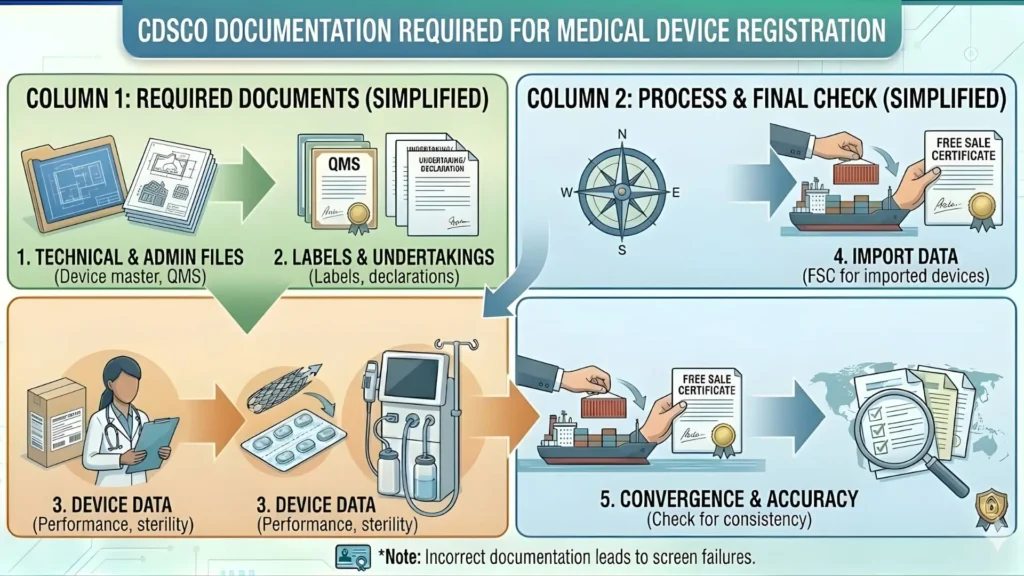
Documents Required for CDSCO Registration — Operation Theatre Medical Devices
The documentation requirements vary based on the device class. Below is a consolidated checklist covering all three classes applicable to OT medical devices.
Common Documents for All Classes (A, B, C)
- Duly filled application form (MD-1 for enrollment / MD-14 or MD-9 for license)
- Device description and intended use statement
- Product labelling, instructions for use (IFU), and packaging details
- ISO 13485 Quality Management System certificate (Class B and C)
- Declaration of Conformity signed by the authorized signatory
- Free Sale Certificate or Marketing Authorization from country of origin (for imports)
- Authorized Indian Representative (AIR) appointment letter (for importers)
Additional Documents for Class B Devices
- Technical File covering design, materials, manufacturing process
- Performance testing/safety evaluation data from NABL-accredited or internationally recognised labs
- Risk Management documentation as per ISO 14971
Additional Documents for Class C Devices
- Clinical Evaluation Report (CER) — either from clinical investigations or published literature review
- Post-Market Surveillance plan
- Conformity Assessment Certificate from a CDSCO-notified testing body
- IEC 60601 series test reports (for electrical/electronic devices like electrosurgical units and monitors)
- Usability Engineering File as per IEC 62366
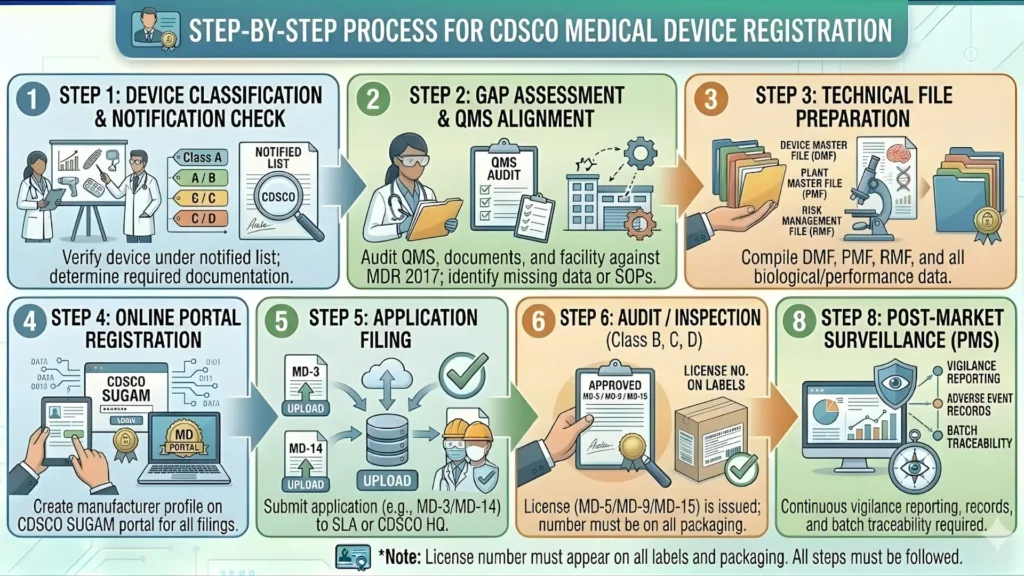
Step-by-Step CDSCO Registration Process for OT Medical Devices
The CDSCO registration process in India is entirely online through the SUGAM portal. Here is a step-by-step guide for 2026.
Step 1 — Determine Device Classification
Before filing any application, confirm your device's IMDR classification (Class A, B, C, or D) using the CDSCO classification list or Schedule III of MDR 2017. Incorrect classification leads to application rejection and delays.
Step 2 — Register on the SUGAM Portal
Create a company account on sugam.gov.in. Separate registrations are required for manufacturers and importers. Use your company's CIN, PAN, and authorised signatory details for registration.
Step 3 — Compile Technical Documentation
Prepare all documents as per the checklist for your device class. Ensure all test reports are from NABL-accredited or internationally recognised testing laboratories. Documents in foreign languages must be translated and notarised.
Step 4 — Submit Application Online
Log in to SUGAM and file the appropriate form — MD-1 for Class A enrollment, or MD-14/MD-9 for Class B and C licenses. Upload all documents in PDF format. Pay the prescribed government fee online.
Step 5 — Deficiency Response (If Raised)
CDSCO may raise a deficiency query after reviewing your application. You typically have 30 days to respond. Prompt and complete responses reduce overall processing time significantly.
Step 6 — Inspection (If Applicable)
For Class C devices and manufacturing licenses, CDSCO may conduct a factory or site inspection. Ensure your facility is audit-ready with all SOPs, quality records, and manufacturing processes documented.
Step 7 — Grant of License or Enrollment
Upon successful review, CDSCO issues the enrollment certificate (Class A) or the import/manufacturing license (Class B and C). The license is valid for a specified period and must be renewed before expiry.
CDSCO Registration Fees for Operation Theatre Medical Devices
Fees are prescribed under Schedule VI of MDR 2017 and are paid online via the SUGAM portal. Below are the applicable fees for OT device categories.
| Application Type | Class A | Class B | Class C |
| Enrollment / Import License (Indian Manufacturer) | Rs. 2,500 | Rs. 5,000 | Rs. 10,000 |
| Import License (Foreign Manufacturer / Importer) | Rs. 5,000 | Rs. 10,000 | Rs. 25,000 |
| Manufacturing License | Rs. 2,500 | Rs. 5,000 | Rs. 10,000 |
| License Renewal | Rs. 1,000 | Rs. 2,500 | Rs. 5,000 |
Note: Fees are subject to revision by CDSCO. Always verify the current fee schedule on the SUGAM portal before filing. Additional testing fees payable to NABL-accredited labs are separate from CDSCO filing fees.
Validity and Renewal of CDSCO License for OT Medical Devices
License Validity
- Class A Enrollment Certificate: Valid for 5 years from the date of issue.
- Class B Import / Manufacturing License: Valid for 5 years.
- Class C Import / Manufacturing License: Valid for 5 years.
- Licenses can cover multiple products under one application if products fall in the same classification and are from the same manufacturer.
Renewal Timeline
- Apply for renewal at least 9 months before the expiry date to avoid any gap in compliance.
- File renewal on the SUGAM portal using the existing license number.
- Submit updated ISO 13485 certificates, updated labelling if applicable, and any post-market surveillance reports (Class C).
- Licenses that lapse cannot be used — you must apply for a fresh registration, which takes considerably longer.
Important: Any change to the device design, intended use, manufacturer's address, or AIR details must be reported to CDSCO via a Change Application before the change is implemented. Failure to notify CDSCO of significant changes can invalidate your existing license.
Expected Processing Timeline for CDSCO Registration (2026)
| Application Type | Class A | Class B | Class C |
| New Registration | 30–45 working days | 45–90 working days | 90–180 working days |
| Renewal | 15–30 working days | 30–45 working days | 45–90 working days |
| Deficiency Response | 30 days to respond | 30 days to respond | 30 days to respond |
Timelines can vary based on application completeness, CDSCO workload, and whether an inspection is required. Incomplete or deficient applications significantly extend processing time.
Post-Registration Compliance for OT Medical Device Manufacturers
Getting the CDSCO registration is just the beginning. Indian MDR 2017 mandates ongoing compliance obligations that manufacturers and importers must fulfil throughout the product lifecycle.
- Adverse Event Reporting: Any serious adverse event or near-miss involving your medical device must be reported to CDSCO within 30 days (or immediately in life-threatening cases).
- Post-Market Surveillance (PMS): Class C device holders must maintain active PMS systems, collect real-world performance data, and submit periodic safety reports.
- Field Safety Corrective Action (FSCA): If a safety issue is identified, a recall or corrective action must be initiated and reported to CDSCO.
- Annual Returns: Manufacturers and importers must submit annual returns on SUGAM portal by 31st March every year.
- Labelling Compliance: Devices must at all times carry correct labelling as per Schedule I of MDR 2017, including CDSCO license/enrollment number, batch number, expiry date, and manufacturer details.
Common Mistakes to Avoid During CDSCO Registration
Many applications get delayed or rejected due to avoidable errors. Here are the most frequent mistakes applicants make:
- Incorrect Device Classification: Misclassifying a Class B device as Class A leads to application rejection and compliance gaps.
- Outdated ISO 13485 Certificate: Submitting an expired or soon-to-expire QMS certificate causes deficiency notices.
- Incomplete Clinical Evidence (Class C): Submitting insufficient clinical literature or poorly structured CERs is a leading cause of rejection for high-risk devices.
- AIR Not Registered on SUGAM: Foreign manufacturers must ensure their AIR is independently registered and active on SUGAM before filing.
- Missing IEC Test Reports: For Class C electrical devices (electrosurgical units, patient monitors), missing IEC 60601 compliance reports is a critical deficiency.
- Non-Compliance with Labelling Rules: Labelling that does not include all mandatory fields under Schedule I of MDR 2017 triggers rejection.
Conclusion — Getting CDSCO Registration Right in 2026
CDSCO registration for operation theatre medical devices is a multi-step, documentation-intensive process that requires a deep understanding of India's Medical Devices Rules, 2017. Whether you are registering a Class A operation table or a Class C surgical robot, the quality of your technical file, clinical data, and testing reports directly determines how fast and smoothly your application progresses.
The Indian OT medical devices market is growing rapidly — driven by increased surgical volumes, healthcare infrastructure expansion, and government schemes like PM-ABHIM. Getting your CDSCO registration in place positions you to tap into this demand legally and sustainably.
If you are unsure about your device's classification, the documents required, or the registration process, consulting a CDSCO-experienced regulatory affairs professional is highly recommended. Errors at the classification stage can lead to months of delay and potential compliance liability.
Frequently Asked Questions
Is CDSCO registration mandatory for all 27 operation theatre devices listed under IMDR?
Yes. All 27 OT devices in this classification list — whether Class A, B, or C — are notified medical devices under MDR 2017. They cannot be imported, manufactured, or sold in India without the appropriate CDSCO enrollment or license.
Can a foreign manufacturer apply for CDSCO registration directly?
No. A foreign manufacturer must appoint an Authorized Indian Representative (AIR) who is registered on the SUGAM portal. The AIR files and holds the import license on behalf of the foreign manufacturer.
What is the difference between CDSCO enrollment and a CDSCO license?
Enrollment applies to Class A (low-risk) devices through Form MD-1 and involves a simpler submission. A license (Form MD-14 for importers, Form MD-9 for manufacturers) applies to Class B, C, and D devices and requires more extensive technical and clinical documentation.
How long does it take to get CDSCO approval for a surgical robot (Class C device)?
For a Class C device like a surgical robot, the typical processing time is 90 to 180 working days, assuming the application is complete and no major deficiencies are raised. Applications with incomplete clinical data can take significantly longer.
Do scalpels and scalpel blades need separate CDSCO registrations?
Yes. Scalpels (S.No. 9) and scalpel blades (S.No. 10) are classified separately as Class B devices and may require separate registration entries, though they can be covered under a single company license depending on how they are presented in the application.
Is ISO 13485 certification mandatory for Class A device enrollment?
While ISO 13485 is strongly recommended for all device categories, it is mandatory under MDR 2017 for Class B, C, and D devices. For Class A enrollment, QMS compliance is expected but a formal ISO 13485 certificate may not be mandatorily required in all cases.
What happens if I sell an OT medical device without CDSCO registration in India?
Selling unregistered notified medical devices in India is a serious violation under MDR 2017 and the Drugs and Cosmetics Act. Penalties include product seizure, cancellation of license, financial penalties, and in severe cases, criminal prosecution under Section 27 of the Drugs and Cosmetics Act.
Does a multiparameter monitor with critical parameters need clinical data for CDSCO approval?
Yes. As a Class C device, the multiparameter monitor with critical parameters (S.No. 22) requires a Clinical Evaluation Report (CER), conformity assessment, and IEC 60601 compliance testing as part of the CDSCO license application.
How do I renew my CDSCO registration for OT medical devices?
Renewal applications must be filed on the SUGAM portal at least 9 months before the license expiry date. Submit updated ISO 13485 certificates, current labelling, and updated post-market surveillance data (for Class C). Pay the renewal fee as per Schedule VI of MDR 2017.
Is there a fast-track CDSCO approval process for operation theatre devices?
India currently does not have a formal fast-track pathway specifically for OT devices. However, devices already approved by US FDA, EU (CE Mark), TGA Australia, or Health Canada may qualify for a waiver of local clinical data under CDSCO's Substantial Equivalence pathway, which can reduce documentation burden and processing time.