- All dental medical devices sold or manufactured in India must be registered with CDSCO under MDR 2017.
- Devices are classified into Class A, B, C & D based on risk — from basic toothbrushes (Class A) to dental implants (Class C).
- The registration process, documents, and fees differ by device class — Class C/D devices require clinical trial data.
- Non-compliance with CDSCO dental device regulations can result in product recall, penalties, or import ban under the Drugs and Cosmetics Act.
CDSCO registration for dental medical devices is mandatory under India's Medical Device Rules (MDR), 2017. All dental devices — from basic instruments to complex implants — must be licensed before manufacture, import, or sale in India. CDSCO classifies dental devices into Class A (low risk), Class B (low-moderate risk), Class C (moderate-high risk), and Class D (high risk). Each class has specific documentation, clinical evidence, and fee requirements. Registration is done through the SUGAM portal by submitting Form MD-14 along with technical, safety, and performance documents.
What is CDSCO Registration for Dental Medical Devices?
CDSCO stands for the Central Drugs Standard Control Organization, the national regulatory body under India's Ministry of Health and Family Welfare. It oversees the approval, import, manufacture, and post-market surveillance of medical devices — including dental medical devices — across the country.
CDSCO registration for dental medical devices means obtaining an official license or permission from CDSCO to manufacture, import, or sell any dental device in India. Without this registration, no dental product can legally enter the Indian market.
The registration requirement was formally introduced and expanded under the Medical Devices Rules (MDR), 2017, which replaced earlier provisions under the Drugs and Cosmetics Act, 1940. The MDR 2017 brought all medical devices — including dental instruments, restorative materials, implants, and equipment — under a comprehensive regulatory framework.
Legal Framework: MDR 2017 and CDSCO Regulations
The primary legal basis for dental device regulation in India includes:
- Medical Devices Rules (MDR), 2017 — Main regulatory framework for device classification, licensing, and surveillance
- Drugs and Cosmetics Act, 1940 (Amended) — Parent legislation covering medical devices
- First Schedule, Part 1 of MDR 2017 — Lists all notified medical devices and their risk classifications
- CDSCO Notifications and Circulars — Periodic updates on new devices brought under regulation
- New Drugs and Clinical Trials Rules, 2019 — Applicable for clinical data requirements (Class C and D devices)
India follows a risk-based classification system aligned with the Global Harmonization Task Force (GHTF) guidelines, which divides dental devices into four classes (A, B, C, D) based on their intended use, invasiveness, and potential risk to patients.
Why CDSCO Registration is Mandatory for Dental Devices
CDSCO registration is not optional — it is a legal requirement. Here is why it matters for manufacturers, importers, and distributors of dental medical devices in India:
- Legal compliance: Selling or importing unregistered dental devices is a punishable offense under the Drugs and Cosmetics Act.
- Patient safety: The registration process ensures dental devices meet Indian and international safety and performance standards.
- Market access: Hospitals, dental clinics, and distributors increasingly demand proof of CDSCO registration before procuring products.
- Export credibility: CDSCO registration enhances the credibility of Indian dental device manufacturers in global markets.
- Government tenders: Government procurement of dental devices requires valid CDSCO registration.
- IPR and brand protection: Registration helps in protecting the product identity in the Indian market.
Classification of Dental Medical Devices: Class A, B, C & D
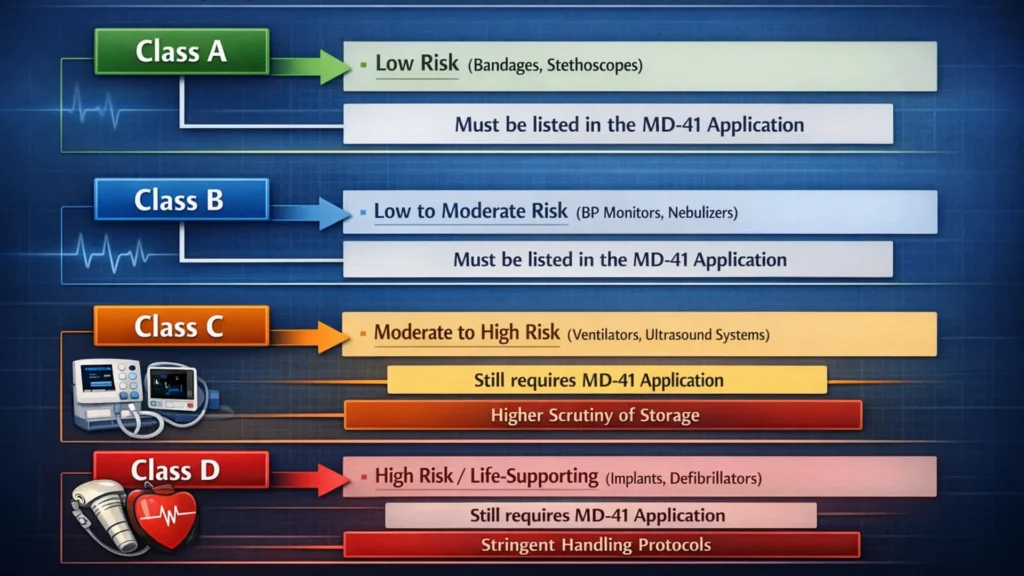
Under MDR 2017, all dental medical devices are classified based on risk level. The classification determines the regulatory pathway, documentation requirements, and scrutiny level applied by CDSCO.
Class A — Low Risk
Class A devices are non-invasive, low-risk tools with minimal patient contact risk. These include basic dental instruments, impression trays, toothbrushes, and mixing accessories. They pose the least risk and require the most basic level of regulatory oversight.
Examples: Dental spatulas, impression trays, cotton rolls, toothbrushes, forceps, dappen dishes.
Class B — Low to Moderate Risk
Class B devices have a slightly higher risk profile. They may contact oral tissues more directly or have chemical interactions. Dental cements, impression materials, temporary crowns, and pre-formed crowns fall here.
Examples: Silicone impression materials, alginate, zinc phosphate cement, temporary dental crowns, dental anaesthesia kits.
Class C — Moderate to High Risk
Class C dental devices are those that are implanted, invasive, or involve longer-term body contact. They require clinical data and stricter regulatory scrutiny.
Examples: Transgingival implants, dental amalgam, bone matrix implants, collagen membranes, denture adhesives with active ingredients.
Class D — High Risk
Class D covers the highest-risk medical devices. While most dental devices fall under Class A, B, or C, any dental device that uses human blood derivatives or is life-sustaining may be classified as Class D. No dental products from the uploaded list fall under Class D; however, manufacturers should verify with CDSCO for custom-developed dental technologies.
Complete List of Dental Devices by Class (As per MDR 2017 First Schedule Part 1)
The following tables list all dental medical devices notified under CDSCO MDR 2017, classified by their risk class. These are based on the official product classification list (MD-28 to MD-37 series).
Class A Dental Medical Devices
| Sl. No. | Product Name | Class |
| 1 | Agar dental impression material | A |
| 2 | Alginate dental impression material | A |
| 3 | Dental collar/crown scissors | A |
| 4 | Dental excavator, reusable | A |
| 5 | Dental excavator, single-use | A |
| 6 | Basic electric toothbrush, line-powered | A |
| 7 | Basic manual toothbrush | A |
| 8 | Dappen dish, reusable | A |
| 9 | Dappen dish, single-use | A |
| 10 | Dental examination kit | A |
| 11 | Dental material mixing surface, reusable | A |
| 12 | Dental material mixing surface, single-use | A |
| 13 | Dental spatula, reusable | A |
| 14 | Dental spatula, single-use | A |
| 15 | Wax dental impression material | A |
| 16 | Dental impression material kit, reusable | A |
| 17 | Dental impression material kit, single-use | A |
| 18 | Dental impression material mixer | A |
| 19 | Dental impression material syringe | A |
| 20 | Dental impression tray material | A |
| 21 | Dental impression tray, reusable | A |
| 22 | Dental polishing brush | A |
| 23 | Dental suction system cannula, reusable | A |
| 24 | Dental suction system cannula, single-use | A |
| 25 | Dental suction system fluid-separation unit | A |
| 26 | Plaster dental impression material | A |
| 27 | Assistive electric toothbrush | A |
| 28 | Assistive manual toothbrush, reusable | A |
| 29 | Assistive manual toothbrush, single-use | A |
| 30 | Bar dental precision attachment | A |
| 31 | Basic electric toothbrush, battery-powered | A |
| 32 | Dental cotton roll | A |
| 33 | Dental impression tray, single-use | A |
| 34 | Dental articulation paper forceps | A |
| 35 | Dental dressing forceps, reusable | A |
| 36 | Dental dressing forceps, single-use | A |
| 37 | Rubber dam clamp forceps | A |
| 38 | Tooth extraction forceps | A |
| 39 | Dental amalgam capsule | A |
| 40 | Dental amalgam mercury dispenser | A |
| 41 | Dental anaesthesia syringe, intraligamentary | A |
| 42 | Dental anaesthesia syringe, reusable | A |
| 43 | Dental anaesthesia syringe, single-use | A |
| 44 | Dental anaesthesia syringe/needle | A |
Class B Dental Medical Devices
| Sl. No. | Product Name | Class |
| 1 | Agar dental impression material (hydrocolloid) | B |
| 2 | Alginate dental impression material | B |
| 3 | Composite dental impression material | B |
| 4 | Dental crown, polymer | B |
| 5 | Dental crown/bridge resin, temporary | B |
| 6 | Dental crown/bridge, temporary | B |
| 7 | Dental crown, metal/ceramic | B |
| 8 | Dental crown, metal/polymer | B |
| 9 | Dental bone particle collector | B |
| 10 | Dental suction system | B |
| 11 | Polyether dental impression material | B |
| 12 | Polysulfide dental impression material | B |
| 13 | Silicone dental impression material | B |
| 14 | Dental suction system pump | B |
| 15 | Dental suction system disinfection control unit | B |
| 16 | Zinc polycarboxylate dental cement | B |
| 17 | Preformed dental crown, permanent | B |
| 18 | Preformed dental crown, temporary | B |
| 19 | Zinc phosphate dental cement | B |
| 20 | Dental anaesthesia injection kit | B |
| 21 | Dental anaesthesia syringe cartridge | B |
| 22 | Bite registration rim | B |
| 23 | Bite registration rim wax | B |
| 24 | Bite registration rim wax, plate | B |
| 25 | Ceramic artificial teeth | B |
Class C Dental Medical Devices
| Sl. No. | Product Name | Class |
| 1 | Dental bone matrix implant, animal-derived | C |
| 2 | Carboxymethylcellulose sodium denture adhesive | C |
| 3 | Carboxymethylcellulose sodium/polymer denture adhesive, zinc-free | C |
| 4 | Dental amalgam | C |
| 5 | Dental amalgam alloy | C |
| 6 | Dental amalgam mercury | C |
| 7 | Temporary mandibular condyle prosthesis | C |
| 8 | Temporomandibular joint disc | C |
| 9 | Transgingival implant | C |
| 10 | Transmandibular implant | C |
| 11 | Pliable-polymer dental regeneration membrane, bioabsorbable, ligated | C |
| 12 | Pliable-polymer dental regeneration membrane, bioabsorbable, tacked | C |
| 13 | Dental surgical procedure kit, medicated, reusable | C |
| 14 | Dental surgical procedure kit, medicated, single-use | C |
| 15 | Membrane fixation tack, bioabsorbable | C |
| 16 | Periodontal root surface regeneration material | C |
| 17 | Periodontal tissue reconstructive material | C |
| 18 | Bone matrix implant, human-derived | C |
| 19 | Collagen dental regeneration membrane | C |
| 20 | Dental soft-tissue matrix implant, animal-derived | C |
| 21 | Dental anaesthesia system | C |
| 22 | Calcium hydroxide dental cement | C |
Class D Dental Medical Devices
No dental devices from the current notified list (MD-28 to MD-37) have been classified as Class D. Manufacturers of experimental or blood-contacting dental products should consult CDSCO directly for classification guidance.
Eligibility Criteria for CDSCO Dental Device Registration
Before applying for CDSCO registration, make sure your business meets the following eligibility requirements:
For Indian Manufacturers:
- Must hold a valid Manufacturing License in Form 25 or Form 28 issued by the State Licensing Authority (SLA)
- Manufacturing facility must comply with Schedule M-III (Good Manufacturing Practices for Medical Devices)
- Must hold or be applying for ISO 13485 certification
- Device must be listed under the notified categories in MDR 2017
For Importers:
- Must appoint an authorized Indian Agent (AIA) who takes regulatory responsibility
- Foreign manufacturer must hold CE Mark, US FDA clearance, or equivalent approval in their home country
- Free Sale Certificate (FSC) from the country of origin is mandatory
- The device must be marketed in the country of manufacture
General Requirements:
- Applicant must be a legal entity registered in India
- All device labelling must comply with Schedule VII of MDR 2017
- Post-market surveillance plan must be in place
Documents Required for CDSCO Dental Medical Device Registration
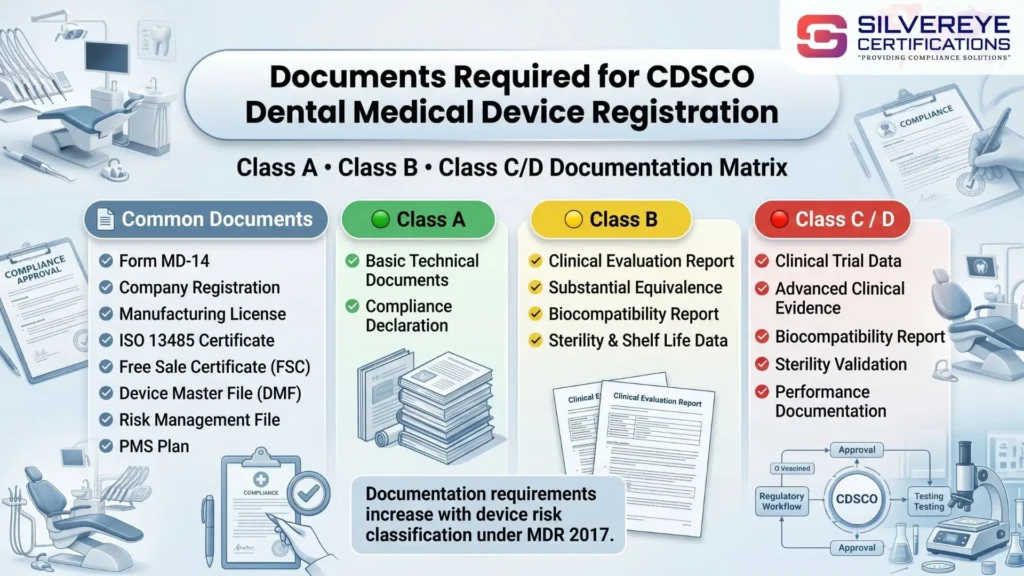
The documentation requirements vary by device class. Below is a consolidated reference table:
| Document | Class A | Class B | Class C/D |
| Form MD-14 (Application Form) | ✓ | ✓ | ✓ |
| Certificate of Incorporation / Partnership Deed | ✓ | ✓ | ✓ |
| Manufacturing License (Form 25 or 28) | ✓ | ✓ | ✓ |
| ISO 13485 Certificate | ✓ | ✓ | ✓ |
| Free Sale Certificate (for imports) | ✓ | ✓ | ✓ |
| Device Master File / Technical File | ✓ | ✓ | ✓ |
| Clinical Evaluation / Performance Data | ✗ | ✓ | ✓ |
| Substantial Equivalence Document | ✗ | ✓ | ✓ |
| Clinical Trial Data (India) | ✗ | ✗ | ✓ |
| Risk Management File (ISO 14971) | ✓ | ✓ | ✓ |
| Biocompatibility Report (ISO 10993) | ✗ | ✓ | ✓ |
| Sterility / Shelf Life Test Report | ✗ | ✓ | ✓ |
| Post-Market Surveillance Plan | ✓ | ✓ | ✓ |
Note: All documents must be submitted via the SUGAM online portal. Physical submissions are no longer the primary route for most applications.
Key Document Descriptions:
- Form MD-14: The official application form for import or manufacture license. Must include device name, classification, intended use, and manufacturer details.
- Device Master File (DMF): Complete technical documentation including design, materials, manufacturing process, sterilization (if applicable), and labelling.
- Risk Management File: Risk analysis prepared as per ISO 14971 showing identified hazards, risk controls, and residual risks.
- Clinical Evaluation Report (CER): Required for Class B and above. Can be based on literature review, post-market data, or clinical trials.
- Biocompatibility Report: Required for devices that contact body tissues or fluids, tested as per ISO 10993 series.
Step-by-Step CDSCO Registration Process for Dental Devices
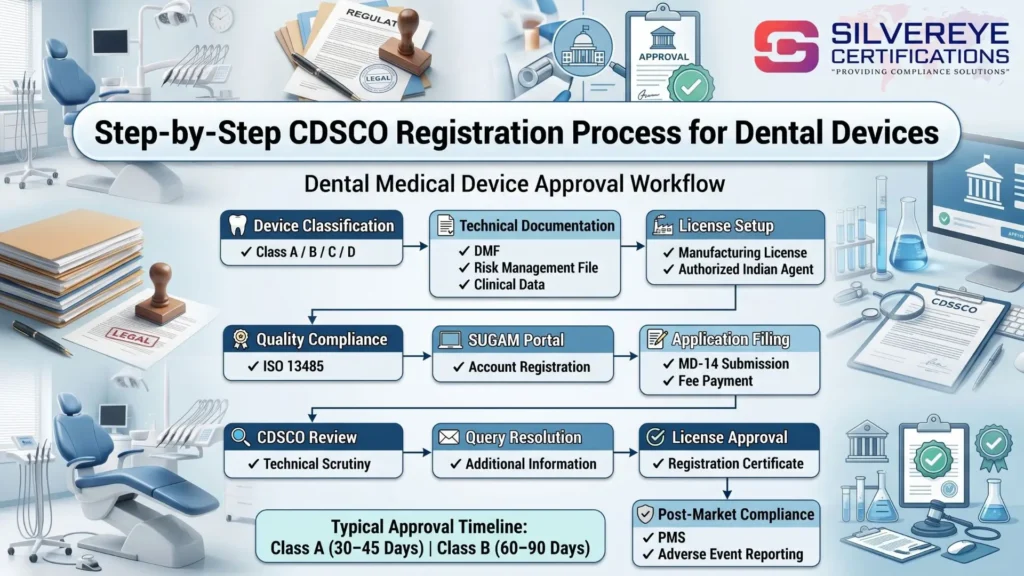
Here is the complete registration process for dental medical devices in India, updated as of 2026:
- Device Classification Confirmation: Identify whether your dental device is Class A, B, C, or D using MDR 2017 First Schedule.
- Prepare Technical Documentation: Compile all required documents — Form MD-14, DMF, risk file, biocompatibility data, clinical evaluation (if applicable).
- Obtain Manufacturing License / Importer Agreement: Secure Form 25/28 from SLA (for Indian manufacturers) or appoint an authorized Indian agent (for importers).
- ISO 13485 Certification: Get your quality management system certified by an accredited body.
- SUGAM Portal Registration: Create an account on the SUGAM portal (sugam.gov.in). This is CDSCO's official e-governance platform.
- Submit Application (Form MD-14): Upload all documents, pay the prescribed fees, and submit the application online.
- Scrutiny by CDSCO: CDSCO reviews the application. For Class C/D devices, additional queries or panel review may be initiated.
- Additional Information Requests: CDSCO may request clarifications or additional data. Respond within the stipulated time.
- Grant of License: Upon approval, CDSCO grants the manufacturing or import license in the prescribed form.
- Post-Market Obligations: Maintain adverse event reporting, periodic safety updates, and post-market surveillance as required.
Typical Processing Time:
- Class A: 30 to 45 working days
- Class B: 60 to 90 working days
- Class C: 90 to 180 working days (may involve expert committee review)
CDSCO Registration Fees for Dental Devices
CDSCO registration fees for dental medical devices are prescribed under MDR 2017 and are payable online through the SUGAM portal. The fees vary based on device class and whether the applicant is a manufacturer or importer.
| Device Class | Application Fee (Indian Manufacturer) | Application Fee (Importer) |
| Class A (Low Risk) | As per MDR 2017 Schedule | As per MDR 2017 Schedule |
| Class B (Low-Moderate Risk) | As per MDR 2017 Schedule | As per MDR 2017 Schedule |
| Class C (Moderate-High Risk) | As per MDR 2017 Schedule | As per MDR 2017 Schedule |
| Class D (High Risk) | As per MDR 2017 Schedule | As per MDR 2017 Schedule |
Note: Exact fee amounts are subject to revision by the Ministry of Health. Always check the latest fee schedule on the official CDSCO website (cdsco.gov.in) or the SUGAM portal before applying. Small-scale industries may be eligible for fee concessions under certain government schemes.
Validity and Renewal of CDSCO Dental Device License
- Class A and B licenses: Valid for 5 years, subject to renewal.
- Class C and D licenses: Valid for 5 years, subject to renewal and continued compliance.
- Renewal applications must be submitted at least 9 months before expiry to avoid lapse.
- If a license lapses, the manufacturer or importer must cease all sale and manufacturing activities until renewal is granted.
- Any change in device design, materials, intended use, or manufacturer details requires a variation application before the change is implemented.
- Importers must also renew the authorization of the authorized Indian agent (AIA) periodically.
Benefits of CDSCO Dental Medical Device Registration
- Legal Authorization: Enables lawful manufacture, import, and distribution of dental devices in India.
- Market Trust: Hospitals, clinics, and dental professionals prefer CDSCO-registered products for procurement.
- Competitive Advantage: Registered products can participate in government tenders and public health programs.
- Global Credibility: CDSCO registration enhances acceptance of Indian dental device exports in certain international markets.
- Patient Protection: Ensures all marketed devices have met minimum safety and performance benchmarks.
- Reduced Liability: Registration acts as evidence of regulatory due diligence in case of adverse event investigations.
Common Mistakes to Avoid During Dental Device Registration
- Incorrect Classification: Misclassifying a Class C device as Class B delays the review and may result in rejection.
- Incomplete Technical File: Missing risk management documentation or biocompatibility data is among the top reasons for application rejection.
- Outdated ISO Certificate: Submitting an expired ISO 13485 certificate leads to automatic query or rejection.
- Wrong Form Selection: Using an incorrect form for the type of application (e.g., import vs. manufacture) wastes processing time.
- No Authorized Indian Agent (AIA): Foreign manufacturers who try to register without appointing a valid AIA will face immediate rejection.
- Non-compliant Labelling: Dental device labels must include all mandatory information as per Schedule VII of MDR 2017.
- Delayed Response to Queries: CDSCO grants limited time to respond to queries. Missing the deadline leads to application abandonment.
Conclusion
CDSCO registration for dental medical devices in India is a non-negotiable regulatory requirement for manufacturers, importers, and distributors. With the dental device market in India growing rapidly — driven by increasing dental awareness, a rising middle class, and expanding dental clinic infrastructure — regulatory compliance has never been more critical.
Whether you are manufacturing basic dental spatulas (Class A) or complex transgingival implants (Class C), understanding your device classification and following the correct CDSCO registration pathway will protect your business, your brand, and most importantly, your patients.
Stay updated with CDSCO notifications and SUGAM portal guidelines, as the regulatory landscape for dental medical devices in India continues to evolve in 2026 and beyond.
Frequently Asked Questions
Is CDSCO registration mandatory for all dental devices in India?
Yes. All dental medical devices notified under MDR 2017 must be registered with CDSCO before they can be manufactured, imported, or sold in India. Non-compliance is a criminal offense under the Drugs and Cosmetics Act
How long does CDSCO registration take for dental devices?
It depends on the device class. Class A typically takes 30 to 45 working days, Class B takes 60 to 90 days, and Class C devices may take 90 to 180 working days due to additional scrutiny.
Can I sell dental devices online in India without CDSCO registration?
No. Selling notified dental medical devices without valid CDSCO registration is illegal, whether online or offline. E-commerce platforms are increasingly verifying regulatory compliance before listing medical devices.
What is the difference between Class A and Class B dental devices?
Class A dental devices are low-risk, non-invasive tools (like spatulas, trays, and toothbrushes). Class B devices are low-to-moderate risk, with more direct tissue contact or chemical interaction (like dental cements and impression materials).
Does a basic toothbrush require CDSCO registration?
Yes. Basic manual and electric toothbrushes are classified as Class A dental devices under MDR 2017 and require a CDSCO manufacturing license or import license, depending on the applicant.
What is Form MD-14 in CDSCO registration?
Form MD-14 is the official application form for obtaining a license to manufacture or import medical devices, including dental devices, in India. It is submitted through the SUGAM online portal along with supporting technical documents.
Do dental implants require clinical trial data for CDSCO approval?
Yes. Dental implants such as transgingival implants and transmandibular implants are classified as Class C devices and require substantial clinical evidence, which may include clinical trial data, for CDSCO approval.
What is the role of an Authorized Indian Agent (AIA) for foreign dental device manufacturers?
An AIA is a legally registered Indian entity who acts as the regulatory representative for a foreign manufacturer. The AIA is responsible for ensuring compliance with Indian regulations and takes co-responsibility for the safety of the imported device.
How do I renew my CDSCO dental device license?
You must apply for renewal through the SUGAM portal at least 9 months before the expiry of your existing license. Submit the renewal application with updated documents, pay the prescribed fee, and maintain continued compliance with MDR 2017.
Are dental amalgam and dental amalgam alloy classified as high-risk devices?
Yes. Dental amalgam, dental amalgam alloy, and dental amalgam mercury are classified as Class C (moderate-to-high risk) devices under MDR 2017, primarily due to the use of mercury and the risks associated with handling and patient exposure.