- Exactly which documents you need to submit for a valid MD-16 application under the Medical Device Rules, 2017.
- The step-by-step portal process on the CDSCO Sugam portal — from account creation to MD-17 license grant.
- Government fee structure, realistic approval timelines, and what to do if our application gets a query.
- Post-approval obligations, license validity, renewal process, and common mistakes that lead to rejection.
What Is a CDSCO Medical Device Test License (MD-16) and Why Do You Need One?
If you want to bring a foreign medical device into India for testing, evaluation, or clinical investigation purposes — without actually selling it commercially — you need a CDSCO Medical Device Test License. Under the Medical Device Rules, 2017 (MDR 2017), this process is governed by Form MD-16 (the application) and Form MD-17 (the actual license granted by CDSCO).
India's Central Drugs Standard Control Organization (CDSCO) has put a clear gating mechanism in place. You cannot simply import a medical device and start testing it at a hospital, R&D lab, or evaluation center without prior regulatory clearance. The MD-16 route is specifically designed for this purpose — it is faster and less complex than a full import license, but it still demands complete documentation and compliance.
Whether you are a manufacturer conducting a pre-submission study, a distributor evaluating a new device for future market entry, a research institution running a clinical investigation, or an academic lab testing device performance — the MD-16 application is your legal gateway.
In 2026, CDSCO tightened digital compliance through the Sugam portal, and paper-based submissions are no longer accepted for most categories. This guide walks you through every step of the MD-16 application process as it stands today.
Who Is Eligible to Apply for MD-16 Test Import License?
Not everyone can file a Form MD-16 application. CDSCO expects the applicant to fulfill certain eligibility conditions before the application is accepted on the portal.
Eligible Applicants Include:
- Indian importers or distributors holding a valid Drugs License (Form 20B/21B) or Medical Device Import License
- Research and development organizations registered in India
- Academic or medical institutions conducting device evaluation or clinical investigation
- Authorized Indian representatives of foreign manufacturers who have appointed them in writing
- Diagnostic laboratories or hospitals undertaking performance evaluation studies
Key Eligibility Conditions:
- The medical device must fall under the definition of a medical device as per Rule 3(1)(w) of MDR 2017
- The device must be imported strictly for testing, evaluation, R&D, or clinical investigation — NOT for commercial sale
- Quantity imported must match the stated purpose and timeline of the study or evaluation
- Foreign manufacturer must have valid market authorization in their country of origin (CoO)
If you are unsure whether your device qualifies, check the CDSCO Medical Device Classification list or seek a regulatory consultant's opinion before filing.
Complete Document Checklist for MD-16 Medical Device Test License Application
One of the biggest reasons for application delays or rejections is incomplete or incorrect documentation. Here is the exact document list you need, organized by category.
A. Applicant and Business Documents
| Document | Remarks |
| Form MD-16 (duly filled) | Available on CDSCO Sugam portal; must be digitally signed |
| Copy of Valid Drug License / Import License | Form 20B or 21B or existing MD import license |
| Authorization Letter from Foreign Manufacturer | On company letterhead; authorizes Indian entity to import for testing |
| Power of Attorney / Authorized Signatory Details | If filed through a regulatory consultant or agent |
| PAN Card and GST Registration (if applicable) | Of the importing entity in India |
| Company Incorporation Certificate | If applicant is a company or LLP |
B. Device-Specific Technical Documents
| Document | Remarks |
| Device Description and Intended Use | Detailed write-up of the device, its mechanism of action, and intended clinical or testing use |
| Risk Classification Justification | Class A / B / C / D as per MDR 2017 Schedule II or III |
| Country of Origin Certificate (CoO) | Certificate confirming manufacture location, duly apostilled |
| Market Authorization / CE Mark / FDA 510(k) / Equivalent | Proof of regulatory approval in country of origin |
| Free Sale Certificate (FSC) | Issued by competent authority of originating country |
| Device Master File / Technical Dossier Summary | Not full dossier — but key technical specs required |
| Labeling and Instructions for Use (IFU) | English version or certified English translation |
| Shelf Life and Storage Conditions | Applicable especially for in vitro diagnostic devices (IVD) |
C. Purpose-Specific Documents
| Purpose of Import | Additional Documents Required |
| Clinical Investigation / Trial | Ethics Committee approval, Clinical Investigation Plan, ICMR-CTR registration number |
| Performance Evaluation (IVD) | Study protocol, name of lab/institution, qualified personnel details |
| R&D / Pre-Submission Testing | Declaration of purpose on company letterhead, lab accreditation certificate (NABL preferred) |
| Exhibition / Demonstration | Event invitation letter, confirmed return/destruction plan after use |
D. Declaration and Undertaking
- Undertaking that the device will not be sold or commercially distributed
- Undertaking that unused devices or residual quantities will be returned or destroyed as per applicable rules
- Declaration of accuracy of submitted documents
- Undertaking regarding post-import reporting obligations
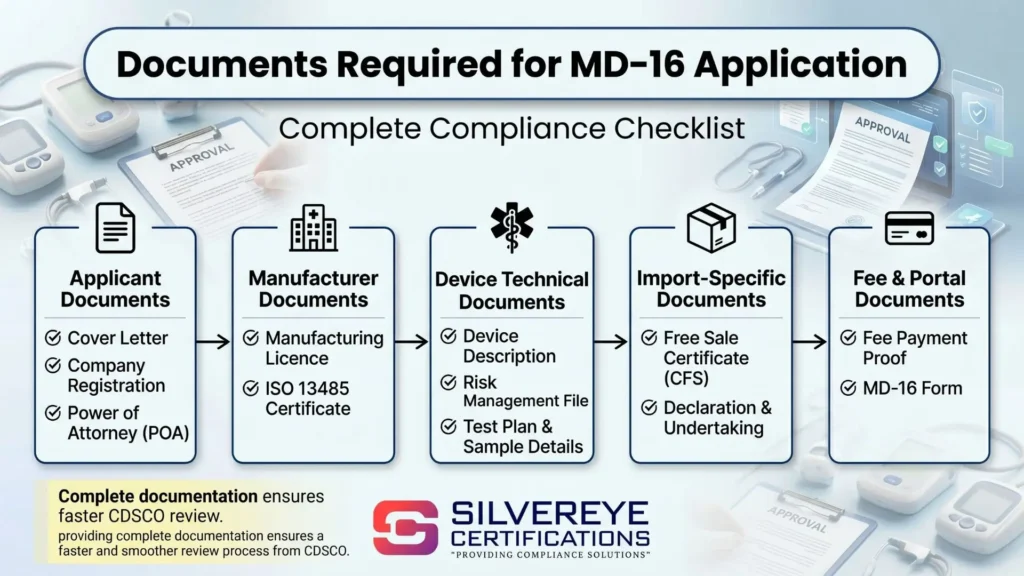
Tip: All foreign documents must be apostilled or notarized and, if in a language other than English, accompanied by a certified English translation. Incomplete apostille is one of the top reasons for CDSCO query letters.
Government Fee Structure for MD-16 Test Import License
As of 2026, the fee for a Test Import License application under the Medical Device Rules, 2017 is prescribed under the Second Schedule of the MDR 2017.
| Fee Category | Amount (INR) |
| Application fee for Test Import License (MD-16) | Rs. 2,000 per device |
| Fee for additional devices (same application) | Rs. 2,000 per additional device |
| Late renewal fee (if applicable) | As prescribed by CDSCO from time to time |
| Payment Mode | Online via CDSCO Sugam portal (Net Banking / NEFT / Challan) |
Note: Fee amounts are subject to revision by the Ministry of Health and Family Welfare. Always confirm the current fee schedule on the CDSCO official website or the Sugam portal at the time of application.
Step-by-Step Process: How to Apply for MD-16 on the CDSCO Sugam Portal
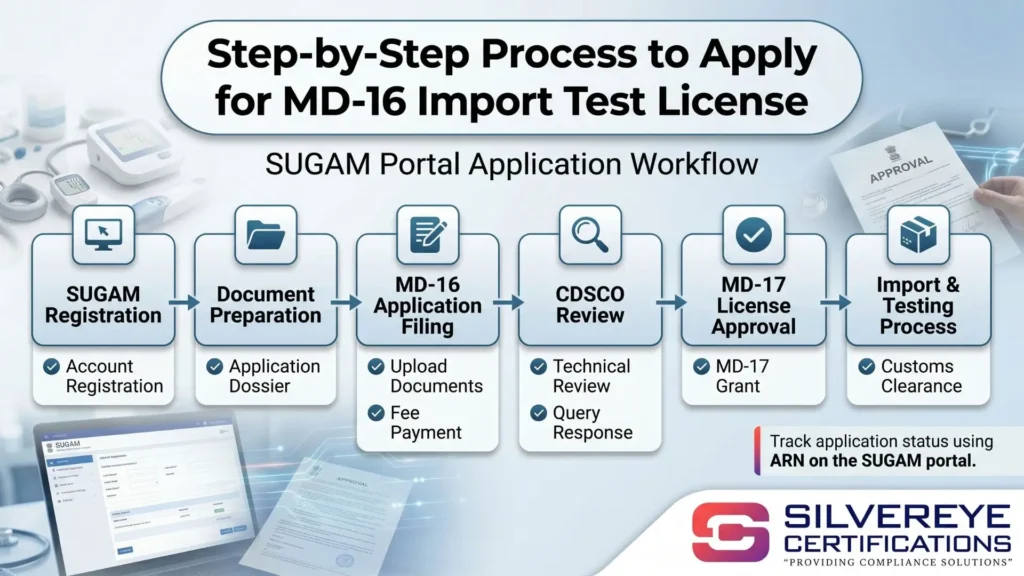
The entire application process for the Test Import License is handled through the CDSCO Sugam online portal. Here is a detailed walkthrough:
Step 1: Register / Log In to the CDSCO Sugam Portal
- Go to sugam.cdsco.gov.in
- If you are a first-time user, click on New Registration and create an account under the category Importer / Manufacturer / Research Institution
- Existing users log in with their credentials
- Ensure your Digital Signature Certificate (DSC) is registered on the portal — it is mandatory for submission
Step 2: Select the Correct Application Form
- After login, navigate to Medical Devices & Diagnostics > Import > Test Import License
- Select Form MD-16 from the dropdown
- Verify that you are selecting 'Test Import' and not 'Commercial Import License'
Step 3: Fill the Application Form
- Enter applicant details: name, address, drug license number, and authorized signatory
- Enter device details: generic name, brand name, manufacturer's name and country, device classification, model number, and intended purpose
- Mention the quantity to be imported and the specific purpose (R&D / clinical investigation / performance evaluation / exhibition)
- State the duration for which the license is sought
Step 4: Upload Supporting Documents
- Upload all documents in the prescribed format (PDF, size limit as specified on portal)
- Each document must be properly labeled — mislabeled documents are a common source of queries
- Technical documents such as CE certificate, FSC, and CoO must be individually uploaded — do not merge into one PDF
- Authorization letter must be on original letterhead of the foreign manufacturer — scanned copies are acceptable if legible
Step 5: Pay the Application Fee
- After form submission, you are redirected to the fee payment page
- Pay online using the available payment modes on the portal
- Download and save the payment challan / receipt — you will need this for follow-up queries
Step 6: Submit the Application and Note the Application Number
- Review all entries before final submission
- On submission, an Application Reference Number (ARN) is generated
- This ARN is used to track the status of your application on the portal
- A confirmation email is sent to the registered email address
Step 7: CDSCO Technical Scrutiny and Query Resolution
- CDSCO officials review the application for technical completeness within the stipulated timeline
- If any document is missing or clarification is needed, a Query Letter is raised on the portal
- You must respond to queries within the specified timeframe — failure to respond on time may result in application rejection
- Upload query responses with additional documents or clarifications as requested
Step 8: Grant of Test Import License (Form MD-17)
- On successful verification and satisfaction of all requirements, CDSCO grants the Test Import License
- The license is issued in Form MD-17 and is available for download from the Sugam portal
- MD-17 specifies the name of the device, quantity permitted, purpose, period of validity, and conditions of import
- Print and keep a copy of the MD-17 for customs clearance and import documentation
MD-16 Application Approval Timeline
Many applicants ask: how long does it actually take to get a CDSCO Test Import License? The honest answer depends on several factors — document completeness, device class, and current CDSCO workload.
| Stage | Estimated Timeline |
| Portal submission and acknowledgment | Immediate (same day) |
| Application assigned to technical officer | 3 to 5 working days |
| CDSCO technical review (no query raised) | 15 to 30 working days |
| Query raised — applicant response period | 30 days from query date (extendable on request) |
| Post-query review and decision | 10 to 15 working days after response |
| Total timeline (clean application, no query) | Approximately 30 to 45 working days |
| Total timeline (with one query round) | 60 to 90 working days |
| Fast-track / urgent cases (if applicable) | CDSCO does not have a formal fast-track for MD-16 as of 2026 |
Practical insight: Applications for Class A and Class B devices with complete documentation typically get processed faster. Class C and D devices, or devices intended for clinical investigation, tend to attract more scrutiny and take longer.
MD-17 License Validity and Renewal: What You Need to Know
Validity Period
- A Test Import License (Form MD-17) is typically granted for a period of 1 year, or for the duration of the study / purpose stated in the application, whichever is earlier
- If you need an extension, you must apply before the license expires
Renewal / Extension Process
- Submit a renewal application through the CDSCO Sugam portal before the expiry date
- Attach updated authorization letter, updated study status or purpose declaration, and proof of ongoing need
- Renewal fees are applicable as per the MDR 2017 schedule
- Continued unauthorized possession of an expired license is a regulatory violation
Post-License Obligations
- Maintain records of quantity imported, quantity used/tested, and quantity remaining
- Do not transfer, sell, or commercially distribute the test-imported device
- Submit a completion report or end-of-study certificate to CDSCO if required by the license conditions
- Unused or excess devices must be returned to the foreign manufacturer or destroyed — as per the conditions mentioned in MD-17
- If the device fails and there is an adverse event, it must be reported to CDSCO as per MDR 2017 post-market obligations
MD-16 vs. Other CDSCO Import Forms: Know the Difference
| Form | Purpose | When to Use |
| Form MD-14 | Application for Import License (commercial) | When you want to import and sell a medical device in India |
| Form MD-15 | Grant of Import License (commercial) | License issued after MD-14 approval |
| Form MD-16 | Application for Test Import License | When importing for testing, R&D, clinical investigation only |
| Form MD-17 | Grant of Test Import License | License issued by CDSCO after MD-16 approval |
| Form MD-41 | Application for Clinical Investigation | When conducting formal clinical trials of a device in India |
Always use MD-16 when the purpose of import is not commercial. Using MD-14 for test purposes, or attempting to import under no license at all, constitutes a violation under the Drugs and Cosmetics Act, 1940 and MDR 2017, and can attract penalties.
Benefits of Obtaining a Test Import License Through MD-16
- Legal compliance: You can legally bring a foreign medical device into India without fear of confiscation or customs hold
- Faster than commercial license: The MD-16 route has a narrower documentation scope compared to a full import license, making it more suitable for short-term evaluation needs
- Enables clinical investigations: Essential prerequisite for devices that are part of clinical investigation protocols requiring Ethics Committee and CDSCO approval
- Builds regulatory track record: An approved test import history is seen positively by CDSCO when you subsequently apply for a full commercial import license for the same device
- Flexible device categories: Applicable across all four risk classes (A, B, C, D) of medical devices and in vitro diagnostics
- Pathway for new technologies: Helps international manufacturers assess Indian market readiness and performance of their device before making a commercial launch decision
Regulatory Framework: Legal Basis for MD-16 Under MDR 2017
The Test Import License is governed by the following key regulatory instruments:
- The Drugs and Cosmetics Act, 1940 (as amended): Primary legislation governing drugs and medical devices in India
- Medical Device Rules, 2017: Rules 23 and 24 deal with import of medical devices; Rule 34 covers test import provisions
- Forms MD-16 and MD-17: Prescribed under First Schedule, Part III of the MDR 2017
- CDSCO Office Memorandums and Guidance Documents: Supplementary guidance issued from time to time by CDSCO
As of 2026, CDSCO continues to update its guidance notes for specific device categories. It is good practice to check the CDSCO website for the latest circulars before submitting your application.
Conclusion
The MD-16 Test Import License process is well-defined under India's Medical Device Rules, 2017, and CDSCO has made it increasingly digital and streamlined through the Sugam portal. But the process rewards preparation — applicants who submit complete, consistent, and properly formatted documentation get their MD-17 faster and with fewer queries.
If you are a foreign manufacturer looking to evaluate your device's performance in the Indian market, or an Indian institution conducting formal clinical investigation, or an R&D lab testing a device's safety and efficacy — the MD-16 is the right and lawful path.
Use this guide as your authoritative reference for 2026. Always cross-check with the CDSCO official website for the latest notifications, fee schedules, and portal updates, as regulatory requirements can change with new Ministry orders or CDSCO circulars.
When in doubt, consult a CDSCO-experienced regulatory affairs professional before submission. A well-prepared application not only saves time — it builds a credible regulatory relationship with CDSCO that benefits your long-term market access strategy in India.
Frequently Asked Questions
Can I import a medical device for testing without any CDSCO license?
No. Any import of a notified medical device for any purpose — including testing or evaluation — requires prior CDSCO approval. Importing without a valid MD-17 license is a violation under the Drugs and Cosmetics Act and MDR 2017, and is subject to seizure and penalties.
How many devices can I cover under a single MD-16 application?
You can apply for multiple devices in a single application, but each device must be listed separately with its own technical details and justification. Fees are applicable per device.
Is a CDSCO Test Import License (MD-17) accepted at all Indian customs ports?
Yes. A valid MD-17 license is recognized at all designated customs ports for medical device imports. It is advisable to carry a print copy and upload it on the ICEGATE portal for smoother customs clearance.
Do I need a full import license (MD-14/MD-15) before applying for MD-16?
Not necessarily. MD-16 is a standalone application. However, having an existing import license can sometimes support your credibility as an importer. Check the specific requirements based on your applicant type.
What happens if my test import study gets delayed and the MD-17 expires?
You must apply for a renewal or extension before the expiry date. Operating with an expired license is non-compliant. Apply for renewal at least 30 days before expiry to avoid any regulatory gap.
Can a foreign manufacturer directly apply for MD-16 without an Indian entity?
No. The application must be filed by an Indian importer or an authorized Indian representative. The foreign manufacturer must provide an authorization letter to the Indian entity for this purpose.
Is the MD-16 application process the same for IVD devices and other medical devices?
The core process is the same. However, IVD devices intended for performance evaluation may require additional documents such as a study protocol, NABL-accredited lab details, and reference method documentation.
How do I track the status of my MD-16 application after submission?
Log in to the CDSCO Sugam portal and use your Application Reference Number (ARN) to check the current status. Status updates include 'Under Review,' 'Query Raised,' 'Approved,' or 'Rejected.'
What is the difference between a Test Import License and a No Objection Certificate (NOC) from CDSCO?
They are different instruments. A Test Import License (MD-17) permits import for specific testing purposes. A NOC from CDSCO is sometimes required for specific regulatory situations such as import of unregistered drugs/devices for personal use or emergency. For organized testing or R&D, MD-17 is the correct route.
Can I sell or transfer the devices imported under MD-16 to another party in India?
Absolutely not. Test-imported devices are strictly prohibited from commercial sale, transfer, or distribution under any circumstances. Violation of this condition can lead to license cancellation and legal action under the Drugs and Cosmetics Act.