- CDSCO Korean face serum registration is mandatory under the Drugs and Cosmetics Act, 1940 — covering both import (COS-1/COS-2) and domestic manufacture (COS-5/COS-8) routes.
- Importers of Korean face serums must file a COS-1 application and receive a COS-2 Grant of Import License before any shipment enters India.
- Manufacturers making Korean-formulated face serums in India need to apply via COS-5 and obtain the COS-8 Grant of Manufacture License from the state licensing authority.
- All Korean face serum products must comply with INCI ingredient listing, Schedule 4 prohibited substance checks, and Indian labelling rules under Cosmetics Rules, 2020.
Introduction
CDSCO Korean face serum registration in India follows two paths. For importing Korean-made serums, you submit a COS-1 application and receive COS-2 Grant of Import License. For manufacturing Korean-formulated serums in India, you apply via COS-5 and receive COS-8 Grant of Manufacture License.
Both processes require product safety data, GMP certificates, INCI ingredient lists, and label compliance under the Cosmetics Rules, 2020. Import licenses are valid for 3 years; manufacture licenses are valid for 5 years. Registration is applied online through the CDSCO Sugam Portal.
What Is CDSCO Korean Face Serum Registration?
CDSCO Korean face serum registration is the official regulatory process through which Korean face serum products — or products formulated using Korean cosmetic science — are approved for import or manufacture and sale in India. The registration is overseen by the Central Drugs Standard Control Organization (CDSCO), which functions under the Ministry of Health and Family Welfare, Government of India.
A face serum is classified as a cosmetic under Indian regulations. Under the Drugs and Cosmetics Act, 1940, and the Cosmetics Rules, 2020, no cosmetic product — whether imported or manufactured in India — can be sold commercially without proper regulatory compliance.
Korean face serums have become one of the most searched and purchased beauty products in India. From Vitamin C serums and hyaluronic acid formulas to niacinamide and peptide blends, Indian consumers are actively seeking K-beauty serums. This demand makes the CDSCO registration process critical knowledge for every importer, brand, and manufacturer working in this space.
Two Registration Pathways for Korean Face Serums in India
There are two distinct regulatory pathways for Korean face serum registration under CDSCO, depending on whether you are importing the product from Korea or manufacturing it in India:
| Pathway | Route | Application Form | Grant Form | License Authority | Validity |
| Import Korean Face Serum from Korea | Import | COS-1 | COS-2 | CDSCO (Central) | 3 Years |
| Manufacture Korean Face Serum in India | Manufacture | COS-5 | COS-8 | State Licensing Authority (SLA) | 5 Years |
Both pathways are governed by the Cosmetics Rules, 2020. The import route is managed centrally by CDSCO, while the manufacture route is primarily handled by the State Licensing Authority (SLA) where the manufacturing unit is located, with CDSCO providing oversight at the central level.
COS-1 Application: Registering an Imported Korean Face Serum
The COS-1 is the prescribed application form for importing cosmetics into India, including Korean face serums. It is filed by the Indian importer on the CDSCO Sugam Portal before the first consignment of the Korean face serum enters India.
Who Submits the COS-1 Application for Korean Face Serum?
The Indian importer — whether an individual, partnership, LLP, or company registered in India — submits the COS-1 application. The Korean manufacturer cannot directly apply. The Indian entity must hold a valid state-issued drug license or cosmetics business license to be eligible.
Information Required in the COS-1 Form for Korean Face Serum
| Field | Details to Provide |
| Product Name | Exact product name as it will appear on the Indian label |
| Generic / Common Name | Face Serum / Vitamin C Face Serum / Hyaluronic Acid Serum, etc. |
| Korean Manufacturer Name | Full legal name of the Korean manufacturing entity |
| Manufacturer Address | Complete address of the Korean factory |
| Country of Origin | Republic of Korea (South Korea) |
| Product Category | Skincare — Leave-on Cosmetic (Face Serum is leave-on) |
| Intended Use | Brightening / Anti-aging / Hydrating / Soothing, etc. |
| Complete Ingredient List | INCI names in descending order of concentration |
| Pack Sizes | All SKUs being imported (e.g., 15ml, 30ml, 50ml) |
| Shelf Life | As declared by Korean manufacturer |
| Label Draft | English label draft compliant with Rule 135, Cosmetics Rules 2020 |
| Applicant Details | Name, address, license number of Indian importer |
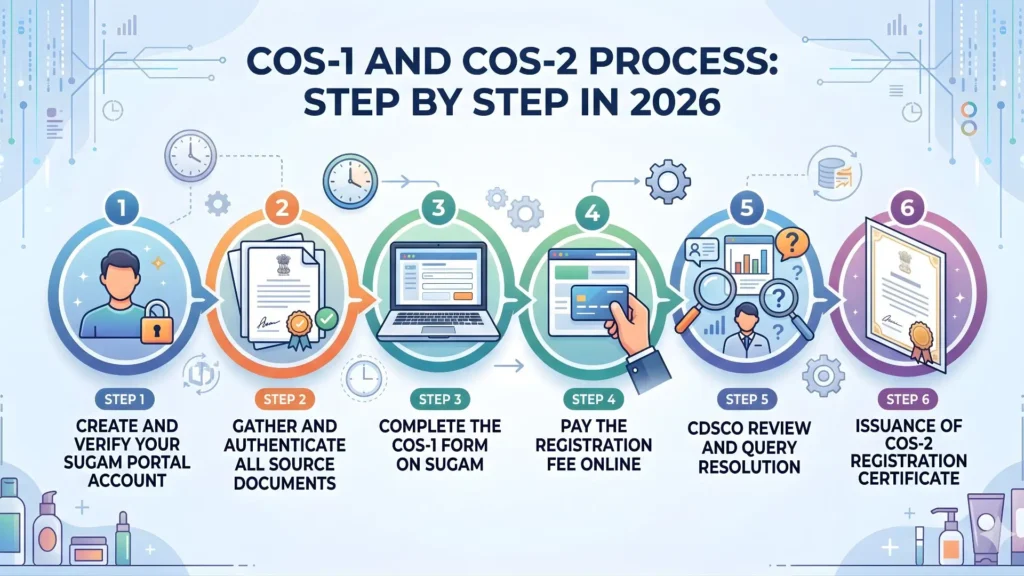
Step-by-Step COS-1 Application Process for Korean Face Serum Import
- Register on CDSCO Sugam Portal as an importer entity
- Log in and select 'Cosmetics Import License Application' (COS-1)
- Fill in all product details — product name, category, ingredients, and pack sizes
- Enter Korean manufacturer details — name, address, and manufacturing license number
- Upload all mandatory supporting documents (see document checklist below)
- Pay the prescribed government fee through the online payment gateway
- Submit and save the Application Reference Number for tracking
- Respond to any Deficiency Letter (query) raised by the CDSCO reviewer
- Receive COS-2 Grant of Import License upon approval
- Use the COS-2 license number on all import documents and product labels
COS-2: Grant of Import License for Korean Face Serum
After the COS-1 application is reviewed, evaluated, and approved by CDSCO, the licensing authority issues the COS-2 — the Grant of Import License. This is the legal document that authorizes the Indian importer to bring the specific Korean face serum into India for commercial sale.
What Does the COS-2 License for Korean Face Serum Contain?
- Unique CDSCO Import License Number
- Name and address of the licensed Indian importer
- Name of the Korean face serum product(s) covered
- Name and address of the Korean manufacturer
- Date of grant and expiry date (3 years from grant)
- Any specific conditions attached by CDSCO
COS-1 vs COS-2 — Key Differences
| Point | COS-1 (Application) | COS-2 (Grant of License) |
| What It Is | Application form filed by importer | Official license issued by CDSCO |
| Stage | Starting point | End result after approval |
| Purpose | Request permission to import | Legal proof of permission |
| Who Holds | Filed with CDSCO | Held by Indian importer |
| Validity | N/A | 3 years from grant date |
| Required At Customs | No | Yes — must quote COS-2 number |
COS-5 Application: Registering a Korean Face Serum Manufactured in India
If a business wants to manufacture a face serum using a Korean formulation or Korean-origin ingredients inside India, they need to apply for a Manufacture License through the COS-5 application form. This is filed with the State Licensing Authority (SLA) of the state where the manufacturing facility is located.
Many Indian cosmetic companies license Korean formulations (especially popular serums with Centella Asiatica, Snail Mucin, or multi-peptide actives) and want to manufacture them domestically. The COS-5 process applies to all such cases.
Who Submits the COS-5 Application?
The COS-5 application is submitted by the owner or licensed entity of the cosmetic manufacturing unit in India. The facility must be located in India and must meet GMP (Good Manufacturing Practice) standards as required under the Cosmetics Rules, 2020.
Key Information Required in the COS-5 Application
| Field | Details Required |
| Name of Applicant / Company | Indian manufacturer's legal name |
| Manufacturing Facility Address | Complete address with state, PIN, and contact details |
| Product Name(s) | Name of the Korean-formulated face serum to be manufactured |
| Product Category | Skincare — Leave-on / Face Serum |
| Complete Formula | Full formulation with INCI names and percentage concentrations |
| Manufacturing Process | Brief description of the manufacturing process |
| Equipment List | Key equipment used in manufacturing |
| QC/QA Details | Quality control and quality assurance process outline |
| Pack Sizes | All variants to be manufactured |
| Label Draft | Proposed label in compliance with Indian labelling rules |
| Technical Staff | Name and qualifications of responsible technical person |
Step-by-Step COS-5 Application Process for Korean Face Serum Manufacture
- Establish and equip the cosmetic manufacturing facility as per GMP norms
- Appoint a qualified Technical Manager / Responsible Person for manufacturing
- Register on the CDSCO Sugam Portal and access the COS-5 module
- Fill in the COS-5 form with complete product and facility details
- Upload all required documents (see checklist below)
- Pay the prescribed government fee
- The SLA may conduct a facility inspection before granting the license
- Respond to any queries or deficiency notices from the SLA
- Receive COS-8 Grant of Manufacture License upon approval
- Commence manufacturing only after receiving the COS-8 license

COS-8: Grant of Manufacture License for Korean Face Serum
The COS-8 is the Grant of Manufacture License issued by the State Licensing Authority (SLA) after the COS-5 application is approved. It is the official permit that allows a manufacturing unit in India to produce the specified Korean-formulated face serum for commercial distribution.
What Does the COS-8 Manufacture License Contain?
- Unique Manufacture License Number
- Name and address of the manufacturing unit
- Product name(s) approved for manufacture
- Category of cosmetic (face serum / skincare)
- Date of grant
- Validity (5 years from date of grant)
- Name of the Responsible Technical Person
- Conditions of manufacture, if any
COS-5 vs COS-8 — Key Differences
| Point | COS-5 (Application) | COS-8 (Grant of License) |
| What It Is | Application for manufacture license | License issued by State Licensing Authority |
| Stage | Starting point | Final approval |
| Authority | SLA of the state | SLA of the state |
| Purpose | Request permission to manufacture | Legal proof of manufacture permission |
| Validity | N/A | 5 years from grant date |
| Required Before | Commencing production | Must be displayed at factory |
All Four CDSCO Forms for Korean Face Serum
| Form | Purpose | Filed With | Issued By | Validity | Route |
| COS-1 | Application to import Korean face serum | CDSCO (Online) | CDSCO | N/A | Import |
| COS-2 | Grant of Import License for Korean face serum | N/A | CDSCO | 3 Years | Import |
| COS-5 | Application to manufacture Korean face serum in India | State Licensing Authority | SLA | N/A | Manufacture |
| COS-8 | Grant of Manufacture License for Korean face serum | N/A | SLA | 5 Years | Manufacture |
Full CDSCO Cosmetics Application Forms Table (All Forms)
For comprehensive understanding, here is the complete table of all CDSCO cosmetics forms under the Cosmetics Rules, 2020, which helps you understand where COS-1, COS-2, COS-5, and COS-8 fit within the broader regulatory structure:
| Form No. | Purpose | Filed By | Issued By |
| COS-1 | Application for Grant of License to Import Cosmetics | Indian Importer | CDSCO |
| COS-2 | Grant of License to Import Cosmetics | N/A | CDSCO |
| COS-3 | Application for Renewal of Import License | Indian Importer | CDSCO |
| COS-4 | Renewal of Import License | N/A | CDSCO |
| COS-5 | Application for Grant of License to Manufacture Cosmetics | Indian Manufacturer | State Licensing Authority |
| COS-6 | Grant of License to Manufacture Cosmetics (Loan License / Contract Manufacturing) | N/A | SLA |
| COS-7 | Application for Renewal of Manufacture License | Indian Manufacturer | SLA |
| COS-8 | Renewal / Grant of Manufacture License | N/A | SLA |
| COS-9 | Application for License to Manufacture Cosmetics for Export Only | Indian Manufacturer | SLA |
| COS-10 | Grant of License to Manufacture for Export Only | N/A | SLA |
| COS-11 | Application to Add / Amend Products on Existing License | Licensed Entity | CDSCO / SLA |
| COS-12 | Amended License (Product Addition or Variation) | N/A | CDSCO / SLA |
| COS-13 | Application for Duplicate License | Licensed Entity | CDSCO / SLA |
| COS-14 | Issue of Duplicate License | N/A | CDSCO / SLA |
Important: COS-6 is specifically used for loan licensing or contract manufacturing arrangements — relevant if you want an Indian contract manufacturer to produce your Korean-formulated face serum on your behalf under a licensing arrangement.
Documents Required for CDSCO Korean Face Serum Registration
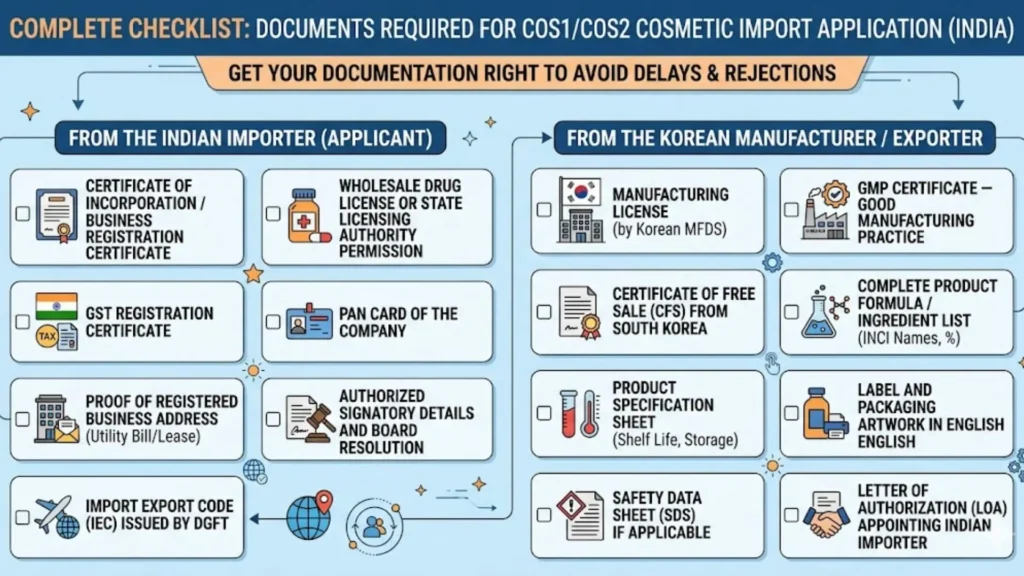
A. Documents for COS-1 (Import of Korean Face Serum)
Documents from the Indian Importer:
- Copy of Drug License / Cosmetics Business License (state-issued)
- PAN Card of the company or applicant
- GST Registration Certificate
- Certificate of Incorporation / Partnership Deed / MSME Certificate
- Authorization letter if filed through a representative
- Undertaking in the format prescribed by CDSCO
Documents from the Korean Manufacturer:
- GMP Certificate (Good Manufacturing Practice) — issued by MFDS Korea or accredited body
- Free Sale Certificate (FSC) — confirming the face serum is legally sold in South Korea
- Manufacturing License of the Korean facility
- Authorization letter from Korean manufacturer to the Indian importer
- Complete INCI ingredient list with percentage concentrations
- Safety Assessment Report / Cosmetic Product Safety Report (CPSR)
- Certificate of Analysis (COA) for the product
- Product Specification Sheet
- Technical Data Sheet / Product Information File (PIF)
- Stability Study Summary showing shelf life data
Product and Label Documents:
- Draft label in English compliant with Rule 135 of Cosmetics Rules, 2020
- Artwork or existing Korean label (original)
- All pack size variants with net content details
- Claims substantiation data if any special claims (anti-aging, brightening, SPF) are made
B. Documents for COS-5 (Manufacture of Korean Face Serum in India)
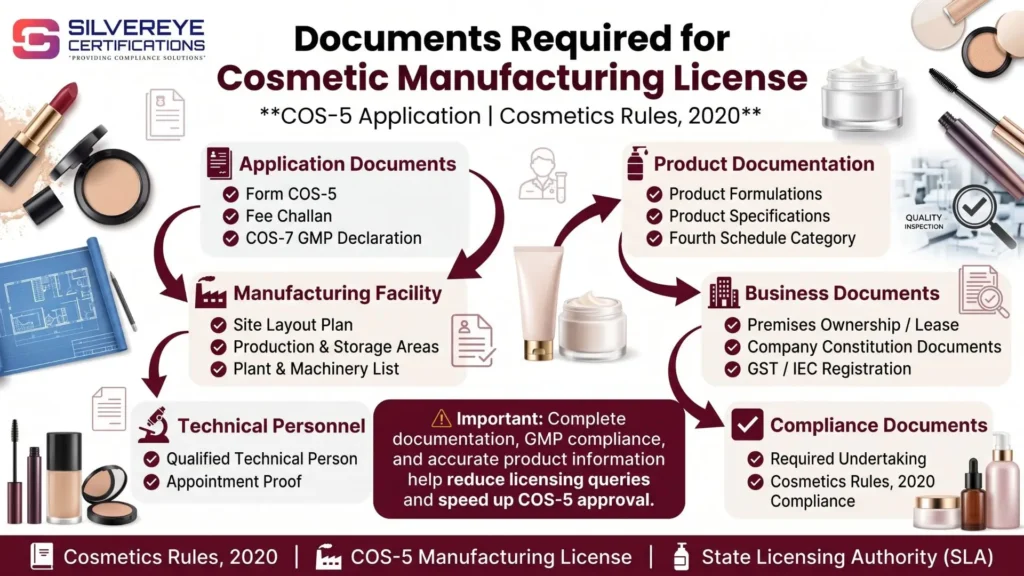
Facility and Entity Documents:
- Proof of ownership / lease of the manufacturing facility
- Site Master File (SMF) of the manufacturing unit
- Equipment list with specifications
- Water testing report (purified water used in formulation)
- Qualification certificates of the Technical Manager / Responsible Person
- Staff list with qualifications
Product and Formula Documents:
- Complete formulation with INCI names and % concentrations
- Manufacturing Process / SOP (Standard Operating Procedure)
- Raw material specifications and supplier details
- Product stability data
- Safety Assessment Report for the face serum formulation
- Draft label compliant with Indian labelling rules
- Batch manufacturing records (sample)
Eligibility Criteria for CDSCO Korean Face Serum Registration
Eligibility for COS-1 Import Registration (Korean Face Serum)
- Must be an Indian entity (individual, company, LLP, or firm)
- Must hold a valid Drug License or Cosmetics Business License from the state
- Korean manufacturer must be GMP-certified
- Product must not contain any substance listed as prohibited in Schedule 4 of Cosmetics Rules, 2020
- Valid GST and PAN registration required
- Korean face serum must carry all mandatory label declarations for Indian market
Eligibility for COS-5 Manufacture Registration (Korean Formulated Face Serum)
- Must own or lease a cosmetic manufacturing facility in India
- Facility must comply with GMP standards as per Cosmetics Rules, 2020
- A qualified Technical Manager or Responsible Person must be appointed
- Manufacturing facility must have adequate infrastructure — clean rooms, purified water system, QC lab
- Product formulation must comply with permitted ingredient list and not contain Schedule 4 prohibited substances
- Valid state license and GST registration required
CDSCO Korean Face Serum Registration Fees
| Form | Type | Approximate Government Fee | Remarks |
| COS-1 | Import Application — Face Serum | INR 3,000 – INR 10,000 per product | Fee varies by category and number of SKUs |
| COS-2 | Import License Grant | Included in COS-1 fee | No separate fee on issuance |
| COS-3 | Import License Renewal | Similar to COS-1 fee | Filed 3-6 months before expiry |
| COS-5 | Manufacture License Application | INR 1,500 – INR 5,000 (state-wise) | State-specific fees; check with SLA |
| COS-8 | Manufacture License Renewal | Similar to COS-5 fee | Filed before 5-year expiry |
| COS-11 | Amendment / Product Addition | INR 1,000 – INR 3,000 | For adding new SKUs or variants |
Note: Government fees are subject to revision. Always confirm the latest fee schedule on the CDSCO Sugam Portal (sugam.gov.in) or with your regulatory consultant before filing. Professional / consultant fees are separate and vary.
Timeline for CDSCO Korean Face Serum Registration (2026)
| Stage | Import (COS-1/COS-2) | Manufacture (COS-5/COS-8) |
| Document Preparation | 3–5 weeks | 4–8 weeks (facility compliance takes longer) |
| Application Filing | 1–2 days | 1–2 days |
| CDSCO / SLA Review | 30–60 days | 30–90 days (may include facility inspection) |
| Deficiency Letter Response | Up to 30 days (if raised) | Up to 30 days (if raised) |
| Facility Inspection | Not required for import | Required — SLA inspects manufacturing unit |
| License Issuance | 2–4 weeks after approval | 2–4 weeks after inspection clearance |
| Total Estimated Timeline | 3 to 5 months | 4 to 8 months |
Pro Tip: A well-prepared application with zero document deficiencies can be processed significantly faster. Engaging a CDSCO-experienced regulatory affairs consultant for Korean face serum registration reduces delays and rejection risks substantially.
Validity and Renewal of CDSCO Korean Face Serum License
| License | Validity | When to Renew | Form for Renewal | Risk of Late Renewal |
| COS-2 (Import) | 3 Years | 3–6 months before expiry | COS-3 | Import stops; customs blocks clearance |
| COS-8 (Manufacture) | 5 Years | 3–6 months before expiry | COS-7 | Manufacturing must stop; penalty fees apply |
Indian Labelling Rules for Korean Face Serum (Rule 135, Cosmetics Rules 2020)
Every Korean face serum sold in India — whether imported or manufactured domestically using a Korean formulation — must comply with the labelling requirements under Rule 135 of the Cosmetics Rules, 2020. The label must be in English and must include:
- Product name — as registered with CDSCO
- Generic name — e.g., Face Serum / Vitamin C Face Serum
- Name and address of the Indian importer or manufacturer
- Country of origin — Republic of Korea (for imports)
- Net content by weight or volume
- Complete ingredient list in INCI nomenclature (descending order of concentration)
- Directions for use
- Precautions and warnings, if applicable
- Batch number / Lot number
- Month and year of manufacture
- Best before / Expiry date
- Maximum Retail Price (MRP) inclusive of all taxes
- CDSCO Import License Number (COS-2) — for imported face serums
- Manufacture License Number (COS-8) — for India-manufactured face serums
Labels can be in sticker form in English, placed alongside or over the original Korean label, provided the sticker does not hide any mandatory information on the original label.
Active Ingredients in Korean Face Serums and CDSCO Compliance Check
Korean face serums often feature innovative and highly concentrated actives. Before registering any Korean face serum with CDSCO, the following popular actives must be checked for Indian compliance:
| Active Ingredient | Common Korean Serum Use | India Compliance Note |
| Niacinamide (Vitamin B3) | Brightening, pore care | Generally permitted; concentration limits apply |
| Hyaluronic Acid | Deep hydration serum | Permitted as a cosmetic ingredient |
| Vitamin C (L-Ascorbic Acid) | Brightening, anti-oxidant | Permitted; concentration to be stated |
| Retinol / Retinoids | Anti-aging serum | Certain concentrations regulated; check Schedule 4 |
| Centella Asiatica (Cica) | Soothing, repair serum | Permitted cosmetic ingredient |
| Snail Mucin | Hydration and repair | Permitted; but full safety data required |
| AHA/BHA (Glycolic, Salicylic Acid) | Exfoliating serum | Concentration limits apply; must not exceed Indian limits |
| Peptides (Argireline, Matrixyl) | Anti-aging / lifting serum | Generally permitted; safety data needed |
| Tranexamic Acid | Brightening / hyperpigmentation | Emerging ingredient; check latest CDSCO updates |
| SPF Actives (if serum has SPF) | Sun protection serum | Treated as sunscreen; may need additional compliance |
Critical: If your Korean face serum contains any ingredient listed in Schedule 4 (Prohibited Substances) of the Cosmetics Rules, 2020, the CDSCO registration application will be rejected. Conduct an ingredient screening audit before filing.
Common Mistakes That Delay CDSCO Korean Face Serum Registration
- Filing COS-1 without a valid state cosmetics business license or drug license
- GMP certificate of Korean manufacturer expired or from an unacceptable certification body
- Free Sale Certificate (FSC) from MFDS Korea does not specifically cover the face serum product
- Ingredient list uses Korean or chemical names instead of INCI nomenclature
- Label draft does not include MRP, batch number, or importer details in English
- Prohibited ingredients under Schedule 4 present in the serum formula — not caught before filing
- Safety Assessment Report is missing or does not cover all the actives in the serum
- Failure to respond to CDSCO Deficiency Letter within the stipulated 30-day window
- Authorization letter from Korean manufacturer not notarised or apostilled as required
- Product claims (anti-aging, skin whitening, SPF) not backed by substantiation data
Benefits of Getting CDSCO Korean Face Serum Registration Done Correctly
- legal compliance — import or manufacture Korean face serums without risk of seizure, penalty, or legal action
- Access to all Indian sales channels — modern trade, e-commerce, pharmacies, beauty retailers
- Brand trust and consumer confidence — CDSCO-registered products carry higher credibility
- Smooth customs clearance — COS-2 license number ensures faster port processing
- Scalability — once registered, additional SKUs or variants can be added via a simpler COS-11 amendment process
- Contractual advantage — major Indian retail chains and e-commerce platforms require CDSCO compliance proof
- Long-term market presence — 3-year import license and 5-year manufacture license provide business continuity
CDSCO Korean Face Serum Registration vs. Other Asian Country Serum Registrations
| Aspect | Korean Face Serum | Japanese Face Serum | Chinese Face Serum |
| Foreign Reg. Authority | MFDS (Korea) | PMDA (Japan) | NMPA (China) |
| FSC Source | MFDS Korea | PMDA / METI Japan | NMPA China |
| GMP Acceptance | Korean CGMP accepted | ISO 22716 accepted | Chinese GMP accepted |
| CDSCO Form (Import) | COS-1 / COS-2 | COS-1 / COS-2 | COS-1 / COS-2 |
| Consumer Demand in India | Extremely High (K-beauty boom) | High (J-beauty growing) | Moderate |
| Documentation Ease | Moderate — MFDS well-known | Moderate | Complex |
| Average Processing Time | 3–5 months | 3–6 months | 4–7 months |
Conclusion: Your Roadmap for CDSCO Korean Face Serum Registration in 2026
CDSCO Korean face serum registration is a well-defined but detail-intensive process. Whether you are an Indian importer bringing in Korean serums via the COS-1 and COS-2 route, or a manufacturer producing Korean-formulated serums in India via the COS-5 and COS-8 route, the key to a smooth registration is documentation accuracy, ingredient compliance, and label correctness.
The K-beauty serum market in India is growing rapidly, and brands that secure their CDSCO registration early gain a significant competitive edge — legal market access, platform listing eligibility, and consumer trust. The investment of time and effort in getting CDSCO Korean face serum registration done correctly pays dividends in long-term business sustainability.
With registration timelines ranging from 3 to 8 months depending on the route, starting the process well in advance of your planned market launch is the smartest strategy for any Korean face serum brand or importer targeting the Indian market in 2026.
Need expert help with your CDSCO Korean face serum registration? Consulting a CDSCO-experienced regulatory affairs professional ensures your COS-1 or COS-5 application is complete, correct, and processed without costly delays or rejections.
Frequently Asked Questions: CDSCO Korean Face Serum Registration
Is CDSCO registration mandatory for every Korean face serum sold in India?
Yes. Every Korean face serum imported into India for commercial sale must have a valid CDSCO COS-2 Import License. Without it, customs can seize the shipment and the importer faces legal penalties under the Drugs and Cosmetics Act, 1940. There is no exemption for small quantities or e-commerce-only sales.
What is the difference between COS-1 and COS-5 for Korean face serums?
COS-1 is for importing a Korean-made face serum from Korea into India. COS-5 is for manufacturing a Korean-formulated face serum inside India at an Indian facility. Both are different pathways with different licensing authorities — CDSCO handles import (COS-1/COS-2) and the State Licensing Authority handles manufacture (COS-5/COS-8).
Can I sell a Korean face serum online in India without a CDSCO license?
No. Whether you sell offline or online — on platforms like Amazon, Flipkart, Nykaa, or your own website — the Korean face serum must have a valid CDSCO import license (COS-2). E-commerce platforms increasingly verify CDSCO compliance before listing cosmetic products.
How many Korean face serum products can I register under one COS-1 application?
Each product formulation typically requires a separate COS-1 application and COS-2 license. Different serums with different formulations (e.g., a Vitamin C serum and a Hyaluronic Acid serum) are treated as separate products. However, the same serum in different pack sizes (15ml, 30ml, 50ml) may be covered in one application as product variants.
Does CDSCO test Korean face serums before granting the COS-2 license?
Not in every case. CDSCO may direct the applicant to submit product samples for government laboratory testing, particularly if there are unusual actives, special claims, or if the reviewer has concerns. Routine serum applications with standard ingredients generally do not require mandatory testing, but CDSCO reserves the right to ask for it.
What is the role of MFDS Korea in the CDSCO registration of Korean face serums?
MFDS (Ministry of Food and Drug Safety) is South Korea's regulatory authority for cosmetics. For CDSCO registration, MFDS plays a key role by issuing the Free Sale Certificate (FSC) — which confirms the face serum is legally manufactured and sold in South Korea — and by certifying Korean GMP standards. These MFDS-issued documents are mandatory for the COS-1 application.
How long is the CDSCO import license (COS-2) valid for a Korean face serum?
The COS-2 Grant of Import License is valid for 3 years from the date of issue. The Indian importer must apply for renewal using Form COS-3 at least 3 to 6 months before the expiry date to ensure uninterrupted import operations.
What happens if I import a Korean face serum without a CDSCO license?
Importing Korean face serums without a valid CDSCO COS-2 license is illegal under the Drugs and Cosmetics Act, 1940. The consequences include: confiscation of the entire consignment at the port of entry, imposition of fines, prosecution of the importer, and potential blacklisting from future import applications. It is never advisable to import without proper registration.
Can a Korean face serum with SPF claims be registered as a cosmetic with CDSCO?
A face serum that makes SPF or sun protection claims may be treated differently. Products with SPF claims can fall under the regulated category of sunscreens, which may require additional compliance steps and ingredient verification under the Indian sunscreen regulations within the Cosmetics Rules, 2020. Always declare SPF claims upfront in the COS-1 application and consult a regulatory expert for sunscreen-serum combination products.
Can I add new Korean face serum variants to my existing CDSCO license?
Yes. If you are already holding a COS-2 import license and want to add new product variants (new formulations, new pack sizes, or new SKUs), you can file a COS-11 Amendment Application with CDSCO. This is generally a faster and less complex process than a fresh COS-1 application, provided the new variants do not have significantly different formulations or ingredients.