

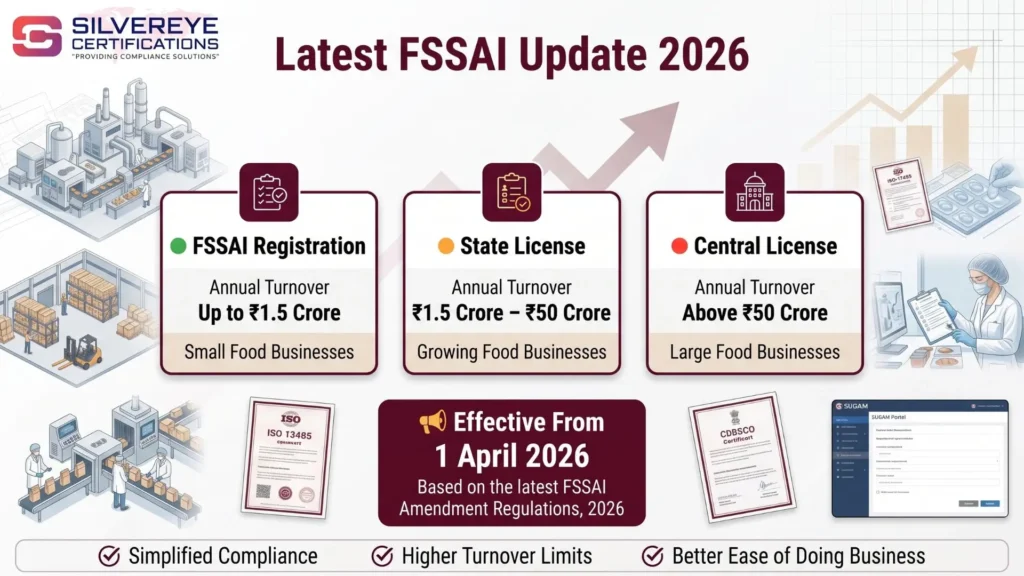
- New 2026 turnover slabs decide your license type: Registration up to ₹1.5 crore, State License ₹1.5 crore–₹50 crore, Central License above ₹50 crore, effective 1 April 2026.
- Manufacturing always needs a license (not just registration) once you cross Basic Registration turnover — and certain manufacturer categories need a Central License regardless of turnover, including nutraceutical/proprietary food makers and 100% export-oriented units.
- Every manufacturer must implement a documented Food Safety Management System (FSMS) and follow Schedule 4 Good Manufacturing Practices (GMP) and Good Hygiene Practices (GHP) as a condition of the license.
- Licenses granted after 1 April 2026 carry perpetual validity, subject to risk-based inspections — no more mandatory renewal every 1–5 years.
Introduction
An FSSAI license for food manufacturers is the mandatory food safety approval every factory, processing unit, or production facility needs before making packaged food in India. Since 1 April 2026, the category depends on annual turnover — Basic Registration up to ₹1.5 crore, State License up to ₹50 crore, or Central License above ₹50 crore — though certain manufacturing activities (health supplements, proprietary food, 100% export units) require a Central License regardless of turnover. Fees run from ₹100 to ₹7,500 a year, and every manufacturer must additionally follow Schedule 4 GMP/GHP hygiene standards and maintain a documented Food Safety Management System.
What Is an FSSAI License for Food Manufacturers?
An FSSAI license for food manufacturers is the approval issued by the Food Safety and Standards Authority of India to any business that produces, processes, packages, or repacks food for sale — from a small home-based bakery to a large multi-line processing plant. It confirms that the manufacturing premises, ingredients, hygiene practices, and finished products meet the safety and quality standards set under the Food Safety and Standards Act, 2006.
Manufacturing is treated more strictly than simple trading or retail, because a defect at the production stage can affect every unit that reaches consumers. That's why manufacturers face Schedule 4 GMP/GHP compliance, a documented FSMS, and premises inspection requirements that traders and retailers of pre-packaged goods don't always face.
Why Food Manufacturers Need This License
- Legal requirement: Manufacturing food without a valid FSSAI license can attract a penalty of up to ₹5 lakh and imprisonment of up to six months under Section 63 of the FSS Act.
- Supply chain access: Distributors, retail chains, and e-commerce platforms verify a manufacturer's FSSAI license number before agreeing to stock or list their products.
- Bank and investor confidence: Term loans, working capital finance, and investor due diligence for food manufacturing units routinely require a valid, category-appropriate FSSAI license.
- Export readiness: A Central License and Schedule 4 compliance record are typically the starting documents any export buyer or certification body will ask to see.
Latest FSSAI Update 2026: Revised Turnover Thresholds for Manufacturers
FSSAI issued Order No. RCD-01002/1/2021-Regulatory-FSSAI-Part(1) on 13 March 2026, implementing the Food Safety and Standards (Licensing and Registration of Food Businesses) Amendment Regulations, 2026 (notified via Gazette on 10 March 2026). This order revised the turnover-based categorization for every food business, including manufacturers, effective 1 April 2026, and it supersedes all earlier turnover-threshold orders.
| License Type | Old Turnover Limit (pre-2026) | New Turnover Limit (from 1 April 2026) |
| Basic Registration | Up to ₹12 lakh | Up to ₹1.5 crore |
| State License | ₹12 lakh – ₹20 crore | Above ₹1.5 crore up to ₹50 crore |
| Central License | Above ₹20 crore | Above ₹50 crore |
Two other changes from this order matter for manufacturers specifically:
- Perpetual validity: registrations and licenses granted under the amended regulations no longer expire after a fixed 1–5 year term — they remain valid on an ongoing basis, subject to risk-based inspections.
- Automatic category upgrade: if your turnover crosses the top of your current slab, FSSAI moves you to the next category automatically and free of cost, and you keep your existing 14-digit license number.
Important caveat for high-risk manufacturers: current guidance on the 2026 amendment confirms that manufacturers of dairy, meat, packaged drinking water, infant food, and fishery products must continue to comply fully with all applicable hygiene, testing, and food safety requirements regardless of the revised turnover thresholds — a higher registration ceiling does not mean lighter compliance for these categories.
Also worth tracking: FSSAI has separately floated a draft amendment (still at consultation stage as of early 2026) proposing that manufacturers maintain daily production and raw-material-utilisation records, and follow FIFO/FEFO stock rotation principles under Schedule 4. Since this was a draft under review, confirm its final status on FoSCoS before treating it as a settled requirement.
Types of FSSAI License for Food Manufacturing Units
1. Basic Registration (Turnover up to ₹1.5 crore)
Suited to petty manufacturers — home-based food producers, small bakeries, cottage-industry units, and micro food processors. Fee: ₹100 per year. Processing time: typically 7–10 working days.
2. State License (Turnover above ₹1.5 crore up to ₹50 crore)
Applicable to mid-sized manufacturing units and processing plants operating within one state. Fee: ₹2,000–₹5,000 per year depending on scale. Processing time: 30–60 working days, including a premises inspection focused on Schedule 4 GMP/GHP compliance.
3. Central License (Turnover above ₹50 crore, or activity-based triggers)
Mandatory for large, multi-state, or export-oriented manufacturers, and for certain manufacturing activities irrespective of turnover. As per the FoSCoS Kind of Business (KoB) Eligibility Matrix, this includes:
- Health supplement, nutraceutical, and Food for Special Dietary Use (FSDU) manufacturers
- Proprietary food manufacturers and manufacturers of non-specified food/food ingredients
- 100% Export-Oriented Units (EOUs) and exporter-manufacturers
- Ayurveda Aahara product manufacturers
- Radiation processing facilities
- Manufacturers supplying to Central Government institutions or agencies
Fee: ₹7,500 per year. Processing time: 60–90 working days, given the more detailed inspection expected at this level.

Eligibility and Manufacturing-Specific Compliance
- Documented Food Safety Management System (FSMS): Every manufacturer must maintain an FSMS based on Hazard Analysis and Critical Control Points (HACCP) principles, scaled to the complexity of the operation.
- Schedule 4 GMP/GHP compliance: Covers premises maintenance, equipment sanitation, food handler hygiene and health checks, pest control, and — for Central License holders — more advanced sanitation protocols and regular third-party audits.
- Layout and machinery adequacy: The manufacturing layout must support hygienic production flow, with separate zones for raw material storage, processing, packaging, and finished-goods storage where applicable.
- Water and raw material quality: Manufacturers using significant process water need an NABL-accredited water test report; ingredient sourcing must be traceable and compliant with applicable food safety standards.
- Recall readiness: Manufacturers must have a documented recall plan and a nominated responsible person able to act on it if a safety issue is identified post-sale.
Documents Required for FSSAI Manufacturing License
Common documents (all categories)
- Photograph and photo ID proof of the Food Business Operator (Aadhaar, PAN, Voter ID, Passport, or Driving License)
- Address proof of the manufacturing premises (electricity bill, rent agreement, or property tax receipt)
- List of food products to be manufactured, with category classification
- Bank account details (cancelled cheque or passbook copy)
Additional documents for State License
- Business constitution certificate — GST registration, Shop & Establishment certificate, Udyam Registration, or Certificate of Incorporation
- Layout plan of the manufacturing unit, drawn to scale, with machinery list
- Food Safety Management System (FSMS) plan
- Water testing report from an NABL-accredited laboratory, where applicable
- Partnership deed / MOA & AOA, and a board resolution authorizing the signatory (for companies)
Additional documents for Central License
- Turnover proof — audited financial statements or a CA certificate
- Form IX — nomination of the authorised person by the company
- Food recall plan (standard operating procedure for withdrawing unsafe stock)
- Import Export Code (IEC), where the manufacturer also imports raw materials or exports finished goods
- Geo-tagged photographs of the manufacturing facility (2026 portal requirement)

Step-by-Step FSSAI Application Process for a Manufacturing Unit
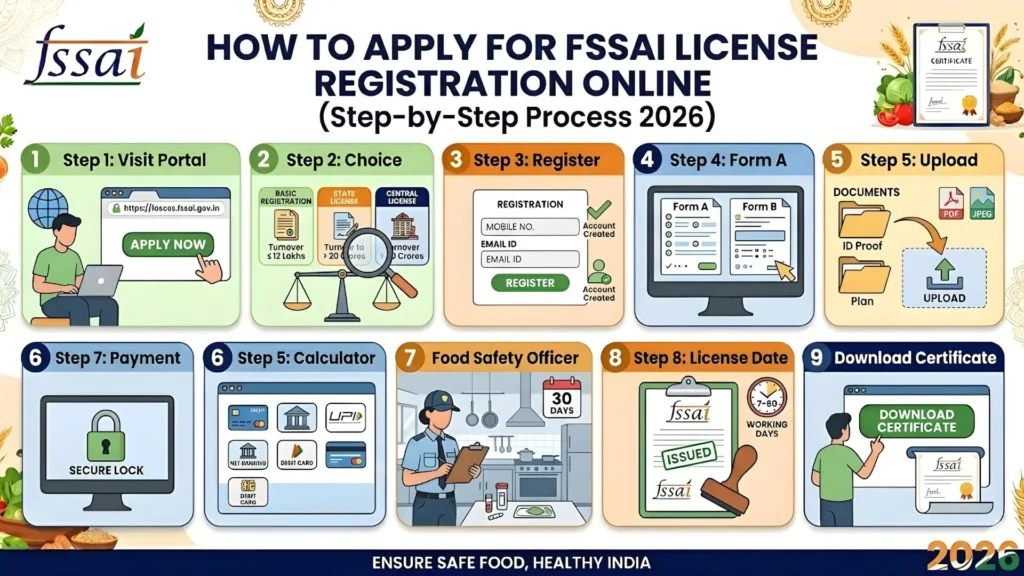
- Register on the FoSCoS portal using your business email and mobile number.
- Select the correct Kind of Business (KoB) — 'Manufacturer' along with the specific product category (dairy, bakery, confectionery, beverages, etc.).
- The portal auto-suggests your license category (Basic, State, or Central) based on turnover and KoB — verify this against the 2026 threshold table and the activity-based Central License triggers above.
- Fill Form A (Basic Registration) or Form B (State/Central License) with business, premises, machinery, and product details.
- Upload the required documents — FSMS plan, layout plan, water test report, and any category-specific approvals.
- Pay the government fee online — you can pay for up to 5 years upfront if applying before the perpetual-validity provisions apply to your category.
- For State/Central applications, a Food Safety Officer inspects the premises for Schedule 4 GMP/GHP compliance before approval.
- On approval, download your FSSAI Registration Certificate (Basic) or License Certificate (State/Central), display it at the premises, and print the 14-digit number on all product packaging.
FSSAI License Fee Chart for Manufacturers
| License Category | Government Fee (per year) | Typical Validity |
| Basic Registration | ₹100 | Perpetual (post-1 April 2026); earlier registrations run 1–5 years as chosen |
| State License | ₹2,000 – ₹5,000 (scale-dependent) | Perpetual (post-1 April 2026); earlier licenses run 1–5 years as chosen |
| Central License | ₹7,500 | Perpetual (post-1 April 2026); earlier licenses run 1–5 years as chosen |
Note: For licenses issued before the perpetual-validity rule applied to your category, fee is calculated as annual fee × number of years chosen (1 to 5), payable upfront in a single instalment on the FoSCoS portal. These figures are government fees only; consultancy charges, if you use an agent, are billed separately.
Schedule 4 GMP and GHP: What Manufacturers Must Actually Implement
Schedule 4 of the FSS (Licensing and Registration of Food Businesses) Regulations, 2011 is the core hygiene and manufacturing-practice standard every license holder signs up to as a condition of their license. It's organised in parts, with the requirements scaling up as the license category rises:
| Schedule 4 Focus Area | What It Requires of Manufacturers |
| Premises and equipment | Clean, well-maintained facility; equipment suitable for food-contact use and properly sanitised on a routine schedule |
| Food handler hygiene | Medical examination of food handlers, health certificates on file, personal hygiene and handwashing protocols |
| Pest control | Contracted pest control by a licensed operator, with documented service records |
| Temperature and storage control | Cold storage temperature monitoring and logging, proper raw material and finished goods storage |
| FSMS and HACCP | Documented Food Safety Management System with hazard analysis and critical control points appropriate to the product and process |
| Recall and incident readiness | A documented recall plan, a nominated responsible person, and a process for reporting and correcting safety incidents |
FSSAI License Renewal and Ongoing Compliance for Manufacturers
- Renewal window: for licenses still on a fixed term, file for renewal 30 days before expiry at the latest; an express renewal window may open up to 180 days before expiry.
- Late fee: ₹100 per day applies if renewal is filed after the 30-day-before-expiry deadline but before the license lapses.
- Annual Return (Form D-1): State/Central license holders must file this by 31 May every year.
- Half-yearly Return (Form D-2): mandatory specifically for milk and milk product manufacturers, for the periods April–September and October–March.
- Ongoing inspections: manufacturers, especially Central License holders and high-risk categories, should expect periodic risk-based inspections and, in some cases, mandatory third-party audits even after perpetual validity is granted.
- Display and labelling: the FSSAI certificate must be displayed at the manufacturing premises, and the 14-digit number must appear on every product package.
Penalties for Manufacturing Food Without a Valid FSSAI License
Manufacturing food without a valid FSSAI registration or license is a punishable offence under the FSS Act, 2006 — penalties can go up to ₹5 lakh along with imprisonment of up to six months, in addition to the risk of a factory shutdown order from the local food safety authority. Non-compliance with Schedule 4 GMP/GHP conditions, even where a license is otherwise valid, can also lead to suspension or cancellation of the license.
Frequently Asked Questions
Is FSSAI license mandatory for all food manufacturers in India?
Yes. Every entity that manufactures, processes, packages, or repacks food — from a small home kitchen business to a large factory — must hold either FSSAI Basic Registration or a State/Central License, based on turnover and activity.
What is the new FSSAI turnover limit for manufacturers in 2026?
From 1 April 2026: Basic Registration up to ₹1.5 crore turnover, State License between ₹1.5 crore and ₹50 crore, and Central License above ₹50 crore, as per FSSAI Order dated 13 March 2026.
Do all manufacturers need a Central License regardless of turnover?
No, only specific categories — including health supplement/nutraceutical manufacturers, proprietary food manufacturers, 100% export-oriented units, and a few other activity-based categories on the FoSCoS Kind of Business matrix. Most manufacturers are categorised purely by turnover.
How much does an FSSAI manufacturing license cost?
Government fees range from ₹100 per year for Basic Registration to ₹2,000–₹5,000 per year for a State License and ₹7,500 per year for a Central License.
What is Schedule 4 and why does it matter for manufacturers?
Schedule 4 of the FSS (Licensing and Registration of Food Businesses) Regulations, 2011 sets the Good Manufacturing Practices (GMP) and Good Hygiene Practices (GHP) every license holder must follow, covering premises, equipment, food handler hygiene, and pest control, as a binding condition of the license
How long does it take to get an FSSAI license for a manufacturing unit?
Basic Registration typically takes 7–10 working days. State Licenses usually take 30–60 working days, and Central Licenses 60–90 working days, since both involve a Schedule 4-focused premises inspection.
Is the FSSAI license now valid for a lifetime?
Licenses and registrations granted under the 2026 amended regulations carry perpetual validity, subject to periodic risk-based inspections — they no longer need renewal every 1–5 years.
What documents are required for an FSSAI manufacturing license?
At minimum: photo ID, address proof, product list, and bank details. State and Central applications additionally need a layout plan, machinery list, FSMS plan, water testing report, and — for Central — turnover proof and a food recall plan.
Do manufacturers need to file an FSMS plan even for Basic Registration?
Schedule 4 compliance and a documented FSMS are formal conditions primarily emphasised at the State and Central License stage, but even Basic Registration holders are expected to follow basic hygiene and safety practices under the regulations.
What happens if a manufacturer doesn't renew their FSSAI license on time?
A late fee of ₹100 per day applies if filed after the 30-day-before-expiry window. If the license lapses completely, the business may have to apply afresh and could face penalties for manufacturing without a valid license in the interim.