
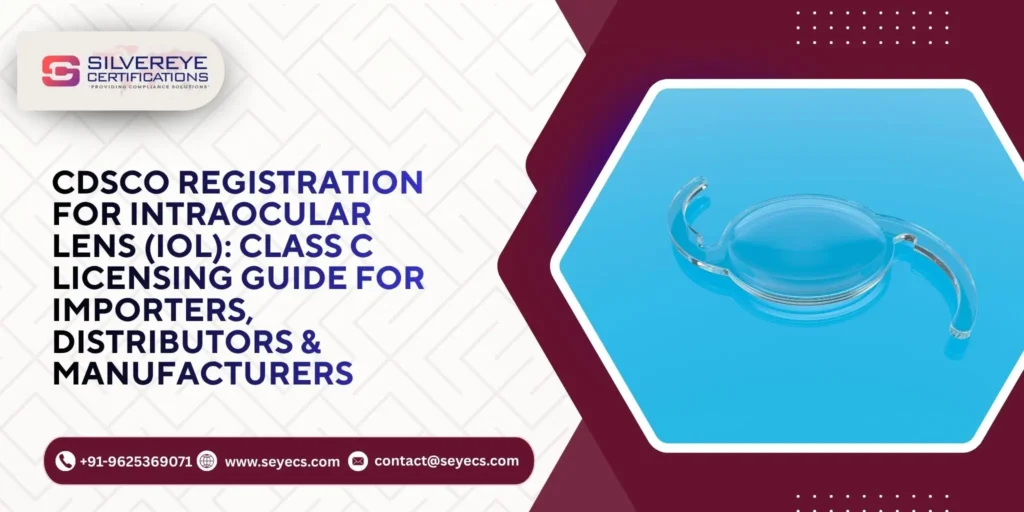
- CDSCO Registration For Intraocular Lens is a Class C implantable device — it needs a Central Licensing Authority approval, not a self-certification, before it can be sold, imported, or manufactured in India.
- Three separate license tracks exist depending on your role: MD-14/MD-15 (importer), MD-41/MD-42 (wholesaler/distributor), and MD-7/MD-9 (Class C manufacturer).
- Every application is filed online on CDSCO's SUGAM portal, and most licenses (MD-9, MD-15) stay valid indefinitely once granted, subject to a retention fee every 5 years; MD-42 must be renewed every 5 years.
- Missing documentation — Free Sale Certificate, ISO 13485, Device Master File, or a valid Power of Attorney — is the single biggest reason IOL applications get delayed or queried.
What Is CDSCO Registration for Intraocular Lens?
CDSCO registration for Intraocular Lens is the regulatory clearance issued by the Central Drugs Standard Control Organization (CDSCO), India's national medical device regulator under the Ministry of Health and Family Welfare, before an IOL can legally be imported, distributed, or manufactured in India. Because an intraocular lens is implanted directly inside the eye during cataract or refractive surgery, it carries a higher clinical risk than everyday supplies, which is why CDSCO places it in Class C under the Medical Device Rules, 2017 rather than in the lower-risk Class A or B categories.
In practical terms, this means an intraocular lens cannot move through India's supply chain — from a foreign factory, to an Indian warehouse, to a hospital operation theatre — without three separate compliance checkpoints: an import license for the entity bringing the lens into India, a wholesale registration for the entity storing and distributing it, and a manufacturing license for any entity producing it domestically.
Why Intraocular Lens Falls Under Class C
CDSCO's four-tier classification system (Class A, B, C, D) grades devices by the level of harm they could cause if something goes wrong. Class C covers moderate-to-high-risk devices, which typically includes implants and devices that stay inside the body or are used for extended, invasive procedures — anaesthesia machines and high-frequency ventilators are grouped in the same risk tier.
An intraocular lens sits in this bracket because it is a permanent ocular implant: manufacturing defects, biocompatibility issues, or contamination can directly affect a patient's vision, so CDSCO requires the same rigour applied to other Class C implantable devices — Central Licensing Authority review, GMP/ISO 13485 compliance, and site inspection — rather than the lighter self-certification route available for Class A devices.
Who Needs CDSCO Registration for Intraocular Lens?
Not every business in the IOL supply chain files the same form. CDSCO structures the requirement around your role:
- Importers — any company bringing IOLs manufactured outside India into the Indian market for commercial sale, through an Indian Authorized Agent.
- Wholesalers / Distributors — stockists, distributors, and traders who store and supply IOLs to hospitals, eye-care chains, and retailers within India.
- Manufacturers — Indian companies producing Class C IOLs domestically for sale or distribution within India.
A single company can hold more than one license at the same time — for example, an Indian distributor that also acts as the Authorized Agent for a foreign IOL brand typically holds both an MD-42 wholesale license and applies for the MD-15 import license on the foreign manufacturer's behalf.
For Importers: MD-14 Application and MD-15 Grant of Import Licence
Foreign IOL manufacturers cannot approach CDSCO directly. They must appoint an Indian Authorized Agent — an Indian entity that already holds a valid wholesale license (Form MD-42) or a manufacturing license (Form MD-5/MD-9) — to file the import application on their behalf through the SUGAM portal.
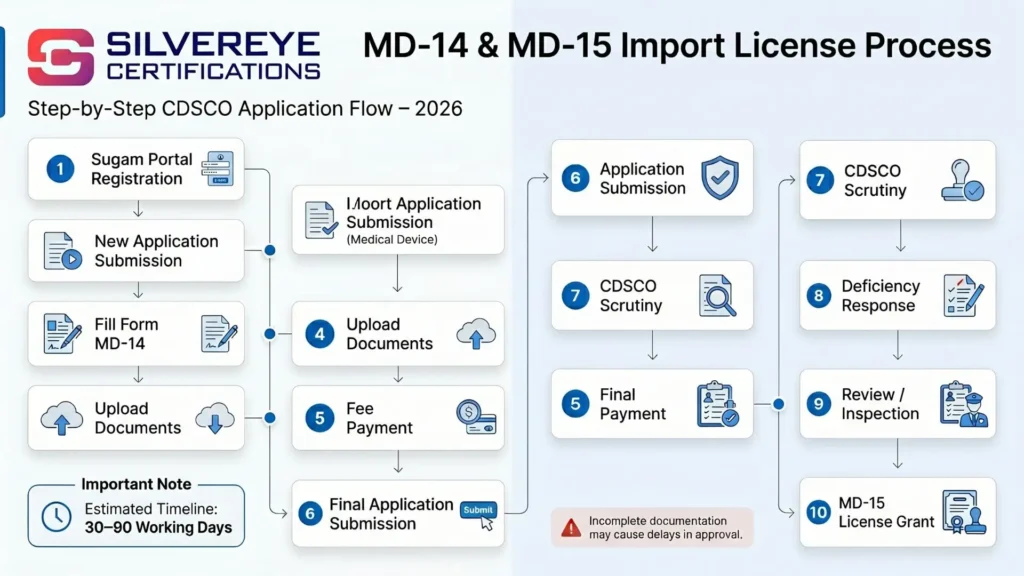
Form MD-14 is the application for permission to import the intraocular lens into India. Once CDSCO reviews and approves it, the import license itself is granted on Form MD-15, which is the legal document that allows the Authorized Agent to import, stock, and sell the IOL under the manufacturer's brand name in India.
Who Can Apply for MD-15
- An Indian Authorized Agent appointed by the overseas IOL manufacturer through a notarized and apostilled Power of Attorney.
- The agent must independently hold a valid MD-42 wholesale registration or an MD-5/MD-9 manufacturing license before it can apply for MD-15.
- A hospital, research institute, or import house bringing in IOLs strictly for clinical investigation instead follows the MD-16/MD-17 test-licence route, not MD-14/MD-15.
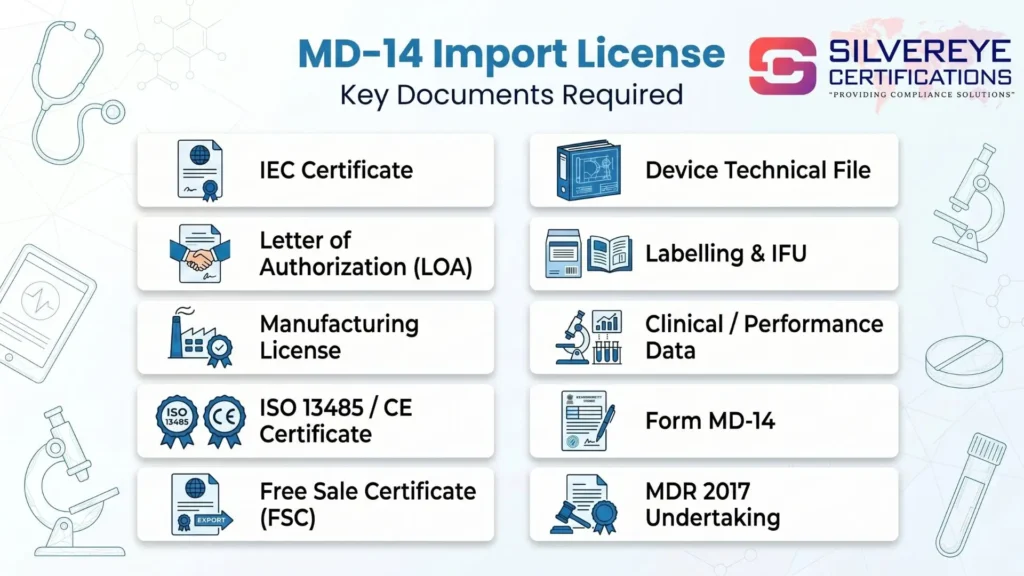
Documents Required for MD-14 / MD-15 (Importer)
| Document | Purpose |
| Form MD-14 application + covering letter | Formal request for import permission |
| Power of Attorney (notarised/apostilled) | Authorises the Indian agent to act for the foreign manufacturer |
| Copy of Authorised Agent's MD-42 / MD-9 licence | Proves the agent is legally allowed to distribute in India |
| Free Sale Certificate (FSC) | Confirms the IOL is freely marketed in its country of origin |
| ISO 13485 Certificate | Confirms the manufacturer's quality management system |
| Device Master File (DMF) | Full technical file — design, materials, biocompatibility, sterilization |
| Plant Master File (PMF) | Details of the overseas manufacturing site |
| CE certificate / other regulatory approval (if any) | Supports risk classification and prior market approval |
| Performance evaluation & test reports | Demonstrates the IOL meets essential safety and performance principles |
| Fee challan (Bharatkosh / treasury) | Proof of government fee payment |
MD-15 Import License Fee for a Class C Device
Government fees for the import license follow the Second Schedule of the Medical Device Rules, 2017 and are charged per manufacturing site plus per distinct device. For Class C devices such as IOLs, applicants commonly budget around USD 3,000 per overseas manufacturing site and roughly USD 1,000–1,500 for each distinct IOL model or power range being registered. Because fee notifications are periodically revised, always confirm the current amount on the CDSCO SUGAM/Bharatkosh portal before filing.
MD-15 Process, Timeline & Validity
- Step 1 — Register the Indian Authorized Agent on the CDSCO SUGAM portal.
- Step 2 — Compile the Device Master File, Plant Master File, FSC, ISO 13485 certificate and other technical documents.
- Step 3 — File Form MD-14 online with the fee challan and Power of Attorney.
- Step 4 — Respond to any CDSCO deficiency queries raised during document scrutiny.
- Step 5 — Receive the import licence on Form MD-15 once CDSCO is satisfied.
The full cycle typically takes 3 to 6 months depending on how quickly queries are resolved. Once granted, the MD-15 license remains valid indefinitely, provided the license-holder pays the prescribed retention fee before every 5-year anniversary of issue; missing the retention deadline attracts a late fee and can eventually lead to suspension.
For Wholesalers / Distributors: MD-41 Application and MD-42 Grant of Registration
Form MD-41 is the application that a retailer, wholesaler, stockist, or distributor of intraocular lenses files with the State Licensing Authority (SLA) to obtain the Form MD-42 Medical Device Registration Certificate. Unlike the import and manufacturing licences, MD-42 is state-specific and issued by the SLA rather than the Central Licensing Authority — a distributor with warehouses in two states needs an MD-42 for each location.
Eligibility for MD-42
- A registered business entity (proprietorship, partnership, or company) with a commercial premises for storing IOLs.
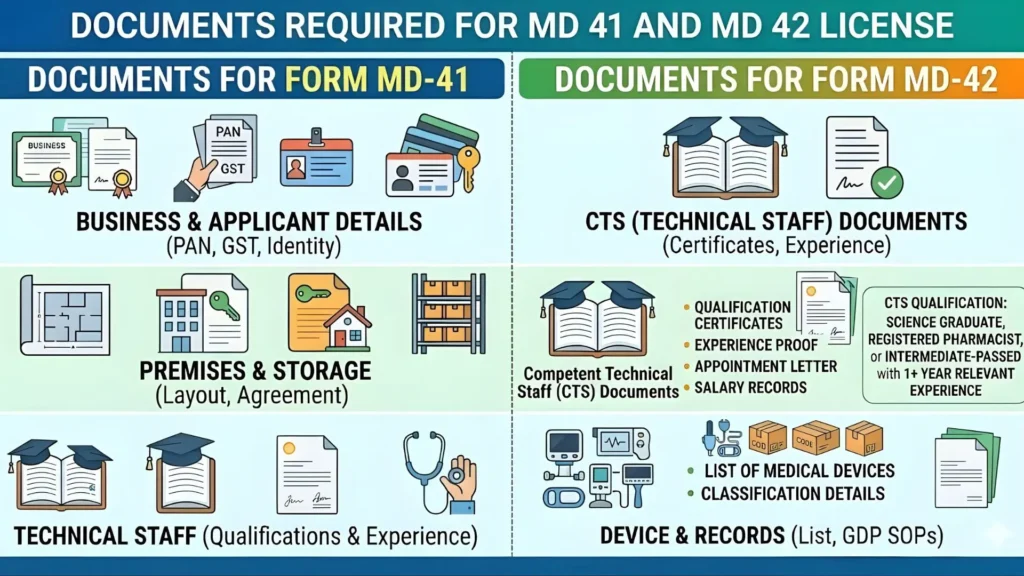
- A Competent Technical Staff member — a registered pharmacist, a science/pharmacy graduate, or someone with equivalent experience in medical device sale — must supervise the storage and sale activity.
- Premises must meet CDSCO's storage conditions: adequate space, temperature and lighting control, and pest-free, segregated storage suitable for ophthalmic implants.
Documents Required for MD-41 / MD-42 (Wholesaler / Distributor)
| Document | Purpose |
| Form MD-41 application | Formal request for the registration certificate |
| Identity proof (Aadhaar / PAN) of applicant | Establishes the applicant's identity |
| Proof of premises (ownership deed / rent agreement) | Confirms the storage location |
| Premises layout plan and photographs | Shows storage arrangement for CDSCO/SLA review |
| Technical staff qualification certificates | Confirms Competent Technical Staff eligibility |
| Self-certification of Good Distribution Practice | Declares compliance with storage/distribution norms |
| Fee challan (Rs. 3,000) | Proof of government fee payment |
MD-42 Fee, Process & Validity
The government fee for MD-42 is Rs. 3,000 per premises, paid online through the SUGAM portal at the time of filing Form MD-41. After submission, a Drug Inspector from the SLA typically inspects the storage premises to verify compliance before the certificate is granted. The process usually takes 30 to 90 days depending on the state and how quickly the inspection is scheduled.
An MD-42 registration certificate is valid for 5 years from the date of issue and must be renewed before expiry — ideally 45 days in advance — to avoid a penalty or a gap in your legal authority to sell IOLs.
For Manufacturers (Class C IOL): MD-7 Application and MD-9 Grant of License
Form MD-7 is the application filed by a domestic manufacturer to obtain a manufacturing license for a Class C intraocular lens. Approval is granted on Form MD-9 by the Central Licensing Authority — unlike Class A/B devices (Form MD-3/MD-5), Class C and Class D manufacturing licenses are audited centrally by CDSCO, not the state authority, because of the higher risk profile of implants like IOLs.
Eligibility for MD-9 (Class C Manufacturer)
- Manufacturing site must comply with the Quality Management System requirements of ISO 13485 (or ICMED 13485) and the Fifth Schedule of the Medical Device Rules, 2017.
- Technical/production staff need a diploma or degree in engineering, pharmacy, or a related science, with a minimum of 4 years' relevant manufacturing experience.
- Testing staff need a degree or diploma in engineering, pharmacy, or science, with at least 2 years' testing experience.
- A Plant Master File and Device Master File covering the IOL's materials, design, sterilisation, and performance testing must be ready before filing.
Documents Required for MD-7 / MD-9 (Manufacturer)
| Document | Purpose |
| Form MD-7 application + covering letter | Formal request for the manufacturing licence |
| Fee challan | Proof of government fee payment |
| Firm constitution documents | Establishes legal structure of the applicant |
| Site ownership / tenancy agreement | Confirms the manufacturing premises |
| Plant Master File (Appendix I, Fourth Schedule) | Facility, personnel, layout, equipment, sanitation details |
| Device Master File for the IOL | Design, materials, biocompatibility, sterilisation, labelling |
| ISO 13485 / QMS compliance evidence | Confirms quality system readiness for inspection |
| Personnel qualification & experience records | Confirms technical and testing staff eligibility |
MD-9 Fee, Inspection Timeline & Validity
The government fee for an MD-9 manufacturing license is Rs. 50,000 for the manufacturing site plus Rs. 1,000 for each distinct IOL model or product registered under it. After Form MD-7 is submitted, CDSCO conducts a site inspection — for Class C and D devices this is carried out by Medical Device Officers, usually within 60 days of the application, provided the submitted data is in order. The license is generally granted within about 45 days of a satisfactory inspection, making the overall cycle roughly 2 to 4 months.
Once granted, an MD-9 manufacturing license remains valid on an ongoing basis, subject to payment of the prescribed retention fee every 5 years; it is not transferable to another entity, and any change of manufacturing location must go through CDSCO's post-approval change process rather than a fresh application.
Importer vs Wholesaler vs Manufacturer: Quick Comparison
| Role | Application Form | Licence / Certificate | Issuing Authority | Typical Fee | Validity |
| Importer | MD-14 | MD-15 | Central Licensing Authority (CDSCO) | ~USD 3,000/site + ~USD 1,000-1,500/device | Indefinite; retention fee every 5 years |
| Wholesaler / Distributor | MD-41 | MD-42 | State Licensing Authority (SLA) | Rs. 3,000 per premises | 5 years; must be renewed |
| Manufacturer (Class C) | MD-7 | MD-9 | Central Licensing Authority (CDSCO) | Rs. 50,000/site + Rs. 1,000/product | Indefinite; retention fee every 5 years |
CDSCO Registration Process for IOL, Step by Step
- Confirm the device classification. IOL is Class C, so the higher-scrutiny, centrally-audited pathway applies regardless of whether you're importing, distributing, or manufacturing.
- Register on the CDSCO SUGAM portal (sugam.cdsco.gov.in) — this is the single online window for all applications, fee payment, and query responses.
- Assemble your document set — Device Master File, Plant Master File, ISO 13485/GMP evidence, Free Sale Certificate (for imports), and premises documents (for wholesale).
- Pay the prescribed government fee through the designated treasury/Bharatkosh challan and attach the payment proof to the application.
- Submit the relevant form — MD-14, MD-41, or MD-7 — with all supporting documents through SUGAM.
- Undergo scrutiny and, where applicable, a site inspection by CDSCO or the SLA's Drug Inspector.
- Resolve any deficiency queries promptly — slow or incomplete query responses are the most common cause of delay.
- Receive the licence — MD-15, MD-42, or MD-9 — and diarise the retention/renewal date so the licence never lapses.
Timeline at a Glance
| Licence | Typical Processing Time |
| MD-15 (Import) | 3 to 6 months |
| MD-42 (Wholesale/Distribution) | 30 to 90 days |
| MD-9 (Manufacturing, Class C) | 2 to 4 months (includes a site inspection, generally within 60 days of filing) |
Benefits of Completing CDSCO Registration for Your IOL Business
- Legal market access — Without the applicable license, importing, stocking, or manufacturing IOLs in India is prohibited under the Drugs and Cosmetics Act and the Medical Device Rules, 2017.
- Hospital and tender eligibility — Most hospitals, eye-care chains, and government procurement tenders require proof of a valid CDSCO license before they will list or purchase an IOL brand.
- Patient safety assurance — The review and inspection process filters out substandard implants before they reach the operation theatre.
- Business credibility — A valid MD-9, MD-15, or MD-42 signals regulatory maturity to distributors, investors, and hospital procurement teams.
- Avoids penalties — Operating without registration can lead to product seizure, monetary penalties, and prosecution under the Act.
Common Mistakes That Delay IOL Registration
- Filing under the wrong form — for example, using the Class A/B pathway (MD-3/MD-5) instead of the Class C pathway (MD-7/MD-9) for a domestically manufactured IOL.
- Submitting a Power of Attorney that isn't properly notarized or apostilled in the manufacturer's country of origin.
- An incomplete Device Master File that skips biocompatibility, sterilization validation, or performance test data specific to the IOL.
- Appointing an Indian Authorized Agent who doesn't already hold a valid MD-42 or manufacturing licence, which stalls the MD-14 filing before it can even begin.
- Letting the 5-year retention fee or MD-42 renewal date lapse, which can suspend an otherwise valid licence.
Conclusion
Because an intraocular lens is a permanent implant, CDSCO treats it with the same regulatory seriousness as other Class C devices — which means there's no shortcut around the MD-14/MD-15, MD-41/MD-42, or MD-7/MD-9 pathways depending on your role in the supply chain. Getting the classification, documentation, and Indian Authorized Agent arrangement right the first time is what separates a 3-month approval from a 9-month one. If you're planning an IOL launch in India, start by identifying exactly which of the three pathways applies to your business, then work backwards from CDSCO's document checklist.
Frequently Asked Questions
Is CDSCO registration mandatory for intraocular lenses sold in India?
Yes. IOLs are notified Class C medical devices under the Medical Device Rules, 2017, so every importer, wholesaler/distributor, and manufacturer must hold the applicable CDSCO licence before the product can legally be sold or supplied in India.
Why is an intraocular lens classified as Class C and not Class B?
Classification depends on invasiveness and risk. An IOL is a permanent implant placed inside the eye, which places it in the moderate-to-high-risk Class C tier alongside other implantable and invasive devices, rather than the lower-risk Class B tier used for non-implantable diagnostic or monitoring equipment.
What is the difference between Form MD-14 and Form MD-15?
Form MD-14 is the application an Indian Authorized Agent files to request permission to import the IOL. Form MD-15 is the actual import license CDSCO issues once that application is approved — MD-14 is the request, MD-15 is the result.
Can a foreign IOL manufacturer apply for MD-15 directly?
No. A foreign manufacturer cannot approach CDSCO directly. It must appoint an Indian Authorized Agent, who already holds a valid MD-42 wholesale license or an MD-5/MD-9 manufacturing license, to file Form MD-14 on its behalf.
What is the difference between MD-41 and MD-42?
Form MD-41 is the application a wholesaler, distributor, or stockist submits to the State Licensing Authority. Form MD-42 is the registration certificate issued once that application is approved — think of MD-41 as the form you file and MD-42 as the certificate you receive
How much does CDSCO import registration cost for a Class C IOL?
Budget roughly USD 3,000 per overseas manufacturing site plus around USD 1,000–1,500 per distinct IOL model, based on the Second Schedule fee structure for Class C devices. Fee notifications are revised periodically, so confirm the exact current amount on the CDSCO SUGAM portal before you file.
Does a Class C IOL manufacturer need ISO 13485 certification?
Yes. CDSCO requires the manufacturing site to comply with a Quality Management System equivalent to ISO 13485 (or ICMED 13485) as part of the MD-9 license application, and this is verified during the mandatory site inspection.
How long is a CDSCO license for intraocular lens valid?
MD-9 (manufacturing) and MD-15 (import) licenses remain valid indefinitely once granted, provided the prescribed retention fee is paid before every 5-year anniversary. MD-42 (wholesale/distribution registration) is valid for 5 years and must be renewed before it lapses.
Can one company hold the importer, wholesaler, and manufacturer licenses at the same time?
Yes. It's common for an Indian company to hold an MD-42 wholesale registration while also acting as the Indian Authorized Agent that files for an MD-15 import license on behalf of a foreign IOL brand, or to hold an MD-9 manufacturing license alongside its own distribution registration.
What happens if I sell or import IOLs in India without a valid CDSCO license?
Operating without the applicable license is a violation of the Drugs and Cosmetics Act and the Medical Device Rules, 2017. Consequences can include seizure of stock at customs or in the market, monetary penalties, and legal action against the business and its Indian agent.
Where is the CDSCO application for IOL filed?
All three pathways — MD-14, MD-41, and MD-7 — are filed online through CDSCO's SUGAM portal (sugam.cdsco.gov.in), with wholesale/distribution applications routed to the relevant State Licensing Authority and import/manufacturing applications routed to the Central Licensing Authority.