
- Every Korean cosmetic imported into India must display mandatory label elements in English — including INCI ingredient list, MRP, importer name, batch number, and expiry date.
- CDSCO regulates cosmetic imports under the Drugs & Cosmetics Act 1940 via Form COS-2 (Import License) — no license means no legal sale in India.
- The Legal Metrology (Packaged Commodities) Rules 2011 governs MRP, net quantity, and language requirements on every K-beauty product sold in India.
- Non-compliance can attract product seizure, fines up to ₹1 lakh, and cancellation of your import or manufacturing license under Indian law.
Korean cosmetics Cosmetics Labelling Requirements for India (K-beauty) selling must be carry labels approved under the Drugs & Cosmetics Act 1940, CDSCO guidelines, and Legal Metrology (Packaged Commodities) Rules 2011. Mandatory elements include: product name, INCI ingredient list (in descending order), net quantity, MRP (incl. all taxes), manufacturing/expiry date, batch number, country of origin, importer's name and Indian address, and a customer care number. Labels must be printed in English.
Importers need a valid COS-2 license from CDSCO before the first shipment arrives. Non-compliance attracts penalties ranging from product seizure to ₹1 lakh in fines
Why Korean Cosmetics Need Special Compliance Attention in India
India is the fastest-growing market for Korean beauty products. In 2025, K-beauty exports to India crossed $120 million, with skincare and sheet masks dominating. But this growth comes with a strict regulatory backdrop that many Korean brands and Indian distributors underestimate.
India treats cosmetics as a regulated category under the Drugs & Cosmetics Act 1940. Unlike fast-moving consumer goods, a cosmetic product cannot legally be imported, stored, sold, or stocked without a valid CDSCO import license (COS-2). On top of that, packaging and labeling must comply with the Legal Metrology (Packaged Commodities) Rules 2011, which governs price, weight, and consumer information disclosures.
This dual-regulatory requirement — one from the health ministry (CDSCO) and one from the consumer affairs ministry (Legal Metrology) — is what makes Indian cosmetics compliance uniquely complex for Korean exporters.
Governing Laws & Regulatory Authorities
| Regulatory Body | Governing Law | What It Controls |
| CDSCO (Central Drugs Standard Control Organisation) | Drugs & Cosmetics Act, 1940 & Rules 1945 | Import/manufacturing licenses, product registration, safety standards |
| Legal Metrology Department | Legal Metrology Act 2009 & PC Rules 2011 | MRP, net quantity, language, label declarations |
| BIS (Bureau of Indian Standards) | BIS Act 2016 | Voluntary/mandatory quality standards for some cosmetic categories |
| FSSAI | Food Safety & Standards Act 2006 | Only applies if the cosmetic contains food-grade claims (limited scope) |
| Customs (CBIC) | Customs Act 1962 | Port-level verification of import licenses before clearance |
Mandatory Korean Cosmetics Labeling Requirements for India
Under Rule 145 of the Drugs & Cosmetics Rules 1945, read with Legal Metrology (Packaged Commodities) Rules 2011, every cosmetic product sold in India — whether imported or locally manufactured — must display the following elements on its label.
Product Name
- The name must accurately describe the product (e.g., 'Snail Mucin Moisturiser', 'Hyaluronic Acid Serum').
- The generic or common name should be in English.
- Korean script (Hangul) may appear alongside but cannot replace the English name.
INCI Ingredient List
This is one of the most important and frequently violated requirements. INCI stands for International Nomenclature of Cosmetic Ingredients — a globally standardised naming system.
- All ingredients must be listed in descending order of concentration.
- Ingredients present at less than 1% may be listed in any order after those above 1%.
- INCI names must be used — not trade names, not Korean names, not chemical symbols.
- Colour additives (e.g., CI 77491 for iron oxide red) should be listed at the end.
- The heading 'Ingredients:' must appear before the list.
Example of a compliant INCI listing:
Ingredients: Water (Aqua), Niacinamide, Glycerin, Butylene Glycol, Panthenol, Adenosine, Hyaluronic Acid, Centella Asiatica Extract, Phenoxyethanol, Ethylhexylglycerin.
Net Quantity
- Must be declared in metric units — ml for liquids, g for solids, and a combination for dual-phase products.
- Net quantity must appear on the principal display panel (PDP).
- Font size requirements: The numeral height must be at least 2mm for packages under 50ml/50g.
MRP (Maximum Retail Price)
- MRP must include all taxes — GST, customs duty, cess, etc.
- It must be declared as 'MRP Rs. _____ (Incl. of all taxes)'.
- MRP stickers must be tamper-evident and must not cover original product information.
- The price must appear on the label or sticker in a location visible at point of purchase.
- Printing MRP on a peel-off sticker is allowed but the sticker must be non-removable.
Importer Name, Address & Contact
- The name and complete Indian address of the licensed importer must appear on the label.
- A customer care number or email address is mandatory since 2023 under updated PC Rules.
- The importer's CDSCO license number (COS-2) does not need to appear on the label, but the importer's identity must be verifiable.
- If the Korean brand has a subsidiary in India, that entity's details must appear.
Country of Origin
- Must state 'Made in Republic of Korea' or 'Country of Origin: Korea'.
- This is mandatory under both Legal Metrology PC Rules and Customs (Import of Goods at Concessional Rate) Rules.
Manufacturing Date / Expiry Date / Best Before
- Date of manufacture ('Mfg. Date' or 'Mfd.') must be stated as Month-Year (e.g., Mfd. 03/2025).
- Expiry date or 'Use Before' date must be visible and must be displayed as Exp. MM/YYYY.
- If the shelf life is more than 30 months, a 'Period After Opening' (PAO) symbol is acceptable in place of expiry — a jar icon with the number of months (e.g., 12M).
- PAO symbol alone is not sufficient if shelf life is under 30 months.
Batch Number / Lot Number
- A batch/lot number must be declared as 'Batch No.' or 'Lot No.' followed by the code.
- This is critical for traceability and recall management.
Warnings & Precautions
- Any safety warnings required by the product category (e.g., 'Keep away from eyes' for hair dyes, 'Do not use on broken skin' for exfoliants).
- Products containing certain restricted substances (e.g., hydroquinone, retinol above threshold) must carry specific warnings as per CDSCO Schedule M-II.
Cruelty-Free Declarations
India banned animal testing for cosmetics in 2014, both for finished products and ingredients. However, labeling claims require caution:
- 'Cruelty-Free' or 'Not Tested on Animals' claims are permissible in India but must be truthful.
- CDSCO does not issue an official cruelty-free certification. Claims are brand-led and must be supported by documentation.
- Leaping Bunny, PETA, or equivalent international certification adds credibility but is not mandated.
- Claiming 'Vegan' additionally requires that no animal-derived ingredients appear in the INCI list.
Quick Reference: Mandatory vs Recommended Label Elements
| Label Element | Mandatory? | Governing Rule | Language |
| Product Name | Yes | D&C Rules 1945, Rule 145 | English |
| INCI Ingredient List | Yes | D&C Rules, Schedule S | English (INCI) |
| Net Quantity | Yes | PC Rules 2011, Rule 6(1)(e) | English / Metric |
| MRP (Incl. all taxes) | Yes | PC Rules 2011, Rule 6(1)(h) | English |
| Importer Name & Address | Yes | PC Rules 2011, Rule 6(1)(c) | English |
| Customer Care Number/Email | Yes | PC Rules 2011 (2023 amendment) | English |
| Country of Origin | Yes | PC Rules 2011, Rule 6(1)(f) | English |
| Manufacturing Date | Yes | PC Rules 2011, Rule 6(1)(g) | MM/YYYY |
| Expiry / Best Before Date | Yes (if <30 months shelf life) | D&C Rules 1945 | MM/YYYY |
| PAO Symbol | Conditional | EU-aligned practice | Months numeric |
| Batch / Lot Number | Yes | D&C Rules 1945, Rule 96 | Alphanumeric |
| Directions for Use | Yes (complex products) | D&C Rules 1945 | English |
| Warnings / Precautions | Category-specific | Schedule M-II | English |
| Cruelty-Free Declaration | Optional (if claimed) | Brand responsibility | English |
| Vegan Declaration | Optional (if claimed) | Brand responsibility | English |
| Barcode / QR Code | Recommended | FMCG industry practice | — |
Language Requirements for Cosmetic Labels in India
India's official stance is that labels must be in English. However, additional regional language translations are encouraged for certain markets but not mandated for cosmetics specifically.
- Primary label language: English is compulsory.
- Hindi translations are welcome but not legally required for cosmetics (unlike food).
- Korean text (Hangul) is permitted as supplementary information but cannot substitute English declarations.
- The font must be legible, with minimum print size of 1mm height for secondary details and 2mm for net quantity.
- All mandatory label information must contrast clearly with the background.
- Stickers over the original Korean label are permitted but must be permanent, tamper-evident, and cover/replace all Korean-only mandatory fields.
CDSCO License Applications: COS-1, COS-2, COS-5 & COS-8
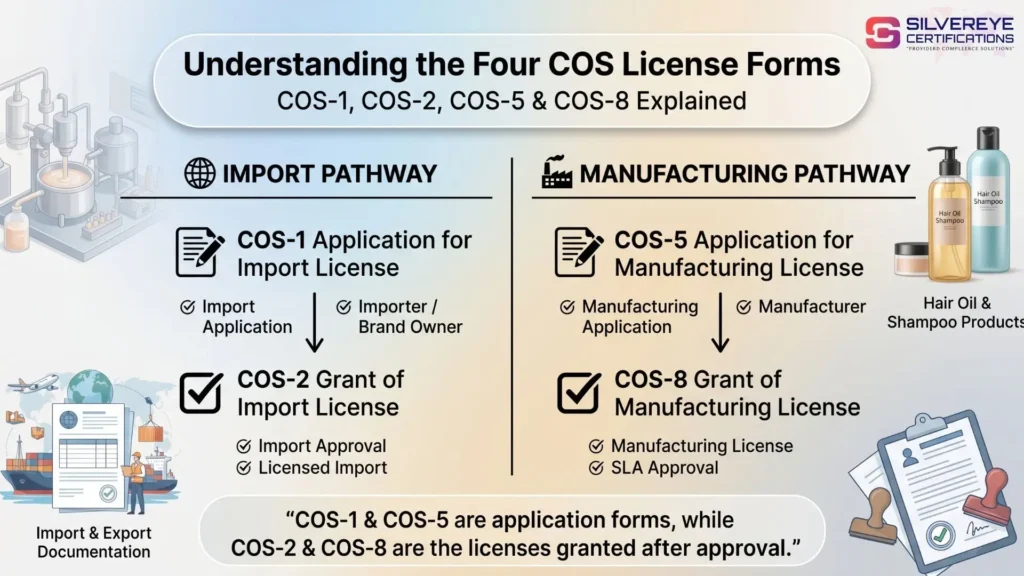
CDSCO issues four primary forms related to cosmetic import and manufacturing in India. Understanding each form is essential before you begin selling Korean beauty products.
Form COS-1 — Application for Import License
| Detail | Information |
| What is it? | Application form submitted by the licensed importer to CDSCO to obtain permission to import cosmetics into India. |
| Who applies? | Indian entity (company/LLP/proprietorship) with a valid GST number and Indian address. |
| Where to apply? | CDSCO online portal: sugam.gov.in |
| Supporting documents | Product details, country of origin certificate, free sale certificate from Korean authority (MFDS), safety data, GMP certificate, label draft, test reports |
| Processing time | 30–90 working days (standard); faster under fast-track |
| Validity after grant | COS-2 license is valid for 5 years from grant date |
| Fee | As per CDSCO fee schedule (varies by number of products) |
Form COS-2 — Grant of License for Import of Cosmetics
| Detail | Information |
| What is it? | The actual import license issued by CDSCO upon successful review of the COS-1 application. |
| Legal basis | Rule 130 of the Drugs & Cosmetics Rules 1945 |
| Who receives it? | The Indian importer named in the COS-1 application |
| What it authorises | Legal importation, storage, distribution, and sale of listed cosmetic products in India |
| Validity | 5 years; renewable before expiry |
| License cancellation grounds | Non-compliance with labeling, sale of unsafe products, import without license |
| Verification | COS-2 license number can be verified on CDSCO's public portal |
Form COS-5 — Application for Manufacturing License
| Detail | Information |
| What is it? | Application form for an Indian entity seeking to manufacture cosmetics (including Korean formulations under contract) in India. |
| Who applies? | Indian cosmetic manufacturers, contract manufacturers, co-packers of Korean formulations |
| Regulatory authority | State Licensing Authority (SLA) of the respective Indian state — not CDSCO directly |
| Prerequisites | Adequate premises, qualified technical staff (e.g., graduate in pharmacy/chemistry), GMP compliance |
| Supporting documents | Site plan, equipment list, personnel qualifications, product list, fee payment proof |
| Processing time | 60–120 working days depending on state |
| Common use case | Korean brands setting up Indian manufacturing or licensing Indian contract manufacturers |
Form COS-8 — Grant of License for Manufacturing Cosmetics
| Detail | Information |
| What is it? | The manufacturing license issued by the State Licensing Authority upon approval of the COS-5 application. |
| Legal basis | Rule 132 of the Drugs & Cosmetics Rules 1945 |
| Who receives it? | The Indian manufacturer at their specific premises |
| What it authorises | Legal manufacture of listed cosmetic products at the licensed site in India |
| Validity | 5 years; subject to periodic GMP inspection |
| Renewal | Must be renewed before expiry; inspections are a standard part of the renewal process |
| Note for Korean brands | If Korean formulations are manufactured in India under license, the COS-8 holder is the Indian company |
Step-by-Step Process: How to Import Korean Cosmetics Legally into India
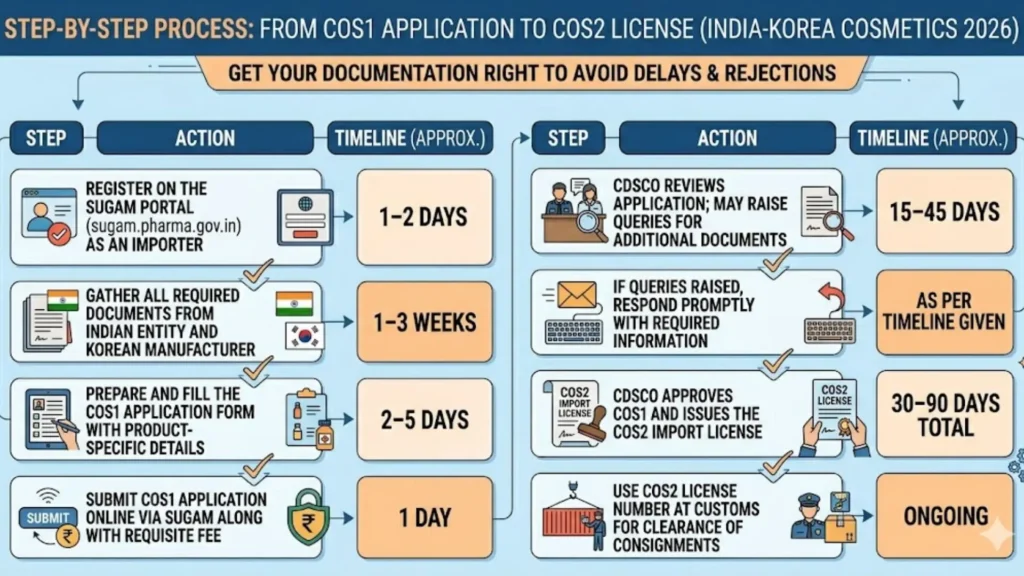
- Identify your products and confirm they are classified as 'cosmetics' under the D&C Act definition.
- Register your Indian importing entity (company/LLP) and obtain GST registration.
- Gather required documents from your Korean manufacturer: GMP certificate, MFDS Free Sale Certificate, safety data sheets, product formulation, and test reports.
- Draft a compliant Indian label (in English) covering all mandatory elements listed in Section 3.
- Submit Form COS-1 on the CDSCO Sugam portal along with all required documents and applicable fees.
- Respond to any queries raised by CDSCO during their review period (30–90 working days).
- Upon approval, receive COS-2 license granting permission to import the specified products.
- Ensure your shipments bear COS-2 license number declaration at the port of entry.
- Customs (CBIC) will verify the import license before releasing the goods.
- Apply compliant labels (with MRP, importer details, INCI list, etc.) before distribution if stickering at the warehouse.
- Maintain records of batch numbers, import quantities, and distribution chain for traceability.
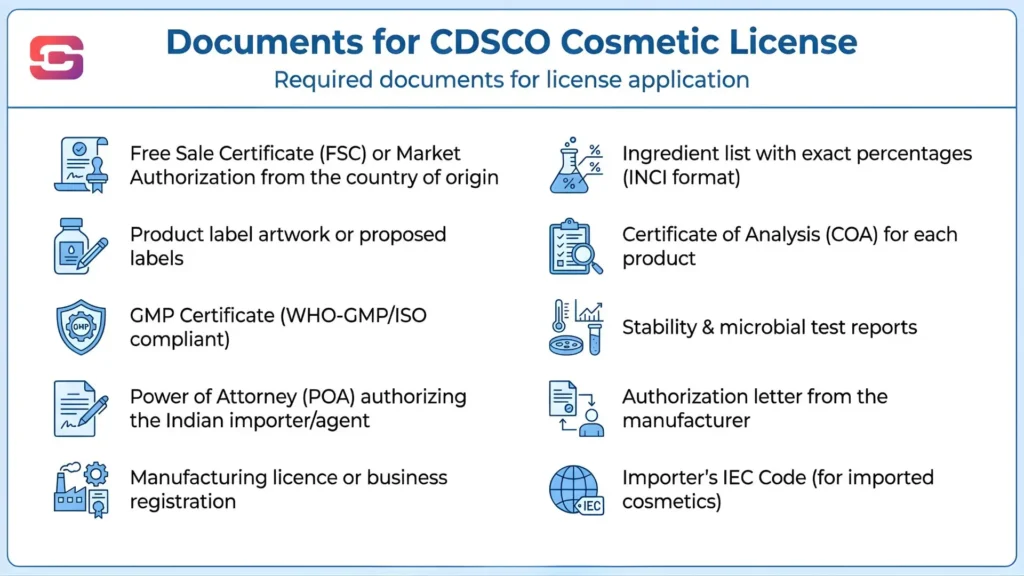
Documents Required for Korean Cosmetics Import (COS-1 / COS-2)
| Document | Source | Purpose |
| Free Sale Certificate (FSC) | MFDS (Ministry of Food and Drug Safety), Korea | Proves the product is legally sold in Korea |
| GMP Certificate | Korean manufacturer / MFDS | Confirms manufacturing meets Good Manufacturing Practice |
| Certificate of Analysis (CoA) | Korean lab / NABL-accredited Indian lab | Confirms product meets quality specs |
| Safety Data Sheet | Korean brand / manufacturer | Ingredient safety information |
| Product Formulation / Composition | Korean manufacturer | Needed for CDSCO review |
| Label Draft (English) | Indian importer | For CDSCO label approval |
| Undertaking by Importer | Indian importer | Legal declaration of compliance |
| GST Certificate | Indian GST authority | Identity of Indian importer |
| Power of Attorney (if agent) | Indian agent/importer | If a third party is applying on behalf of the brand |
| Test Reports (in vitro / clinical) | Accredited lab | For novel ingredients or functional claims |
Fees for CDSCO Cosmetic License Applications
Fees are prescribed under the Drugs & Cosmetics Rules 1945 and are subject to revision. The following are indicative figures applicable in 2026. Always confirm current fees on the CDSCO Sugam portal before filing.
| Application Type | Form | Indicative Fee (INR) | Notes |
| Import License Application | COS-1 | ₹3,000 per product / ₹50,000 for 30+ products | Fee varies by product count |
| Import License Grant | COS-2 | Included in COS-1 fee | No separate fee for grant |
| Manufacturing License Application | COS-5 | ₹3,500–₹10,000 | State-wise variation |
| Manufacturing License Grant | COS-8 | Included in COS-5 fee | No separate fee for grant |
| License Renewal | Applicable form | Same as initial fee | Must renew before expiry |
| Amendment to existing license | As applicable | ₹1,000–₹5,000 | For adding new products or changes |
Validity & Renewal of CDSCO Cosmetic Licenses
| License Type | Validity | Renewal Window | Consequence of Lapse |
| COS-2 (Import License) | 5 years from grant | Apply 3 months before expiry | Import legally prohibited; goods may be seized at port |
| COS-8 (Manufacturing License) | 5 years from grant | Apply 3 months before expiry | Manufacturing operations must stop; products recalled |
| Label Approval | Co-terminus with license | Reapply if label changes | Non-compliant label = misbranded product |
Important: If your license expires and you have stock in India, you cannot legally sell it until the license is renewed. Plan your renewal application at least 6 months in advance to account for CDSCO processing time.
Penalties for Non-Compliance with Cosmetic Labeling Laws in India
India's regulatory framework for cosmetics carries real enforcement teeth. Non-compliance is not treated lightly, especially post-2020 as enforcement has become more consistent.
| Violation | Governing Act | Penalty |
| Import without COS-2 license | D&C Act 1940, Section 10A | Imprisonment up to 3 years + fine up to ₹5,000 or value of goods, whichever is higher |
| Misbranded cosmetic (wrong label info) | D&C Act 1940, Section 16 & 22 | Seizure of goods; fine ₹500–₹5,000; cancellation of license |
| Spurious / adulterated cosmetic | D&C Act 1940, Section 16 & 27 | Imprisonment up to 7 years + fine up to ₹10 lakh |
| Missing MRP or incorrect MRP declaration | Legal Metrology Act 2009, Section 36 | Fine up to ₹25,000 for first offence; ₹1 lakh for repeat |
| Missing net quantity / INCI list | PC Rules 2011, Rule 18 | Fine up to ₹10,000 for first offence; ₹1 lakh for repeat |
| Incorrect country of origin claim | PC Rules 2011, Rule 6(1)(f) | Fine up to ₹5,000 per package; product seizure |
| Sale of cosmetic with expired date | D&C Act 1940 | Seizure + fine; potential criminal prosecution |
| Unregistered cruelty-free / organic claim | Consumer Protection Act 2019 | Fine up to ₹10 lakh for misleading advertising |
Enforcement agencies: CDSCO officers, state drug controllers, Legal Metrology inspectors, and customs officials all have powers to inspect, seize, and prosecute. E-commerce platforms are also now required to verify seller compliance before listing cosmetics.
E-Commerce & D2C: Special Labeling Considerations for K-Beauty in India
- The rise of D2C (direct-to-consumer) Korean beauty brands selling through platforms like Amazon India, Nykaa, Myntra, Meesho, and their own websites adds another compliance layer.
- Online product listings must display INCI ingredients and mandatory label information even digitally — CDSCO and the Consumer Protection (E-Commerce) Rules 2020 require this.
- The product page must include importer name, address, and customer care contact.
- Cross-border e-commerce (shipping directly from Korea without COS-2) is not legally permissible for commercial sale in India. Each shipment must come via a COS-2 licensed importer.
- Marketplace platforms (Amazon, Nykaa) are now required to delist non-compliant sellers under Consumer Protection (E-Commerce) Rules.
- QR codes linking to digital labels are encouraged but do not replace physical label requirements.
If You Manufacture in India: COS-5 & COS-8 in Detail
Some Korean brands choose to manufacture their products in India — either through a wholly-owned subsidiary or via Indian contract manufacturers (CMOs/CDMOs). This is also a growing trend driven by the 'Make in India' initiative and import duty optimisation.
Eligibility for COS-5 / COS-8
- Must have a dedicated manufacturing premises (leased or owned) in India.
- Must employ a qualified technical person — typically a pharmacist, chemist, or equivalent graduate.
- Premises must comply with Schedule M Part-II of the D&C Rules (GMP requirements for cosmetics).
- Products intended to be manufactured must not be on the prohibited list (Schedule S).
GMP Requirements (Schedule M-II)
- Clean room requirements for certain categories (skin creams, serums).
- Batch manufacturing records (BMR) must be maintained for each production batch.
- Quality Control (QC) testing of raw materials and finished products is mandatory.
- Adequate storage — temperature-controlled for products with specific storage requirements.
- Staff hygiene protocols and training documentation.
Key Difference: Import vs Manufacture Path
| Factor | Import Route (COS-2) | Manufacturing Route (COS-8) |
| Who files | Indian importer | Indian manufacturer |
| Authority | CDSCO (Central) | State Licensing Authority |
| Lead time | 30–90 days | 60–120 days |
| Ongoing compliance | CDSCO inspections | State LA + CDSCO periodic |
| Best for | Testing Indian market, low volumes | Scale, cost efficiency, 'Made in India' branding |
| Label origin claim | 'Made in Korea' or 'Imported' | 'Made in India' (if formulated/manufactured in India) |
Conclusion
This pillar page was created to serve Korean cosmetic brands, Indian importers, regulatory consultants, and e-commerce sellers who need a single, reliable resource on Indian cosmetic compliance. The information covers CDSCO regulations under the Drugs & Cosmetics Act 1940, Legal Metrology (Packaged Commodities) Rules 2011, and BIS standards as applicable in 2026.
This guide is informational and does not constitute legal advice. For specific regulatory queries, consult a CDSCO-registered regulatory consultant or legal professional.
Key authorities and resources:
- CDSCO Sugam Portal
- CDSCO Schedule S (Prohibited/Restricted Ingredients): cdsco.gov.in
- Legal Metrology PC Rules 2011: consumeraffairs.nic.in
- MFDS Korea (Free Sale Certificate): mfds.go.kr
Frequently Asked Questions
Do I need a separate CDSCO license for each Korean cosmetic product?
Not necessarily. A single COS-2 import license can cover multiple products from the same manufacturer. However, each product must be individually listed in the license application and approved by CDSCO. Adding new products later requires an amendment to the existing license.
Can I import Korean cosmetics for personal use without a COS-2 license?
Yes. Personal use imports (small quantities, typically up to 5–10 units brought in luggage) do not require a COS-2 license. However, commercial import — even small batches ordered online for resale — legally requires a valid COS-2 license.
Is a Free Sale Certificate from Korea (MFDS) mandatory for COS-1?
Yes. The Free Sale Certificate (FSC) from Korea's Ministry of Food and Drug Safety (MFDS) is a standard requirement for COS-1 applications. It proves the product is legally marketed in Korea. Without it, CDSCO may reject the application or request additional safety documentation.
Do Korean cosmetics need to be tested in India before getting a license?
Not always. CDSCO generally accepts international test reports from accredited labs. However, for certain product categories with novel ingredients or specific safety concerns, CDSCO may request testing at an NABL-accredited Indian laboratory. Always check the specific product guidelines on CDSCO's portal.
Can I use a sticker to convert the Korean label to an Indian-compliant label?
Yes. Applying a compliant sticker over the original Korean label is a common and accepted practice. The sticker must be permanent (non-peelable), must cover or supplement all Korean-only mandatory information, and must include all required English declarations. It must not cover any information required to be visible by law.
How long does CDSCO take to process a COS-1 import license application?
Processing typically takes 30 to 90 working days. Incomplete applications, missing documents, or queries from CDSCO can extend this significantly. Some applicants experience timelines of 4–6 months due to back-and-forth. Engaging a regulatory consultant familiar with CDSCO processes is recommended.
What happens if my Korean cosmetic contains an ingredient prohibited in India?
Products containing ingredients listed in CDSCO's Schedule S (prohibited ingredients) cannot be imported or sold in India. If the product contains a restricted ingredient (permitted up to a limit), reformulation or documentary evidence of compliance is required. Check CDSCO Schedule S before finalising the product list for import.
Is GST charged on imported Korean cosmetics and at what rate?
Most cosmetics attract 18% GST in India. Some products like hair oil, toothpaste, and soap attract 12%. Luxury cosmetics (perfumes, skincare with high-end positioning) may also attract 18%. Additionally, Basic Customs Duty (BCD) on imported cosmetics is typically 20%, plus Social Welfare Surcharge. MRP declared on labels must include all taxes.
Are cruelty-free and vegan claims legally regulated in India?
India does not have a specific regulatory body certifying 'cruelty-free' or 'vegan' claims for cosmetics. However, the Consumer Protection Act 2019 prohibits misleading claims. If you make a cruelty-free claim, you must be able to substantiate it with documentation. Internationally recognised certifications (Leaping Bunny, PETA Certified) serve as credible proof.
What is the renewal timeline for a COS-2 import license?
COS-2 licenses are valid for 5 years. Renewal applications should be filed at least 3 months before expiry to avoid any gap in legal import authorisation. CDSCO renewal processing may take 30–60 days.