
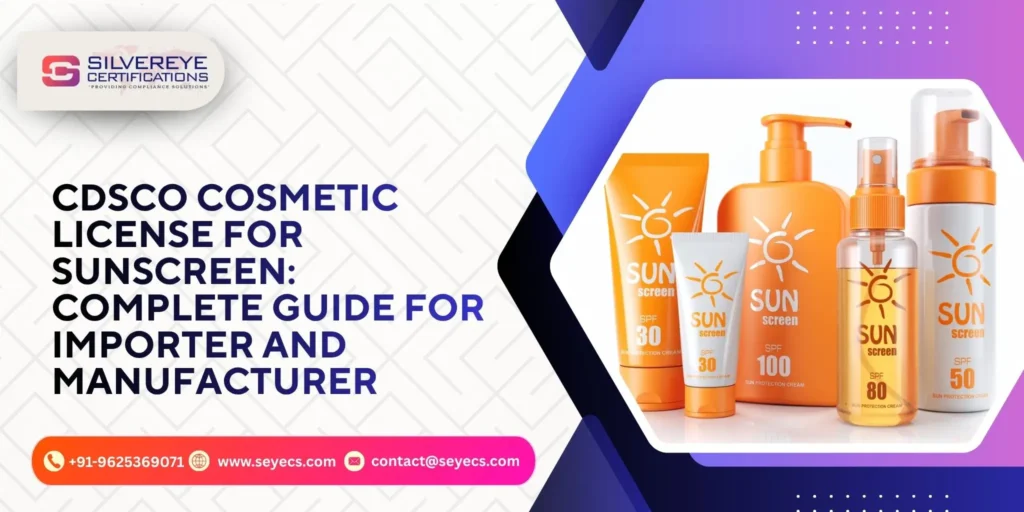
- Sunscreen is regulated as a cosmetic under the Drugs and Cosmetics Act, 1940 and Cosmetics Rules, 2020 — not as a drug.
- For importing sunscreen in India, you must file COS-1 (application) and receive COS-2 (grant of import license) from CDSCO.
- For manufacturing sunscreen in India, you must file COS-5 (application) and receive COS-8 (grant of manufacturing license) from the State Licensing Authority.
- Non-compliance with these licensing requirements can lead to product seizure, heavy fines, or cancellation of your business registration.
To legally manufacture or import sunscreen in India in 2026, you need a cosmetic license under the Drugs and Cosmetics Act, 1940. Importers must apply using Form COS-1 and receive Form COS-2 (import license) from CDSCO. Manufacturers must apply using Form COS-5 and receive Form COS-8 (manufacturing license) from the State Licensing Authority. Both require GMP compliance, proper documentation, and applicable fee payment. The entire process typically takes 60–120 working days.
What Is CDSCO Cosmetic License For Sunscreen and How Is It Regulated in India?
Sunscreen products in India are classified as cosmetics under the Drugs and Cosmetics Act, 1940 (amended) and the Cosmetics Rules, 2020, which replaced the earlier Drugs and Cosmetics Rules, 1945 with respect to cosmetics. This means anyone who wants to manufacture or import sunscreen products in India — whether an SPF 30 lotion, mineral sunscreen, or after-sun gel — must obtain the appropriate cosmetic license from the designated regulatory authority.
The Central Drugs Standard Control Organization (CDSCO) is the apex body that regulates cosmetic imports at the national level. For manufacturing, the State Licensing Authority (SLA) of the respective state where the manufacturing unit is located is the primary authority.
It is important to note that if a sunscreen product makes therapeutic claims (such as treating sun damage or preventing skin cancer), it may additionally fall under the drug category — requiring separate licensing under drug regulations. Most standard SPF sunscreens, however, fall purely under the cosmetic category.
Types of Sunscreen Products — Comprehensive List for License Planning
Before applying for any license, it is important to categorize the exact sunscreen products you plan to manufacture or import. Below is a complete product table that will help you understand the licensing pathway applicable to each sunscreen type:
| S.No. | Product Name | Category | Form | License Required | Applicable Form |
| 1 | SPF 30 Sunscreen Lotion | Sun Protection | Lotion | Manufacturing / Import | COS-5 / COS-1 |
| 2 | SPF 50+ Sunscreen Cream | Sun Protection | Cream | Manufacturing / Import | COS-5 / COS-1 |
| 3 | SPF 50 PA+++ Sunscreen Gel | Sun Protection | Gel | Manufacturing / Import | COS-5 / COS-1 |
| 4 | Mineral Sunscreen (Zinc Oxide) | Physical UV Filter | Lotion/Cream | Manufacturing / Import | COS-5 / COS-1 |
| 5 | Chemical Sunscreen (Avobenzone) | Chemical UV Filter | Fluid/Lotion | Manufacturing / Import | COS-5 / COS-1 |
| 6 | Tinted Sunscreen SPF 40 | Sunscreen + Makeup | Fluid/Foundation | Manufacturing / Import | COS-5 / COS-1 |
| 7 | Sunscreen Spray SPF 50 | Aerosol Sun Care | Spray | Manufacturing / Import | COS-5 / COS-1 |
| 8 | Sunscreen Stick SPF 30 | Sun Care Solid | Stick | Manufacturing / Import | COS-5 / COS-1 |
| 9 | Kids Sunscreen Lotion SPF 50+ | Children's Sun Care | Lotion | Manufacturing / Import | COS-5 / COS-1 |
| 10 | After-Sun Soothing Gel | Post-Sun Care | Gel | Manufacturing / Import | COS-5 / COS-1 |
| 11 | Matte Sunscreen SPF 50 PA++++ | Oil-Control Sun Care | Fluid | Manufacturing / Import | COS-5 / COS-1 |
| 12 | BB Cream with SPF 30 | Sunscreen + BB Cream | Cream | Manufacturing / Import | COS-5 / COS-1 |
| 13 | Broad Spectrum Sunscreen SPF 100 | High-Protection | Lotion | Manufacturing / Import | COS-5 / COS-1 |
| 14 | Water-Resistant Sunscreen SPF 50 | Sports / Active | Lotion | Manufacturing / Import | COS-5 / COS-1 |
| 15 | Sunscreen Lip Balm SPF 30 | Lip Sun Care | Stick/Balm | Manufacturing / Import | COS-5 / COS-1 |
| 16 | Organic / Natural Sunscreen SPF 30 | Natural/Organic Sun Care | Cream | Manufacturing / Import | COS-5 / COS-1 |
| 17 | Sunscreen Body Butter SPF 20 | Body Sun Care | Butter | Manufacturing / Import | COS-5 / COS-1 |
| 18 | Invisible Sunscreen SPF 50 | Ultra-Light Sun Care | Fluid/Serum | Manufacturing / Import | COS-5 / COS-1 |
| 19 | Imported Branded Sunscreen (e.g., La Roche-Posay SPF 50+) | Imported Sun Care | Lotion/Cream | Import Only | COS-1 → COS-2 |
| 20 | Private Label Sunscreen SPF 30 | Contract Manufacturing | Lotion/Cream | Manufacturing | COS-5 → COS-8 |
Note: All sunscreen products listed above fall under the cosmetics category (not drugs) as long as they do not make therapeutic claims. The applicable license forms (COS-1/COS-2 for import, COS-5/COS-8 for manufacturing) apply uniformly across all these product types.
Understanding the Four COS Forms — COS-1, COS-2, COS-5, and COS-8
The Cosmetics Rules, 2020 prescribe specific forms for licensing. Here is a clear comparison of all four key forms:
| Form | Purpose | Who Applies | Issued By | Validity | Key Rule |
| COS-1 | Application for Import License | Importer | CDSCO / State Licensing Authority | As specified | Rule 21 — Drugs & Cosmetics Act |
| COS-2 | Grant of License for Import | CDSCO / Authority | Granted to Importer | 1–3 Years | Post COS-1 approval |
| COS-5 | Application for Manufacturing License | Manufacturer | State Licensing Authority (SLA) | As specified | Rule 32 — Schedule M-II |
| COS-8 | Grant of License for Manufacturing | SLA | Granted to Manufacturer | 5 Years (Renewable) | Post COS-5 approval + inspection |
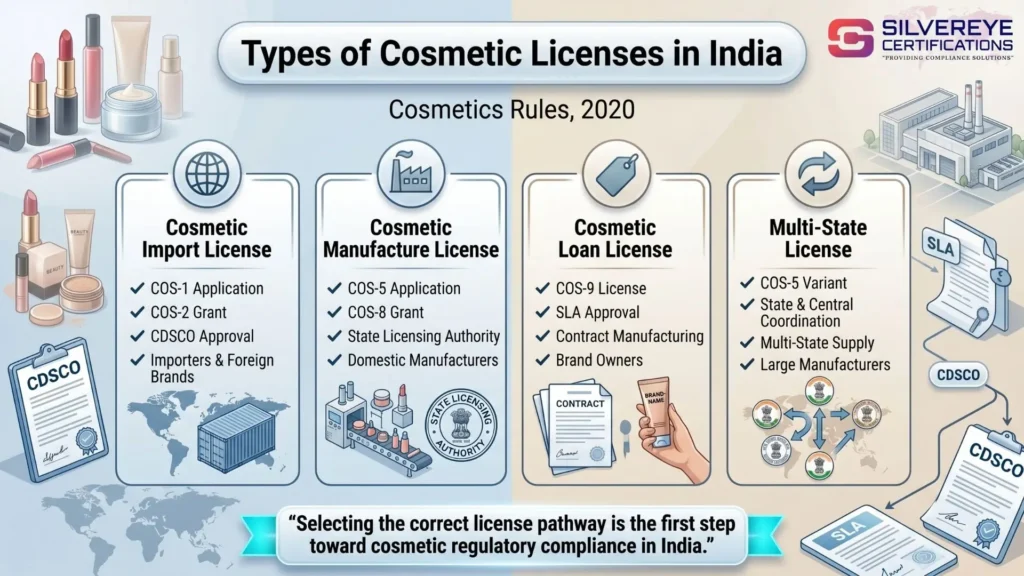
Understanding these four forms is critical before you begin the licensing process. The import pathway (COS-1 → COS-2) and the manufacturing pathway (COS-5 → COS-8) are entirely separate, and each has its own requirements, authority, and timeline.
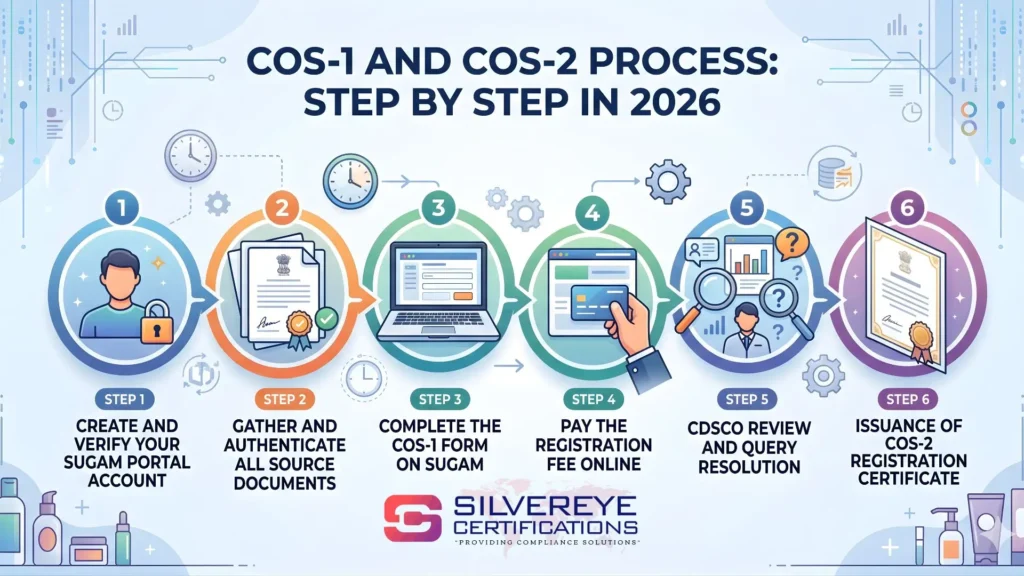
How to Get Sunscreen Import License in India (COS-1 and COS-2)
If you are planning to import sunscreen products — whether you are a brand owner sourcing from international manufacturers, a distributor importing established foreign brands, or a startup building a private-label import business — this is the pathway for you.
Step 1: Understand Who Can Apply for COS-1
Any person, company, or firm that intends to import cosmetics (including sunscreen) into India for sale or distribution must apply for an import license. The applicant must:
- Be a registered business entity in India (Proprietorship, Partnership, LLP, or Private/Public Limited Company)
- Have a valid Import Export Code (IEC) issued by DGFT (Director General of Foreign Trade)
- Have a designated Responsible Person (technically qualified) for the cosmetic products
- Have a valid business address / registered office in India
Step 2: Fill Form COS-1 (Application for Import License)
Form COS-1 is the official application form prescribed under the Cosmetics Rules, 2020 for importing cosmetics. The applicant must submit this form to the State Licensing Authority (SLA) of their state (or CDSCO in some cases, depending on the product category and state delegation).
Key details to be filled in COS-1 include:
- Name and address of the applicant / importing firm
- Name and address of the overseas manufacturer
- Full product name, formulation, and intended use
- Country of origin of the cosmetic product
- List of all ingredients (INCI names preferred)
- Proposed label / artwork for the Indian market
- IEC number and GST registration
- Technical qualifications of the Responsible Person
Step 3: Submit Required Documents Along with COS-1
Along with the filled COS-1 form, the following documents must be submitted:
- Free Sale Certificate from the country of origin (attested by the Indian Embassy)
- Certificate of Analysis (CoA) from the overseas manufacturer
- Safety Data Sheet (SDS) of the product
- Formulation / composition details
- Draft label complying with Indian labeling regulations
- Import Export Code (IEC) copy
- Business registration documents
- Authorization letter from the overseas manufacturer appointing the Indian importer
- Application fee (Demand Draft / online payment as applicable)
Step 4: Processing and Scrutiny
After submission of the COS-1 application, the licensing authority scrutinizes the documents. If additional information or clarification is needed, a query letter is issued. The applicant must respond within the stipulated time frame.
Step 5: Issuance of COS-2 (Grant of Import License)
Once the COS-1 application is approved, the authority issues Form COS-2, which is the actual Grant of License for Import of Cosmetics. This license allows the importer to legally bring sunscreen products into India and sell them in the Indian market.
- Validity: COS-2 is generally valid for 1–3 years and must be renewed before expiry.
- Renewal: The renewal application must be filed before the expiry date to avoid disruption in import operations.
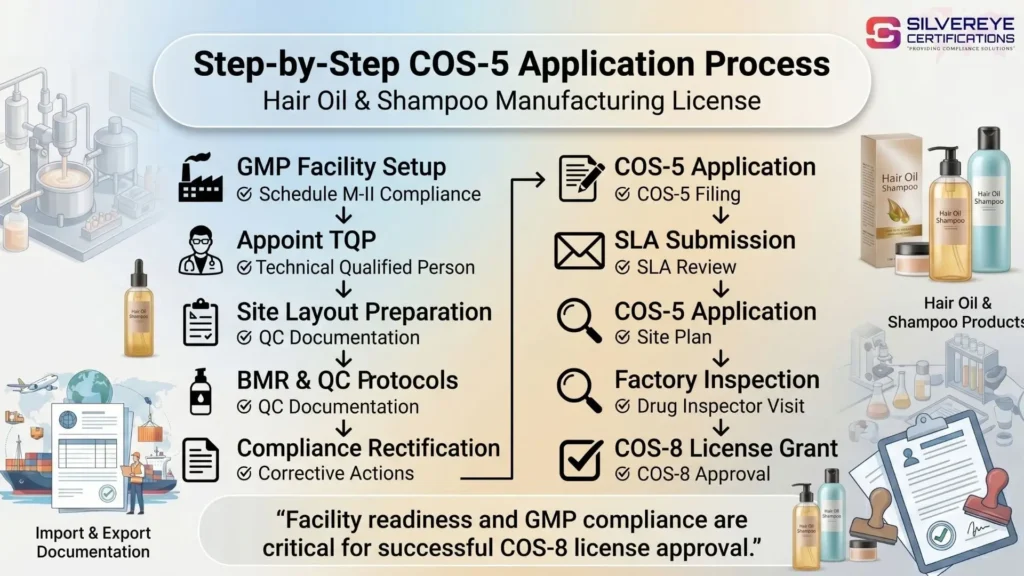
How to Get Sunscreen Manufacturing License in India (COS-5 and COS-8)
If you are setting up a cosmetic manufacturing unit in India to produce sunscreen products — whether for your own brand, as a contract/third-party manufacturer, or for export — you must obtain a manufacturing license under the Cosmetics Rules, 2020.
Step 1: Set Up a GMP-Compliant Manufacturing Facility
Before you even apply for COS-5, your manufacturing facility must be GMP (Good Manufacturing Practices) compliant as per Schedule M-II of the Cosmetics Rules, 2020. Schedule M-II is the Indian standard for cosmetic GMP and covers:
- Plant layout and premises requirements (clean rooms, storage areas, testing areas)
- Equipment qualification and calibration
- Personnel qualifications (technically qualified person on site)
- Quality control and in-process testing procedures
- Water system (purified water for cosmetics)
- Documentation and batch manufacturing records
- Pest control, waste management, and hygiene protocols
Step 2: Appoint a Technically Qualified Person
Every cosmetic manufacturing unit in India must have at least one technically qualified person responsible for manufacturing operations. For cosmetics, the qualification typically required is:
- Graduate in Pharmacy (B.Pharm) or equivalent
- Graduate in Chemistry with relevant experience
- Diploma in Cosmetology or equivalent in some states
The qualified person's credentials must be submitted as part of the COS-5 application.
Step 3: Fill Form COS-5 (Application for Manufacturing License)
Form COS-5 is the official application form for obtaining a cosmetic manufacturing license. It must be submitted to the State Licensing Authority (SLA) of the state where your manufacturing plant is located. The form requires:
- Name and full address of the applicant / business entity
- Details of the manufacturing premises (address, ownership/lease)
- List of cosmetic products proposed for manufacture
- Manufacturing process flow for each product
- Product formulations and ingredient lists
- Details of the technically qualified person
- Plant layout plan (showing all rooms and areas)
- Equipment list with capacity details
- Water testing reportsGMP compliance declaration
Step 4: Factory Inspection by State Licensing Authority
After submission of COS-5, the State Licensing Authority assigns a Drug Inspector to conduct a physical inspection of your manufacturing facility. During this inspection, the inspector verifies:
- Compliance of the factory layout with the submitted plan
- GMP implementation and Schedule M-II compliance
- Presence of qualified personnel
- Quality control laboratory setup
- Raw material storage and finished goods storage areas
- Sanitation, pest control, and hygiene standards
Any non-conformances identified during inspection must be rectified before the license is granted.
Step 5: Issuance of COS-8 (Grant of Manufacturing License)
If the factory inspection is satisfactory and all documents are in order, the State Licensing Authority issues Form COS-8, which is the Grant of License to Manufacture Cosmetics. This is your official manufacturing license for sunscreen and other cosmetics.
- Validity: COS-8 is typically valid for 5 years from the date of issue.
- Renewal: The renewal application under the applicable form must be submitted at least 3 months before the license expiry date.
- Scope of License: The license mentions specific cosmetic categories permitted for manufacture. If you want to add new product categories later, you may need an amendment to the existing license.
Complete Document Checklist — Manufacturing vs Import License
Use the table below as your master checklist before submitting your license application. Incomplete applications are a common cause of delays.
| Document | Manufacturing (COS-5) | Import (COS-1) |
| Application Form | COS-5 (Form) | COS-1 (Form) |
| Site/Plant Layout Plan | Required | Not Required |
| GMP / Schedule M-II Certificate | Required | Not Required |
| Manufacturing Process | Required | Not Required |
| Product Formula / Composition | Required | Required |
| Certificate of Analysis (CoA) | Required | Required |
| Import Export Code (IEC) | Not Required | Required |
| FSSAI / Other Regulatory No. | If applicable | If applicable |
| Safety Data Sheet (SDS) | Required | Required |
| Label / Draft Artwork | Required | Required |
| Ownership Proof / Partnership Deed | Required | Required |
| Proof of Premises | Required | Required |
| Authorized Signatory Documents | Required | Required |
| Country of Origin Certificate | Not Required | Required |
| Free Sale Certificate (Exporting Country) | Not Required | Required |
| Affidavit / Declaration | Required | Required |
| Application Fee (Demand Draft / Online) | As per Schedule | As per Schedule |
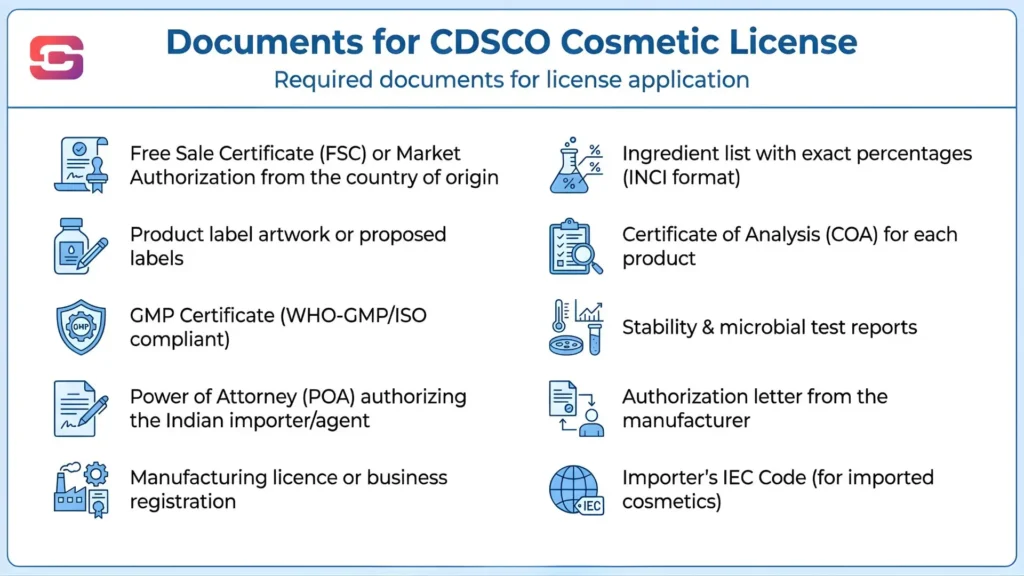
Tip: Always get your documents notarized/attested wherever required. Documents from overseas manufacturers must be apostilled or attested by the Indian Embassy in the respective country.
Eligibility Criteria for CDSCO Cosmetic Sunscreen License in India
Not everyone can apply directly for a cosmetic license. Below are the eligibility requirements for each license type:
Eligibility for COS-1 / COS-2 (Import License)
- Registered business entity in India (individual/company/firm)
- Valid Import Export Code (IEC) from DGFT
- Must not be a blacklisted or debarred entity
- Must have a designated Responsible Person
- Products being imported must comply with Indian safety and labeling norms
Eligibility for COS-5 / COS-8 (Manufacturing License)
- Registered business entity in India
- Own or legally leased manufacturing premises in India
- GMP-compliant facility as per Schedule M-II
- At least one qualified technical person employed on site
- Proper quality control laboratory or third-party lab arrangement
- Compliance with state pollution control board requirements (for manufacturing)
License Fees for Sunscreen Manufacturing and Import in India
License fees vary by state and product category. Below are the approximate fees to help you plan your budget:
| License Type | Form | Approximate Fee (INR) | Validity | Renewal Fee |
| Import License Application | COS-1 | ₹3,000 – ₹5,000 (per product/category) | As Granted | Re-apply |
| Grant of Import License | COS-2 | Included in COS-1 process | 1–3 Years | ₹2,000 – ₹3,000 |
| Manufacturing License Application | COS-5 | ₹2,500 – ₹5,000 (per premises/category) | As Granted | Re-apply |
| Grant of Manufacturing License | COS-8 | ₹5,000 – ₹15,000 (state-specific) | 5 Years | ₹3,000 – ₹8,000 |
Important: Always check the latest fee schedule from your State Licensing Authority or CDSCO website, as fees are revised periodically. State-specific fee schedules may differ significantly from the approximate figures above.
License Validity and Renewal Timeline For CDSCO Cosmetic License For Sunscreen
Manufacturing License (COS-8) Validity
- Validity: 5 years from date of grant
- Renewal: Apply at least 3 months before expiry
- Renewal Application: Submit the applicable renewal form with updated documents and fees
- If renewal is filed before expiry, the license continues to be valid during the renewal process
Import License (COS-2) Validity
- Validity: Generally 1–3 years (as specified in the license)
- Renewal: Must apply before expiry to avoid lapse
- Late renewal: May result in a gap in import operations — avoid delay
- Products must be re-evaluated if formulation or source changes
Pro Tip: Mark your license expiry dates in your compliance calendar 6 months in advance. Lapsed licenses can disrupt your manufacturing or import operations and may require fresh applications in some cases.
Benefits of Getting a Proper Sunscreen License in India
Many businesses — especially startups and first-time manufacturers — ask why they should invest time and money in getting licensed when the Indian cosmetics market is so vast. Here is why a proper license is not just a legal requirement but a business advantage:
- Legal Protection: A licensed business is protected from raids, product seizures, and regulatory penalties.
- Market Access: Retail chains, e-commerce platforms, and modern trade require valid licenses before listing your products.
- Export Readiness: A valid Indian manufacturing license (COS-8) is a prerequisite for exporting to many international markets.
- Brand Credibility: Consumers and B2B buyers increasingly verify product authenticity — a valid license boosts trust.
- Investment & Funding: Investors and VCs perform regulatory due diligence — a proper license strengthens your business valuation.
- Private Label & Contract Manufacturing: Third-party manufacturers require your license details before they can manufacture for you.
End-to-End Process Timeline For Cosmetic License Sunscreen — From Application to License
Import License (COS-1 → COS-2) — Typical Timeline
- Prepare all documents: 1–2 weeks
- Submit COS-1 application to SLA / CDSCO: Day 1
- Acknowledgment / Application number: 3–5 working days
- Scrutiny and query (if any): 15–30 working days
- Response to queries (if applicable): 7–15 working days
- Final approval and issuance of COS-2: 30–60 working days (total: 60–90 working days)
Manufacturing License (COS-5 → COS-8) — Typical Timeline
- GMP-compliant facility setup: 30–90 days (varies by facility readiness)
- Submit COS-5 application to SLA: Day 1
- Acknowledgment and scrutiny: 15–30 working days
- Factory inspection scheduled: 30–45 working days after submission
- Rectification of inspection observations (if any): 15–30 days
- Issuance of COS-8: 15–30 working days after successful inspection
- Total estimated time: 90–150 working days (from submission)
Labeling Requirements for Sunscreen in India
A valid license is only part of the compliance picture. Your sunscreen product labels must comply with the Cosmetics Rules, 2020 labeling requirements. Key mandatory label elements include:
- Brand name and product name
- Name and address of the manufacturer (and importer if applicable)
- Batch number / Lot number
- Date of manufacture and best before / expiry date
- Net quantity (weight or volume)
- Complete ingredient list (INCI names, in descending order)
- Directions for use and precautions
- SPF value and PA rating (if applicable)
- "For external use only" declaration
- License number of the manufacturer or importer
- Country of origin (for imported products)
- MRP (Maximum Retail Price) if sold at retail
Note: Any claim like "dermatologist tested", "hypoallergenic", "broad spectrum", or "water resistant" must be substantiated with appropriate clinical or lab evidence. Misleading claims can result in regulatory action.
Conclusion
Getting a sunscreen manufacturing license or import license in India in 2026 is a straightforward process if you follow the correct pathway. Whether you are applying for COS-1 and COS-2 for import, or COS-5 and COS-8 for manufacturing, the key is to prepare your documents thoroughly, ensure GMP compliance, and stay updated with the latest Cosmetics Rules, 2020 and CDSCO notifications.
The Indian sunscreen market is growing rapidly — driven by increasing awareness about UV protection, rising disposable incomes, and a young, health-conscious population. A valid license is your first and most important step to tap into this market legally and confidently.
If you are unsure about the specific requirements applicable to your product range, it is always advisable to consult a regulatory affairs expert or a licensed cosmetic consultant who is updated on 2026 regulatory changes.
Frequently Asked Questions
Is sunscreen classified as a cosmetic or drug in India?
In India, sunscreens are regulated as cosmetics under the Drugs and Cosmetics Act, 1940 and the Cosmetics Rules, 2020. However, if a sunscreen makes therapeutic or medicinal claims, it may fall under drug regulations.
What is the difference between COS-1 and COS-2?
COS-1 is the application form submitted by an importer to obtain permission to import cosmetics including sunscreen. COS-2 is the actual grant/license issued by the authority after reviewing and approving the COS-1 application.
What is the difference between COS-5 and COS-8?
COS-5 is the application form for obtaining a cosmetic manufacturing license. COS-8 is the actual license granted by the State Licensing Authority (SLA) after a factory inspection and approval of the COS-5 application.
Which authority grants the sunscreen manufacturing license in India?
The State Licensing Authority (SLA) of the respective state where the manufacturing facility is located grants the manufacturing license (COS-8). The Central Drugs Standard Control Organisation (CDSCO) oversees import licenses.
How long does it take to get a sunscreen manufacturing license?
Typically, it takes 60–120 working days from the date of complete application submission, subject to factory inspection, document verification, and state authority processing timelines
Do I need a separate license for each sunscreen product?
You need a manufacturing license for your facility/premises and category. However, each product may require separate registration or listing depending on the product type and applicable rules.
What is Schedule M-II and is it mandatory for sunscreen manufacturers?
Schedule M-II under the Cosmetics Rules, 2020 specifies Good Manufacturing Practices (GMP) for cosmetics. Compliance with Schedule M-II is mandatory for all cosmetic manufacturers including sunscreen manufacturers in India.
Can a small-scale manufacturer apply for a sunscreen manufacturing license?
Yes, small and medium-scale manufacturers can apply for COS-5 and COS-8. However, they must comply with GMP norms under Schedule M-II, including proper facility layout, qualified technical staff, and quality control systems.
What is the validity period of the sunscreen import license (COS-2)?
The import license granted under COS-2 is generally valid for 1 to 3 years depending on the product and authority decision. It must be renewed before expiry to continue importing sunscreen products legally.
Can I manufacture and import sunscreen under the same license?
No. Manufacturing and importing are two separate activities requiring different licenses. For manufacturing, you need COS-5 (application) and COS-8 (grant). For importing, you need COS-1 (application) and COS-2 (grant).