- MD-7 is the mandatory CDSCO application form for obtaining a CDSCO Medical Device manufacturing license for Class C (high-risk) and Class D (highest-risk) medical devices under the Medical Device Rules, 2017 — both reviewed exclusively by the Central Licensing Authority.
- Form MD-9 is the official Grant of License issued by CDSCO upon approval; it authorizes you to legally manufacture, sell, or distribute your Class C or Class D device across India.
- Clinical evaluation reports, ISO 13485 certification, Schedule M GMP compliance, and risk management documentation (ISO 14971) are non-negotiable prerequisites for Class C and D applications.
- The typical CDSCO approval timeline for a well-prepared Class C or Class D application ranges from 90 to 180 working days; errors in documentation or GMP non-compliance can extend this to 12 months or more.
Understanding the Medical Device Risk Classification in India
Before diving into the MD-7 and MD-9 process, it is essential to understand where Class C and Class D devices sit within India's regulatory classification system and why they face the most stringent licensing requirements.
India's Four-Tier Risk Classification System
| Class | Risk Level | Device Examples | Licensing Body | License Form |
| A | Low Risk | Surgical gloves, bandages, tongue depressors, bed pans | State Licensing Authority (SLA) | MD-14 / MD-9 |
| B | Low-Moderate Risk | Hypodermic needles, suture needles, ultrasound gel, stethoscopes | State Licensing Authority (SLA) | MD-14 / MD-9 |
| C | High Risk | Lung ventilators, bone fixation plates, drug-eluting stents, dialysis machines, X-ray machines | Central Licensing Authority — CDSCO | MD-7 / MD-9 |
| D | Highest Risk | Cardiac pacemakers, HIV test kits, heart valves, active implantable devices, donor screening IVDs | Central Licensing Authority — CDSCO | MD-7 / MD-9 |
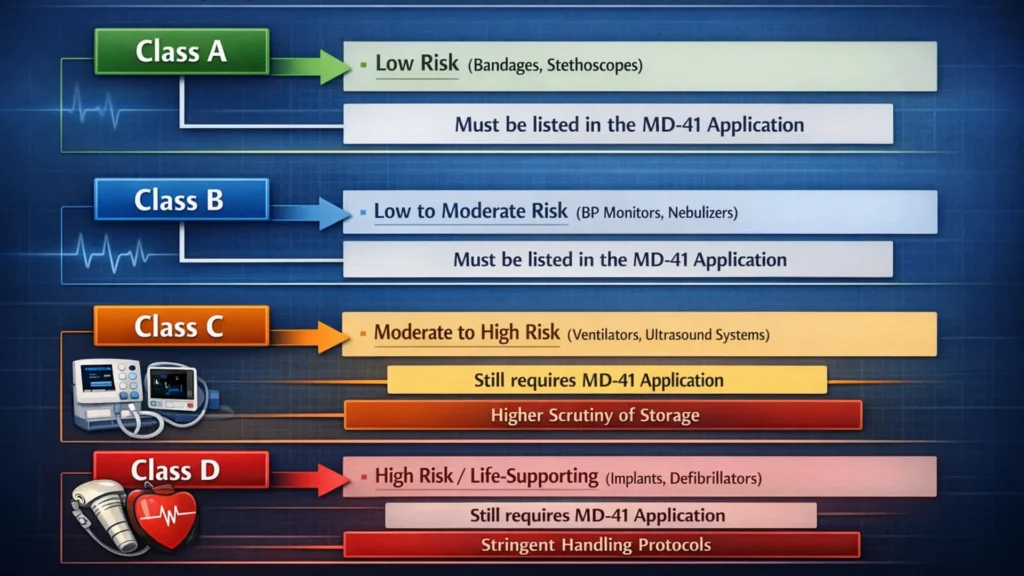
Class C and Class D devices are licensed exclusively by the Central Licensing Authority (CLA) — which is CDSCO at the national level. State licensing authorities have no jurisdiction over these device categories.
Why Class C and Class D Devices Face Stricter Regulation
The stricter regulatory requirements for Class C and Class D are justified by their direct contact with critical body systems, their role in life-sustaining or life-determining functions, or their irreversibility of harm when they fail. A poorly manufactured cardiac stent or a false-negative HIV test can cost lives. CDSCO's licensing regime for these categories reflects that gravity.
Legal Framework: Medical Device Rules, 2017 and CDSCO Authority
India's medical device regulation is anchored in the Medical Device Rules (MDR), 2017, notified under the Drugs and Cosmetics Act, 1940. For Class C and Class D devices, the following legislative instruments are directly relevant:
- Medical Device Rules, 2017 — Primary legislation for classification, licensing, clinical investigation, import, manufacture, and post-market obligations.
- Schedule M — Good Manufacturing Practices (GMP) requirements for medical device manufacturing premises and processes.
- Schedule VI — Essential Principles of Safety and Performance for medical devices, aligned with IMDRF/GHTF guidelines.
- Schedule VII — Clinical Investigation requirements for Class C and Class D devices.
- Form MD-7 — Application form for CDSCO Medical Device manufacturing license for Class C and Class D devices (Central Licensing Authority).
- Form MD-9 — Grant of License issued by CDSCO upon approval of MD-7 application.
- Form MD-14 — Application for CDSCO Medical Device manufacturing license for Class A and Class B devices (State Licensing Authority).
Amendments to the Medical Device Rules in 2023 and 2024 further expanded the list of notified medical devices, bringing more product categories under mandatory licensing. As of 2026, CDSCO has notified over 250 medical device categories that require a valid license before manufacture or import.
| Important 2026 Update: The Ministry of Health and Family Welfare extended the mandatory licensing requirement to several new Class C device categories in 2024, including certain powered wheelchairs, continuous glucose monitoring systems, and advanced wound care devices. Verify your device's classification against the latest CDSCO notification before applying. |
Who Needs an MD-7 License? Eligibility Criteria for Class C and Class D
Any entity manufacturing, assembling, or relabeling a Class C or Class D medical device for commercial sale in India must hold a valid MD-7 / MD-9 license. Here is a detailed breakdown of eligibility:
Applicant Categories
- Domestic Manufacturers: Indian companies or entities that manufacture Class C or Class D devices within India. These include original equipment manufacturers (OEMs), contract manufacturers, and assemblers.
- Loan License Applicants: Companies that manufacture devices using another licensed manufacturer's facilities and equipment. The loan licensee applies on Form MD-7 with additional declarations naming the primary licensee.
- Repacker / Relabeler: Entities that repack or relabel a licensed product under their own brand require a separate CDSCO Medical Device manufacturing license, including Class C and D products.
Eligibility Requirements — Detailed Breakdown
| Eligibility Criterion | Specific Requirements |
| Business Entity Type | Registered under Companies Act, LLP Act, or Partnership Act. Valid GST registration, PAN, and incorporation documents mandatory. |
| Technical / Qualified Person | A degree holder in science, engineering, pharmacy, or medicine with minimum 3–5 years of relevant experience in medical device manufacturing or quality assurance. For Class D, higher qualifications are generally expected. |
| Manufacturing Premises | Dedicated manufacturing space complying with Schedule M (GMP). Must include controlled environments, quality labs, and adequate utilities. Subject to mandatory CDSCO inspection before license grant. |
| Quality Management System | ISO 13485:2016 certification from a NABCB-accredited or internationally recognized certification body is effectively mandatory for Class C and Class D. |
| Risk Management | Documented risk management file compliant with ISO 14971:2019 is required for all Class C and Class D devices. |
| Clinical Evidence | Clinical evaluation report (CER) or clinical investigation data demonstrating safety and performance. Class D devices typically require more robust clinical data. |
| Essential Principles Compliance | Declaration of Conformity to Schedule VI Essential Principles of Safety and Performance, with supporting technical documentation. |
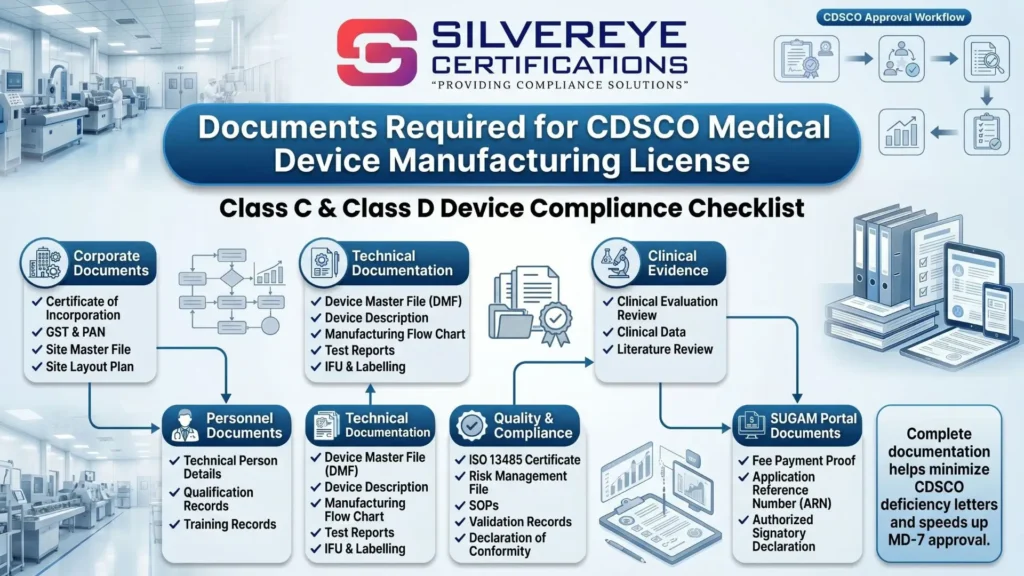
Complete Document Checklist for CDSCO Medical Device Manufacturing License (Class C & Class D)
This is the most critical section for anyone actively preparing an MD-7 application. CDSCO's deficiency letters most commonly cite missing or inadequate documentation. This checklist is comprehensive and verified for 2026.
Corporate and Administrative Documents
- Certificate of Incorporation or equivalent registration certificate of the business entity
- GST Registration Certificate
- PAN Card of the company
- Memorandum and Articles of Association (for companies) or Partnership Deed / LLP Agreement
- Board Resolution or Power of Attorney authorizing the applicant / signatory
- Site Master File (SMF) — describing the manufacturing site, organizational structure, and quality systems
- Premises ownership deed or registered lease agreement
- Site layout plan / floor plan with dimensions and area designations (manufacturing zones, clean rooms, QC labs, storage, utilities)
Personnel Documents
- Appointment letter, CV, and educational certificates of the Technical Person / Head of Quality
- Proof of experience (employment certificates, offer letters) of technical staff
- List of all technical personnel with their qualifications and roles
- Training records and competency assessment documents for key personnel
Technical and Product Documentation
- Device description document — complete technical description, intended use, indications and contraindications
- Device Master File (DMF) — full technical dossier including design specifications, materials, manufacturing process
- Bill of Materials (BOM) with complete specification and source of all components and raw materials
- Manufacturing process flow diagram with in-process quality control checkpoints
- Sterility and biocompatibility data (ISO 10993 series) for devices in contact with the body
- Electrical safety and EMC testing data (IEC 60601 series) for electrical/electronic devices
- Performance testing and functional testing data
- Shelf life and stability data (real-time and accelerated)
- Labelling and Instructions for Use (IFU) — compliant with Appendix I of Schedule I, MDR 2017
- Design verification and validation records
- Software documentation (if device contains software) — per IEC 62304 and CDSCO software guidance
Quality and Compliance Documents
- ISO 13485:2016 certificate from a recognized certification body (mandatory for Class C and D)
- Declaration of Conformity to Schedule VI Essential Principles of Safety and Performance
- Risk Management File — compliant with ISO 14971:2019, including FMEA, hazard analysis, and residual risk evaluation
- SOPs for all manufacturing and quality control processes
- Validation documents — process validation, equipment qualification (IQ, OQ, PQ), sterilization validation (if applicable)
- Post-market surveillance plan and procedures
- Complaint handling and adverse event reporting SOP
- Internal audit records and management review minutes
Clinical Evidence Documents
- Clinical Evaluation Report (CER) — systematic review of clinical data demonstrating safety and performance
- Clinical investigation data from India or reference countries (if applicable)
- Literature review of published clinical studies on the device or equivalent device
- Pre-clinical study reports (animal studies, bench testing) where clinical studies are insufficient
- Ethics committee approval for any clinical investigation conducted in India
- For Class D IVD devices: performance evaluation data from WHO-recognized reference standards
Fee Payment and Portal Documents
- Proof of fee payment from the SUGAM portal
- SUGAM portal-generated application reference number (ARN)
- Signed undertaking / declaration by the authorized signatory
| Practical Tip: Prepare your technical dossier in the CTD (Common Technical Document) format used by major regulatory agencies. CDSCO has been progressively aligning with IMDRF documentation standards, and a well-structured CTD-format dossier significantly reduces the risk of receiving deficiency letters. |
Step-by-Step MD-7 Application Process on CDSCO Medical Device Manufacturing License
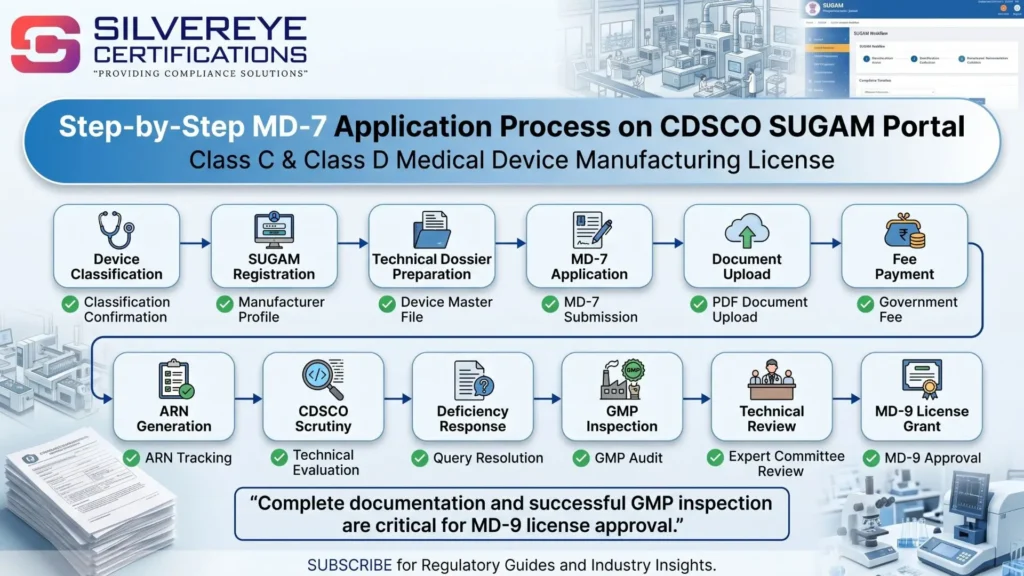
The entire MD-7 application process for Class C and Class D devices happens on the CDSCO SUGAM portal. Here is the complete step-by-step workflow:
| Step | Stage | Details |
| 1 | Device Classification Confirmation | Confirm your device is Class C or Class D using CDSCO's notified device list and the risk-based classification criteria in MDR 2017. |
| 2 | SUGAM Portal Registration | Register your company on sugam.gov.in. Create a Manufacturer profile. Provide company PAN, GST, incorporation details and obtain login credentials. |
| 3 | Prepare Technical Dossier | Compile the complete technical documentation package (see Section 4 checklist). This is the most time-intensive step — budget 3 to 6 months for preparation. |
| 4 | Fill Form MD-7 Online | Log in to SUGAM, navigate to the manufacturing license module, and complete Form MD-7 online. Enter device details, company information, technical personnel data, and premises information. |
| 5 | Upload Documents | Upload all required documents in PDF/A format via the SUGAM document upload interface. Ensure all PDFs are signed, legible, and under CDSCO's specified file size limits. |
| 6 | Fee Payment | Pay the prescribed application fee through the SUGAM online payment gateway. Download and retain the fee payment receipt as part of your records. |
| 7 | Application Submission and ARN | Submit the completed application. CDSCO generates an Application Reference Number (ARN) — this is your official tracking ID for all follow-up communications. |
| 8 | CDSCO Scrutiny | CDSCO officers review the application for completeness, format compliance, and technical adequacy. A deficiency letter is issued via the SUGAM portal if information is missing or insufficient. |
| 9 | Response to Deficiency | Respond to all deficiency points within the stipulated timeframe (typically 30 days per query cycle). Upload revised or additional documents as requested. |
| 10 | Mandatory GMP Site Inspection | For Class C and Class D manufacturing licenses, a CDSCO-appointed inspector conducts a physical GMP inspection of your manufacturing premises. Non-compliance at this stage delays approval. |
| 11 | Technical Committee Review (if applicable) | Complex or novel Class C and Class D devices may be referred to CDSCO's Technical Expert Committee for additional scientific review. |
| 12 | Grant of License — Form MD-9 | Upon satisfactory completion of all reviews and inspections, CDSCO issues Form MD-9 (Grant of License). The digitally signed license is available for download on the SUGAM portal. |
Typical Total Timeline: A well-prepared, deficiency-free application for a Class C device typically takes 90 to 120 working days. Class D devices, given their higher risk profile, often take 120 to 180 working days. Applications referred to technical committees or requiring additional clinical data can exceed 12 months.
CDSCO Medical Device Manufacturing License Application Fee Structure for Class C & Class D Devices
The fee schedule for MD-7 manufacturing license applications is prescribed under the Medical Device Rules, 2017. The following table reflects the applicable fees — always verify on the SUGAM portal for the most current figures before filing, as fee revisions can occur.
| Application Type | Class C Fee | Class D Fee | Renewal Fee | Amendment Fee |
| CDSCO Manufacturing License (MD-7) — Indian Company | Rs. 5,000 | Rs. 5,000 | 50% of original | Rs. 2,500 |
| CDSCO Manufacturing License — MSME / Small Entity | Concession applicable (verify on SUGAM) | Concession applicable | 50% of original | Concession applicable |
| Import License (for Class C/D — via MD-7/MD-16) | Rs. 7,500 | Rs. 7,500 | 50% of original | Rs. 2,500–5,000 |
| Duplicate / Replacement License | Rs. 500 | Rs. 500 | N/A | N/A |
| Test License (for market evaluation) | Rs. 5,000 | Rs. 5,000 | 50% of original | N/A |
Note: The above fee figures are indicative based on the notified fee schedule under MDR 2017. CDSCO processes only online payments through the SUGAM portal — no demand drafts, cheques, or cash payments are accepted. Always retain the digital payment receipt as part of your compliance records.
Form MD-9: Understanding the Grant of License and Its Legal Significance
Form MD-9 is the official Grant of License issued by CDSCO's Central Licensing Authority upon successful approval of your MD-7 application. It is a legally binding document with specific conditions attached. Here is what a standard Form MD-9 contains:
- Full legal name and registered address of the licensee
- Name, technical description, model number, and CDSCO reference number of the licensed device(s)
- Device class (Class C or Class D)
- Unique CDSCO license number
- Date of issue and license expiry date
- Specific conditions and restrictions attached to the license (e.g., post-market surveillance obligations, specific storage conditions)
- Name and signature of the Central Licensing Authority officer
- Digital signature / QR code for verification (on SUGAM-issued licenses from 2023 onwards)
Legal Obligations Once You Hold an MD-9 License
Receiving your MD-9 is the beginning of your compliance journey, not the end. Here are the key ongoing obligations:
- Display the MD-9 license prominently at the licensed manufacturing premises at all times.
- Ensure the licensed device is manufactured only at the premises specified in the license.
- Notify CDSCO immediately of any change in company name, address, technical personnel, or device specifications — and apply for an amendment before implementing changes.
- Maintain all manufacturing, testing, and quality records for a minimum period of five years from the date of manufacture of the last batch.
- Cooperate fully with CDSCO inspectors during scheduled or unannounced inspections.
- Report serious adverse events (SAEs) and field safety corrective actions (FSCAs) to CDSCO within prescribed timelines.
- Submit Periodic Safety Update Reports (PSURs) as required for Class C and Class D devices.
MD-9/MD-7 License Validity, Renewal, and What Happens If It Lapses
Validity Period
| License Type | Initial Validity | Renewed Validity |
| Class C Manufacturing License (MD-9) | 5 years from the date of issue | 5 years per renewal cycle |
| Class D Manufacturing License (MD-9) | 5 years from the date of issue | 5 years per renewal cycle |
| Loan License (Class C / D) | Co-terminus with primary manufacturer's license | Renews with primary license — requires fresh co-terminus confirmation |
| Test License (MD-7) | 1 year from date of issue | Renewable for additional 1-year terms |
Renewal Process — Step by Step
- File the renewal application on the SUGAM portal at least 6 months before the license expiry date to ensure continuity of operations.
- Use the renewal module in SUGAM — the system pre-fills data from your existing license. Review and update all fields where applicable.
- Attach updated documents: current ISO 13485 certificate, updated clinical evaluation report (if device or clinical evidence has changed), revised site master file (if premises changed), updated technical dossier (if device specifications changed).
- Pay the renewal fee (50% of the original application fee for the applicable class).
- A CDSCO GMP re-inspection may be triggered as part of the renewal process — ensure your premises are inspection-ready before filing.
- Track the renewal application status on SUGAM. If a deficiency letter is issued during renewal review, respond within the specified timeline.
What Happens If Your MD-9/MD-7 License Lapses?
If your MD-9 license expires without a timely renewal application, the consequences are immediate and serious:
- You must stop manufacturing or selling the licensed device immediately upon license expiry.
- Any continued manufacture or sale after license expiry constitutes a violation of the Medical Device Rules, 2017 and can attract prosecution under the Drugs and Cosmetics Act.
- A lapsed license requires a complete fresh application — there is no reinstatement process. The full MD-7 process must be restarted from scratch, including a new GMP inspection.
- Ongoing product recall obligations continue even after license lapse — the manufacturer remains liable for devices already in the market.
| Critical Reminder: Set internal calendar alerts 9 months and 6 months before your MD-9 license expiry date. CDSCO does not send automatic expiry reminders. The burden of timely renewal is entirely on the licensee. |
Clinical Data and Risk Management Requirements for Class C & Class D Devices
This is the section that separates Class C and Class D licensing from lower-risk device licensing. Clinical evidence and risk management are not optional add-ons — they are foundational requirements that CDSCO scrutinizes most closely.
Clinical Evaluation Requirements
A Clinical Evaluation Report (CER) must demonstrate that your Class C or Class D device performs as intended and is acceptably safe for the intended patient population. The CER must include:
- Systematic literature search and appraisal of published clinical data on the same or similar devices
- Clinical data from clinical investigations conducted on the device, if available
- Analysis of clinical data from post-market experience (for devices already marketed in other countries)
- Identification and analysis of clinical risks, residual risks, and their acceptability
- Comparison against state-of-the-art technology in the same intended use category
- Conclusion on whether the benefit-risk profile is acceptable for the intended use
When Is a Clinical Investigation in India Required?
CDSCO may require a clinical investigation in India (as opposed to accepting foreign clinical data) in the following situations:
- The device is a novel device with no established predicate or equivalent device.
- The device's intended use population has significant physiological, genetic, or epidemiological differences from the populations in available international studies.
- CDSCO's Technical Expert Committee determines that existing clinical evidence is insufficient.
- The device is an active implantable device with long-term safety implications.
Clinical investigations in India must be approved by CDSCO (Form MD-10 application for clinical investigation), conducted at Ethics Committee-approved clinical sites, and comply with Schedule VII of the Medical Device Rules, 2017.
Risk Management Requirements — ISO 14971:2019
For all Class C and Class D devices, a comprehensive risk management file is mandatory. The risk management process must include:
- Risk analysis — identification of all potential hazards and hazardous situations associated with the device
- Risk evaluation — comparison of identified risks against acceptability criteria
- Risk control — measures implemented to reduce or eliminate identified risks, with verification of control effectiveness
- Residual risk evaluation — analysis of residual risks after controls are applied
- Overall residual risk acceptability — conclusion that benefits outweigh residual risks for the intended use
- Risk management review — ongoing monitoring and update of the risk management file throughout the device lifecycle
GMP Inspection: What CDSCO Looks for During Class C & Class D Site Audits
A GMP site inspection is mandatory for all Class C and Class D manufacturing license applications. Understanding what CDSCO inspectors look for helps you prepare effectively.
Key Areas Evaluated During CDSCO GMP Inspection
| Inspection Area | What CDSCO Evaluates |
| Premises and Facilities | Layout, cleanliness, controlled environments, clean room classification (if applicable), segregation of manufacturing zones, environmental monitoring systems. |
| Equipment | Equipment calibration records, qualification status (IQ/OQ/PQ), preventive maintenance schedules, and equipment logbooks. |
| Personnel | Qualifications and training records of technical staff, gowning and hygiene procedures, health monitoring for personnel in controlled environments. |
| Documentation and Records | SOPs, batch manufacturing records, quality control records, complaint registers, deviation logs, CAPA (Corrective and Preventive Action) records. |
| Quality Control Laboratory | Laboratory equipment, reference standards, testing methods (validated per pharmacopeial or CDSCO-approved methods), out-of-specification (OOS) investigation procedures. |
| Sterility and Biocompatibility | Sterilization validation data, ongoing sterility testing, biocompatibility testing records per ISO 10993 series — critical for devices with patient contact. |
| Post-Market Surveillance | Adverse event reporting procedures, complaint handling records, field safety corrective action history, post-market clinical follow-up plan. |
Common GMP Inspection Failures and How to Avoid Them
- Missing or outdated equipment calibration records — maintain calibration schedules and ensure all instruments have current calibration certificates.
- Poorly documented SOPs that do not match actual practice — train all personnel on SOPs and conduct internal audits to ensure procedural compliance.
- Inadequate clean room monitoring records — install environmental monitoring systems and maintain temperature, humidity, and particle count logs.
- Incomplete batch records — every manufacturing batch must have a complete Batch Manufacturing Record (BMR) traceable from raw materials to finished product.
- No CAPA system in place — demonstrate a documented CAPA system with examples of CAPAs initiated, investigated, and closed.
Benefits of Obtaining a Class C & Class D MD-9 Manufacturing License
Beyond regulatory compliance, holding a valid MD-9 license for Class C and Class D devices delivers significant business, clinical, and commercial advantages:
- Legal Authorization: Full Legal Market Access: The MD-9 license is the only legally valid authorization to manufacture and sell Class C or Class D devices in India. Without it, your device cannot enter the market — period.
- Tender Access: Government Tender Eligibility: Central and state government procurement agencies — including CMSS, HLL Lifecare, and state health departments — mandate a valid CDSCO license as a prerequisite for tender participation.
- Export Advantage: International Market Recognition: Several Asian and African markets recognize CDSCO licensing as a reference approval, making Indian regulatory approval a gateway to export market access.
- Business Credibility: Investor and Partner Credibility: A CDSCO MD-9 license for a Class C or D device is a significant due diligence milestone for investors, acquirers, and international distribution partners.
- Brand Safety: Brand Protection: Licensing prevents uncertified or substandard devices from competing in the same product category under ambiguous regulatory status.
- Healthcare Impact: Patient Safety Assurance: The rigorous GMP, clinical evidence, and risk management requirements that underpin the MD-9 license directly translate to safer, more reliable devices reaching patients.
Key CDSCO Regulatory Updates Affecting Class C & Class D Licensing (2025–2026)
The CDSCO regulatory environment is actively evolving. Here are the most significant changes impacting Class C and Class D device licensing as of 2026:
- 2024 Notification: Expanded Notified Device List: CDSCO's 2024 notification expanded mandatory licensing to new Class C categories including continuous glucose monitoring systems, powered mobility devices, and specific software as a medical device (SaMD) categories.
- SaMD Update 2025: SaMD Regulatory Framework: CDSCO released updated guidance on Software as a Medical Device (SaMD) classification and licensing in 2025, clarifying that AI/ML-based clinical decision support tools meeting Class C/D risk criteria require full MD-7 / MD-9 licensing.
- IMDRF Alignment: IMDRF Convergence: India has accelerated its convergence with IMDRF (International Medical Device Regulators Forum) guidelines, particularly on UDI (Unique Device Identification), post-market surveillance, and clinical evaluation methodology.
- Digital Filing: SUGAM Portal Upgrade 2025: The SUGAM portal received a major upgrade in 2025 enabling fully paperless MD-7 applications with digital signatures, automated deficiency tracking, and real-time application status monitoring.
- Faster Processing: 90-Day Target for Complete Applications: Under the National Medical Devices Policy 2023, CDSCO has committed to processing complete, deficiency-free Class C applications within 90 working days, subject to GMP inspection scheduling.
- PMS Enforcement: Stricter Post-Market Surveillance Enforcement: CDSCO has enhanced post-market surveillance enforcement in 2025-26, with increased focus on periodic safety update reports and field safety corrective action compliance for Class C and Class D licensees.
Conclusion: MD-7 and MD-9 Licensing Is a Long Game — Start Right
Obtaining a Class C or Class D manufacturing license through Form MD-7 and receiving Form MD-9 from CDSCO is one of the most demanding regulatory achievements in the Indian healthcare space. The requirements — GMP-compliant infrastructure, ISO 13485 certification, robust clinical evidence, comprehensive risk management, and mandatory site inspection — exist because the stakes are highest for these device categories.
Whether you are an established medical device manufacturer expanding your portfolio into higher-risk categories, a startup developing a novel Class C implantable device, or a multinational seeking Indian regulatory approval for a Class D diagnostic system, the path to MD-9 requires meticulous preparation, strong documentation, and ideally, experienced regulatory guidance.
The companies that succeed in CDSCO Class C and Class D licensing are those that treat the process not as a bureaucratic hurdle but as a systematic demonstration of their commitment to patient safety and product quality. That mindset — backed by the right documentation, GMP investment, and clinical evidence — is what turns an MD-7 application into an MD-9 Grant of License.
Frequently Asked Questions
What is the difference between Form MD-7 and Form MD-9 in CDSCO?
Form MD-7 is the application form you submit to CDSCO to request a manufacturing license for a Class C or Class D medical device. It contains all your company details, device specifications, and compliance declarations. Form MD-9 is the Grant of License — the official approval document CDSCO issues after reviewing and approving your MD-7 application
Is ISO 13485 mandatory for MD-7 Class C and Class D applications?
Yes, ISO 13485:2016 certification is effectively mandatory for Class C and Class D device manufacturing license applications. CDSCO expects evidence of a documented and operational Quality Management System meeting ISO 13485 requirements. While the Rules do not explicitly state 'ISO 13485 is mandatory' in all clauses, CDSCO officers consistently require it for high-risk device applications, and applications without it regularly receive deficiency letters.
How long does it take to get a CDSCO MD-9 license for a Class D device?
For a well-prepared, complete application with no documentation gaps, the typical timeline for a Class D device is 120 to 180 working days from application submission. This includes CDSCO scrutiny, any deficiency correspondence, and the mandatory GMP site inspection. If the application is referred to a Technical Expert Committee, or if additional clinical data is requested, the timeline can extend to 12 to 18 months.
Can a startup or small company obtain a Class C or Class D manufacturing license?
Yes, the MDR 2017 does not restrict licensing by company size. However, the requirements — GMP-compliant premises, ISO 13485 certification, qualified technical personnel, clinical evaluation data, and risk management documentation — represent a significant investment.
What is the fee for a Class D medical device manufacturing license in India?
The application fee for a Class D manufacturing license under Form MD-7 is approximately Rs. 5,000 for Indian manufacturers. The renewal fee is 50% of the original fee. However, fees are subject to revision by the Ministry of Health and Family Welfare. Always verify the current fee schedule on the CDSCO website or SUGAM portal immediately before filing.
Is a clinical investigation in India mandatory for all Class C and Class D devices?
Not necessarily. CDSCO accepts a well-structured Clinical Evaluation Report (CER) based on published literature and international clinical data for most Class C and Class D devices that have regulatory approval in recognized reference countries (US, EU, Japan, Australia, Canada).
What is a loan license for Class C or Class D devices and how does it work?
A loan license is an arrangement where a company (the loan licensee) manufactures its product at the premises and using the equipment of another licensed manufacturer (the primary licensee), without owning those facilities. The loan licensee applies on Form MD-7 and declares the primary licensee's details.
What happens during a CDSCO GMP inspection for Class C and Class D devices?
A CDSCO-appointed Drug Inspector (or a team for complex facilities) visits your registered manufacturing premises on a scheduled date. The inspection covers premises and environmental conditions, equipment calibration and validation, documentation and record-keeping, quality control laboratory, personnel qualifications and training, manufacturing processes and in-process controls, and post-market surveillance systems.
Can one MD-9 license cover multiple Class C or Class D devices?
Yes. A single MD-9 license can cover multiple devices manufactured at the same licensed facility, provided each device has its own technical documentation, risk management file, and clinical evaluation data included in the application.
What are the post-market surveillance (PMS) obligations after receiving MD-9?
Class C and Class D licensees must maintain a documented post-market surveillance system that includes: periodic review of device performance data and complaints; adverse event reporting to CDSCO within prescribed timelines (serious adverse events typically within 30 days of awareness); field safety corrective actions (recalls, field modifications) with mandatory CDSCO notification; post-market clinical follow-up (PMCF) plans for devices where long-term clinical data gaps exist; and Periodic Safety Update Reports (PSURs) submitted to CDSCO at specified intervals.