- Whether your massager qualifies as a medical device under India's MDR 2017 and CDSCO rules
- Step-by-step CDSCO registration process for both importing and manufacturing massager in India
- Complete documents checklist, applicable fees, validity period, and renewal timelines for 2026
- eCommerce & labeling compliance rules so you can sell legally on Amazon, Flipkart, and your own store
Introduction
The massager market in India is growing fast. Walk into any pharmacy, browse any online marketplace, or step into a physiotherapy clinic — massager are everywhere. But here is a question that most importers, brand owners, and manufacturers skip until it is too late: does your massager need CDSCO registration in India?
The answer depends on how the device is positioned, what claims are made, and how it is classified under India's Medical Devices Rules, 2017 (MDR 2017). Get this wrong and you risk import rejection, product seizure, or heavy penalties under the Drugs and Cosmetics Act, 1940.
This guide covers everything — from product classification and CDSCO registration for massager to import licensing, manufacturing compliance, labeling rules, eCommerce requirements, and the most common mistakes businesses make. Updated for 2026.
What Is a Medical Device Registration For Massager?
A massager is a device designed to apply mechanical vibration, percussion, heat, or electrical stimulation to the body for the purpose of relieving muscle tension, improving blood circulation, reducing pain, or promoting relaxation.
In India's regulatory environment, massagers are not automatically classified as medical devices. The classification depends entirely on the intended use and the claims made by the manufacturer or importer.
Common Types of Massager in the Indian Market
| Massager Type | Common Use Claims |
| Handheld percussion massager | Muscle recovery, pain relief |
| Foot massager (electric) | Circulation improvement, relaxation |
| TENS/EMS device | Pain relief, muscle stimulation |
| Neck & shoulder massager | Tension relief, pain management |
| Full-body massage chair | Relaxation, stress relief |
| Infrared heating massager | Deep tissue pain relief, joint stiffness |
| Vibrating foam roller | Muscle recovery, sports performance |
| Eye massager | Eye strain, relaxation |
The type of claim you make on your product packaging, website, or promotional material is what determines whether your device falls under wellness/consumer territory or medical device territory — and that distinction changes everything from a compliance standpoint.
Wellness Device vs. Medical Device — A Critical Distinction
This is the single most important question for anyone selling massager in India. Many businesses unknowingly market consumer wellness products using medical language and end up triggering regulatory requirements they were not prepared for.
| Parameter | Wellness Device | Medical Device |
| Primary claim | Relaxation, comfort, general wellbeing | Pain relief, disease management, therapeutic use |
| Regulatory oversight | Consumer Protection Act / BIS | CDSCO under MDR 2017 |
| CDSCO registration required? | No | Yes (if notified) |
| Import license needed? | No specific license | Yes — Form MD-14/15 |
| Label claim restriction | No specific medical claims allowed | Approved claims only |
| Applicable law | Legal Metrology Act | Drugs & Cosmetics Act, 1940 |
| Critical Rule for 2026 |
| If your massager packaging, IFU (Instructions for Use), or website claims to treat, manage, or alleviate any specific medical condition — such as arthritis, neuropathy, chronic back pain, sciatica, or sports injuries — it is likely to be classified as a medical device under Indian law and will require CDSCO registration. |
When Does a Massager Require CDSCO Registration in India?
Under India's Medical Devices Rules, 2017, a product is a medical device if it meets the definition under Section 3(b) of the Drugs and Cosmetics Act — meaning it is intended for use in the diagnosis, prevention, monitoring, treatment, or alleviation of disease, or to affect the structure or any function of the human body.
Massagers with specific therapeutic claims fall under this definition. The Central Drugs Standard Control Organization (CDSCO) maintains a list of notified medical devices. TENS units, EMS devices, and certain electrical therapeutic massagers are explicitly notified and require registration.
Scenarios That Trigger CDSCO Registration
- Medical claims on packaging: Terms like 'treats arthritis,' 'relieves chronic pain,' 'reduces inflammation,' or 'physiotherapy use' push the product into medical device territory.
- Electrical nerve or muscle stimulation: TENS (Transcutaneous Electrical Nerve Stimulation) and EMS (Electrical Muscle Stimulation) devices are notified medical devices regardless of claim language.
- Professional/clinical use intent: Devices sold specifically to hospitals, physiotherapy clinics, or medical professionals are treated as medical devices.
- Prescription-grade features: Devices with adjustable waveforms, clinical protocols, or FDA/CE clearance for a medical indication will require CDSCO registration for import or sale.
- FDA/CE medical device certificate: If your product holds medical device regulatory status in another country, Indian authorities are likely to treat it as a medical device.
If your massager is a pure consumer wellness product — marketed only for relaxation, comfort, or general muscle ease — and makes no medical claims, it generally does not require CDSCO registration. However, you still need to follow labeling, import duty, and BIS compliance rules where applicable.
Product Classification Under MDR 2017
Under the Medical Devices Rules, 2017, all notified medical devices are classified into four risk-based classes. Massagers that qualify as medical devices typically fall into Class A or Class B depending on their intended use and risk profile.
| Device Class | Risk Level & Typical Massager Examples |
| Class A (Low Risk) | Simple mechanical massagers sold for therapeutic use, non-powered devices with therapeutic claims |
| Class B (Low-Moderate Risk) | Electrically powered massagers with therapeutic claims, TENS/EMS devices for home use |
| Class C (Moderate-High Risk) | Devices used in clinical settings with significant therapeutic intervention (less common for massagers) |
| Class D (High Risk) | Not applicable for typical massagers |
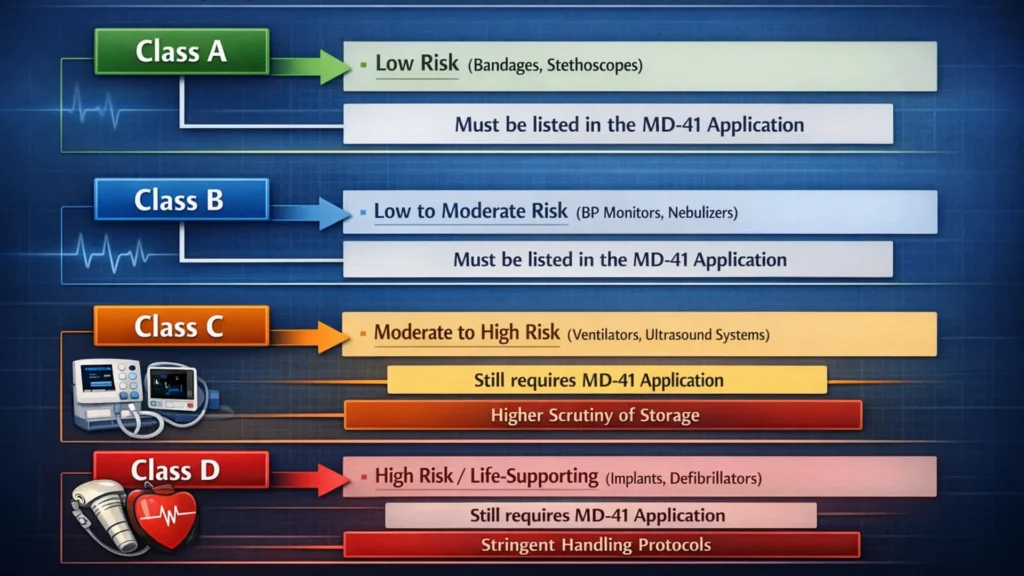
The classification determines the regulatory pathway — specifically, whether the manufacturer requires a Type Examination Certificate, clinical data, or a Quality Management System (QMS) audit before registration is granted.
How Classification Affects Your Registration Process
- Class A devices: Self-certification path with manufacturer declaration
- Class B devices: Third-party testing and type examination certificate required
- Class C devices: Additional performance data and clinical evidence required
- Class D devices: Highest scrutiny — not typical for massager products
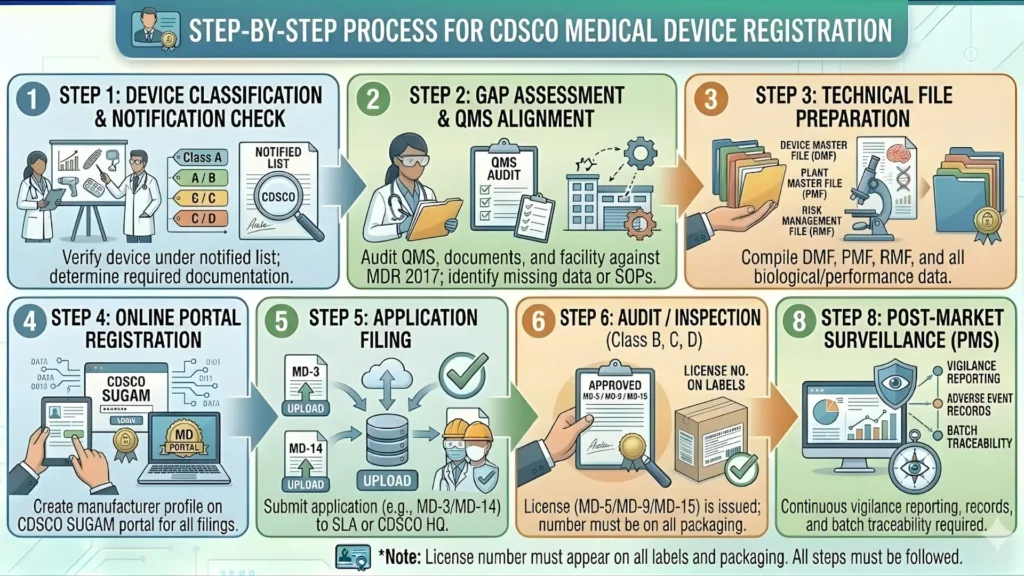
CDSCO Import Registration for Massagers — Step-by-Step Process
If you are planning to import massagers into India that qualify as medical devices, you need to obtain an Import Registration Certificate (IRC) from CDSCO before the goods can clear Indian customs. This is separate from, but related to, the import license obtained from the State Licensing Authority.
Step 1: Determine Applicability
Assess whether your device meets the definition of a medical device under MDR 2017. Verify if the device is on the CDSCO notified list. Confirm the risk class based on the device's intended use and technology.
Step 2: Appoint an Indian Authorized Agent
Foreign manufacturers must appoint an Indian Authorized Agent (IAA) — a company or individual registered in India — who will act as the regulatory representative. The IAA takes legal responsibility for the imported product in India.
Step 3: Obtain a Free Sale Certificate (FSC)
The manufacturer in the country of origin must obtain a Free Sale Certificate (FSC) or Certificate of Exportability from the relevant regulatory authority in the manufacturing country (e.g., FDA for USA, CE for EU). This document confirms the product is approved for sale in its home market.
Step 4: Apply on SUGAM Portal
All CDSCO applications are submitted online through the SUGAM portal. Create an account, select the appropriate application form (Form MD-14 for import license), upload all required documents, and pay the prescribed fees.
Step 5: CDSCO Review and Query Response
CDSCO officials review the application and may raise queries. Respond to queries within the prescribed timeline (typically 30 days per query response window). Provide additional technical data if requested.
Step 6: Grant of Import Registration Certificate
Upon satisfactory review, CDSCO issues the Import Registration Certificate valid for a specified period. After this, you apply to the State Drug Controller for an Import License (Form 10/10-A).
Manufacturing Medical Device License for Massagers in India
If you manufacture massagers in India and they qualify as medical devices, you need a Manufacturing License from the State Licensing Authority, along with CDSCO registration. The process under MDR 2017 involves demonstrating that your manufacturing facility meets the required standards.
Key Requirements for Manufacturing License
- Premises & facility: Adequate manufacturing space, environmental controls, and separation of production areas as per Schedule V/VI of MDR 2017.
- Quality Management System: ISO 13485 certification is practically mandatory for Class B devices and above. For Class A, internal quality procedures with documentation are required.
- Technical file: Complete design and development file, risk analysis (ISO 14971), and performance/safety data for the device.
- Qualified personnel: At least one qualified person (typically a degree holder in relevant science/engineering) must be on staff.
- Testing capability: In-house or contracted testing for electrical safety (IEC 60601-1) and performance standards as applicable.
Manufacturing Registration Steps
- Application to State Drug Controller: Submit Form MD-3 (application for manufacturing license) along with site master file.
- Site inspection: State Drug Controller inspectors conduct a GMP audit of the manufacturing premises.
- CDSCO product registration: Simultaneously, the product must be registered with CDSCO via the SUGAM portal.4. Grant of license: Upon successful inspection and CDSCO registration, the manufacturing license (Form MD-5 or MD-9) is issued.
Labeling Requirements for Massagers in India
Whether or not your massager requires CDSCO registration, labeling compliance is non-negotiable. Incorrect labels are one of the top reasons for customs clearance rejection and marketplace delisting.
Mandatory Label Information Under MDR 2017 (For Medical Devices)
| Label Element | Requirement Details |
| Product name & model | Full product name as registered with CDSCO |
| Manufacturer name & address | Complete address including country of manufacture |
| Importer name & address | Indian importer's name and address (mandatory for imported devices) |
| CDSCO registration number | Must appear on label once registration is obtained |
| Batch/lot number | Unique batch identifier for traceability |
| Manufacturing date | Month and year of manufacture |
| Expiry date (if applicable) | Where relevant to device performance |
| Intended use | Brief description consistent with registered indication |
| Instructions for use | Reference to included IFU document |
| Cautions & contraindications | Key safety warnings in English and one Indian language |
| Storage conditions | Temperature, humidity requirements if applicable |
Legal Metrology Requirements (All Packaged Products)
- Net quantity declaration in metric units
- Maximum Retail Price (MRP) including all taxes
- Country of origin (mandatory under recent trade rules)
- Customer care details — toll-free number or email
- Month and year of packing or expiry
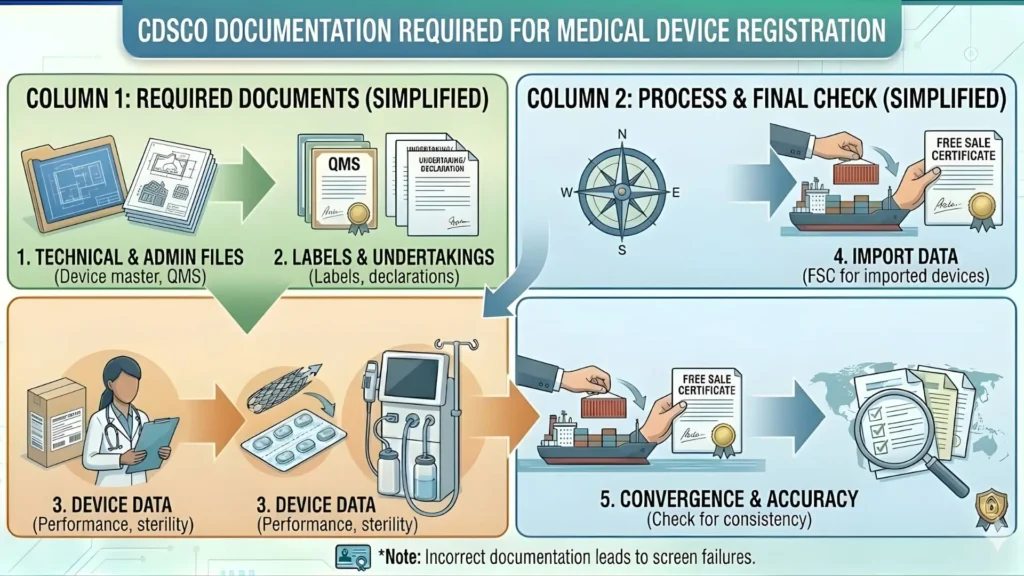
Documents Required for Medical Device Registration For Massagers
Preparing a complete and accurate application is critical. Incomplete submissions result in CDSCO queries that can delay your registration by months. Below is the standard documents checklist for 2026.
For Import Registration (Form MD-14)
| Document | Details |
| Application form (Form MD-14) | Submitted online via SUGAM portal |
| Free Sale Certificate (FSC) | Issued by competent authority in manufacturing country |
| CE Certificate or FDA 510(k) | Evidence of approval in the country of origin (Class B and above) |
| Test reports | Electrical safety (IEC 60601), EMC, and relevant performance standards |
| Technical file / Design dossier | Risk analysis, design documentation, performance data |
| Declaration of Conformity | Signed by manufacturer confirming standards compliance |
| Indian Authorized Agent agreement | Signed agreement appointing IAA with POA |
| ISO 13485 certificate | QMS certification of manufacturing facility |
| Labeling samples | Draft labels for India market in correct format |
| Instructions for Use (IFU) | In English; must describe intended use clearly |
| Undertaking from Indian importer | Legal responsibility declaration |
| Power of Attorney | Authorizing Indian agent to apply on behalf of foreign manufacturer |
For Manufacturing Registration (Form MD-3)
| Document | Details |
| Application form (Form MD-3) | For manufacturing license from State Drug Controller |
| Site master file | Description of manufacturing facility, processes, and controls |
| Layout plan of premises | Detailed floor plan with area designations |
| QMS documentation | SOPs, quality manual, validation records |
| Technical file for each device | Design dossier, risk file, testing data |
| Key personnel CVs | Qualifications of qualified person and QA head |
| Equipment list & calibration records | All manufacturing and testing equipment |
| ISO 13485 certificate (if available) | Strengthens application significantly |
Medica Device Registration For Massagers Fees and Validity
Government fees for CDSCO medical device registration depend on the applicant type (Indian MSME, large company, or foreign manufacturer) and the device class. Here are the current indicative fee structures.
| Application Type | Category | Indicative Fee (INR) |
| Import Registration (Form MD-14) | Indian MSME | Rs. 5,000 per device |
| Import Registration (Form MD-14) | Other Indian companies | Rs. 25,000 per device |
| Import Registration (Form MD-14) | Foreign manufacturer | Rs. 2,00,000 per device |
| Manufacturing License (Form MD-3) | Indian MSME | Rs. 2,500 per device |
| Manufacturing License (Form MD-3) | Other Indian companies | Rs. 12,500 per device |
| Annual license renewal | All categories | As prescribed under MDR 2017 |
Step By Step Process For Medical Device Registration For Massagers
| Stage | Action Required | Responsible Party |
| 1. Classify the device | Determine if massager is a medical device; identify risk class | Manufacturer / Regulatory consultant |
| 2. Appoint Indian agent | Execute IAA agreement with Power of Attorney | Foreign manufacturer |
| 3. Obtain FSC/CE/FDA | Get regulatory approval in country of origin | Foreign manufacturer |
| 4. Prepare technical file | Compile design dossier, test reports, QMS data | Manufacturer / IAA |
| 5. Prepare Indian labels | Draft labels compliant with MDR 2017 + Legal Metrology | IAA / Importer |
| 6. Apply on SUGAM | Submit Form MD-14 online with all documents and fees | IAA / Importer |
| 7. Respond to CDSCO queries | Address technical or administrative questions | IAA + Manufacturer |
| 8. Receive IRC | Obtain Import Registration Certificate from CDSCO | CDSCO issues to IAA |
| 9. Apply for import license | Submit to State Drug Controller for Form 10/10-A | Indian importer |
| 10. Commercial shipment | Proceed with import on commercial basis | Importer |
Common Mistakes to Avoid For Medical Device Registration For Massagers
These are the most frequently seen compliance errors that importers and manufacturers make when dealing with massager registration in India.
- Assuming all massagers are consumer goods: Many importers import electric massagers without checking if therapeutic claims trigger medical device regulations. Always review packaging and marketing claims before shipment.
- Not appointing an Indian Authorized Agent before shipping: Without an IAA, foreign manufacturers cannot obtain CDSCO registration. This is a prerequisite, not an afterthought.
- Submitting incomplete technical files: Missing ISO 13485 certificates, incomplete test reports, or unsigned declarations result in CDSCO queries and months of delay.
- Using unapproved label claims post-registration: Changing product claims after registration without informing CDSCO is a regulatory violation.
- Confusing BIS certification with CDSCO registration: BIS certification under the Electronics and IT Goods Order applies to electrical safety of consumer electronics. It does not replace CDSCO medical device registration.
- Ignoring eCommerce platform compliance updates: Platforms update their documentation requirements regularly. Brands must stay current with marketplace compliance notices.
- Not filing annual returns: Registered device holders are required to file annual reports. Failure to do so can result in license suspension.
Conclusion
Navigating CDSCO registration for massagers in India is not as complex as it looks — once you understand the key distinction: is your massager a wellness product or a medical device? That single question drives every compliance decision you need to make.
If your massager makes therapeutic claims, uses electrical stimulation technology, or is intended for clinical use, CDSCO registration is mandatory. Skipping it puts your business, your imports, and your marketplace listings at risk.
For pure wellness massagers with no medical claims, you still need to comply with Legal Metrology, BIS, and eCommerce platform rules — but the CDSCO registration requirement does not apply.
Whether you are a foreign manufacturer looking to enter India or a domestic brand building a massage device range, working with an experienced Indian regulatory consultant or Authorized Agent will save you time, prevent costly mistakes, and ensure your product reaches Indian consumers legally and efficiently.
Frequently Asked Questions
Is a massager a medical device in India?
Not necessarily. A massager becomes a medical device in India only if it is intended for use in the treatment, prevention, or alleviation of a disease or medical condition, or if it affects the structure or function of the human body. If your massager is marketed purely for relaxation and general wellness with no specific medical claims, it is typically not classified as a medical device.
Do I need CDSCO registration to import a back massager for personal use?
Personal-use imports are generally not subject to CDSCO registration. CDSCO registration applies to commercial imports — i.e., when you are importing massagers for sale in India. A single device for personal use, declared as such at customs, does not require a registration certificate.
Are TENS machines and EMS devices classified as medical devices in India?
Yes. TENS (Transcutaneous Electrical Nerve Stimulation) and EMS (Electrical Muscle Stimulation) devices are explicitly notified medical devices under India's Medical Devices Rules, 2017. They require CDSCO registration and an import license regardless of whether they are sold for home use or professional use.
What is the difference between CDSCO registration and an import license for massagers?
These are two separate authorizations. CDSCO Registration (Import Registration Certificate) is a product-level approval granted by the Central Drugs Standard Control Organisation confirming that the device is safe and effective. An Import License is an entity-level license granted by the State Drug Controller (State Licensing Authority) allowing a specific company to import that registered device commercially.
How long does CDSCO registration for a massager take?
The realistic timeline for CDSCO import registration is 3 to 9 months, depending on the completeness of your application, the number of query rounds, and the complexity of your device. Having all documents — FSC, test reports, ISO 13485, technical file — ready before applying significantly reduces delays.
Can I sell a massager on Amazon India without CDSCO registration?
You can sell a wellness massager (without medical claims) on Amazon India without CDSCO registration. However, if your product makes therapeutic claims or is classified as a medical device, you need valid CDSCO registration and an import license.
Is ISO 13485 certification mandatory for massager manufacturers in India?
ISO 13485 is not legally mandatory for Class A medical devices, but it is practically essential for Class B and above. State Drug Controllers and CDSCO expect evidence of a functioning QMS. For manufacturers exporting to India, ISO 13485 certification from the manufacturing facility is a standard requirement in the technical file.
What are the penalties for importing an unregistered medical device massager in India?
Importing an unregistered medical device is a violation of the Drugs and Cosmetics Act, 1940. Penalties can include confiscation of goods, cancellation of import privileges, fines, and in serious cases, criminal prosecution. Customs authorities are increasingly checking medical device compliance at ports.
Do massage chairs require CDSCO registration?
Standard massage chairs sold for relaxation and comfort generally do not require CDSCO registration. However, if a massage chair incorporates TENS/EMS technology, makes specific medical claims (e.g., treats lumbar disc disease), or is marketed for clinical/physiotherapy use, it may require registration. The label and marketing claims are the deciding factor.
What is the validity of a CDSCO Import Registration Certificate for massagers?
The validity period for CDSCO Import Registration Certificates is specified in the certificate itself and is subject to the conditions of MDR 2017. License holders are required to file annual returns and comply with post-market surveillance requirements.