- MD-16 is the prescribed application form and MD-17 is the grant of Import Test License issued by CDSCO for importing medical device samples for testing and evaluation.
- Any foreign manufacturer or Indian importer seeking to bring medical devices into India strictly for testing must obtain this license before shipment under the Medical Device Rules, 2017.
- The entire MD-16 and MD-17 process is completed online via the SUGAM portal — making it faster, paperless, and trackable from application to approval.
What Is an CDSCO Import Test License for Medical Devices in India?
If you are a foreign manufacturer, an Indian distributor, or a regulatory consultant trying to bring a medical device into India for the very first time, you already know the question that keeps coming up — can we import a few samples just to test them before committing to full registration?
The answer is yes, but there is a formal legal route you must follow. Under the Medical Device Rules, 2017 (MDR 2017), the Central Drugs Standard Control Organization (CDSCO) allows companies to import medical device samples specifically for the purpose of testing, evaluation, research, or clinical investigation — provided they hold a valid Import Test License.
This license is obtained through a two-form process:
- Form MD-16 is the application form you submit to CDSCO requesting permission to import medical device samples for testing.
- Form MD-17 is the official Import Test License document that CDSCO grants after reviewing and approving your MD-16 application.
MD-16 is what you apply with, and MD-17 is what you get back. Together, they define the legal framework for pre-market sample importation in India.
Legal Framework: Medical Device Rules, 2017 and the Role of CDSCO
India regulates medical devices through the Drugs and Cosmetics Act, 1940, and the Medical Device Rules, 2017 (MDR 2017), which came into effect on January 1, 2018. The MDR 2017 replaced the earlier Medical Devices Rules, 2006 and brought a structured, risk-based regulatory framework aligned with global standards.
CDSCO, operating under the Ministry of Health and Family Welfare, is the nodal authority that:
- Reviews and approves MD-16 applications
- Issues MD-17 Import Test Licenses
- Monitors compliance with conditions attached to the license
- Takes enforcement action in case of misuse or non-compliance
The key provisions governing Import Test License under MDR 2017 are:
| Rule / Section | What It Governs |
| Rule 23 & 24, MDR 2017 | Import of medical devices — general provisions |
| Form MD-16 | Application for Import Test License |
| Form MD-17 | Grant of Import Test License by CDSCO |
| Rule 37, MDR 2017 | Conditions attached to test license (quantity limits, end-use restrictions) |
| Rule 68, MDR 2017 | Fees payable for license applications |
| Schedule VI | Device classification (Class A, B, C, D) |
Who Needs an MD-16 Import Test License? — Eligibility Criteria
The MD-16 application and subsequent MD-17 grant are intended for a specific set of applicants. Before you invest time and resources in the application, make sure your situation falls within one of these categories:
Eligible Applicants
- Foreign manufacturers who want to send device samples to India for clinical evaluation, performance testing, or regulatory dossier preparation before applying for a full import license.
- Indian authorized agents or importers acting on behalf of a foreign manufacturer, who need device samples for quality testing, demonstration, or internal evaluation.
- Research institutions and hospitals participating in clinical investigations involving imported medical devices — especially for devices not yet commercially available in India.
- Regulatory affairs consultants and contract research organizations (CROs) helping foreign brands enter the Indian market.
- Indian distributors preparing for market entry and needing to demonstrate device performance to potential clients or regulatory bodies.
Who Does NOT Need This License?
- Entities that already hold a valid MD-15 Import License — they can import devices commercially without a separate test license (though they still cannot misuse commercial stock for testing purposes).
- Manufacturers importing devices exclusively for export without any domestic testing or sales.
- Import of in-vitro diagnostic (IVD) devices under a separate IVD-specific regulatory pathway, unless the device is also classified as a medical device.
| Quick Check: If your primary goal is to import a medical device sample to test it in a lab, evaluate it in a hospital, or prepare your technical dossier for full registration — you need Form MD-16 and will receive Form MD-17. |
Medical Device Classification Under MDR 2017 — Does It Affect Your Test License?
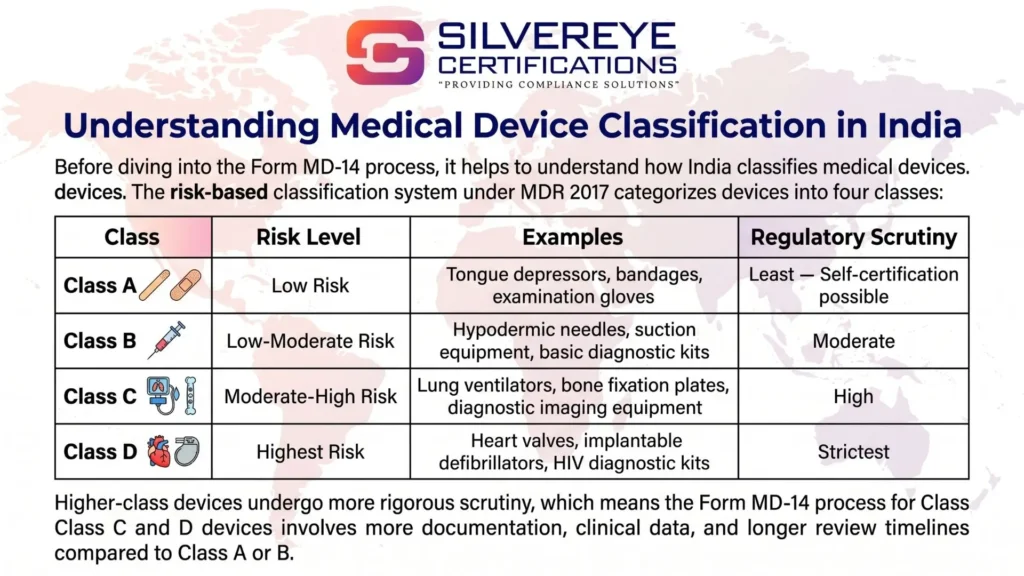
Yes, it absolutely does. Under MDR 2017, medical devices are classified into four risk-based classes:
| Class | Risk Level | Examples | CDSCO Review Intensity |
| Class A | Low Risk | Tongue depressors, bandages, stethoscopes | Self-certification / lighter scrutiny |
| Class B | Low-Medium Risk | Hypodermic syringes, blood pressure monitors | Moderate documentation review |
| Class C | Medium-High Risk | Ventilators, dialysis machines, CT scan components | Detailed technical dossier required |
| Class D | High Risk | Cardiac stents, implantable pacemakers, HIV test kits | Strictest scrutiny and additional data |
For Import Test License applications (MD-16), the class of your device influences:
- The depth of technical documentation you need to submit
- The review timeline at CDSCO
- Whether additional clinical or performance data is expected even at the testing stage
- The quantity of samples CDSCO may permit under MD-17
Class A and B devices generally see faster approval for test licenses. Class C and D devices require more robust supporting documentation even for a test import application.
Documents Required for MD-16 Application — Complete Checklist
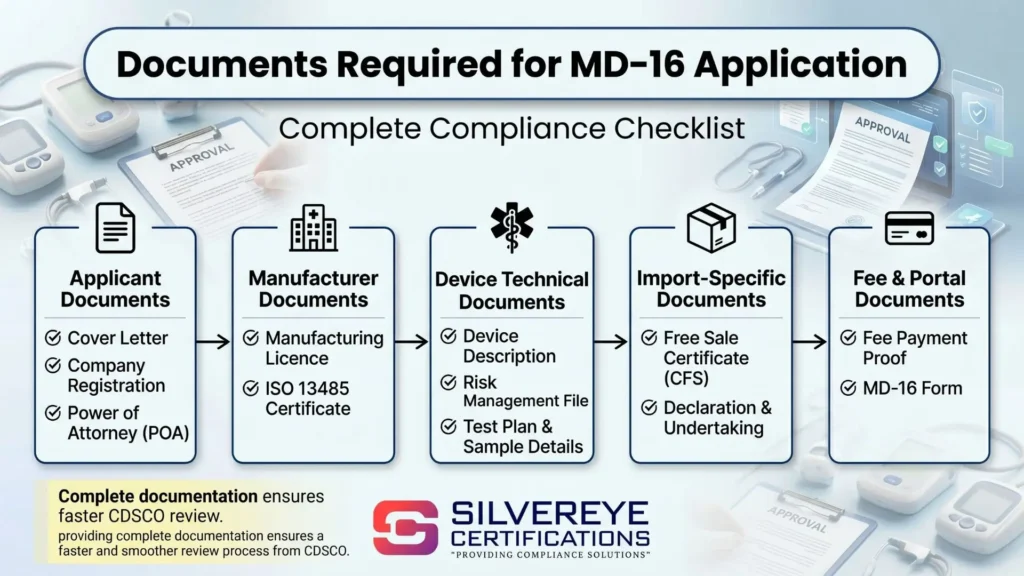
Getting the documentation right is arguably the most critical part of your MD-16 application. Incomplete or inconsistent documents are the single biggest reason applications get delayed or rejected at CDSCO. Here is the complete, up-to-date document checklist for 2026:
Part A — Applicant and Company Documents
- Covering letter on company letterhead, addressed to the concerned CDSCO Zonal Officer or Central Authority
- Certificate of Incorporation or Business Registration of the Indian applicant entity
- Power of Attorney (POA) from the foreign manufacturer authorizing the Indian applicant to apply on their behalf
- Address proof of the Indian applicant (registered office — utility bill, lease agreement, or GST registration)
Part B — Manufacturer Documents (Foreign Manufacturer)
- Certificate of Free Sale (CFS) from the country of origin — issued by the competent health authority or regulatory body
- ISO 13485:2016 Certificate of the manufacturer (quality management system certification)
- Manufacturing License or approval from the home country regulatory authority
- WHO-GMP Certificate (if applicable or if requested by CDSCO for specific device categories)
Part C — Device-Specific Technical Documents
- Device description and intended use — a clear, concise document explaining what the device does, how it works, and its intended patient population
- Device classification justification — a written rationale explaining under which CDSCO device category the product falls
- Technical specifications and product brochure
- Summary of safety and performance data — relevant clinical or bench-test data already available for the device
- Risk management summary (in line with ISO 14971)
- Regulatory approval from the country of origin (e.g., FDA 510(k), CE Mark, TGA approval) — if available
Part D — Import-Specific Documents
- Details of the proposed test plan — what will be tested, at which facility, and what the objectives are
- Name and address of the testing laboratory or hospital where evaluation will be conducted
- Quantity of samples requested (with justification for the quantity)
- Declaration that samples will not be commercially sold or distributed
- Undertaking that samples will be destroyed or returned after testing, if required by CDSCO
Part E — Fees and Portal Documents
- Proof of fee payment (challan or online payment receipt from the SUGAM portal)
- Duly filled Form MD-16 (generated and submitted via SUGAM portal)
Government Fees for MD-16 Application —Fee Structure
The fee for an Import Test License application under Form MD-16 is prescribed under Schedule VI of the MDR 2017. Fees are paid online via the SUGAM portal and are non-refundable regardless of the outcome of the application.
| Application Type | Applicable Fee (INR) | Notes |
| MD-16 Application — Import Test License | ₹2,000 | Per application, regardless of device class |
| Renewal of MD-17 Import Test License | ₹2,000 | Applicable at each renewal cycle |
| Amendment to existing MD-17 license | ₹1,000 | For minor changes like quantity, test facility |
| Duplicate license copy (MD-17) | ₹500 | If original is lost or damaged |
Fee payment is made online via the SUGAM portal using Net Banking, Credit/Debit Card, or NEFT/RTGS. Keep the payment reference number handy as it is required during form submission.
Step-by-Step Process to Apply for MD-16 Import Test License on SUGAM Portal
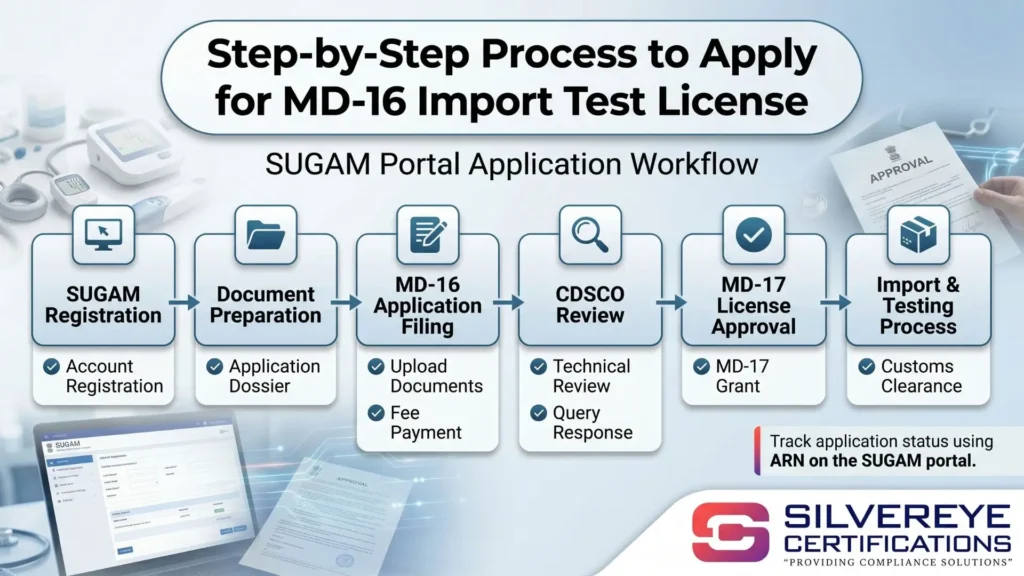
The entire MD-16 application process is online through the SUGAM portal. Here is the exact flow from registration to receiving your MD-17 license:
Step 1 — Register on the SUGAM Portal
- Visit sugam.gov.in and create a new account if you do not already have one.
- During registration, select 'Importer' as your role and enter your company details.
- Verify your email and mobile number to activate the account.
Step 2 — Prepare Your Application Dossier
- Compile all the documents listed in the checklist above.
- Scan all documents in PDF format. Each file should be under the prescribed size limit (typically 5MB per file on SUGAM).
- Ensure the device is listed in the notified medical devices list under MDR 2017, or confirm if it falls under the non-notified category.
Step 3 — File the MD-16 Application
- Log in to SUGAM portal and navigate to 'Medical Device' → 'Import' → 'Application for Import Test License (MD-16)'.
- Fill in all mandatory fields: applicant details, manufacturer details, device details, intended test purpose, quantity, and testing facility.
- Upload all supporting documents one by one.
- Pay the prescribed application fee online.
- Submit the application and note down your Application Reference Number (ARN) for tracking.
Step 4 — CDSCO Technical Review
- Your application is assigned to a Drug Inspector or Senior Drug Inspector at the relevant CDSCO division.
- The officer may raise a Query Letter if any document is missing or requires clarification. You typically get 30 days to respond.
- If your response is satisfactory, the file is forwarded to the Drugs Controller General of India (DCGI) or designated authority for final approval.
Step 5 — Grant of MD-17 Import Test License
- Once approved, CDSCO generates the Form MD-17 — your official Import Test License.
- You can download the signed MD-17 license from your SUGAM dashboard.
- The license will specify: device name, quantity permitted, validity period, testing facility, and any special conditions.
Step 6 — Use the License for Import
- Share the MD-17 license with your customs clearing agent.
- When the shipment arrives in India, submit the MD-17 license to the Port-of-Entry Drug Inspector along with commercial invoice, packing list, and airway bill or bill of lading.
- After testing is complete, comply with all end-use conditions — such as submitting a test report to CDSCO if required, or destroying/returning samples.
Processing Timeline — How Long Does MD-16 Approval Take?
One of the most common questions applicants ask is: how long does it take to get the MD-17 Import Test License? Here is a realistic breakdown based on the current CDSCO processing environment in 2026:
| Stage | Typical Timeframe |
| Document preparation and dossier building | 1–3 weeks |
| SUGAM portal submission and fee payment | 1 day |
| CDSCO initial scrutiny and queue time | 2–4 weeks |
| CDSCO query letter (if raised) + applicant response | 2–4 weeks additional |
| Final review and approval by DCGI/designated authority | 2–4 weeks |
| MD-17 license generation and download | 1–2 days after approval |
| Total estimated timeline (no queries) | 6–8 weeks |
| Total estimated timeline (with queries) | 10–14 weeks |
These timelines can vary depending on the device class (Class D takes longer), the completeness of your application, and CDSCO's workload at any given time. Applications with complete documentation, no discrepancies, and clear test rationale tend to process faster.
Validity, Renewal, and Amendment of MD-17 Import Test License
Validity Period
An MD-17 Import Test License is typically valid for one year from the date of issue. The license clearly specifies its validity period, which begins from the date printed on the MD-17 document.
Renewal Process
- A renewal application must be filed before the expiry of the current MD-17 license — ideally 60 days before expiry to avoid any import disruption.
- Renewal is done through the same SUGAM portal by filing a fresh MD-16 application along with renewal documents and the prescribed renewal fee.
- You will need to submit an updated test plan if the original testing period has extended or if additional quantities are required.
- If the MD-17 license expires and you have not renewed it, you must re-apply from scratch — there is no late renewal provision under MDR 2017.
Amendment to MD-17 License
If you need to make changes to an existing MD-17 license — such as adding a new testing facility, revising the quantity of samples, or updating the device description — you can apply for an Amendment via the SUGAM portal.
- Amendment fee: ₹1,000 as per the current fee schedule
- Supporting documents for the specific change must be attached
- CDSCO will review the amendment request and issue a revised MD-17 if approved
MD-16 vs MD-14 vs MD-15 — Understanding the Difference
Many applicants confuse the different CDSCO import forms. Here is a clear comparison so you know exactly which form applies to your situation:
| Form | Purpose | Who Uses It | License Granted |
| MD-14 | Application for Import License (commercial) | Importers who want to commercially import & sell medical devices in India | MD-15 — Import License |
| MD-15 | Grant of Import License (commercial) | Issued by CDSCO to authorize commercial import | Valid for commercial import & distribution |
| MD-16 | Application for Import Test License (non-commercial) | Importers, researchers, manufacturers for testing/evaluation only | MD-17 — Import Test License |
| MD-17 | Grant of Import Test License | Issued by CDSCO for sample import for testing only | Valid only for testing; no commercial use |
Navigating the SUGAM Portal for MD-16 Application
The SUGAM portal is the official online gateway for all CDSCO regulatory submissions. Here are practical, experience-based tips to make your MD-16 submission smoother:
- Create your SUGAM account well in advance — do not wait until the day you plan to submit. Account activation can take up to 48 hours.
- Use Google Chrome or Mozilla Firefox for the SUGAM portal. Internet Explorer and some versions of Edge have reported compatibility issues.
- All PDF uploads must be under 5 MB. Use a PDF compressor if your files are larger.
- Complete the application in a single session if possible. Draft applications saved on SUGAM have been known to time out or lose data.
- Double-check all device classification fields before submitting — wrong classification is one of the most common errors that triggers a query.
- Keep a copy of your Application Reference Number (ARN). You will need it for all future communication with CDSCO and for tracking your application status.
- Check your registered email regularly. CDSCO sends query letters and approval notifications to the email linked to your SUGAM account.
Key Benefits of Obtaining an MD-17 Import Test License
Beyond legal compliance, there are real strategic and business benefits to securing your MD-17 Import Test License before entering the Indian market:
- Legal entry point: the most straightforward, legally recognized path to bring your device physically to India before full market authorization.
- Enables real-world data collection: you can gather Indian patient data, conduct performance evaluations in Indian clinical settings, and build a locally relevant technical dossier for your MD-14/MD-15 application.
- Reduces full registration risk: testing your device before committing to full registration helps identify any compliance gaps, regulatory mismatches, or performance issues specific to the Indian market.
- Supports clinical trial applications: for devices requiring clinical investigation, the MD-17 license can be used in conjunction with clinical trial approvals to import investigation devices.
- Strengthens commercial relationships: demonstrating a device in a hospital or lab environment under a legal license builds trust with potential Indian distributors, hospital procurement teams, and KOLs (key opinion leaders).
- Demonstrates regulatory seriousness: Indian hospitals, distributors, and government tenders increasingly prefer foreign manufacturers who have initiated regulatory activity in India — an active MD-17 license shows commitment.
What Comes After the MD-17 Import Test License? — Your Path to Full Registration
The MD-17 Import Test License is a stepping stone, not the final destination. After your testing phase is complete and you have the data you need, the next steps typically look like this:
Compile test results and evaluation reports from the India-based testing.
- Prepare the full Technical Dossier as per MDR 2017 Schedule V requirements.
- Apply for MD-14 (Import License Application) via the SUGAM portal, which, if approved, results in the issuance of MD-15 (Import License) — allowing full commercial import and sale in India.
- For Class C and Class D devices, you may also need to obtain approval from the technical committee and the apex committee before the Import License is issued.
- Once the MD-15 Import License is in place, commercial distribution through registered Indian importers and distributors can begin.
Recent CDSCO Updates Affecting MD-16 & MD-17 Applications
Staying current with CDSCO regulatory changes is critical. Here are the most relevant recent updates that affect Import Test License applications:
- SUGAM Portal Upgrades (2024–2025): CDSCO has continued upgrading the SUGAM portal with better document upload management, application tracking dashboards, and faster query response mechanisms. Applicants are encouraged to use the latest portal version.
- Enhanced Device Traceability Requirements: CDSCO has been progressively implementing UDI (Unique Device Identification) requirements. While test imports are not yet mandated to carry UDI labels, this may change — stay updated.
- Notified Medical Devices List Expansion: Several new device categories have been brought under MDR 2017 regulation in 2024–2025. If your device has been newly notified, it may now require formal CDSCO approval even for test imports.
- Risk-Based Review Approach: CDSCO has adopted a more risk-proportionate review approach, meaning Class A and B device test license applications receive faster processing, while Class C and D receive more detailed technical scrutiny.
- Reciprocity with Trusted Countries: Devices already approved by FDA, EMA, TGA, Health Canada, PMDA, and certain other regulators are being reviewed with greater deference at CDSCO, particularly for Class C and D devices — which benefits test license applications for such devices.
Conclusion — Your Roadmap to a Successful MD-17 Import Test License
If you are planning to enter the Indian medical device market, the Import Test License — obtained through Form MD-16 and granted as Form MD-17 — is one of the first and most important regulatory steps you will take. It is not just a formality. It is your legal gateway to testing your device in India, gathering market-relevant data, and building the regulatory foundation for full commercial registration.
The process, while structured, is very manageable with the right preparation. The SUGAM portal has made submissions faster and more transparent. CDSCO's move towards a risk-based, digitized review process means that well-prepared applications — particularly for lower-risk device classes — are moving through the pipeline more efficiently than ever before.
Here is your final quick-action checklist:
- Confirm your device is notified under MDR 2017 and determine its risk class
- Identify and appoint a qualified Indian authorized agent if you are a foreign manufacturer
- Compile all required documents — with extra attention to certificates, POA notarization, and your test plan
- Register on the SUGAM portal and submit your MD-16 application with the correct fee
- Monitor your application regularly and respond to any CDSCO queries within the stipulated timeframe
- After receiving MD-17, use your testing period strategically to build data for your full MD-14/MD-15 registration
Frequently Asked Question
What is the difference between Form MD-16 and Form MD-17?
Form MD-16 is the application form you submit to CDSCO to request permission to import medical device samples for testing. Form MD-17 is the Import Test License that CDSCO issues after approving your application.
Can I import any quantity of samples under MD-17?
No. The MD-17 license specifies the exact quantity of samples authorized for import. You cannot import more units than what is mentioned on the license. If you need additional samples, you must apply for an amendment to the existing license or file a fresh MD-16 application.
Is the MD-17 Import Test License required for all medical devices?
The MD-17 license is required for all medical devices notified under MDR 2017 when importing samples for testing and evaluation. If a device category has not yet been notified under the MDR 2017, the regulatory requirement may differ — consult a CDSCO-registered regulatory consultant to confirm before proceeding.
How long is the MD-17 Import Test License valid?
No. Devices imported under an MD-17 Import Test License cannot be sold, rented, distributed, or used for any commercial purpose. They are strictly limited to testing, evaluation, research, or clinical investigation as specified in the license. Violation of this condition is a serious regulatory offence.
What is the government fee for MD-16 application?
As per the current MDR 2017 Schedule VI, the application fee for MD-16 (Import Test License) is ₹2,000. This fee is payable online via the SUGAM portal and is non-refundable. Verify the exact current fee on the CDSCO website before payment.
Can a foreign manufacturer directly apply for MD-16, or does it need an Indian agent?
A foreign manufacturer must typically appoint an Indian authorized agent or importer who will be the legal applicant for the MD-16 on the SUGAM portal. The license (MD-17) will be issued in the name of the Indian applicant entity. The foreign manufacturer grants authority through a Power of Attorney.
How can I track my MD-16 application status?
After submitting your MD-16 application on the SUGAM portal, you will receive an Application Reference Number (ARN). You can log in to the SUGAM portal at any time and track your application status using this ARN.
What happens if CDSCO raises a query on my MD-16 application?
CDSCO sends a Query Letter through the SUGAM portal and your registered email, listing the specific documents or clarifications required. You typically have 30 days to respond with the requested information.
Can I use the devices imported under MD-17 in a clinical trial?
Yes, but with conditions. If the purpose specified in your MD-16 application includes clinical investigation or clinical trial use, and CDSCO approves it, the MD-17 license allows those devices to be used in a clinical trial setting.