- CDSCO Registration for ENT Medical Devices is legally mandatory in India under the Medical Device Rules (MDR), 2017 — no ENT device can be manufactured, imported, or sold without a valid CDSCO license.
- ENT devices span Class A to Class D depending on risk — from basic diagnostic instruments like otoscopes (Class A/B) to cochlear implants and ENT lasers (Class C/D) — each class has a distinct registration pathway.
- The application is filed on the CDSCO SUGAM portal domestic manufacturers use Form MD-3/MD-9 while importers use Form MD-14 / Form MD-15, both governed by MDR 2017.
- A CDSCO device registration/license is valid for 5 years and must be renewed before expiry — operating without renewal is a punishable offence under the Drugs and Cosmetics Act, 1940.
Introduction
If you are a manufacturer, importer, or distributor of ENT (Ear, Nose, and Throat) medical devices in India, understanding CDSCO Registration for ENT Medical Devices is not optional — it is the foundation of your legal market presence. India is one of the largest and fastest-growing markets for ENT healthcare globally, driven by rising incidences of hearing loss, chronic sinusitis, sleep apnea, and upper respiratory disorders.
The Central Drugs Standard Control Organization (CDSCO), operating under India's Ministry of Health and Family Welfare, is the apex regulatory authority for all medical devices in India. Since the Medical Device Rules (MDR), 2017 came into full effect, every ENT medical devices — from a simple otoscope to a cochlear implant — requires a CDSCO registration or license before it can be legally manufactured, imported, distributed, or sold.
What Is CDSCO Registration for ENT Medical Devices?
CDSCO Registration for ENT Medical Devices refers to the official regulatory approval process through which ENT devices — instruments, implants, diagnostic tools, and therapeutic equipment used in Ear, Nose, and Throat medicine — are authorized for manufacture, import, and commercial sale in India.
This registration is issued by the Central Drugs Standard Control Organization (CDSCO) — India's national regulatory authority for medical devices — under the Medical Device Rules (MDR), 2017, which is framed under the Drugs and Cosmetics Act, 1940.
Depending on whether you are a domestic manufacturer or an importer, the type of registration certificate or license differs:
| Applicable Form | License/Certificate Issued | Issuing Authority |
| Form MD-3 | Form MD-5 (Manufacturing License) | State Licensing Authority (SLA) |
| Form MD-7 | Form MD-9 (Manufacturing License) | CDSCO (Central Licensing Authority) |
| Form-14 (Form 27 for Class A) | Form MD-15 (Import License) | CDSCO (Central Licensing Authority) |
| Form MD-41 & MD-42 | Form MD-42 | State Licensing Authority (SLA) |
| Key Regulatory Reference — 2026 Governing Law: Drugs and Cosmetics Act, 1940 (as amended through 2023)Applicable Rules: Medical Device Rules (MDR), 2017 Regulatory Authority: CDSCO, Ministry of Health & Family Welfare, Government of India Application Portal: SUGAM Online Portal Relevant Notification: Medical Devices (Amendment) Rules, 2020 / 2022 amendments |
Which ENT Medical Devices Require CDSCO Registration?
ENT medicine covers a broad range of devices — from basic diagnostic tools to complex implantable systems. Under MDR 2017, medical devices are defined broadly to include instruments, apparatus, appliances, implants, materials, or other articles intended for use in human beings for diagnostic or therapeutic purposes.
The following ENT device categories require CDSCO registration in India:
Ear (Otology) Devices
- Hearing aids (BTE, ITE, ITC, CIC, RIC) — Class B
- Cochlear implants — Class C or D
- Bone-anchored hearing systems (BAHS) — Class C
- Tympanostomy tubes (ear tubes / grommets) — Class B
- Otoscopes and video otoscopes — Class A or B
- Audiometers and tympanometers — Class B
- Ear irrigation / cerumen management devices — Class A or B
- Otologic surgical instruments (curettes, forceps) — Class A or B
- Ossicular prostheses (TORP, PORP) — Class C
- Ear wax removal kits — Class A
Nose (Rhinology) Devices
- Nasal speculums and rhinoscopes — Class A
- Nasal dilators and stents — Class B
- Functional Endoscopic Sinus Surgery (FESS) instruments — Class B
- Nasal splints and septal buttons — Class B
- Nasal polyp forceps and micro-debriders — Class B
- Sinoscopes and rigid nasal endoscopes — Class B
- Nasal irrigation systems — Class A or B
- Nasal packing / hemostatic agents — Class B
Throat (Laryngology / Pharyngology) Devices
- Laryngoscopes (direct and video) — Class A or B
- Laryngeal stents and voice prostheses — Class C
- Microlaryngeal forceps and scissors — Class B
- Tracheal stents — Class C
- Tracheostomy tubes and accessories — Class B or C
- Pharyngeal / tonsil surgical instruments — Class B
- Coblation wands for ENT — Class C
- Flexible nasopharyngoscopes — Class B
- Sleep apnea oral appliances and mandibular advancement devices — Class B
ENT Diagnostic, Imaging & Therapeutic Systems
- ENT surgical navigation systems — Class C or D
- ENT laser systems (CO2, KTP, Nd:YAG) — Class C or D
- Surgical microscopes for ENT — Class B
- ENT-specific ultrasound systems — Class B or C
- Balloon sinuplasty kits — Class C
- Powered ENT shavers / microdebrider systems — Class B or C
- ENT endoscopy towers and camera systems — Class B
| Important Note on Device Classification The classification of ENT medical devices can vary depending on intended use, level of invasiveness, duration of contact with the body, and the specific body system involved. CDSCO follows the classification criteria under Schedule II of MDR 2017. Always verify your specific device's classification through CDSCO's device classification tool on the SUGAM portal or consult a qualified regulatory expert before applying. Misclassification of a device is a common reason for application rejection or delays — it is critical to get this right before filing. |
Classification of ENT Medical Devices Under MDR 2017
Understanding the classification of your ENT device is the first and most critical step in the CDSCO registration process. The Medical Device Rules, 2017, classifies all medical devices into four risk-based classes:
| Class | Risk Level | ENT Device Examples | Licensing Authority | Key Forms |
| Class A | Low Risk | Otoscopes, nasal speculums, tongue depressors, ear wax kits | State Licensing Authority (SLA) | MD-3 / MD-5 (Mfg) | Form 27 (Import) |
| Class B | Low-Moderate Risk | Hearing aids, tympanostomy tubes, audiometers, FESS instruments, laryngoscopes, tracheostomy tubes | SLA (Mfg) / CDSCO (Import) | MD-3 / MD-5 (Mfg) | Form-14 / MD-15 (Import) |
| Class C | Moderate-High Risk | Cochlear implants, ossicular prostheses, tracheal stents, balloon sinuplasty, powered shavers | CDSCO (Central) | MD-3 / MD-9 (Mfg) | Form-14 / MD-15 (Import) |
| Class D | High Risk | Active cochlear implants, ENT lasers (high-power), surgical navigation systems, active implantable devices | CDSCO (Central) | MD-3 / MD-9 (Mfg) | Form-14 / MD-15 (Import) |
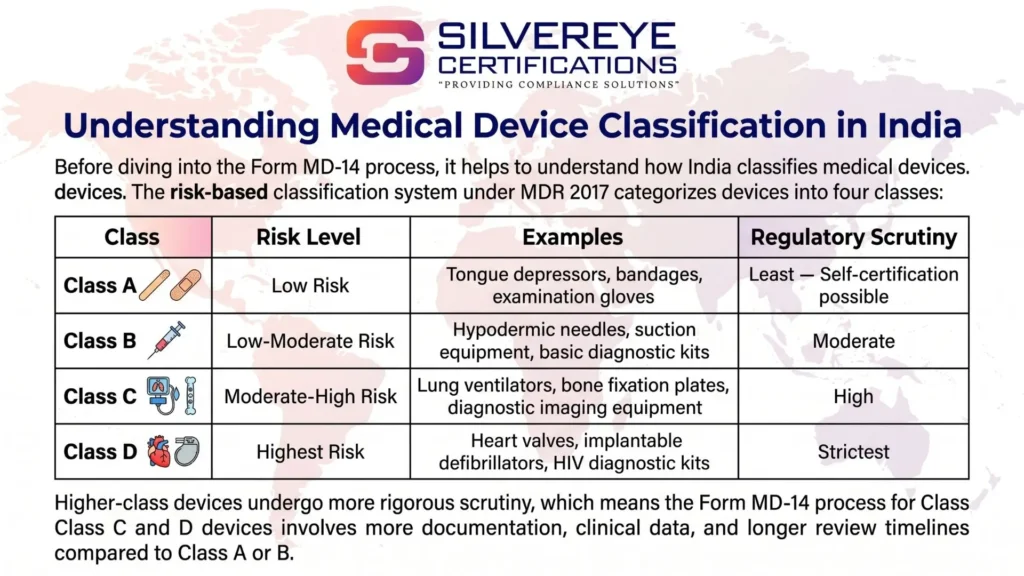
The classification determines which regulatory authority handles your application, the complexity of your technical dossier, the fee structure, and the timeline for approval. Higher-class devices require more extensive documentation and are subject to more rigorous scrutiny.
Why Is CDSCO Registration Mandatory for ENT Medical Devices?
India's medical device regulatory framework underwent a significant transformation when the Medical Device Rules, 2017 replaced the earlier regulatory provisions under the Drugs and Cosmetics Act. From April 1, 2020, all medical devices — including ENT devices — became mandatorily regulated.
Here is why CDSCO Registration for ENT Medical Devices is non-negotiable:
- Legal Compliance: Manufacturing, importing, or selling any ENT medical device without a valid CDSCO registration is a punishable offence under Section 18 of the Drugs and Cosmetics Act, 1940. Penalties include cancellation of license, seizure of goods, fines, and imprisonment.
- Patient Safety: ENT devices — especially implantables like cochlear implants, tympanostomy tubes, and ossicular prostheses — operate in highly sensitive anatomical areas. Regulatory oversight ensures quality and safety standards are met before devices reach patients.
- Market Access: Hospitals, ENT clinics, audiological centres, and online marketplaces require valid CDSCO registration proof before stocking or selling your device. Government tenders also mandate CDSCO compliance.
- Customs Clearance: Import consignments for ENT devices require valid CDSCO Import License documentation at Indian ports of entry. Without it, shipments are held or confiscated.
- Trust and Credibility: CDSCO registration signals compliance with India's national quality and safety framework — critical for building trust with ENT specialists, hospitals, and procurement committees.
- Export Opportunity: Several countries require proof of home country regulatory approval before granting market access. A CDSCO license strengthens your regulatory dossier for export markets.
Eligibility Criteria for CDSCO Registration of ENT Medical Devices
The eligibility requirements differ based on whether the applicant is a domestic manufacturer or an importer. Here are the detailed criteria:
For Domestic Manufacturers
- The manufacturer must be a legally registered entity in India — Private Limited Company, LLP, Partnership Firm, Sole Proprietorship, or Government entity.
- Premises: The manufacturing site must meet the requirements of Schedule I of MDR 2017, which specifies minimum infrastructure, equipment, and quality management system (QMS) requirements for medical device manufacture.
- For Class A and B devices, the QMS should align with ISO 13485 principles, though formal certification may not be mandated. For Class C and D, ISO 13485 certification is mandatory.
- Technical Competence: The applicant must have a qualified person responsible for regulatory compliance and quality management.
- All manufacturing facilities are subject to inspection by the licensing authority before the license is granted.
For Importers / Authorized Indian Agents (AIA)
- The AIA must be a legally registered entity in India with a valid address, GST registration, and applicable trade license.
- Single AIA Rule: A foreign manufacturer can appoint only one Authorized Indian Agent per device or device category for a given import license application.
- The foreign manufacturer must hold a valid manufacturing license and Good Manufacturing Practice (GMP) certification or ISO 13485 certification from the country of origin.
- The ENT device must be approved/freely sold in the country of origin and must have a valid Free Sale Certificate (FSC) or Certificate of Marketability (CMC).
- The AIA must have adequate premises for storage of imported ENT devices with appropriate conditions as per MDR 2017.
For the ENT Device (Product Eligibility)
- The device must have a clearly defined intended use aligned with its risk classification
- Performance and safety data must be available — clinical evaluation, biocompatibility data (ISO 10993), and applicable performance standards
- The device must not be recalled, banned, or under regulatory action in the country of manufacture or any other major regulatory market
- Labelling must comply with Schedule V of MDR 2017
- Software-driven ENT devices (e.g., diagnostic AI tools, ENT navigation) must also comply with CDSCO's software-as-medical-device (SaMD) guidelines if applicable
Documents Required for CDSCO Registration of ENT Medical Devices
The documentation requirements vary by device class and applicant type. Below is a comprehensive list covering both domestic manufacturer and importer pathways. All foreign documents must be in English or accompanied by certified English translations, and must be apostilled or consularly legalized as applicable.
Documents for Importers (Form-14 / Form MD-15) — Class B, C, D ENT Devices
| S.No. | Document | Class B | Class C/D |
| 1 | Duly filled Form-14 on SUGAM portal (signed by AIA) | ✔ | ✔ |
| 2 | Certificate of Incorporation / Business Registration of AIA in India | ✔ | ✔ |
| 3 | AIA Appointment Letter from Foreign Manufacturer (notarized) | ✔ | ✔ |
| 4 | Power of Attorney from Foreign Manufacturer in favour of AIA (apostilled) | ✔ | ✔ |
| 5 | Free Sale Certificate (FSC) / Certificate of Marketability from Country of Origin | ✔ | ✔ |
| 6 | GMP / ISO 13485 Certificate of Foreign Manufacturer | ✔ | ✔ |
| 7 | Undertaking from Foreign Manufacturer (CDSCO format) | ✔ | ✔ |
| 8 | Technical Dossier: Device Description, Specifications, Intended Use | ✔ | ✔ |
| 9 | Performance Test Reports (per applicable IEC/ISO standards) | ✔ | ✔ |
| 10 | Risk Analysis Report (ISO 14971) | ✔ | ✔ |
| 11 | Biocompatibility Data (ISO 10993) — for body-contact devices | Conditional | ✔ |
| 12 | Clinical Evaluation Report (ISO 14155 / MEDDEV 2.7.1) | Conditional | ✔ |
| 13 | Sterility and Shelf-life Data (for sterile ENT devices) | Conditional | ✔ |
| 14 | User Manual / Instructions for Use (IFU) in English | ✔ | ✔ |
| 15 | Labelling Details per Schedule V of MDR 2017 | ✔ | ✔ |
| 16 | List of Countries where device is marketed | ✔ | ✔ |
| 17 | Proof of Government Fee Payment (SUGAM Challan) | ✔ | ✔ |
| 18 | Premises / Storage Facility Declaration by AIA | ✔ | ✔ |
| 19 | Electrical Safety & EMC Test Reports (for powered ENT devices) | Conditional | ✔ |
| 20 | Software Documentation (for software-driven ENT devices) | Conditional | ✔ |
| 21 | Post-Market Surveillance Plan | Conditional | ✔ |
Documents for Domestic Manufacturers (Form MD-3 / MD-5 or MD-9)
- Duly filled Form MD-3 on SUGAM portal
- Certificate of Incorporation / Business registration of manufacturing entity
- Site Master File (SMF) — detailed description of manufacturing premises and operations
- Floor plan and layout of manufacturing facility
- List of manufacturing equipment and calibration records
- Quality Management System documentation (SOP manual, QMS plan)
- ISO 13485 Certificate (mandatory for Class C/D; recommended for Class A/B)
- Technical Dossier: design, manufacturing process, material specifications
- Performance test reports and risk analysis (ISO 14971)
- Biocompatibility data (ISO 10993) for body-contact ENT devices
- Clinical evaluation report (for Class C/D devices)
- Labelling per Schedule V of MDR 2017
- Declaration of Conformity
- Proof of government fee payment
- Undertaking regarding compliance with MDR 2017 requirements
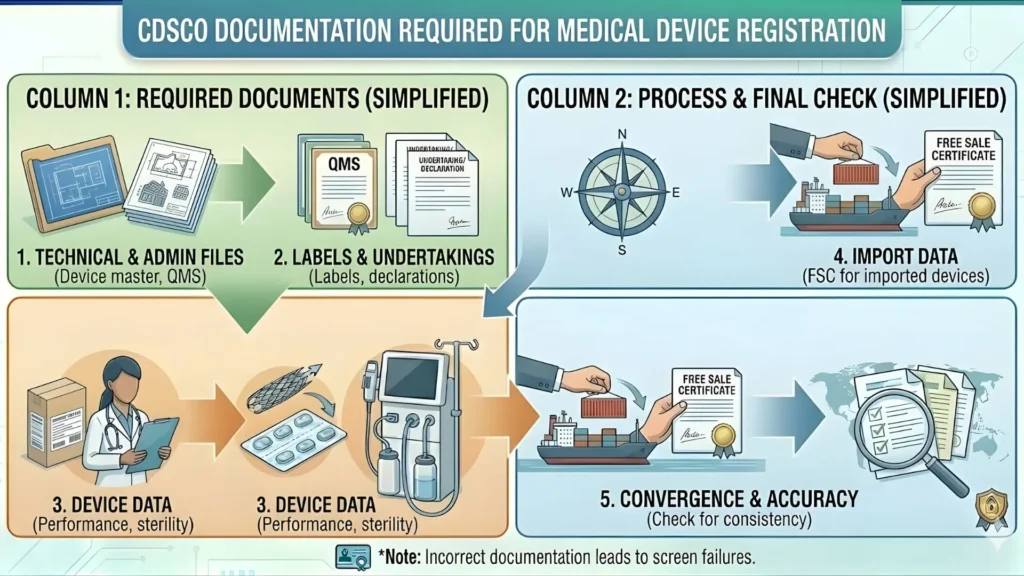
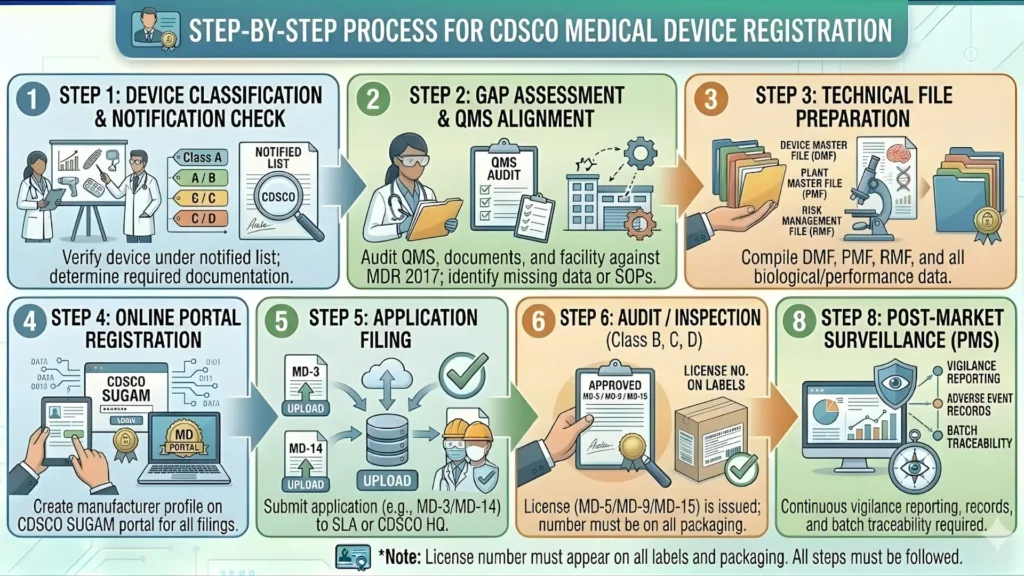
Step-by-Step Process for CDSCO Registration of ENT Medical Devices
The CDSCO registration process for ENT medical devices follows a structured pathway. Here is the complete step-by-step guide for 2026:
Step 1: Determine Device Classification
Before anything else, confirm your ENT device's classification under Schedule II of MDR 2017 — Class A, B, C, or D. This determines the licensing authority (SLA vs CDSCO), the forms required, the fee, and the technical dossier depth. Use the device classification guidance on the SUGAM portal or consult a regulatory expert.
Step 2: Register on the SUGAM Portal
Create an account on CDSCO's SUGAM online portal at sugam.cdsco.gov.in. For importers, register as an Authorized Indian Agent (AIA). For domestic manufacturers, register as a manufacturer. All CDSCO ENT device registration applications are filed exclusively through SUGAM — physical filing is no longer accepted for new applications.
Step 3: Prepare the Technical Dossier
Compile the complete technical dossier for your ENT device. This includes device description, performance data, risk analysis, clinical evaluation, biocompatibility data, labelling, and all supporting documents listed in Section 6. The quality of your dossier is the single biggest factor in determining approval speed and avoiding queries.
Step 4: Appoint AIA (For Importers)
The foreign manufacturer must formally appoint an Authorized Indian Agent (AIA) through a notarized appointment letter and apostilled Power of Attorney. The AIA will be the license holder and legal representative before CDSCO in India.
Step 5: Pay Government Fee
Calculate and pay the prescribed government fee through the SUGAM portal using the challan mechanism. The fee depends on the device class (see Section 8 for fee details). Always retain the official payment receipt for upload with the application.
Step 6: File Application on SUGAM Portal
Log in to SUGAM, select the appropriate application type (manufacture/import, device class), fill in all required fields, upload all documents in the prescribed format (PDF, within size limits), and attach the payment challan. Submit the application and note your Application Reference Number for follow-up.
Step 7: Initial Scrutiny by CDSCO
After submission, CDSCO's designated officer conducts an initial scrutiny to check completeness. If any deficiencies are found at this stage, a deficiency letter is issued. The applicant must respond with corrections within the stipulated time (typically 30 days).
Step 8: Technical Evaluation / Expert Committee Review
For Class C and D ENT devices, the application may be referred to an Expert Committee for technical evaluation. The committee may request additional data, clinical evidence, or a product demonstration. This step is not typically required for Class A and B devices unless complexity warrants it.
Step 9: Site Inspection (For Manufacturers)
For domestic manufacturers, the licensing authority (SLA for Class A/B, CDSCO for Class C/D) conducts a physical inspection of the manufacturing premises to verify GMP compliance, facility infrastructure, QMS implementation, and equipment calibration. The manufacturing license is not granted until inspection clearance is received.
Step 10: Grant of License / Registration Certificate
Once CDSCO or SLA is satisfied with the application, technical evaluation, and inspection (where applicable), the registration certificate or import license is issued. For importers this is Form MD-15; for manufacturers it is Form MD-5 (Class A/B) or Form MD-9 (Class C/D). The certificate is available for download on SUGAM.
Government Fee Structure for CDSCO ENT Medical Device Registration
The government fee for CDSCO registration of ENT medical devices is prescribed under the First Schedule to the Medical Device Rules, 2017. The fee varies by device class and application type. The following are the current standard fee rates:
| Application Type | Device Class | Fee (INR) | Remarks |
| Import License Application (Form-14) | Class A | Rs. 1,000 per device | Filed as Form 27 for Class A imports |
| Import License Application (Form-14) | Class B | Rs. 5,000 per device | Via SUGAM portal |
| Import License Application (Form-14) | Class C | Rs. 25,000 per device | Expert committee review may apply |
| Import License Application (Form-14) | Class D | Rs. 50,000 per device | Full technical evaluation required |
| Manufacturing License (Form MD-3) | Class A/B | Rs. 3,500 per category | State licensing authority |
| Manufacturing License (Form MD-3) | Class C/D | Rs. 50,000 per device | CDSCO — includes inspection |
| License Renewal (All Types) | All Classes | Same as original application fee | File 6 months before expiry |
| License Amendment | All Classes | Rs. 2,500 per amendment | For changes to AIA, address, models |
| Duplicate License | All Classes | Rs. 500 | In case of loss/damage |
Validity and Renewal of CDSCO ENT Medical Device Registration
Validity Period
A CDSCO registration certificate or import license for ENT medical devices is valid for 5 years from the date of grant. The validity period is printed on the face of the license/certificate. Both manufacturing licenses (Form MD-5 / MD-9) and import licenses (Form MD-15) have the same 5-year validity.
Renewal Process — Key Points
- Renewal application must be filed on the SUGAM portal before the expiry of the existing license. CDSCO strongly recommends initiating the renewal process at least 6 months before the expiry date to allow adequate processing time.
- The renewal application requires filing of the same form as the original application (Form MD-3 or Form-14) with updated documents — including a current GMP/ISO 13485 certificate, valid FSC (for importers), and updated technical dossier if there have been any design or labelling changes.
- Operating with an expired CDSCO registration — even by a single day — is a regulatory violation. If renewal is pending and the license is about to expire, the licensee must suspend import/manufacturing operations until renewal is granted.
- There is no concept of automatic renewal. Each renewal must be formally applied for with the full fee and requisite documentation.
- If a renewal application is filed before the expiry of the existing license and CDSCO processing is pending, the licensee may continue operations under the existing license while the renewal is under review — confirm this with CDSCO for your specific situation.
Amendment to Existing Registration
An amendment to the existing registration is required when there are changes in:
- Name, address, or legal status of the AIA / manufacturer
- Manufacturing site of the ENT device
- Addition of new ENT device models or variants under the same manufacturer/brand
- Changes in device name, labelling, or specifications
- Change in foreign manufacturer's name or ownership
- Change in intended use or classification-relevant design modification
Labelling Requirements for ENT Medical Devices in India — MDR 2017
All ENT medical devices manufactured in India or imported for sale must comply with the labelling requirements under Schedule V of the Medical Device Rules, 2017. Non-compliant labelling is one of the most common reasons for CDSCO queries and product recalls.
- Mandatory labelling elements for ENT medical devices include:
- Name of the device and generic name (e.g., Cochlear Implant — Active Implantable Medical Device)
- Model number, lot/batch number, and serial number (for implantable devices)
- Date of manufacture and expiry date (for sterile/time-limited devices)
- Name and address of manufacturer (foreign or domestic)
- Name and address of AIA / importer (with CDSCO Import License number — Form MD-15 reference)
- Instructions for Use (IFU) in English — and regional languages where mandated
- Storage and handling conditions
- Sterilization method and sterility indicators (for sterile ENT devices)
- Country of origin
- Single-use designation or instructions for reuse/reprocessing (where applicable)
- Caution statements per CDSCO requirements (e.g., 'Caution: Federal law restricts this device to sale by or on the order of a physician')
- Applicable standards and certifications (CE, ISO, IEC references)
- MRI compatibility information (for implantable ENT devices like cochlear implants)
Common Reasons for CDSCO ENT Device Registration Rejection or Delay
Understanding what causes rejections and delays helps you prepare stronger applications. These are the most frequently observed issues in CDSCO ENT device registration:
| Issue | Typical Impact | Preventive Action |
| Wrong device classification filed | Rejection / Resubmission | Confirm classification via SUGAM classification tool or regulatory consultant before filing |
| FSC not issued by competent national authority | Query / Rejection | Obtain FSC from the national regulatory authority of the country of origin, not a third-party certifier |
| Performance test reports not to applicable IEC/ISO standards | Query | Verify required standards for your specific ENT device category before commissioning tests |
| Technical dossier incomplete or poorly structured | Multiple queries / delays | Use CDSCO's published dossier structure guidance; engage a qualified regulatory affairs professional |
| Biocompatibility data absent for body-contact ENT devices | Query / Rejection | Include ISO 10993 biocompatibility evaluation data for all ENT devices that contact body tissues |
| Foreign documents not apostilled / legalized | Query / Rejection | Apostille all foreign documents before submission — check Hague Convention membership of country |
| GMP / ISO 13485 certificate expired | Rejection | Verify certificate validity; renew before filing application |
| Labelling non-compliant with Schedule V | Query | Have all labelling reviewed against Schedule V requirements before filing |
| Late or inadequate response to CDSCO queries | Application abandonment | Monitor SUGAM portal daily; respond to queries within 30 days with complete information |
| AIA appointment letter missing mandatory details | Query | Use CDSCO's published format for AIA appointment letters and Power of Attorney |
Benefits of CDSCO Registration for ENT Medical Devices
Beyond regulatory compliance, obtaining CDSCO Registration for ENT Medical Devices unlocks significant business and clinical benefits:
- Legal Market Access: Sell or distribute your ENT devices through any channel — public hospitals, private ENT clinics, audiological centres, e-commerce platforms, and retail — without regulatory risk.
- Government Tender Eligibility: Central and state government ENT procurement tenders — including devices supplied under National Programme for Prevention and Control of Deafness (NPPCD) and ADIP scheme — mandatorily require CDSCO registration.
- E-Commerce Platform Listing: Amazon India, Flipkart, and Tata 1mg require valid CDSCO registration / license numbers for listing medical devices. Without it, your ENT device listings will be removed.
- Hospital Procurement: NABL-accredited hospitals and corporate hospital chains (Fortis, Apollo, Manipal) have internal medical device procurement policies requiring CDSCO-registered devices only.
- Brand Credibility and Market Trust: CDSCO-registered ENT devices signal quality, safety, and regulatory compliance — essential for building trust with ENT surgeons, audiologists, and procurement decision-makers.
- Export Market Leverage: Indian CDSCO registration/license is recognized as evidence of regulatory approval by several importing countries, strengthening your regulatory dossier for international market access.
- Reduced Customs Risk: With a valid CDSCO Import License, your ENT device consignments clear Indian customs smoothly without risk of detention, confiscation, or penalty.
- Faster Line Extension: Once registered, adding new models or variants of the same ENT device brand is significantly faster and cheaper through the amendment process compared to fresh registrations.
Conclusion
CDSCO Registration for ENT Medical Devices is a structured, document-intensive process that demands regulatory precision, deep product knowledge, and proactive communication with CDSCO. With India's ENT healthcare market growing rapidly — driven by increasing hearing loss prevalence, expanding surgical ENT infrastructure, and government health programmes like NPPCD and ADIP — the opportunity for compliant ENT device manufacturers and importers is substantial.
The key to successful CDSCO ENT device registration lies in three things: accurate device classification, a comprehensive and well-structured technical dossier, and an experienced Authorized Indian Agent who actively manages CDSCO communications.
Whether you are bringing a cochlear implant from Germany, a balloon sinuplasty system from the USA, an audiology device from Denmark, or you are an Indian startup manufacturing ENT diagnostic instruments domestically — this guide gives you the foundational framework to approach CDSCO registration with clarity and confidence.
For complex ENT devices — particularly Class C and D implantable or active devices — professional regulatory guidance is highly advisable. Engaging a CDSCO-experienced medical device regulatory consultant early in your product development or import planning cycle significantly reduces registration timelines, query rates, and the risk of costly rejections.
Frequently Asked Questions
Is CDSCO registration mandatory for all ENT medical devices sold in India?
Yes. Under the Medical Device Rules (MDR), 2017, all medical devices — including ENT devices — are mandatorily regulated in India from April 1, 2020. Selling, importing, or manufacturing any ENT medical device without a valid CDSCO registration is a punishable offence.
What is the difference between CDSCO registration and an import license for ENT devices?
For domestic manufacturers, the outcome is a manufacturing license (Form MD-5 for Class A/B, Form MD-9 for Class C/D). For importers, it is an Import License (Form MD-15). Both are colloquially called 'CDSCO registration' in industry practice, but they are distinct regulatory instruments with different application forms and pathways.
Which class do most common ENT diagnostic instruments fall under?
Most basic ENT diagnostic instruments — otoscopes, nasal speculums, laryngoscopes, auriscopes — are Class A or Class B devices under MDR 2017. Class A devices are regulated by State Licensing Authorities (SLAs), while Class B import licenses are issued by CDSCO centrally.
How long does CDSCO ENT device registration take?
For Class A and B ENT devices with a complete, query-free application, the typical timeline is 3 to 6 months. For Class C and D devices that require expert committee review, the timeline can extend to 8 to 14 months.
What is the government fee for importing a Class C ENT device like a cochlear implant?
The current government application fee for importing a Class C medical device (such as a cochlear implant) is Rs. 25,000 per device model. For Class D devices, the fee is Rs. 50,000 per device.
Can a foreign ENT device manufacturer directly apply for CDSCO registration?
No. Foreign manufacturers cannot directly hold a CDSCO Import License in India. They must appoint an Authorized Indian Agent (AIA) — a legally registered Indian entity — who applies for and holds the Import License (Form MD-15) on behalf of the foreign manufacturer.
Is ISO 13485 certification mandatory for ENT device manufacturers?
ISO 13485 certification is mandatory for Class C and D ENT device manufacturers in India. For Class A and B manufacturers, it is strongly recommended but the MDR 2017 requires compliance with the Schedule I GMP requirements — which are aligned with ISO 13485 principles.
Do I need a separate CDSCO registration for each ENT device model?
Generally, yes — each distinct ENT device model requires a separate application and corresponding registration/license. However, variants of the same model (e.g., different sizes of the same tympanostomy tube design) may be covered under the same registration if the core device design and specifications are the same. Confirm this with CDSCO or a regulatory expert for your specific situation.
What happens if my CDSCO ENT device registration expires?
An expired CDSCO registration or import license means you are no longer legally authorised to manufacture, import, or sell the device in India. Continuing operations on an expired license is a violation of the Drugs and Cosmetics Act, 1940, and can lead to seizure of inventory, cancellation of license, fines, and prosecution.
Are ENT surgical robots or AI-assisted ENT diagnostic tools regulated by CDSCO?
Yes. ENT surgical robotic systems and AI-powered ENT diagnostic tools (such as AI-assisted hearing screening software or AI-based endoscopy analysis tools) that meet the definition of a medical device under MDR 2017 are regulated by CDSCO.