- CDSCO Medical Device License For Hearing aids are classified as Class B medical devices under MDR 2017 — CDSCO registration is mandatory before sale or import in India.
- Manufacturers, importers, and authorized agents all need separate CDSCO licenses — one single approval does NOT cover all roles.
- The average CDSCO approval timeline for a hearing aid device ranges from 30 to 90 days depending on the application type and completeness of documents.
- Operating without a valid CDSCO license for hearing aids can attract penalties, product seizure, and criminal prosecution under the Drugs & Cosmetics Act.
Introduction
If you are planning to manufacture, import, or sell hearing aids in India in 2026, getting a CDSCO Medical Device License is not optional — it is legally required. The Central Drugs Standard Control Organization (CDSCO) is India's apex regulatory body for medical devices, and hearing aids now fall squarely under its jurisdiction following the Medical Devices Rules (MDR), 2017.
This comprehensive guide covers everything you need to know — from understanding what CDSCO is and why hearing aids need regulatory approval, to the step-by-step application process, required documents, government fees, validity period, and renewal process. Whether you are a domestic manufacturer, an overseas company looking to enter the Indian market, or a healthcare distributor, this guide will walk you through the full compliance roadmap.
What Is CDSCO and Why Does It Regulate Hearing Aids?
CDSCO stands for the Central Drugs Standard Control Organization. It operates under the Ministry of Health & Family Welfare, Government of India, and functions as the national regulatory authority for pharmaceuticals and medical devices. Think of it as the Indian equivalent of the US FDA or Europe's CE Marking body — but specifically designed for the Indian regulatory landscape.
Before 2017, medical devices in India were lightly regulated. But after the Medical Devices Rules, 2017 (MDR 2017) came into force — and subsequent amendments in 2020 and 2023 — a wide range of devices including hearing aids became notified medical devices. This means they cannot be manufactured, stored, sold, or imported without a valid CDSCO license.
Hearing aids are audio amplification devices that assist individuals with hearing impairment. Since they interface directly with a person's auditory health and physiology, CDSCO classifies them as Class B medical devices — low to moderate risk — under MDR 2017. Class B devices are regulated at the central level by CDSCO, and manufacturers or importers must obtain prior product approval and a manufacturing/import license.
How Are Hearing Aids Classified Under CDSCO?
Under the Medical Devices Rules, 2017, all medical devices are classified into four risk-based categories: Class A (lowest risk), Class B (low to moderate risk), Class C (moderate to high risk), and Class D (highest risk).
| Device Class | Risk Level | Regulatory Authority | Examples |
| Class A | Low Risk | State Licensing Authority (SLA) | Bandages, tongue depressors |
| Class B | Low to Moderate | CDSCO (Central) | Hearing aids, thermometers, syringes |
| Class C | Moderate to High | CDSCO (Central) | Orthopaedic implants, catheters |
| Class D | Highest Risk | CDSCO (Central) | Pacemakers, HIV diagnostics |
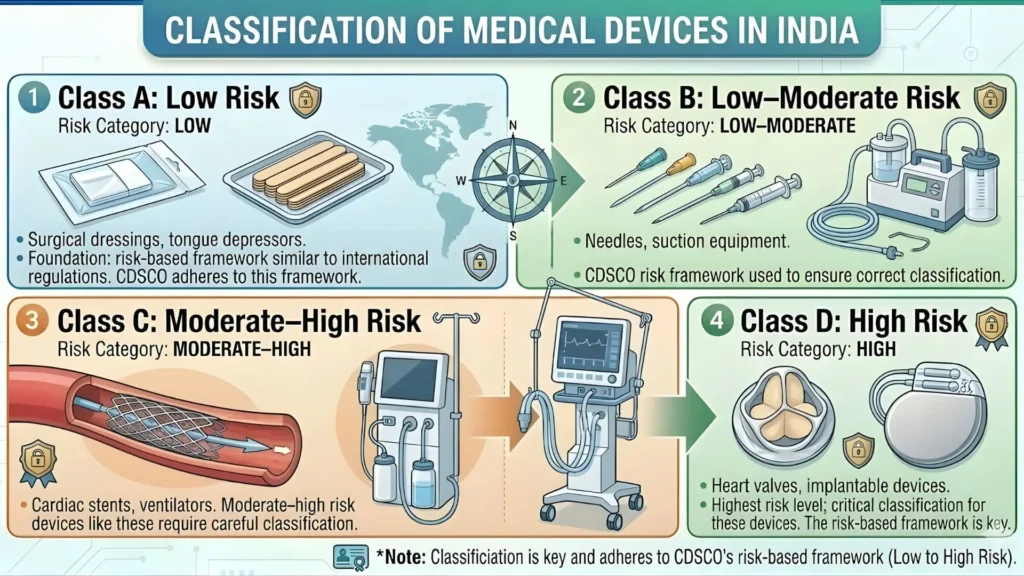
Hearing aids fall under Class B. This classification means your product needs a CDSCO product approval (Form MD-14 or Form MD-15) before you can even apply for a manufacturing or import license (Form MD-3 or Form MD-5). The classification also determines the testing standards, technical documentation, and clinical performance data required.
Why Do You Need a CDSCO Medical Device License for Hearing Aids?
A lot of businesses operating in the hearing aid space still ask — is this license really necessary? The short answer is yes, and here is why it matters practically, not just legally:
- Legal Compliance: Selling, distributing, manufacturing, or importing hearing aids without a valid CDSCO license is a punishable offence under Section 26A of the Drugs & Cosmetics Act, 1940. Penalties include fines and imprisonment.
- Market Access in India: No distributor, hospital, or pharmacy will stock your hearing aids without a valid CDSCO registration number on the product label. This is non-negotiable in the organized retail and institutional segment.
- Import Clearance: Indian Customs will not release your shipment at the port of entry without valid CDSCO import documentation. Even if the product is approved globally, Indian clearance is mandatory.
- Tender Participation: Government tenders — including CGHS, ESI, and state health departments — require proof of valid CDSCO registration. Without it, you cannot bid.
- Consumer Trust and Brand Credibility: A CDSCO-registered product signals safety and quality to audiologists, ENT specialists, and end users. In a trust-sensitive category like hearing health, this matters enormously.
- Export Readiness: A CDSCO Certificate of Registration also helps Indian manufacturers demonstrate regulatory compliance when seeking approvals in other countries.
Who Is Eligible to Apply for a CDSCO Hearing Aid License?
Not everyone can directly apply for a CDSCO Medical Device License. Eligibility depends on your role in the supply chain. Here is a breakdown of who qualifies and what type of license they need:
| Applicant Type | License Type Required | Form Number |
| Indian Manufacturer (new product) | Manufacturing License + Product Approval | Form MD-3 + Form MD-14 |
| Importer (overseas manufacturer) | Import License + Product Approval | Form MD-5 + Form MD-15 |
| Authorised Indian Agent of Foreign Manufacturer | Import License on behalf of overseas company | Form MD-5 (as authorised agent) |
| Contract Manufacturer (making on behalf of brand) | Manufacturing License | Form MD-3 |
| Repacker / Relabeller | Separate State License + CDSCO notification | State + Central coordination |
For overseas manufacturers looking to sell hearing aids in India, they must appoint an authorised Indian agent. The agent acts as the legal representative and is jointly responsible for regulatory compliance. This agent must be a registered entity in India.
Documents Required for CDSCO Hearing Aid License
The documentation requirement for a CDSCO hearing aid license application is detailed and technical. Submitting incomplete documents is the single most common reason for application rejection or delay. Here is a complete checklist — broken into categories for ease of reference:
Corporate & Applicant Documents
- Certificate of Incorporation (for Indian companies) or equivalent overseas registration
- GST Registration Certificate
- PAN Card of the entity
- Board resolution or authorization letter naming the authorized signatory
- Power of Attorney (if a consultant is filing on behalf of the applicant)
Manufacturing / Quality Documents
- ISO 13485:2016 Certificate (Quality Management System for medical devices)
- CE Marking Certificate (for Class B devices — CE Certificate under EU MDR or MDD)
- Manufacturing site address and layout plan
- Free Sale Certificate (FSC) from country of origin — for importers
- GMP (Good Manufacturing Practice) compliance declaration
- Design Dossier / Technical File (product-specific technical documentation)
Product-Specific Technical Documents
- Product description and intended use statement
- Risk assessment report as per ISO 14971
- Biocompatibility evaluation as per ISO 10993 (if applicable for in-ear components)
- Electrical safety and EMC test report as per IEC 60601-1 or equivalent
- Performance testing data — including audiological performance specs per IEC 60118 series
- Shelf life and stability data
- Labelling (draft Indian label compliant with MDR 2017 Schedule III)
- Instructions for Use (IFU) in English or regional language
Import-Specific Documents
- Appointment letter naming authorized Indian agent
- Undertaking by foreign manufacturer for compliance with Indian MDR 2017
- Certificate of Registration from country of origin (e.g., FDA 510K, CE Certificate)
- Declaration of conformity
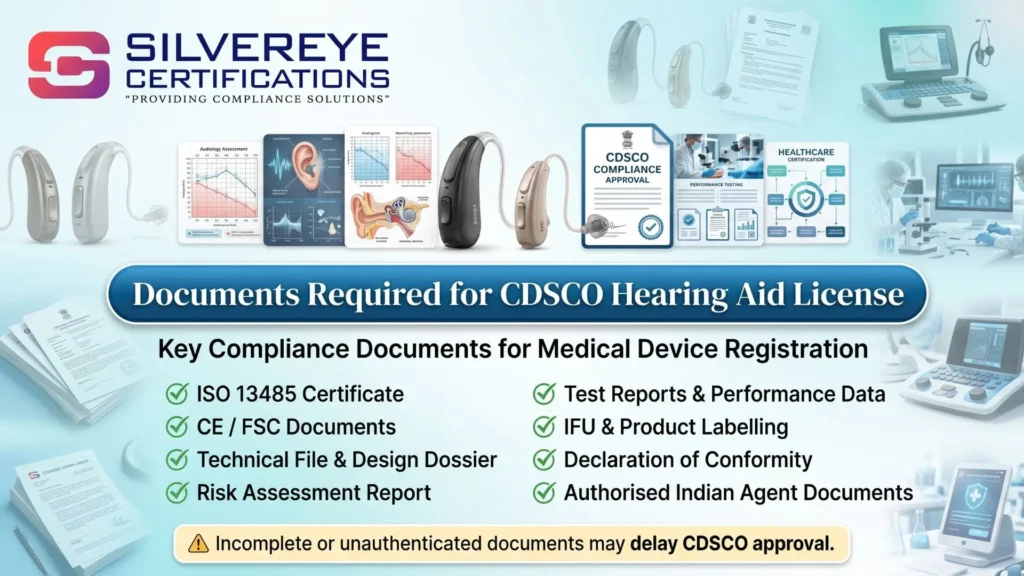
All documents from overseas manufacturers must be apostilled or notarised and, if in a foreign language, accompanied by a certified English translation.
Step-by-Step Process to Get CDSCO Medical Device License for Hearing Aids
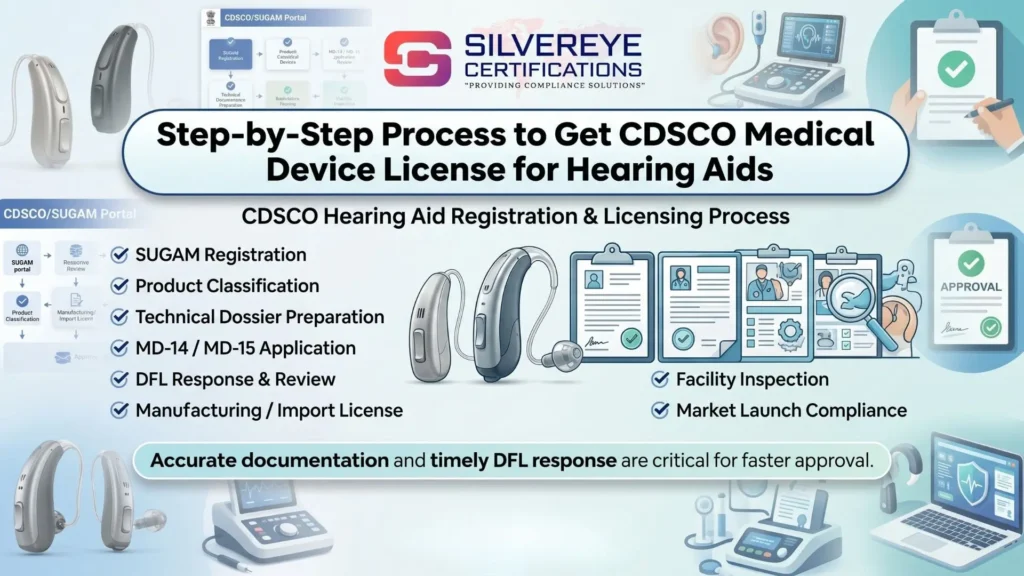
The CDSCO licensing process for hearing aids involves multiple stages. Follow this structured step-by-step process to avoid common pitfalls:
- Create an Account on SUGAM Portal: SUGAM is CDSCO's online licensing portal. Register your entity and create a login. This is the starting point for all CDSCO submissions.
- Product Classification Confirmation: Identify the correct product code for your hearing aid on the SUGAM system. Hearing aids may be classified under different product sub-categories — confirm the exact code before applying.
- Prepare Technical Dossier: Compile all documents listed in the previous section. This is the most time-consuming step. Ensure all test reports are from NABL-accredited labs or internationally recognized testing bodies.
- Submit Product Approval Application (Form MD-14 or MD-15): Upload the complete technical dossier on SUGAM. Pay the required government fee online. CDSCO scrutinizes the dossier and may raise a deficiency letter (DFL) — a list of additional queries or missing documents.
- Respond to Deficiency Letters (DFLs): If CDSCO raises a DFL, respond within the prescribed timeline (typically 30 days). Delays in responding to DFLs are the most common cause of application abandonment.
- Product Approval Granted (Form MD-14 / MD-15): Once satisfied, CDSCO issues the product approval. This approval is product-specific — not manufacturer-specific.
- Apply for Manufacturing or Import License (Form MD-3 / MD-5): With the product approval in hand, apply for the appropriate license. For manufacturing, CDSCO coordinates with the State Licensing Authority for an inspection of your facility.
- Manufacturing Site Inspection (for Indian Manufacturers): A joint central-state inspection team visits the manufacturing facility. They assess GMP compliance, quality control infrastructure, and documentation systems.
- License Issuance: Once all checks are complete, CDSCO issues the formal Manufacturing License (Form MD-3) or Import License (Form MD-5). This license allows commercial activity in India.
- Label Registration and Market Launch: Update product labelling with the CDSCO registration details. You are now compliant to manufacture, import, and sell hearing aids in India.
CDSCO Medical Devices License Fees for Hearing Aids
Government fees for CDSCO applications vary based on the application type and the size of the enterprise. The following table provides indicative fee ranges. Always verify current fees on the SUGAM portal before application submission, as these can be revised by gazette notification.
| Application Type | Form | Fee (Indian Company) | Fee (Foreign / MNC) | Validity |
| Product Approval (Import) | MD-15 | ₹25,000 per device | ₹50,000 per device | Product-specific |
| Product Approval (Manufacturing) | MD-14 | ₹10,000 per device | N/A | Product-specific |
| Import License | MD-5 | ₹25,000 (MSME: ₹12,500) | ₹1,00,000 | 2 years |
| Manufacturing License | MD-3 | ₹10,000 (MSME: ₹5,000) | N/A | 3 years |
| License Renewal | MD-6 / MD-8 | 50% of original fee | 50% of original fee | As applicable |
MSMEs (Micro, Small & Medium Enterprises) are eligible for a 50% concession on CDSCO fees. This concession applies to both product approval and licensing fees. Ensure you attach a valid UDYAM registration certificate when availing this benefit.
Validity Period and Renewal of CDSCO Hearing Aid License
Validity Period
| License Type | Validity | Renewal Form |
| Import License (Form MD-5) | 2 years from date of issue | Form MD-8 |
| Manufacturing License (Form MD-3) | 3 years from date of issue | Form MD-6 |
| Product Approval (MD-14 / MD-15) | Product-specific (typically indefinite unless withdrawn) | Amendment application if product changes |
Renewal Process and Timeline
License renewal must be initiated before the expiry date. CDSCO recommends initiating the renewal process at least 90 days before the license expires. Failure to renew before the expiry date results in the license lapsing, after which commercial activity must be halted.
- Log in to SUGAM portal using your existing credentials
- Navigate to the renewal section and select the expiring license
- Upload updated documents — especially renewed ISO 13485, CE certificates, and any updated product documentation
- Pay the renewal fee online (50% of original application fee)
- CDSCO reviews and issues a renewed license — typically within 30 to 60 days if documents are complete
Important: If your CE certificate or ISO certificate expires before your CDSCO license is renewed, CDSCO may suspend your license mid-term. Maintain a tracker for all supporting certificate expiry dates.
India Hearing Aid Market 2026: Why CDSCO Compliance Matters More Than Ever
India has one of the largest populations of people with hearing impairment in the world. According to estimates, over 63 million Indians suffer from significant hearing loss, and the addressable market for hearing aids is growing rapidly due to ageing demographics, increased awareness, and government schemes like ADIP (Assistance to Disabled Persons).
In 2026, CDSCO's enforcement of medical device regulations has become significantly more stringent. The National Medical Devices Policy 2023 has set a clear vision for India to become a global hub for medical device manufacturing, and regulatory compliance is a cornerstone of this vision. Market surveillance activities have increased, and non-compliant products are being pulled off e-commerce platforms and retail shelves.
For hearing aid brands — whether Indian or international — being CDSCO-registered is no longer just a box-ticking exercise. It is a genuine competitive advantage and a market entry prerequisite. The hearing aid brands that get compliant first in each product segment gain a significant head start.
Conclusion
Getting a CDSCO Medical Device License for Hearing Aids in India is a structured but achievable process. The key is preparation — understanding the classification, assembling a complete and accurate technical dossier, and responding promptly to CDSCO queries. In 2026, as India's medical device regulatory landscape matures, compliance is not a burden — it is the price of playing in a large, fast-growing, and legally protected market.
Whether you are a domestic manufacturer scaling up production, a global hearing aid brand entering India, or a distributor seeking to add compliant products to your portfolio, this guide provides the foundational knowledge to start your CDSCO compliance journey. For product-specific advice and hands-on assistance with your CDSCO filing, consult a CDSCO-registered regulatory professional who specializes in medical devices.
Frequently Asked Questions
Is CDSCO registration mandatory for all hearing aids sold in India?
Yes. All hearing aids — digital, analogue, behind-the-ear (BTE), in-the-ear (ITE), and receiver-in-canal (RIC) types — are notified medical devices under MDR 2017. Selling any hearing aid without a valid CDSCO registration is a legal offence.
Can a small Indian hearing aid manufacturer apply for CDSCO license?
Yes. Small and MSME manufacturers are eligible and actually get a 50% concession on government fees. However, they must still meet GMP requirements and maintain ISO 13485:2016 certification, which can be a significant investment for very small units.
How long does the CDSCO hearing aid approval process take?
The standard timeline is 30 to 90 days for product approval after submission of a complete dossier. The actual timeline depends on CDSCO's workload, completeness of your documents, and the number of DFL rounds. With an experienced regulatory consultant, most approvals are achieved within 60 to 75 days.
Do I need a separate license for each hearing aid model?
Yes. Product approval (Form MD-14 or MD-15) is model-specific. If you have 10 hearing aid models, you need 10 separate product approvals. However, the manufacturing or import license (Form MD-3 or MD-5) covers all approved products under one entity.
Can I sell hearing aids on Amazon or Flipkart without a CDSCO license?
No. E-commerce platforms in India are now required to verify CDSCO registration before listing medical devices. Listings without proper regulatory compliance can be taken down, and the seller can face action under MDR 2017 and the Consumer Protection Act.
What is the SUGAM portal and how do I use it?
SUGAM (sugamcibs.gov.in) is CDSCO's online submission and tracking portal for medical device license applications. All CDSCO applications — including product approval, manufacturing licenses, import licenses, renewals, and amendments — are submitted through SUGAM. You create an account, upload documents, pay fees, and track application status online.
Is ISO 13485 mandatory for getting a CDSCO hearing aid license?
For Class B devices like hearing aids, ISO 13485:2016 certification is effectively mandatory. While MDR 2017 mandates adherence to Schedule 5 (GMP requirements), ISO 13485 is the internationally recognised standard that satisfies these requirements. CDSCO routinely requires ISO 13485 certificates as part of the dossier.
What happens if my CDSCO license expires and I continue to sell?
Selling medical devices after your CDSCO license has expired is a violation of MDR 2017 and the Drugs & Cosmetics Act. Consequences include product seizure, cancellation of registration, financial penalties, and in serious cases, criminal prosecution of the responsible persons in the company.
How can a foreign hearing aid manufacturer enter the Indian market?
A foreign manufacturer must appoint an authorised Indian agent or importer. The Indian agent applies for the import license (Form MD-5) and product approval (Form MD-15) on behalf of the foreign manufacturer. The foreign manufacturer must provide all technical documentation, a Free Sale Certificate from the country of origin, and a formal appointment letter for the Indian agent.
Can I apply for CDSCO license myself or do I need a consultant?
Technically, you can apply yourself through the SUGAM portal. However, the technical complexity of the dossier, the specific formatting requirements, and the need to respond accurately to CDSCO queries makes it advisable to work with an experienced CDSCO regulatory consultant — especially for Class B devices. A good consultant reduces approval time significantly and lowers the risk of DFLs.