- CDSCO MD-14 Import License For Cardiac Devices is the mandatory For CDSCO import license for all notified cardiac and cardiovascular medical devices entering India under MDR 2017.
- The application is filed online via the SUGAM portal — no physical submission is required for the main form.
- Approved licenses are valid for 3 years and must be renewed before expiry to avoid supply-chain disruptions.
- Non-compliance attracts penalties under the Drugs and Cosmetics Act, including seizure, recall, and prosecution.
What Is the CDSCO MD-14 Import License?
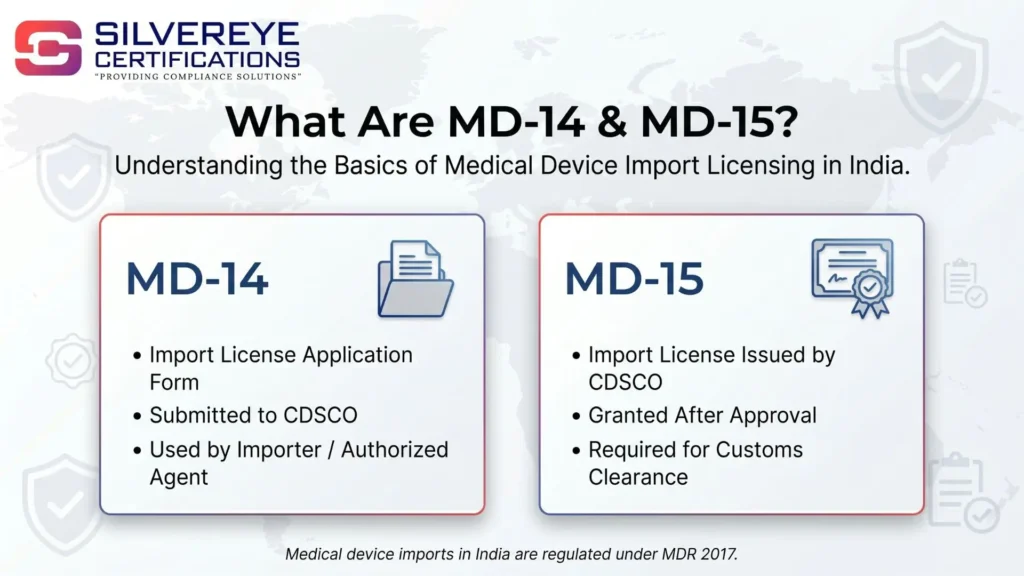
The MD-14 is a Form under Schedule II of the Medical Devices Rules, 2017, issued by the Central Drugs Standard Control Organization (CDSCO) under the Drugs and Cosmetics Act, 1940. It grants legal permission to import notified medical devices — including a wide range of cardiac and cardiovascular devices — into India for sale, distribution, or use.
Without a valid MD-14 license, no importer can legally bring notified cardiac devices into Indian territory. Customs clearance, sale, and distribution are all contingent on holding this license. The CDSCO, under the Ministry of Health and Family Welfare, is the apex regulatory body that evaluates and grants this approval.
India notified cardiac devices as regulated medical devices through a series of government notifications. Currently, devices like cardiac stents, heart valves, pacemakers, defibrillators, cardiac catheters, balloon catheters, and related implantables are all subject to MD-14 import licensing.
Which Cardiac Devices Require an MD-14 Import License?
Under the Medical Devices Rules, 2017, and subsequent notifications by the Ministry of Health and Family Welfare, the following categories of cardiac and cardiovascular devices are notified and require CDSCO import registration or licensing:
| Device Category | Common Examples |
| Cardiac Stents | Drug-eluting stents, bare-metal stents, bioresorbable stents |
| Heart Valves | Mechanical heart valves, bioprosthetic valves, TAVR valves |
| Cardiac Rhythm Management Devices | Pacemakers, ICDs, CRT-D, CRT-P devices |
| Cardiac Catheters | Balloon catheters, diagnostic catheters, EP catheters |
| Cardiac Assist Devices | Ventricular assist devices (VADs), IABP systems |
| Cardiac Implants | Annuloplasty rings, septal occluders, closure devices |
| Diagnostic Cardiology Devices | ECG machines, echocardiography systems (notified categories) |
| Surgical Instruments (Cardiac) | Cardiopulmonary bypass equipment, cannulae (if notified) |
Before initiating the MD-14 application, it is advisable to verify whether your specific device falls under a notified category via the CDSCO website or the latest Gazette notification. Non-notified devices may still require registration under other forms, but MD-14 applies specifically to notified ones.
Who Is Eligible to Apply for CDSCO MD-14 Import License for Cardiac Devices?
The MD-14 import license is not applied for directly by the foreign manufacturer. Indian regulatory law requires a specific applicant structure:
Authorized Indian Agent (AIA)
The foreign manufacturer must appoint a legally registered Indian entity as their Authorized Indian Agent. This entity is the applicant on record before CDSCO. The AIA must:
- Be a company or firm registered under applicable Indian law (Companies Act, LLP Act, etc.)
- Have a valid business address in India
- Hold a valid Whole Sale Drug License (Form 20-B / 21-B under D&C Act) or a specific authorization for medical devices where applicable
- Execute a Power of Attorney or formal agency agreement with the foreign manufacturer
Foreign Manufacturer Requirements
The overseas manufacturer whose device is being imported must:
- Have a valid manufacturing license from their home country regulatory authority (FDA, CE, TGA, etc.)
- Have a Quality Management System compliant with ISO 13485 or equivalent
- Not be debarred, blacklisted, or under regulatory action by CDSCO or their home country authority
- Provide complete technical documentation for the device
Class-Specific Applicability
Cardiac devices typically fall under Class C (moderate-to-high risk) or Class D (high risk) under MDR 2017. The MD-14 license requirement applies to all Class A, B, C, and D notified devices, but the scrutiny level and documentation requirements are higher for Class C and D devices, which cover most cardiac implants.
Documents Required for CDSCO MD-14 Application
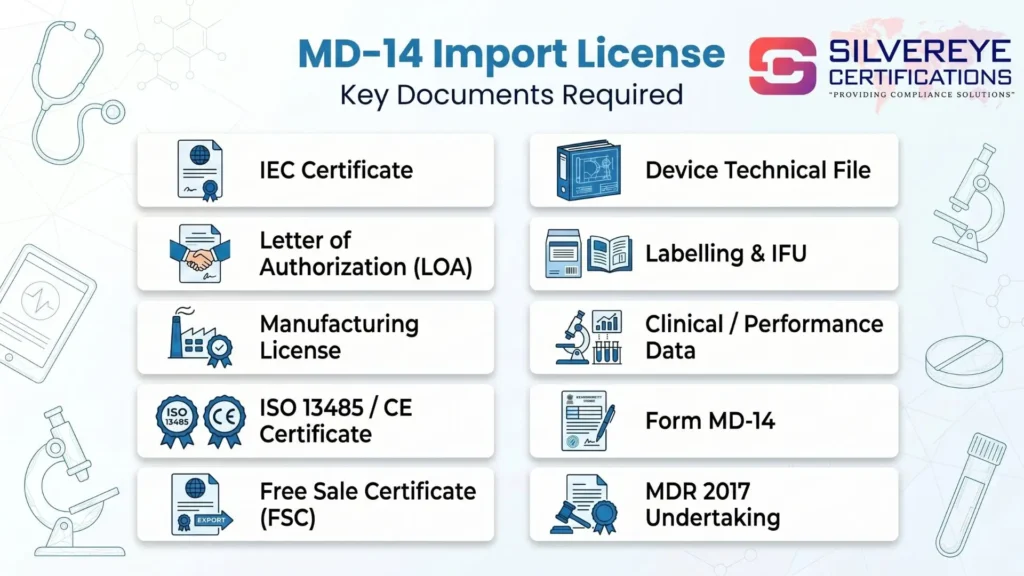
Documentation is the backbone of a successful MD-14 application. Incomplete submissions are the single most common reason for queries and delays from CDSCO. Below is the comprehensive document checklist for cardiac device import license applications:
| Document | Specification / Notes |
| Form MD-14 (duly filled) | Generated and submitted via SUGAM portal; requires digital signature |
| Proof of Manufacturer's Authorization / Power of Attorney | Notarized and apostilled; appointing the Indian agent |
| Manufacturing Licence of the Foreign Manufacturer | Issued by home country authority (FDA 510k/PMA, CE Certificate, etc.) |
| Free Sale Certificate (FSC) / Certificate to Foreign Government (CFG) | From the competent authority of the country of origin; apostilled |
| ISO 13485 Certificate | Current, valid quality management system certificate |
| Test Reports / Performance Data | NABL-accredited lab or recognized international lab reports |
| Clinical Investigation Data / Clinical Evidence | Applicable for Class C & D; published clinical trials or PMCF data |
| Summary Technical Documentation (STED) | Device description, design, labelling, biocompatibility data |
| Declaration of Conformity | Signed by manufacturer; confirming compliance with essential principles |
| Site Master File (if applicable) | For manufacturing site details |
| Undertaking by Applicant (Indian Agent) | Standard format available on SUGAM portal |
| PAN Card of Indian Agent Firm | Mandatory for fee payment and identity verification |
| GST Registration Certificate | Current GST certificate of the Indian agent |
| Whole Sale Licence (Form 20B/21B or equivalent) | Valid drug/device wholesale licence of the Indian agent |
| Device Labelling / IFU (Instructions for Use) | English version; must comply with MDR 2017 labelling requirements |
| List of Countries Where Device Is Marketed | Official statement from manufacturer |
| Biocompatibility Data (ISO 10993) | For implantable cardiac devices; mandatory for Class C & D |
| Shelf Life / Stability Data | Accelerated and real-time studies where applicable |
| Sterilization Validation Data (if sterile device) | EO, gamma, or other relevant sterilization method data |
Step-by-Step MD-14 Application Process For Cardiac Devices
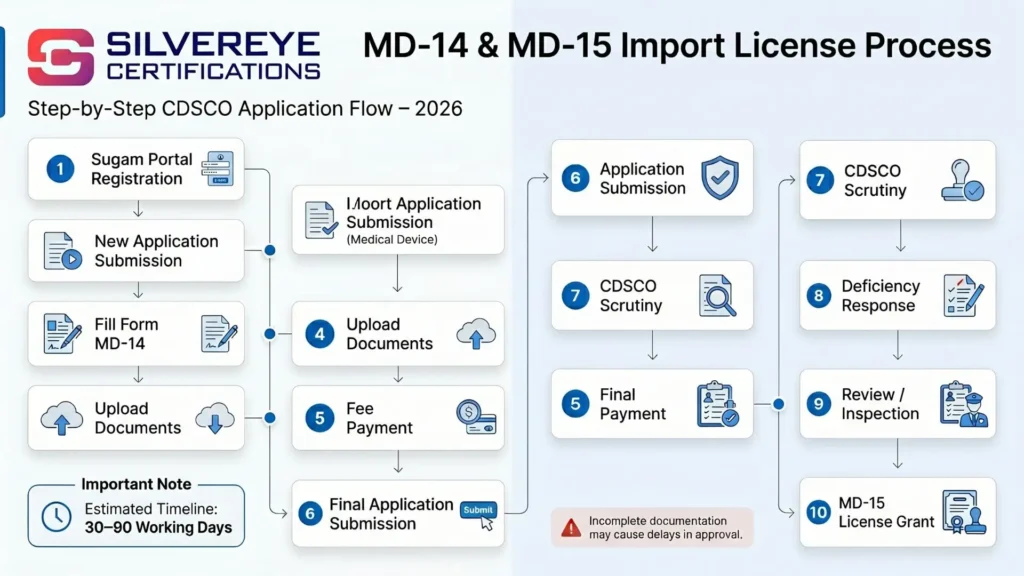
Here is the complete workflow for obtaining your MD-14 import license for cardiac devices in India. Follow each step carefully to avoid rejection or unnecessary delays.
Step 1: Foreign Manufacturer Appoints Authorized Indian Agent
The manufacturer executes a Power of Attorney (POA) or agency agreement, clearly defining the scope of authority granted to the Indian agent. This document must be notarized in the country of origin and apostilled.
Step 2: Indian Agent Obtains SUGAM Portal Registration
The Authorized Indian Agent registers on the SUGAM portal (https://sugam.cdsco.gov.in) as an importer/manufacturer. A valid User ID and password are required. The agent must also complete KYC verification on the portal.
Step 3: Device Classification Confirmation
Before filing, confirm the device class (A, B, C, or D) using the classification rules under Schedule III of MDR 2017. Cardiac implants like stents and heart valves typically fall under Class C or D. The classification determines the documentation set required.
Step 4: Compile and Prepare Technical Dossier
Assemble all the documents listed in Section 4 above. Prepare the technical dossier as per the CDSCO Common Submission Dossier Template (CSDT). All documents must be in PDF format with clear legibility, and file sizes must adhere to SUGAM portal upload limits.
Step 5: Online Filing via SUGAM Portal
Log in to the SUGAM portal and select the MD-14 form. Fill in all mandatory fields including device name, generic name, model number, intended use, storage conditions, and manufacturer details. Upload all supporting documents. Review the application before final submission.
Step 6: Pay Government Application Fee
After form submission, the portal generates a fee payment challan. Pay the applicable government fee online via the payment gateway integrated in SUGAM. Keep the payment receipt for records.
Step 7: Application Review by CDSCO
CDSCO's medical device division reviews the application. For Class C and D devices, the application is evaluated by the Drug Controller General of India (DCGI) or designated officers. A technical screening is conducted first, followed by expert committee review if required.
Step 8: Responding to Queries (Raised by CDSCO)
CDSCO typically raises queries via the SUGAM portal if any document is deficient or clarification is needed. Query responses must be submitted within the stipulated time frame (usually 30-60 days). Failure to respond within the timeline can result in application closure.
Step 9: Grant of MD-14 License
Once the application is found complete and satisfactory, CDSCO issues the MD-14 import license via the SUGAM portal. The license contains the device name, model number, manufacturer details, Indian agent details, validity period, and any conditions of use.
Step 10: Post-Licensing Compliance
After receiving the MD-14 license, the importer must ensure label compliance per MDR 2017, report adverse events via the Vigilance portal, maintain import records, and comply with any post-market surveillance (PMS) requirements specified in the license conditions.
Government Fees for MD-14 Import License For Cardiac Devices
As per the Medical Devices Rules, 2017 (Third Schedule — Fees), the government fees for MD-14 import license applications in India are structured as follows:
| Device Class | Application Fee (INR) | Renewal Fee (INR) |
| Class A | Rs. 5,000 | Rs. 2,500 |
| Class B | Rs. 25,000 | Rs. 12,500 |
| Class C | Rs. 50,000 | Rs. 25,000 |
| Class D | Rs. 50,000 | Rs. 25,000 |
Important: The above fees are indicative based on MDR 2017 Third Schedule. Fees are subject to revision by the government. Always verify the current fee structure on the official CDSCO website or the SUGAM portal at the time of filing. Payment is accepted online through the integrated payment gateway.
In addition to government fees, applicants should budget for preparation costs — technical dossier compilation, apostille charges, translation services, regulatory consulting fees, and testing expenses — which can vary significantly based on device complexity.
MD-14 License Validity and Renewal For Cardiac Devices
Validity Period
An MD-14 import license for cardiac devices is valid for 3 (three) years from the date of issue. The license is device-specific and manufacturer-specific — it cannot be transferred to a different device model or manufacturer.
When to Apply for Renewal
Renewal applications must be submitted before the expiry of the current license. Best practice is to initiate the renewal process at least 6 months before the expiry date. This buffer time accounts for CDSCO review timelines, potential queries, and any documentation updates required.
Renewal Process
- Log in to the SUGAM portal and initiate the renewal application against the existing MD-14 license number.
- Update all documents that have expired or changed since the original grant — especially the ISO 13485 certificate, FSC, manufacturing license, and any updated clinical data.
- Pay the applicable renewal fee as per the fee schedule.
- CDSCO will review the renewal application. If the device and manufacturer details remain unchanged and no adverse events have been reported, renewal is typically faster than the original grant.
- The renewed license carries a fresh 3-year validity from the renewal date.
Lapsed License — What Happens?
If the MD-14 license lapses (expires without renewal), the importer must stop importing the device immediately. Any devices imported after expiry are considered illegal imports under the Drugs and Cosmetics Act, attracting penalties. A fresh application must be filed, and the timelines start from scratch.
Timeline: How Long Does MD-14 Approval Take?
One of the most common questions from importers is: how long will CDSCO take to grant the MD-14 license? Here is a realistic timeline breakdown for cardiac devices:
| Stage | Estimated Timeline |
| Dossier preparation and document compilation | 4 to 12 weeks (depending on device complexity) |
| SUGAM portal filing and fee payment | 1 to 3 days |
| CDSCO initial technical screening | 4 to 12 weeks |
| Expert committee review (Class C/D devices) | 4 to 16 weeks (if required) |
| Query response period | 30 to 60 days (applicant side) |
| Grant of MD-14 license (post-complete docs) | 2 to 4 weeks |
| Total estimated timeline (realistic) | 6 to 18 months for cardiac Class C/D devices |
Key Compliance Requirements After License Grant
Getting the MD-14 license is step one. Maintaining compliance after the grant is equally critical. Here are the ongoing obligations for licensed importers of cardiac devices:
- Labelling Compliance: All devices must carry labels in the format prescribed under Rule 23 of MDR 2017 — including the manufacturer name, address, lot number, date of manufacture, expiry/shelf life, sterility indicators, and CDSCO license number.
- Adverse Event Reporting: Any serious adverse event (SAE) involving the device must be reported to the CDSCO Adverse Event Reporting & Monitoring System within specified timelines (usually 30 days for non-life-threatening and 10 days for life-threatening events).
- Post-Market Surveillance (PMS): Class C and D cardiac devices are required to have an active PMS plan. Importers must maintain incident records and submit periodic safety update reports (PSUR) as mandated.
- Import Records Maintenance: Maintain detailed import records including shipping documents, invoice, CDSCO licence copy, batch/lot details, and distribution records for a minimum of 5 years.
- Field Safety Corrective Action (FSCA): In the event of a recall, field safety notice, or FSCA initiated by the manufacturer anywhere in the world, the Indian importer is obligated to notify CDSCO and carry out the corrective action in India simultaneously.
- Annual Reporting: File annual sales and distribution reports as required under MDR 2017.
- License Amendment: Any change in manufacturer details, device name, model, or agent must be updated via an amendment application on SUGAM before continuing imports.
Benefits of Obtaining a CDSCO MD-14 Import License For Cardiac Devices
Beyond mere legal compliance, obtaining the MD-14 import license for cardiac devices offers tangible business and reputational benefits:
- Legal Market Access: The MD-14 grants unrestricted legal right to import, distribute, and sell cardiac devices across India.
- Customs Clearance Smooth: Customs authorities require the MD-14 license number for clearing notified medical device shipments. A valid license eliminates detention risks.
- Tender and Hospital Eligibility: Government hospitals, AIIMS, state health departments, and major private hospital chains require suppliers to hold valid CDSCO licenses for empanelment and tender participation.
- Price Regulation Benefits: NPPA-regulated devices (like cardiac stents, which are under price control) can only be marketed through licensed importers — an MD-14 is a prerequisite.
- Consumer and Clinician Trust: CDSCO registration builds clinical credibility, making adoption by cardiologists and hospital administrators significantly easier.
- Global Regulatory Recognition: India's MDR 2017 alignment with international standards means an MD-14 holder demonstrating CDSCO compliance often finds the process easier in other emerging markets too.
Conclusion
The CDSCO MD-14 import license for cardiac devices is not a box-ticking exercise. It is a substantive regulatory review process that demands thorough documentation, a compliant manufacturer, a capable Indian agent, and proactive follow-up with CDSCO. In 2026, with India's healthcare sector expanding rapidly and regulatory scrutiny intensifying, getting your MD-14 strategy right from the start can save months of delays and significant cost.
Whether you are importing cardiac stents, pacemakers, heart valves, or catheterisation equipment, the framework laid out in this guide covers every dimension of the process. Work with experienced regulatory professionals, maintain document currency, and use the SUGAM portal efficiently — these three practices alone will place your application ahead of the majority.
If you need help with MD-14 application filing, dossier preparation, or CDSCO regulatory strategy for your cardiac device business in India, engage a CDSCO-experienced regulatory consulting firm with a proven track record in Class C and D medical device submissions.
Frequently Asked Questions
Is the MD-14 import license the same as CDSCO medical device registration?
No. The MD-14 is the import licence granted to the Indian authorized agent/importer. In some contexts, CDSCO also uses the term 'registration' for certain categories.
Can a foreign company directly apply for MD-14 without an Indian agent?
No. The MD-14 application must be filed by an Authorized Indian Agent (AIA) on behalf of the foreign manufacturer. A foreign company cannot directly hold an MD-14 import licence in India. Appointing a legally registered Indian entity as AIA is mandatory.
What is the difference between Class C and Class D for cardiac devices?
Class C devices present moderate-to-high risk — examples include cardiac catheters, diagnostic devices, and some implants. Class D devices present the highest risk
Is CE Mark or USFDA approval sufficient for CDSCO MD-14 clearance?
No. CE marking or USFDA approval is supporting evidence that can strengthen your application, but it does not substitute the CDSCO MD-14 license.
How long is the MD-14 import licence valid?
The MD-14 import licence is valid for 3 years from the date of issue. After 3 years, a renewal application (Form MD-15) must be filed before expiry. There is no automatic extension — an expired licence means you cannot legally import until renewal is granted.
What happens if I change the Indian agent (Authorized Indian Agent) after getting the MD-14?
If the Indian agent changes, you must file an amendment application with CDSCO via the SUGAM portal before the new agent begins importing. Importing under an old agent's licence after the agency agreement has been terminated is a compliance violation.
Are cardiac diagnostics (like ECG machines) covered under MD-14?
Only if the specific device has been notified as a regulated medical device by the government. Not all cardiac diagnostic equipment is notified.
Can the same MD-14 cover multiple models of the same cardiac device?
Multiple models of the same device from the same manufacturer may be covered in a single application, subject to CDSCO's current guidelines on device grouping.
What is the penalty for importing cardiac devices without an MD-14 license?
Importing medical devices without a valid CDSCO license is a criminal offence under the Drugs and Cosmetics Act, 1940. Penalties include seizure and confiscation of the goods, monetary fines, cancellation of other licenses, and prosecution of the responsible persons including imprisonment in serious cases.
How do I check the status of my MD-14 application on SUGAM?
Log in to your account on the SUGAM portal and navigate to the 'My Applications' section. The application status — Submitted, Under Review, Query Raised, Approved, or Rejected — is updated in real time.