
- COS1 is the official application form submitted to CDSCO to request permission for importing cosmetics from South Korea to India.
- COS2 is the Import License that CDSCO issues after your COS1 application is reviewed and approved — this is your legal permit to import.
- Both COS1 and COS2 are mandatory under the Drugs & Cosmetics Act, 1940; skipping either step can lead to consignment rejection or legal penalties.
- The entire COS1-to-COS2 process typically takes 30–90 days depending on documentation completeness and CDSCO workload in 2026.
Introduction: The Korean Beauty Wave Is Hitting India Fast
If you are planning to import cosmetics from South Korea to India, you are already on the right track. The K-beauty market — covering Korean skincare, serums, sheet masks, BB creams, sunscreens, and makeup — has exploded in India over the past few years. Consumers are actively searching for authentic Korean beauty products, and Indian retailers, distributors, and e-commerce brands are scrambling to meet this demand.
But here's what most aspiring importers get wrong — they jump into sourcing without understanding the regulatory framework. Importing cosmetics into India is not as simple as placing an international order. The Government of India, through the Central Drugs Standard Control Organization (CDSCO), requires every importer to hold a valid Import License before any cosmetic product can legally enter the country.
This is where COS1 and COS2 come in. These two forms are the backbone of the Korean cosmetics import license India process, and understanding them is non-negotiable if you want to run a legally compliant import business in 2026.
The Legal Framework: What Law Governs Cosmetic Imports in India?
Before we get into COS1 and COS2, it is important to understand the legal foundation. Cosmetics imported into India fall under the Drugs and Cosmetics Act, 1940, and the Drugs and Cosmetics Rules, 1945. Under Rule 133, no person shall import any cosmetic unless it is registered with the Central Licensing Authority, which is CDSCO.
This means every Korean cosmetic brand, product, or formulation that enters India must go through a formal registration and licensing process. The importer — not the foreign manufacturer — holds this responsibility in India.
| Regulatory Body | Requirement | Applicable Law |
| CDSCO (Central Drugs Standard Control Organization) | Import License (COS2) after Application (COS1) | Drugs & Cosmetics Act, 1940 |
| State Licensing Authority | Importer must be registered as a legal entity | Drugs & Cosmetics Rules, 1945 |
| Customs Authority | Valid COS2 license required at port of entry | Customs Act, 1962 |
| BIS (if applicable) | Quality compliance for certain product categories | BIS Act, 2016 |
COS1 and COS2 License Explained: What Is the Difference?
This is probably the most common question from first-time importers — and the confusion is understandable because both terms are often used together. Let us break it down simply.
What Is COS1?
COS1 is the application form that an importer submits to CDSCO to apply for permission to import cosmetics from a foreign country — in this case, South Korea — into India. When you submit COS1, you are essentially telling CDSCO: 'Here are my details, here are the product details, here is my manufacturer information — please grant me an import license.'
COS1 is not a license by itself. It is the starting point — the formal request. You cannot import a single unit of any Korean cosmetic product without first submitting a valid and complete COS1 application.
What Is COS2?
COS2 is the actual Import License that CDSCO issues after reviewing and approving your COS1 application. Once CDSCO is satisfied with your application, documentation, and product details, they grant you the COS2 license. This license is the legal proof that you are authorized to import specific Korean cosmetic products into India.
Think of COS1 as your 'application' and COS2 as your 'approval.' Without COS2, your consignment will be held at customs, and in worst-case scenarios, it may be destroyed or sent back to the country of origin at your expense.
| COS1 vs COS2 — At a Glance COS1 = Application Form submitted by the importer to CDSCO COS2 = Import License issued by CDSCO after approving the COS1 application COS1 is the input; COS2 is the output — one leads to the other COS2 is product-specific — you need a separate license for each unique cosmetic product Both are issued under the Drugs & Cosmetics Act, 1940 and managed through SUGAM portal |
Who Needs to Apply for COS1 and COS2 License in India?
If you are any of the following, you must apply for COS1 and obtain COS2 before importing any Korean cosmetic product:
- Indian distributors or wholesale traders importing directly from Korean brands
- E-commerce businesses planning to sell Korean skincare and makeup online
- Retail brands looking to white-label or resell Korean cosmetic formulations
- Manufacturing companies importing Korean cosmetic raw materials classified as cosmetics
- Beauty salons and clinics importing professional Korean cosmetic treatments for commercial use
- Trading companies acting as import agents on behalf of Indian buyers
Individual consumers importing personal use cosmetics in small, reasonable quantities for personal consumption may be exempt, but any commercial-scale import — even a modest B2B order — requires a valid COS2 license.
Eligibility Criteria to Apply for COS1 (Import License Application)
Not just anyone can walk into CDSCO and apply for a cosmetic import license. You need to meet the following baseline eligibility requirements before filing your COS1 application:
- Your business must be a legally registered entity in India — Pvt Ltd, LLP, Partnership Firm, or Proprietorship.
- You must have a valid wholesale drug license or an equivalent cosmetic import authorization from the State Licensing Authority (SLA) of your state.
- You must have a registered or authorized place of business in India where the imported cosmetics will be stored.
- The Korean manufacturer must be a licensed cosmetic manufacturer in South Korea, holding a valid GMP (Good Manufacturing Practice) certificate.
- You must be able to provide product-specific documentation including formulation details, ingredients list, shelf life, and safety data.
You cannot apply for a COS1 license for a generic 'all Korean cosmetics' blanket approval. The COS1 application is product-specific. If you plan to import 10 different Korean skincare products, you will need to file 10 separate COS1 applications — and in return, receive 10 separate COS2 licenses.
Documents Required for COS1 Application — The Complete Checklist
Getting your documentation right is the single biggest factor that determines how quickly your COS2 license gets approved. Incomplete or incorrect paperwork is the number one reason for delays and rejections. Here is a detailed list of documents you need:
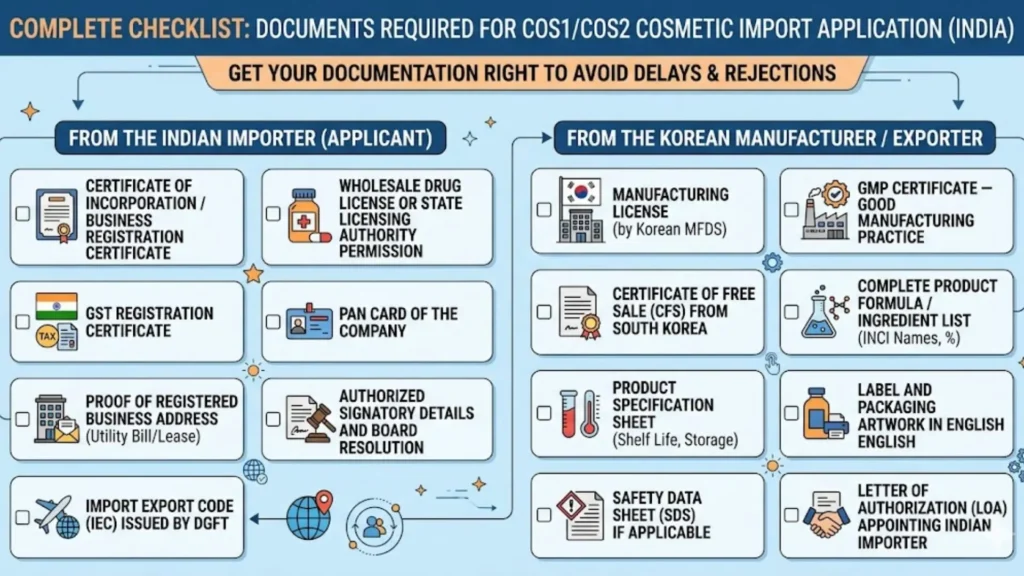
From the Indian Importer (Applicant)
- Certificate of Incorporation / Business Registration Certificate
- Wholesale Drug License or State Licensing Authority permission for cosmetic import
- GST Registration Certificate
- PAN Card of the company
- Proof of registered business address (utility bill or lease agreement)
- Authorized signatory details and board resolution (for companies)
- Import Export Code (IEC) issued by DGFT
From the Korean Manufacturer / Exporter
- Manufacturing License issued by the Korean Ministry of Food and Drug Safety (MFDS)
- GMP Certificate — Good Manufacturing Practice certificate of the Korean facility
- Certificate of Free Sale (CFS) from South Korean competent authority confirming the product is freely sold in South Korea
- Complete product formula / ingredient list with INCI names and percentage composition
- Product specification sheet — shelf life, storage conditions, batch testing details
- Label and packaging artwork in English (or translated with notarized translation)
- Safety Data Sheet (SDS) if applicable
- Letter of Authorization (LOA) from the Korean manufacturer appointing you as the authorized importer in India
| Pro Tip for Faster Approval: All documents from South Korea must be apostilled or notarized and either in English or accompanied by a certified English translation. CDSCO increasingly scrutinizes ingredient lists for banned substances. Cross-check your Korean product formulation against CDSCO's Restricted/Prohibited Cosmetic Ingredients list before applying. Apply through the official SUGAM online portal (sugam.pharma.gov.in) for faster tracking and processing. |
Step-by-Step Process: From COS1 Application to COS2 License
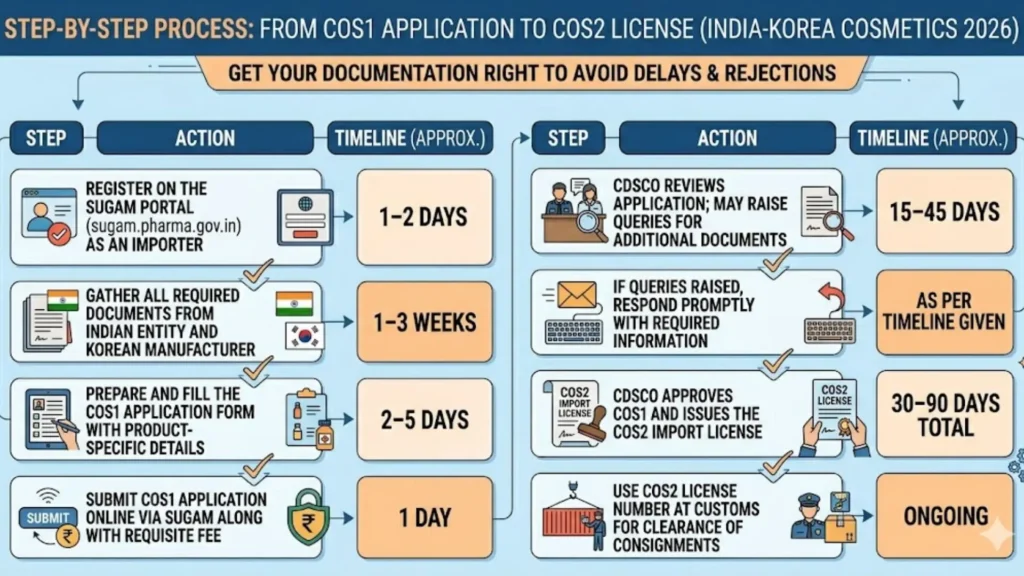
Here is exactly how the process works, from start to finish, for importing cosmetics from South Korea to India in 2026:
| Step | Action | Timeline (Approx.) |
| Step 1 | Register on the SUGAM Portal (sugam.pharma.gov.in) as an importer | 1–2 days |
| Step 2 | Gather all required documents from Indian entity and Korean manufacturer | 1–3 weeks |
| Step 3 | Prepare and fill the COS1 Application Form with product-specific details | 2–5 days |
| Step 4 | Submit COS1 application online via SUGAM along with requisite fee | 1 day |
| Step 5 | CDSCO reviews application; may raise queries for additional documents | 15–45 days |
| Step 6 | If queries raised, respond promptly with required information | As per timeline given |
| Step 7 | CDSCO approves COS1 and issues the COS2 Import License | 30–90 days total |
| Step 8 | Use COS2 license number at customs for clearance of consignments | Ongoing |
COS1 Application Fee and COS2 License Fee in 2026
Many importers ask: how much does the COS1 and COS2 license cost? Here is a general breakdown based on current CDSCO fee structure. Note that fees are subject to periodic revision, and you should always verify the latest fee schedule on the official CDSCO website or SUGAM portal before applying.
| Fee Type | Details | Approximate Amount (INR) |
| COS1 Application Fee | Per product application submitted to CDSCO | Rs. 3,000 – Rs. 5,000 per product |
| COS2 License Fee | Import license grant fee (on approval) | Rs. 3,000 – Rs. 5,000 per product |
| Renewal Fee | COS2 license validity is typically 3 years; renewal charges apply | Similar to original fee |
| Additional Query Response | No additional CDSCO fee, but notarization/translation may add cost | Varies |
Important: If you are importing multiple Korean products, the fee applies per product. A brand importing 15 Korean cosmetic SKUs will need to budget for 15 separate COS1 applications and 15 separate COS2 licenses. This is a significant investment, so plan accordingly.
Validity and Renewal of COS2 Import License
Once CDSCO grants your COS2 license, it is valid for a period of 3 years from the date of issue. You must apply for renewal before the license expires to continue importing that specific Korean cosmetic product without interruption.
- Renewal application must be submitted at least 30–60 days before the COS2 license expiry date
- Same documentation requirements apply during renewal, especially if the product formulation, packaging, or manufacturer details have changed
- If your Korean manufacturer changes the product formulation, you may need a fresh COS1 application rather than a simple renewal
- CDSCO can suspend or cancel a COS2 license if there are product safety concerns, adverse reports, or non-compliance issues
Common Mistakes That Delay or Reject Your COS1/COS2 Application
After helping businesses understand this process, here are the most common mistakes that lead to rejections or unnecessary delays. Avoid all of these:
| Mistake | Why It Causes Problems | How to Avoid |
| Submitting documents without apostille/notarization | CDSCO requires foreign documents to be authenticated | Get all Korean documents apostilled before applying |
| Using non-INCI ingredient names on product formula | CDSCO cross-checks against standard INCI nomenclature | Ensure Korean manufacturer uses INCI names on formula |
| Not getting Letter of Authorization (LOA) from Korean brand | Without LOA, you cannot prove you are authorized to import | Secure a notarized LOA from the Korean manufacturer |
| Missing Certificate of Free Sale (CFS) | CFS proves the product is sold legally in South Korea | Obtain CFS from South Korean MFDS-authorized authority |
| Applying for the wrong product category | Cosmetics vs. drugs classification matters in India | Confirm product is classified as cosmetic, not drug, in India |
| Ignoring CDSCO query response timelines | CDSCO may close the application for non-response | Set alerts and respond to queries within stipulated time |
Applying Through SUGAM Portal — The Online Route in 2026
CDSCO has made the entire COS1 application process digital through the SUGAM portal (sugam.pharma.gov.in). This is the only officially accepted route for cosmetic import license applications in 2026. Physical applications at CDSCO offices are no longer the standard procedure.
- Create an account as an 'Importer' on the SUGAM portal
- Fill in the COS1 application form online with all product-specific details
- Upload scanned copies of all required documents in the specified format (PDF, JPG)
- Pay the application fee online through the integrated payment gateway
- Track your application status, respond to CDSCO queries, and download your COS2 license — all from the same portal
The SUGAM portal has significantly improved transparency and reduced processing times compared to earlier manual processes. However, the quality of your uploaded documents and the completeness of your application remain the most critical factors for timely approval.
Additional Compliance Requirements After Getting COS2 License
Getting your COS2 import license is the biggest regulatory hurdle, but it is not the last one. Here are some additional compliance requirements that apply once you start importing Korean cosmetics into India:
- Labeling Compliance: All Korean cosmetic products must carry labels in English with ingredients, country of origin, importer name and address, net quantity, MRP, and 'Best Before' date — as per Legal Metrology (Packaged Commodities) Rules, 2011
- Declaration of Ingredients: The ingredient list must match what was declared in the COS1 application. Any change in formulation requires fresh documentation
- No Banned Ingredients: Products must not contain any ingredient banned under Indian law. The CDSCO publishes a negative list of prohibited cosmetic ingredients
- Import Customs Documentation: At the port of entry, you will need your COS2 license, commercial invoice, bill of lading, packing list, and COA (Certificate of Analysis)
- Storage and Distribution: You are responsible for maintaining proper storage conditions as specified in the product documentation
Conclusion: Start Your Korean Cosmetics Import Journey the Right Way
Importing cosmetics from South Korea to India is a genuinely exciting business opportunity in 2026. The demand for authentic K-beauty products in India is growing faster than most markets, and early movers with the right regulatory groundwork are already winning big.
But the path from a South Korean warehouse to an Indian consumer's hands runs straight through CDSCO's COS1 and COS2 license process. Getting this right — with the correct documents, proper application, and timely follow-up — is the difference between a smooth import operation and a costly customs nightmare.
Start by registering on the SUGAM portal, connect with your Korean supplier to gather the necessary manufacturer documentation, and ensure your Indian entity has the required wholesale license before you apply. If the process feels overwhelming, working with a CDSCO-experienced regulatory consultant can save you significant time and money.
One last thing to keep in mind — this is a legal and compliance-first business. Every shortcut taken now can lead to much larger problems later. Do it right, and you will have a licensed, scalable Korean cosmetics import operation that is built to last.
Frequently Asked Questions
Can I import Korean cosmetics without a COS2 license?
No. Importing cosmetics from South Korea to India without a valid COS2 license is a violation of the Drugs and Cosmetics Act, 1940. Your consignment can be seized at customs and you may face legal action, penalties, and business registration consequences.
Is COS1 the same as an Import License?
No. COS1 is the application form you submit to apply for an import license. The COS2 is the actual import license that CDSCO grants after reviewing your COS1 application. One follows the other.
How long does it take to get COS2 from COS1 submission?
The process typically takes between 30 to 90 days, depending on the completeness of your documentation, the nature of the product, and current CDSCO workload. Applications with complete documentation and no queries are processed faster.
Do I need a separate COS2 license for every Korean cosmetic product?
Yes. The COS2 import license is product-specific. Each distinct cosmetic product (different brand, formulation, or SKU) requires a separate COS1 application and COS2 license. Importing 10 products means 10 separate licenses.
Can a foreign Korean company apply for COS2 directly?
No. The COS2 import license must be held by an Indian entity. The Korean manufacturer cannot apply for it directly. They need to authorize an Indian importer or distributor through a formal Letter of Authorization (LOA) to apply on their behalf.
What is the role of CDSCO in Korean cosmetics import?
CDSCO (Central Drugs Standard Control Organization) under the Ministry of Health and Family Welfare, Government of India, is the central regulatory authority for cosmetic imports. They review COS1 applications, verify product safety and compliance, and issue the COS2 import license.