

- New 2026 rule: restaurants are now classified by annual turnover — Registration up to ₹1.5 crore, State License ₹1.5 crore–₹50 crore, Central License above ₹50 crore.
- Every FSSAI license and registration issued on or after 1 April 2026 has perpetual validity — no fixed expiry, only an annual fee and a compliance return.
- Most standalone restaurants, cafés, and dhabas fall in the State License band, while small eateries and home-style kitchens usually only need Basic Registration.
Introduction
If your restaurant's annual turnover is up to ₹1.5 crore, you only need FSSAI Registration (₹100/year). Turnover between ₹1.5 crore and ₹50 crore needs a State License (₹5,000/year), and above ₹50 crore needs a Central License (₹7,500/year). This follows FSSAI's Order dated 13 March 2026, effective 1 April 2026. Apply on the FoSCoS portal with Form A (Registration) or Form B (License); once granted, your license or registration stays valid indefinitely — no renewal, just an annual fee and a Food Safety Compliance Return.
What Is an FSSAI License for Restaurants?
An FSSAI license for restaurants is the mandatory food-safety authorization issued by the Food Safety and Standards Authority of India to any Food Business Operator (FBO) that prepares, cooks, stores, or serves food for consumption — whether dine-in, takeaway, or delivery. FSSAI classifies restaurants as a Food Service business: an operation that prepares and serves food and drinks to customers in exchange for money, with meals generally eaten on the premises but often also offered as takeaway or delivery.
This applies equally to full-service restaurants, quick-service outlets, dhabas, cafés, bars serving food, cloud kitchens, and hotel restaurants — every one of them needs an FSSAI registration or license before opening for business, and the license/registration number must be displayed at the premises and printed on menus and bills.
The 2026 FSSAI Turnover Update for Restaurants
On 10 March 2026, FSSAI notified the Food Safety and Standards (Licensing and Registration of Food Businesses) Amendment Regulations, 2026. Acting on the powers granted under this amendment, FSSAI's Regulatory Compliance Division issued Order No. RCD-01002/1/2021-Regulatory-FSSAI-Part(1) [I/36087/2026] dated 13 March 2026, signed by Sweety Behera, Director (Regulatory Compliance). This order revised the turnover thresholds for categorising food businesses — including restaurants — into Registration, State License, or Central License, effective from 1 April 2026.
Before vs After: Restaurant Licensing Thresholds
| Category | Old Threshold | New Threshold (from 01.04.2026) |
| Registration | Turnover up to ₹12 lakh | Turnover up to ₹1.5 crore |
| State License | Turnover ₹12 lakh – ₹20 crore | Turnover above ₹1.5 crore up to ₹50 crore |
| Central License | Turnover above ₹20 crore | Turnover above ₹50 crore |
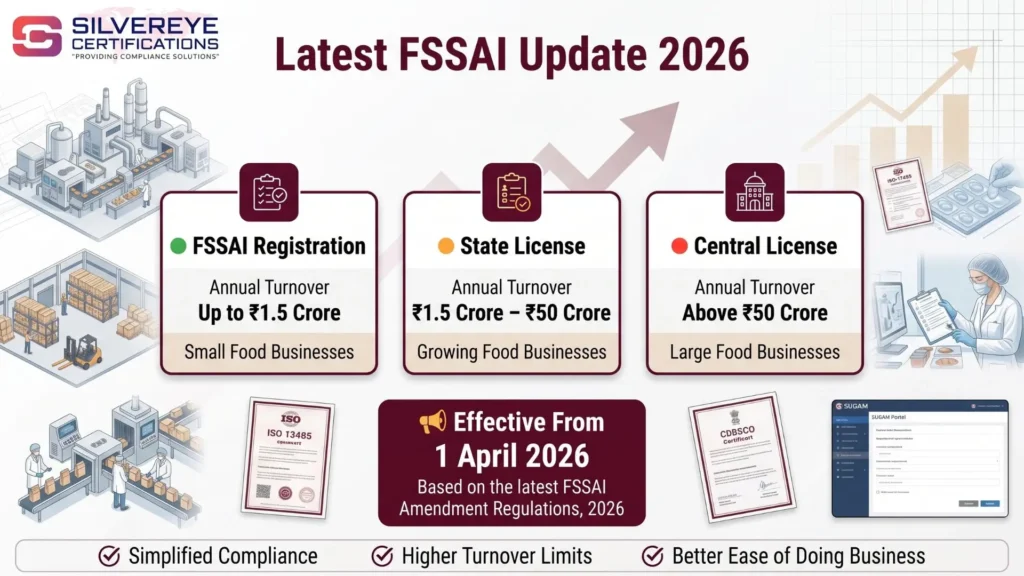
The practical effect: a growing restaurant that once had to jump from Registration straight into a State License at just ₹12 lakh in turnover now has much more headroom — up to ₹1.5 crore — before it needs to upgrade. This order supersedes all earlier orders and regulations on turnover thresholds for food business categorisation, and the same 2026 amendment package also introduced perpetual validity and risk-based inspection, both explained below.
Who Needs This License? (Eligibility)
You need FSSAI registration or a license under the restaurant/food service category if you run any of the following:
- Standalone restaurants, fine-dining establishments, and quick-service restaurants (QSRs)
- Cafés, bakeries with seating, bars and pubs serving food, and food courts
- Dhabas and roadside eateries with a fixed premises
- Hotel restaurants and in-house dining (in addition to the hotel's own FSSAI category, if applicable)
- Cloud kitchens and delivery-only kitchens operating from a licensed premises
- Canteens and cafeterias attached to offices, institutions, or factories
Types of FSSAI License for Restaurants
| License Type | Annual Turnover | Annual Fee | Best Suited For |
| Registration | Up to ₹1.5 crore | ₹100 | Small eateries, home-style kitchens, tiny cafés, petty food stalls with a fixed premises |
| State License | ₹1.5 crore – ₹50 crore | ₹5,000 | Most standalone restaurants, mid-size cafés, dhabas, and multi-outlet local chains |
| Central License | Above ₹50 crore | ₹7,500 | Large restaurant chains, multi-state operations, and restaurants inside airports/railway premises |

A quick clarification: hotels are licensed slightly differently — a 5-star-and-above hotel needs a Central License regardless of turnover, and up to a 4-star hotel needs a State License. But the restaurant or food-service outlet inside that hotel is still assessed on the same turnover-based criteria as any other restaurant.
Documents Required for FSSAI License – Restaurants
The exact document list scales with your license type, but a typical restaurant applying for Registration or a State License should keep the following ready:
- Completed and signed Form A (Registration) or Form B (State/Central License)
- Photo ID and address proof of the proprietor, partners, or directors
- Proof of possession of business premises — rent agreement, sale deed, or electricity bill
- Partnership deed, certificate of incorporation, or MOA & AOA, as applicable to your business structure
- List of food categories/menu items to be prepared and served
- Kitchen layout/blueprint showing area allocation (mandatory for State/Central License)
- List of kitchen equipment and machinery, where applicable
- Food Safety Management System (FSMS) plan or self-declaration
- Water analysis report (chemical & bacteriological) from a recognized/NABL-accredited laboratory, since water is used as a food ingredient
- NOC from the local municipal corporation
- Passport-size photograph of the applicant

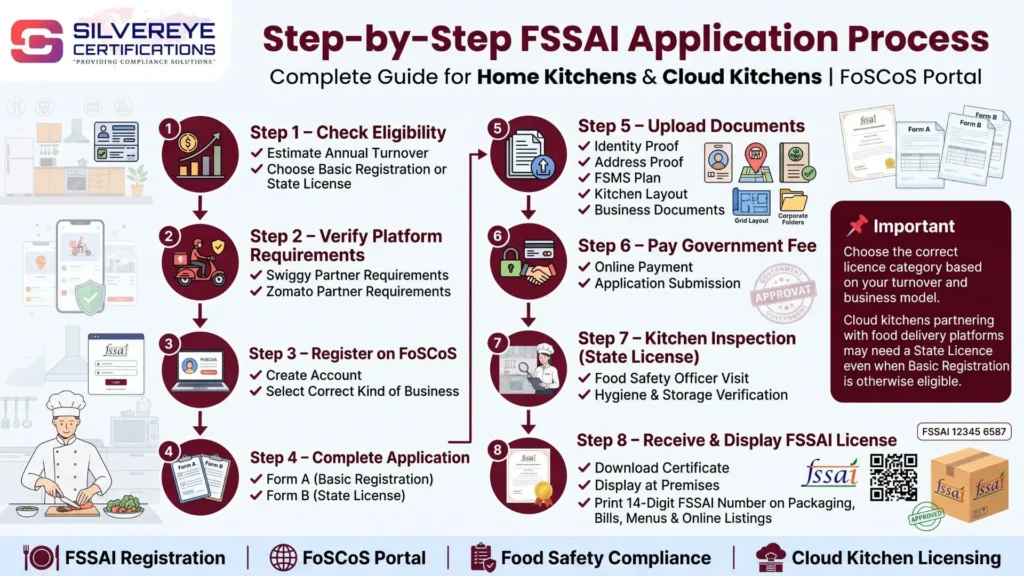
Step-by-Step FSSAI License Application Process for Restaurants (via FoSCoS)
All FSSAI registrations and licenses — including for restaurants — are processed through the FoSCoS (Food Safety Compliance System) portal at foscos.fssai.gov.in. The earlier FLRS portal has been discontinued.
- Determine your category — Registration, State License, or Central License — based on your restaurant's actual annual turnover under the 2026 thresholds. Use the portal's built-in eligibility wizard if you're unsure.
- Create your FBO account on FoSCoS using your mobile number and email, and verify via OTP.
- Select "Restaurant" as the Kind of Business (KoB) — do not select "Manufacturer", a common mistake that causes rejection.
- Fill Form A or Form B with complete business, premises, and menu details.
- Upload the required documents in the accepted formats (PDF/JPG/PNG, typically under 2 MB each).
- Pay the applicable annual fee online through the portal.
- Undergo inspection, where applicable — a food safety officer may visit to check hygiene, water quality, storage, and safe food-handling practices before a State/Central License is granted.
- Download your digitally signed Registration Certificate or License from FoSCoS and display it prominently at your restaurant, with the number printed on menus, bills, and online listings.
FSSAI License Fees for Restaurants (2026)
| Category | Annual Fee |
| Registration (turnover up to ₹1.5 crore) | ₹100 |
| State License (₹1.5 crore – ₹50 crore) | ₹5,000 |
| Central License (above ₹50 crore) | ₹7,500 |
This fee is payable every year even under the perpetual-validity system introduced in 2026 — perpetual validity removes the renewal paperwork, not the annual fee obligation. Beyond the government fee, most restaurants also budget for water testing, kitchen-layout drafting, and any professional consultancy assistance.
Validity and Renewal: The Big 2026 Change
Under the earlier framework, a restaurant's FSSAI license or registration was valid for a fixed term of 1 to 5 years chosen at the time of application, and had to be renewed at least 30 days before expiry — with a late fee of ₹100 per day for delayed renewal, and cancellation if the window was missed entirely.
The 2026 amendment replaces this with perpetual validity: a license or registration issued on or after 1 April 2026 stays valid indefinitely and is not tied to an expiry date. It ends only in three situations:
- Suspension by the Food Authority for non-compliance
- Cancellation following a formal proceeding
- Voluntary surrender by the operator (with 30 days' written notice on closure of business, and no refund of fees already paid)
Two obligations continue regardless of perpetual validity:
- The annual license/registration fee must still be paid every year.
- The Food Safety Compliance Return (FSCR) must be filed by the due date.
Missing either results in automatic (deemed) suspension — your restaurant cannot legally operate until outstanding fees, returns, and any applicable penalty are cleared.
| Practical Tip: If your restaurant's existing license was due to expire on or around the transition (before 31 March 2026), don't assume automatic perpetual carryover — renew it under the pre-amendment process if it was expiring, and confirm your updated status on the FoSCoS portal after 1 April 2026. |
Hygiene & Kitchen Compliance Standards for Restaurants
- Clean, pest-free kitchen and storage areas with proper ventilation
- Potable water supply, backed by a water analysis report from a recognised laboratory
- Separate raw and cooked food storage to avoid cross-contamination
- Staff trained in basic food-handling hygiene, with clean uniforms and, where required, medical fitness checks
- Proper waste disposal and drainage systems
- Display of the FSSAI license/registration number at the premises and on menus, bills, and online food-delivery listings
- Voluntary participation in FSSAI's Hygiene Rating scheme, which many restaurants use as a customer-trust signal alongside the mandatory license
FSSAI Licensing Table for Dairy Products (2026)
Most restaurants and cafés use dairy inputs daily — milk, paneer, cheese, cream, ghee, curd, or ice cream — either bought in or made on-site (for example, an in-house paneer or ice-cream unit). If your restaurant processes or manufactures dairy products rather than simply buying them ready-made, that activity falls under FSSAI's "Dairy units" Kind of Business, which follows the same revised turnover thresholds as of 1 April 2026:
| License Type | Annual Turnover | Annual Fee | Typical Dairy Products Covered |
| Registration | Up to ₹1.5 crore | ₹100 | Small-scale paneer/curd making, milk vending, petty milkmen |
| State License | ₹1.5 crore – ₹50 crore | ₹5,000 | Milk, paneer, cheese, ghee, curd, flavoured milk, ice cream units |
| Central License | Above ₹50 crore | ₹7,500 | Large dairy processors, packaged milk/milk-product brands, dairy exporters |
If you're simply purchasing dairy products from a licensed supplier and using them as ingredients in your restaurant's menu, you don't need a separate dairy license — your restaurant's own Registration/State/Central License already covers that. A separate dairy license only applies if your restaurant itself is manufacturing or processing dairy products for sale, such as a dedicated ice-cream or paneer production unit.
Why an FSSAI License Matters for Restaurants
- Legal necessity — operating a restaurant without valid registration/license is an offence under the Food Safety and Standards Act, 2006
- Builds customer trust — the FSSAI number on your menu and billing signals regulatory approval to diners
- Mandatory for delivery platforms — Zomato, Swiggy, and similar apps require a valid FSSAI license number before listing any restaurant or cloud kitchen
- Enables business growth — banks, franchise partners, and mall/food-court operators typically ask for a valid FSSAI license before onboarding
- Reduces regulatory risk — a valid, correctly categorised license lowers the chance of seizure, shutdown, or penalty during a surprise inspection
Penalties for Non-Compliance FSSAI Registration
Running a restaurant without valid FSSAI registration or license is punishable under Section 63 of the FSS Act, 2006 — a fine of up to ₹5 lakh and imprisonment of up to six months. Other common violations include:
- Unhygienic or unsanitary food preparation — fine up to ₹1 lakh (Section 56)
- Selling substandard or misbranded food — fine up to ₹5 lakh / ₹3 lakh respectively (Sections 51 & 52)
- Missing the annual fee payment or Food Safety Compliance Return — automatic deemed suspension under the 2026 amendment
- Repeat or serious violations can lead to license cancellation, in addition to the fines above
Conclusion
The 2026 turnover update has made FSSAI licensing for restaurants easier to classify — most standalone restaurants and cafés now fit comfortably within the State License band, and small eateries get far more room under Basic Registration before needing to upgrade. But hygiene expectations, risk-based inspections, and the annual fee/return obligation continue regardless of your slab. Before you apply, confirm your exact turnover-based category, keep your kitchen layout and water test report ready, and file through the FoSCoS portal to stay compliant under the framework effective from 1 April 2026.
Frequently Asked Questions
Do all restaurants need an FSSAI license?
Yes. Every restaurant, café, dhaba, or food-service outlet in India must hold either FSSAI Registration or a License, depending on annual turnover, before commencing operations.
What is the current FSSAI turnover limit for restaurants in 2026?
Effective 1 April 2026: Registration up to ₹1.5 crore, State License between ₹1.5 crore and ₹50 crore, and Central License above ₹50 crore, as per FSSAI Order No. I/36087/2026 dated 13 March 2026.
Which FSSAI license do most restaurants need?
Most standalone restaurants and cafés with turnover above ₹1.5 crore and up to ₹50 crore fall under the State License category — the most common license type for this business segment.
Has the FSSAI renewal system for restaurants been abolished?
For licenses and registrations issued on or after 1 April 2026, yes — they carry perpetual validity and don't need periodic renewal. The annual fee and compliance return still have to be filed.
Do cloud kitchens need the same FSSAI license as restaurants?
Yes. Cloud kitchens are classified the same way as restaurants — by turnover — and must display their FSSAI number on their premises and on every food-delivery app listing.
Is a kitchen layout plan mandatory for a restaurant's FSSAI license?
A layout plan is generally required for State and Central License applications, though it may not be needed for a basic Registration.
Does a restaurant need FSSAI approval to be listed on Zomato or Swiggy?
Yes. Food delivery platforms require every restaurant and cloud kitchen to have a valid FSSAI license or registration number before listing.
Do I need a separate dairy license if my restaurant makes its own paneer or ice cream?
Yes, if you manufacture dairy products in-house for sale rather than just buying them ready-made, that activity falls under FSSAI's Dairy Units category, following the same 2026 turnover thresholds.
How long does it take to get an FSSAI license for a restaurant?
Registration is typically processed within 7–10 working days, while a State License usually takes 30–60 days depending on inspection scheduling; Central License can take longer.
What happens if a restaurant doesn't pay its annual FSSAI fee?
The license or registration is automatically (deemed) suspended, and the restaurant cannot legally operate until the fee, any penalty, and pending returns are cleared.
What is the penalty for running a restaurant without an FSSAI license?
Under Section 63 of the FSS Act, 2006, operating without a valid license or registration can attract a fine of up to ₹5 lakh and imprisonment of up to six months.
Can a restaurant upgrade from Registration to a State License later?
Yes. If your turnover grows beyond ₹1.5 crore, you can migrate to a State License through FoSCoS; your existing license number is typically retained during the upgrade.