
- Repackers and relabellers are treated as 'deemed manufacturers' by FSSAI — they need a manufacturing-type license even though they don't own a production facility.
- Relabellers must get their products made only by a third-party manufacturer holding a valid FSSAI license, and need a separate license/registration for each such manufacturer they use.
- Every relabelled or repacked product must carry both the relabeller's/repacker's details and the original manufacturer's name and license number on the label.
- The 2026 turnover thresholds — Registration up to ₹1.5 crore, State License up to ₹50 crore, Central License above ₹50 crore — apply to repackers and relabellers the same way they apply to any other food business.
Introduction
An FSSAI license for repackers and relabellers is the mandatory food safety approval for any business that breaks bulk food into smaller retail packs (repacking) or sells third-party manufactured food under its own brand label (relabelling), without owning a manufacturing unit. FSSAI treats both as 'deemed manufacturers' under specific Kind of Business categories on FoSCoS — 'Repacker' and 'Re-labeller' — and applies the same 2026 turnover slabs as regular manufacturers: Registration up to ₹1.5 crore, State License up to ₹50 crore, Central License above ₹50 crore. The product label must show both the repacker's/relabeller's FSSAI number and the original manufacturer's name and license number.
What Is FSSAI License for Repackers and Relabellers?
An FSSAI license for repackers and relabellers is the food safety approval required by any business that handles already-manufactured food without owning the factory that made it — either by repacking it into different quantities or packaging, or by relabelling it for sale under a private brand. FSSAI does not treat this as a lighter trading activity; both categories are classified as 'deemed manufacturers' and carry manufacturing-level compliance obligations.
This is the exact license category behind most private-label and white-label food brands in India — D2C companies that get products made in a partner factory and sell them under their own name are, in FSSAI's eyes, relabellers, not simple traders.
Repacker vs Relabeller: What's the Difference?
| Aspect | Repacker | Relabeller |
| What they do | Opens bulk/wholesale packs and divides contents into smaller retail-sized packs; may change pack size, type, or outer packaging | Sources a finished, already-packaged product from a third-party manufacturer and sells it under their own brand label |
| Physical packaging change | Yes — breaks or repackages the product itself | No — typically affixes or changes only the label, not the underlying package |
| FoSCoS Kind of Business | Repacker | Re-labeller (also called Relabeler) |
| Manufacturing premises required? | Needs premises suitable for repacking operations | Not required to own any manufacturing premises at all |
| Label must show | Repacker's name, address, and FSSAI number, plus original manufacturer details where applicable | Both the relabeller's and the original manufacturer's/processor's name, address, and FSSAI license number |
Why This License Matters for Repacking and Relabelling Businesses
- Legal requirement: Repacking or relabelling food without the correct FSSAI Kind of Business license is treated the same as unlicensed manufacturing under the FSS Act, 2006.
- Brand accountability: Once a product carries your label, you — the relabeller — are fully responsible for its safety and compliance, even though a third party manufactured it.
- Retail and e-commerce listing: Marketplaces and retail chains check that a private-label brand's FSSAI number matches the correct 'Relabeller' or 'Repacker' Kind of Business, not just a generic trading registration.
- Investor and franchise readiness: Correct licensing under the right KoB is a standard due-diligence check for private-label brands raising funding or signing large retail/distribution deals.
2026 FSSAI Turnover Update and How It Applies to Repackers/Relabellers
FSSAI's Order No. RCD-01002/1/2021-Regulatory-FSSAI-Part(1), dated 13 March 2026, revised the turnover thresholds used to categorize food businesses under the Food Safety and Standards (Licensing and Registration of Food Businesses) Amendment Regulations, 2026 (Gazette notification dated 10 March 2026), effective 1 April 2026.
| License Type | Old Turnover Limit (pre-2026) | New Turnover Limit (from 1 April 2026) |
| Basic Registration | Up to ₹12 lakh | Up to ₹1.5 crore |
| State License | ₹12 lakh – ₹20 crore | Above ₹1.5 crore up to ₹50 crore |
| Central License | Above ₹20 crore | Above ₹50 crore |
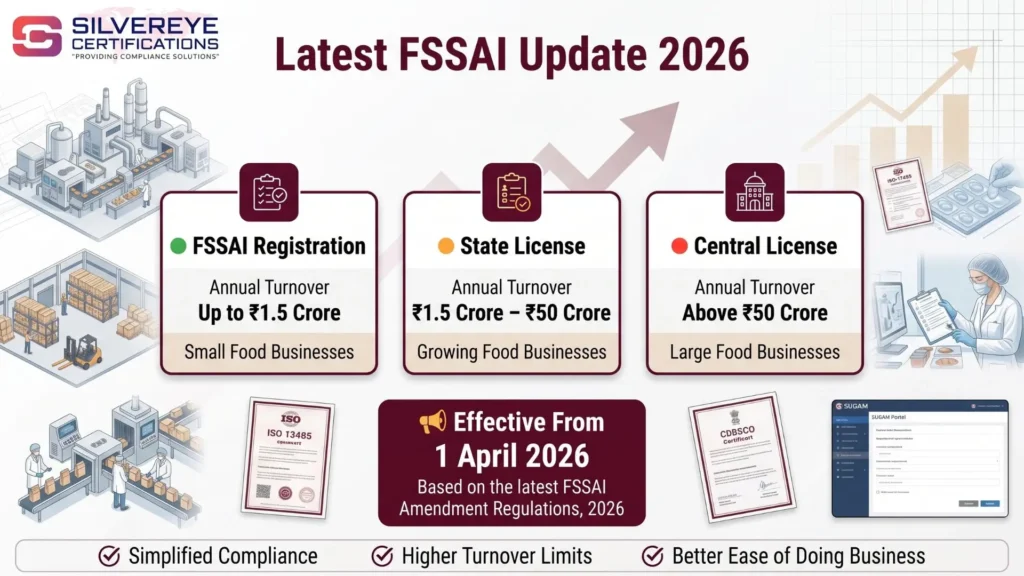
These slabs apply to repackers and relabellers just as they apply to any manufacturer: your turnover decides Registration, State, or Central License, unless an activity-based exception applies (see below). Two other 2026 changes matter here too:
- Perpetual validity: licenses granted after 1 April 2026 no longer expire on a fixed 1–5 year term, subject to risk-based inspections.
- Automatic category upgrade: if your turnover crosses your current slab, FSSAI upgrades you automatically at no extra cost, keeping your existing 14-digit number.
Activity-based exception: if you operate as a relabeller or repacker's head office across more than one state, FSSAI guidance (following a 2013 Office Memorandum, still applied in practice) directs that the head office/registered office take a Central License, regardless of the turnover slab that would otherwise apply — since the relabeller's single license covers all its outsourced manufacturing relationships nationally.
There's also an older, capacity-based reference point still cited by several FSSAI consultants: food processing units — including repackers and relabellers — with installed capacity above 2 MT/day (excluding grains) have historically been pointed toward Central License eligibility. Since the 2026 turnover overhaul is now the primary categorisation framework, treat this capacity figure as a secondary reference and verify your exact category on the current FoSCoS Kind of Business matrix before applying.
Key FSSAI Rules Every Repacker and Relabeller Must Follow
- A relabeller must source products only from a manufacturer that itself holds a valid FSSAI license — you cannot outsource to an unlicensed facility.
- A relabeller needs a separate license or registration entry for each third-party manufacturer it works with, as clarified under FSSAI's licensing amendment framework regularised in April 2021.
- Relabellers and repackers must appoint one person responsible for compliance across all their relabelling/repacking units.
- Relabellers cannot own or operate their own manufacturing/processing premises under this Kind of Business — if you start manufacturing yourself, you need a separate 'Manufacturer' KoB license.
- If you operate in more than one state, the relabeller's head office or registered office can be issued a single Central License covering the business, per FSS Licensing and Registration Regulations, 2011 guidance.
- A documented product recall plan is mandatory, in line with the Food Safety and Standards (Food Recall) Regulations, 2017, since the relabeller carries responsibility for the branded product even though a third party made it.
- Simply holding a 'Marketer' or 'Trader' Kind of Business is not a substitute for the Relabeller KoB if you are putting your own brand label on someone else's manufactured product.
Mandatory Dual Labelling Requirements
Because two businesses are involved in getting a repacked or relabelled product to market, FSSAI requires both parties' details to appear on the pack — this is the single most important compliance point for this category.
- Name, address, and FSSAI license/registration number of the repacker or relabeller
- Name, address, and FSSAI license/registration number of the original manufacturer or processor
- Complete ingredient list, allergen declarations, and nutritional information, updated to reflect the retail pack (not just copied from the wholesale pack)
- Batch/lot number, date of manufacture or packing, and best-before/use-by date
- Net quantity of the product in the new (repacked) pack size, in metric units
- FSSAI logo and 14-digit number, plus the vegetarian (green) or non-vegetarian (brown) symbol
Note: some declarations (such as the full ingredient list, date of manufacture, and veg/non-veg logo) are not mandatory on the outer wholesale package if the retail-sized inner packs already carry them correctly — but once you repack into a new retail unit, that inner pack must carry the full set of mandatory declarations.
Documents Required for FSSAI License for Repackers and Relabellers
Common documents (all categories)
- Photo ID and address proof of the Food Business Operator / authorised signatory
- Business constitution certificate — GST registration, Certificate of Incorporation, Partnership Deed, or Udyam Registration
- List of products to be repacked or relabelled, with category classification
- Bank account details (cancelled cheque or passbook copy)
Relabeller-specific documents
- Copy of the third-party manufacturer's valid FSSAI license, for every manufacturer being used
- Manufacturing/supply agreement or contract with each third-party manufacturer
- Sample label drafts showing both the relabeller's and manufacturer's details, as per FSSAI's dual-labelling requirement
- Authorisation letter naming the person responsible for compliance across all relabelling units
- Documented product recall plan
Repacker-specific documents
- Layout plan of the repacking premises and list of repacking equipment
- Food Safety Management System (FSMS) plan covering the repacking process and hygiene controls
- Water testing report from an NABL-accredited laboratory, where relevant to the repacking process
- Source/supply documentation for the bulk product being repacked

Step-by-Step FSSAI Application Process
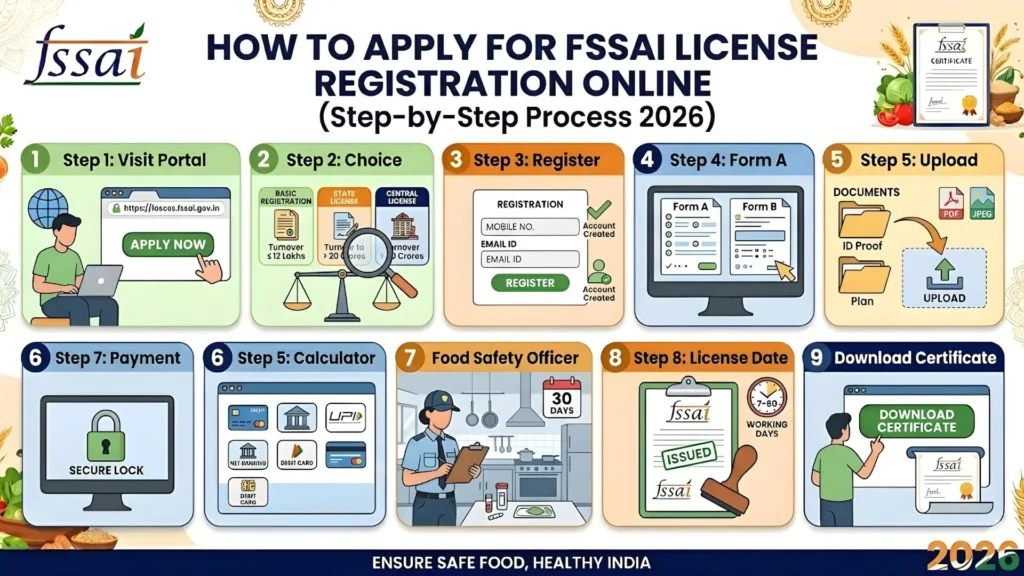
- Decide your correct Kind of Business — 'Repacker' if you physically repackage bulk product, or 'Re-labeller' if you only affix your brand label on a third party's finished, packaged product.
- Register on the FoSCoS portal (foscos.fssai.gov.in) and select the matching KoB along with your product category.
- For relabellers: gather each third-party manufacturer's FSSAI license details and your supply agreements before starting the application, since these are required per manufacturer relationship.
- Fill Form A (Basic Registration) or Form B (State/Central License) based on your turnover slab and any activity-based Central License trigger (multi-state head office, for example).
- Upload all required documents, including sample labels showing the dual-labelling format.
- Pay the applicable government fee online.
- For State/Central applications, a Food Safety Officer inspects the repacking premises (for repackers) or reviews documentation and the compliance framework (for relabellers, who don't have a manufacturing site to inspect).
- On approval, print the 14-digit FSSAI number and all mandatory dual-labelling declarations on every repacked or relabelled product before it goes to market.
FSSAI License Fee Chart for Repackers and Relabellers
| License Category | Government Fee (per year) | Typical Timeline |
| Basic Registration | ₹100 | 7–10 working days |
| State License | ₹2,000 – ₹5,000 (scale-dependent) | 30–60 working days |
| Central License | ₹7,500 | 60–90 working days |
These are government fees only; the license is valid for the term you choose (1–5 years) for licenses issued before the perpetual-validity rule applies to your category, and consultancy charges if you use an agent are billed separately.
Renewal and Ongoing Compliance
- Renewal window: for licenses still on a fixed term, file at least 30 days before expiry; an express window may open up to 180 days before expiry.
- Late fee: ₹100 per day applies if renewal is filed after the 30-day-before-expiry deadline but before the license lapses.
- Annual Return (Form D-1): mandatory for all manufacturers, including repackers and relabellers, due by 31 May every year for the previous financial year, filed through FoSCoS.
- Adding a new third-party manufacturer: relabellers should update their FSSAI records/license to reflect each new manufacturer relationship rather than relying on an old approval covering a different supplier.
- Perpetual validity: licenses granted after 1 April 2026 no longer need renewal on a fixed term, subject to risk-based inspections — but responsibility for compliance, recalls, and accurate dual labelling remains ongoing regardless of validity status.
Penalties for Non-Compliance
Repacking or relabelling food without the correct FSSAI Kind of Business license is treated as unlicensed manufacturing under the FSS Act, 2006, carrying penalties of up to ₹5 lakh and imprisonment of up to six months. Incorrect or missing dual-labelling information — omitting the original manufacturer's details, for instance — can separately trigger action for misbranding under the Act, even if the relabeller otherwise holds a valid license.
Frequently Asked Questions
Is a separate FSSAI license required for repacking or relabelling food products?
Yes. FSSAI treats repackers and relabellers as deemed manufacturers, and you must apply under the specific 'Repacker' or 'Re-labeller' Kind of Business on FoSCoS — a general trading or marketer registration is not sufficient.
What is the difference between a repacker and a relabeller under FSSAI?
A repacker physically breaks bulk packaging and repacks the product into smaller retail units. A relabeller doesn't touch the physical packaging — they get a finished, packaged product made by a third-party manufacturer and sell it under their own brand label.
Can a relabeller own a manufacturing unit?
No. Relabellers are deemed manufacturers who do not own or operate manufacturing/processing premises; they must get all products made by a manufacturer holding a valid FSSAI license.
Does a relabeller need a separate license for each manufacturer they use?
Yes. As clarified under FSSAI's licensing framework, a relabeller needs a separate license/registration entry for each third-party manufacturer or processor it sources products from.
What must appear on the label of a repacked or relabelled product?
Both the repacker's/relabeller's name, address, and FSSAI number, and the original manufacturer's name, address, and FSSAI license number, along with the standard mandatory declarations (ingredients, batch number, dates, net quantity, and veg/non-veg symbol).
What is the FSSAI license fee for a repacking or relabelling business?
Government fees follow the same structure as other food businesses: ₹100 per year for Basic Registration, ₹2,000–₹5,000 per year for a State License, and ₹7,500 per year for a Central License, based on turnover and activity.
Do the 2026 turnover thresholds apply to repackers and relabellers?
Yes. The same slabs apply — Registration up to ₹1.5 crore, State License up to ₹50 crore, and Central License above ₹50 crore — unless an activity-based trigger like a multi-state head office pushes the business to Central License regardless of turnover.
Is a private-label or white-label brand automatically a relabeller?
If you don't own the manufacturing unit and simply put your brand's label on a third party's finished product, yes — FSSAI classifies this as relabelling, and a 'Marketer' or 'Trader' registration alone is not considered sufficient for this activity.
Does a relabeller need to hold a Central License if it operates in multiple states?
Generally yes for the head office/registered office, following FSSAI guidance that a relabeller's single license should cover its business nationally when it operates across more than one state.
What happens if the original manufacturer's details are missing from a relabelled product's label?
This can be treated as misbranding under the FSS Act, 2006, separate from any licensing penalty, since accurate dual labelling is a specific compliance requirement for this category.