
- Manufacturers of health supplements, nutraceuticals, and novel foods need a Central FSSAI License regardless of turnover — production capacity or revenue does not lower this requirement.
- Under the FSSAI Order of 16 September 2021, State Licenses for these products could not be renewed after 1 January 2022 — existing units had to migrate to Central License.
- A separate Product Approval / Non-Specified Food approval (₹50,000 + GST per application) is mandatory before launch if your product uses a novel ingredient or makes a health/disease-risk-reduction claim.
- The general 2026 turnover thresholds — Registration up to ₹1.5 crore, State License up to ₹50 crore, Central above ₹50 crore — still govern related activities like trading, retailing, or repacking supplement products.
Introduction
An FSSAI license for health supplements and nutraceuticals is the mandatory Central License every manufacturer, importer, or marketer of protein powders, vitamins, herbal extracts, and functional foods needs in India. Unlike regular food businesses, turnover doesn't decide the category here — manufacturing these products always requires a Central FSSAI License, governed by the FSS (Health Supplements, Nutraceuticals, Food for Special Dietary Use, Food for Special Medical Purpose, Functional Food and Novel Food) Regulations, 2016.
The government fee is ₹7,500 a year, and products with new ingredients or health claims need a separate Product Approval costing ₹50,000 + GST before they can be sold.
What Is an FSSAI License for Health Supplements and Nutraceuticals?
An FSSAI license for health supplements and nutraceuticals is the food safety authorization issued by the Food Safety and Standards Authority of India to any business that manufactures, imports, distributes, repacks, or markets products covered under the FSS (Health Supplements, Nutraceuticals, Food for Special Dietary Use, Food for Special Medical Purpose, Functional Food and Novel Food) Regulations, 2016.
This category covers protein powders and whey supplements, multivitamin and mineral capsules, herbal and botanical extracts, sports nutrition products, meal-replacement shakes, probiotics and prebiotics, and any 'novel food' that doesn't fit an existing FSSAI standard. These products are regulated more strictly than ordinary packaged food because they carry nutrition and health claims that directly influence consumer wellbeing.
Why This License Matters for Supplement and Nutraceutical Brands
- Legal requirement: Manufacturing or selling health supplements without a valid Central FSSAI License and, where applicable, Product Approval is a punishable offence under the FSS Act, 2006.
- Marketplace gatekeeping: Amazon, Flipkart, and quick-commerce platforms verify the FSSAI license number and product category before listing any supplement brand.
- Consumer safety and trust: FSSAI screens every ingredient against the permitted Schedules and RDA limits set by ICMR, protecting consumers from unsafe dosages or banned substances.
- Investor and export readiness: A valid Central License and product-level approvals are typically the first documents diligence teams and export buyers ask for.
2026 FSSAI Turnover Update and How It Applies to Supplements
FSSAI's Order No. RCD-01002/1/2021-Regulatory-FSSAI-Part(1), dated 13 March 2026, revised the turnover thresholds used to categorise food businesses generally, under the Food Safety and Standards (Licensing and Registration of Food Businesses) Amendment Regulations, 2026 (Gazette notification dated 10 March 2026), effective 1 April 2026.
| License Type | Old Turnover Limit (pre-2026) | New Turnover Limit (from 1 April 2026) |
| Basic Registration | Up to ₹12 lakh | Up to ₹1.5 crore |
| State License | ₹12 lakh – ₹20 crore | Above ₹1.5 crore up to ₹50 crore |
| Central License | Above ₹20 crore | Above ₹50 crore |
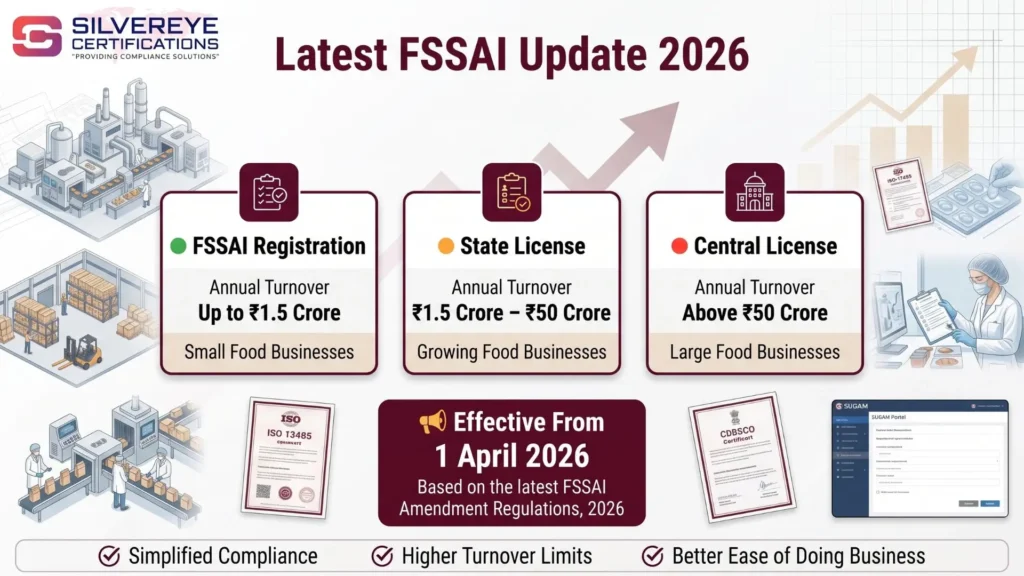
Important distinction for this category: these turnover slabs are the default rule for general food businesses. For manufacturers of health supplements, nutraceuticals, and novel foods specifically, a separate, activity-based FSSAI order (16 September 2021) already mandates a Central License irrespective of turnover or production capacity — this activity-based requirement continues to override the turnover slabs for manufacturing. The 2026 turnover thresholds are more directly relevant if your business only trades, retails, or repacks pre-approved supplement products rather than manufacturing them, or if you run a small-scale outlet selling third-party supplement brands.
- Other 2026 changes relevant to every FBO, including supplement manufacturers: perpetual validity of registrations/licenses issued after 1 April 2026, subject to risk-based inspections.
- Automatic category upgrade with no extra cost and no change of license number, if turnover crosses your existing slab.
License and Approval Types for Health Supplements & Nutraceuticals
1. Central FSSAI License (mandatory for all manufacturers)
Every unit manufacturing health supplements, nutraceuticals, food for special dietary use (FSDU), food for special medical purpose (FSMP), functional foods, or novel foods must hold a Central License. Fee: ₹7,500 per year (plus applicable GST). There is no turnover or capacity threshold that allows a smaller license for manufacturing this category.
2. Product Approval / Non-Specified Food Approval
If your product contains an ingredient not listed in Schedules I–VIII of the 2016 Regulations, uses a new processing technology, or makes a health/nutrient/disease-risk-reduction claim, you additionally need approval under the FSS (Approval for Non-Specified Food and Food Ingredients) Regulations, 2017. Fee: ₹50,000 + GST per application, filed via Form I on FSSAI's ePAAS (electronic Product & Claim Approval Application System).
3. Advertisement & Health Claims Approval
Separate from product approval, if you want to advertise a specific health, nutrition, or disease-risk-reduction claim, FSSAI's claims-approval route applies. Fee: ₹50,000 per application (maximum three claims per application), reviewed by an expert committee, with preliminary review typically completed within 1–8 days after scrutiny begins — though scientific evaluation for a new or complex claim can extend the overall timeline.
4. Basic Registration / State License (for allied activities only)
Small retailers or repackers dealing only in already-approved, pre-packaged supplement products (not manufacturing them) may qualify for Basic Registration (turnover up to ₹1.5 crore) or a State License (₹1.5 crore–₹50 crore) for that specific trading activity — but the moment manufacturing is involved, the Central License requirement applies regardless of scale.
Eligibility Criteria For FSSAI License For Health Supplements & Nutraceuticals
| Business Activity | License/Approval Required | Turnover Relevant? |
| Manufacturing health supplements/nutraceuticals | Central FSSAI License | No — mandatory regardless of turnover |
| Product with novel ingredient or health claim | Product Approval (Non-Specified Food) | No — mandatory regardless of turnover |
| Importing supplement products | Central FSSAI License + IEC | No — mandatory regardless of turnover |
| Trading / retailing pre-approved supplements only | Basic Registration or State License | Yes — based on 2026 turnover slabs |
| Repacking or relabelling supplement products | State or Central License, based on scale | Partially — check KoB on FoSCoS |
Documents Required for FSSAI License for Health Supplements & Nutraceuticals
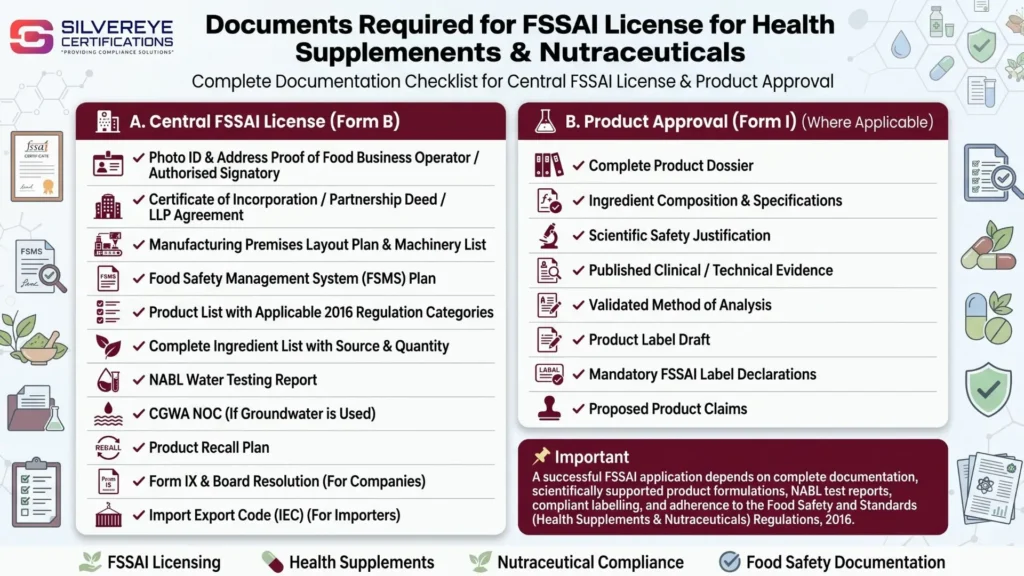
For the Central License application (Form B)
- Photo ID and address proof of the Food Business Operator / authorised signatory
- Business constitution certificate — Certificate of Incorporation, Partnership Deed, or LLP Agreement
- Layout plan of the manufacturing premises and list of machinery/equipment
- Food Safety Management System (FSMS) plan and list of products with category as per the 2016 Regulations Schedules
- Complete list of ingredients with source and quantity for each product
- Water testing report from an NABL-accredited laboratory; NOC from CGWA is additionally required if groundwater is used
- Recall plan and nomination of a responsible person (Form IX with board resolution, for companies)
- Import Export Code (IEC), for importers of supplement raw materials or finished products
For Product Approval (Form I, if applicable)
- Complete product dossier — composition, source and specification of every ingredient
- Scientific justification / published data supporting safety and any claimed benefit
- Validated method of analysis for the ingredient(s) in question
- Label draft showing all mandatory declarations and the proposed claim wording
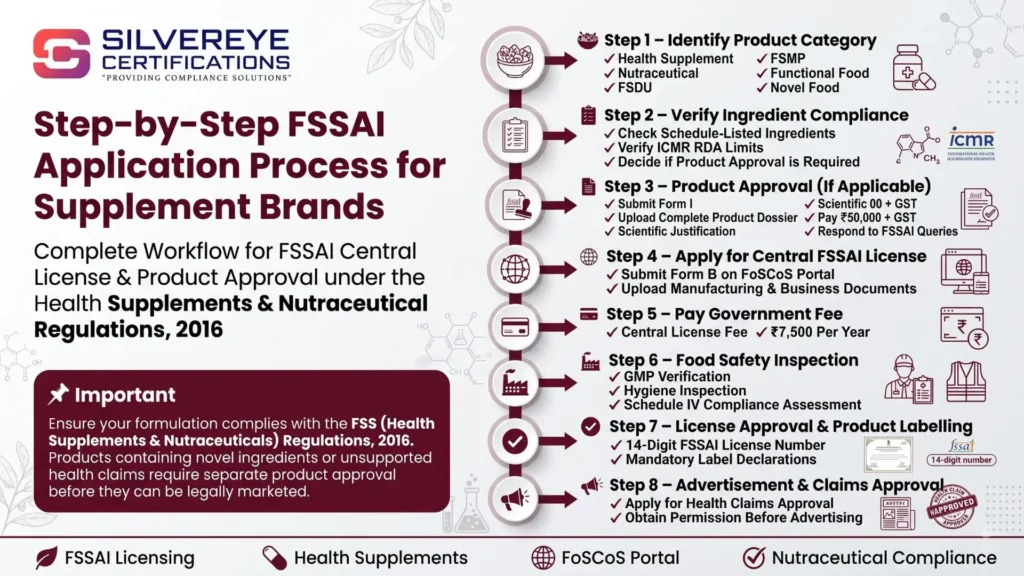
Step-by-Step FSSAI Application Process for Supplement Brands
- Confirm your product category — Health Supplement, Nutraceutical, FSDU, FSMP, Functional Food, or Novel Food — under the 2016 Regulations before choosing a Kind of Business (KoB) on FoSCoS.
- Check whether your formulation uses only Schedule-listed ingredients within ICMR RDA limits. If yes, you may proceed directly to the Central License application; if not, file for Product Approval first.
- For novel ingredients or claims, submit Form I with the product dossier and the ₹50,000 + GST fee via ePAAS; respond to any FSSAI queries within the stipulated 15–30 days.
- Once product-level approval (if needed) is in hand, apply for the Central FSSAI License using Form B on the FoSCoS portal (foscos.fssai.gov.in), uploading all manufacturing-unit documents.
- Pay the government fee — ₹7,500 per year for the Central License.
- A Food Safety Officer inspects the manufacturing premises for GMP, hygiene, and Schedule 4 compliance before the license is granted.
- On approval, the 14-digit Central License number must appear on every product label, along with all mandatory declarations.
- If you plan to advertise a specific health claim, file a separate Advertisement & Claims Approval application before running that campaign.
FSSAI Fee Chart for Health Supplements & Nutraceuticals
| Requirement | Government Fee | Typical Timeline |
| Central FSSAI License | ₹7,500 per year | 60–90 working days (includes inspection) |
| Product Approval (Non-Specified Food) | ₹50,000 + GST per application | Varies; scientific review can take several months |
| Advertisement & Claims Approval | ₹50,000 per application (max. 3 claims) | Preliminary review in 1–8 days; full evaluation can extend further for novel claims |
| Basic Registration (allied trading activity only) | ₹100 per year | 3–7 working days |
| State License (allied trading activity only) | ₹2,000 – ₹5,000 per year | 30–60 working days |
Dairy-Based Ingredient Table for Nutraceuticals and Supplements
Many popular supplement categories — protein powders, dairy whiteners, and functional dairy blends — are built on dairy-derived ingredients. FSSAI classifies these under specific Food Product Category (FPC) codes on FoSCoS, which you must select correctly at the time of application, in addition to your Health Supplement/Nutraceutical category:
| Dairy-Derived Ingredient | FSSAI Product Category Code | Common Supplement Use |
| Whey powder / acid whey powder | FSSR 2.1.12 (FPC 1.8.2 – Dried whey products) | Whey protein concentrate/isolate supplements |
| Milk and cream powder / skimmed milk powder | FSSR 2.1.10 (FPC 1.5) | Protein and meal-replacement blends |
| Dairy whitener (skimmed/low/medium/high fat) | FSSR 2.1.11 (FPC 1.5.1.1) | Functional dairy-based drink mixes |
| Whey protein cheese / whey-based cheese | FPC 1.6.3 / 1.6.6 | Casein and whey-cheese-derived protein products |
| Liquid whey and whey products | FPC 1.8.1 | Ready-to-drink whey-based functional beverages |
If your dairy-derived ingredient (for example, a novel whey fraction or a non-standard casein hydrolysate) doesn't fit any listed FSSR/FPC code, treat it as a non-specified ingredient and route it through Product Approval before use in a supplement formulation.
Mandatory Labelling for Health Supplements and Nutraceuticals
- FSSAI logo with the 14-digit license number, minimum 5 mm in height
- Product name and correct category label — 'Health Supplement' or 'Nutraceutical' as applicable
- Complete ingredient list in descending order of weight, with INS numbers for additives
- Nutritional information panel and Recommended Dietary Allowance (%RDA), with maximum daily intake warnings
- Mandatory disclaimer: 'This product is not intended to diagnose, treat, cure or prevent any disease.'
- Vegetarian (green) or non-vegetarian (brown) symbol, allergen declarations, batch number, and manufacture/best-before dates
Permitted vs Prohibited Ingredients — What You Need to Know
- Permitted vitamins and minerals: only specific chemical forms in specific quantities are allowed — for example, Vitamin C as ascorbic acid, Vitamin B12 as cyanocobalamin.
- Permitted amino acids: L-glutamine, L-arginine, branched-chain amino acids (BCAAs), and similar Schedule-listed amino acids.
- Permitted herbal ingredients: many traditional herbs such as ashwagandha, turmeric, and tulsi are allowed as standardised extracts within prescribed limits.
- Prohibited substances: ephedrine, stimulants, anabolic compounds, and certain banned herbal species cannot be used in any FSSAI-regulated supplement.
- Anything outside the permitted Schedules needs Novel Food / Non-Specified Food approval before it can be used in a formulation.
FSSAI License Renewal and Ongoing Compliance
- Renewal window: file at least 30 days before expiry for licenses still on a fixed 1–5 year term; an express window can open up to 180 days before expiry.
- Late fee: ₹100 per day if renewal is filed after the 30-day-before-expiry deadline but before the license lapses.
- Annual Return (Form D-1): due by 31 May every year for Central License holders.
- Re-labellers and third-party manufacturers: must ensure their contract manufacturer holds a valid, current Central License for the same product category.
- Ingredient and claim changes: any reformulation that adds a non-Schedule ingredient or a new health claim requires a fresh Product Approval or Claims Approval before the updated product is sold.
Penalties for Non-Compliance
Manufacturing or selling health supplements and nutraceuticals without a valid Central FSSAI License, or without the required Product Approval for novel ingredients and claims, is an offence under the FSS Act, 2006. Beyond the standard penalty of up to ₹5 lakh and imprisonment of up to six months for operating without a license, misleading advertisements or unapproved health claims can separately attract a penalty of up to ₹10 lakh under the FSS (Advertising and Claims) Regulations, 2018.
Conclusion
Obtaining an FSSAI License for Health Supplements and Nutraceuticals is not just a regulatory requirement—it is the foundation for building a legally compliant and trusted supplement business in India. Whether you manufacture protein powders, vitamins, herbal supplements, sports nutrition products, probiotics, or novel food formulations, ensuring the correct Central FSSAI License, Product Approval (where applicable), and compliant product labelling is essential before entering the market.
As FSSAI regulations continue to evolve, businesses must stay updated with licensing requirements, permitted ingredients, health claim regulations, and ongoing compliance obligations to avoid delays, penalties, or product recalls. A properly planned compliance strategy not only ensures smooth market entry but also strengthens consumer confidence, marketplace acceptance, and export opportunities.
Frequently Asked Questions
Is FSSAI license mandatory for health supplements and nutraceuticals in India?
Yes. Every business that manufactures, imports, or markets health supplements, nutraceuticals, or novel foods must hold a Central FSSAI License, and certain products additionally need a separate Product Approval.
Can a small nutraceutical manufacturer apply for Basic Registration instead of a Central License?
No. Since the FSSAI Order of 16 September 2021, manufacturing of health supplements and nutraceuticals requires a Central License irrespective of turnover or production capacity — Basic Registration and State License are not available for this manufacturing activity.
What is the fee for an FSSAI Central License for supplements?
The government fee is ₹7,500 per year, plus applicable GST. This is separate from any Product Approval or Claims Approval fees.
Do I need Product Approval for every supplement I launch?
Not always. If your product uses only ingredients listed in Schedules I–VIII of the 2016 Regulations within permitted RDA limits, and makes no new health claim, you generally don't need separate Product Approval. Novel ingredients, new technology, or health/disease-risk-reduction claims require it.
How much does FSSAI Product Approval cost?
The government fee for Non-Specified Food/Product Approval is ₹50,000 plus GST per application, filed through FSSAI's ePAAS portal using Form I.
How long does it take to get a Central FSSAI License for a supplement unit?
Typically 60–90 working days, since it involves document scrutiny and a mandatory premises inspection by a Food Safety Officer.
Can I sell whey protein or dairy-based supplements under the same license?
Yes, provided you select the correct Food Product Category code for the dairy-derived ingredient (for example, whey powder under FSSR 2.1.12) alongside your Health Supplement/Nutraceutical category on the FoSCoS application.
What happens if I use an ingredient not listed in the FSSAI Schedules?
You must apply for Non-Specified Food/Novel Food approval before using that ingredient in any formulation sold in India — using it without approval is a compliance violation.
What is the penalty for selling an unapproved health supplement?
Operating without a valid Central FSSAI License or required Product Approval can attract a penalty of up to ₹5 lakh and imprisonment of up to six months; unapproved or misleading health claims can separately attract a penalty of up to ₹10 lakh.
What labelling disclaimer is mandatory on health supplement packs?
Every health supplement label must carry the statement: 'This product is not intended to diagnose, treat, cure or prevent any disease,' along with the FSSAI logo, license number, ingredient list, and %RDA information