

- BP Monitors are classified as Class B medical devices under CDSCO's Medical Device Rules, 2017 — there is no separate Class A, C, or D category for this product.
- Manufacturers use Form MD-3 (application) and Form MD-5 (license) from the State Licensing Authority; importers use MD-14/MD-15, and wholesalers use MD-41/MD-42.
- CDSCO registration for BP monitors is mandatory before manufacture, import, sale, or distribution in India — non-compliance can mean product seizure and penalties.
- Licenses are generally valid in perpetuity subject to a retention fee every 5 years; approval timelines range from 30 days (wholesale) to several months (import).
Introduction
CDSCO Registration for BP Monitor is mandatory under India's Medical Device Rules, 2017, before any blood pressure monitor — manual, digital, or ambulatory — can be manufactured, imported, sold, or distributed in the country. CDSCO classifies the BP monitor as a Class B (low-to-moderate risk) medical device, so it does not fall under separate Class A, C, or D categories.
Indian manufacturers apply through Form MD-3 and receive the manufacturing license as Form MD-5 from their State Licensing Authority. Importers use Form MD-14/MD-15, and wholesalers/distributors use Form MD-41/MD-42. Licenses are typically valid in perpetuity with a five-year retention fee cycle.
What Is CDSCO Registration for BP Monitor?
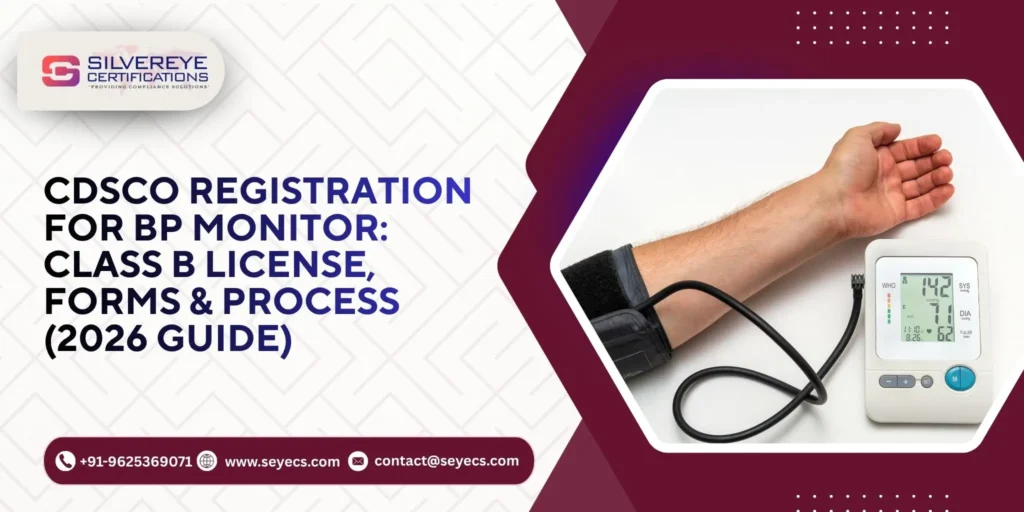
A Blood Pressure (BP) Monitor is a notified medical device used to measure systolic and diastolic blood pressure through an inflatable cuff, pressure sensor, and digital or mechanical display. Because it is used to diagnose and monitor a vital physiological parameter, every BP monitor sold, manufactured, or imported in India must be registered with the Central Drugs Standard Control Organization (CDSCO) under the Medical Device Rules, 2017 (MDR 2017).
CDSCO Registration for BP Monitor is the umbrella term for the licensing process that applies to manufacturers, importers, and wholesalers of this device. Depending on your role in the supply chain, you will apply for one or more of the following: a manufacturing license (MD-3/MD-5), an import license (MD-14/MD-15), or a wholesale license (MD-41/MD-42). CDSCO, functioning under the Directorate General of Health Services, Ministry of Health and Family Welfare, is the National Regulatory Authority responsible for approving and monitoring all these licenses.
Whether you manufacture a BP monitor domestically, import a BP monitor from an overseas supplier, or plan to wholesale a BP monitor to hospitals and retailers, CDSCO registration for BP monitor businesses follows the same underlying framework: correct classification, complete documentation, and timely license renewal.
Why CDSCO Registration Is Mandatory for BP Monitors
Following the CDSCO notification G.S.R. 102(E) dated 11 February 2020, all medical devices in India — barring select Class A non-sterile, non-measuring devices — fall under a mandatory licensing regime. A BP monitor is a measuring device, which means self-certification or voluntary registration is not sufficient; it requires a formal license before it can legally enter the Indian market.
- Ensures the device meets safety, accuracy, and performance benchmarks under the Essential Principles laid out in MDR 2017.
- Protects patients and healthcare providers from inaccurate or substandard blood pressure readings.
- Legally required for e-commerce listing, hospital procurement, government tenders, and export documentation.
- Non-compliance can result in product seizure, monetary penalties, and legal action under the Drugs and Cosmetics Act, 1940.
CDSCO Classification of BP Monitor: Why It's Class B (Not A, C, or D)
CDSCO classifies all medical devices into four risk-based categories — Class A (low risk), Class B (low-to-moderate risk), Class C (moderate-to-high risk), and Class D (high risk) — under the First Schedule of MDR 2017. A BP monitor, regardless of whether it is manual (aneroid/mercury), digital/electronic, or ambulatory, is consistently classified as a Class B device because it is non-invasive, does not sustain life, and carries low-to-moderate risk if it malfunctions.
Unlike device categories such as patient monitors or infusion pumps — which can span multiple classes depending on their features — CDSCO does not maintain separate Class A, C, or D listings for BP monitors. This is confirmed by CDSCO's official MDR 2017 First Schedule classification list and is consistent across independent regulatory sources. Presenting a fabricated A/C/D split for this specific product would be inaccurate, so this guide focuses on the correct, single classification: Class B.
BP Monitor Types and Their CDSCO Classification
| BP Monitor Type | Description | CDSCO Class |
| Manual/Aneroid BP Monitor | Mechanical sphygmomanometer with a hand pump and dial gauge, operated with a stethoscope. | Class B |
| Digital/Electronic BP Monitor | Automatic or semi-automatic cuff-based device with electronic pressure sensors and digital display. | Class B |
| Ambulatory BP Monitoring System (ABPM) | Wearable device that records blood pressure at intervals over 24 hours for clinical assessment. | Class B |
| Wrist/Upper-Arm Digital BP Monitor | Consumer or clinical-grade cuff-based device for home or point-of-care use. | Class B |
| Regulatory Note A related but distinct device — the invasive arterial pressure/oximetry monitor used in ICUs with a catheter-linked transducer — is also classified as Class B, but it is a different notified device with its own intended use and is not interchangeable with a standard non-invasive BP monitor for licensing purposes. |
CDSCO Registration Pathways for BP Monitor (By Business Role)
Because BP monitors are Class B devices, the applicable forms depend on whether you manufacture, import, or wholesale/distribute the device — not on a device sub-class. Here is the complete form-wise breakdown:
| Business Role | Application Form | License/Grant Form | Licensing Authority |
| Domestic Manufacturer (Class A/B devices) | MD-3 | MD-5 | State Licensing Authority (SLA) |
| Domestic Manufacturer (Class C/D devices — not applicable to BP monitor) | MD-7 | MD-9 | Central Licensing Authority (CDSCO) |
| Importer (Foreign Manufacturer via Indian Agent) | MD-14 | MD-15 | Central Licensing Authority (CDSCO) |
| Wholesaler/Distributor/Stockist | MD-41 | MD-42 | State Licensing Authority (SLA) |
Note: MD-7 and MD-9 apply only to Class C and Class D devices such as heart valves, pacemakers, and ventilators. Since BP monitors are Class B, manufacturers use MD-3/MD-5, not MD-7/MD-9.
MD-3 Application and MD-5 Grant of License: Manufacturing BP Monitors (Class A/B)
Manufacturers who want to produce BP monitors within India must apply to their State Licensing Authority (SLA) using Form MD-3. Once the application, supporting documents, and (where required) the Notified Body audit are satisfactorily completed, the SLA grants the manufacturing license in Form MD-5.
Who Should Apply for MD-3/MD-5
- Domestic manufacturers setting up a facility to produce BP monitors in India.
- Contract manufacturers producing BP monitors for a brand owner or loan licensee.
- Manufacturers who already hold a Test License (Form MD-13) and want to move to commercial production.
Documents Required for MD-5 License
- Covering letter and duly filled Form MD-3 application
- Constitution details of the manufacturer (company registration, MSME/IEC where applicable)
- Site Master File describing the manufacturing premises and processes
- Device Master File covering design, specifications, and labelling of the BP monitor
- Test License (Form MD-13), where applicable, for generating quality control data
- Compliance undertaking for the Fifth Schedule (Quality Management System requirements)
- Product labels, Instructions for Use (IFU), and brochures
- Proof of fee payment (challan/online receipt)
MD-3/MD-5 Process, Fees, Timeline & Validity
| Parameter | Details |
| Application Form | MD-3 (submitted via the CDSCO SUGAM portal) |
| Grant of License Form | MD-5 |
| Licensing Authority | State Licensing Authority (SLA) |
| Government Fee | ₹5,000 per manufacturing site + ₹500 per distinct BP monitor model |
| Approval Timeline | Approximately 3 to 6 months, depending on the state and Notified Body audit scheduling |
| Validity | Valid in perpetuity, subject to payment of a retention fee before every 5-year cycle |
| Renewal | Retention fee must be paid before completion of 5 years from the date of issue to avoid lapse |
MD-14 Application and MD-15 Grant of License: Importing BP Monitors
Foreign manufacturers cannot apply to CDSCO directly. A BP monitor manufactured outside India must be imported through an Indian Authoriezd Agent, who holds a valid wholesale license (MD-42) or manufacturing license, and who files the import application in Form MD-14 through the SUGAM portal. Once CDSCO reviews the documentation — and, for higher-scrutiny cases, conducts a site evaluation — the import license is granted in Form MD-15.
Who Should Apply for MD-14/MD-15
- Foreign BP monitor manufacturers entering the Indian market (via an Indian Authorised Agent)
- Indian importers/distributors bringing in BP monitors manufactured overseas
- Companies adding new BP monitor models to an existing import license
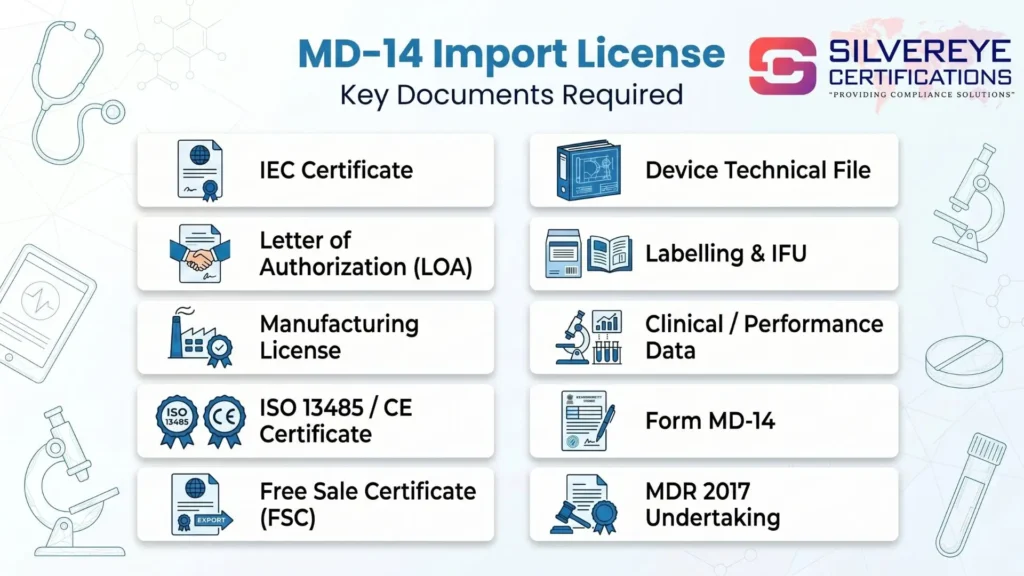
Documents Required for MD-15 License
- Form MD-14 application, duly completed
- Power of Attorney (PoA) authorizing the Indian Agent, notarized/apostilled as applicable
- Free Sale Certificate (FSC) from the country of origin's regulatory authority
- Device Master File and Plant Master File
- ISO 13485 Quality Management System certificate
- CE Marking certificate or equivalent international regulatory approval, where available
- Product labels and Instructions for Use (IFU) compliant with Indian labelling rules
- Wholesale license (MD-42) or manufacturing license of the Indian Authorized Agent
MD-14/MD-15 Process, Fees, Timeline & Validity
| Parameter | Details |
| Application Form | MD-14 (filed by the Indian Authorised Agent on the SUGAM portal) |
| Grant of License Form | MD-15 |
| Licensing Authority | Central Licensing Authority (CDSCO) |
| Government Fee (Class B) | Approximately USD 2,000 per manufacturing site + USD 1,000 per distinct device model (indicative; confirm current fee on the CDSCO portal) |
| Approval Timeline | Approximately 3 to 9 months, depending on document completeness and query resolution |
| Validity | Valid in perpetuity, subject to a retention fee before every 5-year cycle |
| Renewal | Retention application filed with the old license and fee challan before the 5-year cycle lapses |
MD-41 Application and MD-42 Grant of License: Wholesale of BP Monitors
Any business that wants to stock, sell, exhibit, or distribute BP monitors in India — whether sourced domestically or imported — needs a wholesale license. The applicant files Form MD-41 through the CDSCO SUGAM portal, and after document verification and a premises inspection by a Drug Inspector, the State Licensing Authority grants the license in Form MD-42.
Who Should Apply for MD-41/MD-42
- Wholesalers and stockists distributing BP monitors to hospitals, pharmacies, or retailers
- E-commerce sellers and marketplace vendors listing BP monitors for sale
- Indian Authorized Agents who need a valid MD-42 license before filing an MD-14 import application
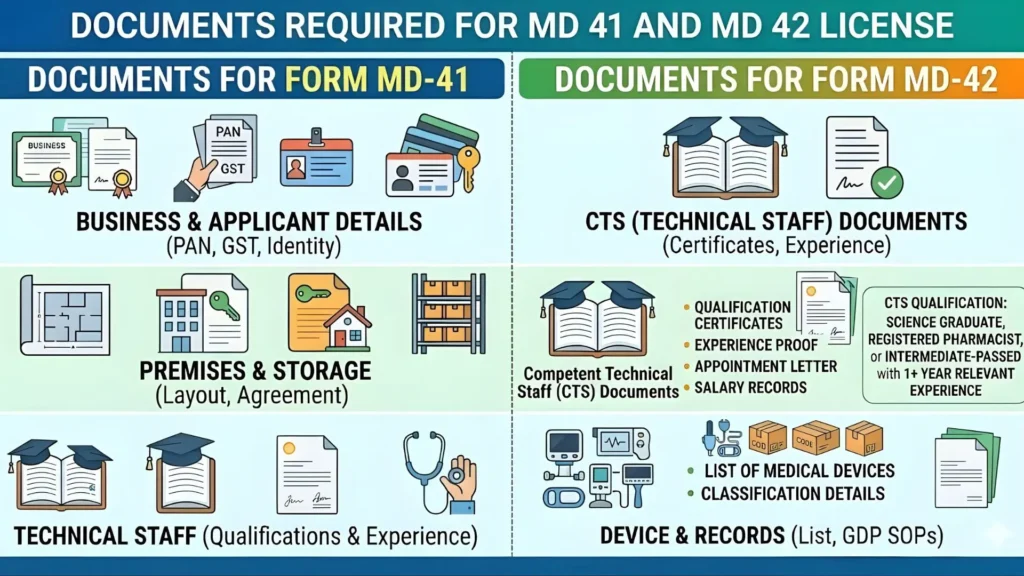
Documents Required for MD-42 License
- Form MD-41 application, duly completed
- Business registration proof (GST, PAN, incorporation certificate, or partnership deed)
- Premises proof, layout plan, and photographs of the storage facility
- Qualification and appointment proof of the Technical/Competent Person (e.g., D.Pharm, B.Pharm, or equivalent experience)
- Standard Operating Procedures (SOPs) for storage, handling, and record-keeping
- Proof of government fee payment
MD-41/MD-42 Process, Fees, Timeline & Validity
| Parameter | Details |
| Application Form | MD-41 (filed via the CDSCO SUGAM portal or applicable state portal) |
| Grant of License Form | MD-42 |
| Licensing Authority | State Licensing Authority (SLA) |
| Government Fee | Approximately ₹3,000 per premise (indicative; confirm current fee with your SLA) |
| Approval Timeline | Approximately 30 to 90 working days, depending on document readiness and inspection scheduling |
| Validity | Valid in perpetuity, subject to a retention fee before every 5-year cycle |
| Renewal | Apply for retention at least 90 days before the 5-year cycle ends to avoid business disruption |
Step-by-Step Process for CDSCO Registration for BP Monitor
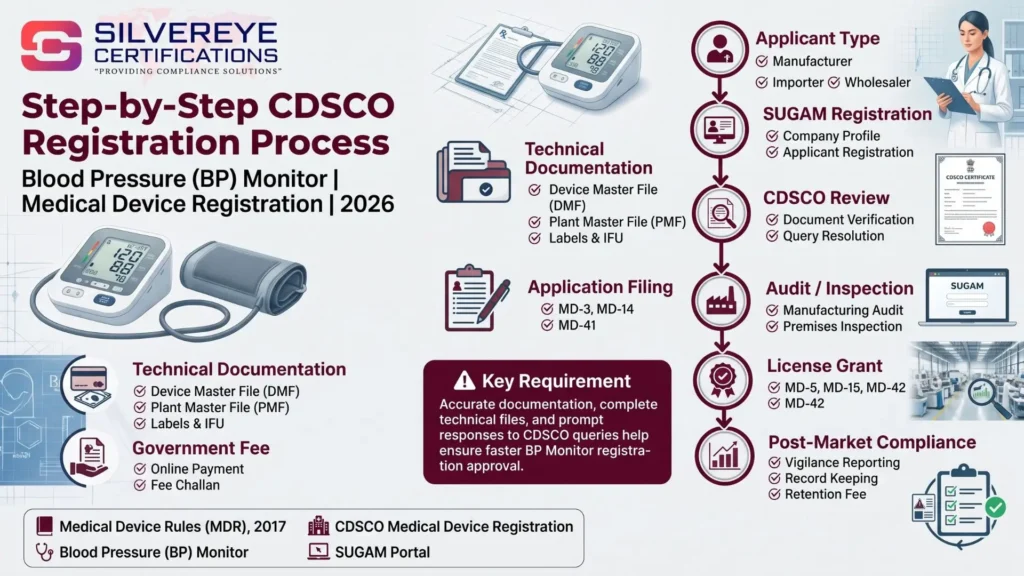
- Identify your role in the supply chain — manufacturer, importer, or wholesaler/distributor — since this determines which form(s) you file.
- Register your organization on the CDSCO SUGAM portal and complete your applicant profile.
- Compile the Device Master File, Site/Plant Master File, labels, and IFU for the BP monitor model(s).
- Prepare role-specific documents: manufacturing (MD-3), import (MD-14 with PoA and FSC), or wholesale (MD-41 with premises proof).
- Pay the applicable government fee through the prescribed online payment mode and retain the challan/receipt.
- Submit the application online and respond promptly to any CDSCO or SLA queries or deficiency letters.
- Facilitate the Notified Body audit (for manufacturing) or Drug Inspector premises inspection (for wholesale), if applicable.
- Receive the grant of license — MD-5, MD-15, or MD-42 — and begin compliant manufacturing, import, or distribution.
- Maintain post-market compliance: adverse event reporting, record-keeping, and timely retention fee payment every 5 years.
Benefits of CDSCO Registration for BP Monitor
- Legal authorization to manufacture, import, sell, or distribute BP monitors anywhere in India.
- Builds credibility with hospitals, pharmacy chains, e-commerce platforms, and government procurement bodies.
- Reduces risk of product seizure, financial penalties, or business suspension under the Drugs and Cosmetics Act.
- Enables participation in tenders and institutional supply contracts that mandate CDSCO-licensed devices.
- Strengthens patient safety by ensuring the device meets India's Essential Principles for accuracy and performance.
Why Choose Silvereye Certifications for CDSCO Registration
Silvereye Certifications helps manufacturers, importers, and wholesalers of BP monitors and other medical devices navigate CDSCO's MD-3/MD-5, MD-14/MD-15, and MD-41/MD-42 processes end-to-end — from device classification and dossier preparation to SUGAM portal filing, audit coordination, and license retention. Our regulatory team keeps documentation aligned with the latest MDR 2017 requirements so applications move through CDSCO and the State Licensing Authority with minimal queries and delays.
Frequently Asked Questions: CDSCO Registration for BP Monitor
Is CDSCO registration mandatory for BP monitors in India?
Yes. Since the G.S.R. 102(E) notification of 11 February 2020, BP monitors — being measuring devices — require a mandatory CDSCO license before manufacture, import, sale, or distribution in India.
What CDSCO class does a BP monitor fall under?
A BP monitor is classified as a Class B (low-to-moderate risk) medical device under MDR 2017. This applies uniformly to manual, digital, and ambulatory BP monitors — there is no separate Class A, C, or D listing for this device.
Which form do manufacturers use to get a BP monitor manufacturing license?
Manufacturers apply using Form MD-3 to their State Licensing Authority. Once approved, the manufacturing license is granted in Form MD-5.
Which form is used to import BP monitors into India?
Importers, through an Indian Authorised Agent, apply using Form MD-14. CDSCO grants the import license in Form MD-15.
What license is needed to wholesale or distribute BP monitors?
Wholesalers, stockists, and distributors need to apply using Form MD-41. The State Licensing Authority grants the wholesale license in Form MD-42.
Do BP monitors need MD-7 or MD-9 licenses?
No. MD-7 and MD-9 apply only to Class C and Class D devices, such as pacemakers and ventilators. Since BP monitors are Class B, manufacturers use MD-3/MD-5 instead.
What is the government fee for an MD-5 manufacturing license?
The fee is approximately ₹5,000 per manufacturing site plus ₹500 for each distinct BP monitor model, payable to the State Licensing Authority.
How long does it take to get a CDSCO import license (MD-15) for a BP monitor?
Approval timelines are generally 3 to 9 months, depending on document completeness, classification clarity, and how quickly CDSCO queries are resolved.
How long is a CDSCO license for a BP monitor valid?
MD-5, MD-15, and MD-42 licenses are typically valid in perpetuity, provided the licensee pays the prescribed retention fee before completing every 5-year cycle from the date of issue.
Can a foreign BP monitor manufacturer apply directly to CDSCO?
No. Foreign manufacturers must appoint an Indian Authorised Agent holding a valid wholesale (MD-42) or manufacturing license, who then files the MD-14 import application on their behalf.
What documents are essential for BP monitor CDSCO registration?
Core documents include the Device Master File, Site/Plant Master File, product labels and IFU, Free Sale Certificate (for imports), ISO 13485 certificate, and proof of the applicable government fee payment.
What happens if a BP monitor is sold in India without CDSCO registration?
Selling, manufacturing, or importing an unregistered BP monitor is a violation of the Drugs and Cosmetics Act, 1940, and can lead to product seizure, monetary penalties, and legal proceedings against the business.