
- Importers must obtain a COS-2 Grant of Import License via COS-1 application on the SUGAM portal before shipping any perfume to India.
- Domestic manufacturers need COS-5 application leading to COS-8 Grant of Manufacturing License under the Drugs & Cosmetics Act, 1940.
- All perfumes — including Eau de Parfum, Eau de Toilette, attar, body mist, and deodorant sprays — are regulated cosmetics under Schedule S of the D&C Rules, 2020.
- Silvereye Certifications handles end-to-end CDSCO cosmetic registration for perfumes, from documentation to SUGAM portal filing and license issuance.
What is CDSCO Cosmetic Registration for Perfumes?
CDSCO cosmetic registration for perfumes is the mandatory licensing process under the Drugs & Cosmetics Act, 1940 and D&C Rules, 2020 that any importer or manufacturer must complete before selling perfumes in India. Importers apply via COS-1 to receive a COS-2 import license. Manufacturers apply via COS-5 to receive a COS-8 manufacturing license. Both processes are completed online through the SUGAM portal. All perfume types — EDP, EDT, cologne, attar, body mist, and deodorant spray — are covered. Registration ensures product safety, ingredient compliance, and legal market entry in India.
Why CDSCO Cosmetic Registration for Perfumes is Mandatory in India
India classifies perfumes and fragrances as cosmetics under the Drugs and Cosmetics Act, 1940 (D&C Act). This means any business — whether importing international fragrance brands or manufacturing perfumes locally — must obtain the appropriate CDSCO license before placing products on the Indian market.

The Central Drugs Standard Control Organization (CDSCO) enforces compliance through the State Licensing Authority (SLA) and the Central Licensing Authority (CLA). The regulatory framework was significantly updated in 2020 through the New Drugs and Cosmetics Rules, which replaced the older Cosmetic Rules, 1945. Under the 2020 rules, the SUGAM online portal became the single window for all cosmetic license applications.
Failure to obtain CDSCO cosmetic registration for perfumes can result in:
- Seizure of imported or manufactured stock by enforcement authorities
- Heavy fines and penalties under the D&C Act
- Criminal prosecution for the importer, manufacturer, or authorized agent
- Ban on future import or manufacturing activities
Which Perfume Products Require CDSCO Registration?
Every fragrance product sold or distributed in India — regardless of price point or brand origin — requires a valid CDSCO cosmetic license. The table below lists specific perfume product types, their common names, and applicable Schedule.
| Product Name | Common Trade Name | Category | Fragrance Concentration | Schedule |
| Parfum / Pure Perfume | Extrait de Parfum | Fine Fragrance | 20–40% | Schedule S |
| Eau de Parfum (EDP) | EDP Spray, Perfume Spray | Fine Fragrance | 15–20% | Schedule S |
| Eau de Toilette (EDT) | EDT Spray, Toilette Water | Fine Fragrance | 8–15% | Schedule S |
| Eau de Cologne (EDC) | Cologne, Splash Cologne | Fine Fragrance | 3–8% | Schedule S |
| Attar / Ittar | Natural Attar, Rose Attar, Oud Attar | Traditional Fragrance Oil | 100% (oil-based) | Schedule S |
| Body Mist / Body Spray | Fragrance Mist, Refreshing Mist | Light Fragrance | 1–3% | Schedule S |
| Deodorant Spray (Fragrance-Based) | Deo Spray, Body Deodorant | Deodorant/Fragrance | 0.5–2% | Schedule S |
| Roll-On Perfume | Perfume Roller, Roll-On Fragrance | Fine Fragrance / Alcohol-free | 10–25% (oil) | Schedule S |
| Solid Perfume / Balm | Perfume Balm, Wax Perfume | Solid Fragrance | 10–30% (wax) | Schedule S |
| Perfumed Talcum Powder | Scented Body Powder, Dusting Powder | Cosmetic Powder with Fragrance | Fragrance Added | Schedule S |
| Car / Home Fragrance | Room Freshener Spray, Car Perfume | Air Care / Fragrance | Varies | Schedule S |
| Aromatic Reed Diffuser Liquid | Reed Diffuser Oil, Diffuser Refill | Home Fragrance | Varies | Schedule S |
Note: Products with active pharmaceutical or antiperspirant ingredients may require additional Drug Controller approval beyond the standard cosmetic license.
Understanding the Four Key CDSCO Forms for Perfume Registration
CDSCO uses four specific forms for cosmetic licensing in India. Two forms are for importers and two are for manufacturers. Understanding which form applies to your business is the starting point for a successful CDSCO cosmetic registration for perfumes.
| Form | Full Name | Who Files It | Purpose |
| COS-1 | Application for Grant of License to Import Cosmetics | Importer / Authorised Indian Agent | Initial application to import perfumes and cosmetics into India |
| COS-2 | Grant of License to Import Cosmetics | Issued by State Licensing Authority (SLA) | Official import license granted after COS-1 review |
| COS-5 | Application for Grant of License to Manufacture Cosmetics | Domestic Manufacturer | Application to manufacture perfumes and cosmetics in India |
| COS-8 | Grant of License to Manufacture Cosmetics | Issued by State Licensing Authority (SLA) | Official manufacturing license granted after COS-5 inspection |
COS-1 Application: How Importers Apply for Perfume Import License
If you are importing perfumes into India — whether from France, the UAE, the USA, or any other country — you must file a COS-1 application on the SUGAM portal. The COS-1 is the gateway to receiving your COS-2 import license.
Who is Eligible to File COS-1?
- Any Indian company, LLP, or sole proprietor acting as an importer of cosmetic products
- Authorized Indian Agents (AIA) representing foreign manufacturers
- Wholesale importers and distributors sourcing perfume products from abroad
- E-commerce businesses importing fragrance products for online retail in India
Documents Required for COS-1 (Import License Application)
| No. | Document | Details / Remarks |
| 1 | COS-1 Application Form | Duly filled and signed by authorized signatory; submitted via SUGAM portal |
| 2 | Business Registration Certificate | Certificate of Incorporation, MSME certificate, or Shop & Establishment Act registration |
| 3 | GST Registration Certificate | Valid GSTIN of the importing entity in India |
| 4 | Import Export Code (IEC) | Issued by DGFT; mandatory for all importers |
| 5 | Site Plan / Premises Plan | Layout of the import/storage premises with dimensions |
| 6 | List of Cosmetic Products to be Imported | Product-wise list mentioning product name, brand, category, HS code |
| 7 | Product Label / Artwork | Draft label complying with Schedule O of D&C Rules, 2020 (in English) |
| 8 | Product Formula / Ingredient List | INCI names of all ingredients; declaration of restricted/prohibited substances |
| 9 | Certificate of Analysis (COA) | Issued by foreign manufacturer for each product batch |
| 10 | Certificate of Free Sale (CFS) | Issued by Competent Authority in the country of manufacture; notarised and apostilled |
| 11 | Manufacturing License of Foreign Manufacturer | Valid manufacturing license from the country of origin |
| 12 | Authorisation Letter / Power of Attorney | Authorising Indian agent to apply on behalf of foreign manufacturer |
| 13 | Undertaking / Self-Declaration | Confirming product does not contain prohibited ingredients under Schedule K |
| 14 | Safety Data Sheet (SDS) | For alcohol-based perfumes and aerosol sprays |
| 15 | Proof of Paid Fee | Challan / online payment receipt for prescribed government fee |
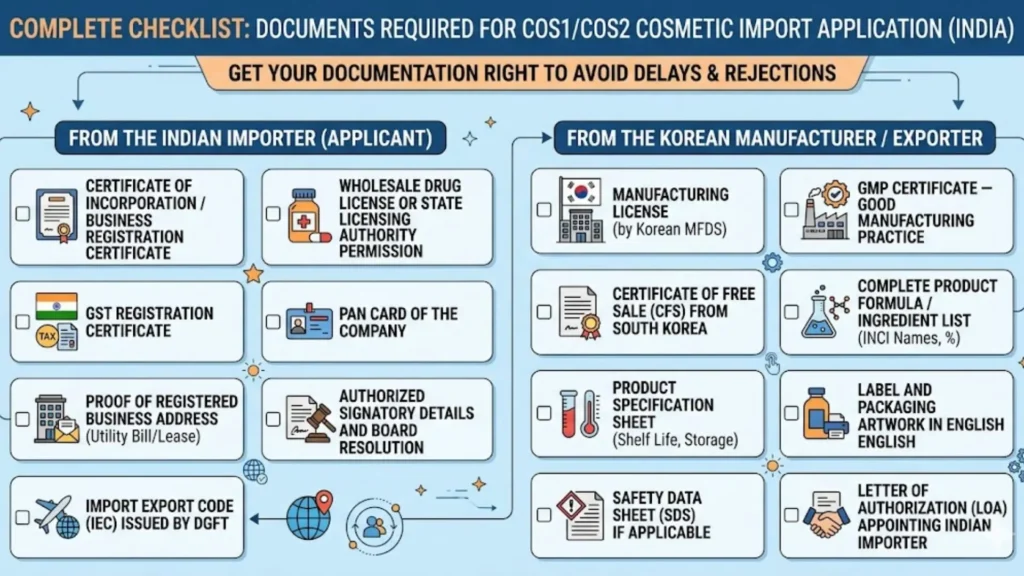
Step-by-Step COS-1 Application Process on SUGAM Portal
- Register on SUGAM Portal: Visit sugam and create a new account as an importer.
- Select Form COS-1: Navigate to Cosmetics > New Import License > COS-1 Application.
- Fill Applicant Details: Enter company name, IEC, GST, premises address, and contact details.
- Add Product List: Upload product-wise details with brand name, formulation, and country of origin.
- Upload Documents: Attach all required documents (COA, CFS, label, formula, authorization).
- Pay Government Fee: Pay the prescribed fee online through the SUGAM payment gateway.
- Submit Application: Submit the form. An application ID is generated for tracking.
- Scrutiny by SLA: The State Licensing Authority reviews the application and may raise queries.
- Grant of COS-2: Once approved, the COS-2 import license is issued on the SUGAM portal.
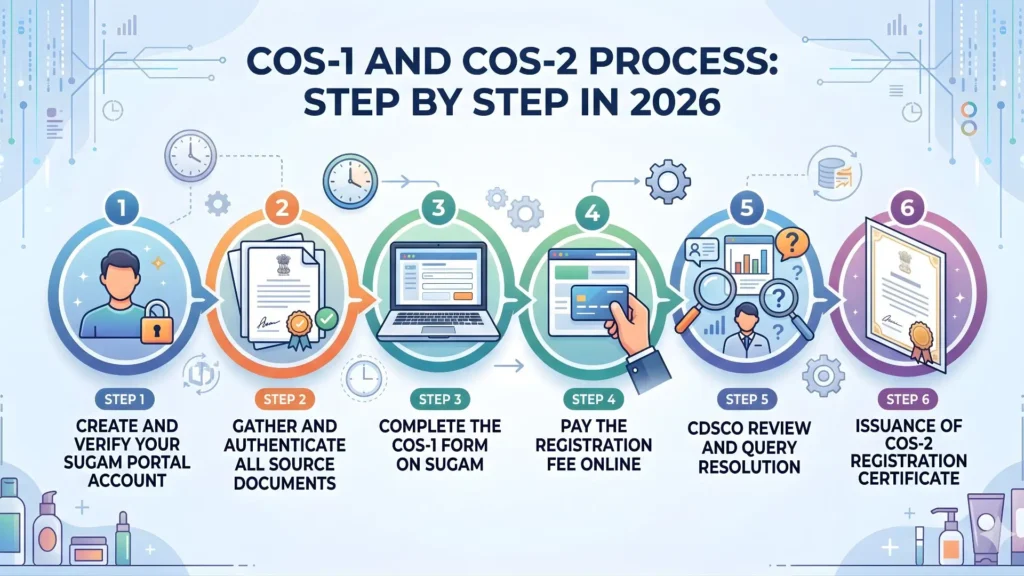
COS-2: Grant of License to Import Perfumes
The COS-2 is the actual import license that allows you to legally bring perfumes into India. It is issued by the State Licensing Authority after successful review of your COS-1 application. The COS-2 license specifies the products, quantities, and conditions under which import is permitted.
What Does a COS-2 License Include?
- Name and address of the importer / authorized agent
- List of approved cosmetic products with brand names and categories
- Country of origin and name of the foreign manufacturer
- Conditions of import, labelling requirements, and storage conditions
- Validity period and renewal date
Fees and Timeline for COS-1 and COS-2
| Parameter | Domestic Applicant | Foreign Applicant | Remarks |
| Application Fee (COS-1) | ₹3,000 per application | Equivalent in USD | Payable online via SUGAM |
| Fee per Product/Brand | ₹1,000 per product | Equivalent in USD | For each additional cosmetic product added |
| Late Renewal Penalty | ₹1,000 per month | – | Applicable if license lapses |
| Processing Time | 30–60 working days | 45–90 working days | Subject to document completeness |
| License Validity | 3 years | 3 years | Renewable before expiry |
COS-5 Application: How Manufacturers Apply for Perfume Manufacturing License
If you manufacture perfumes in India — whether for domestic sale, export, or both — you need a COS-5 application which leads to a COS-8 manufacturing license. This applies to all scales of operation, from small-batch artisanal attar producers to large-scale fragrance manufacturing units.
Who Needs to File COS-5?
- Companies and individuals manufacturing perfumes, body mists, attars, or deodorant sprays in India
- Contract manufacturers producing fragrances for third-party brands
- Export-oriented units manufacturing perfumes for global markets from India
- Start-ups and MSMEs setting up fragrance manufacturing facilities
Premises and Infrastructure Requirements for COS-5
Before filing COS-5, your manufacturing premises must meet specific infrastructure standards under Schedule M and the D&C Rules, 2020:
- Dedicated manufacturing area with clean, non-porous flooring and adequate ventilation
- Separate zones for raw material storage, compounding, filling, and finished goods storage
- Adequate lighting (minimum 300 lux in manufacturing areas)
- Clean and safe water supply meeting IS 10500 standards
- Quality control laboratory with basic testing equipment
- Trained staff with a qualified technical supervisor (preferably a pharmacist or cosmetic chemist)
- Proper waste management and effluent disposal system
Documents Required for COS-5 (Manufacturing License Application)
| No. | Document | Details / Remarks |
| 1 | COS-5 Application Form | Duly filled on SUGAM portal by the manufacturer or authorised signatory |
| 2 | Business Registration Certificate | Certificate of Incorporation, Partnership Deed, or Proprietorship certificate |
| 3 | GST Registration | Valid GSTIN of the manufacturing entity |
| 4 | Land / Building Ownership / Lease Deed | Proof of legal possession of manufacturing premises |
| 5 | Site Master File (SMF) | Complete site layout, premises plan with dimensions, zoning details |
| 6 | Equipment List | List of all manufacturing, filling, and quality control equipment with make and model |
| 7 | List of Products to be Manufactured | Product-wise details: name, category, formulation type |
| 8 | Product Formulation / Master Formula | INCI ingredient list, quantities, process description for each product |
| 9 | Technical Supervisor / Qualified Person Details | Qualification certificates, experience proof, appointment letter |
| 10 | Standard Operating Procedures (SOPs) | SOPs for manufacturing, QC testing, cleaning, labelling, and recall |
| 11 | Quality Control Lab Report | Evidence of in-house or third-party QC testing capability |
| 12 | Safety Data Sheet (SDS) | For all raw materials, especially alcohol, essential oils, and aerosolised substances |
| 13 | Water Testing Report | Recent water quality test confirming suitability for cosmetic manufacturing |
| 14 | Undertaking / Self Declaration | Confirming compliance with Schedule M, Schedule K (prohibited substances), and D&C Rules, 2020 |
| 15 | Proof of Paid Fee | Challan or online payment receipt for COS-5 application fee |
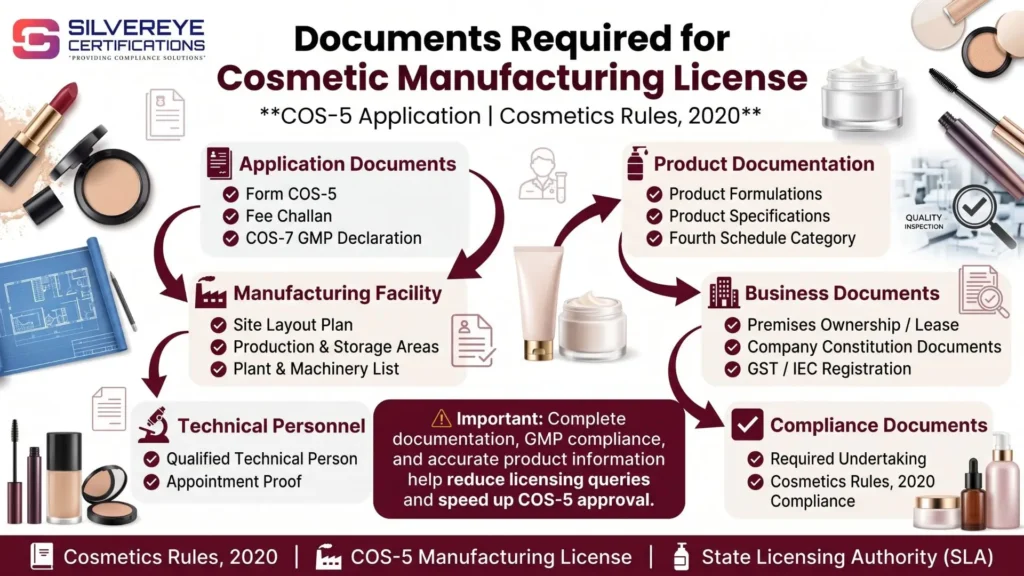
Step-by-Step COS-5 Application Process
- Register on SUGAM: Visit sugam. Create a manufacturer account with your company credentials.
- Select COS-5 Form: Go to Cosmetics > New Manufacturing License > COS-5.
- Enter Business and Premises Details: Company details, manufacturing address, facility description.
- Add Product Details: Product name, category, formulation, INCI list.
- Upload Documents: Attach all required documents from the checklist above.
- Pay Application Fee: Pay prescribed fee online through SUGAM payment gateway.
- Submit Application: Application reference number is generated for tracking.
- Premises Inspection by SLA: Drug Inspector visits manufacturing site to verify infrastructure.
- Query Resolution: Respond to any deficiencies raised during inspection or document review.
- Grant of COS-8: Manufacturing license is issued on SUGAM upon satisfactory review.

COS-8: Grant of License to Manufacture Perfumes
The COS-8 is the manufacturing license issued by the State Licensing Authority (SLA) upon successful review of your COS-5 application and satisfactory site inspection. It is product-specific and premises-specific, meaning any new product or new premises requires a fresh or amended license.
Fees and Timeline for COS-5 and COS-8
| Parameter | Details | Remarks |
| Application Fee (COS-5) | ₹3,500 per application | Varies slightly by state; payable via SUGAM |
| Fee per Product Category | ₹1,500 per category | Skin care, hair care, perfumery are separate categories |
| Inspection Fee | As prescribed by SLA | Payable at time of inspection scheduling |
| Processing Time (Documents) | 15–30 working days | From submission to inspection scheduling |
| Inspection to License Grant | 30–45 working days | Subject to no major deficiencies found |
| Total Timeline (Typical) | 45–90 working days | From application to COS-8 issuance |
| License Validity | 5 years | Renewable before expiry |
Labelling Requirements for Perfumes Under D&C Rules, 2020
Every perfume sold in India — whether imported or domestically manufactured — must carry a compliant label as per Schedule O of the D&C Rules, 2020. Non-compliant labelling can lead to license suspension or product rejection at customs.
| No. | Label Element | Requirement |
| 1 | Product Name / Brand Name | As registered; must match license |
| 2 | Net Contents | In metric units (ml or g) |
| 3 | Batch Number / Lot Number | For traceability |
| 4 | Date of Manufacture | Month and year of manufacture |
| 5 | Best Before / Use Before Date | In MM/YYYY format for cosmetics with shelf life under 30 months |
| 6 | Name and Address of Manufacturer | Full address of manufacturing unit |
| 7 | Name and Address of Importer | For imported products; Indian importer address mandatory |
| 8 | Country of Origin | Mandatory for imported perfumes |
| 9 | List of Ingredients (INCI Names) | In descending order of weight |
| 10 | Directions for Use / Precautions | Safety warnings, e.g. 'Keep away from eyes', 'Flammable' |
| 11 | MRP (Maximum Retail Price) | Including all taxes; in INR |
| 12 | License Number | COS-2 (import) or COS-8 (manufacture) number |
Prohibited and Restricted Ingredients in Perfumes (Schedule K)
Before applying for CDSCO cosmetic registration for perfumes, verify your formulations against Schedule K of the D&C Rules, 2020, which lists prohibited and restricted substances in cosmetics sold in India. Certain fragrance ingredients restricted under IFRA (International Fragrance Association) guidelines are also considered during CDSCO scrutiny.
- Prohibited: Mercury compounds, lead acetate, hexachlorophene, bovine spongiform encephalopathy-risk materials
- Restricted: Certain nitromusks (e.g., Musk Ambrette, Musk Tibetene), certain coumarin levels, certain oakmoss/treemoss extracts
- Permitted with limits: Alcohol (ethanol or isopropyl alcohol), benzyl alcohol, certain essential oils at defined concentrations
- Aerosol Specific: Chlorofluorocarbons (CFCs) are prohibited as propellants; use HFA or CO2-based propellants for spray perfumes
Validity and Renewal of CDSCO Perfume Licenses
| License Type | Validity | Renewal Window | Renewal Process |
| COS-2 (Import License) | 3 Years | 3 months before expiry | File renewal application on SUGAM with updated CFS, COA, and payment |
| COS-8 (Manufacturing License) | 5 Years | 6 months before expiry | File renewal on SUGAM; fresh inspection may be required if premises changed |
| Product Addition to Existing License | N/A | Any time | File amendment application on SUGAM with product-specific documents |
| Change of Premises / Address | N/A | Before operational change | Amendment application with new premises documents and inspection |
CDSCO Cosmetic Registration for Perfumes vs. Drug Registration
A common question from importers is whether their perfume with skincare benefits or antibacterial properties requires drug registration instead of cosmetic registration. The answer depends on the primary intended purpose of the product.
| Criteria | Cosmetic Registration (COS) | Drug Registration (CDSCO) |
| Primary Purpose | Aesthetic, fragrance, cleansing, beautification | Treatment, cure, or prevention of disease/body odour medically |
| Examples | Perfumes, attars, body mists, deodorant sprays (fragrance-based) | Medicated deodorants with active antiperspirant drugs |
| Applicable Law | D&C Act 1940 + D&C Rules 2020 (cosmetics) | D&C Act 1940 + MDR 2017 (drugs) |
| CDSCO Form | COS-1 / COS-2 (import), COS-5 / COS-8 (manufacturing) | Form 40 / CT-04 (import/manufacturing of drugs) |
| Regulatory Authority | State Licensing Authority (SLA) | CDSCO Central Authority |
How Silvereye Certifications Helps You Get CDSCO Cosmetic Registration for Perfumes
Silvereye Certifications is a specialised regulatory consulting firm with deep expertise in CDSCO cosmetic registration for perfumes, fragrances, and all personal care products. We handle importers, exporters, and manufacturers across India with a track record of fast and error-free license approvals.
Our Services Include:
- End-to-end COS-1 and COS-2 import license filing on SUGAM portal
- COS-5 application preparation and COS-8 manufacturing license support
- Product formula review and Schedule K compliance check
- Label design and Schedule O compliance verification
- CFS / COA documentation support and foreign manufacturer coordination
- SUGAM portal registration and account management
- License renewal, amendment, and product addition support
- Post-license compliance management and regulatory advisory
Conclusion
CDSCO cosmetic registration for perfumes is a non-negotiable legal requirement for anyone importing or manufacturing fragrances in India. Whether you are filing a COS-1 application for an import license (COS-2) or a COS-5 application for a manufacturing license (COS-8), the SUGAM portal is your central hub. Getting the documentation right from day one — especially the CFS, COA, label compliance, and formulation disclosure — is the key to a smooth and fast approval.
With the right regulatory partner, the process is far more predictable than it appears. Silvereye Certifications has helped dozens of perfume brands, importers, and manufacturers successfully navigate the CDSCO cosmetic registration process. Reach out to us today to get started.
Frequently Asked Questions
Do I need a separate CDSCO license for each perfume brand I import?
Yes. Each brand from a different foreign manufacturer requires a separate COS-1 application and COS-2 license, as the Certificate of Free Sale and manufacturing authorization is brand and manufacturer specific.
Can a small-scale or home-based perfume maker apply for COS-5?
Yes, but your premises must meet the minimum infrastructure requirements under the D&C Rules, 2020. CDSCO inspectors will physically verify your manufacturing space, equipment, and quality control measures before issuing a COS-8 license.
How long does it take to get a COS-2 import license for perfumes?
Typically 30–60 working days from complete application submission. If documents are complete and the SLA does not raise queries, the timeline can be shorter. Incomplete applications significantly delay the process.
Is a Certificate of Free Sale (CFS) mandatory for perfume imports?
Yes. A CFS issued by the Competent Authority of the country of manufacture is a mandatory document for all cosmetic imports including perfumes. It must be notarised and apostilled in the country of origin.
Can I import perfumes without registering, for personal use?
Small quantities for genuine personal use may be allowed through customs without a commercial import license. However, any commercial import — even samples — requires a valid COS-2 license.
What is the SUGAM portal and how does it work?
SUGAM is the CDSCO's online portal for all drug and cosmetic regulatory submissions in India. All COS-1 and COS-5 applications, fee payments, document uploads, and license downloads happen through SUGAM.
Does attar (ittar) require CDSCO cosmetic registration?
Yes. Attar is classified as a cosmetic under Schedule S of the D&C Rules, 2020. Both domestic attar manufacturers and importers of foreign attar brands need valid COS licenses.
What happens if my CDSCO import license expires?
Importing perfumes on an expired COS-2 license is illegal under the D&C Act. Your shipment can be seized at the port of entry. A late renewal penalty of ₹1,000 per month is also levied. Always renew at least 3 months before expiry.
Can I add new perfume products to my existing COS-2 or COS-8 license?
Yes. You can file an amendment application on the SUGAM portal to add new products to an existing license. The amendment requires product-specific documents including COA, label, formula, and CFS (for imports).
Do deodorant sprays need CDSCO cosmetic registration or drug registration?
Fragrance-based deodorant sprays that work by masking odour are cosmetics and require COS registration. Products that contain active antiperspirant ingredients (e.g., aluminium chlorohydrate above certain concentrations with drug claims) may require drug registration. When in doubt, consult a regulatory expert.