
- One concept, five rulebooks: EPR credits work the same way in principle across plastic, e-waste, battery, tyre and used oil waste — a recycler generates a certificate, a producer buys it to meet its target — but each stream has its own CPCB portal, targets and fees.
- Big 2026 change: CPCB has rolled out a Common EPR (CEPR) Single Sign-On Portal and a dedicated EPR Certificate Trading Portal, so businesses no longer need five separate logins to manage EPR credits.
- No entity can trade without registering first: Whether you're a producer buying credits or a recycler generating them, CPCB registration on the relevant portal is the mandatory first step — unregistered transactions are void.
- Fees and targets vary a lot: From a few hundred rupees for a small used-oil collection agent to lakhs for a large plastic or oil producer — this guide breaks down every stream separately.
Introduction
EPR Credits Registration is the process of enrolling on CPCB's Extended Producer Responsibility portals so a business can either generate EPR certificates (as a recycler/processor) or purchase them (as a producer, importer or brand owner) to meet its recycling obligations. It applies across five waste streams in India — plastic packaging, e-waste, battery waste, tyre waste, and used oil — each governed by its own CPCB rule and portal.
In 2026, CPCB unified access through a Common EPR (CEPR) Single Sign-On Portal and an EPR Certificate Trading Portal (EPR-ETP, operated via MSTC) for transparent credit exchange. Registration is mandatory before any EPR credit can be bought, sold, or counted toward a compliance target.
What Are EPR Credits and Why Does Registration Matter?
An EPR credit — also called an EPR certificate — is proof that a specific quantity of waste (plastic, e-waste, batteries, tyres, or used oil) has actually been collected and processed by a CPCB-registered recycler or processor. Producers, importers and brand owners (PIBOs) don't usually recycle their own waste; instead, they buy these credits from registered recyclers to demonstrate they've met their annual recycling or collection obligation.
Here's the part people often miss: you cannot buy, sell, or even hold an EPR credit unless you're registered on the correct CPCB portal for that waste stream. A recycler that isn't registered can't legally generate a valid certificate, and a producer that isn't registered can't use a certificate to offset its target — the whole system runs on both sides of the transaction being verified entities. That's exactly why "EPR credits registration" and "EPR registration" are, in practice, the same starting point.
If you're trying to figure out how EPR credits work for your specific waste stream, what registration will cost, and where to actually register in 2026 now that CPCB has merged its portals — this guide covers all five active EPR regimes in one place.
2026 Update: CPCB's Common EPR (CEPR) Portal and Credit Trading Platform
This is the single biggest operational change in India's EPR system since individual portals were first launched, and it directly affects how EPR credits registration works going forward:
- Common EPR Portal (epr.cpcb.gov.in): In February 2026, CPCB introduced a Single Sign-On (SSO) system so registered entities can access plastic, e-waste, battery, tyre and used oil EPR modules through one login and a unique Common EPR ID (CEPR ID), instead of separate credentials for each waste stream.
- Plastic Waste EPR Portal migration: The standalone Plastic Waste EPR Portal was discontinued from 28 June 2026, with all registered user data migrated into the Common EPR Portal. Existing plastic EPR obligations and registrations continue unchanged — only the login and access point have moved.
- EPR Certificate Trading Portal (EPR-ETP): CPCB has also stood up a dedicated electronic platform, operated through MSTC, for the transparent trading of EPR certificates across waste streams — replacing the earlier system of largely bilateral, opaque certificate deals between producers and recyclers.
- What this means practically: If your business already holds registrations under one or more legacy portals (plastic, e-waste, battery, tyre, used oil), you'll need to link those existing credentials to your new CEPR ID rather than treat this as a fresh registration — check the Common EPR Portal directly for your specific migration status.
Because this transition has been rolling out through 2026, it's genuinely worth confirming your current portal status before filing — a consultant such as Silvereye Certifications can check which of your registrations have migrated and which still need action.
Legal Framework: Which Rule Governs Which EPR Credit
| Waste Stream | Governing Rule | In Force Since |
| Plastic packaging | Plastic Waste Management (Amendment) Rules, 2022 (further amended 2024 & 2026) | 2022, with phased targets through 2028-29 |
| E-waste | E-Waste (Management) Rules, 2022 | 1 April 2023 |
| Batteries | Battery Waste Management Rules, 2022 | 22 August 2022 (notified) |
| Tyre waste | Hazardous and Other Wastes (M&TM) Amendment Rules, 2022 — Schedule IX | 21 July 2022 |
| Used oil | Hazardous and Other Wastes (M&TM) Second Amendment Rules, 2023 — Chapter VII | 1 April 2024 |
Who Needs EPR Credits Registration?
Broadly, two kinds of stakeholders register for EPR credits in every waste stream, though the exact terminology shifts slightly:
- Credit buyers — Producers, Importers, Brand Owners (PIBOs): Any business that manufactures, imports, or brands plastic packaging, electrical/electronic equipment, batteries, tyres, or base/lubrication oil for the Indian market. These entities register to receive an annual recycling target and then buy EPR credits to meet it.
- Credit generators — Recyclers, Refurbishers, Processors, Retreaders: Entities that actually collect and process the waste — plastic waste processors, e-waste dismantlers/recyclers, battery recyclers/refurbishers, tyre recyclers/retreaders, and used oil recyclers. These entities register to legally generate and sell EPR certificates.
A few stream-specific additions worth knowing:
- Used oil also has a separate "Used Oil Importer" and "Collection Agent" category
- Tyre waste has a separate "Retreader" category alongside Producer and Recycler
- Battery waste requires producers to additionally submit an annual EPR Plan (Form 1(C))
- An entity playing more than one role — e.g., a company that's both a producer and a recycler — must register separately for each role in every stream
EPR Credits by Waste Stream: Targets, Fees and Portals
1. Plastic Packaging EPR Credits
Plastic EPR obligations are split into four packaging categories (rigid, flexible, multilayered, and compostable), each carrying its own recycling and, since FY 2025-26, recycled-content targets. Registered Plastic Waste Processors generate EPR certificates on the portal against verified recycled or end-of-life-managed quantities, and PIBOs purchase matching-category certificates to close their obligation.
- Certificate pricing: Plastic EPR certificate prices are market-driven on the CPCB portal, without a statutory floor or ceiling — unlike battery and e-waste, where CPCB plays a more direct role in certificate mechanics.
- 2026 update: Recycled-content mandates took effect in FY 2025-26 (for example, rigid Category I packaging needs a minimum 30% recycled plastic, rising over subsequent years), and recycled material must now conform to IS 14534:2023 standards.
- Portal: Now accessed via the Common EPR Portal (previously the standalone Plastic Waste EPR Portal, discontinued 28 June 2026).
2. E-Waste EPR Credits
Producers of the 106 notified categories of Electrical and Electronic Equipment (EEE) under Schedule I are assigned annual recycling targets calculated on generation from previously sold EEE. Registered recyclers and dismantlers generate EPR certificates for verified quantities processed, calculated as QEPR = Quantity of end product (QP) × Conversion Factor (CF).
| Financial Year | EPR Recycling Target (Established Producers) |
| 2023-24 & 2024-25 | 60% of e-waste generation |
| 2025-26 & 2026-27 | 70% of e-waste generation |
| 2027-28 onward | 80% of e-waste generation |
New producers (whose years of sales are fewer than their product's average life) follow a separate Schedule IV target: 15% of FY 2021-22 sales for FY 2023-24, rising to 20% of the sales figure two years prior from FY 2024-25 onward. Importers of used EEE carry a 100% obligation on the imported quantity.
3. Battery Waste EPR Credits
Under the Battery Waste Management Rules, 2022, producers register via Form 1(A) and receive their registration in Form 1(B); recyclers and refurbishers generate EPR certificates based on the weight of key battery metals recovered and sold from processed waste batteries — measured separately for each chemistry (lead-acid, lithium-ion, nickel-cadmium, and other zinc-based types), and across each battery category (portable, automotive, industrial, and EV).
- Certificate formula: EPR certificate weight (kg) = weight of identified key battery metal(s) recovered and sold from recycling, tracked per chemistry and battery type.
- Annual EPR Plan: Producers must additionally file Form 1(C) — a battery-specific recycling plan — for batteries placed in the market the previous financial year.
4. Tyre Waste EPR Credits
Producers of new tyres meet their recycling target by purchasing EPR Certificates from CPCB-registered recyclers, calculated using the formula QEPR = QP (quantity of end product) × CF (conversion factor) × WP (weightage), across end products like crumb rubber, reclaimed rubber, CRMB, recovered carbon black, and pyrolysis oil/char.
- Current target: 100% of new tyres manufactured or imported two financial years earlier (from FY 2024-25 onward).
- Certificate validity: Two years from the end of the financial year of generation.
For the full breakdown of tyre waste EPR — fees, documents, and the complete conversion-factor table — see our dedicated EPR Registration for Tyre Waste guide.
5. Used Oil EPR Credits
Producers of base oil/lubrication oil, and used oil importers, meet their obligation by buying EPR Certificates from registered recyclers, calculated as QEPR = QP × CF × WP, where re-refined base oil carries a weightage of 1.0 and co-processing/energy recovery carries 0.25.
- Current target: For FY 2025-26, 10% of base/lubrication oil sold or imported in FY 2023-24, on a glide path to 50% by FY 2030-31.
- Certificate validity: Two years from the end of the financial year of generation; expired certificates are automatically archived.
For the full target schedule, fee tables and documents required, see our dedicated EPR Registration for Used Oil guide.
Latest EPR Credits Notifications & Updates (2025–2026)
| Date | Notification / Update |
| Feb 2026 | CPCB launches the Common EPR (CEPR) Portal with Single Sign-On access and a unified CEPR ID across plastic, e-waste, battery, tyre and used oil EPR |
| Feb 2026 | CPCB rolls out the EPR Certificate Trading Portal (EPR-ETP), operated via MSTC, for transparent credit trading in place of largely bilateral deals |
| 25.02.2026 | CPCB issues the Guidance Document for Submission of Annual Return by Registered Producers on the Used Oil EPR Portal |
| FY 2025-26 | Plastic packaging recycled-content mandates take effect (e.g., 30% recycled content for rigid Category I packaging, per IS 14534:2023) |
| FY 2025-26 | E-waste recycling target for established producers steps up from 60% to 70%; annual return due 30 June 2026 |
| 28.06.2026 | Standalone Plastic Waste EPR Portal discontinued; all data migrated to the Common EPR Portal |
| FY 2025-26 | Used oil recycling target for producers steps up from 5% to 10% of FY 2023-24 sales/imports |
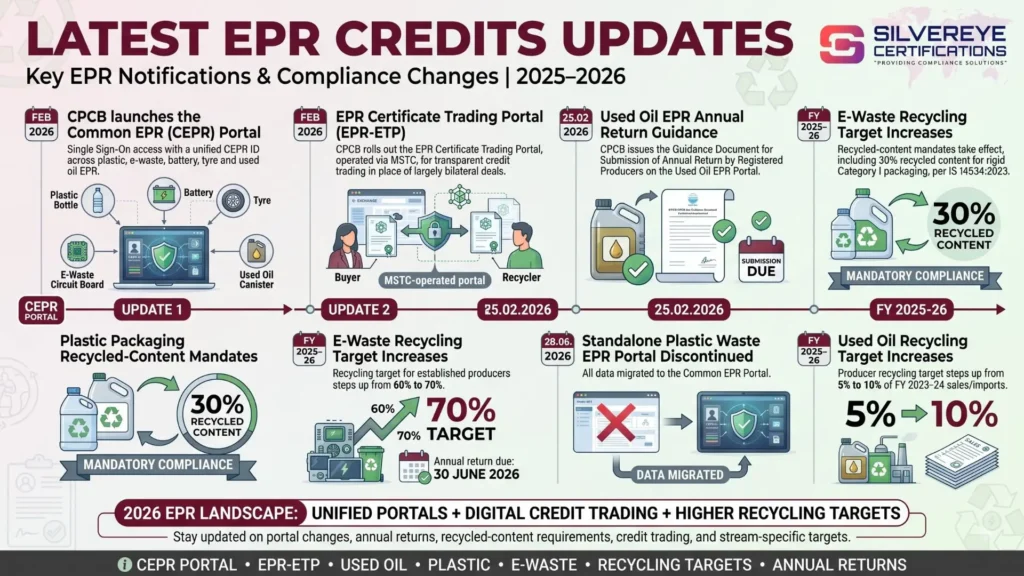
Because CPCB has been actively consolidating its EPR infrastructure through 2026, notification dates and portal URLs are the fastest-moving part of this compliance area — always cross-check the live Common EPR Portal or a compliance consultant before filing.
Benefits of Registering for EPR Credits
- Legal market access: Registration is what lets a producer legally sell into the Indian market and lets a recycler legally issue certificates — unregistered entities are locked out of both sides of the transaction.
- Avoids Environmental Compensation: Every stream imposes financial penalties for missed targets or use of false certificates; registered, on-time compliance keeps a business out of that exposure.
- Single-window efficiency (2026 onward): The Common EPR Portal means a business handling multiple waste streams no longer manages five separate logins and renewal calendars.
- Transparent, fair-priced credit trading: The new EPR-ETP platform reduces the opacity and price uncertainty that came with purely bilateral recycler-producer deals.
- Stronger ESG and audit position: A clean, portal-verified EPR credit trail increasingly matters for marketplace approvals, tenders, and investor/ESG due diligence.
Documents Typically Required for EPR Credits Registration
Document requirements differ slightly by stream, but this core set applies almost everywhere:
- PAN card of the company (or of the authorised person for a proprietorship/partnership)
- GST registration number
- CIN (Corporate Identification Number), where applicable
- IEC (Importer Exporter Code) — required for any importing entity
- Aadhaar of the authorised person
- Sales, import, or procurement data for the preceding one to two financial years
- Stream-specific declarations — e.g., tyre composition and plant-wise data for tyres, an EPR Plan (Form 1(C)) for batteries, recycling/collection facility details for recyclers
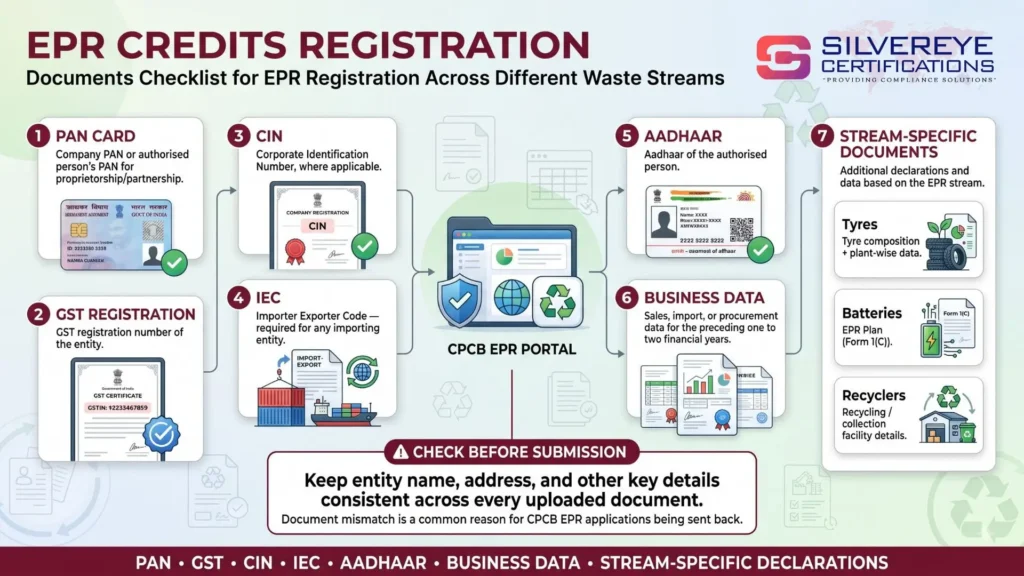
Across every CPCB EPR portal, the most common reason applications get sent back is a mismatch between the address or entity details on different uploaded documents — keeping everything consistent before you submit saves real time.
Step-by-Step EPR Credits Registration Process
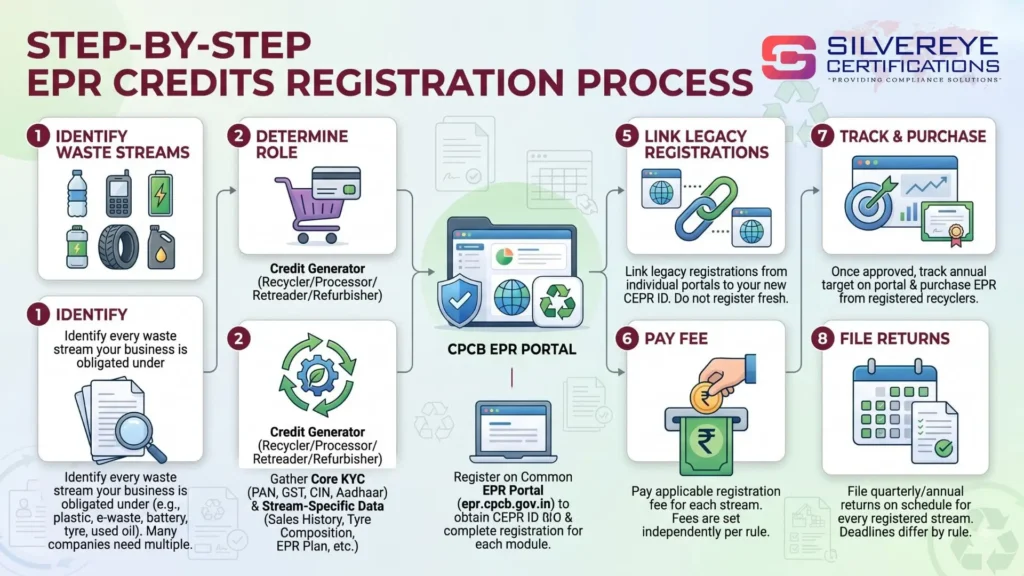
- Identify every waste stream your business is obligated under — many mid-sized companies are surprised to find they need more than one (for instance, an electronics importer that also uses branded batteries).
- Determine your role in each stream: are you a credit buyer (producer/importer/brand owner) or a credit generator (recycler/processor/retreader/refurbisher)?
- Gather your core KYC and business documents, plus the stream-specific data set (sales history, tyre composition, EPR Plan, etc.).
- Register on the Common EPR Portal (epr.cpcb.gov.in) to obtain your CEPR ID, then complete registration for each applicable waste-stream module.
- If you already hold legacy registrations on an individual portal (plastic, e-waste, battery, tyre, or used oil), link those credentials to your new CEPR ID rather than registering fresh.
- Pay the applicable registration fee for each stream — fee structures are set independently per rule and are not unified under the Common Portal.
- Once approved, track your annual target on the portal dashboard and purchase EPR credits from registered recyclers through the EPR Certificate Trading Portal where applicable.
- File your quarterly and/or annual returns on schedule for every registered stream — deadlines differ by rule, so track them separately even under the unified login.
EPR Credits Registration Fees — Quick Comparison Across Streams
| Waste Stream | Producer/Importer Fee Range (New Registration) | Recycler Fee Range |
| Plastic packaging | Market-driven; certificate cost typically ~₹0.5–2/kg (varies by category and market conditions) | Registration required; no statutory floor/ceiling on certificate price |
| E-waste | Varies by producer category and turnover; consult current CPCB fee schedule | Registration required; certificate value tied to CF-based calculation |
| Battery waste | Registration via Form 1(A); fee varies by producer category | Registration required; certificates tied to recovered battery-metal weight |
| Tyre waste | ₹25,000 + ₹0.625/MT (new); ₹12,500 + ₹0.625/MT (renewal) | ₹15,000 (new); ₹7,500 + ₹0.625/MT (renewal) |
| Used oil | ₹25,000 to ₹10,00,000 based on volume (new) | ₹25,000 to ₹75,000 based on facility capacity (new) |
Tyre waste and used oil have the clearest, publicly notified flat-and-slab fee structures. Plastic, e-waste and battery fees are more variable and tied to turnover, category, and evolving CPCB notifications — always confirm the current figure on the relevant portal before budgeting.
Validity, Renewal & Compliance Timeline (Across Streams)
| Waste Stream | Registration/Certificate Validity | Return Filing |
| Plastic packaging | Typically annual registration cycle | Annual return; frequency per CPCB notification |
| E-waste | Registration renewed periodically per CPCB policy | Quarterly + annual (Form-3, due 30 June following FY) |
| Battery waste | Registration valid per CPCB terms; EPR Plan filed annually (Form 1(C)) | Annual EPR Plan by 30 June; returns per portal schedule |
| Tyre waste | 2 years (registration); EPR Certificate valid 2 years from end of FY generated | Quarterly + annual returns |
| Used oil | 2 years (registration); EPR Certificate valid 2 years from end of FY generated | Annual returns by 30 June (Producers/Importers); quarterly + annual (Recyclers/Collection Agents) |
A practical rule of thumb across every stream: start your renewal application well before expiry — CPCB treats an expired registration the same as no registration at all, which means you can't legally buy or sell EPR credits until it's renewed.
What Happens If You Don't Register or Comply?
Every EPR rule in India follows the same enforcement logic: registered entities cannot transact with unregistered ones, and non-compliance — missed targets, false certificates, or operating without registration — triggers Environmental Compensation (EC).
Beyond the financial penalty, CPCB can suspend or cancel a registration, and persistent violations can draw further action under the Environment (Protection) Act, 1986. For importers specifically, non-compliance can also mean customs holds on shipments, since EPR proof is increasingly checked at the point of import clearance.
How Silvereye Certifications Can Help
Managing EPR credits across even two or three waste streams — say, plastic packaging and e-waste for a consumer electronics brand — used to mean juggling separate portals, separate document formats, and separate renewal calendars. The 2026 shift to the Common EPR Portal simplifies login, but the underlying targets, fees, and filing deadlines are still stream-specific, which is exactly where most businesses lose time.
Silvereye Certifications is a regulatory compliance consultancy supporting manufacturers, importers and brand owners across BIS, CDSCO, WPC-ETA, TEC-MTCTE, and EPR authorisations — including plastic, e-waste, battery, tyre waste, and used oil. For EPR credits registration specifically, Silvereye Certifications typically helps with:
- Mapping exactly which EPR streams and roles your business falls under, so nothing is missed
- Preparing and cross-checking documentation for consistency across every portal you need to register on
- Calculating your likely annual target and the applicable registration fee for each stream before you file
- Guiding you through Common EPR Portal migration if you hold existing legacy registrations
- Tracking renewal timelines and quarterly/annual return deadlines across all registered streams
If your business needs to register for EPR credits in one waste stream or several, working with an experienced consultant like Silvereye Certifications can help you get the category, documentation and timeline right the first time.
Conclusion
EPR credits registration in India isn't one process — it's five parallel systems that happen to share the same underlying logic: a recycler proves it processed the waste, a producer buys that proof to meet its own obligation, and CPCB tracks the whole exchange.
The 2026 move to a Common EPR Portal and a dedicated credit trading platform makes the login and trading side genuinely simpler, but the targets, fees and filing deadlines are still specific to each waste stream, and they keep shifting year to year. Whether you're registering for one stream or five, getting the category and documentation right the first time saves real back-and-forth with CPCB — and a consultancy like Silvereye Certifications can walk you through the entire process, from first registration to ongoing credit purchases and returns.
Frequently Asked Questions
What exactly is an EPR credit?
An EPR credit (or EPR certificate) is proof, issued by CPCB through a registered recycler or processor, that a specific quantity of waste — plastic, e-waste, batteries, tyres, or used oil — has been collected and processed in an environmentally sound manner. Producers buy these credits to meet their annual recycling obligation.
Do I need separate registration for each waste stream?
Yes. Plastic, e-waste, battery, tyre waste, and used oil are each governed by a different CPCB rule and portal module, so a business dealing in more than one waste type must register separately for each — though the 2026 Common EPR Portal now lets you manage all of them under one login.
What is the Common EPR Portal, and do I need to re-register there?
It's CPCB's unified Single Sign-On system, launched in February 2026, giving every registered entity a Common EPR ID (CEPR ID) to access plastic, e-waste, battery, tyre and used oil modules from one login. If you already hold registrations on the legacy portals, you generally link those credentials to your new CEPR ID rather than registering from scratch — check your specific migration status on the portal.
Can I trade EPR credits directly with any recycler I choose?
You can only transact with a CPCB-registered recycler in the same waste stream. CPCB has also introduced the EPR Certificate Trading Portal (EPR-ETP) via MSTC to make this exchange more transparent than the earlier bilateral-deal model.
How is the value or quantity of an EPR credit calculated?
Most streams use a similar formula: eligible credit quantity = quantity of end product produced × a CPCB-determined conversion factor × (in some streams) a weightage factor specific to the end product or process.
How long is an EPR certificate valid?
For tyre waste and used oil, an EPR Certificate is valid for two years from the end of the financial year in which it was generated, after which it's automatically archived or deleted. Validity periods for other streams follow their respective rule notifications.
What is the current e-waste recycling target for producers?
For FY 2025-26 and FY 2026-27, established producers must recycle 70% of their e-waste generation, rising to 80% from FY 2027-28 onward. New producers follow a separate, lower target schedule under Schedule IV.
Is plastic EPR credit pricing regulated by CPCB?
No. Plastic EPR certificate prices are market-driven on the CPCB portal, with no statutory floor or ceiling — this differs from streams like used oil, where CPCB directly fixes the price band for certificate exchange.
What happens if a producer doesn't meet its EPR target?
CPCB can levy Environmental Compensation for the shortfall, and registration can be suspended or cancelled for persistent or serious non-compliance, alongside further enforcement action under the Environment (Protection) Act, 1986.
Can a recycler transact with an unregistered producer, or vice versa?
No. Every EPR rule in India prohibits registered entities from transacting with unregistered ones — both the credit generator and the credit buyer must hold valid, current registration for the transaction to count.
Do small businesses or startups need EPR credits registration?
In most streams, yes — registration itself is typically mandatory for any producer, importer or brand owner placing regulated products in the market, even if certain oil or plastic categories qualify for reduced or exempted recycling targets. The registration requirement and the target obligation are treated as separate questions.
Where can I find the exact fee for my specific EPR stream?
This guide gives current, verified fee figures for tyre waste and used oil, and general ranges for plastic, e-waste and battery. Because fee schedules for the latter three are more variable, always check the live Common EPR Portal or confirm with a consultant like Silvereye Certifications before budgeting.