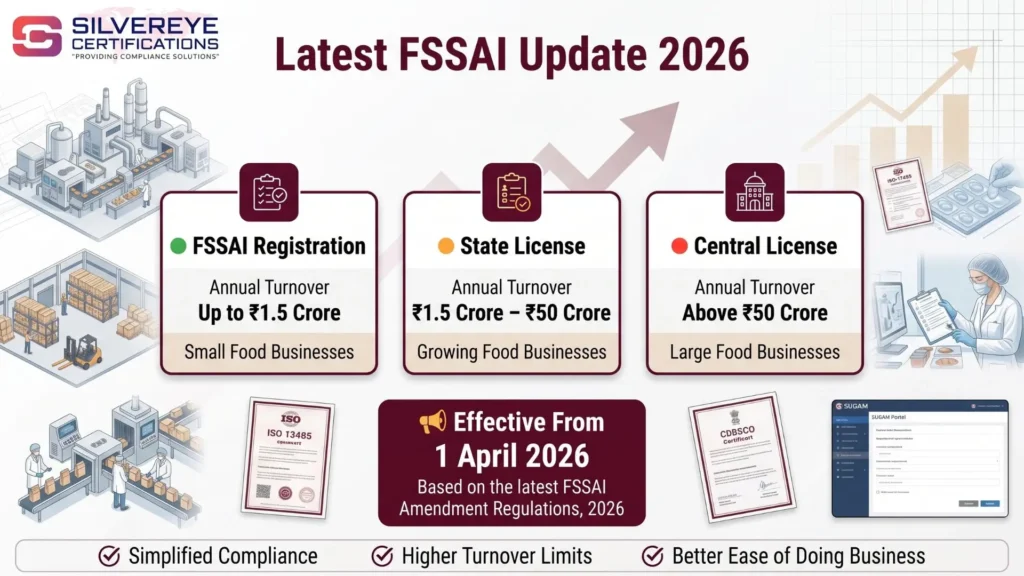
- New 2026 turnover slabs: Basic Registration up to ₹1.5 crore, State License ₹1.5 crore–₹50 crore, Central License above ₹50 crore, effective 1 April 2026.
- FSSAI licenses applied for after 1 April 2026 carry perpetual validity, subject to periodic risk-based inspections — no more repeat renewals every 1–5 years.
- Beverage makers that bottle packaged drinking water or mineral water also need BIS IS 14543 certification before the FSSAI Central License is granted.
- Government fee ranges from ₹100/year for Basic Registration to ₹7,500/year for a Central License, regardless of validity term chosen.
Introduction
An FSSAI license for beverages is the mandatory food safety approval every water, juice, soft drink, energy drink, dairy-drink, or tea/coffee manufacturer needs before selling in India. Since 1 April 2026, the category depends on annual turnover: Basic Registration (up to ₹1.5 crore), State License (₹1.5 crore–₹50 crore), or Central License (above ₹50 crore, or for importers, exporters, and e-commerce beverage sellers regardless of turnover).
Fees run from ₹100 to ₹7,500 a year, and licenses now carry perpetual validity once granted after the new rules kicked in.
What Is an FSSAI License for Beverages?
An FSSAI license for beverages is the food safety approval issued by the Food Safety and Standards Authority of India (FSSAI) to any person or company that manufactures, packages, imports, exports, stores, distributes, or sells drinkable products in India. This covers packaged drinking water, mineral water, carbonated soft drinks, fruit and vegetable juices, energy and sports drinks, flavoured milk and dairy-based beverages, tea, coffee, and ready-to-drink beverages of every kind.
The license is a legal requirement under the Food Safety and Standards Act, 2006, and every FBO (Food Business Operator) receives a unique 14-digit registration or license number that must be printed on packaging and displayed at the business premises.
Why Beverage Businesses Need FSSAI Registration or License
- Legal requirement: Selling beverages without a valid FSSAI number can attract a penalty of up to ₹5 lakh and imprisonment of up to six months under Section 63 of the FSS Act.
- Market access: Aggregators such as Swiggy, Zomato, Blinkit, Amazon, and Quick Commerce platforms verify the FSSAI number before onboarding any beverage brand.
- Consumer trust: The FSSAI number and logo signal that your beverage has passed hygiene, labelling, and quality checks — this matters for D2C and export-facing beverage brands.
- Bank and investor requirements: Most working-capital loans, FMCG distributor tie-ups, and export documentation ask for a valid FSSAI license as standard.
Latest FSSAI Update 2026: Revised Turnover Thresholds
FSSAI issued Order No. RCD-01002/1/2021-Regulatory-FSSAI-Part(1) on 13 March 2026, implementing the Food Safety and Standards (Licensing and Registration of Food Businesses) Amendment Regulations, 2026 (notified via Gazette on 10 March 2026). This order revised the turnover-based categorisation for every food and beverage business and comes into effect from 1 April 2026, superseding all earlier turnover-threshold orders.
| License Type | Old Turnover Limit (pre-2026) | New Turnover Limit (from 1 April 2026) |
| Basic Registration | Up to ₹12 lakh | Up to ₹1.5 crore |
| State License | ₹12 lakh – ₹20 crore | Above ₹1.5 crore up to ₹50 crore |
| Central License | Above ₹20 crore | Above ₹50 crore |
Two other changes worth noting for beverage FBOs:
- Perpetual validity: Registrations and licenses granted under the amended regulations no longer expire after a fixed 1–5 year term — they remain valid on an ongoing basis, subject to risk-based inspections by food safety officers.
- Automatic category upgrade: If your turnover crosses the top of your current slab, FSSAI will move you to the next category automatically and free of cost, and you keep your existing 14-digit number.
If you already hold a beverage license and your turnover now falls into a lower slab under the new rule (for example, a small juice unit that was on a State License but earns under ₹1.5 crore), you can apply to move to the simpler Basic Registration and cut your annual fee.
Types of FSSAI License for Beverage Businesses
1. Basic Registration (Turnover up to ₹1.5 crore)
Suited to home-based beverage sellers, small juice or lemonade stalls, tea/coffee kiosks, and petty beverage vendors. Fee: ₹100 per year. Processing time: typically 3–7 working days, faster via the Tatkal option for eligible applicants.
2. State License (Turnover above ₹1.5 crore up to ₹50 crore)
Applicable to mid-sized beverage manufacturers, bottling units, juice processors, dairy-beverage makers, and distributors operating within one state. Fee: ₹2,000–₹5,000 per year depending on scale and category. Processing time: 30–60 working days including premises inspection.
3. Central License (Turnover above ₹50 crore, or activity-based triggers)
Mandatory for large national or multi-state beverage brands, and — importantly — for certain activities irrespective of turnover:
- Import or export of beverages or beverage ingredients (100% export-oriented units included)
- Beverage manufacturers supplying to Central Government institutions, canteens, or agencies
- E-commerce beverage businesses selling pan-India through their own platform
- Packaged drinking water and mineral water plants (in addition to BIS IS 14543 certification)
Fee: ₹7,500 per year. Processing time: 30–60 working days.

FSSAI License Fee Chart for Beverage Businesses
| License Category | Government Fee (per year) | Typical Validity |
| Basic Registration | ₹100 | Perpetual (post-1 April 2026); earlier licenses run 1–5 years as chosen |
| State License | ₹2,000 – ₹5,000 (scale-dependent) | Perpetual (post-1 April 2026); earlier licenses run 1–5 years as chosen |
| Central License | ₹7,500 | Perpetual (post-1 April 2026); earlier licenses run 1–5 years as chosen |
Note: For licenses issued before the perpetual-validity rule kicked in, fee is calculated as annual fee × number of years chosen (1 to 5), payable upfront in a single instalment on the FoSCoS portal. These figures are government fees only — consultancy or professional-service charges, if you use an agent, are billed separately.
Documents Required for FSSAI License for Beverages
Common documents (all categories)
- Photograph and photo ID proof of the Food Business Operator (Aadhaar, PAN, Voter ID, Passport, or Driving License)
- Address proof of the business premises (electricity bill, rent agreement, or property tax receipt)
- List of beverage products to be manufactured, packaged, or sold
- Bank account details (cancelled cheque or passbook copy)
Additional documents for State License
- Business constitution certificate — GST registration, Shop & Establishment certificate, Udyam Registration, or Certificate of Incorporation
- Layout plan of the manufacturing/bottling unit, drawn to scale
- Water testing report from an NABL-accredited laboratory (mandatory for beverage manufacturers, including packaged water and juice units)
- Food Safety Management System (FSMS) plan
- Partnership deed / MOA & AOA, and a board resolution authorising the signatory (for companies)
Additional documents for Central License
- Import Export Code (IEC) from DGFT, where trade activity is involved
- Turnover proof — audited financial statements or a CA certificate
- Form IX — nomination of the authorised person by the company
- Food recall plan (standard operating procedure for withdrawing unsafe stock)
- Geo-tagged photographs of the manufacturing facility (2026 portal requirement)

Step-by-Step FSSAI License Application Process for Beverage Units
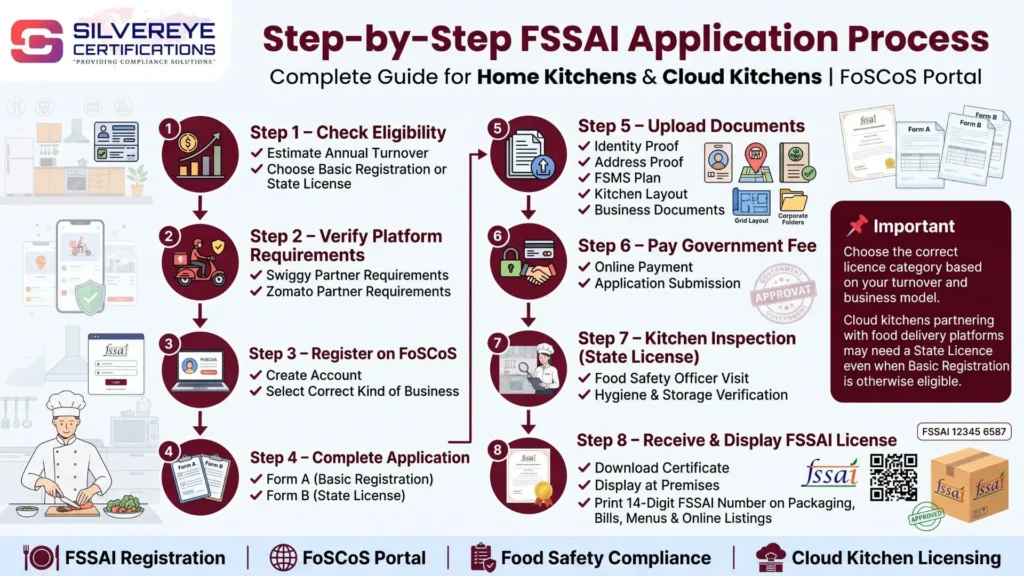
- Register on the FoSCoS portal using your business email and mobile number.
- Select the correct Kind of Business (KoB) — for beverages this typically falls under Manufacturer / Water & Beverages / Dairy, depending on your product.
- The portal auto-suggests your license category (Basic, State, or Central) based on the turnover and KoB you enter — verify this against the 2026 threshold table above.
- Fill Form A (Basic Registration) or Form B (State/Central License) with business, premises, and product details.
- Upload the required documents as flatbed scans (phone photos are commonly rejected by the 2026 portal filters).
- Pay the government fee online — you can pay for up to 5 years upfront if applying before the perpetual-validity provisions apply to your category.
- For State/Central applications, a Food Safety Officer conducts a premises inspection before approval.
- On approval, download your FSSAI Registration Certificate (Basic) or License Certificate (State/Central) and print the 14-digit number on all beverage packaging.
FSSAI License for Dairy-Based Beverages: Capacity-Wise Criteria
Milk-based drinks — flavoured milk, lassi, chaas/buttermilk, milkshakes, and dairy-based RTD beverages — fall under the FSSAI 'Dairy Processing' Kind of Business. In addition to the turnover slabs above, dairy and dairy-beverage units are further classified by installed processing capacity, as per FoSCoS Kind of Business eligibility norms. Always confirm current slabs on the FoSCoS portal, as capacity criteria are reviewed periodically alongside turnover thresholds.
| License Type | Milk Handling Capacity | Milk Solids (per annum) | Approx. Annual Fee |
| Registration | Up to 500 litres/day | Up to 2.5 MT | ₹100 |
| State License | 501 – 10,000 litres/day | 2.5 MT – 500 MT | ₹3,000 |
| State License | 10,001 – 50,000 litres/day | 501 MT – 2,500 MT | ₹5,000 |
| Central License | More than 50,000 litres/day | More than 2,500 MT | ₹7,500 |
If your dairy-beverage business also crosses the relevant turnover threshold (₹1.5 crore or ₹50 crore) before it crosses the capacity threshold, the higher of the two criteria will decide your license category.
FSSAI License Renewal and Compliance for Beverage FBOs
- Renewal window: For licenses that still run on a fixed term, file for renewal 30 days before expiry at the latest; an express renewal window may open up to 180 days before expiry.
- Late fee: ₹100 per day applies if renewal is filed after the 30-day-before-expiry deadline but before the license lapses.
- Annual Return (Form D-1): State/Central license holders must file this by 31 May every year.
- Half-yearly Return (Form D-2): Mandatory specifically for dairy and dairy-beverage manufacturers, for the periods April–September and October–March.
- Display and labelling: The FSSAI certificate must be displayed at the premises, and the 14-digit number must appear on every beverage package or label.
Penalties for Operating a Beverage Business Without FSSAI License
Manufacturing, distributing, or selling beverages without a valid FSSAI registration or license is a punishable offence under the FSS Act, 2006 — penalties can go up to ₹5 lakh along with imprisonment of up to six months, in addition to the risk of a factory or outlet shutdown order from the local food safety authority.
Frequently Asked Questions
Is FSSAI license mandatory for a beverage business in India?
Yes. Every entity that manufactures, packages, stores, distributes, imports, exports, or sells beverages — from a small juice cart to a national bottling plant — must hold either FSSAI Basic Registration or a State/Central License.
What is the new FSSAI turnover limit for 2026?
From 1 April 2026: Basic Registration up to ₹1.5 crore turnover, State License between ₹1.5 crore and ₹50 crore, and Central License above ₹50 crore, as per FSSAI Order dated 13 March 2026.
How much does an FSSAI license cost for a beverage company?
Government fees range from ₹100 per year for Basic Registration to ₹2,000–₹5,000 per year for a State License and ₹7,500 per year for a Central License.
Do I need BIS certification along with FSSAI for packaged drinking water?
No. BIS certification doesn't mandatory for packaged drinking water and is generally required before your FSSAI Central License application is processed.
How long does it take to get an FSSAI license for a beverage unit?
Basic Registration typically takes 3–7 working days. State and Central Licenses usually take 30–60 working days, since they involve a premises inspection by a food safety officer.
Is the FSSAI license now valid for a lifetime?
Licenses and registrations granted under the 2026 amended regulations carry perpetual validity, subject to periodic risk-based inspections — they no longer need renewal every 1–5 years.
What documents are required for an FSSAI beverage license?
At minimum: photo ID, address proof, product list, and bank details. State and Central applications additionally need a layout plan, water testing report, FSMS plan, and — for Central — turnover proof, IEC, and a food recall plan.
What happens if I don't renew my FSSAI license on time?
A late fee of ₹100 per day applies if you file after the 30-day-before-expiry window. If the license lapses completely, the business may have to apply afresh and could face penalties for operating without a valid license in the interim.
Can a small juice stall apply for Basic Registration only?
Yes, if its annual turnover is up to ₹1.5 crore under the current 2026 threshold. If turnover grows beyond that, FSSAI will move the business into the State License category.
Is Central License required even if my beverage turnover is below ₹50 crore?
Yes, in specific cases — if you import or export beverages, are a 100% export-oriented unit, supply to Central Government institutions, or run an e-commerce beverage business, a Central License is required regardless of turnover.
What is the difference between FSSAI registration and FSSAI license?
Registration is for small food/beverage businesses under the Basic Registration turnover slab (up to ₹1.5 crore). A 'license' refers to the State or Central License issued to larger businesses, and involves more documentation and a mandatory premises inspection.
Do dairy-based beverage makers need any additional filing?
Yes. In addition to the standard Annual Return (Form D-1), manufacturers of milk and milk-based beverages must file a Half-Yearly Return (Form D-2) for the April–September and October–March periods.