
- One process, five portals: The core steps — register, declare targets, upload documents, pay fees, get approved — are similar, but Plastic, E-Waste, Battery, Tyre, and Used Oil each run on a separate CPCB portal.
- Single Sign-On now live: CPCB has rolled out an CPCB EPR SSO Portal at epr.cpcb.gov.in so PIBOs dealing in more than one waste category don't need separate logins for every portal.
- Form I + Action Plan is central: Every category requires a completed application form and a clear EPR Action Plan showing how collection and recycling targets will be met, usually backed by recycler tie-ups.
- Approval isn't the finish line: After the EPR Certificate is issued, quarterly and annual return filing on the same portal is what keeps the registration compliant and renewable.
Introduction
The EPR Registration Process on the CPCB Portal involves creating an account on the relevant category-specific portal (Plastic, E-Waste, Battery, Tyre, or Used Oil), submitting Form I with company and product details, declaring an EPR Action Plan for collection and recycling, uploading supporting documents, paying the registration fee online, and waiting for CPCB or SPCB approval.
Most applications are cleared in 15–40 working days. Once approved, the EPR Certificate is issued digitally, and the entity must file quarterly and annual returns to stay compliant and renew on time.
What Is the EPR Registration Process For CPCB Portal?
The CPCB EPR Portal is the Central Pollution Control Board's digital system for registering, tracking, and enforcing Extended Producer Responsibility obligations across India's five regulated waste categories. Rather than one single website, it is actually a family of category-specific portals — one each for Plastic Waste, E-Waste, Battery, Tyre, and Used Oil — all now reachable through a unified Single Sign-On (SSO).
Each portal lets a Producer, Importer, or Brand Owner (PIBO) submit its application, declare an EPR Action Plan, pay the registration fee, track approval status, file periodic returns, and generate or trade EPR certificates once it's registered. Recyclers, refurbishers, retreaders, and collection agents use the same portals to register on the processing side of the chain.
Understanding the process on each portal — not just knowing that registration is “mandatory” — is what actually determines how fast your EPR Certificate gets approved. This guide breaks the CPCB EPR Registration Process down step by step for every category.
Before You Start: Eligibility & Document Checklist
Before logging into any CPCB EPR portal, confirm two things: which category (or categories) your business falls under, and whether you qualify for any exemption. For plastic packaging specifically, brand owners in the Micro & Small enterprise category are exempted from EPR Registration, while all other producers, importers, and brand owners must register regardless of scale. E-Waste, in contrast, carries no turnover-based exemption at all.
You will also need to know where to register. For plastic waste, PIBOs operating across more than two states or Union Territories register directly with CPCB, while those active in only one or two states register with the concerned State Pollution Control Board (SPCB) or Pollution Control Committee (PCC) through the same centralized portal interface.
Keep these documents ready before starting any application:
- Certificate of Incorporation / business registration proof
- PAN and GST registration certificate
- Authorized signatory ID proof and a board resolution or authorization letter
- Registered office / factory address proof
- Product, packaging, or equipment category details as per the relevant Schedule
- Previous financial year's sales, production, or import data
- Recycler, refurbisher, retreader, or Producer Responsibility Organisation (PRO) tie-up details for the Action Plan
- Digital Signature Certificate (DSC) or Aadhaar-based e-sign, where required for submission
Latest CPCB Portal Notifications & Updates (2025–2026)
The registration process itself is periodically updated by CPCB, so it helps to know what has changed recently before you log in.
- Plastic Waste Management (Amendment) Rules, 2026 (notified 31 March 2026, G.S.R. 237(E)): The plastic EPR portal now captures recycled-content and reuse-target declarations, and compliance verification can be carried out by a Registered Environmental Auditor under the Environment Audit Rules, 2025.
- Plastic Waste Management (Amendment) Rules, 2025: Effective 1 July 2025, the portal application now links each registration to mandatory QR code, barcode, or unique-number labelling on packaging.
- Battery Waste Management (Amendment) Rules, 2025: The battery EPR portal added fields for second-life battery use declarations and expanded traceability requirements.
- E-Waste (Management) Amendment Rules, 2024: The e-waste EPR portal's product Schedule was expanded to include solar photovoltaic modules/cells, EV components, and most electronic medical devices.
- Used Oil EPR Portal enforcement notice (February 2025): CPCB directed all SPCBs/PCCs to push pending producers, importers, and recyclers to complete registration on the Used Oil EPR Portal within 15 days, following historically low sign-up numbers since its June 2024 launch.
- Single Sign-On (SSO) rollout: All five EPR portals are now accessible through one login at epr.cpcb.gov.in, and the transfer of EPR certificates between registered entities has also resumed and is operational on the unified portal.
Step-by-Step EPR Registration Process: Plastic Waste
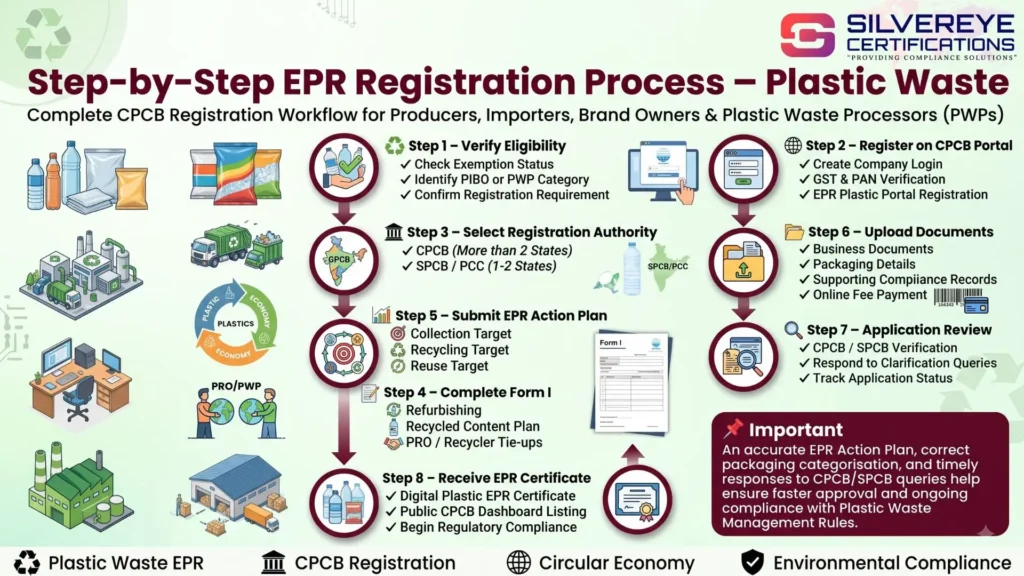
Plastic EPR Registration runs on the Centralized EPR Portal for Plastic Packaging. Here's the process producers, importers, brand owners, and plastic waste processors (PWPs) follow:
- Check exemption status: Confirm whether you qualify as a Micro or Small brand owner (exempt) or must register as a standard PIBO or PWP.
- Create your login: Visit eprplastic.cpcb.gov.in and register your company using GST and PAN details.
- Choose CPCB or SPCB/PCC: PIBOs active in more than two states register centrally with CPCB; those in one or two states register with their SPCB/PCC through the same portal.
- Fill Form I: Submit the prescribed application form with packaging category (rigid, flexible, or multi-layered), material composition, and sales volume data.
- Submit your EPR Action Plan: Declare how you will meet your annual collection, recycling, reuse, and (post-2026 amendment) recycled-content targets, including any PRO or recycler tie-ups.
- Upload documents and pay the fee: Attach the required documents and complete payment through the portal's integrated gateway.
- Track and respond to queries: CPCB/SPCB reviews the application; respond promptly to any clarification requests to avoid delays.
- Receive your EPR Certificate: Once approved, the digital Plastic EPR Certificate is issued and visible on the public CPCB dashboard.
Step-by-Step EPR Registration Process: E-Waste (E-Waste EPR Portal)
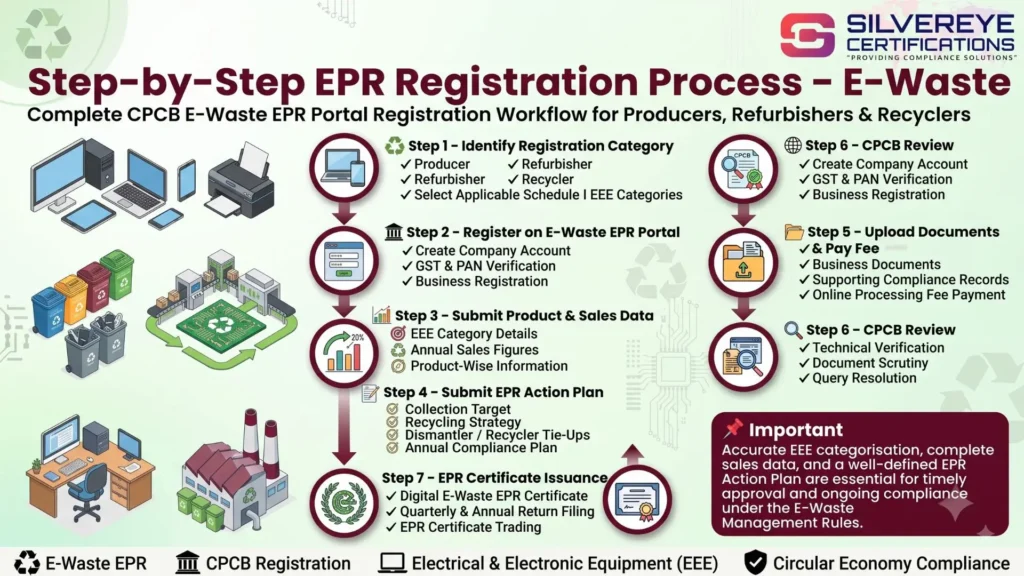
E-Waste EPR Registration covers the 21 categories of notified Electrical and Electronic Equipment (EEE) under Schedule I. The process on the E-Waste EPR Portal looks like this:
- Identify your role and Schedule I category: Determine whether you are registering as a Producer, Refurbisher, or Recycler, and list every EEE category your products fall under.
- Register on the portal: Create your account with company, GST, and PAN details on the E-Waste EPR Portal.
- Submit product and sales data: Enter EEE-wise sales figures, since your annual collection target is calculated from prior-year sales or estimated generation.
- Declare your collection target and Action Plan: Producers must show how they will meet the applicable year's e-waste collection target through their own or empanelled dismantlers/recyclers.
- Upload documents and pay the processing fee: New producers whose sales have only just started can access a concessional processing fee of ₹10,000; established producers and recyclers follow a capacity-linked fee table.
- CPCB review: Applications are typically processed in 30–60 working days; incomplete or mismatched data is the most common cause of delay.
- Certificate issuance: Once approved, the E-Waste EPR Certificate is generated on the portal, and the entity can then start filing quarterly/annual returns and trading EPR certificates.
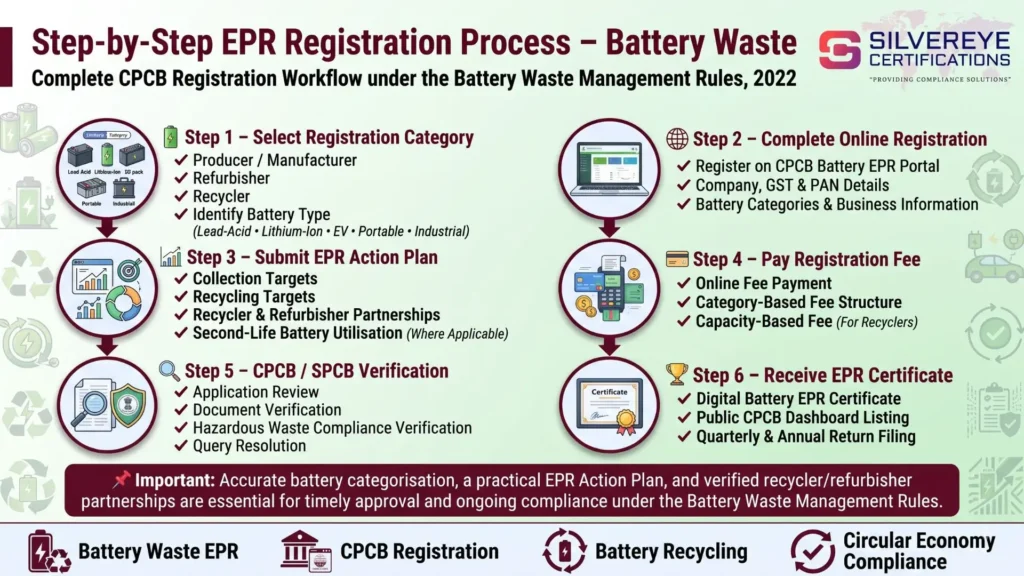
Step-by-Step EPR Registration Process: Battery Waste (EPR Portal for Battery Waste Management)
Battery Waste EPR Registration is governed by the Battery Waste Management Rules, 2022 and its 2023 and 2025 amendments. Producers, refurbishers, and recyclers follow this sequence:
- Register as the correct entity type: Producers/manufacturers register centrally with CPCB; recyclers and refurbishers must additionally register with their concerned SPCB/PCC through the same centralized portal.
- Complete the online application: Provide company details and declare the battery chemistries and types you manufacture, import, or sell (lead-acid, lithium-ion, EV, portable, industrial, etc.).
- Submit your EPR Action Plan: Show how you will meet your category's recycling and refurbishment targets, including recycler/refurbisher partnerships and, where relevant, second-life use pathways.
- Pay the applicable registration fee: Fees differ for producers/manufacturers versus recyclers and are tiered by recycling capacity for processing entities.
- Await verification: CPCB/SPCB verifies the application; recyclers may also need to demonstrate compliance with hazardous-waste handling standards.
- Receive the EPR Certificate: Once issued, your registration becomes visible on the portal's public dashboard, and quarterly/annual return filing begins from the next reporting cycle.
Step-by-Step EPR Registration Process: Tyre Waste (Waste Tyre EPR Portal)
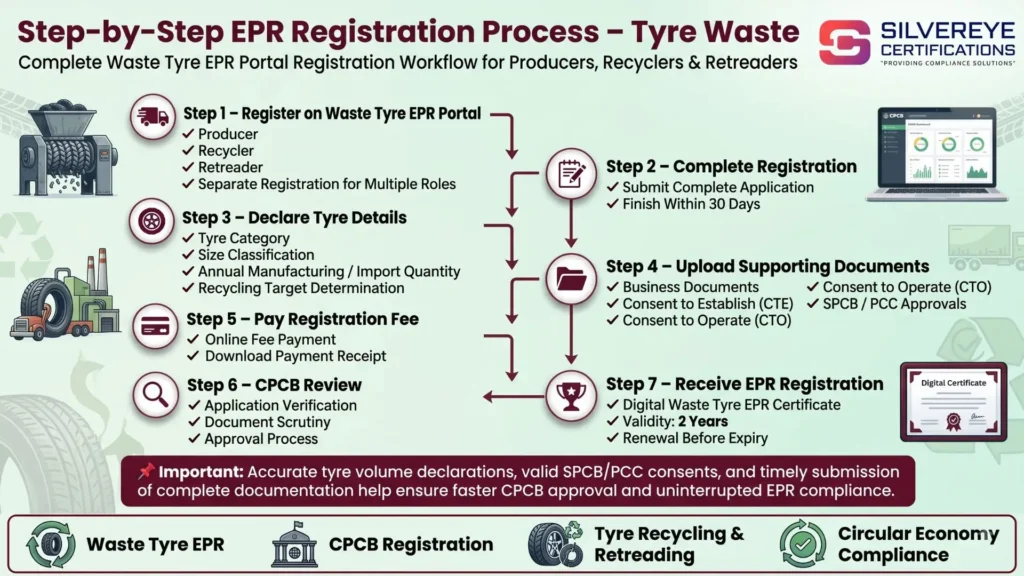
Waste Tyre EPR Registration is governed by Schedule IX of the Hazardous and Other Wastes (Management and Transboundary Movement) Amendment Rules, 2022, and runs on the dedicated Waste Tyre EPR Portal:
- Create your account: Sign up on the Waste Tyre EPR Portal as a Producer, Recycler, or Retreader; a producer that is also a recycler must register separately in both capacities.
- Complete registration within 30 days: Once you sign up, the portal requires you to complete the full registration process within 30 days.
- Declare tyre category and volumes: Enter tyre type, size classification, and annual manufacturing or import quantity, which determines your recycling target.
- Submit supporting documents: Recyclers and retreaders must also furnish Consent to Establish (CTE) and Consent to Operate (CTO) from their SPCB/PCC.
- Pay the registration fee, if applicable: Complete payment through the portal's payment gateway as per the applicable fee table.
- CPCB review and approval: Approval is typically granted within about 15 days of a complete submission.
- Certificate valid for 2 years: Once issued, the Waste Tyre EPR Registration is valid for two years, after which the applicant must renew based on the original registration's validity date.
If you run into persistent technical issues on the tyre portal, CPCB allows applicants to log a complaint through the portal's own ‘Complaint Lodge’ system, or request participation in an EPR CAMP session for direct assistance.
Step-by-Step EPR Registration Process: Used Oil (Used Oil EPR Portal)
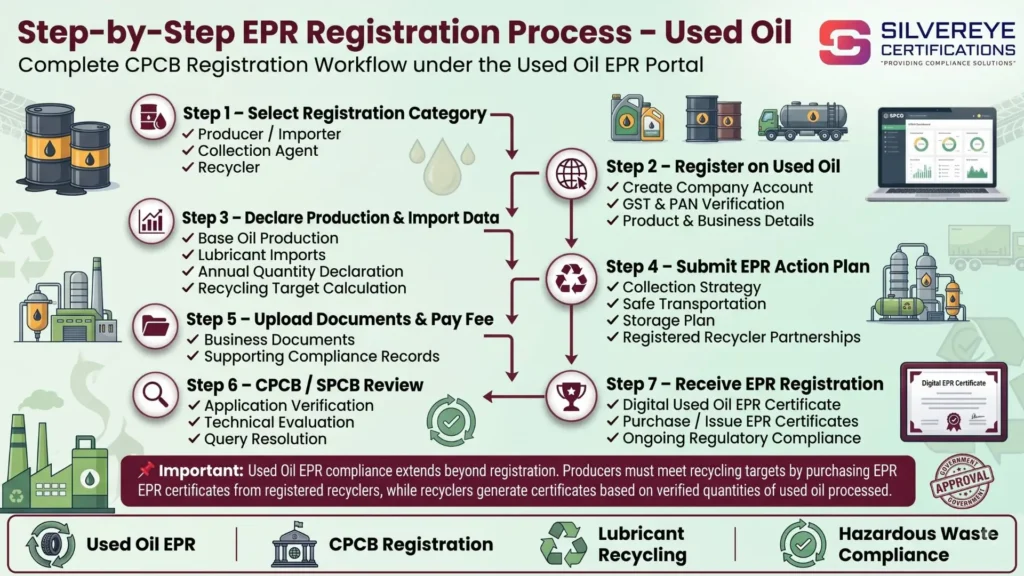
Used Oil EPR is the newest of the five categories, introduced under Chapter VII of the Hazardous and Other Wastes (Management and Transboundary Movement) Second Amendment Rules, 2023, effective 1 April 2024. The process on works as follows:
- Determine your role: Register as a Producer/Importer of base oil or finished lubricants, a Collection Agent, or a Recycler.
- Register on the Used Oil EPR Portal: Create your account and submit company, GST, and product details.
- Declare production/import volumes: Enter base oil or lubricant production/import figures, which form the basis of your annual recycling target.
- Submit your EPR Plan: Outline how used oil will be collected, transported, stored safely, and channelled only to registered recyclers.
- Upload documents and pay fees: Complete document upload and fee payment as per the category-wise fee structure.
- CPCB/SPCB review: Given the category's recent launch and CPCB's active enforcement push since February 2025, applications are being processed steadily, though timelines can vary as the portal matures.
- Certificate and ongoing compliance: Once approved, producers must purchase EPR certificates from registered recyclers to meet targets, while recyclers issue certificates for each batch of used oil processed.
After Registration: Filing Returns & Generating EPR Certificates
Getting the EPR Certificate is not the end of the CPCB EPR Registration Process — it's the start of an ongoing compliance cycle. Across all five portals, registered entities are generally expected to:
- File quarterly returns: Reporting collection, sales, or processing data for the period, depending on category and entity type.
- File annual returns: A consolidated yearly report (often referred to as Form-1) confirming whether annual targets were met.
- Maintain Form-2 records: Detailed internal records of waste handled, which may be requested during a CPCB/SPCB audit.
- Generate or purchase EPR certificates: Recyclers/processors generate EPR certificates for waste they've processed; producers who fall short of their own targets buy these certificates through the portal to close the gap.
- Track deadline extensions: CPCB periodically extends return-filing deadlines (as it did for e-waste and battery annual returns in recent cycles) — check the relevant portal's notice board rather than assuming a fixed date.
EPR Registration Fees by Category
Fees are set independently for each CPCB EPR portal and are periodically revised, so always confirm current figures on the live portal before paying. As a general pattern:
| Category | Fee Basis | Renewal |
| Plastic | Based on PIBO/PWP category and packaging volume | Same basis, payable on renewal cycle |
| E-Waste | Tiered by producer/recycler status; ₹10,000 concessional fee for new producers | Applicable on amendment or renewal |
| Battery | Tiered separately for producers vs. recyclers, linked to recycling capacity | Same as original registration fee |
| Tyre | Nominal fee as per CPCB's published schedule, if applicable | Due every 2 years |
| Used Oil | Based on producer/importer/collection agent/recycler category | Applicable on renewal |
Validity & Renewal Timeline
| Category | Validity | Typical Approval Time |
| Plastic | Ongoing, tied to annual target compliance | 15–40 working days |
| E-Waste | Ongoing, tied to annual returns | 30–60 working days |
| Battery | Ongoing, tied to annual returns | 15–40 working days |
| Tyre | 2 years, then renewal | ~15 days after complete submission |
| Used Oil | Ongoing, tied to annual returns | Varies; portal still scaling up |
Common Portal Errors That Delay EPR Registration
- Sales, production, or import figures on the application that don't match GST returns
- Selecting the wrong entity type (Producer vs. Importer vs. Brand Owner vs. Recycler)
- Incomplete or vague EPR Action Plans without named recycler/PRO tie-ups
- Uploading documents in an unsupported file format or exceeding the size limit
- Registering on only one portal when the business actually spans two or more categories (for example, an electronics brand that also uses plastic packaging and sells battery-powered devices)
- Missing quarterly/annual return deadlines even after the certificate is approved, which can trigger Environmental Compensation despite having an active registration
Benefits of Completing the CPCB EPR Registration Process Correctly
- Faster approval: Clean, consistent documentation is the single biggest factor in avoiding the 35–40-day query cycle.
- Uninterrupted sales and imports: A valid, portal-visible EPR Certificate prevents customs holds and marketplace delisting.
- Access to EPR credit trading: Entities that exceed their targets can generate and sell surplus EPR certificates on the same portal.
- Audit-ready compliance trail: Consistent return filing on the portal builds the documentation trail regulators and ESG auditors ask for.
- Multi-category efficiency: Using the SSO at epr.cpcb.gov.in lets businesses manage all their EPR categories from one login instead of five separate ones.
How Silvereye Certifications Helps with the CPCB EPR Portal Process
Silvereye Certifications is a regulatory compliance consultancy that supports Indian and international businesses with BIS, CDSCO, WPC-ETA, TEC/MTCTE, and EPR Authorization, among other approvals. For the CPCB EPR Registration Process specifically, Silvereye Certifications works across all five portals — Plastic, E-Waste, Battery, Tyre, and Used Oil — and typically helps businesses with:
- Identifying the correct portal, entity type, and category classification before you start
- Preparing Form I and the EPR Action Plan in a CPCB-aligned format to reduce query cycles
- Coordinating document upload, fee payment, and application tracking end-to-end
- Setting up recycler, refurbisher, retreader, or PRO tie-ups needed to support the Action Plan
- Managing ongoing quarterly and annual return filing so an approved registration stays compliant
- Tracking renewal deadlines, including the 2-year cycle for Waste Tyre EPR Registration
Since Silvereye Certifications also handles BIS, CDSCO, WPC, and TEC/MTCTE approvals, businesses that need EPR Registration alongside other product certifications — for example, an electronics importer needing both BIS and E-Waste EPR — can manage related compliance work through a single consultancy rather than coordinating multiple vendors.
Conclusion
The EPR Registration Process on the CPCB Portal follows a consistent logic across Plastic, E-Waste, Battery, Tyre, and Used Oil — register, declare your Action Plan, submit documents, pay fees, get approved, and then keep filing returns. Where businesses usually lose time is in the details: picking the wrong category, submitting a vague Action Plan, or letting return-filing deadlines slip after the certificate is issued.
Following the category-specific steps in this guide, and keeping your documentation clean before you apply, is the most reliable way to get through CPCB review without repeated queries. If you'd rather have the portal navigation, documentation, and ongoing filings handled for you, Silvereye Certifications supports the EPR Registration Process across all five CPCB portals from application to renewal.
Frequently Asked Questions
What is the first step in the EPR Registration Process on the CPCB Portal?
The first step is identifying your correct category (Plastic, E-Waste, Battery, Tyre, or Used Oil) and entity type (Producer, Importer, Brand Owner, Recycler, etc.), since this determines which CPCB portal and application form you need to use.
Is there one CPCB portal for all EPR categories?
Not exactly. Each category has its own dedicated portal — for example, eprplastic.cpcb.gov.in for plastic — but all five are now accessible through a Single Sign-On at epr.cpcb.gov.in, so you don't need five separate logins.
What is an EPR Action Plan and why does it matter?
It's the section of your application where you explain how you will meet your annual collection, recycling, reuse, or recycled-content targets, usually by naming the registered recyclers, refurbishers, retreaders, or PROs you'll work with. A vague or missing Action Plan is one of the most common reasons applications get delayed.
How long does the CPCB EPR Registration Process take?
Most complete applications are approved in 15–40 working days, though e-waste applications can take 30–60 working days. Applications that draw CPCB queries or need additional documents take longer.
Do I need to register separately if my business deals in more than one category?
Yes. A business selling battery-powered electronics in plastic packaging, for instance, would typically need Plastic, E-Waste, and Battery EPR Registration, each filed on its own portal (or through the shared SSO login).
What happens after my EPR Certificate is approved?
6. What happens after my EPR Certificate is approved?
You move into the compliance phase: filing quarterly and annual returns, maintaining Form-2 records, and either generating EPR certificates (if you're a recycler/processor) or purchasing them to cover any shortfall (if you're a producer).
Is Waste Tyre EPR Registration different from the others in terms of validity?
Yes. Waste Tyre EPR Registration is explicitly valid for two years and must be renewed based on the original validity date, while Plastic, E-Waste, Battery, and Used Oil registrations remain active on an ongoing basis, subject to continuous return filing
Are small businesses exempt from the EPR Registration Process?
It depends on the category. Micro & Small brand owners are exempt from Plastic EPR Registration, but E-Waste EPR has no turnover-based exemption, so even small importers of notified electronics must register.
What documents commonly cause application delays?
Mismatched sales/GST figures, incomplete Action Plans, and documents uploaded in the wrong format or missing the authorized signatory's proof are the most frequent causes of CPCB queries and processing delays.
Can I check my EPR application status online?
Yes. Each category-specific portal (and the unified SSO at epr.cpcb.gov.in) allows applicants to track their application and certificate status directly online.