
- Two routes, one law — importers use COS-1/COS-2, manufacturers use COS-5/COS-8, both under the Cosmetics Rules, 2020.
- Different authorities — COS-2 is granted by the Central Licensing Authority (CDSCO); COS-8 is granted by the State Licensing Authority.
- Different timelines — import registration can take up to 180 working days; manufacturing licenses are typically granted within 45 days.
- No product sells without one — selling an unregistered cosmetic in India risks seizure of stock and legal penalties, regardless of route.
There are two routes for cosmetic product registration in India, depending on where the product is made. If you import cosmetics from abroad, you file Form COS-1 with the Central Licensing Authority (CDSCO) and receive the COS-2 Import Registration Certificate, typically within 180 working days. If you manufacture cosmetics inside India, you file Form COS-5 with your State Licensing Authority and receive the COS-8 Manufacturing License, usually within 45 days of document verification. Both routes are mandatory under the Cosmetics Rules, 2020 — no cosmetic can be legally sold in India without one of them.
Introduction: Registration Depends on Where You Make the Product
Every cosmetic sold in India — skin cream, shampoo, lipstick, perfume, or soap — needs regulatory clearance before it reaches a shelf. What confuses most first-time applicants is that cosmetic product registration in India isn't a single process. It splits into two distinct pathways depending on where the product is physically manufactured: import registration for products made outside India, and a manufacturing license for products made inside India. Both are governed by the Drugs and Cosmetics Act, 1940 and the Cosmetics Rules, 2020, and both are non-negotiable — but the forms, the authority you deal with, and the timelines are completely different.
This guide covers both pathways in one place: who needs which one, the product categories they apply to, documents, fees, timelines, validity, and renewal — so you can identify your route in the first few minutes and go straight to what's relevant.
Which Registration Route Applies to You?
| Your Situation | Route | Governing Authority |
| Foreign brand exporting to India / Indian importer sourcing from abroad | COS-1 application → COS-2 Registration Certificate | Central Licensing Authority (CDSCO) |
| Setting up your own manufacturing facility in India | COS-5 application → COS-8 Manufacturing License | State Licensing Authority (State Drug Controller) |
| Manufacturing on someone else's licensed premises (loan license) | COS-6 application → COS-9 Loan License | State Licensing Authority (State Drug Controller) |
| Using a GMP-certified contract manufacturer's own COS-8 site | No license needed in your name — the manufacturer's COS-8 applies | Not applicable |
Legal Framework Governing Cosmetic Registration
Cosmetic regulation in India runs under the Drugs and Cosmetics Act, 1940, and the Cosmetics Rules, 2020 (which replaced the earlier cosmetics provisions of the Drugs and Cosmetics Rules, 1945). Under Section 3(aaa) of the Act, a cosmetic is any article meant to be rubbed, poured, sprinkled, or applied to the human body for cleansing, beautifying, or altering appearance. Both import and manufacturing registrations are administered through the CDSCO SUGAM portal, though the deciding authority differs — central for imports, state-level for domestic manufacturing.
Cosmetic Product Categories Covered Under Registration
CDSCO classifies cosmetics into roughly 80 product categories for registration purposes. Every product you register — whether imported or manufactured — must be correctly mapped to one of these categories, since it determines the applicable fee and the labelling standard applied. Major category clusters include:
| Category Cluster | Examples |
| Skin care | Creams, lotions, moisturisers, sunscreens, face washes, serums |
| Hair care | Shampoos, conditioners, hair oils, hair colours, styling gels |
| Colour cosmetics | Lipsticks, foundations, eyeliners, nail polish, blushes |
| Fragrances | Perfumes, deodorants, antiperspirants, body mists |
| Oral care | Toothpaste, mouthwash (where classified as cosmetic, not drug) |
| Bath & body | Soaps, body washes, bath salts, talcum powder |
| Baby care | Baby lotions, baby powders, baby shampoos |
| Personal hygiene | Intimate washes, wet wipes classified as cosmetics |
A product that claims to treat or cure a medical condition — such as acne treatment claims — may be classified as a drug rather than a cosmetic, which changes the entire regulatory pathway. Always confirm classification before filing.
Cosmetic Import Registration — Form COS-1 and COS-2
If your cosmetic products are manufactured outside India and you want to sell them here, this is your route.
Who Can Apply for COS-1
- The foreign manufacturer's Authorized Indian Agent, appointed via Power of Attorney
- An Indian subsidiary of the foreign cosmetic brand
- An Indian importer or distributor holding valid authorization from the manufacturer
Foreign manufacturers cannot file directly — Indian representation is mandatory.
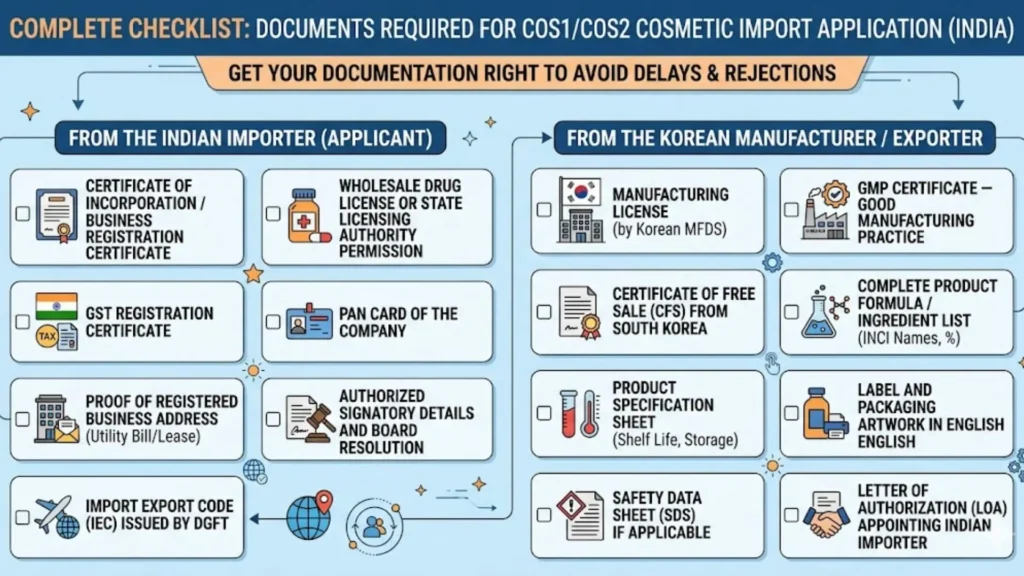
Documents Required for COS-1
- Covering letter stating the purpose of the application
- Authorization letter/Power of Attorney from the manufacturer, apostilled or attested by the Indian Embassy
- Form COS-1, duly filled, signed, and stamped
- Certificate of Free Sale (CFS) or equivalent, issued by the country of origin's regulatory authority
- Manufacturing license or GMP certificate of the foreign facility (ISO 22716 and equivalent certifications are accepted)
- List of ingredients with percentage composition, signed by the manufacturer
- Product labels and packaging artwork, compliant with CDSCO labelling rules and in English
- Specification sheet and testing methods for the product
- Import Export Code (IEC) of the Indian importer
- Government fee payment proof
COS-1 to COS-2: Step-by-Step Process
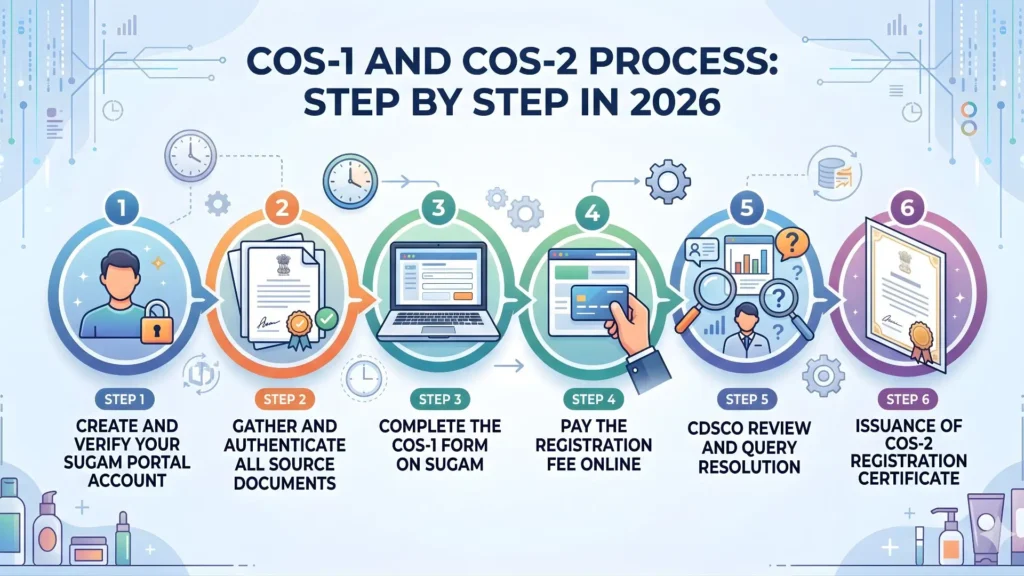
- Appoint an Authorized Indian Agent (if the foreign manufacturer has no Indian subsidiary) and obtain a notarised/apostilled Power of Attorney.
- Register on the CDSCO SUGAM portal and compile the document checklist above.
- Categorize each product correctly against CDSCO's cosmetic category list — this step alone prevents most delays.
- File Form COS-1 online with all supporting documents.
- Pay the prescribed government fee through the Bharatkosh payment gateway.
- Respond to any CDSCO queries on ingredients, labelling, or safety data through the SUGAM dashboard.
- Once satisfied, CDSCO issues the COS-2 Registration Certificate, authorising import and sale in India.
As per Rule 13(5) of the Cosmetics Rules, 2020, CDSCO aims to complete this review within 180 working days of a complete filing, though well-documented applications with recognised-market paperwork (EU, US, Japan, South Korea) often move faster.
Import Registration Fees (Third Schedule)
| Fee Head | Amount |
| Grant/retention of Registration Certificate, per product category | USD 1,000 (or INR equivalent) |
| Each additional product category | USD 1,000 |
| Registration of each manufacturing site | USD 500 |
| Each product variant (shade, fragrance, etc.) | USD 50 |
Fees are payable in USD or the INR equivalent via the Bharatkosh gateway and are generally non-refundable. Always confirm current amounts on the CDSCO SUGAM portal, since Third Schedule fees are revised periodically.
COS-2 Validity and Retention
Per CDSCO's own regulatory guidance, a Registration Certificate granted in Form COS-2 remains valid in perpetuity, subject to payment of the registration certificate retention fee before completion of every 5-year period from the date of issue — the same lifetime-plus-retention structure used for the COS-8 manufacturing license.
It stays valid unless suspended or cancelled by the Central Licensing Authority. Note that plenty of industry guidance still describes this in shorthand as '5-year validity, renew before expiry' — treat that as referring to the same 5-year retention cycle, and confirm the exact requirement for your certificate on the SUGAM portal, since fee and process notifications are updated from time to time.
Manufacturing License — Form COS-5 and COS-8
If your cosmetics are manufactured inside India, this is your route — covered here at a summary level, since fees, documents, and step-by-step process may run deeper than a single section; the mechanics are as follows.
Who Can Apply for COS-5
- New manufacturers setting up a cosmetic production facility in India
- Existing license holders adding new product categories or a new site
- Startups and D2C brands moving from contract manufacturing to their own facility
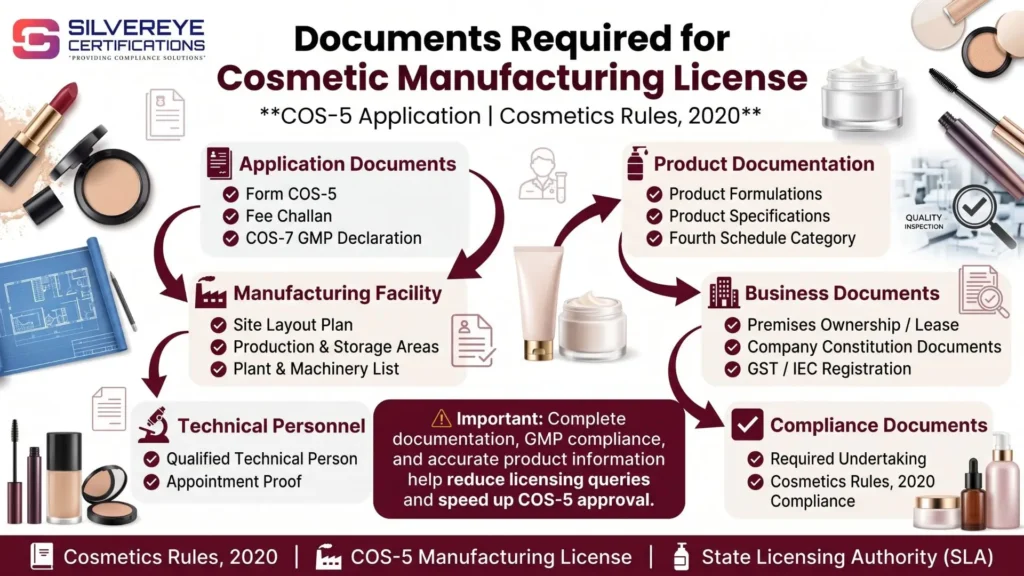
Documents Required for COS-5
- Cover letter and duly filled Form COS-5
- Site master file and approved plant layout
- Ownership or rental proof for the manufacturing premises
- Constitution of the firm (Incorporation Certificate, Partnership Deed, UDYAM Aadhaar, etc.)
- List of products with formulas, and machinery/equipment list
- Technical staff qualification and consent documents, per Rule 26
- Form COS-7 self-declaration of GMP compliance under the Seventh Schedule
- Fee payment receipt
COS-5 to COS-8: Step-by-Step Process
- Register on the SUGAM portal and file Form COS-5 with the State Licensing Authority.
- Upload documents as specified in Part II of the Second Schedule of the Cosmetics Rules, 2020.
- Pay the fee prescribed in the Third Schedule.
- The Licensing Authority scrutinizes documents and schedules a site inspection to verify GMP compliance.
- Once satisfied, the State Licensing Authority grants the COS-8 Manufacturing License, typically within 45 days of document verification.
- A follow-up audit inspection generally occurs within 30 days of the license being granted.

Manufacturing License Fees (Third Schedule)
| Fee Head | Amount |
| Grant of manufacturing license (COS-8), up to 10 items per category | ₹10,000 |
| Each additional item beyond 10, per category | ₹500 |
| License retention fee (every 5 years) | Same as grant fee, per the Third Schedule |
COS-8 Validity and Retention
Under Rule 30, a license or loan license issued in Form COS-8 or COS-9 remains valid in perpetuity, subject to payment of the retention fee before completion of every 5-year period from the date of issue, unless suspended or cancelled by the State Licensing Authority. Missing the retention deadline attracts a late fee of 2% per month, and non-payment for 180 days results in deemed cancellation.
Import Route vs. Manufacturing Route: Side-by-Side Comparison
| Import Route (COS-1 → COS-2) | Manufacturing Route (COS-5 → COS-8) | |
| Applies to | Products made outside India | Products made inside India |
| Licensing authority | Central Licensing Authority (CDSCO) | State Licensing Authority (State Drug Controller) |
| Application form | COS-1 | COS-5 |
| License/certificate | COS-2 Registration Certificate | COS-8 Manufacturing License |
| Typical timeline | Up to 180 working days | Around 45 days after document verification |
| Site inspection | Not applicable — foreign site is not physically inspected by the SLA | Mandatory before license grant |
| Base fee | USD 1,000 per category | ₹10,000 per category (up to 10 items) |
| Validity structure | Perpetual, subject to 5-yearly retention fee | Perpetual, subject to 5-yearly retention fee |
Benefits of Completing Cosmetic Product Registration
- Legal market access — registered products can be legally sold, distributed, and cleared through customs without seizure risk.
- Retailer and marketplace approval — most organised retail chains and e-commerce platforms require a valid COS-2 or COS-8 number before listing a product.
- Consumer trust — registration confirms the product meets India's safety and quality standards under the Ninth Schedule.
- Brand protection — a registered product is far easier to defend against counterfeit or unauthorized sellers.
- Smoother scaling — once the base registration exists, adding new variants or categories is an endorsement process rather than a fresh filing.
Common Mistakes That Delay Registration
- Inconsistent names/addresses for the manufacturer or importer across different documents
- Missing or non-apostilled Power of Attorney for the Indian Authorised Agent
- Products mapped to the wrong CDSCO category, affecting both fees and labelling checks
- Labels that include non-cosmetic or drug-like claims not permitted under the Cosmetics Rules, 2020
- Incomplete technical staff or GMP documentation for the manufacturing route
- Filing before ingredient compliance is checked against Indian standards — a frequent cause of import queries
Renewal and Retention Timeline at a Glance
| License | Retention Cycle | Consequence of Delay |
| COS-2 (Import) | Every 5 years from date of issue | Risk of suspension/cancellation by Central Licensing Authority |
| COS-8 (Manufacturing) | Every 5 years from date of issue | 2% late fee per month; deemed cancelled after 180 days unpaid |
| COS-9 (Loan License) | Every 5 years from date of issue | Same late-fee and cancellation structure as COS-8 |
Conclusion
Cosmetic product registration in India comes down to one question: where is the product made? Import it, and you're on the COS-1 to COS-2 track with CDSCO, working to a 180-working-day rhythm. Manufacture it domestically, and you're on the COS-5 to COS-8 track with your State Licensing Authority, working to a 45-day rhythm after document verification.
Both tracks converge on the same principle — complete, consistent documentation filed correctly the first time is what keeps either timeline on track, and both licenses are built to last, provided the 5-year retention fee is paid on schedule.
Frequently Asked Questions
What is the difference between COS-1/COS-2 and COS-5/COS-8?
COS-1/COS-2 is the import registration route for cosmetics manufactured outside India and is handled by the Central Licensing Authority (CDSCO). COS-5/COS-8 is the manufacturing license route for cosmetics made inside India and is handled by the State Licensing Authority.
Which authority issues the COS-2 Registration Certificate?
The Central Licensing Authority under CDSCO, part of the Directorate General of Health Services, Ministry of Health and Family Welfare, issues the COS-2 certificate.
How long does cosmetic import registration take?
As per Rule 13(5) of the Cosmetics Rules, 2020, CDSCO aims to process a complete COS-1 application within 180 working days, though timelines vary with documentation quality.
How long does a manufacturing license take?
The State Licensing Authority typically grants the COS-8 license within 45 days of successful document verification, followed by a site inspection.
Can a foreign manufacturer apply for COS-1 directly?
No. A foreign manufacturer must appoint an Authorised Indian Agent, Indian subsidiary, or Indian importer to file the COS-1 application on their behalf.
What documents does an importer need for COS-1?
Key documents include the covering letter, manufacturer's authorisation/Power of Attorney, Certificate of Free Sale, ingredient list, product labels, GMP/manufacturing license copy, and the IEC code of the Indian importer.
What is the government fee for cosmetic import registration?
The base fee is USD 1,000 per product category, plus USD 500 per manufacturing site and USD 50 per variant, as prescribed in the Third Schedule of the Cosmetics Rules, 2020.
Is a manufacturing license required for every product I make in India?
The COS-8 license covers the manufacturing site and the product categories registered against it. Adding new categories typically requires an endorsement to the existing license rather than a fresh application.
Do COS-2 and COS-8 ever expire completely?
Both are structured to remain valid in perpetuity, provided the retention fee is paid before the end of each 5-year cycle and the license isn't suspended or cancelled for non-compliance.
Can I sell an imported cosmetic in India before COS-2 is granted?
No. Cosmetics cannot be imported or sold in India without a valid COS-2 Registration Certificate — Indian regulations do not permit retrospective or post-import registration.
What happens if my cosmetic product is classified as a drug instead?
Products making medicinal claims (such as treating a skin disease) may fall under drug regulations instead of the Cosmetics Rules, 2020, which follow a different and generally more stringent approval pathway.
Is animal testing required or allowed for registration?
No. Rule 39(7) of the Cosmetics Rules, 2020 prohibits testing cosmetics on animals for both import and manufacturing registrations in India.