
- Get licensed to manufacture or import toothpaste and oral care products in India under the Drugs & Cosmetics Act, 1940.
- Covers COS-1, COS-2, COS-5, and COS-8 application forms with documents, eligibility, fees, and approval timelines.
- Applicable to all oral hygiene products: fluoride toothpaste, herbal toothpaste, mouthwash, teeth whitening gels, and more.
- Updated for 2026 regulatory requirements including CDSCO amendments and State Licensing Authority (SLA) compliance.
Overview
Toothpaste and oral hygiene cosmetic registration in India is regulated under the Drugs and Cosmetics Act, 1940, and the Cosmetics Rules, 2020. Manufacturers must apply using COS-5 (application) and receive COS-8 (grant of manufacturing license), while importers must use COS-1 (application) to receive COS-2 (grant of import license).
Products covered include fluoride toothpaste, herbal toothpaste, mouthwash, whitening strips, teeth-whitening gels, and dental rinses. Applications are submitted to the respective State Licensing Authority (SLA) or CDSCO depending on product category. Fees, valid premises, qualified staff, and GMP compliance are mandatory requirements for approval.
Introduction: Why Registration Matters for Oral Hygiene Products
India’s oral healthcare market is growing rapidly. With a market size projected to exceed ₹40,000 crore by 2026, the demand for toothpaste, mouthwash, teeth-whitening gels, and other oral hygiene products has never been higher. But before any of these products can hit the shelf — whether you manufacture them in India or import them from abroad — you need the right licenses and registrations.
This guide covers toothpaste and oral hygiene cosmetic registration in India from start to finish. Whether you are a startup launching a herbal toothpaste brand, an established FMCG company importing teeth-whitening strips, or a contract manufacturer looking to expand, this pillar page explains the entire regulatory framework in plain language.
The two core regulatory pathways are: Manufacturing (COS-5 Application → COS-8 Grant) and Importing (COS-1 Application → COS-2 Grant). Both are governed by the Drugs and Cosmetics Act, 1940, and the Cosmetics Rules, 2020.
What Are Toothpaste and Oral Hygiene Cosmetic Registration Under Indian Law?
Under Schedule S of the Cosmetics Rules, 2020, oral hygiene products are classified as cosmetics. Any product that is applied to teeth, gums, or the oral cavity for cleansing, protecting, or maintaining oral health falls under this category.
Complete List of Regulated Oral Hygiene Products
| S.No. | Product Name | Product Type / Variant | Registration Pathway |
| 1 | Fluoride Toothpaste | Standard cavity protection toothpaste | COS-5/COS-8 (Manufacturing) or COS-1/COS-2 (Import) |
| 2 | Herbal / Ayurvedic Toothpaste | Neem, clove, charcoal, turmeric-based paste | COS-5/COS-8 or COS-1/COS-2 |
| 3 | Whitening Toothpaste | Peroxide or abrasive-based whitening formula | COS-5/COS-8 or COS-1/COS-2 |
| 4 | Sensitive Teeth Toothpaste | Potassium nitrate / stannous fluoride formula | COS-5/COS-8 or COS-1/COS-2 |
| 5 | Kids / Children Toothpaste | Low fluoride, flavored toothpaste for children | COS-5/COS-8 or COS-1/COS-2 |
| 6 | Charcoal Toothpaste | Activated charcoal-based toothpaste | COS-5/COS-8 or COS-1/COS-2 |
| 7 | Gel Toothpaste | Transparent gel format (fluoride/herbal) | COS-5/COS-8 or COS-1/COS-2 |
| 8 | Toothpaste Powder (Dantmanjan) | Powder-form oral cleansing product | COS-5/COS-8 or COS-1/COS-2 |
| 9 | Mouthwash / Oral Rinse | Alcohol-based or alcohol-free antibacterial rinse | COS-5/COS-8 or COS-1/COS-2 |
| 10 | Teeth-Whitening Gel | Peroxide-based whitening gel (tray application) | COS-5/COS-8 or COS-1/COS-2 |
| 11 | Whitening Strips | Teeth-whitening adhesive strips | COS-1/COS-2 (primarily imported) |
| 12 | Dental Floss | Waxed or unwaxed oral hygiene thread | COS-1/COS-2 (Import) or COS-5/COS-8 |
| 13 | Tongue Cleaner / Scraper | Oral hygiene device/cosmetic accessory | State-level registration (as applicable) |
| 14 | Gum Paint / Gum Gel | Topical gel for gum care and protection | COS-5/COS-8 or COS-1/COS-2 |
| 15 | Breath Freshener Spray | Oral spray for fresh breath (non-medicated) | COS-5/COS-8 or COS-1/COS-2 |
| 16 | Oil Pulling Oil | Coconut / sesame-based oral oil (Ayurvedic) | COS-5/COS-8 or COS-1/COS-2 |
| 17 | Anti-Cavity Varnish | Fluoride varnish for enamel protection | CDSCO-level registration may apply |
| 18 | Desensitizing Gel | Topical gel for sensitive teeth relief | COS-5/COS-8 or COS-1/COS-2 |
| 19 | Natural / Organic Toothpaste | SLS-free, certified organic formulation | COS-5/COS-8 or COS-1/COS-2 |
| 20 | Probiotic Toothpaste | Probiotic bacteria-infused toothpaste | COS-5/COS-8 or COS-1/COS-2 |
Important: Products containing active pharmaceutical ingredients (e.g., medicated fluoride above a prescribed limit, prescription-strength peroxides) may be regulated as drugs rather than cosmetics. Always verify with your licensing authority before proceeding.
Regulatory Framework: Who Governs Oral Hygiene Cosmetic in India?
Oral hygiene cosmetic in India fall under multiple regulatory layers. Understanding who governs what can save you significant time during the application process.
| Authority | Role | Applicable To |
| Central Drugs Standard Control Organisation (CDSCO) | Sets national standards, approves new cosmetic ingredients, oversees imports | Import registrations, new cosmetic ingredient approvals |
| State Licensing Authority (SLA) | Issues manufacturing and import licenses at state level | All oral hygiene cosmetic manufacturers within the state |
| Bureau of Indian Standards (BIS) | Sets quality and labeling standards for toothpaste | IS 6356, IS 11551 compliance for toothpaste |
| Advertising Standards Council of India (ASCI) | Governs advertising claims for cosmetics | Marketing and labeling claims on oral hygiene products |
| Ministry of AYUSH | Governs Ayurvedic / herbal oral hygiene products | Herbal / Dantmanjan / oil pulling products |
COS-1: Application for Import License of Oral Hygiene Cosmetic
If you want to import toothpaste, mouthwash, whitening strips, or any other oral hygiene cosmetic into India, you need to start with the COS-1 form. This is the official application form under the Cosmetics Rules, 2020, for obtaining a license to import cosmetics.
Who Needs to Apply for COS-1?
- Any Indian company or individual seeking to import oral hygiene cosmetics from outside India
- Authorized agents or distributors of foreign oral hygiene brands entering the Indian market
- E-commerce sellers importing branded toothpaste or mouthwash in commercial quantities
- OEM contract businesses importing private-label oral hygiene products
Eligibility Criteria for COS-1 (Import License)
- The applicant must be an Indian citizen or a company registered in India
- Must have a valid business address in India with adequate storage facilities
- Must employ or have access to a qualified person (as defined in Cosmetics Rules, 2020)
- Imported products must comply with Schedule S standards for oral hygiene products
- Products must not contain any prohibited substances listed under Cosmetics Rules, 2020
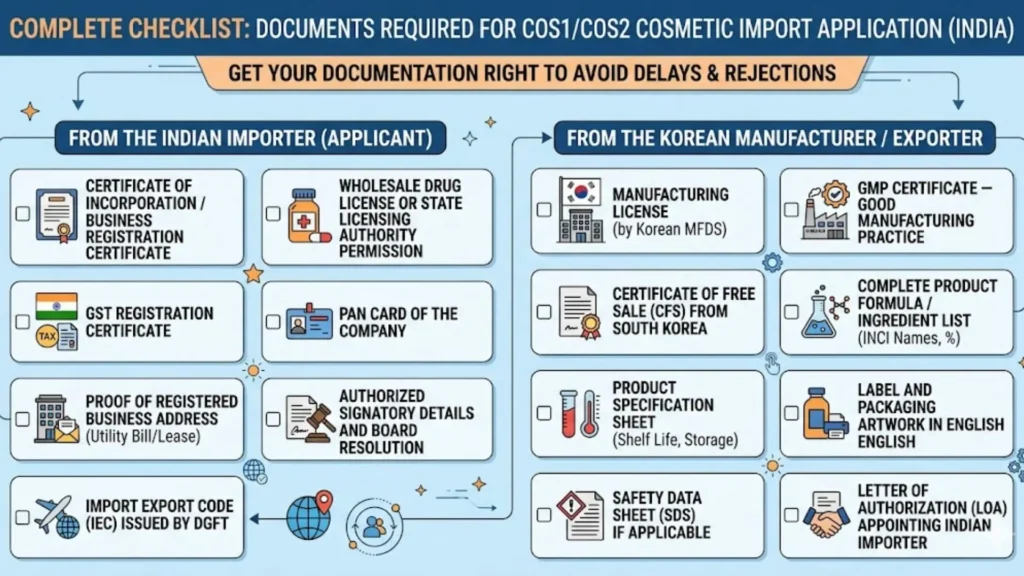
Documents Required for COS-1 Application
| No. | Document Required | Notes / Specifics |
| 1 | Duly filled COS-1 application form | Submit in prescribed format under Cosmetics Rules, 2020 |
| 2 | Certificate of Incorporation / Partnership Deed | For companies, LLPs, or partnership firms |
| 3 | PAN Card of the applicant / company | Self-attested copy required |
| 4 | Proof of business premises | Rent agreement or ownership documents |
| 5 | Details of storage facility | Layout plan with temperature/humidity control if applicable |
| 6 | Product list with brand names | All oral hygiene products to be imported |
| 7 | Country of origin certificate | From exporting country’s authorized authority |
| 8 | Free Sale Certificate (FSC) | Issued by the competent authority of the exporting country |
| 9 | GMP / ISO Certificate of foreign manufacturer | Certified by the relevant national authority |
| 10 | Label / packaging artwork drafts | As per labeling requirements under Cosmetics Rules, 2020 |
| 11 | Safety data of product ingredients | Especially for whitening agents (peroxide content) |
| 12 | Authorized agent / distributor agreement | If applying on behalf of a foreign brand |
| 13 | Treasury Challan / Fee payment proof | Prescribed government fee payment |
| 14 | Affidavit / self-declaration | Declaring all information is accurate and products are safe |
COS-1 Application Process — Step by Step
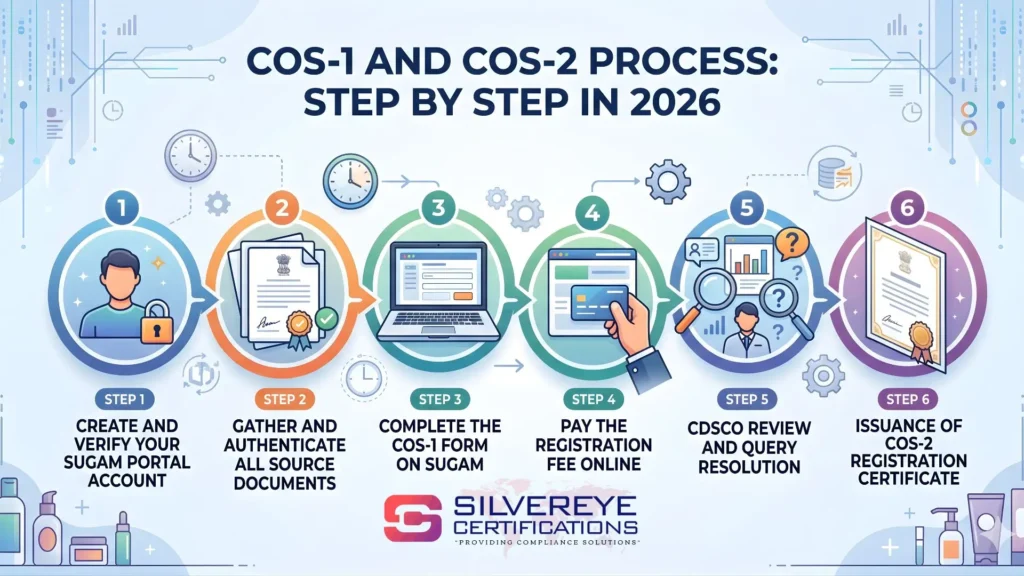
- Prepare all documents listed above and verify against the latest Cosmetics Rules, 2020 checklist.
- Register on the State Licensing Authority (SLA) portal of your state or submit physically depending on the state’s process.
- Fill the COS-1 form accurately with all product details, importer details, and supporting documents.
- Pay the prescribed application fee via treasury challan or online portal.
- Submit the application to the State Licensing Authority (SLA) of the state where your business is registered.
- The SLA may seek clarifications or inspection of your storage facility.
- On satisfactory review, the SLA issues the COS-2 (Grant of Import License).
COS-1 Application Fee
The application fee for COS-1 varies by state. As a general reference, fees typically range from ₹500 to ₹2,000 depending on the number of products and the state. Always verify the current fee schedule with your State Licensing Authority.
COS-2: Grant of License for Import of Oral Hygiene Cosmetic
Once your COS-1 application is successfully reviewed and approved by the State Licensing Authority, you receive the COS-2 — the actual Grant of Import License. This document legally authorizes you to import the specified oral hygiene cosmetic into India.
What Does COS-2 License Cover?
- Specifies the exact products (by brand name and formulation) you are authorized to import
- Mentions the country of origin and foreign manufacturer’s name
- Includes the name and address of the licensed Indian importer
- States the validity period of the import license
- Lists any conditions or restrictions imposed by the licensing authority
COS-2 Validity and Renewal
| Parameter | Details | Important Notes |
| License Validity | 3 years from date of issue | Must be renewed before expiry to continue imports |
| Renewal Application | Apply for renewal 3 months before expiry | Use prescribed renewal form with updated documents |
| Renewal Fee | Varies by state (generally ₹500–₹1,500) | Check current fee schedule with your SLA |
| Changes in Products | File amendment application for new products | New COS-1 may be required for additions |
| License Cancellation | Occurs on violation of Cosmetics Rules | Appeal process available before final cancellation |
COS-5: Application for Manufacturing License of Oral Hygiene Cosmetic
If you plan to manufacture toothpaste, mouthwash, herbal tooth powder, or any oral hygiene cosmetic in India, the COS-5 is your starting point. This is the official application form for obtaining a cosmetic manufacturing license under the Cosmetics Rules, 2020.
Who Needs COS-5?
- Any individual, company, or firm that wants to manufacture oral hygiene cosmetics in India
- Contract manufacturers producing third-party or private-label oral care products
- Startups or MSMEs launching their own toothpaste or oral care brands
- Existing units adding new oral hygiene product lines to their licensed range
- Ayurvedic / herbal product companies expanding into oral hygiene cosmetics (non-drug Ayurvedic)
Eligibility Criteria for COS-5 (Manufacturing License)
- Must have a dedicated manufacturing premises that meets GMP (Good Manufacturing Practice) standards
- Must employ a qualified technical person (as specified under Cosmetics Rules, 2020)
- Premises must have adequate production area, quality control lab, storage, and utilities
- Must have valid premises documents (ownership or lease with minimum required area)
- All equipment and machinery must be listed and verified during inspection
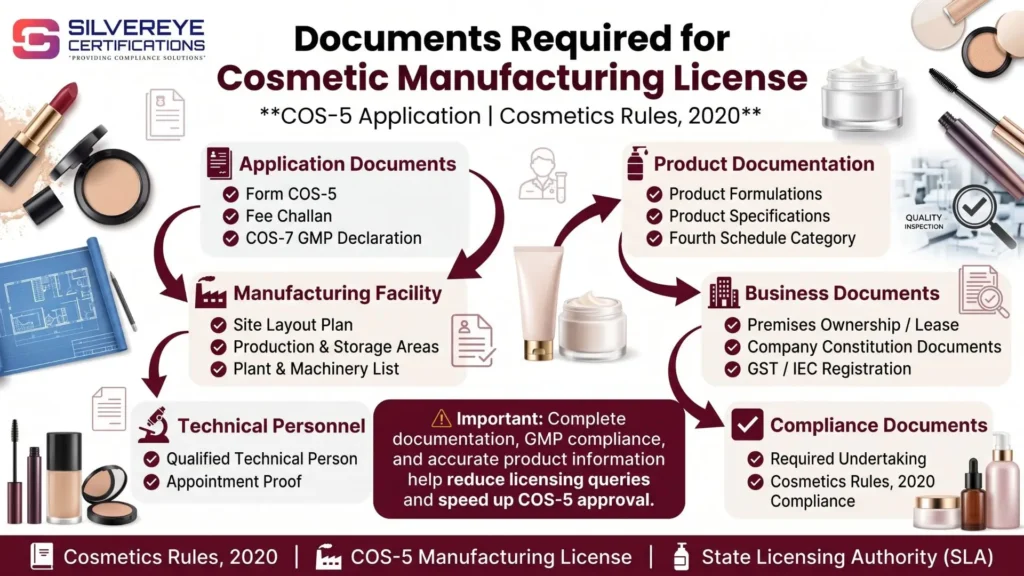
Documents Required for COS-5 Application
| No. | Document Required | Details / Remarks |
| 1 | Duly filled COS-5 application form | In prescribed format under Cosmetics Rules, 2020 |
| 2 | Certificate of Incorporation / Registration | Company, LLP, sole proprietorship as applicable |
| 3 | PAN and GST registration | Both documents self-attested |
| 4 | Ownership / lease deed of manufacturing premises | Minimum area requirements must be met |
| 5 | Site plan / layout of manufacturing unit | Showing production, QC lab, storage, toilets, canteen etc. |
| 6 | List of manufacturing equipment | With make, model, and capacity of each machine |
| 7 | Qualification certificate of Technical Person (TP) | Degree in pharmacy, chemistry, or related field |
| 8 | Appointment letter of Technical Person | Confirming employment on full-time basis |
| 9 | Product list with complete formulations | All oral hygiene products to be manufactured |
| 10 | Stability testing data (if available) | For new formulations being registered |
| 11 | Water testing report | Purified water test report as per BP/IP standards |
| 12 | Safety data sheets for all raw materials | Especially for fluoride compounds, SLS, peroxides |
| 13 | Batch manufacturing records (sample) | Standard operating procedures for each product type |
| 14 | Label artwork drafts | As per Schedule S labeling requirements |
| 15 | Fee payment proof | Treasury challan or online payment confirmation |
| 16 | Affidavit / undertaking by applicant | Declaring GMP compliance and accuracy of information |
COS-5 Application Process — Step by Step
- Ensure your manufacturing premises meets GMP requirements under Schedule M-II of Cosmetics Rules, 2020.
- Appoint a qualified Technical Person and obtain their consent letter.
- Prepare complete documentation including facility layout, equipment list, and product formulations.
- Fill the COS-5 form and compile all supporting documents as per the checklist.
- Pay the prescribed manufacturing license application fee.
- Submit to the State Licensing Authority (SLA) of the state where your factory is located.
- SLA deputes a Drug Inspector or designated officer for premises inspection.
- Inspector verifies GMP compliance, equipment, qualified staff, and documentation.
- Inspection report is submitted to SLA; deficiencies (if any) are communicated to the applicant.
- After successful inspection and compliance, the SLA issues COS-8 (Grant of Manufacturing License).

COS-8: Grant of License for Manufacturing Oral Hygiene Cosmetic
The COS-8 is the manufacturing license granted by the State Licensing Authority after successful review of your COS-5 application and physical inspection of your manufacturing unit. It is the legal authorization to manufacture cosmetic in India.
What COS-8 License Contains
- Name and address of the licensed manufacturing unit
- List of oral hygiene products authorized for manufacture (brand names and categories)
- Name and qualification of the Technical Person responsible for manufacturing
- Any specific conditions imposed by the licensing authority
- License number, issue date, and validity period
COS-8 Validity, Fees, and Renewal
| Parameter | Details | Important Notes |
| License Validity | 5 years from date of issue | Longer validity than import license (COS-2) |
| Renewal Application | Apply 3 months before expiry | Submit renewal form with updated documents |
| License Fee | Varies by state and product category | Generally ₹1,000–₹5,000 for initial grant |
| Amendment for New Products | File amendment to add new products to existing license | Additional fee and possible re-inspection |
| Change in Technical Person | Intimation to SLA required within 30 days | New qualified person’s credentials to be submitted |
| Suspension / Cancellation | On GMP non-compliance or rule violations | Show-cause notice issued before cancellation |
COS-1, COS-2, COS-5, COS-8: Side-by-Side Comparison
| Parameter | COS-1 (Import Application) | COS-2 (Import License Granted) | COS-5 (Mfg. Application) | |
| COS-8 (Mfg. License Granted) — Reference Row | ||||
| Purpose | Apply for import license | Actual import authorization issued | Apply for mfg. license | Actual mfg. authorization issued |
| Submitted By | Importer | N/A (issued by SLA) | Manufacturer | N/A (issued by SLA) |
| Submitted To | State Licensing Authority | State Licensing Authority | State Licensing Authority | State Licensing Authority |
| Key Requirement | Free Sale Certificate, GMP of foreign mfr. | Approved COS-1 application | GMP premises, qualified TP | Approved COS-5 + inspection pass |
| Validity | Application (no validity) | 3 years | Application (no validity) | 5 years |
| Renewal | N/A | 3 months before expiry | N/A | 3 months before expiry |
| Inspection Required | Storage facility check | N/A | Full GMP inspection mandatory | N/A |
GMP Requirements for Oral Hygiene Cosmetic Manufacturing
Good Manufacturing Practice (GMP) compliance is non-negotiable for obtaining your COS-8 license. Schedule M-II of the Cosmetics Rules, 2020 lays down detailed GMP guidelines specific to cosmetic manufacturing in India.
Key GMP Requirements for Toothpaste & Oral Care Units
- Adequate production area with separate zones for manufacturing, filling, labeling, and packaging
- Dedicated Quality Control (QC) laboratory with standard testing equipment
- Purified water system meeting BP/IP standards for toothpaste and oral rinse production
- Pest control program and environmental monitoring records
- Written Standard Operating Procedures (SOPs) for each manufacturing step
- Batch manufacturing records (BMR) and batch packaging records (BPR) for every batch
- Temperature and humidity control in storage areas
- Qualified Technical Person supervising manufacturing operations
- Calibrated weighing and measuring equipment with regular calibration records
- Proper waste disposal system complying with local environmental regulations
Labeling Requirements for Toothpaste and Oral Hygiene Products
Whether you manufacture or import oral hygiene cosmetic, your product labels must comply with Schedule S of the Cosmetics Rules, 2020. Incorrect labeling is one of the most common reasons for license rejection or product seizure.
| S.No. | Labeling Requirement | Notes |
| 1 | Product name and brand name | Clearly printed on principal display panel |
| 2 | Complete list of ingredients | In INCI nomenclature, descending order by weight |
| 3 | Net content (weight/volume) | In metric units |
| 4 | Manufacturer’s name and address | Full address including state and PIN code |
| 5 | License number | COS-8 or COS-2 number as applicable |
| 6 | Batch number / lot number | For traceability purposes |
| 7 | Manufacturing date (MFG) | Month and year format acceptable |
| 8 | Best before / Expiry date | EXP date or ‘Use before’ date |
| 9 | Directions for use | Recommended usage instructions |
| 10 | Precautions / warnings | E.g., ‘Keep out of reach of children’ for fluoride toothpaste |
| 11 | Country of origin | Required on imported products |
| 12 | MRP (Maximum Retail Price) | As per Legal Metrology Act requirements |
Common Mistakes to Avoid During Registration
Many applicants face delays or rejections due to avoidable errors. Here is what experienced practitioners say you should watch out for:
- Submitting incomplete or outdated Free Sale Certificates for import applications
- Not having a full-time qualified Technical Person — part-time consultants are often not accepted by SLAs
- Premises not meeting minimum area requirements before applying for COS-5
- Incorrect or inconsistent ingredient names on labels vs. product formulation sheets
- Missing stability testing data for new or novel formulations
- Not accounting for state-specific variations in fee schedules and documentation requirements
- Applying to the wrong authority (CDSCO vs. SLA) based on product type
- Not filing amendment applications when changing formulation or adding products
Expected Timeline for Registration Approval
| Stage | Estimated Time | Key Dependency |
| Document preparation and verification | 2–4 weeks | Completeness of GMP compliance and TP appointment |
| COS-1 / COS-5 application submission | 1–2 days | Availability of online/offline SLA portal |
| SLA initial scrutiny | 2–4 weeks | Accuracy and completeness of submitted documents |
| Premises inspection (COS-5 only) | 2–6 weeks after application | Inspector availability and GMP readiness |
| Deficiency compliance (if any) | 2–4 weeks (applicant’s side) | Speed of corrective action taken |
| COS-2 / COS-8 grant | 4–8 weeks from complete submission | No pendencies at SLA level |
| Total (Import – COS-2) | 6–12 weeks (approx.) | Subject to state-specific workload |
| Total (Manufacturing – COS-8) | 10–20 weeks (approx.) | Inspection scheduling is the biggest variable |
Benefits of Getting Your Oral Hygiene Cosmetic License
Going through the proper registration process is not just a legal requirement — it offers real business benefits:
- Legal protection: Your brand is protected from counterfeit or parallel imports under the licensed framework
- Market access: Licensed products can be sold across all channels including modern trade, pharma retail, and e-commerce
- Export readiness: Indian manufacturing licenses are recognized and help in obtaining export approvals
- Investor confidence: Licensed businesses are more attractive to investors and institutional buyers
- Bank finance: Easier access to MSME loans and working capital for licensed cosmetics manufacturers
- Brand credibility: Consumers trust products that display valid license numbers on labels
- GMP compliance: The discipline of maintaining GMP standards improves product quality and reduces rejections
| State-Wise Variation Notice (2026) While the COS-1, COS-2, COS-5, and COS-8 forms are standardized nationally under the Cosmetics Rules, 2020, actual fee amounts, portal systems, inspection timelines, and documentation preferences can vary significantly between states. States like Maharashtra, Karnataka, Gujarat, Uttar Pradesh, and Tamil Nadu have their own SLA portals. Always verify the current requirements directly with your State Licensing Authority or a licensed regulatory consultant before filing. |
Conclusion: Your Roadmap to Oral Hygiene Cosmetic Registration
Getting your toothpaste and oral hygiene cosmetic registration in India does not have to be complicated. The process is structured, transparent, and manageable when you understand the four key forms: COS-1, COS-2, COS-5, and COS-8.
To summarize your action plan:
- If you are importing: File COS-1 with all required documents → Receive COS-2 from your SLA.
- If you are manufacturing: Ensure GMP compliance → Appoint a Technical Person → File COS-5 → Pass inspection → Receive COS-8.
- Maintain your license: Renew before expiry, file amendments for new products, and keep GMP records up to date.
The oral hygiene market in India is competitive and growing. Getting your regulatory house in order is the first and most important step toward building a successful, compliant, and scalable oral care brand in 2026 and beyond.
Frequency Asked Questions
Do I need a separate license for each type of toothpaste I manufacture?
No. You do not need a separate COS-8 license for each toothpaste variant. Your single manufacturing license can cover multiple products. However, you do need to list every product and variant on your COS-5 application. If you add new products later, you must file an amendment to your existing license.
Is herbal or Ayurvedic toothpaste regulated differently?
It depends on the ingredients and claims. If your herbal toothpaste makes only cosmetic claims (cleaning, whitening), it falls under the Cosmetics Rules, 2020, and you apply for COS-5/COS-8. If it makes therapeutic claims (treating pyorrhea, treating gum disease), it may need registration under the Drugs and Cosmetics Act as an Ayurvedic drug, requiring a separate license from AYUSH authorities.
Can a foreign company directly apply for COS-1?
No. COS-1 must be applied for by an Indian entity — either an Indian company, LLP, or individual. Foreign companies must appoint an authorized Indian agent or set up an Indian subsidiary to apply for the import license.
What is the minimum area required for a toothpaste manufacturing unit?
The Cosmetics Rules, 2020 (Schedule M-II) specify minimum area requirements for cosmetic manufacturing units. For most oral hygiene products, the production area requirement is generally a minimum of 50–80 square meters depending on the product category and manufacturing scale. Verify the exact requirement with your State Licensing Authority during pre-application consultation.
How long does it take to get a COS-8 manufacturing license?
The total timeline from application to license grant is typically 10 to 20 weeks, depending on inspection scheduling and deficiency compliance. The biggest variable is the SLA’s inspection schedule. Well-prepared units with complete GMP infrastructure tend to get licensed faster.
Can I sell my registered oral hygiene product on Amazon or Flipkart?
Yes. Once you hold a valid COS-8 (manufacturing) or COS-2 (import) license, your products can be listed and sold on any e-commerce platform in India. The license number must appear on the product label as required under Cosmetics Rules, 2020.
Is there an age restriction on teeth-whitening products?
The Cosmetics Rules, 2020, and EU-inspired guidelines suggest that teeth-whitening products containing hydrogen peroxide above 0.1% should not be used by children under 18. Manufacturers and importers must display appropriate warnings on labels for such products.
What happens if I start manufacturing before getting a COS-8 license?
Manufacturing cosmetics without a valid license is a serious offense under the Drugs and Cosmetics Act, 1940. Penalties include seizure of products, cancellation of business registration, fines, and in severe cases, imprisonment. Do not commence manufacturing before your COS-8 is granted.
Do I need BIS certification for toothpaste?
BIS (Bureau of Indian Standards) certification is currently voluntary for most toothpaste products in India. However, BIS standards IS 6356 (toothpaste) and IS 11551 exist, and conforming to them strengthens your product’s market credibility. Some institutional buyers and government tenders may require BIS certification.
How do I add a new product to my existing COS-8 license?
To add a new oral hygiene product to your existing manufacturing license, you must file an amendment application with your State Licensing Authority. The amendment requires you to submit the new product’s formulation, label artwork, and any required test data. An additional fee is payable and a re-inspection may or may not be required depending on whether the new product involves significantly different manufacturing processes.