
- New 2026 turnover slabs: Registration up to ₹1.5 crore, State License ₹1.5 crore–₹50 crore, Central License above ₹50 crore — effective 1 April 2026.
- BIS/ISI certification is no longer compulsory for packaged drinking water; FSSAI's Scheme of Testing applies instead from 1 January 2026.
- FSSAI approvals granted from 1 April 2026 have perpetual validity — no renewal filing, only an annual fee and yearly return.
- Packaged drinking water is a "high-risk" food category, so a State or Central License is the realistic starting point for most water plants.
Introduction
Packaged drinking water is classified as a high-risk food category, so most manufacturers need an FSSAI State or Central License (not Basic Registration) through the FoSCoS portal. Under FSSAI's revised 2026 turnover rule (effective 1 April 2026), the licensing category is decided by turnover: up to ₹1.5 crore needs Registration, ₹1.5 crore to ₹50 crore needs a State License, and above ₹50 crore needs a Central License.
Water manufacturing units, however, are directed to State or Central licensing regardless of this general threshold because of their high-risk status. Government fees range from₹100 to ₹7,500 a year, and licenses issued from1 April 2026 carry perpetual validity, so there's no repeated renewal cycle. BIS/ISI certification is no longer mandatory for packaged drinking water — it has been replaced by FSSAI's mandatory Scheme of Testing.
What Is FSSAI Registration for Packaged Drinking Water?
FSSAI registration for packaged drinking water is the government approval that every packaged drinking water manufacturer, bottler, packer, or seller must hold under the Food Safety and Standards Act, 2006, before they can legally produce or sell bottled water in India. It is issued by the Food Safety and Standards Authority of India (FSSAI) through the online FoSCoS (Food Safety Compliance System) portal at foscos.fssai.gov.in.
Because bottled water is consumed directly and can carry health risks if contaminated, FSSAI treats packaged drinking water and packaged mineral water as a high-risk food category. In practice, this means a water business almost always needs a State License or Central License, and the exact category depends on annual turnover, production capacity, and whether the business sells in one state or across India.
Latest FSSAI Update (2026): Revised Turnover Thresholds
On 13 March 2026, FSSAI's Regulatory Compliance Division issued Order No. RCD-01002/1/2021-Regulatory-FSSAI-Part(1), implementing revised turnover thresholds for categorizing food businesses under the Food Safety and Standards (Licensing and Registration of Food Businesses) Regulations, 2011. The order followed the Food Safety and Standards (Licensing and Registration of Food Businesses) Amendment Regulations, 2026, notified on 10 March 2026, based on recommendations of the NITI Aayog High-Level Committee on Non-Financial Regulatory Reforms. These revised thresholds took effect from 1 April 2026 and supersede all earlier turnover-based categorisation rules.
| License / Registration Type | Revised Turnover Threshold (from 1 April 2026) |
| FSSAI Registration | Annual turnover up to ₹1.5 crore |
| FSSAI State License | Annual turnover above ₹1.5 crore and up to ₹50 crore |
| FSSAI Central License | Annual turnover above ₹50 crore |
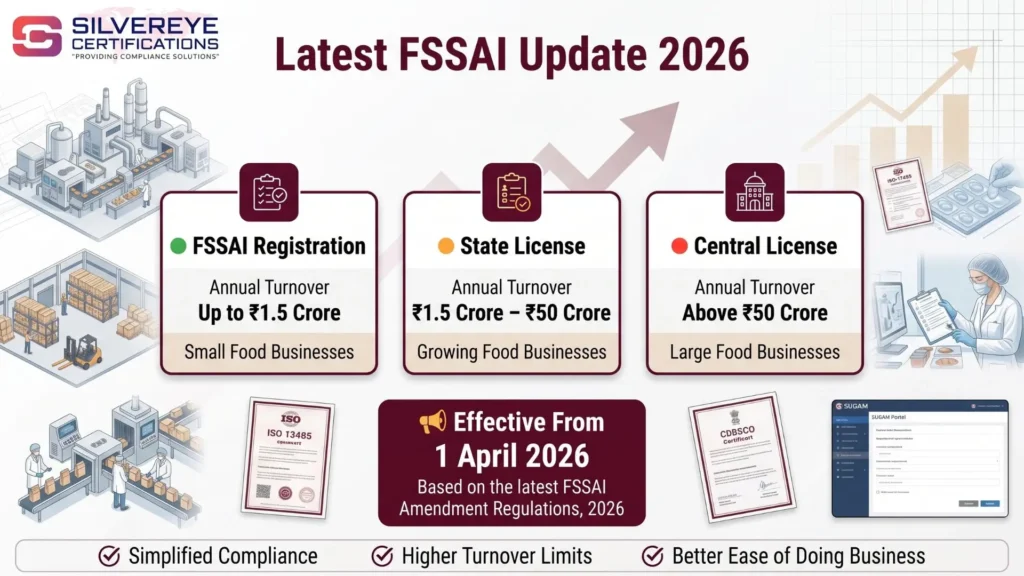
This is a major jump from the earlier limits (₹12 lakh for Registration and ₹20 crore for State License), and it substantially reduces the compliance burden for small and mid-sized food businesses. That said, for packaged drinking water specifically, FSSAI's separate high-risk food categorization still generally pushes manufacturing units toward a State or Central License rather than Basic Registration, so treat the turnover table above as one filter among several, not the only one.
Is BIS/ISI Certification Still Required for Packaged Drinking Water in 2026?
This is one of the most-searched questions on this topic, and the answer changed recently. For years, packaged drinking water manufacturers needed both an FSSAI license and a separate BIS (Bureau of Indian Standards) certification under IS 14543, carrying the ISI mark on every bottle. FSSAI has now formally withdrawn the mandatory BIS certification requirement for packaged drinking water and mineral water through a gazette notification, with the change operationalized by an enforcement order dated 17 December 2025 and effective from 1 January 2026.
In place of the BIS mark, FSSAI has introduced a compulsory Scheme of Testing and Inspection that every licensed water manufacturer must follow. This includes monthly microbiological testing (coliform, Salmonella, Shigella, Staphylococcus aureus and similar parameters), mandatory raw-water testing through FSSAI-notified NABL-accredited laboratories, detailed test-record maintenance, annual risk-based inspections, and packaging that complies with the Food Safety and Standards (Packaging) Regulations, 2018.
Practical takeaway: don't assume BIS is completely irrelevant to your plant — many consultants, state authorities, and older FoSCoS document checklists still reference BIS licence/BIS application receipt as an upload requirement for packaged drinking water. Because this is a genuinely fast-moving regulatory area, always confirm the current document checklist on foscos.fssai.gov.in or with your state food safety office before you apply, rather than relying on any single source, including this one.
Why Packaged Drinking Water Needs FSSAI Approval
- Legal requirement: Manufacturing, packing, storing, distributing, or selling packaged drinking water without valid FSSAI approval is an offence under the FSS Act, 2006, with penalties and possible imprisonment.
- Consumer trust: An FSSAI number on the label signals that the water has been produced under regulated hygiene and safety standards.
- Market access: E-commerce platforms, supermarkets, hotels, and distributors will not stock or list packaged water without a valid FSSAI license number.
- High-risk classification: FSSAI has classified packaged drinking water and mineral water as a high-risk food category, which brings mandatory pre-license inspection, annual third-party audits, and stricter quality checks.
- Business credibility: Banks, NBFCs, and investors typically ask for a valid FSSAI license before extending working-capital loans or funding to a water plant.
Types of FSSAI License for a Packaged Drinking Water Business
Once you know your expected annual turnover, match it against the table below. Remember that packaged drinking water manufacturing units are usually required to hold at least a State License because of the high-risk classification, even for relatively modest production volumes.
| Type | Who It's For | Typical Turnover Band (2026) |
| FSSAI Registration | Very small-scale sellers, petty retailers, or resellers of pre-packaged water (rarely applicable to manufacturers) | Up to ₹1.5 crore |
| FSSAI State License | Water bottling/packaging plants operating within a single state, small-to-mid production capacity | ₹1.5 crore to ₹50 crore |
| FSSAI Central License | Large manufacturers, multi-state operators, importers/exporters, 100% export-oriented units | Above ₹50 crore |

If your business already holds an FSSAI approval and your turnover now falls into a different slab under the 2026 rules, you don't need to start over — you can apply for a category modification on FoSCoS to move to the correct license type.
Eligibility Criteria for FSSAI Registration for Packaged Drinking Water
- The applicant must be a legally constituted entity — proprietorship, partnership, LLP, private limited company, or cooperative — engaged in manufacturing, bottling, packing, or selling packaged drinking water or mineral water.
- The manufacturing unit must have a fixed business premises that meets Schedule 4 hygiene and Good Manufacturing Practice (GMP) standards under the FSS (Licensing and Registration of Food Businesses) Regulations, 2011.
- Source water (borewell, municipal supply, or surface water) must undergo appropriate treatment — filtration, reverse osmosis, demineralisation, remineralisation and disinfection, with mandatory desalination for seawater — before packaging.
- The applicant should be prepared for a pre-license inspection, since packaged drinking water falls under FSSAI's high-risk category.
- A Food Safety Management System (FSMS) plan is required for State and Central License applications.
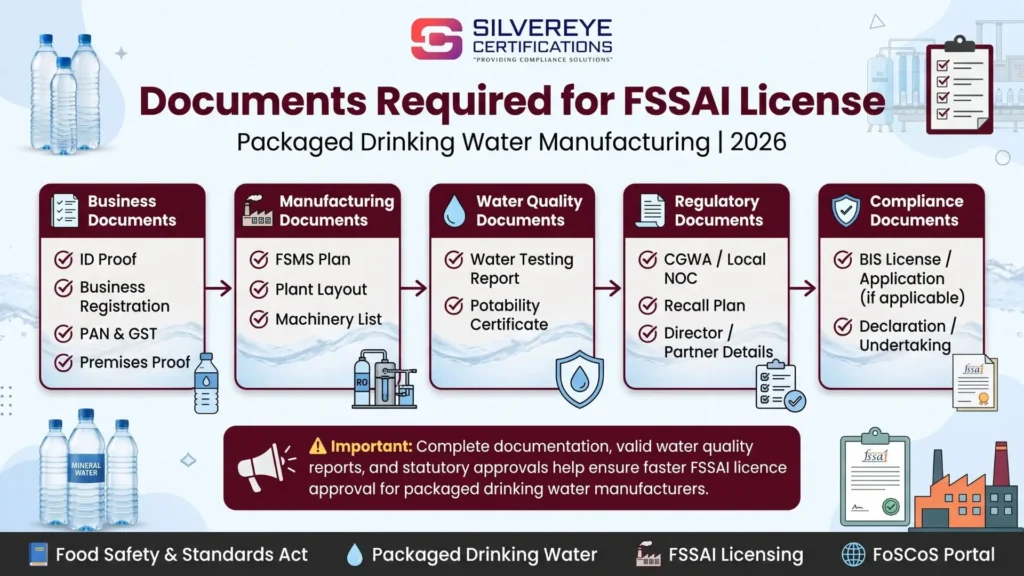
Documents Required for FSSAI License (Packaged Drinking Water)
Basic Documents (all applicants)
- Passport-size photograph and ID proof (Aadhaar, PAN, voter ID, or passport) of the proprietor/partners/directors
- Proof of business premises — rent agreement, electricity bill, or property ownership document
- Business constitution proof — partnership deed, MOA & AOA, LLP agreement, or certificate of incorporation
- PAN card of the business entity and GST registration certificate, where applicable
- A declaration/undertaking about the nature and scale of the food business
Additional Documents for State / Central License
- Food Safety Management System (FSMS) plan and layout plan of the processing unit
- List of machinery and equipment used for water treatment and packaging, with installed capacity
- Water testing/analysis report from a recognized laboratory confirming potability
- NOC from the local municipal body or Panchayat, and NOC for groundwater extraction from the Central Ground Water Authority (CGWA) where borewell water is used
- Recall plan, and for manufacturers, a list of directors/partners with full address and contact details
- Any BIS license copy or BIS application receipt, if currently requested in your state's FoSCoS checklist for packaged drinking water — confirm this on the portal at the time of filing, since this requirement is being phased out
Step-by-Step FSSAI Registration Process for Packaged Drinking Water
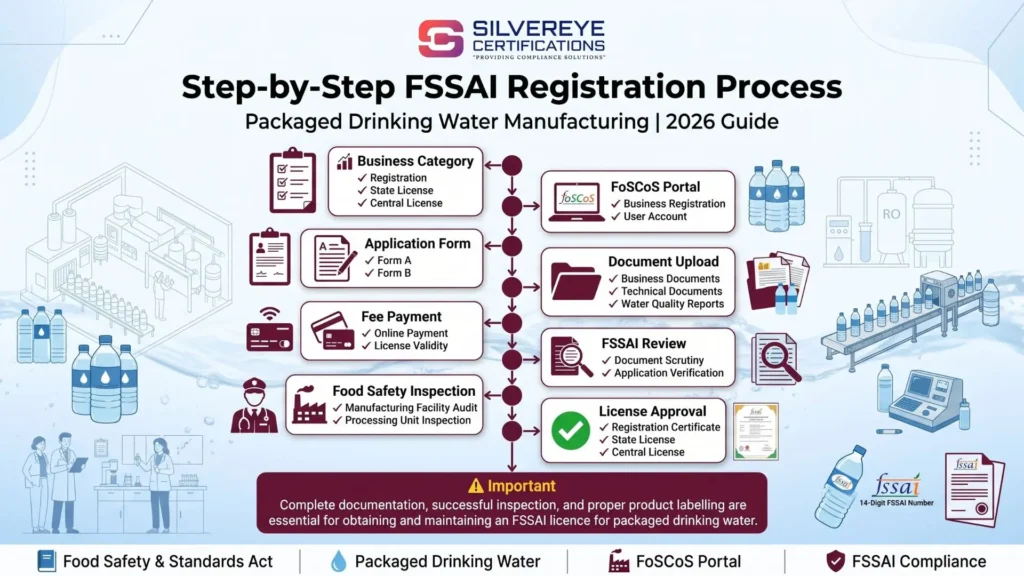
- Determine the correct category — Registration, State License, or Central License — based on your turnover slab under the 2026 rules and FSSAI's high-risk classification for water businesses.
- Create an account on the FoSCoS portal (foscos.fssai.gov.in) using your mobile number and email ID.
- Select "Apply for New License/Registration," choose your state, and pick the correct Kind of Business (e.g., "Water — Packaged Drinking Water" or "Mineral Water").
- Fill Form A (for Registration) or Form B (for State/Central License) with business, premises, and product details.
- Upload all required documents in the prescribed format (PDF/JPEG, within the size limits set by the portal).
- Pay the applicable government fee online through net banking, UPI, or a debit/credit card, choosing your validity period (1 to 5 years, where renewal still applies).
- Await scrutiny and, for State/Central License applications, a pre-license inspection of your premises by a Food Safety Officer, typically within 30 days.
- On approval, download your FSSAI Registration Certificate or License from the FoSCoS portal and display it prominently at your business premises.
- Print your 14-digit FSSAI license/registration number on every bottle, jar, or pouch label before dispatch.
FSSAI Fees for Packaged Drinking Water (2026)
| License Type | Government Fee | Notes |
| FSSAI Registration | ₹100 per year | Can be paid for up to 5 years upfront (₹500 total) |
| FSSAI State License | ₹2,000 – ₹5,000 per year | Varies by business type and production capacity |
| FSSAI Central License | ₹7,500 per year | Applies to large manufacturers and multi-state operators |
These are official government fees paid directly on FoSCoS; they don't include any professional or consultancy charges if you choose to use a Food Safety Mitra or a private consultant. GST at 18% applies on select FSSAI service fees such as the Central License and product approval fees.
Validity and Renewal: What "Perpetual Validity" Means in 2026
Before the 2026 amendment, every FSSAI registration or license had a fixed validity of 1 to 5 years and had to be renewed before expiry, with a penalty of ₹100 per day for late renewal. Under the Food Safety and Standards (Licensing and Registration of Food Businesses) Amendment Regulations, 2026, approvals granted from 1 April 2026 onward carry perpetual validity — they do not expire on their own and do not need a fresh renewal application, as long as the business stays compliant and pays its annual fee.
This does not remove your obligations. You still need to pay the applicable annual fee, file your annual return (Form D-1) by 31 May each year, and apply for a category modification on FoSCoS if your turnover moves you into a different slab. A license can still be suspended or cancelled for non-compliance, non-payment, or failed inspections.
Labeling Requirements for Packaged Drinking Water
- 14-digit FSSAI license/registration number, clearly printed on the label
- Product name, source of water, net quantity/volume, and batch number
- Manufacturing date, expiry/best-before date, and complete manufacturer address
- Recommended storage conditions and any applicable food safety symbols
- Where BIS certification is still in force for your product line or state requirement, the ISI mark and CM/L number alongside the FSSAI number
Penalties for Operating Without FSSAI Approval
Manufacturing or selling packaged drinking water without a valid FSSAI registration or license is a punishable offence under the FSS Act, 2006. Penalties can include fines that commonly range from ₹2 lakh up to ₹10 lakh for high-risk food categories such as packaged drinking water, along with potential imprisonment for repeat or serious violations, product seizure, and closure of the unit until compliance is restored. Given how low the government fee is compared to these penalties, delaying FSSAI registration is rarely worth the risk.
Common Mistakes to Avoid
- Applying for Basic Registration when your production scale actually requires a State or Central License due to the high-risk classification
- Submitting a rented-premises address without a valid rent agreement or NOC from the property owner
- Skipping the water source treatment and testing documentation, which frequently delays pre-license inspection
- Missing the 31 May annual return deadline, which can trigger penalties or automatic suspension under the 2026 rules
- Not updating your license category on FoSCoS after your turnover crosses into a new threshold slab
Conclusion
FSSAI registration for packaged drinking water sits at the intersection of two regulatory tracks: the general turnover-based categorization that FSSAI revised in March 2026, and the stricter, high-risk treatment that packaged drinking water and mineral water receive regardless of scale. Getting this right — choosing the correct license type, preparing the right documents, and staying current on the BIS-to-testing-scheme transition — is what keeps a water business legally compliant, inspection-ready, and trusted by consumers and retail partners alike. Because this area of regulation is moving quickly, treat foscos.fssai.gov.in and your state food safety office as the final word before you file, and revisit your category whenever your turnover or production scale changes
Frequently Asked Questions
Is FSSAI registration mandatory for packaged drinking water?
Yes. Every food business operator manufacturing, packaging, storing, or selling packaged drinking water in India must hold a valid FSSAI Registration, State License, or Central License before starting operations.
Which FSSAI license is needed for a packaged drinking water plant — Registration, State, or Central?
It depends on annual turnover and FSSAI's high-risk classification for water businesses. Most manufacturing units need at least a State License; large or multi-state manufacturers with turnover above ₹50 crore need a Central License.
Is BIS/ISI certification still compulsory for packaged drinking water in 2026?
No. FSSAI has withdrawn the mandatory BIS certification requirement for packaged drinking water, effective 1 January 2026, and replaced it with a compulsory Scheme of Testing that covers microbiological, source-water, and packaging checks. Always confirm the latest document checklist on FoSCoS before applying, as some state offices are still updating their processes.
What are the new 2026 FSSAI turnover limits?
Effective 1 April 2026: Registration applies up to ₹1.5 crore turnover, State License applies between ₹1.5 crore and ₹50 crore, and Central License applies above ₹50 crore, as notified in FSSAI Order No. RCD-01002/1/2021-Regulatory-FSSAI-Part(1) dated 13 March 2026.
How much does an FSSAI license for packaged drinking water cost?
Government fees range from ₹100 per year for Basic Registration to ₹2,000–₹5,000 per year for a State License and ₹7,500 per year for a Central License, excluding any consultancy charges.
How long does it take to get an FSSAI license for a water plant?
Processing typically takes 30–60 days, depending on document accuracy and the pre-license inspection schedule, since packaged drinking water is a high-risk category requiring physical verification of the premises.
Does my FSSAI license expire now that validity is 'perpetual'?
Licenses and registrations granted from 1 April 2026 do not expire automatically, but you must still pay the annual fee, file your yearly return, and remain compliant — non-payment or violations can still lead to suspension or cancellation.
What documents are needed for FSSAI registration for packaged drinking water?
Common requirements include ID and address proof, business constitution documents, premises proof, a Food Safety Management System plan, machinery and layout details, water testing reports, and (where still applicable) a BIS licence or application receipt for State/Central License applicants.
Can I upgrade my Basic Registration to a State or Central License later?
Yes. If your turnover crosses your current threshold, you can file a category modification application on the FoSCoS portal instead of applying afresh, and your existing number generally continues under the upgraded category.
What happens if I sell packaged drinking water without FSSAI approval?
It's a punishable offence under the FSS Act, 2006, attracting fines that can reach several lakh rupees for high-risk food categories, along with possible imprisonment, product seizure, and forced closure of the unit.